

Taxonomy of the burden of treatment: a multi-country web-based qualitative study of patients with chronic conditions
Open accessThe DOI matches its Crossref record; 43 of the 43 references it cites were found in a registry or an index.
Abstract
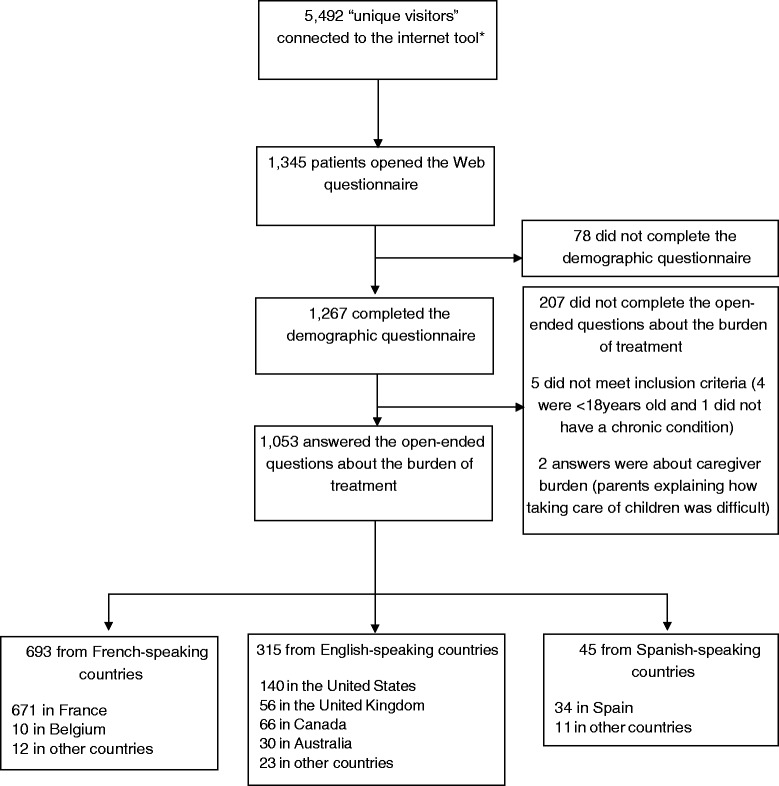
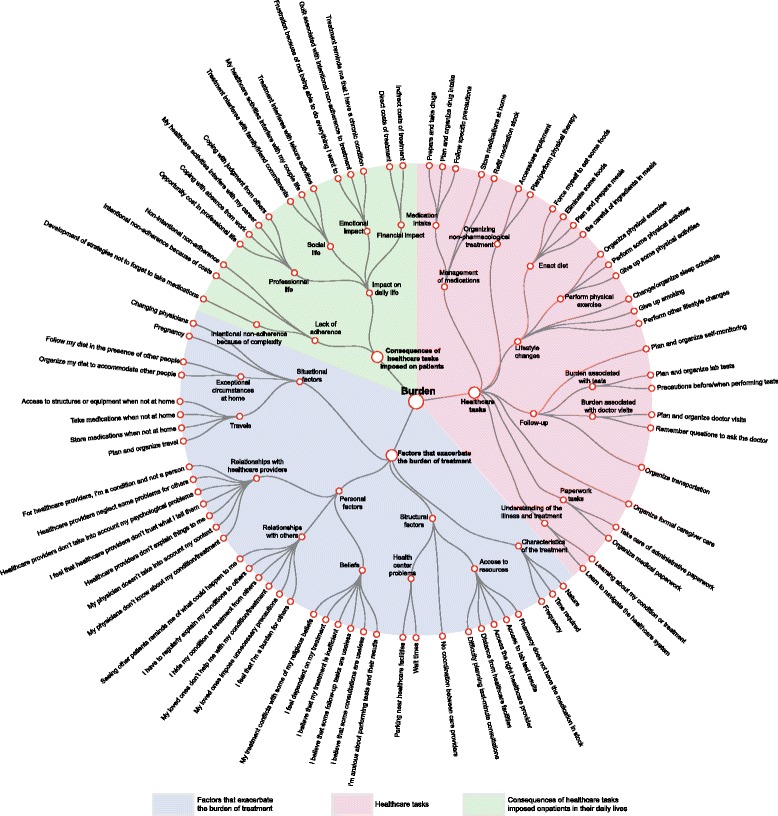
BACKGROUND: Management strategies for patients with chronic conditions are becoming increasingly complex, which may result in a burden of treatment for patients. To develop a Minimally Disruptive Medicine designed to reduce the burden of treatment, clinicians need to understand which healthcare tasks and aggravating factors may be responsible for this burden. The objective of the present study was to describe and classify the components of the burden of treatment for patients with chronic conditions from the patient's perspective. METHODS: We performed a multi-country qualitative study using an online survey and a purposive sampling strategy to select English-, French-, and Spanish-speaking participants with different chronic conditions. Participants were recruited by physicians, patients' associations, advertisement on social media, and 'snowballing'. The answers were analyzed by i) manual content analysis with a grounded theory approach, coded by two researchers, and ii) automatic textual analysis by Reinert's method. RESULTS: Between 2013 and 2014, 1,053 participants from 34 different countries completed the online survey using 408,625 words. Results from both analyses were synthesized in a taxonomy of the burden of treatment, which described i) the tasks imposed on patients by their diseases and by their healthcare system (e.g., medication management, lifestyle changes, follow-up, etc.); ii) the structural (e.g., access to healthcare resources, coordination between care providers), personal, situational, and financial factors that aggravated the burden of treatment; and iii) patient-reported consequences of the burden (e.g., poor adherence to treatments, financial burden, impact on professional, family, and social life, etc.). Our findings may not be applicable to patients with chronic conditions who differ from those who responded to our survey. CONCLUSIONS: Our taxonomy of the burden of treatment, provided by patients with chronic conditions from different countries and settings, supports the development of tools to ascertain the burden of treatment and highlights potential targets for interventions to minimize it.
Overview
The claims and statistics of this paper haven’t been checked yet.
Free: it reads the open-access text and checks the first 5 claims that cite a source we can check. Create a free account to check every claim.
Integrity signals
Registry
Cites
Statistics
Figures
Verification
Claims the paper makes
The claims and statistics of this paper haven’t been checked yet.
Free: it reads the open-access text and checks the first 5 claims that cite a source we can check. Create a free account to check every claim.
Claims other papers make about this one
Each is checked against this paper’s own text: does it say what the citing paper says it does?
In the citing paper
“Individual people may incur needless harms without net benefits, bear the psychological impact of disease labeling, or carry an avoidable supplementary burden of treatment in addition to the burden of illness (Grady and Redberg 2010; Moynihan et al., 2012; Tran et al., 2015).”
From When more is not better: 10 ‘don’ts’ in endometriosis management. An ETIC* position statement (2019) · cites this paper as Tran et al., 2015
Self-check
Percentages, sums and reported differences re-computed from the paper’s own numbers.
The self-check needs the paper’s full text.
Citations
Cites
Health Measurement Scales: A Practical Guide to Their Development and Use
Streiner, D. L., Norman, G. R., & Cairney, J. (1989) · Cited by 9,595
(2013) · Handbooks of Sociology and Social Research · doi:10.1007/978-94-007-6772-0 · Cited by 7,486
Barnett, K., Mercer, S. W., Norbury, M., Watt, G., Wyke, S., & Guthrie, B. (2012) · The Lancet · doi:10.1016/s0140-6736(12)60240-2 · Cited by 6,972 · cited 1×
“Background Multimorbidity is becoming increasingly common: 42 % of patients have one chronic condition and 23 % have multiple chronic conditions [1].”
BackgroundQualitative research: standards, challenges, and guidelines
Malterud, K. (2001) · The Lancet · doi:10.1016/s0140-6736(01)05627-6 · Cited by 5,014 · cited 1×
“The strength of this study relies in our focus on reducing the researcher’s impact on the analysis by involving multiple researchers in the manual content analysis, each researcher supplementing and contesting others’ statements [36], and by performing two separate analysis, one of which was automatic.”
MethodQualitative Data Analysis for Health Services Research: Developing Taxonomy, Themes, and Theory
Bradley, E. H., Curry, L. A., & Devers, K. J. (2007) · Health Services Research · doi:10.1111/j.1475-6773.2006.00684.x · Cited by 3,437
Boyd, C. M., Darer, J., Boult, C., Fried, L. P., Boult, L., & Wu, A. W. (2005) · JAMA · doi:10.1001/jama.294.6.716 · Cited by 2,581 · cited 1×
“For example, a physician following clinical practice guidelines could prescribe up to 12 medications for a patient with osteoporosis, osteoarthritis, diabetes mellitus, hypertension, and chronic obstructive pulmonary disease [5].”
BackgroundQualitative Research: Qualitative interviews in medical research
Britten, N. (1995) · BMJ · doi:10.1136/bmj.311.6999.251 · Cited by 1,670
Denscombe, M. (2003) · Cited by 1,205
A Systematic Review of Prevalence Studies on Multimorbidity: Toward a More Uniform Methodology
Fortin, M., Stewart, M., Poitras, M.-E., Almirall, J., & Maddocks, H. (2012) · The Annals of Family Medicine · doi:10.1370/afm.1337 · Cited by 1,135 · cited 1×
“Some authors argued that using more than three disease entities would likely identify patients with greater health needs and would therefore be more useful to clinicians [30].”
BackgroundSampling hard to reach populations
Faugier, J., & Sargeant, M. (1997) · Journal of Advanced Nursing · doi:10.1046/j.1365-2648.1997.00371.x · Cited by 1,050 · cited 1×
“Participants who had been invited were encouraged to invite relatives and friends who had chronic conditions to participate by a ‘snowball’ sampling method [14], which involves identifying an initial number of participants who serve as ‘seeds’ to help identify peers who, in turn, are asked to invite others and so fort…”
Background
Cited by
Items 201–235 of 235
Burdening the Predictive Mind: A Predictive Processing Approach to Health-Related BurdensPreprint
Smart, P. R., Fair, N., Fraser, S. D., & Boniface, M. (2024) · PsyArXiv (OSF Preprints) · doi:10.31234/osf.io/h8scp
Reducing Violence Risk: Home Healthcare Nurses and Early Identification of Informal Caregiver Burden
Lambert, P. (2024) · Home Healthcare Now · doi:10.1097/nhh.0000000000001302
Al-Ebrahim, S. Q., Ouweini, A. E., Boura, F., Tayyem, H. M. A., Diab, R., Osman, O., Awwad, N., Tobeh, M., Salame, F. A. L., Jabi, S. A. L., et al. (2025) · Exploratory Research in Clinical and Social Pharmacy · doi:10.1016/j.rcsop.2025.100620
Lenfant, T., Perrodeau, É., Ravaud, P., & Tran, V.-T. (2025) · medRxiv · doi:10.1101/2025.06.25.25330282
Self-citationEdgar, B., Jones, C., Martin, L., Stevenson, K. S., Thomson, P. C., Mark, P. B., & Kingsmore, D. B. (2025) · BMC Nephrology · doi:10.1186/s12882-025-04594-2
“However the dynamic and context-dependent nature of treatment burden precludes its generalisation across patients with different conditions or in different countries [27].”
Pagulayan, K. F., Rau, H., Das, R., Bambara, J. K., Hoffman, J. M., & Williams, R. M. (2025) · Contemporary Clinical Trials Communications · doi:10.1016/j.conctc.2025.101584
“Even if Veterans agree with their providers ’ recommendations and are willing to engage in them, one large study identified over 80 factors involved with managing chronic health conditions [10].”
Walton, H., Simpson, A., Ramsay, A. I. G., Hunter, A., Jones, J., Ng, P. L., Leeson-Beevers, K., Bloom, L. C., Kai, J., Kokocinska, M., et al. (2022) · Figshare · doi:10.6084/m9.figshare.19178977
Walton, H., Simpson, A., Ramsay, A. I. G., Hunter, A., Jones, J., Ng, P. L., Leeson-Beevers, K., Bloom, L. C., Kai, J., Kokocinska, M., et al. (2022) · Figshare · doi:10.6084/m9.figshare.19178983
Walton, H., Simpson, A., Ramsay, A. I. G., Hudson, E., Hunter, A., Jones, J., Ng, P. L., Leeson-Beevers, K., Bloom, L. C., Kai, J., et al. (2022) · Figshare · doi:10.6084/m9.figshare.19625418
Walton, H., Simpson, A., Ramsay, A. I. G., Hunter, A., Jones, J., Ng, P. L., Leeson-Beevers, K., Bloom, L. C., Kai, J., Kokocinska, M., et al. (2022) · Figshare · doi:10.6084/m9.figshare.19178980
Additional file 1 of Treatment burden in multimorbidity: an integrative review
Lee, J. E., Lee, J., Shin, R., Oh, O., & Lee, K. S. (2024) · Figshare · doi:10.6084/m9.figshare.27129524
Walton, H., Simpson, A., Ramsay, A. I. G., Hunter, A., Jones, J., Ng, P. L., Leeson-Beevers, K., Bloom, L. C., Kai, J., Kokocinska, M., et al. (2022) · Figshare · doi:10.6084/m9.figshare.19178971
Frost, J., Hall, A., Taylor, E., Lines, S., Mandizha, J., & Pope, C. (2024) · Figshare · doi:10.6084/m9.figshare.26582672
Walton, H., Simpson, A., Ramsay, A. I. G., Hunter, A., Jones, J., Ng, P. L., Leeson-Beevers, K., Bloom, L. C., Kai, J., Kokocinska, M., et al. (2022) · Figshare · doi:10.6084/m9.figshare.19178974
Additional file 4 of Treatment burden in multimorbidity: an integrative review
Lee, J. E., Lee, J., Shin, R., Oh, O., & Lee, K. S. (2024) · Figshare · doi:10.6084/m9.figshare.27129533
Walton, H., Simpson, A., Ramsay, A. I. G., Hudson, E., Hunter, A., Jones, J., Ng, P. L., Leeson‐Beevers, K., Bloom, L. C., Kai, J., et al. (2022) · Figshare · doi:10.6084/m9.figshare.19625415
Additional file 2 of Treatment burden in multimorbidity: an integrative review
Lee, J. E., Lee, J., Shin, R., Oh, O., & Lee, K. S. (2024) · Figshare · doi:10.6084/m9.figshare.27129527
Walton, H., Simpson, A., Ramsay, A. I. G., Hudson, E., Hunter, A., Jones, J., Ng, P. L., Leeson-Beevers, K., Bloom, L. C., Kai, J., et al. (2022) · Figshare · doi:10.6084/m9.figshare.19625412
Additional file 3 of Treatment burden in multimorbidity: an integrative review
Lee, J. E., Lee, J., Shin, R., Oh, O., & Lee, K. S. (2024) · Figshare · doi:10.6084/m9.figshare.27129530
Walton, H., Simpson, A., Ramsay, A. I. G., Hunter, A., Jones, J., Ng, P. L., Leeson-Beevers, K., Bloom, L. C., Kai, J., Kokocinska, M., et al. (2022) · Figshare · doi:10.6084/m9.figshare.19178965
„arriba Diabetes“-Entscheidungshilfe – Ergebnisse einer qualitativen Evaluationsstudie
Lindner, N., Hoffman, M.-C., & Banzhoff, N.-D. (2026) · Zeitschrift für Evidenz Fortbildung und Qualität im Gesundheitswesen · doi:10.1016/j.zefq.2025.11.009
Giraud, J.-S., Brun, M., Desmaris, R., Cottu, P. H., & Acramel, A. (2026) · Journal of Oncology Pharmacy Practice · doi:10.1177/10781552261422457 · Cited by 1
Aase, D. A., DSouza, K. N., Orellana, M. A., Rauchfuss, L. K., McGowan, M. L., Shenoy, C. C., & Ainsworth, A. J. (2026) · Women s Reproductive Health · doi:10.1080/23293691.2026.2634334
Michalski‐Monnerat, C., Wibin, A., Geese, F., Jaques, C., Mabire, C., & Bryant‐Lukosius, D. (2026) · International Journal of Nursing Studies · doi:10.1016/j.ijnurstu.2026.105515
Nøst, T. H., Woodhouse, A., Similä, W. A., Hara, K. W., Landmark, T., Solvang, A.-E. H., Glette, M., & Steinsbekk, A. (2026) · BMC Health Services Research · doi:10.1186/s12913-026-14345-0
“However, this can lead to a high treatment burden [3], including challenges like receiving contradictory advice from different services, difficulties in finding available and affordable treatment options and interventions that are perceived to be accessible only to those who have the skills and…”
Willingness to adopt digital behavior change interventions in people with chronic conditions
Oikonomidi, T. (2021) · theses.fr (ABES) · doi:10.70675/1c55ba23zaa2az4f6ez987fz81d53ee22274
Chen, L., Zhang, Y., Li, J.-X., Zhong, W.-Y., Pan, X., & Xu, L. (2026) · Frontiers in Public Health · doi:10.3389/fpubh.2026.1769132
Understanding the Burden of Illness: Steps Towards an Ontology of Patient Experience
Smart, P. R., Fair, N., & Boniface, M. (2026) · Applied Ontology · doi:10.1177/15705838261438032
“…have undertaken research into multiple types of burden, including symptom burden (Cleeland, 2007; Gapstur, 2007), treatment burden (Eton et al., 2022; Hounkpatin et al., 2022; May et al., 2014; Rosbach & Andersen, 2017; Sav et al., 2013; Tran et al., 2015), and side-effect burden (Gapstur, 2007).”
Wortham, W. K., Sullivan, K., Ancharski, K., Kaplan, D., Zhang, F., Timmer, S. G., Cloître, M., Chemtob, C. M., & Lindsey, M. A. (2026) · Journal of Child and Family Studies · doi:10.1007/s10826-026-03304-2
“Higher initial symptom severity has been negatively associated with treatment completion and, in part, this may be attributed to treatment burden, defined as time and effort associated with the treatment (Cross et al. 2022; Heckman et al. 2015; Rock and Cross 2020; Tran et al. 2015).”
Alageel, S. M., Alhamdan, H., Bedaiwi, A., Alaqil, H., & Alageel, S. (2026) · BMC Geriatrics · doi:10.1186/s12877-026-07862-4
“Factors such as education, culture, beliefs, family and social support, financial resources, available support systems, and the healthcare environment all contribute to the patient’s capacity [2].”
Liu, J., Yang, T., Xu, R., Wan, J., & Zhu, X. (2026) · Population Health Management · doi:10.1177/19427891261468437
“Contrary to Sweeney et al. ’ s fi ndings, 30 the most easily adopted activity was Item 8 (Maintain a healthy diet by following recipes recommended online).”
InfluentialWu, W., Xu, G., & Gao, X. (2026) · Circulation Heart Failure · doi:10.1161/circheartfailure.126.014681
Amato, L., Ciccaglione, G., Giannetta, N., Simone, E. D., Panattoni, N., Dionisi, S., Improta, A., Taborri, S., & Muzio, M. D. (2026) · Healthcare · doi:10.3390/healthcare14172670
“Its intensity is influenced by the healthcare system, socioeconomic status, and level of education [3].”
Friedman, J., Shpigel, D. M., Ipek, S. I., Swencionis, C., & Weinberger, A. H. (2026) · Journal of Racial and Ethnic Health Disparities · doi:10.1007/s40615-026-03233-2
Clinical significance of "complex" multimorbidity in hospitalised adult patients
Lenti, M. V., Brera, A. S., Civitarese, G., Sabatino, A. D., Klersy, C., & Corazza, G. R. (2026) · Internal and Emergency Medicine · doi:10.1007/s11739-026-04565-x
Metadata
- Authors
- Tran, V.-T., Barnes, C., Montori, V. M., Falissard, B., & Ravaud, P.
- Affiliations
- Inserm (FR)
- Université Paris Descartes (FR)
- Université Paris-Sud (FR)
- Corresponding author
- Tran, Viet-Thi
- Venue
- BMC Medicine
- Published
- 2015-05-14
- Volume
- 13
- Issue
- 1
- Pages
- 115-115
- ISSN
- 1741-7015 (ISSN-L)
- PMC
- PMC4446135
- OpenAlex
- W1540405158
- Semantic Scholar
- bec83eb876f665dfaa27aa62ccb5f5e326e7b014
- Cited by
- 235
- References
- 43
- Citations by year
- 2026: 19 · 2025: 16 · 2024: 24 · 2023: 15 · 2022: 39 · 2021: 26 · 2020: 23 · 2019: 22 · 2018: 21 · 2017: 14 · 2016: 15 · 2015: 1
- FWCI
- 13.34
- Type
- journal article
- Language
- en
- Open access
- gold
- doi.org
- Locations
- BMC Medicine (publishedVersion, cc-by)
- PubMed Central (publishedVersion, cc-by)
- PubMed (publishedVersion)
- Funders
- Fondation pour la Recherche Médicale
- Topics
- Health Sciences › Medicine › Epidemiology › Chronic Disease Management Strategies
- Health Sciences › Medicine › Geriatrics and Gerontology › Pharmaceutical Practices and Patient Outcomes
- Health Sciences › Medicine › Family Practice › Medication Adherence and Compliance
- Keywords
- chronic disease, patient perspectives, medication management, medication adherence, financial burden, health care access, care coordination, quality of life impact, patient-reported outcomes
- MeSH terms
- Chronic Disease, Data Collection, Delivery of Health Care, Humans, Male, Middle Aged, Cost of Illness, Disease Management, Internet, Qualitative Research
About these checks
Registry, retraction, Cites and statistics results are computed, not judged, with one exception: a printed reference that no index lists is read once by a model before it counts as a citation error. Claims are extracted by a model and kept only when their quote appears verbatim in the text; each cited source is then checked, with a model’s help, for whether it says what the claim relies on. Those verdicts can be wrong — read the claim’s quote and the cited source before relying on one.
Statistics and arithmetic are recomputed, not judged.
Confidence bands are shown only for fields calibrated on our annotated test set. None is calibrated yet, so no band is shown.
What counts as a claim ›How we measure confidence ›How we check this ›
Are you an author, or do you see a problem with this page? Request a review
Data sources
Bibliographic data: Semantic Scholar, OpenAlex, Crossref.
Contains information from the Semantic Scholar Academic Graph Datasets, made available under the ODC Attribution License (ODC-BY 1.0).
Semantic Scholar’s data is described in: Kinney, R., et al. (2023). The Semantic Scholar Open Data Platform. arXiv:2301.10140.
