

Predatory’ open access: a longitudinal study of article volumes and market characteristics
Open accessThe DOI matches its Crossref record; 28 of the 28 references it cites were found in a registry or an index.
Abstract
BACKGROUND: A negative consequence of the rapid growth of scholarly open access publishing funded by article processing charges is the emergence of publishers and journals with highly questionable marketing and peer review practices. These so-called predatory publishers are causing unfounded negative publicity for open access publishing in general. Reports about this branch of e-business have so far mainly concentrated on exposing lacking peer review and scandals involving publishers and journals. There is a lack of comprehensive studies about several aspects of this phenomenon, including extent and regional distribution. METHODS: After an initial scan of all predatory publishers and journals included in the so-called Beall's list, a sample of 613 journals was constructed using a stratified sampling method from the total of over 11,000 journals identified. Information about the subject field, country of publisher, article processing charge and article volumes published between 2010 and 2014 were manually collected from the journal websites. For a subset of journals, individual articles were sampled in order to study the country affiliation of authors and the publication delays. RESULTS: Over the studied period, predatory journals have rapidly increased their publication volumes from 53,000 in 2010 to an estimated 420,000 articles in 2014, published by around 8,000 active journals. Early on, publishers with more than 100 journals dominated the market, but since 2012 publishers in the 10-99 journal size category have captured the largest market share. The regional distribution of both the publisher's country and authorship is highly skewed, in particular Asia and Africa contributed three quarters of authors. Authors paid an average article processing charge of 178 USD per article for articles typically published within 2 to 3 months of submission. CONCLUSIONS: Despite a total number of journals and publishing volumes comparable to respectable (indexed by the Directory of Open Access Journals) open access journals, the problem of predatory open access seems highly contained to just a few countries, where the academic evaluation practices strongly favor international publication, but without further quality checks.
Overview
The claims and statistics of this paper haven’t been checked yet.
Free: it reads the open-access text and checks the first 5 claims that cite a source we can check. Create a free account to check every claim.
Integrity signals
Registry
Cites
Statistics
Figures
Verification
Claims the paper makes
The claims and statistics of this paper haven’t been checked yet.
Free: it reads the open-access text and checks the first 5 claims that cite a source we can check. Create a free account to check every claim.
Claims other papers make about this one
Each is checked against this paper’s own text: does it say what the citing paper says it does?
The source backs part of the claim, not all of it — or backs it for a different population, condition or comparison.
In the citing paper
“The growth of online journals that require author publication fees may be driving an increasingly profit-based publishing model (49).”
From Protection of the human gene research literature from contract cheating organizations known as research paper mills (2022) · cites this paper as [49]
Experimental — accuracy not yet measuredThe cited source says what the claim attributes to it.
In the citing paper
“Although these criteria are often considered to be controversial [164], it was shown that predatory journals usually fulfilled several of the criteria outlined by Beall [150,165].”
From Web of Science (WoS) and Scopus: The Titans of Bibliographic Information in Today’s Academic World (2021) · cites this paper as [150]
The cited source says what the claim attributes to it.
In the citing paper
“these artificial journals have evolved and they even manage to pass the selection process of the major bibliographic, as well as OA, DBs [145,150,157,158,166]”
From Web of Science (WoS) and Scopus: The Titans of Bibliographic Information in Today’s Academic World (2021) · cites this paper as [150]
In the citing paper
“Publish or perish research cultures (6,34,43,101) combined with an increasingly commercially-focused publishing environment (49,102) are leading to the dislocation between the scientific and career value of research publications (103)”
From Protection of the human gene research literature from contract cheating organizations known as research paper mills (2022) · cites this paper as [49]
In the citing paper
“When including the entire literature, predatory publishing likely comprises about 5 to 10%.”
From Misinformation in and about science (2021) · cites this paper as [88]
3 more claims about this paper
Create a free account to see every claim other papers make about this one.
Self-check
Percentages, sums and reported differences re-computed from the paper’s own numbers.
The self-check needs the paper’s full text.
Citations
Cites
Bohannon, J. (2013) · Science · doi:10.1126/science.342.6154.60 · Cited by 934
The Development of Open Access Journal Publishing from 1993 to 2009
Laakso, M., Welling, P., Bukvova, H., Nyman, L., Björk, B.-C., & Hedlund, T. (2011) · PLoS ONE · doi:10.1371/journal.pone.0020961 · Cited by 755
Self-citationPredatory publishers are corrupting open access
Beall, J. (2012) · Nature · doi:10.1038/489179a · Cited by 658 · cited 1×
“Jeffrey Beall coined the phrase ‘predatory publishers’ to describe publishers of this sort of journal [6].”
BackgroundSuber, P. (2012) · The MIT Press eBooks · doi:10.7551/mitpress/9286.001.0001 · Cited by 623
The Access/Impact Problem and the Green and Gold Roads to Open Access
Harnad, S. R., Brody, T., Vallières, F., Carr, L. A., Hitchcock, S., Gingras, Y., Oppenheim, C., Stamerjohanns, H., & Hilf, E. R. (2004) · Serials Review · doi:10.1016/j.serrev.2004.09.013 · Cited by 529 · cited 7×
“In addition, there is a ‘green’ route in which authors or third parties can legally make manuscript versions of articles published in traditional journals freely available on the Internet [4].”
BackgroundInfluentialThe publishing delay in scholarly peer-reviewed journals
Björk, B.-C., & Solomon, D. (2013) · Journal of Informetrics · doi:10.1016/j.joi.2013.09.001 · Cited by 432
Self-citation(2000) · Technometrics · doi:10.1080/00401706.2000.10486038 · Cited by 412
Towards Electronic Journals: Realities for Scientists, Librarians, and Publishers,,,,
Tenopir, C., & King, D. W. (2000) · Cited by 400
Anatomy of open access publishing: a study of longitudinal development and internal structure
Laakso, M., & Björk, B.-C. (2012) · BMC Medicine · doi:10.1186/1741-7015-10-124 · Cited by 364 · cited 3×
“Björk and Solomon [32] found delays of 9 – 18 months, depending on the field of science, with social sciences having the longest delays.”
BackgroundMethodSelf-citationWho publishes in “predatory” journals?
Xia, J., Harmon, J. L., Connolly, K. G., Donnelly, R. M., Anderson, M. R., & Howard, H. A. (2015) · Journal of the Association for Information Science and Technology · doi:10.1002/asi.23265 · Cited by 359 · cited 1×
“Xia et al. also studied the origin of authors in seven pharmacological journals included in the above list and found a strong dominance of Indian authors, with Nigerian and Pakistani authors in second and third place [18].”
ResultA study of open access journals using article processing charges
Solomon, D. J., & Björk, B. (2012) · Journal of the American Society for Information Science and Technology · doi:10.1002/asi.22673 · Cited by 356 · cited 8×
“The results turn out quite different depending on the calculation method, in particular for the 10 – 99 stratum, where the average declines from 239 USD per journal to only 104 USD per article.”
BackgroundInfluentialSelf-citationInvestigating journals: The dark side of publishing
Butler, D. (2013) · Nature · doi:10.1038/495433a · Cited by 347 · cited 1×
“Rather than blacklisting journals, which Jeffrey Beall is doing, the strategy has been one of defining quality criteria and accreditations of journals that meet those [34].”
BackgroundInformation Research: an international electronic journal
(2020) · Information Research · doi:10.47989/ir · Cited by 275
Solomon, D. J., & Björk, B. (2012) · Journal of the American Society for Information Science and Technology · doi:10.1002/asi.21660 · Cited by 261 · cited 3×
“Björk and Solomon [32] found delays of 9 – 18 months, depending on the field of science, with social sciences having the longest delays.”
Self-citationFirm action needed on predatory journals
Clark, J., & Smith, R. (2015) · BMJ · doi:10.1136/bmj.h210 · Cited by 239
Scientific Journal Publishing: Yearly Volume and Open Access Availability.
Björk, B., Roos, A., & Lauri, M. (2009) · Työväentutkimus Vuosikirja · Cited by 189
Self-citationThe hybrid model for open access publication of scholarly articles: A failed experiment?
Björk, B. (2012) · Journal of the American Society for Information Science and Technology · doi:10.1002/asi.22709 · Cited by 177
Self-citationSchimmer, R., Geschuhn, K., & Vogler, A. (2015) · MPG.PuRe (Max Planck Society) · doi:10.17617/1.3 · Cited by 149 · cited 8×
“The results turn out quite different depending on the calculation method, in particular for the 10 – 99 stratum, where the average declines from 239 USD per journal to only 104 USD per article.”
BackgroundInfluentialPeripheral scholarship and the context of foreign paid publishing in Nigeria
Omobowale, A. O., Akanle, O., Adeniran, A. I., & Adegboyega, K. (2014) · Current Sociology · doi:10.1177/0011392113508127 · Cited by 99 · cited 2×
“[16] who interviewed 30 academics from two Nigerian universities.”
BackgroundTowards Electronic Journals: Realities for Scientists, Librarians and Publishers,
Kay, M. (2001) · Serials Review · doi:10.1016/s0098-7913(01)00159-9 · Cited by 94
Open Access Article Processing Charges: DOAJ Survey May 2014
Morrison, H., Salhab, J., Calvé-Genest, A., & Horava, T. G. (2015) · Publications · doi:10.3390/publications3010001 · Cited by 88
Predatory and fake scientific journals/publishers: A global outbreak with rising trend: A review
Lukic, T., Blesic, I., Basarin, B., Ivanovic, B., Milosevic, D., & Sakulski, D. (2014) · Geographica Pannonica · doi:10.5937/geopan1403069l · Cited by 80 · cited 1×
“In such cases, the activities are directly fraudulent [14].”
BackgroundPredatory journals and their article publishing charges
XIA, J. (2015) · Learned Publishing · doi:10.1087/20150111 · Cited by 73 · cited 1×
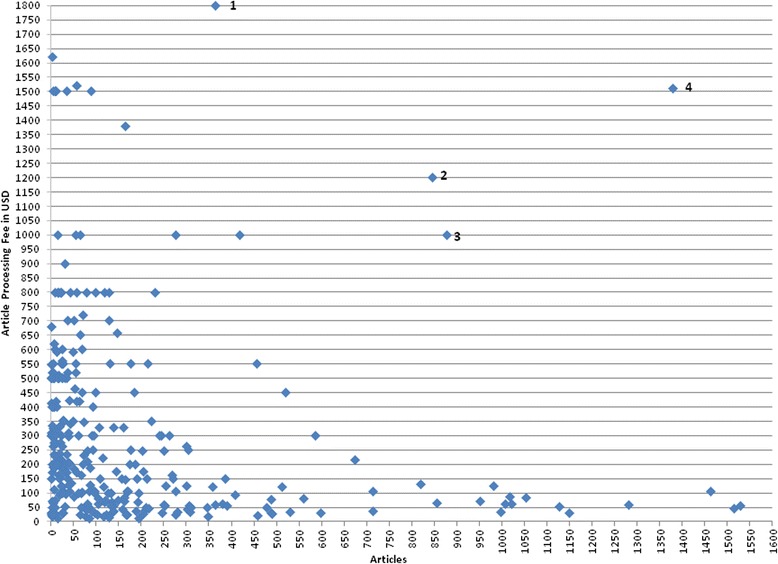
“Xia examined 297 journals listed in Beall’s list of standalone predatory journals, and found an average APC of 94 USD and a range of yearly articles of between 4 and 2,286 (mean 227 articles, median 86) [17].”
BackgroundPenetration of Nigerian predatory biomedical open access journals 2007–2012: a bibliometric study
NWAGWU, W. E., & OJEMENI, O. (2015) · Learned Publishing · doi:10.1087/20150105 · Cited by 70 · cited 2×
“…through publishers who set up large (100+) journal portfolios, and who on average charge almost 800 USD, but during the past three years the 10 – 99 journal journals studied by Ezinwa Nwagwu and Ojemeni [19] had an average APC of 636 USD, which could explain the lower share of Indian authors.”
BackgroundPenetrating the Omerta of Predatory Publishing: The Romanian Connection
Djurić, D. (2014) · Science and Engineering Ethics · doi:10.1007/s11948-014-9521-4 · Cited by 67 · cited 2×
“Djuric describes in detail the publishing pressures in Serbia, where the government requires publishing in journals having an ISI impact factor for academic appointments and even to obtain a PhD [13].”
BackgroundOpen access megajournals : have they changed everything?
Binfield, P. (2013) · cIRcle (University of British Columbia) · doi:10.14288/1.0077872 · Cited by 40
Open-access website gets tough
Noorden, R. V. (2014) · Nature · doi:10.1038/512017a · Cited by 28
Predatory journals and Indian ichthyology
Raghavan, R., Dahanukar, N., Knight, J. D. M., Kumar, A. B., Katwate, U., Krishnakumar, K., Ali, A., & Philip, S. (2014) · doi:10.18520/cs/v107/i5/740-742 · Cited by 25 · cited 1×
“The universities or funding agencies in a number of countries that strongly emphasize publishing in ‘international’ journals for evaluating researchers, but without monitoring the quality of the journals in question [16, 33], are partly responsible for the rise of this type of publishing.”
Background
Research works printed but not linked: 1
- Spears T. Respectable medical journal turns to dark side. Ottawa, ON: Ottawa Citizen; 2014. http://ottawacitizen.com/technology/science/respected-medical-journal-turns-to-dark-side.
Cited by
Web of Science (WoS) and Scopus: The Titans of Bibliographic Information in Today’s Academic World
Pranckutė, R. (2021) · Publications · doi:10.3390/publications9010012 · Cited by 2,696
The Academic, Economic and Societal Impacts of Open Access: An Evidence-Based Review
Tennant, J. P., Waldner, F., Jacques, D. C., Masuzzo, P., Collister, L. B., & Hartgerink, C. H. J. (2016) · F1000Research · doi:10.12688/f1000research.8460.3 · Cited by 560
The foreign gaze: authorship in academic global health
Abimbola, S. (2019) · BMJ Global Health · doi:10.1136/bmjgh-2019-002068 · Cited by 438
Misinformation in and about science
West, J. D., & Bergstrom, C. T. (2021) · Proceedings of the National Academy of Sciences · doi:10.1073/pnas.1912444117 · Cited by 391
“How serious is the problem? According to one study (88), predatory publishers produced nearly half a million articles in 2014, bringing in around $74 million in publication fees.”
BackgroundShamseer, L., Moher, D., Maduekwe, O., Turner, L., Barbour, V., Burch, R., Clark, J., Galipeau, J., Roberts, J., & Shea, B. J. (2017) · BMC Medicine · doi:10.1186/s12916-017-0785-9 · Cited by 383
“Shen C, Bjork B-C.”
BackgroundResultInfluential
Metadata
- Authors
- Shen, C., & Björk, B.-C.
- Affiliations
- Hanken School of Economics (FI)
- Corresponding author
- Shen, Cenyu
- Venue
- BMC Medicine
- Published
- 2015-10-01
- Volume
- 13
- Issue
- 1
- Pages
- 230-230
- ISSN
- 1741-7015 (ISSN-L)
- PMC
- PMC4589914
- OpenAlex
- W2156487032
- Cited by
- 819
- References
- 28
- Citations by year
- 2026: 44 · 2025: 56 · 2024: 46 · 2023: 81 · 2022: 70 · 2021: 93 · 2020: 88 · 2019: 76 · 2018: 91 · 2017: 86 · 2016: 79 · 2015: 7
- FWCI
- 564.37
- Type
- journal article
- Language
- en
- Open access
- gold
- doi.org
- Licence
- Locations
- BMC Medicine (publishedVersion, cc-by)
- Europe PMC (PubMed Central) (publishedVersion, cc-by)
- PubMed Central (publishedVersion, cc-by)
- PubMed (publishedVersion)
- Työväentutkimus Vuosikirja (acceptedVersion)
- Työväentutkimus Vuosikirja (submittedVersion)
- Topics
- Social Sciences › Library and Information Sciences › Publishing and Scholarly Communication
- Social Sciences › Library and Information Sciences › Academic Publishing and Open Access
- Social Sciences › Library and Information Sciences › scientometrics and bibliometrics research
- Keywords
- predatory publishing, predatory journals, predatory publishers, open access publishing, article processing charges, regional distribution of authors, time to publication, peer review quality, Beall's list, DOAJ
- MeSH terms
- Authorship, Humans, Longitudinal Studies, Peer Review, Periodicals as Topic, Publishing, Bibliometrics, Access to Information
About these checks
Registry, retraction, Cites and statistics results are computed, not judged, with one exception: a printed reference that no index lists is read once by a model before it counts as a citation error. Claims are extracted by a model and kept only when their quote appears verbatim in the text; each cited source is then checked, with a model’s help, for whether it says what the claim relies on. Those verdicts can be wrong — read the claim’s quote and the cited source before relying on one.
Statistics and arithmetic are recomputed, not judged.
Confidence bands are shown only for fields calibrated on our annotated test set. None is calibrated yet, so no band is shown.
What counts as a claim ›How we measure confidence ›How we check this ›
Are you an author, or do you see a problem with this page? Request a review
Data sources
Bibliographic data: Semantic Scholar, OpenAlex, Crossref.
Contains information from the Semantic Scholar Academic Graph Datasets, made available under the ODC Attribution License (ODC-BY 1.0).
Semantic Scholar’s data is described in: Kinney, R., et al. (2023). The Semantic Scholar Open Data Platform. arXiv:2301.10140.
