

The DOI matches its Crossref record; 54 of the 54 references it cites were found in a registry or an index.
Comparative safety of anti-epileptic drugs during pregnancy: a systematic review and network meta-analysis of congenital malformations and prenatal outcomes
Open accessAbstract
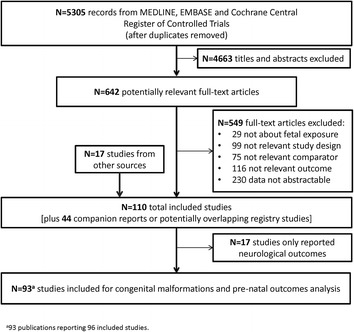
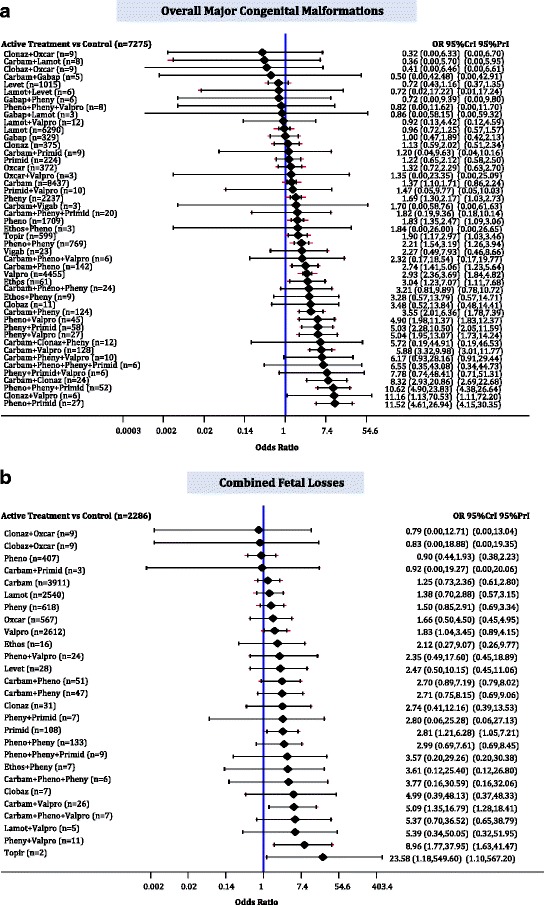
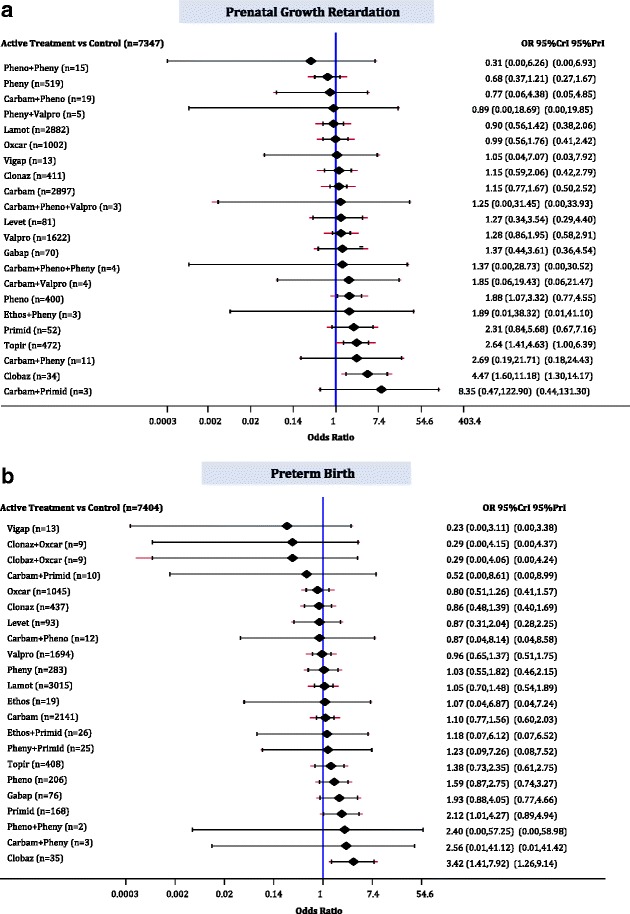
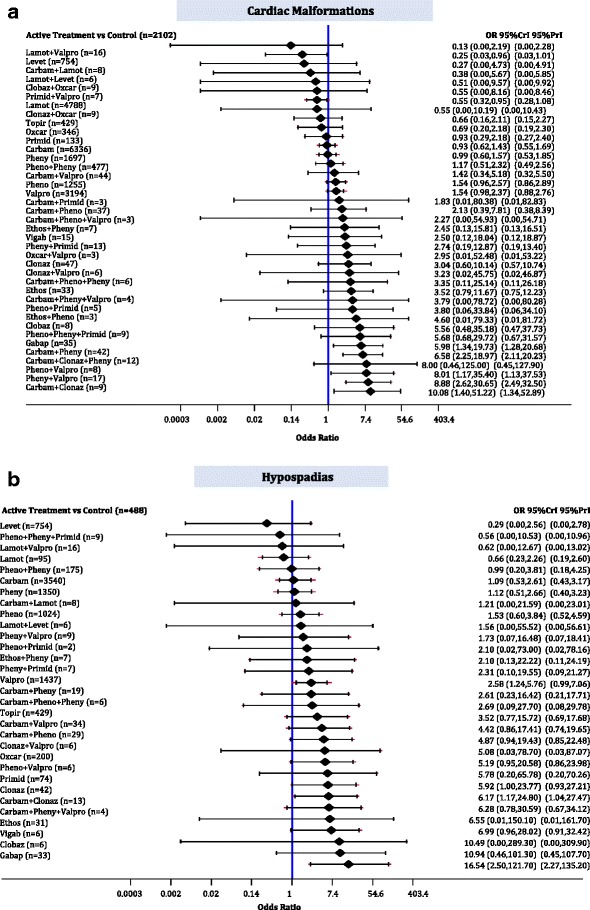
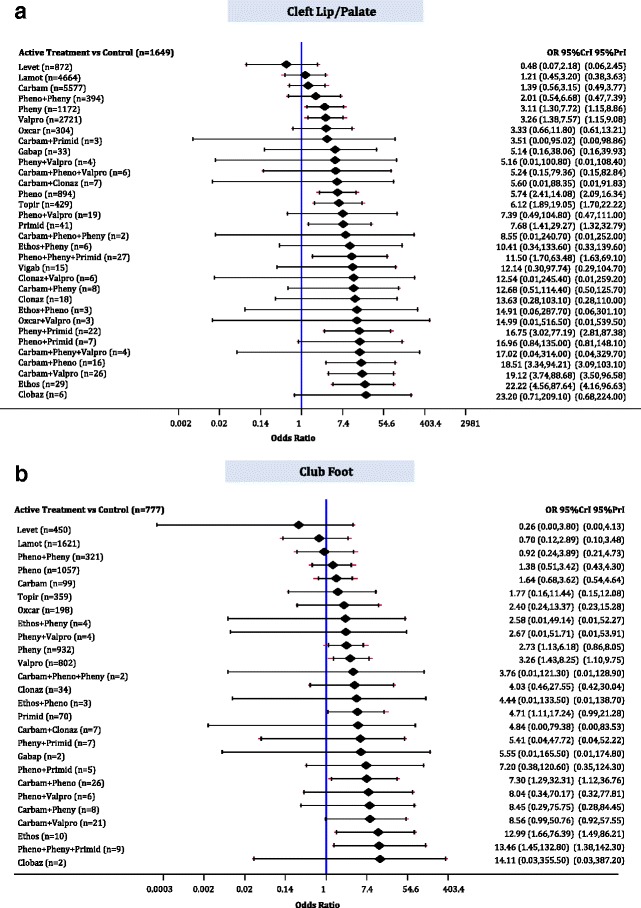
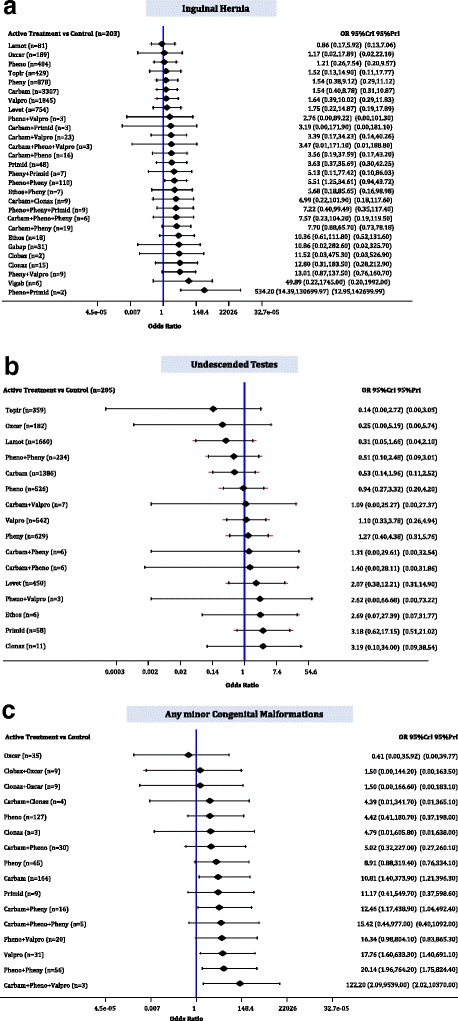
BACKGROUND: Pregnant women with epilepsy frequently experience seizures related to pregnancy complications and are often prescribed anti-epileptic drugs (AEDs) to manage their symptoms. However, less is known about the comparative safety of AED exposure in utero. We aimed to compare the risk of congenital malformations (CMs) and prenatal outcomes of AEDs in infants/children who were exposed to AEDs in utero through a systematic review and Bayesian random-effects network meta-analysis. METHODS: MEDLINE, EMBASE, and Cochrane CENTRAL were searched from inception to December 15, 2015. Two reviewers independently screened titles/abstracts and full-text papers for experimental and observational studies comparing mono- or poly-therapy AEDs versus control (no AED exposure) or other AEDs, then abstracted data and appraised the risk of bias. The primary outcome was incidence of major CMs, overall and by specific type (cardiac malformations, hypospadias, cleft lip and/or palate, club foot, inguinal hernia, and undescended testes). RESULTS: After screening 5305 titles and abstracts, 642 potentially relevant full-text articles, and 17 studies from scanning reference lists, 96 studies were eligible (n = 58,461 patients). Across all major CMs, many AEDs were associated with higher risk compared to control. For major CMs, ethosuximide (OR, 3.04; 95% CrI, 1.23-7.07), valproate (OR, 2.93; 95% CrI, 2.36-3.69), topiramate (OR, 1.90; 95% CrI, 1.17-2.97), phenobarbital (OR, 1.83; 95% CrI, 1.35-2.47), phenytoin (OR, 1.67; 95% CrI, 1.30-2.17), carbamazepine (OR, 1.37; 95% CrI, 1.10-1.71), and 11 polytherapies were significantly more harmful than control, but lamotrigine (OR, 0.96; 95% CrI, 0.72-1.25) and levetiracetam (OR, 0.72; 95% CrI, 0.43-1.16) were not. CONCLUSION: The newer generation AEDs, lamotrigine and levetiracetam, were not associated with significant increased risks of CMs compared to control, and were significantly less likely to be associated with children experiencing cardiac malformations than control. However, this does not mean that these agents are not harmful to infants/children exposed in utero. Counselling is advised concerning teratogenic risks when the prescription is written for a woman of childbearing age and before women continue with these agents when considering pregnancy, such as switching from polytherapy to monotherapy with evidence of lower risk and avoiding AEDs, such as valproate, that are consistently associated with CMs. These decisions must be balanced against the need for seizure control. SYSTEMATIC REVIEW REGISTRATION: PROSPERO CRD42014008925.
Overview
The claims and statistics of this paper haven’t been checked yet.
Run the check — free, no account needed. It reads the open-access text and checks the sources it cites.
Integrity signals
Registry
Cites
Statistics
Figures
Verification
Claims the paper makes
The claims and statistics of this paper haven’t been checked yet.
Run the check — free, no account needed. It reads the open-access text and checks the sources it cites.
Claims other papers make about this one
Each is checked against this paper’s own text: does it say what the citing paper says it does?
The check wasn’t confident either way, so it gives no verdict — never disputed.
In the citing paper
“Important is also that the anti-epileptic drugs, given at young age or during pregnancy, can have major neurodevelopmental implications as well.”
From Development of prefrontal cortex (2022) · cites this paper as [392]
Experimental — accuracy not yet measured
Self-check
Percentages, sums and reported differences re-computed from the paper’s own numbers.
The self-check needs the paper’s full text.
Citations
Cites
The Cochrane Collaboration's tool for assessing risk of bias in randomised trials
Higgins, J. P. T., Altman, D. G., Gotzsche, P. C., Juni, P., Moher, D., Oxman, A. D., Savovic, J., Schulz, K. F., Weeks, L., Sterne, J. A. C., et al. (2011) · BMJ · doi:10.1136/bmj.d5928 · Cited by 33,817
Dermyshi, E., Wang, Y., Yan, C., Hong, W., Qiu, G., Gong, X., & Zhang, T. (2017) · Neonatology · doi:10.1159/000454668 · Cited by 24,586
von Elm, E., Altman, D. G., Egger, M., Pocock, S. J., Gøtzsche, P. C., Vandenbroucke, J. P., & Initiative, F. T. S. (2007) · PLoS Medicine · doi:10.1371/journal.pmed.0040296 · Cited by 23,020
(2014) · Medical Entomology and Zoology · Cited by 17,633
Hutton, B., Salanti, G., Caldwell, D. M., Chaimani, A., Schmid, C. H., Cameron, C., Ioannidis, J. P. A., Straus, S., Thorlund, K., Jansen, J. P., et al. (2015) · Annals of Internal Medicine · doi:10.7326/m14-2385 · Cited by 8,269
Self-citationSalanti, G., Ades, A. E., & Ioannidis, J. P. A. (2011) · Journal of Clinical Epidemiology · doi:10.1016/j.jclinepi.2010.03.016 · Cited by 3,766
Interpretation of random effects meta-analyses
Riley, R. D., Higgins, J. P. T., & Deeks, J. J. (2011) · BMJ · doi:10.1136/bmj.d549 · Cited by 2,884
A Re-Evaluation of Random-Effects Meta-Analysis
Higgins, J. P. T., Thompson, S. G., & Spiegelhalter, D. J. (2009) · Journal of the Royal Statistical Society Series A: Statistics in Society · doi:10.1111/j.1467-985x.2008.00552.x · Cited by 2,569 · cited 1×
“For the NMA effect estimates, a 95% predictive interval (PrI) was also presented, capturing the magnitude of τ(2) and presenting the interval within which we would expect the treatment effect of a future study to lie [40, 41].”
Graphical tools for network meta-analysis in STATA
Chaimani, A., Higgins, J. P. T., Mavridis, D., Spyridonos, P., & Salanti, G. (2013) · PLoS ONE · doi:10.1371/journal.pone.0076654 · Cited by 2,473
Combination of direct and indirect evidence in mixed treatment comparisons
Lu, G., & Ades, A. E. (2004) · Statistics in Medicine · doi:10.1002/sim.1875 · Cited by 2,172
Research works printed but not linked: 1
- Babic M, Jovic N. Postnatal concerns in children born to women with juvenile myoclonic epilepsy. In: European Congress on Epileptology, vol. 55. Stockholm: Epilepsia; 2014. p. 128.
Cited by
Sorted by citations
Tomson, T., Battino, D., Bonizzoni, E., Craig, J. J., Lindhout, D., Perucca, E., Sabers, A., Thomas, S. V., Vajda, F. J. E., Faravelli, F., et al. (2018) · The Lancet Neurology · doi:10.1016/s1474-4422(18)30107-8 · Cited by 556
Development of prefrontal cortex
Kolk, S. M., & Rakic, P. (2022) · Neuropsychopharmacology · doi:10.1038/s41386-021-01137-9 · Cited by 378
Masini, E., Loi, E., Vega-Benedetti, A. F., Carta, M., Doneddu, G., Fadda, R., & Zavattari, P. (2020) · International Journal of Molecular Sciences · doi:10.3390/ijms21218290 · Cited by 310
30 years of second-generation antiseizure medications: impact and future perspectives
Perucca, E., Brodie, M. J., Kwan, P., & Tomson, T. (2020) · The Lancet Neurology · doi:10.1016/s1474-4422(20)30035-1 · Cited by 264
Tomson, T., Battino, D., Bromley, R., Kochen, S. S., Meador, K. J., Pennell, P. B., & Thomas, S. V. (2019) · Epileptic Disorders · doi:10.1684/epd.2019.1105 · Cited by 260
Metadata
- Authors
- Veroniki, A. A., Cogo, E., Rios, P., Straus, S. E., Finkelstein, Y., Kealey, R., Reynen, E., Soobiah, C., Thavorn, K., Hutton, B., Hemmelgarn, B. R., Yazdi, F., D’Souza, J., MacDonald, H., & Tricco, A. C.
- Affiliations
- St. Michael's Hospital (CA)
- University of Toronto (CA)
- University of Ottawa (CA)
- University of Calgary (CA)
- Corresponding author
- Tricco, Andrea C.
- ORCID
- Venue
- BMC Medicine
- Published
- 2017-05-05
- Volume
- 15
- Issue
- 1
- Pages
- 95-95
- ISSN
- 1741-7015 (ISSN-L)
- PMC
- PMC5418725
- OpenAlex
- W2611218072
- Cited by
- 339
- References
- 54
- Citations by year
- 2026: 23 · 2025: 33 · 2024: 50 · 2023: 45 · 2022: 39 · 2021: 46 · 2020: 44 · 2019: 31 · 2018: 22 · 2017: 4
- FWCI
- 5.17
- Type
- journal article
- Language
- en
- Open access
- gold
- doi.org
- Licence
- cc-by
- Locations
- BMC Medicine (publishedVersion, cc-by)
- PubMed Central (publishedVersion, cc-by)
- PubMed (publishedVersion)
- DOAJ (DOAJ: Directory of Open Access Journals) (submittedVersion, cc-by-sa)
- TSpace (University of Toronto) (submittedVersion, cc-by)
- Libraries and Cultural Resources (University of Calgary) (submittedVersion)
- uO Research (University of Ottawa) (submittedVersion, public-domain)
- Spiral (Imperial College London) (submittedVersion, cc-by)
- Funders
- Canadian Institutes of Health Research (Banting Postdoctoral Fellowship Program, New Investigator Award in Knowledge Synthesis)
- Tier 1 Canada Research Chair in Knowledge Translation
- Alberta Heritage Foundation for Medical Research (CA)
- Tier 2 Canada Research Chair in Knowledge Synthesis
- Topics
- Health Sciences › Medicine › Pediatrics, Perinatology and Child Health › Pharmacological Effects and Toxicity Studies
- Health Sciences › Medicine › Public Health, Environmental and Occupational Health › Pregnancy and Medication Impact
- Health Sciences › Medicine › Clinical Neurology › Epilepsy research and treatment
- Keywords
- antiepileptic drugs, pregnancy, congenital malformations, prenatal outcomes, drug safety, epilepsy in pregnancy, valproic acid, ethosuximide, topiramate, phenytoin, carbamazepine, phenobarbital, lamotrigine, cardiac anomalies, hypospadias, cleft lip and palate, clubfoot
- MeSH terms
- Abnormalities, Drug-Induced, Network Meta-Analysis, Adult, Anticonvulsants, Bayes Theorem, Child, Epilepsy, Female, Humans, Infant, Pregnancy, Pregnancy Complications, Pregnancy Outcome, Young Adult
About these checks
Registry, retraction, Cites and statistics results are computed, not judged, with one exception: a printed reference that no index lists is read once by a model before it counts as a citation error. Claims are extracted by a model and kept only when their quote appears verbatim in the text; each cited source is then checked, with a model’s help, for whether it says what the claim relies on. Those verdicts can be wrong — read the claim’s quote and the cited source before relying on one.
Statistics and arithmetic are recomputed, not judged.
Confidence bands are shown only for fields calibrated on our annotated test set. None is calibrated yet, so no band is shown.
What counts as a claim ›How we measure confidence ›How we check this ›
Are you an author, or do you see a problem with this page? Request a review
