

The DOI matches its Crossref record; 49 of the 49 references it cites were found in a registry or an index.
Depression comorbid with tuberculosis and its impact on health status: cross-sectional analysis of community-based data from 48 low- and middle-income countries
Open accessAbstract
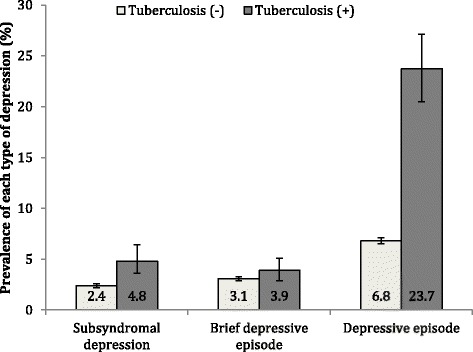
BACKGROUND: Depression in tuberculosis increases the risk for adverse health outcomes. However, little is known about comorbid depression and tuberculosis in the general population. Thus, we assessed the association between depression and tuberculosis, and the decrements in health status associated with this comorbidity in 48 low- and middle-income countries. METHODS: Cross-sectional, community-based data from the World Health Survey on 242,952 individuals aged ≥ 18 years were analyzed. Based on the World Mental Health Survey version of the Composite International Diagnostic Interview, past 12-month depression was categorized into depressive episode, brief depressive episode, subsyndromal depression, and no depression. Health status across six domains (cognition, interpersonal activities, sleep/energy, self-care, mobility, pain/discomfort) was assessed. Multivariable logistic and linear regression analyses were performed to assess the associations. RESULTS: The prevalence of depressive episode among those with and without tuberculosis was 23.7% and 6.8%, respectively (P < 0.001). Tuberculosis was associated with a 1.98 (95% CI 1.47-2.67), 1.75 (95% CI 1.26-2.42), and 3.68 (95% CI 3.01-4.50) times higher odds for subsyndromal depression, brief depressive episode, and depressive episode, respectively. Depressive episode co-occurring with tuberculosis was associated with significantly worse health status across all six domains compared to tuberculosis alone. Interaction analysis showed that depression significantly amplifies the association between TB and difficulties in self-care but not in other health domains. CONCLUSIONS: Depression is highly prevalent in adults with tuberculosis, and is associated with worse health status compared to tuberculosis without depression. Public health efforts directed to the recognition and management of depression in people with tuberculosis may lead to better outcomes.
Overview
The claims and statistics of this paper haven’t been checked yet.
Run the check — free, no account needed. It reads the open-access text and checks the sources it cites.
Integrity signals
Registry
Cites
Statistics
Figures
Verification
Claims the paper makes
The claims and statistics of this paper haven’t been checked yet.
Run the check — free, no account needed. It reads the open-access text and checks the sources it cites.
Claims other papers make about this one
Each is checked against this paper’s own text: does it say what the citing paper says it does?
The source backs part of the claim, not all of it — or backs it for a different population, condition or comparison.
In the citing paper
“Untreated depression at baseline is independently associated with greater disability, poorer quality of life,12,13 TB treatment default12 and negative TB treatment outcomes.14”
From Pharmacological or non-pharmacological interventions for treatment of common mental disorders associated with Tuberculosis: A systematic review (2021) · cites this paper as [13]
Experimental — accuracy not yet measured
Self-check
Percentages, sums and reported differences re-computed from the paper’s own numbers.
The self-check needs the paper’s full text.
Citations
Cites
WARE, J. E., KOSINSKI, M., & KELLER, S. D. (1996) · Medical Care · doi:10.1097/00005650-199603000-00003 · Cited by 17,392 · cited 1×
“health outcome measures including the Short Form 12 [16], the Health Utilities Index Mark 3 [17], and the EuroQol 5D [18], and have been used as indicators of health status in prior WHS studies [19, 20].”
MethodKessler, R. C., & Üstün, T. B. (2004) · International Journal of Methods in Psychiatric Research · doi:10.1002/mpr.168 · Cited by 4,771
Jeon, C. Y., & Murray, M. B. (2008) · PLoS Medicine · doi:10.1371/journal.pmed.0050152 · Cited by 1,486
Stress, depression, the immune system, and cancer
Reiche, E. M. V., Nunes, S. O. V., & Morimoto, H. K. (2004) · The Lancet Oncology · doi:10.1016/s1470-2045(04)01597-9 · Cited by 1,364
Poverty and common mental disorders in developing countries.
Patel, V., & Kleinman, A. M. (2003) · Europe PMC (PubMed Central) · Cited by 1,118
Multi-Attribute Health Status Classification Systems
Feeny, D. H., Furlong, W. J., Boyle, M., & Torrance, G. W. (1995) · PharmacoEconomics · doi:10.2165/00019053-199507060-00004 · Cited by 823
INTERNATIONAL GUIDE FOR MONITORING ALCOHOL CONSUMPTION AND RELATED HARM
Desapriya, E., Stockwell, T. R., Doll, R., & Room, R. (2000) · doi:10.13140/rg.2.2.29007.48808 · Cited by 740
Cegielski, J. P., & McMurray, D. N. (2004) · PubMed · Cited by 619
Tuberculosis among Health-Care Workers in Low- and Middle-Income Countries: A Systematic Review
Joshi, R. P., Reingold, A. L., Menzies, D., & Pai, M. (2006) · PLoS Medicine · doi:10.1371/journal.pmed.0030494 · Cited by 595
Depression and immune function
Kiecolt-Glaser, J. K., & Glaser, R. (2002) · Journal of Psychosomatic Research · doi:10.1016/s0022-3999(02)00309-4 · Cited by 571
Research works printed but not linked: 1
- Kind P. The EuroQoL instrument: an index of health-related quality of life. In: Spilker B, editor. Quality of Life and Pharmacoeconomics in Clinical Trial. Philadelphia, PA: Lippincott-Raven Publishers; 1996. p. 191–201.
Cited by
Sorted by citations
Janse Van Rensburg, A., Dube, A., Curran, R., Ambaw, F., Murdoch, J., Bachmann, M., Petersen, I., & Fairall, L. (2020) · Infectious Diseases of Poverty · doi:10.1186/s40249-019-0619-4 · Cited by 142
Vancampfort, D., Stubbs, B., Firth, J., Damme, T. V., & Koyanagi, A. (2018) · International Journal of Behavioral Nutrition and Physical Activity · doi:10.1186/s12966-018-0708-y · Cited by 129
Self-citationQuality of life with tuberculosis
Aggarwal, A. N. (2019) · Journal of Clinical Tuberculosis and Other Mycobacterial Diseases · doi:10.1016/j.jctube.2019.100121 · Cited by 119
Depression in Sub-Saharan Africa
Gbadamosi, I., Henneh, I. T., Aluko, O. M., Yawson, E. O., Fokoua, A. R., Koomson, A. E., Torbi, J., Olorunnado, S. E., Lewu, F. S., Yusha’u, Y., et al. (2022) · IBRO Neuroscience Reports · doi:10.1016/j.ibneur.2022.03.005 · Cited by 134
Prevalence and associated factors of depression among tuberculosis patients in Eastern Ethiopia
Dasa, T. T., Roba, A. A., Weldegebreal, F., Mesfin, F., Asfaw, A., Mitiku, H., Teklemariam, Z., Geddugol, B. J., Naganuri, M., Befikadu, H., et al. (2019) · BMC Psychiatry · doi:10.1186/s12888-019-2042-6 · Cited by 78
Nuttall, C., Fuady, A., Nuttall, H., Dixit, K., Mansyur, M., & Wingfield, T. (2022) · Infectious Diseases of Poverty · doi:10.1186/s40249-022-01021-8 · Cited by 75
The relationship between mental health and risk of active tuberculosis: a systematic review
Hayward, S. E., Deal, A., Rustage, K., Nellums, L. B., Sweetland, A. C., Boccia, D., Hargreaves, S., & Friedland, J. S. (2022) · BMJ Open · doi:10.1136/bmjopen-2021-048945 · Cited by 70
Caceres-Cardenas, G., Calderón, R., & Ugarte‐Gil, C. (2022) · Therapeutic Advances in Infectious Disease · doi:10.1177/20499361221095831 · Cited by 80
Sweetland, A. C., Galea, J. T., Shin, S. S., Driver, C., Dlodlo, R. A., Karpati, A. M., Wainberg, M. L., & Wor, O. B. O. T. U. T. M. H. (2019) · The International Journal of Tuberculosis and Lung Disease · doi:10.5588/ijtld.18.0530 · Cited by 57
The interplay between depression and tuberculosis
Zhang, K., Wang, X., Tu, J., Rong, H., Werz, O., & Chen, X. (2019) · Journal of Leukocyte Biology · doi:10.1002/jlb.mr0119-023r · Cited by 56
Stubbs, B., Siddiqi, K., Elsey, H., Siddiqi, N., Ma, R., Romano, E., Siddiqi, S., & Koyanagi, A. (2020) · International Journal of Environmental Research and Public Health · doi:10.3390/ijerph18052439 · Cited by 52
Self-citationMental Health of Quarantine and Isolation
Huremović, D. (2019) · Psychiatry of Pandemics · doi:10.1007/978-3-030-15346-5_9 · Cited by 50
Tomita, A. M., Ramlall, S., Naidu, T., Mthembu, S. S., Padayatchi, N., & Burns, J. K. (2019) · Social Psychiatry and Psychiatric Epidemiology · doi:10.1007/s00127-019-01669-y · Cited by 49
Mental Health Status and Its Impact on TB Treatment and Its Outcomes: A Scoping Literature Review
Agbeko, C. K., Mallah, M. A., He, B., Liu, Q., Song, H., & Wang, J. (2022) · Frontiers in Public Health · doi:10.3389/fpubh.2022.855515 · Cited by 49
Loveday, M., Cox, H. S., Evans, D. H., Furin, J. J., Ndjeka, N. O., Osman, M., & 'Optim, K. N. F. T. N. T. T. T. (2020) · South African Medical Journal · doi:10.7196/samj.2020.v110i12.15126 · Cited by 48
More Than Malnutrition: A Review of the Relationship Between Food Insecurity and Tuberculosis
Balinda, I. G., Sugrue, D. D., & Ivers, L. C. (2019) · Open Forum Infectious Diseases · doi:10.1093/ofid/ofz102 · Cited by 49
Rouf, A., Masoodi, M. A., Dar, M. M., Khan, M. S., & Bilquise, R. (2021) · Journal of Clinical Tuberculosis and Other Mycobacterial Diseases · doi:10.1016/j.jctube.2021.100281 · Cited by 42
Huque, R., Elsey, H., Fieroze, F., Hicks, J. P., Huque, S., Bhawmik, P., Walker, I., & Newell, J. N. (2020) · BMC Public Health · doi:10.1186/s12889-020-08986-x · Cited by 40
Febi, A. R., Manu, M. K., Mohapatra, A. K., Praharaj, S. K., & Guddattu, V. (2021) · ERJ Open Research · doi:10.1183/23120541.00251-2021 · Cited by 50
Félez-Nóbrega, M., Haro, J. M., & Koyanagi, A. (2022) · Journal of Affective Disorders · doi:10.1016/j.jad.2022.08.110 · Cited by 39
Self-citationKoyanagi, A., Stubbs, B., Lara, E., Veronese, N., Vancampfort, D., Smith, L., Haro, J. M., Oh, H. Y., & DeVylder, J. (2018) · Epidemiology and Psychiatric Sciences · doi:10.1017/s2045796018000744 · Cited by 38
Self-citationSmith, L., Shin, J. I., Jacob, L., Schuch, F. B., Oh, H. Y., Tully, M. A., Sánchez, G. F. L., Veronese, N., Soysal, P., Yang, L., et al. (2022) · Maturitas · doi:10.1016/j.maturitas.2022.01.007 · Cited by 35
Self-citationMolla, A., Mekuriaw, B., & Kerebih, H. (2019) · Neuropsychiatric Disease and Treatment · doi:10.2147/ndt.s208361 · Cited by 39
Ayana, T. M., Roba, K. T., & Mabalhin, M. O. (2019) · BMC Public Health · doi:10.1186/s12889-019-7684-2 · Cited by 33
Farooq, S., Tunmore, J., & Comber, R. (2021) · Chronic Respiratory Disease · doi:10.1177/14799731211003937 · Cited by 31
Agarwal, N., & Sarthi, P. (2020) · Journal of Family Medicine and Primary Care · doi:10.4103/jfmpc.jfmpc_1404_20 · Cited by 29
Qiu, L., Yang, Q., Tong, Y., Lu, Z., Gong, Y., & Yin, X. (2018) · Frontiers in Psychiatry · doi:10.3389/fpsyt.2018.00618 · Cited by 28
Major Depression and Stigma among Individuals with Multidrug-Resistant Tuberculosis in South Africa
Naidu, T., Pillay, S. R., Ramlall, S., Mthembu, S. S., Padayatchi, N., Burns, J. K., & Tomita, A. M. (2020) · American Journal of Tropical Medicine and Hygiene · doi:10.4269/ajtmh.19-0426 · Cited by 26
Risk Factors for Depression in Tuberculosis Patients: A Meta-Analysis
Shen, R., Zong, K., Liu, J., & Zhang, L. (2022) · Neuropsychiatric Disease and Treatment · doi:10.2147/ndt.s347579 · Cited by 27
Thungana, Y., Wilkinson, R. J., & Zingela, Z. (2022) · BMJ Open · doi:10.1136/bmjopen-2021-058013 · Cited by 26
Dixit, K., Rai, B., Aryal, T. P., de Siqueira-Filha, N. T., Dhital, R., Sah, M. K., Pandit, R. N., Majhi, G., Paudel, P. R., Levy, J., et al. (2024) · BMC Global and Public Health · doi:10.1186/s44263-024-00049-2 · Cited by 27
Basham, C. A., Karim, M. E., Cook, V. J., Patrick, D. M., & Johnston, J. C. (2021) · Annals of Epidemiology · doi:10.1016/j.annepidem.2021.06.002 · Cited by 20
Sutar, R. F., Majumdar, A., Yadav, V., Basera, D. S., & Gupta, H. (2024) · Industrial Psychiatry Journal · doi:10.4103/ipj.ipj_58_23 · Cited by 23
Risk Factors for Depression in Tuberculosis Patients: A Meta-Analysis
Shen, R., Zong, K., Liu, J., & Zhang, L. (2022) · DOAJ (DOAJ: Directory of Open Access Journals) · Cited by 19
Smith, L., Shin, J. I., Song, T., Underwood, B. R., Jacob, L., Sánchez, G. F. L., Schuch, F. B., Oh, H. Y., Veronese, N., Soysal, P., et al. (2022) · Journal of Psychiatric Research · doi:10.1016/j.jpsychires.2022.07.021 · Cited by 20
Self-citationder Walt, M. L. V., & Keddy, K. H. (2021) · Frontiers in Psychiatry · doi:10.3389/fpsyt.2021.617751 · Cited by 20
Jacob, L., Smith, L., Jackson, S. E., Shin, J. I., Haro, J. M., Vancampfort, D., Stubbs, B., & Koyanagi, A. (2020) · Preventive Medicine · doi:10.1016/j.ypmed.2020.106007 · Cited by 21
Self-citationSmith, L., Shin, J. I., Sánchez, G. F. L., Veronese, N., Soysal, P., Oh, H. Y., Grabovac, I., Barnett, Y., Jacob, L., & Koyanagi, A. (2021) · Archives of Gerontology and Geriatrics · doi:10.1016/j.archger.2021.104438 · Cited by 17
Self-citationZhang, L., Wang, S., Zhu, Y., & Yang, T. (2018) · Neuropsychiatric Disease and Treatment · doi:10.2147/ndt.s183039 · Cited by 16
Ma, R., Romano, E., Vancampfort, D., Firth, J., Stubbs, B., & Koyanagi, A. (2022) · Journal of Affective Disorders · doi:10.1016/j.jad.2022.10.002 · Cited by 16
Self-citationTodowede, O. O., Afaq, S., Adhikary, A., Kanan, S., Shree, V., Jennings, H. M., Faisal, M. R., Nisar, Z., Khan, I., Desai, G., et al. (2023) · BMC Health Services Research · doi:10.1186/s12913-023-09783-z · Cited by 16
Pulmonary rehabilitation and tuberculosis: a new approach for an old disease
Mahler, B., & Croitoru, A. (2019) · Pneumologia · doi:10.2478/pneum-2019-0024 · Cited by 16
Koyanagi, A., Smith, L., Shin, J. I., Oh, H. Y., Kostev, K., Jacob, L., Abduljabbar, A. S., & Haro, J. M. (2021) · Journal of Alzheimer s Disease · doi:10.3233/jad-201592 · Cited by 16
Self-citationHassani, S., Shahboulaghi, F. M., Foroughan, M., Nadji, S. A., Tabarsi, P., & Harouni, G. G. (2023) · Canadian Journal of Infectious Diseases and Medical Microbiology · doi:10.1155/2023/4056548 · Cited by 15
Depression and delayed tuberculosis treatment initiation among newly diagnosed patients in Botswana
Molebatsi, K., Wang, Q., Dima, M., Foster, A. H., Modongo, C., Zetola, N. M., & Shin, S. S. (2020) · Global Public Health · doi:10.1080/17441692.2020.1826049 · Cited by 15
Kigozi, G. (2020) · Southern African Journal of Infectious Diseases · doi:10.4102/sajid.v35i1.242 · Cited by 17
Sunjaya, D. K., Paskaria, C., Pramayanti, M., Herawati, D. M. D., & Parwati, I. (2022) · Journal of Multidisciplinary Healthcare · doi:10.2147/jmdh.s359530 · Cited by 14
Cox, S. E., Edwards, T., Faguer, B., Ferrer, J. P., Suzuki, S., Koh, M., Ferdous, F., Saludar, N. R., Garfin, A. M. C., Castro, M. C., et al. (2021) · PLOS Global Public Health · doi:10.1371/journal.pgph.0000011 · Cited by 15
Vancampfort, D., Stubbs, B., Sallis, J. F., Nabanoba, J., Basangwa, D., Oyeyemi, A. L., Kasoma, S. S., Binder, M. D., Myin‐Germeys, I., & Mugisha, J. (2019) · Journal of Physical Activity and Health · doi:10.1123/jpah.2018-0355 · Cited by 14
Self-citationAlemu, W. G., & Amare, T. (2023) · African Health Sciences · doi:10.4314/ahs.v23i1.25 · Cited by 13
Smith, L., Sánchez, G. F. L., Shin, J. I., Kostev, K., Underwood, B. R., Oh, H. Y., Soysal, P., Veronese, N., Schuch, F. B., Tully, M. A., et al. (2023) · European Journal of Nutrition · doi:10.1007/s00394-023-03226-5 · Cited by 13
Self-citationDong, X., Zhao, L., Sun, T., Fei, Y., & Qiu, L. (2019) · American Journal of Tropical Medicine and Hygiene · doi:10.4269/ajtmh.19-0542 · Cited by 12
Depression among TB patients and associated factors in Kathmandu Valley, Nepal
Shrestha, P., Subba, U. K., Brouwer, M., & Sweetland, A. C. (2020) · Global Mental Health · doi:10.1017/gmh.2019.28 · Cited by 11
Mainga, T., Gondwe, M., Mactaggart, I., Stewart, R. C., Shanaube, K., Ayles, H., & Bond, V. A. (2022) · BMC Psychology · doi:10.1186/s40359-022-00881-x · Cited by 11
Depression and Anxiety among Tuberculosis Patients: A Systematic Review and Meta-analysis
Panibatla, V., Nagaraja, S. B., Mohan, D., K., S. M. P., & Sangeetha, M. D. (2024) · Indian Journal of Social Psychiatry · doi:10.4103/ijsp.ijsp_222_23 · Cited by 11
Abdurahman, S., Yadeta, T. A., Ayana, D. A., Kure, M. A., Ahmed, J., & Mehadi, A. (2022) · Neuropsychiatric Disease and Treatment · doi:10.2147/ndt.s370795 · Cited by 14
Depression symptoms among Afghan TB patients: A multi-center study
Stanikzai, M. H., Ishaq, N., Zafar, M. N., Baray, A. H., Anwary, Z., Ahmad, M., & Stanikzai, K. A. (2024) · Indian Journal of Tuberculosis · doi:10.1016/j.ijtb.2024.08.016 · Cited by 12
Comprehensive Intervention for Anxiety and Depression among the Community Elderly with Tuberculosis
Li, X., Wang, B., Xu, Y., Chen, Y., Zhang, Y. W., Huang, J., Yang, J., Tan, D., Li, M., Zhang, D., et al. (2019) · Basic and Applied Social Psychology · doi:10.1080/01973533.2019.1600519 · Cited by 10
Depression, Anxiety, and Cigarette Smoking Among Patients with Tuberculosis
Jones‐Patten, A., Wang, Q., Molebatsi, K., Novotny, T. E., Siddiqi, K., Modongo, C., Zetola, N. M., Mbongwe, B., & Shin, S. S. (2022) · Clinical Nursing Research · doi:10.1177/10547738221132096 · Cited by 10
Chauhan, A., Pandya, A., Bhatt, D., Salaliya, V., Trivedi, R., Kapadia, D., Shukla, P., Shah, A., Chaudhary, S., Joshi, C., et al. (2024) · Journal of Family Medicine and Primary Care · doi:10.4103/jfmpc.jfmpc_532_24 · Cited by 9
Kakuta, T., Tabusadani, M., Yamane, K., Takao, S., Kuroyama, Y., Mori, K., Kawahara, K., Ono, K., Omatsu, S., & Senjyu, H. (2020) · Psychology Health & Medicine · doi:10.1080/13548506.2020.1808235 · Cited by 9
TB stigma and its correlates among HIV-positive people who inject drugs in Ukraine
Hook, K., Sereda, Y., Макаренко, О., Bendiks, S., Rybak, N., Dutta, A., Idrisov, B. T., Drainoni, M.-L., Kiriazova, T. K., & Lunze, K. (2021) · The International Journal of Tuberculosis and Lung Disease · doi:10.5588/ijtld.21.0048 · Cited by 10
Choowong, J., Sawatdee, D., Maneechote, P., & Tulyakul, P. (2020) · Global Journal of Health Science · doi:10.5539/gjhs.v12n9p30 · Cited by 8
Samal, J., Dehury, R. K., Thomas, M. B., & Singh, H. (2025) · Discover Mental Health · doi:10.1007/s44192-025-00248-9 · Cited by 8
Amha, H., Mulugeta, H., Getnet, A., Haile, D. H., Bishaw, K. A., Tilahun, M., & Desta, M. (2021) · Journal of Affective Disorders Reports · doi:10.1016/j.jadr.2021.100080 · Cited by 8
Smith, L., Shin, J. I., Oh, H. Y., Sánchez, G. F. L., Underwood, B. R., Jacob, L., Veronese, N., Soysal, P., Butler, L., Barnett, Y., et al. (2021) · Journal of Affective Disorders · doi:10.1016/j.jad.2021.11.029 · Cited by 8
Self-citationMaroof, M., Pamei, G., Bhatt, M., Awasthi, S., Bahuguna, S. C., & Singh, P. (2022) · Indian Journal of Community Health · doi:10.47203/ijch.2022.v34i04.016 · Cited by 6
Romero-Tamarit, A., Vallès, X., Munar-García, M., Pereiro, J. E., Saborit, N., Tórtola, T., Stojanović, Z., Roure, S., Antuori, A., Cardona, P.-J., et al. (2024) · Infection · doi:10.1007/s15010-024-02184-2 · Cited by 6
Smith, L., Sánchez, G. F. L., Soysal, P., Kostev, K., Jacob, L., Veronese, N., Tully, M. A., Butler, L. T., Barnett, Y., Pizzol, D., et al. (2024) · Aging Clinical and Experimental Research · doi:10.1007/s40520-024-02864-x · Cited by 6
Self-citationPrevalence of Depressive Disorders and Associated Factors among Adult Population of Dubai 2019
Abdullatif, M., Farooq, S., Altheeb, A., Rishmawi, F., Jaradat, H., & Alabady, K. (2021) · Dubai Medical Journal · doi:10.1159/000518811 · Cited by 6
Latent TB and depressive symptoms in household contacts of persons with active TB
Galea, J. T., Chu, A. L., Sweetland, A. C., Jiménez, J., Yataco, R. M., Calderon, R. I., Zhang, Z., Huang, C., Lecca, L. W., & Murray, M. B. (2023) · The International Journal of Tuberculosis and Lung Disease · doi:10.5588/ijtld.22.0609 · Cited by 6
Nurse-led intervention to decrease drug use among LTBI positive homeless adults
Nyamathi, A., Morisky, D., Wall, S. A., Yadav, K., Shin, S., Hall, E., Chang, A. H., White, K., Arce, N., Parsa, T., et al. (2022) · Public Health Nursing · doi:10.1111/phn.13044 · Cited by 5
Shrisunder, R., Muraleedharan, M., Jadhav, S. J., & Figueiredo, D. J. (2025) · BMC Health Services Research · doi:10.1186/s12913-025-12967-4 · Cited by 5
Fonseka, N., Khan, Z., Lewis, M., Kibria, Z., Ahmad, F., Khan, M. F., Ul-Haq, M., Haq, Z. U., Sanauddin, N., Majid, M., et al. (2024) · BMJ Open · doi:10.1136/bmjopen-2023-083483 · Cited by 6
Smith, L., Oh, H., Jacob, L., Sánchez, G. F. L., Veronese, N., Soysal, P., Shin, J. I., Schuch, F. B., Tully, M. A., Butler, L., et al. (2022) · Aging Clinical and Experimental Research · doi:10.1007/s40520-021-02052-1 · Cited by 5
Self-citationPhysical activity and visual difficulties in 36 low- and middle-income countries
Smith, L., Pardhan, S., Gorely, T., Barnett, Y., Jacob, L., Sánchez, G. F. L., Tully, M. A., Shin, J. I., & Koyanagi, A. (2021) · Eye · doi:10.1038/s41433-021-01439-8 · Cited by 5
Self-citationMunteanu, I., Kalambayi, F., Toth, A., Dendrino, D., Burdusel, B., Vlasceanu, S.-G., Parliteanu, O., Dragomir, A., Nemes, R. M., & Mahler, B. (2025) · Applied Sciences · doi:10.3390/app15158173 · Cited by 4
Kunoor, A., Reddy, S. C. K., Gopalakrishnan, V. V., Rakesh, P. S., Kadayara, A., Haridas, N., James, P. T., & Mehta, A. A. (2023) · PULMON · doi:10.4103/pulmon.pulmon_22_23 · Cited by 4
Tuberculosis-related Mood Disorders: Probiotics as a Next-Generation Strategy
Bhardwaj, A., & Gupta, R. (2023) · Current Probiotics · doi:10.2174/0126666499221169231123062539 · Cited by 4
Possible depression in new tuberculosis patients in the Free State province, South Africa
Kigozi, G., Heunis, C., Engelbrecht, M., & Tweheyo, R. (2024) · Southern African Journal of Infectious Diseases · doi:10.4102/sajid.v39i1.653 · Cited by 5
Estigma, prejuicio y adhesión al tratamiento: representaciones sociales de personas con tuberculosis
Braga, S. K. M., Oliveira, T. D. S., Flavio, F. F., Véras, G. C. B., da Silva, B. N., & Silva, C. R. D. V. (2020) · Revista CUIDARTE · doi:10.15649/cuidarte.785 · Cited by 4
Burden of Depression in Tuberculosis Patients in India: A Systematic Review and Meta-analysis
Hussain, S., Ali, H., Singh, S., Kaur, A., & Zaidi, I. (2025) · Preventive Medicine Research & Reviews · doi:10.4103/pmrr.pmrr_66_25 · Cited by 3
Pulmonary Tuberculosis-Associated Morbidity in Africa: A Systematic Review
Okeke, C. C., Ibe, C. C., Nduji, O. J., Ndulue, C. J., Ngige, O., Amuchie, C. C., Ezema, C. C., Onyeogulu, A. O., Ojo, A., Obuseh, M., et al. (2025) · Cureus · doi:10.7759/cureus.77569 · Cited by 3
Stigma and Depression among Tuberculosis Patients in Kedah, Malaysia
Zakaria, R., Amri, N. S., & Mohamad, N. (2022) · IIUM Medical Journal Malaysia · doi:10.31436/imjm.v21i4.2055 · Cited by 3
Sousa, S., & Aguiar, A. (2024) · Mental Health Global Challenges Journal · doi:10.56508/mhgcj.v7i1.180 · Cited by 3
Mental illness and pulmonary tuberculosis: a bidirectional two-sample Mendelian randomization study
Chen, X., Yang, F., & He, R. (2024) · Frontiers in Psychiatry · doi:10.3389/fpsyt.2024.1345863 · Cited by 4
Risk Factors for the Occurrence of Depressive Disorders in Pediatric Patients With Tuberculosis
MIHAILOV, O. M., Stavăr-Matei, L., Țocu, G., Ciubară, A., & Mihailov, R. (2025) · Pediatric Health Medicine and Therapeutics · doi:10.2147/phmt.s495914 · Cited by 4
Konsaku, K., Luangwilai, T., & Ong-Artborirak, P. (2025) · Clinics and Practice · doi:10.3390/clinpract15030043 · Cited by 3
Ugwu, C. I., Kolawole, G. O., Ringwald, B., Bimba, J., Squire, S. B., & Wingfield, T. (2026) · SSM - Health Systems · doi:10.1016/j.ssmhs.2026.100188 · Cited by 2
Castañeda-Daniels, N. P., Campo‐Arias, A., & Pedrozo‐Pupo, J. C. (2022) · Current Medical Research and Opinion · doi:10.1080/03007995.2022.2065144 · Cited by 2
Roque, S., Calçada, D. D. S., Cerqueira-Rodrigues, B., Monteiro, S., Guerreiro, S. G., Palha, J. A., & Correia‐Neves, M. (2023) · Scientific Reports · doi:10.1038/s41598-023-33121-2 · Cited by 2
Nava-Ruelas, R., Todowede, O. O., Siddiqi, N., & Elsey, H. (2023) · Global Health Research · doi:10.3310/grwh1425 · Cited by 3
Kapoor, S., Faujdar, D. S., Garg, U. S., & Dhawan, R. (2023) · D Y Patil Journal of Health Sciences · doi:10.4103/dypj.dypj_56_23 · Cited by 2
Bhatt, D., Pandya, A., Salaliya, V., Chauhan, A., Trivedi, R., Chowdhury, S., Shah, A., Shukla, P., Nimavat, P. D., Joshi, C. S., et al. (2024) · Mental Health and Social Inclusion · doi:10.1108/mhsi-06-2024-0095 · Cited by 2
Sharma, D., Goel, N. K., Sidana, A. K., Sandha, K. S., & Bishnoi, M. (2024) · Indian Journal of Community Medicine · doi:10.4103/ijcm.ijcm_167_23 · Cited by 2
Vishwakarma, D. K. (2020) · Indian Journal of Public Health Research & Development · doi:10.37506/ijphrd.v11i5.9295 · Cited by 2
Sweetland, A. C., Mann, C. G., Fernandes, M. J., Matsuzaka, C. T., Silva, F. V. S. D. M., Lee, J., McCarty, C., Kritski, A. L., Fortes, S., Cavalcanti, M. D. L. T., et al. (2023) · Current Psychiatry Research and Reviews · doi:10.2174/0126660822243332230921052022 · Cited by 2
Bala, M., Rajpoot, A., Layek, A., Gupta, R. K., & Rathore, S. S. (2025) · Indian Journal of Tuberculosis · doi:10.1016/j.ijtb.2025.03.010 · Cited by 1
Xie, B., Wu, M., Pang, Z., & Chen, B. (2025) · Environmental Health and Preventive Medicine · doi:10.1265/ehpm.24-00381 · Cited by 1
Nuwematsiko, R., Atuyambe, L. M., Kasiita, V., Kiwanuka, N., Musiimenta, A., Rutebemberwa, E., & Buregyeya, E. (2025) · PLOS Global Public Health · doi:10.1371/journal.pgph.0004808 · Cited by 1
Metadata
- Authors
- Koyanagi, A., Vancampfort, D., Carvalho, A. F., DeVylder, J. E., Haro, J. M., Pizzol, D., Veronese, N., & Stubbs, B.
- Affiliations
- Instituto de Salud Carlos III (ES)
- KU Leuven (BE)
- Fordham University (US)
- University of Padua (IT)
- National Health Service (GB)
- Corresponding author
- Koyanagi, Ai
- ORCID
- Venue
- BMC Medicine
- Published
- 2017-11-28
- Volume
- 15
- Issue
- 1
- Pages
- 209-209
- ISSN
- 1741-7015 (ISSN-L)
- PMC
- PMC5704363
- OpenAlex
- W2768219072
- Cited by
- 131
- References
- 49
- Citations by year
- 2026: 9 · 2025: 12 · 2024: 15 · 2023: 15 · 2022: 25 · 2021: 17 · 2020: 17 · 2019: 14 · 2018: 5 · 2017: 2
- FWCI
- 8.00
- Type
- journal article
- Language
- en
- Open access
- gold
- doi.org
- Licence
- cc-by
- Locations
- BMC Medicine (publishedVersion, cc-by)
- Europe PMC (PubMed Central) (publishedVersion, cc-by)
- PubMed Central (publishedVersion, cc-by)
- PubMed (publishedVersion)
- RECERCAT (Consorci de Serveis Universitaris de Catalunya) (publishedVersion, other-oa)
- Anglia Ruskin Research Online (Anglia Ruskin University) (submittedVersion)
- Lirias (submittedVersion, cc-by)
- Dipòsit Digital de la Universitat de Barcelona (Universitat de Barcelona) (submittedVersion, cc-by)
- DOAJ (DOAJ: Directory of Open Access Journals) (submittedVersion)
- Figshare (submittedVersion, cc-by)
- Nova Science Publishers (Nova Science Publishers, Inc.) (submittedVersion, other-oa)
- Research Portal (King's College London) (submittedVersion, cc-by)
- Padua Research Archive (University of Padova) (submittedVersion, cc-by)
- Funders
- Instituto de Salud Carlos III
- Topics
- Health Sciences › Medicine › Infectious Diseases › Tuberculosis Research and Epidemiology
- Health Sciences › Medicine › Psychiatry and Mental health › Mental Health Treatment and Access
- Health Sciences › Medicine › Infectious Diseases › Infectious Diseases and Tuberculosis
- Keywords
- depression, tuberculosis, comorbidities, health status, subthreshold depression, depressive episodes, self-care, low- and middle-income countries, World Health Survey, mental health
- MeSH terms
- Adult, Aged, Cross-Sectional Studies, Depression, Female, Health Status, Health Surveys, Humans, Income, Male, Middle Aged, Pain, Risk Factors, Self Care, Social Class, Tuberculosis, Global Health, Comorbidity, Prevalence
About these checks
Registry, retraction, Cites and statistics results are computed, not judged, with one exception: a printed reference that no index lists is read once by a model before it counts as a citation error. Claims are extracted by a model and kept only when their quote appears verbatim in the text; each cited source is then checked, with a model’s help, for whether it says what the claim relies on. Those verdicts can be wrong — read the claim’s quote and the cited source before relying on one.
Statistics and arithmetic are recomputed, not judged.
Confidence bands are shown only for fields calibrated on our annotated test set. None is calibrated yet, so no band is shown.
What counts as a claim ›How we measure confidence ›How we check this ›
Are you an author, or do you see a problem with this page? Request a review
