

Claims of causality in health news: a randomised trial
Open accessThe DOI matches its Crossref record; 34 of the 34 references it cites were found in a registry or an index.
Abstract
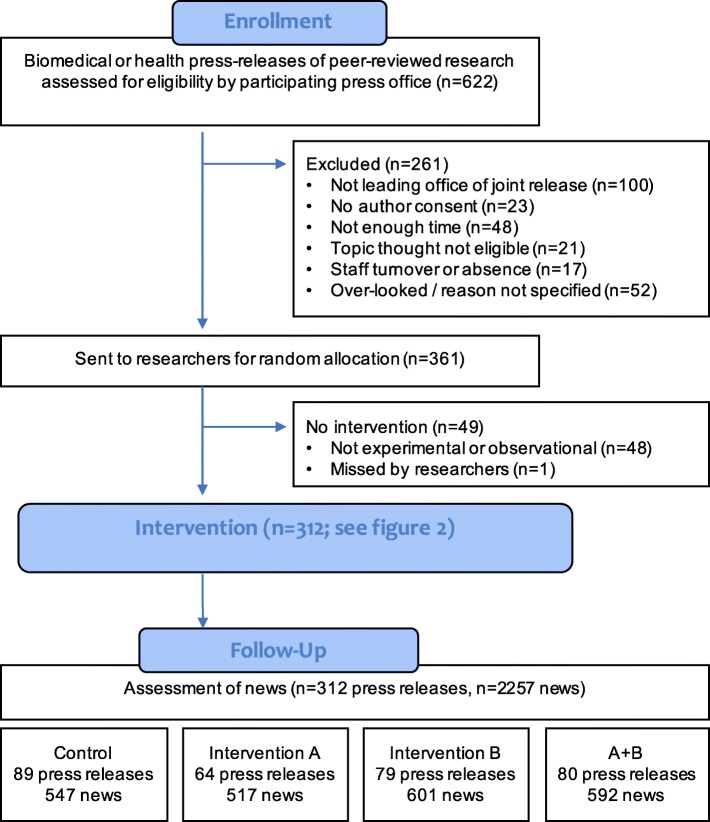
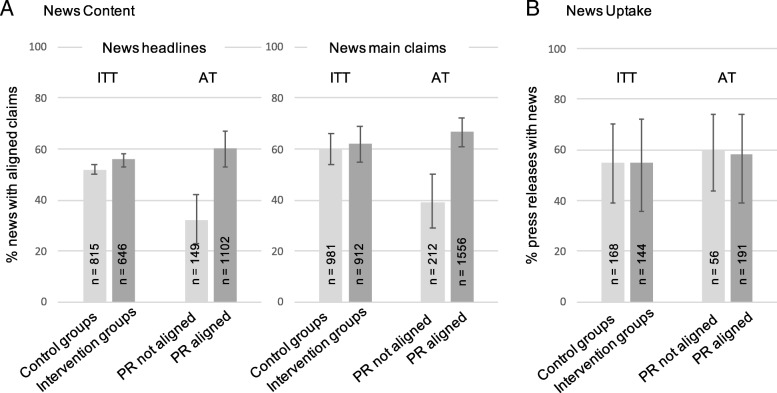
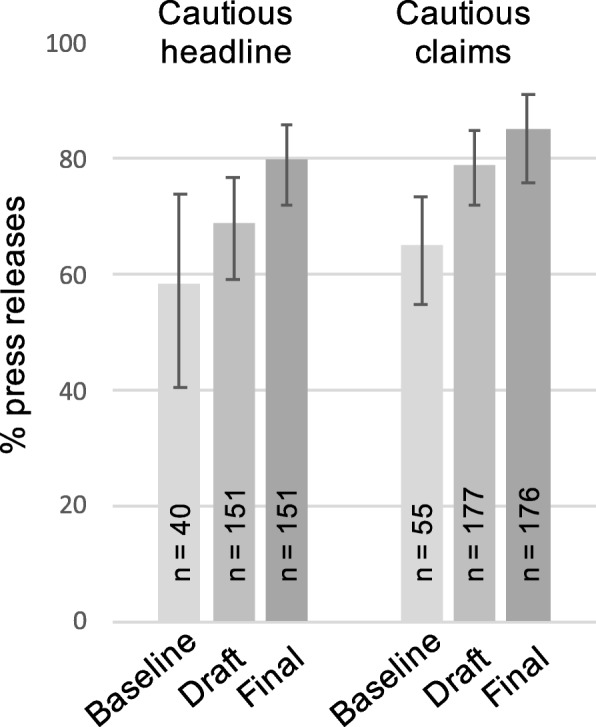
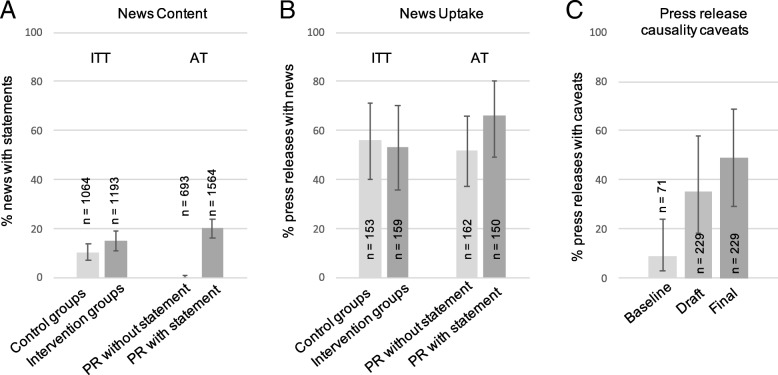
BACKGROUND: Misleading news claims can be detrimental to public health. We aimed to improve the alignment between causal claims and evidence, without losing news interest (counter to assumptions that news is not interested in communicating caution). METHODS: We tested two interventions in press releases, which are the main sources for science and health news: (a) aligning the headlines and main causal claims with the underlying evidence (strong for experimental, cautious for correlational) and (b) inserting explicit statements/caveats about inferring causality. The 'participants' were press releases on health-related topics (N = 312; control = 89, claim alignment = 64, causality statement = 79, both = 80) from nine press offices (journals, universities, funders). Outcomes were news content (headlines, causal claims, caveats) in English-language international and national media (newspapers, websites, broadcast; N = 2257), news uptake (% press releases gaining news coverage) and feasibility (% press releases implementing cautious statements). RESULTS: News headlines showed better alignment to evidence when press releases were aligned (intention-to-treat analysis (ITT) 56% vs 52%, OR = 1.2 to 1.9; as-treated analysis (AT) 60% vs 32%, OR = 1.3 to 4.4). News claims also followed press releases, significant only for AT (ITT 62% vs 60%, OR = 0.7 to 1.6; AT, 67% vs 39%, OR = 1.4 to 5.7). The same was true for causality statements/caveats (ITT 15% vs 10%, OR = 0.9 to 2.6; AT 20% vs 0%, OR 16 to 156). There was no evidence of lost news uptake for press releases with aligned headlines and claims (ITT 55% vs 55%, OR = 0.7 to 1.3, AT 58% vs 60%, OR = 0.7 to 1.7), or causality statements/caveats (ITT 53% vs 56%, OR = 0.8 to 1.0, AT 66% vs 52%, OR = 1.3 to 2.7). Feasibility was demonstrated by a spontaneous increase in cautious headlines, claims and caveats in press releases compared to the pre-trial period (OR = 1.01 to 2.6, 1.3 to 3.4, 1.1 to 26, respectively). CONCLUSIONS: News claims-even headlines-can become better aligned with evidence. Cautious claims and explicit caveats about correlational findings may penetrate into news without harming news interest. Findings from AT analysis are correlational and may not imply cause, although here the linking mechanism between press releases and news is known. ITT analysis was insensitive due to spontaneous adoption of interventions across conditions. TRIAL REGISTRATION: ISRCTN10492618 (20 August 2015).
Overview
The claims and statistics of this paper haven’t been checked yet.
Free: it reads the open-access text and checks the first 5 claims that cite a source we can check. Create a free account to check every claim.
Integrity signals
Registry
Cites
Statistics
Figures
Verification
Claims the paper makes
The claims and statistics of this paper haven’t been checked yet.
Free: it reads the open-access text and checks the first 5 claims that cite a source we can check. Create a free account to check every claim.
Claims other papers make about this one
Each is checked against this paper’s own text: does it say what the citing paper says it does?
The cited source says what the claim attributes to it.
In the citing paper
“In any case, high-quality press releases appear to drive higher-quality news stories on that research (42, 43).”
From Misinformation in and about science (2021) · cites this paper as [42]
Self-check
Percentages, sums and reported differences re-computed from the paper’s own numbers.
The self-check needs the paper’s full text.
Citations
Cites
Grading quality of evidence and strength of recommendations
(2004) · BMJ · doi:10.1136/bmj.328.7454.1490 · Cited by 8,477 · cited 2×
“We limited our focus to only one facet of evidence strength, the distinction between experimental and correlational evidence, because of their fundamentally different relationship with causal inference [26].”
BackgroundContextual prerequisites for understanding: Some investigations of comprehension and recall
Bransford, J. D., & Johnson, M. K. (1972) · Journal of Verbal Learning and Verbal Behavior · doi:10.1016/s0022-5371(72)80006-9 · Cited by 2,131 · cited 1×
“It is these headlines and main claims that are most eye-catching, most shared and that also frame the rest of a story [14,15].”
BackgroundMass media interventions: effects on health services utilisation
Grilli, R., Ramsay, C., & Minozzi, S. (2002) · Cochrane Database of Systematic Reviews · doi:10.1002/14651858.cd000389 · Cited by 533 · cited 1×
“Established news media are the most widespread means to disseminate beneficial information [4], but misleading claims are common [5, 6] and may damage public health and create confusion and mistrust [7 – 11].”
BackgroundSumner, P., Vivian-Griffiths, S., Boivin, J., Williams, A., Venetis, C. A., Davies, A., Ogden, J., Whelan, L., Hughes, B., Dalton, B., et al. (2014) · BMJ · doi:10.1136/bmj.g7015 · Cited by 489 · cited 6×
“These outcomes do not correspond to our main interest here, but were included for comparison with previous research [20, 25].”
BackgroundMethodResultInfluentialSelf-citationA COMPROMISED FOURTH ESTATE?: UK news journalism, public relations and news sources
Lewis, J., Williams, A., & Franklin, B. (2008) · Journalism Studies · doi:10.1080/14616700701767974 · Cited by 371 · cited 1×
“Previous observational research has found that health news content is strongly associated with press release content [5, 22 – 25].”
BackgroundSelf-citationBoutron, I., Altman, D. G., Hopewell, S., Vera-Badillo, F., Tannock, I., & Ravaud, P. (2014) · Journal of Clinical Oncology · doi:10.1200/jco.2014.56.7503 · Cited by 368 · cited 1×
“Previous research has shown an association between health behaviour and specific topics in health news (e.g. vaccines, statins) [10, 11], and ‘ spin ’ in news has been experimentally shown to influence clinicians ’ interpretation [33].”
BackgroundDesign, analysis and presentation of factorial randomised controlled trials
Montgomery, A. A., Peters, T. J., & Little, P. (2003) · BMC Medical Research Methodology · doi:10.1186/1471-2288-3-26 · Cited by 318
Jensen, J. D. (2008) · Human Communication Research · doi:10.1111/j.1468-2958.2008.00324.x · Cited by 298 · cited 1×
“Future research could test whether these explicit caveats increased perceived credibility [34].”
BackgroundYavchitz, A., Boutron, I., Bafeta, A., Marroun, I., Charles, P., Mantz, J., & Ravaud, P. (2012) · PLoS Medicine · doi:10.1371/journal.pmed.1001308 · Cited by 293 · cited 3×
“Previous observational research has found that health news content is strongly associated with press release content [5, 22 – 25].”
BackgroundMaking Health Public: How news coverage is remaking media, medicine, and contemporary life
Briggs, C. L., & Hallin, D. C. (2016) · Routledge eBooks · doi:10.4324/9781315658049 · Cited by 224
Research works printed but not linked: 4
- Castell S Charlton A Clemence M Pettigrew N Pope S Quigley A Public attitudes to science. Ipsos Mori report for Department for Business Innovation and Skills 2015 1 202
- The Academy of Medical Sciences Enhancing the use of scientific evidence to judge the potential benefits and harms of medicines 2017 1 116
- Jackson D Moloney K Inside Churnalism J Stud Routledge 2015 17 763 780
- Schat J Bossema FG Nederlands MN Overdreven gezondheidsnieuws. Relatie tussen overdrijving in academische persberichten en in nieuwsmedia. openaccess.leidenuniv.nl 2018
Cited by
Misinformation in and about science
West, J. D., & Bergstrom, C. T. (2021) · Proceedings of the National Academy of Sciences · doi:10.1073/pnas.1912444117 · Cited by 391
Filmer, H. L., Mattingley, J. B., & Dux, P. E. (2019) · Cortex · doi:10.1016/j.cortex.2019.10.006 · Cited by 89
Causal and Associational Language in Observational Health Research: A Systematic Evaluation
Haber, N., Wieten, S. E., Rohrer, J. M., Arah, O. A., Tennant, P. W. G., Stuart, E. A., Murray, E. J., Pilleron, S., Lam, S. T., Riederer, E., et al. (2022) · American Journal of Epidemiology · doi:10.1093/aje/kwac137 · Cited by 113
Strategies to combat medical misinformation on social media
Trethewey, S. P. (2020) · Postgraduate Medical Journal · doi:10.1136/postgradmedj-2019-137201 · Cited by 74
Andaur Navarro, C. L., Damen, J. A. A., Takada, T., Nijman, S. W. J., Dhiman, P., Ma, J., Collins, G. S., Bajpai, R., Riley, R. D., Moons, K. G. M., et al. (2023) · Journal of Clinical Epidemiology · doi:10.1016/j.jclinepi.2023.03.024 · Cited by 65
How Social Science Got Better: Overcoming Bias with More Evidence, Diversity, and Self-Reflection
Grossmann, M. (2021) · doi:10.1093/oso/9780197518977.001.0001 · Cited by 61
Bratton, L., Adams, R. C., Challenger, A., Boivin, J., Bott, L. A., Chambers, C., & Sumner, P. (2019) · Wellcome Open Research · doi:10.12688/wellcomeopenres.15486.2 · Cited by 22
“A similar pattern emerged again recently in a trial of journal and university press releases that concentrated on the issues of correlation and causality in headlines, statements and caveats (Adams et al., 2019).”
BackgroundSelf-citationInterpretation of observational studies: the good, the bad and the sensational
Ruxton, C. (2022) · Proceedings of The Nutrition Society · doi:10.1017/s0029665122000775 · Cited by 23
Defining and detecting fake news in health and medicine reporting
Treharne, T., & Papanikitas, A. N. (2020) · Journal of the Royal Society of Medicine · doi:10.1177/0141076820907062 · Cited by 18
Communicating science: epigenetics in the spotlight
Dyke, S. O. M., Ennis, C. A., Joly, Y., Walter, J., Siebert, R., & Pastinen, T. (2020) · Environmental Epigenetics · doi:10.1093/eep/dvaa015 · Cited by 16
Causal theory error in college students’ understanding of science studies
Seifert, C. M., Harrington, M. B., Michal, A. L., & Shah, P. (2022) · Cognitive Research Principles and Implications · doi:10.1186/s41235-021-00347-5 · Cited by 29
“Studies described in media reports often highlight a single causal claim and ignore alternatives even when identified explicitly in the associated journal article (Adams et al., 2019; Mueller & Coon, 2013; Sumner et al., 2014).”
BackgroundMethodInfluentialSmartphones within Psychological Science
Ellis, D. A. (2020) · Cambridge University Press eBooks · doi:10.1017/9781108671408 · Cited by 15
Effective communications strategies to increase the impact of environmental health research
Fuoco, R. E., Kwiatkowski, C. F., Birnbaum, L. S., & Blum, A. (2023) · Environmental Health · doi:10.1186/s12940-023-00997-6 · Cited by 14
Li, Z. (2023) · Frontiers in Public Health · doi:10.3389/fpubh.2023.1078115 · Cited by 10
“These problems include omitting contextual information (15, 25), exaggerated conclusions (26), and misleading causal claims (27), which are widespread across a wide range of fields (28, 29).”
BackgroundRisk messages relating to fertility and pregnancy: a media content analysis
Marshall, O., Blaylock, R., Murphy, C., & Sanders, J. (2021) · Wellcome Open Research · doi:10.12688/wellcomeopenres.16744.1 · Cited by 10
How Do Science Journalists Evaluate Psychology Research?
Bottesini, J. G., Aschwanden, C., Rhemtulla, M., & Vazire, S. (2023) · Advances in Methods and Practices in Psychological Science · doi:10.1177/25152459231183912 · Cited by 11
“This is a particularly relevant distinction because there is evidence that the cautiousness of the claims made in press releases may affect the cautiousness of the claims made in media coverage of the research (e.g., Adams et al., 2019).”
BackgroundFake News Management in Healthcare
Ciora, R. A., & Cioca, A.-L. (2021) · E-Health and Bioengineering Conference (EHB) · doi:10.1109/ehb52898.2021.9657578 · Cited by 5
How to get media coverage and boost your science’s impact
Fuoco, R. E. (2021) · Nature · doi:10.1038/d41586-021-02067-8 · Cited by 5
Hepatitis C virus media coverage favorably impacts on antibody testing in the non-interferon era
Morales-Arráez, D. E., Hernández‐Guerra, M., Díaz-Flores, F., Bujalance, Y. N., García-Dopico, J. A., Jiménez, A., & Quintero, E. (2019) · Journal of Public Health · doi:10.1093/pubmed/fdz149 · Cited by 5
Bailey, J., & Balls, M. (2020) · BMJ Open Science · doi:10.1136/bmjos-2019-100039 · Cited by 5
Shadowcasting tourism knowledge through media: Self-driving sex cars?
Cohen, S., Stienmetz, J. L., Hanna, P., Humbracht, M., & Hopkins, D. (2020) · Annals of Tourism Research · doi:10.1016/j.annals.2020.103061 · Cited by 6
Laminoplasty vs Laminectomy and Fusion for Cervical Myelopathy: Alarming Rates of Bias
Avetisian, H., Mathew, K., Myers, A., Prasad, A., Gasho, J. O., Karakash, W. J., Wang, J. C., Hah, R. J., & Alluri, R. K. (2025) · Global Spine Journal · doi:10.1177/21925682251343833 · Cited by 3
“33 Thus, we must promote a research culture that rewards high-quality methodology and transparent conclusions, regardless of whether the results are groundbreaking.”
Avetisian, H., Prasad, A., Mathew, K., McCavitt, D. G., Karakash, W. J., Patel, D. V., Wang, J. C., Hah, R. J., & Alluri, R. K. (2025) · Global Spine Journal · doi:10.1177/21925682251336750 · Cited by 3
“34 From a clinical perspective, surgeons should critically evaluate full manuscripts rather than relying solely on abstracts.”
Sumner, P., Schwartz, L., Woloshin, S., Bratton, L., & Chambers, C. (2021) · BMJ Open · doi:10.1136/bmjopen-2020-041385 · Cited by 4
Self-citationMaking Research Matter: Steps to Impact for Health and Care Researchers
Lamont, T. (2021) · Policy Press eBooks · doi:10.56687/9781447361176 · Cited by 7
4JIS – The “bottom-up” teachings in research integrity
Bommier, C., Stoeklé, H., Haiech, J., Forest, C. D., Filliatreau, G., & Hervé, C. (2020) · Ethics Medicine and Public Health · doi:10.1016/j.jemep.2020.100618 · Cited by 3
Regression-based mediation analysis: a formula for the bias due to an unobserved precursor variable
Kim, S. B., & Lee, J. (2021) · Journal of the Korean Statistical Society · doi:10.1007/s42952-021-00105-9 · Cited by 5
Social Science Biases and Collective Knowledge
Grossmann, M. (2021) · Oxford University Press eBooks · doi:10.1093/oso/9780197518977.003.0001 · Cited by 2
Avoidance of causality outside experiments: Hypotheses from cognitive dissonance reduction
Höfler, M., & Giesche, A. (2024) · Science Progress · doi:10.1177/00368504241235505 · Cited by 2
Barakat, N., Novicoff, W. M., Werner, B. C., & Browne, J. A. (2022) · The Journal of Arthroplasty · doi:10.1016/j.arth.2022.12.008 · Cited by 2
Personality and Individual Differences
Ellis, D. A. (2020) · Cambridge University Press eBooks · doi:10.1017/9781108671408.006 · Cited by 5
Ellis, D. A. (2020) · Cambridge University Press eBooks · doi:10.1017/9781108671408.003 · Cited by 2
Marraro, G. A., Spada, C., & Zeng, Y. (2020) · Critical Care Medicine · doi:10.1097/ccm.0000000000004175 · Cited by 2
“We should bear in mind in this respect that correlation does not imply causation, although correlations can help identify relationships between different variable elements—without this implying evidence of any causal relationship between these elements, however (10, 11).”
BackgroundOpen Science Reform and Social Science Progress
Grossmann, M. (2021) · Oxford University Press eBooks · doi:10.1093/oso/9780197518977.003.0002 · Cited by 2
Evaluation of Individuals’ Perception of Health News in the Period of COVID-19 Pandemic
Yeşilaydın, G., & Donar, G. B. (2022) · Journal of Health Management · doi:10.1177/09720634221128096 · Cited by 1
“This concept, which includes health related issues, has been defined as ‘health journalism’ (Adams et al., 2019).”
BackgroundThe Quiet Resolution of the Science Wars
Grossmann, M. (2021) · Oxford University Press eBooks · doi:10.1093/oso/9780197518977.003.0003 · Cited by 1
Causal claims about correlations reduced in press releases following academic study of health news
Bratton, L., Adams, R. C., Challenger, A., Boivin, J., Bott, L. A., Chambers, C., & Sumner, P. (2020) · Wellcome Open Research · doi:10.12688/wellcomeopenres.15647.1 · Cited by 4
Self-citationWill improvements in health journalism improve health literacy?
Oransky, I. (2020) · Information Services & Use · doi:10.3233/isu-200081 · Cited by 2
Vijf grote uitdagingen in de wetenschapscommunicatie
Smeets, I. (2021) · Tijdschrift voor Communicatiewetenschappen · doi:10.5117/tvc2021.2.005.smee · Cited by 2
Social Interaction and Interpersonal Relationships
Ellis, D. A. (2020) · Cambridge University Press eBooks · doi:10.1017/9781108671408.005 · Cited by 1
Tsimbal, I. V. (2020) · Alfred Nobel University Journal of Philoligy · doi:10.32342/2523-4463-2020-1-19-33
Grossmann, M. (2021) · Oxford University Press eBooks · doi:10.1093/oso/9780197518977.003.0011 · Cited by 1
Opportunities and Constraints of the Disciplines
Grossmann, M. (2021) · Oxford University Press eBooks · doi:10.1093/oso/9780197518977.003.0006 · Cited by 1
Grossmann, M. (2021) · Oxford University Press eBooks · doi:10.1093/oso/9780197518977.003.0008
Motivations of a Practical Orientation
Grossmann, M. (2021) · Oxford University Press eBooks · doi:10.1093/oso/9780197518977.003.0009
Grossmann, M. (2021) · Oxford University Press eBooks · doi:10.1093/oso/9780197518977.003.0004
Multiple Levels of Analysis and Time Scales
Grossmann, M. (2021) · Oxford University Press eBooks · doi:10.1093/oso/9780197518977.003.0007
Popularization and Consilience
Grossmann, M. (2021) · Oxford University Press eBooks · doi:10.1093/oso/9780197518977.003.0010
Grossmann, M. (2021) · Oxford University Press eBooks · doi:10.1093/oso/9780197518977.003.0005
Ellis, D. A. (2020) · Cambridge University Press eBooks · doi:10.1017/9781108671408.008
Ellis, D. A. (2020) · Cambridge University Press eBooks · doi:10.1017/9781108671408.001
Ellis, D. A. (2020) · Cambridge University Press eBooks · doi:10.1017/9781108671408.004
Ellis, D. A. (2020) · Cambridge University Press eBooks · doi:10.1017/9781108671408.002
Ellis, D. A. (2020) · Cambridge University Press eBooks · doi:10.1017/9781108671408.009
Ellis, D. A. (2020) · Cambridge University Press eBooks · doi:10.1017/9781108671408.007
2020 vision? A retrospective study of time-bound curative claims in British and Irish newspapers
McKechnie, D. G., Rashid, M. A., & McCartney, M. (2022) · British Journal of General Practice · doi:10.3399/bjgp22x719261
Ellis, D. A. (2020) · Cambridge University Press eBooks · doi:10.1017/9781108671408.010
Díaz-Rodríguez, N., Binkytė-Sadauskienė, R., Bakkali, W., Bookseller, S., Tubaro, P., Bacevičius, A., & Chatila, R. (2021) · arXiv (Cornell University) · doi:10.48550/arxiv.2104.14492 · Cited by 1
“Spinning can harm news and media interest [1].”
Grossmann, M. (2021) · Oxford University Press eBooks · doi:10.1093/oso/9780197518977.002.0004
Grossmann, M. (2021) · Oxford University Press eBooks · doi:10.1093/oso/9780197518977.002.0006
Grossmann, M. (2021) · Oxford University Press eBooks · doi:10.1093/oso/9780197518977.002.0003
Grossmann, M. (2021) · Oxford University Press eBooks · doi:10.1093/oso/9780197518977.002.0008
Media Stars: Statistical Significance and Research ImpactPreprint
Brodeur, A., Cook, N., Heyes, A., & Wright, T. J. (2025) · SSRN Electronic Journal · doi:10.2139/ssrn.5371748
Wang, K., Wei, C., & Labrecque, J. A. (2026) · BMJ Open · doi:10.1136/bmjopen-2025-109205 · Cited by 1
“There are also published studies in the field of health communication [12], media [13, 14], and computer science [15] that note this disconnect between the intention and expression of causation.”
Bagaimana cara membuat berita kesehatan yang memikat?
Sumner, P., & Adams, R. (2019) · doi:10.64628/aan.hhxt3dydw
Self-citationHow to make health news interesting — without overselling the claims
Sumner, P., & Adams, R. (2019) · doi:10.64628/ab.7pqqpg7eq
Self-citationEagle, S. R., & Sherry, N. S. (2026) · Frontiers in Neurology · doi:10.3389/fneur.2026.1882586
“The concept of “spin,” or overstating the conclusions and/or significance of the research findings in a press release, has been a notable problem across science over the last decade (11–13).”
The Search for Life Elsewhere: Avoiding Hype and Fostering Public Understanding
Albergaria, D., Baan, M., Bimm, J., Devecka, M., Fortuna, M. C., Heenatigala, T., ten Kate, I. L., Kokori, A., Muñoz-Mateos, J. C., Nováková, J., et al. (2026) · Astrobiology · doi:10.1177/15311074261475082
“Media outlets often replicate academic press releases, and studies in other fi elds have shown that many exaggerations in science news are caused by these public relations departments (Sumner et al., 2014; Adams et al., 2019).”
Metadata
- Authors
- Adams, R. C., Challenger, A., Bratton, L., Boivin, J., Bott, L., Powell, G., Williams, A., Chambers, C. D., & Sumner, P.
- Affiliations
- Cardiff University (GB)
- Corresponding author
- Sumner, Petroc
- Venue
- BMC Medicine
- Published
- 2019-05-16
- Volume
- 17
- Issue
- 1
- Pages
- 91-91
- ISSN
- 1741-7015 (ISSN-L)
- PMC
- PMC6521363
- OpenAlex
- W2945644351
- Cited by
- 69
- References
- 34
- Citations by year
- 2026: 3 · 2025: 3 · 2024: 1 · 2023: 4 · 2022: 6 · 2021: 25 · 2020: 21 · 2019: 6
- FWCI
- 17.15
- Type
- journal article
- Language
- en
- Open access
- gold
- doi.org
- Licence
- cc-by
- creativecommons.org/licenses/by/4.0/ (tdm)
- creativecommons.org/licenses/by/4.0/ (vor)
- Locations
- BMC Medicine (publishedVersion, cc-by)
- PubMed Central (publishedVersion, cc-by)
- PubMed (publishedVersion)
- ORCA Online Research @Cardiff (Cardiff University) (acceptedVersion, public-domain)
- DOAJ (DOAJ: Directory of Open Access Journals) (submittedVersion)
- Funders
- H2020 European Research Council (647893-CCT)
- Economic and Social Research Council (ES/M000664/1)
- Topics
- Social Sciences › Library and Information Sciences › Academic Publishing and Open Access
- Social Sciences › Communication › Journalism and Media Studies
- Health Sciences › Health Professions › General Health Professions › Health Literacy and Information Accessibility
- Keywords
- health news, press releases, science communication, headlines, causal inference, correlation versus causation, public health communication
- MeSH terms
- Communication, Double-Blind Method, United Kingdom, Health Promotion, Humans, Mass Media, Public Health, Health Behavior, Causality, Evidence-Based Medicine, Information Dissemination, Biomedical Research
About these checks
Registry, retraction, Cites and statistics results are computed, not judged, with one exception: a printed reference that no index lists is read once by a model before it counts as a citation error. Claims are extracted by a model and kept only when their quote appears verbatim in the text; each cited source is then checked, with a model’s help, for whether it says what the claim relies on. Those verdicts can be wrong — read the claim’s quote and the cited source before relying on one.
Statistics and arithmetic are recomputed, not judged.
Confidence bands are shown only for fields calibrated on our annotated test set. None is calibrated yet, so no band is shown.
What counts as a claim ›How we measure confidence ›How we check this ›
Are you an author, or do you see a problem with this page? Request a review
Data sources
Bibliographic data: Semantic Scholar, OpenAlex, Crossref.
Contains information from the Semantic Scholar Academic Graph Datasets, made available under the ODC Attribution License (ODC-BY 1.0).
Semantic Scholar’s data is described in: Kinney, R., et al. (2023). The Semantic Scholar Open Data Platform. arXiv:2301.10140.
