

Claims of causality in health news: a randomised trial
Open accessThe DOI matches its Crossref record; 34 of the 34 references it cites were found in a registry or an index.
Abstract
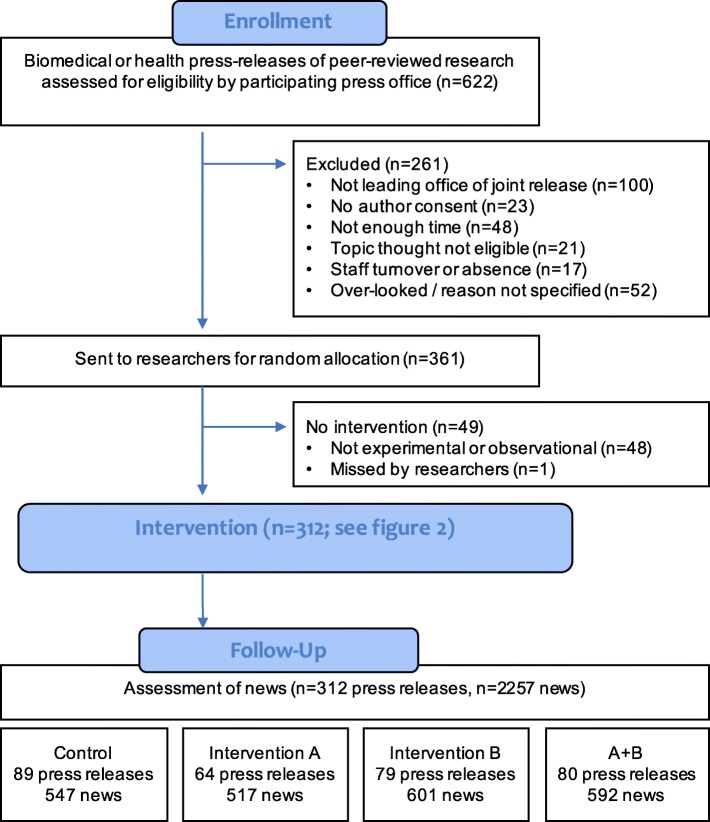
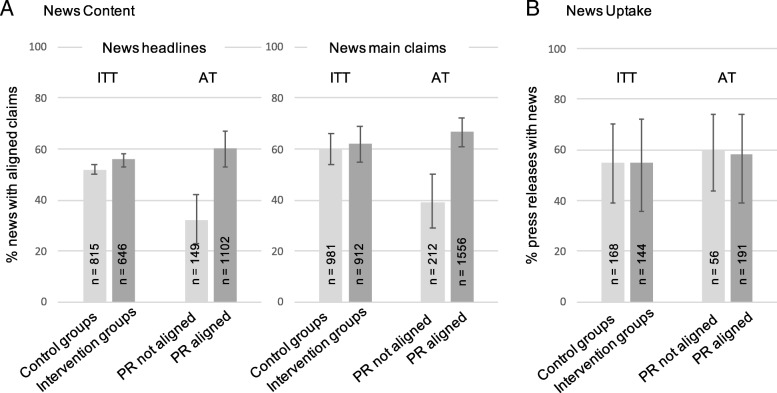
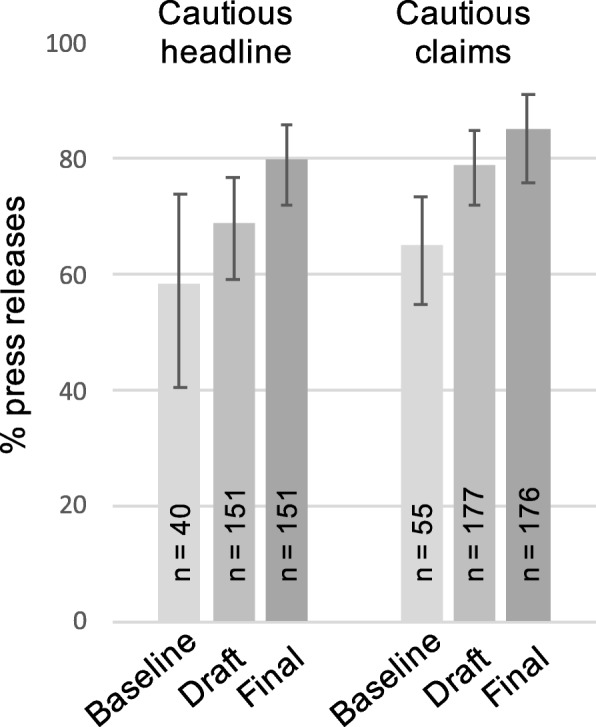
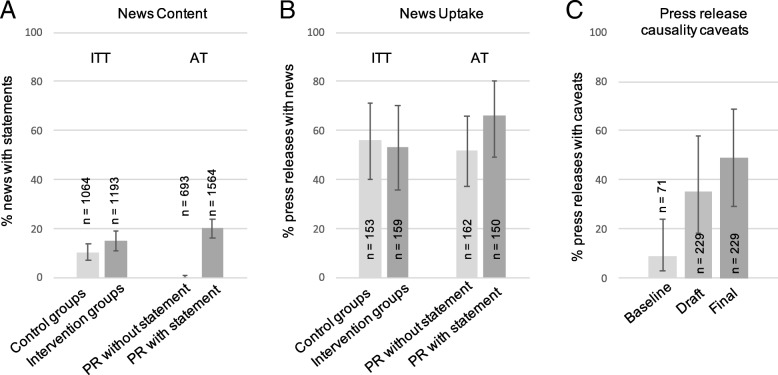
BACKGROUND: Misleading news claims can be detrimental to public health. We aimed to improve the alignment between causal claims and evidence, without losing news interest (counter to assumptions that news is not interested in communicating caution). METHODS: We tested two interventions in press releases, which are the main sources for science and health news: (a) aligning the headlines and main causal claims with the underlying evidence (strong for experimental, cautious for correlational) and (b) inserting explicit statements/caveats about inferring causality. The 'participants' were press releases on health-related topics (N = 312; control = 89, claim alignment = 64, causality statement = 79, both = 80) from nine press offices (journals, universities, funders). Outcomes were news content (headlines, causal claims, caveats) in English-language international and national media (newspapers, websites, broadcast; N = 2257), news uptake (% press releases gaining news coverage) and feasibility (% press releases implementing cautious statements). RESULTS: News headlines showed better alignment to evidence when press releases were aligned (intention-to-treat analysis (ITT) 56% vs 52%, OR = 1.2 to 1.9; as-treated analysis (AT) 60% vs 32%, OR = 1.3 to 4.4). News claims also followed press releases, significant only for AT (ITT 62% vs 60%, OR = 0.7 to 1.6; AT, 67% vs 39%, OR = 1.4 to 5.7). The same was true for causality statements/caveats (ITT 15% vs 10%, OR = 0.9 to 2.6; AT 20% vs 0%, OR 16 to 156). There was no evidence of lost news uptake for press releases with aligned headlines and claims (ITT 55% vs 55%, OR = 0.7 to 1.3, AT 58% vs 60%, OR = 0.7 to 1.7), or causality statements/caveats (ITT 53% vs 56%, OR = 0.8 to 1.0, AT 66% vs 52%, OR = 1.3 to 2.7). Feasibility was demonstrated by a spontaneous increase in cautious headlines, claims and caveats in press releases compared to the pre-trial period (OR = 1.01 to 2.6, 1.3 to 3.4, 1.1 to 26, respectively). CONCLUSIONS: News claims-even headlines-can become better aligned with evidence. Cautious claims and explicit caveats about correlational findings may penetrate into news without harming news interest. Findings from AT analysis are correlational and may not imply cause, although here the linking mechanism between press releases and news is known. ITT analysis was insensitive due to spontaneous adoption of interventions across conditions. TRIAL REGISTRATION: ISRCTN10492618 (20 August 2015).
Overview
The claims and statistics of this paper haven’t been checked yet.
Free: it reads the open-access text and checks the first 5 claims that cite a source we can check. Create a free account to check every claim.
Integrity signals
Registry
Cites
Statistics
Figures
Verification
Claims the paper makes
The claims and statistics of this paper haven’t been checked yet.
Free: it reads the open-access text and checks the first 5 claims that cite a source we can check. Create a free account to check every claim.
Claims other papers make about this one
Each is checked against this paper’s own text: does it say what the citing paper says it does?
The cited source says what the claim attributes to it.
In the citing paper
“In any case, high-quality press releases appear to drive higher-quality news stories on that research (42, 43).”
From Misinformation in and about science (2021) · cites this paper as [42]
Self-check
Percentages, sums and reported differences re-computed from the paper’s own numbers.
The self-check needs the paper’s full text.
Citations
Cites
Grading quality of evidence and strength of recommendations
(2004) · BMJ · doi:10.1136/bmj.328.7454.1490 · Cited by 8,477 · cited 2×
“We limited our focus to only one facet of evidence strength, the distinction between experimental and correlational evidence, because of their fundamentally different relationship with causal inference [26].”
BackgroundContextual prerequisites for understanding: Some investigations of comprehension and recall
Bransford, J. D., & Johnson, M. K. (1972) · Journal of Verbal Learning and Verbal Behavior · doi:10.1016/s0022-5371(72)80006-9 · Cited by 2,131 · cited 1×
“It is these headlines and main claims that are most eye-catching, most shared and that also frame the rest of a story [14,15].”
BackgroundMass media interventions: effects on health services utilisation
Grilli, R., Ramsay, C., & Minozzi, S. (2002) · Cochrane Database of Systematic Reviews · doi:10.1002/14651858.cd000389 · Cited by 533 · cited 1×
“Established news media are the most widespread means to disseminate beneficial information [4], but misleading claims are common [5, 6] and may damage public health and create confusion and mistrust [7 – 11].”
BackgroundSumner, P., Vivian-Griffiths, S., Boivin, J., Williams, A., Venetis, C. A., Davies, A., Ogden, J., Whelan, L., Hughes, B., Dalton, B., et al. (2014) · BMJ · doi:10.1136/bmj.g7015 · Cited by 489 · cited 6×
“These outcomes do not correspond to our main interest here, but were included for comparison with previous research [20, 25].”
BackgroundMethodResultInfluentialSelf-citationA COMPROMISED FOURTH ESTATE?: UK news journalism, public relations and news sources
Lewis, J., Williams, A., & Franklin, B. (2008) · Journalism Studies · doi:10.1080/14616700701767974 · Cited by 371 · cited 1×
“Previous observational research has found that health news content is strongly associated with press release content [5, 22 – 25].”
BackgroundSelf-citationBoutron, I., Altman, D. G., Hopewell, S., Vera-Badillo, F., Tannock, I., & Ravaud, P. (2014) · Journal of Clinical Oncology · doi:10.1200/jco.2014.56.7503 · Cited by 368 · cited 1×
“Previous research has shown an association between health behaviour and specific topics in health news (e.g. vaccines, statins) [10, 11], and ‘ spin ’ in news has been experimentally shown to influence clinicians ’ interpretation [33].”
BackgroundDesign, analysis and presentation of factorial randomised controlled trials
Montgomery, A. A., Peters, T. J., & Little, P. (2003) · BMC Medical Research Methodology · doi:10.1186/1471-2288-3-26 · Cited by 318
Jensen, J. D. (2008) · Human Communication Research · doi:10.1111/j.1468-2958.2008.00324.x · Cited by 298 · cited 1×
“Future research could test whether these explicit caveats increased perceived credibility [34].”
BackgroundYavchitz, A., Boutron, I., Bafeta, A., Marroun, I., Charles, P., Mantz, J., & Ravaud, P. (2012) · PLoS Medicine · doi:10.1371/journal.pmed.1001308 · Cited by 293 · cited 3×
“Previous observational research has found that health news content is strongly associated with press release content [5, 22 – 25].”
BackgroundMaking Health Public: How news coverage is remaking media, medicine, and contemporary life
Briggs, C. L., & Hallin, D. C. (2016) · Routledge eBooks · doi:10.4324/9781315658049 · Cited by 224
Matthews, A., Herrett, E., Gasparrini, A., Van Staa, T., Goldacre, B., Smeeth, L., & Bhaskaran, K. (2016) · BMJ · doi:10.1136/bmj.i3283 · Cited by 221 · cited 2×
“Previous research has shown an association between health behaviour and specific topics in health news (e.g. vaccines, statins) [10, 11], and ‘ spin ’ in news has been experimentally shown to influence clinicians ’ interpretation [33].”
BackgroundSchwitzer, G. (2008) · PLoS Medicine · doi:10.1371/journal.pmed.0050095 · Cited by 174 · cited 1×
“Established news media are the most widespread means to disseminate beneficial information [4], but misleading claims are common [5,6] and may damage public health and create confusion and mistrust [7-11].”
Exaggerations and Caveats in Press Releases and Health-Related Science News
Sumner, P., Vivian-Griffiths, S., Boivin, J., Williams, A., Bott, L., Adams, R., Venetis, C. A., Whelan, L., Hughes, B., & Chambers, C. D. (2016) · PLOS ONE · doi:10.1371/journal.pone.0168217 · Cited by 155 · cited 5×
“These outcomes do not correspond to our main interest here, but were included for comparison with previous research [20, 25].”
BackgroundMethodResultInfluentialSelf-citationWiley, J., & Rayner, K. (2000) · Memory & Cognition · doi:10.3758/bf03209349 · Cited by 145 · cited 1×
“It is these headlines and main claims that are most eye-catching, most shared and that also frame the rest of a story [14, 15].”
BackgroundSchwartz, L. M., Woloshin, S., Andrews, A., & Stukel, T. A. (2012) · BMJ · doi:10.1136/bmj.d8164 · Cited by 136 · cited 1×
“2a and 4a) confirms previously observed associations for other content [5, 20, 24, 25, 29].”
Effects of Newspaper Coverage on Public Knowledge About Modifiable Cancer Risks
Stryker, J. E., Moriarty, C. M., & Jensen, J. D. (2008) · Health Communication · doi:10.1080/10410230802229894 · Cited by 132 · cited 1×
“Established news media are the most widespread means to disseminate beneficial information [4], but misleading claims are common [5, 6] and may damage public health and create confusion and mistrust [7 – 11].”
BackgroundInside Churnalism: PR, journalism and power relationships in flux
Jackson, D., & Moloney, K. (2015) · Journalism Studies · doi:10.1080/1461670x.2015.1017597 · Cited by 130 · cited 1×
“Previous observational research has found that health news content is strongly associated with press release content [5,22-25].”
BackgroundNorris, S. P., Phillips, L. M., & Korpan, C. A. (2003) · Public Understanding of Science · doi:10.1177/09636625030122001 · Cited by 127 · cited 1×
“Indeed studies show that even college students who have taken research design courses find this difficult to discern [30-32].”
BackgroundHaber, N., Smith, E. R., Moscoe, E., Andrews, K., Audy, R., Bell, W., Brennan, A. T., Breskin, A., Kane, J. C., Karra, M., et al. (2018) · PLoS ONE · doi:10.1371/journal.pone.0196346 · Cited by 97 · cited 1×
“However, many are based on correlational evidence [16, 17], where causal conclusions often prove incorrect [18].”
BackgroundMaking Health Public: How News Coverage Is Remaking Media, Medicine, and Contemporary Life
Briggs, C. L., & Hallin, D. C. (2016) · Cited by 79
Poor replication validity of biomedical association studies reported by newspapers
Dumas-Mallet, E., Smith, A., Boraud, T., & Gonon, F. (2017) · PLOS ONE · doi:10.1371/journal.pone.0172650 · Cited by 76 · cited 1×
“However, many are based on correlational evidence [16, 17], where causal conclusions often prove incorrect [18].”
BackgroundHaneef, R., Lazarus, C., Ravaud, P., Yavchitz, A., & Boutron, I. (2015) · PLOS ONE · doi:10.1371/journal.pone.0140889 · Cited by 70 · cited 2×
“For example, in a sample of 130 prominent health stories, 49% had causal claims based on non-randomised designs [6] (see also Additional file 1: Figure S1).”
BackgroundReporting of Limitations of Observational Research
Wang, M. T. M., Bolland, M. J., & Grey, A. (2015) · JAMA Internal Medicine · doi:10.1001/jamainternmed.2015.2147 · Cited by 69 · cited 1×
“These are rare and normally nonspecific, such as suggesting more research is needed [19 – 21].”
BackgroundHow readers understand causal and correlational expressions used in news headlines.
Adams, R. C., Sumner, P., Vivian-Griffiths, S., Barrington, A., Williams, A., Boivin, J., Chambers, C. D., & Bott, L. (2017) · Journal of Experimental Psychology: Applied · doi:10.1037/xap0000100 · Cited by 63 · cited 4×
“Based on previous results [27] showing which causal phrases readers distinguish or treat equivalently, all claims for observational evidence were modified to use hedged/ cautious or associative language ( may , could , might ; e.g. ‘ drinking wine may increase cancer risk ’ ; associated, linked ;…”
BackgroundMethodResultInfluentialSelf-citationInfluence of the News Media on Diagnostic Testing in the Emergency Department
Sharma, V., Dowd, M. D., Swanson, D. S., Slaughter, A. J., & Simon, S. D. (2003) · Archives of Pediatrics & Adolescent Medicine · doi:10.1001/archpedi.157.3.257 · Cited by 61 · cited 1×
“Established news media are the most widespread means to disseminate beneficial information [4], but misleading claims are common [5,6] and may damage public health and create confusion and mistrust [7-11].”
BackgroundBoivin, J., Bunting, L., Koert, E., Chin ieng, U., & Verhaak, C. M. (2016) · Human Reproduction · doi:10.1093/humrep/dew326 · Cited by 59 · cited 1×
“The Academy of Medical Sciences recently reported that only 37% of British adults trust scientific evidence [12], potentially undermining the timely seeking of, and engagement with, medical or healthcare advice [13].”
BackgroundSelf-citationBleske-Rechek, A. L., Morrison, K., & Heidtke, L. D. (2014) · The Journal of General Psychology · doi:10.1080/00221309.2014.977216 · Cited by 51 · cited 1×
“For each bar, n reports total number of news ( a ) or press releases ( b , c ) in that analysis group (i.e. the denominator of the proportion that the bar displays) college students who have taken research design courses find this difficult to discern [30 – 32].”
BackgroundMeasles: the legacy of low vaccine coverage
Ramsay, M. E. (2013) · Archives of Disease in Childhood · doi:10.1136/archdischild-2013-304292 · Cited by 40 · cited 1×
“vaccines, statins) [10, 11], and ‘spin’ in news has been experimentally shown to influence clinicians’ interpretation [33].”
BackgroundWang, M. T. M., Bolland, M. J., Gamble, G. D., & Grey, A. B. (2015) · PLoS ONE · doi:10.1371/journal.pone.0145294 · Cited by 22 · cited 1×
“However, many are based on correlational evidence [16, 17], where causal conclusions often prove incorrect [18].”
BackgroundCaveats in science-based news stories communicate caution without lowering interest.
Bott, L. A., Bratton, L., Diaconu, B., Adams, R. C., Challenger, A., Boivin, J., Williams, A., & Sumner, P. (2019) · Journal of Experimental Psychology Applied · doi:10.1037/xap0000232 · Cited by 20 · cited 3×
“These are rare and normally nonspecific, such as suggesting more research is needed [19-21].”
BackgroundInfluentialSelf-citationMueller, J. F., & Coon, H. M. (2013) · Teaching of Psychology · doi:10.1177/0098628313501038 · Cited by 18 · cited 1×
“Indeed studies show that even college students who have taken research design courses find this difficult to discern [30-32].”
BackgroundPETERS, H. N. (1938) · Journal of Experimental Psychology · doi:10.1037/h0060310 · Cited by 12
Schat, J., Bossema, F. G., Numans, M. E., Smeets, I., & Burger, J. (2017) · Data Archiving and Networked Services (DANS) · doi:10.17026/dans-z9w-h6pn · Cited by 10
Trying to Drink from a Fire Hose: Too Much of the Wrong Kind of Health Care News
Schwitzer, G. (2015) · Trends in Pharmacological Sciences · doi:10.1016/j.tips.2015.08.005 · Cited by 8 · cited 1×
“Each year thousands of news stories make claims about health and millions of readers use them as their main source for up-to-date information [1-3].”
Background
Research works printed but not linked: 4
- Castell S Charlton A Clemence M Pettigrew N Pope S Quigley A Public attitudes to science. Ipsos Mori report for Department for Business Innovation and Skills 2015 1 202
- The Academy of Medical Sciences Enhancing the use of scientific evidence to judge the potential benefits and harms of medicines 2017 1 116
- Jackson D Moloney K Inside Churnalism J Stud Routledge 2015 17 763 780
- Schat J Bossema FG Nederlands MN Overdreven gezondheidsnieuws. Relatie tussen overdrijving in academische persberichten en in nieuwsmedia. openaccess.leidenuniv.nl 2018
Cited by
Misinformation in and about science
West, J. D., & Bergstrom, C. T. (2021) · Proceedings of the National Academy of Sciences · doi:10.1073/pnas.1912444117 · Cited by 391
Filmer, H. L., Mattingley, J. B., & Dux, P. E. (2019) · Cortex · doi:10.1016/j.cortex.2019.10.006 · Cited by 89
Causal and Associational Language in Observational Health Research: A Systematic Evaluation
Haber, N., Wieten, S. E., Rohrer, J. M., Arah, O. A., Tennant, P. W. G., Stuart, E. A., Murray, E. J., Pilleron, S., Lam, S. T., Riederer, E., et al. (2022) · American Journal of Epidemiology · doi:10.1093/aje/kwac137 · Cited by 113
Strategies to combat medical misinformation on social media
Trethewey, S. P. (2020) · Postgraduate Medical Journal · doi:10.1136/postgradmedj-2019-137201 · Cited by 74
Andaur Navarro, C. L., Damen, J. A. A., Takada, T., Nijman, S. W. J., Dhiman, P., Ma, J., Collins, G. S., Bajpai, R., Riley, R. D., Moons, K. G. M., et al. (2023) · Journal of Clinical Epidemiology · doi:10.1016/j.jclinepi.2023.03.024 · Cited by 65
Metadata
- Authors
- Adams, R. C., Challenger, A., Bratton, L., Boivin, J., Bott, L., Powell, G., Williams, A., Chambers, C. D., & Sumner, P.
- Affiliations
- Cardiff University (GB)
- Corresponding author
- Sumner, Petroc
- Venue
- BMC Medicine
- Published
- 2019-05-16
- Volume
- 17
- Issue
- 1
- Pages
- 91-91
- ISSN
- 1741-7015 (ISSN-L)
- PMC
- PMC6521363
- OpenAlex
- W2945644351
- Cited by
- 69
- References
- 34
- Citations by year
- 2026: 3 · 2025: 3 · 2024: 1 · 2023: 4 · 2022: 6 · 2021: 25 · 2020: 21 · 2019: 6
- FWCI
- 17.15
- Type
- journal article
- Language
- en
- Open access
- gold
- doi.org
- Licence
- cc-by
- creativecommons.org/licenses/by/4.0/ (tdm)
- creativecommons.org/licenses/by/4.0/ (vor)
- Locations
- BMC Medicine (publishedVersion, cc-by)
- PubMed Central (publishedVersion, cc-by)
- PubMed (publishedVersion)
- ORCA Online Research @Cardiff (Cardiff University) (acceptedVersion, public-domain)
- DOAJ (DOAJ: Directory of Open Access Journals) (submittedVersion)
- Funders
- H2020 European Research Council (647893-CCT)
- Economic and Social Research Council (ES/M000664/1)
- Topics
- Social Sciences › Library and Information Sciences › Academic Publishing and Open Access
- Social Sciences › Communication › Journalism and Media Studies
- Health Sciences › Health Professions › General Health Professions › Health Literacy and Information Accessibility
- Keywords
- health news, press releases, science communication, headlines, causal inference, correlation versus causation, public health communication
- MeSH terms
- Communication, Double-Blind Method, United Kingdom, Health Promotion, Humans, Mass Media, Public Health, Health Behavior, Causality, Evidence-Based Medicine, Information Dissemination, Biomedical Research
About these checks
Registry, retraction, Cites and statistics results are computed, not judged, with one exception: a printed reference that no index lists is read once by a model before it counts as a citation error. Claims are extracted by a model and kept only when their quote appears verbatim in the text; each cited source is then checked, with a model’s help, for whether it says what the claim relies on. Those verdicts can be wrong — read the claim’s quote and the cited source before relying on one.
Statistics and arithmetic are recomputed, not judged.
Confidence bands are shown only for fields calibrated on our annotated test set. None is calibrated yet, so no band is shown.
What counts as a claim ›How we measure confidence ›How we check this ›
Are you an author, or do you see a problem with this page? Request a review
Data sources
Bibliographic data: Semantic Scholar, OpenAlex, Crossref.
Contains information from the Semantic Scholar Academic Graph Datasets, made available under the ODC Attribution License (ODC-BY 1.0).
Semantic Scholar’s data is described in: Kinney, R., et al. (2023). The Semantic Scholar Open Data Platform. arXiv:2301.10140.
