

Socioeconomic status and stroke incidence, prevalence, mortality, and worldwide burden: an ecological analysis from the Global Burden of Disease Study 2017
Open accessThe DOI matches its Crossref record; 36 of the 36 references it cites were found in a registry or an index.
Abstract
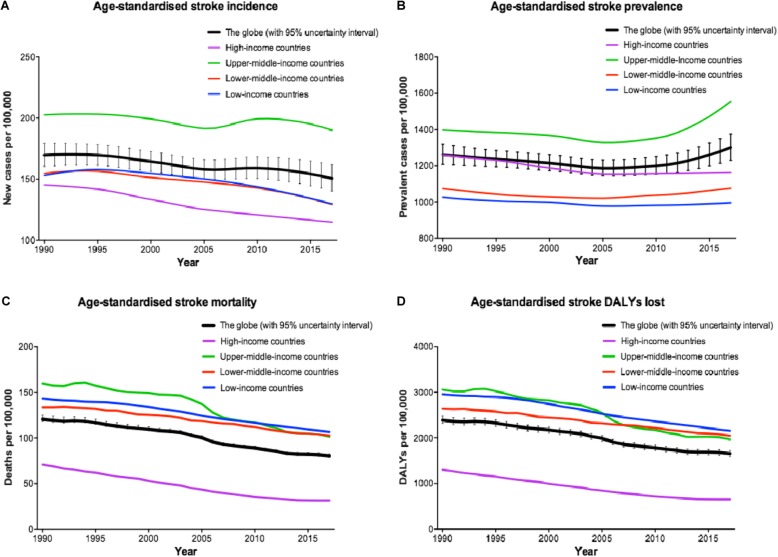
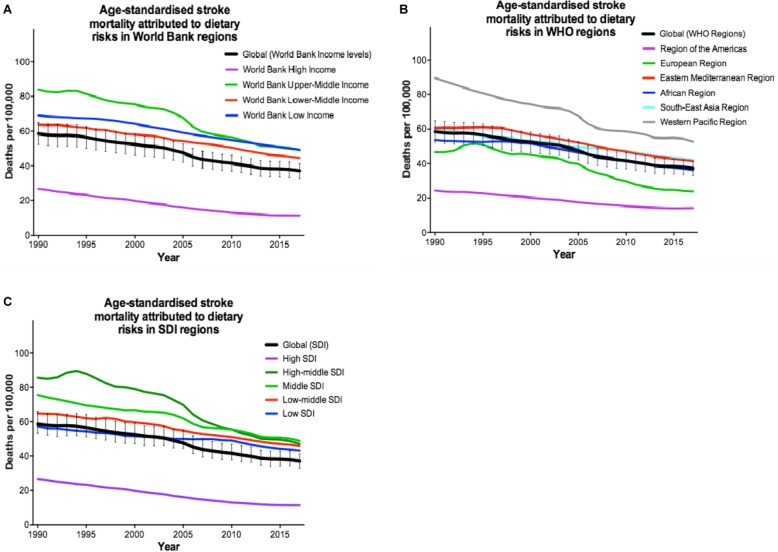
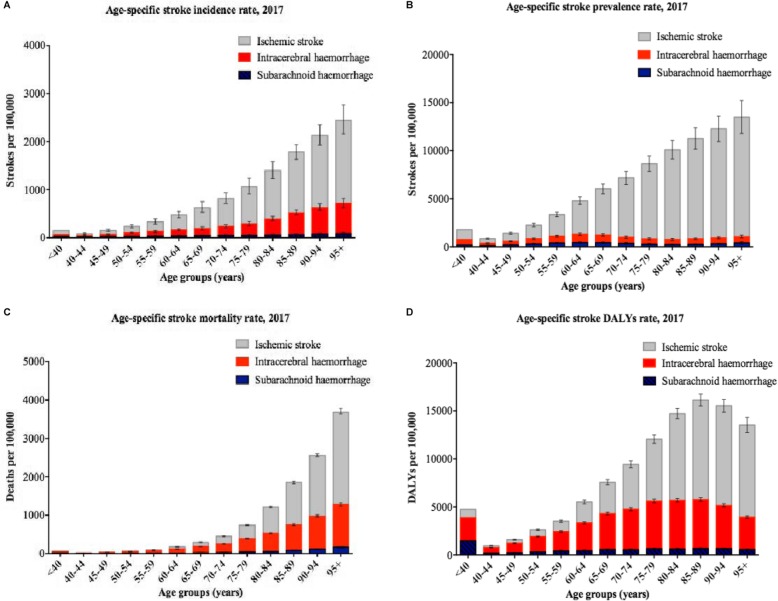
Background: Socioeconomic status (SES) is associated with stroke incidence and mortality. Distribution of stroke risk factors is changing worldwide; evidence on these trends is crucial to the allocation of resources for prevention strategies to tackle major modifiable risk factors with the highest impact on stroke burden. Methods: We extracted data from the Global Burden of Diseases, Injuries, and Risk Factors Study (GBD) 2017. We analysed trends in global and SES-specific age-standardised stroke incidence, prevalence, mortality, and disability-adjusted life years (DALYs) lost from 1990 to 2017. We also estimated the age-standardised attributable risk of stroke mortality associated with common risk factors in low-, low-middle-, upper-middle-, and high-income countries. Further, we explored the effect of age and sex on associations of risk factors with stroke mortality from 1990 to 2017. Results: Despite a growth in crude number of stroke events from 1990 to 2017, there has been an 11.3% decrease in age-standardised stroke incidence rate worldwide (150.5, 95% uncertainty interval [UI] 140.3–161.8 per 100,000 in 2017). This has been accompanied by an overall 3.1% increase in age-standardised stroke prevalence rate (1300.6, UI 1229.0–1374.7 per 100,000 in 2017) and a 33.4% decrease in age-standardised stroke mortality rate (80.5, UI 78.9–82.6 per 100,000 in 2017) over the same time period. The rising trends in age-standardised stroke prevalence have been observed only in middle-income countries, despite declining trends in age-standardised stroke incidence and mortality in all income categories since 2005. Further, there has been almost a 34% reduction in stroke death rate (67.8, UI 64.1–71.1 per 100,000 in 2017) attributable to modifiable risk factors, more prominently in wealthier countries. Conclusions: Almost half of stroke-related deaths are attributable to poor management of modifiable risk factors, and thus potentially preventable. We should appreciate societal barriers in lower-SES groups to design tailored preventive strategies. Despite improvements in general health knowledge, access to healthcare, and preventative strategies, SES is still strongly associated with modifiable risk factors and stroke burden; thus, screening of people from low SES at higher stroke risk is crucial.
Overview
The claims and statistics of this paper haven’t been checked yet.
Free: it reads the open-access text and checks the first 5 claims that cite a source we can check. Create a free account to check every claim.
Integrity signals
Registry
Cites
Statistics
Figures
Verification
Claims the paper makes
The claims and statistics of this paper haven’t been checked yet.
Free: it reads the open-access text and checks the first 5 claims that cite a source we can check. Create a free account to check every claim.
Claims other papers make about this one
Each is checked against this paper’s own text: does it say what the citing paper says it does?
The cited source says what the claim attributes to it.
In the citing paper
“despite the fact that ischemic stroke is most prevalent in older individuals [24, 95] and is strongly linked to systemic diseases, such as hypertension, hypercholesterolemia, obesity, and diabetes mellitus [14].”
From Microglia and monocytes in inflammatory CNS disease: integrating phenotype and function (2022) · cites this paper as [14]
The check wasn’t confident either way, so it gives no verdict — never disputed.
In the citing paper
“Furthermore, patients may face restrictions regarding therapeutic resources because speech therapy requires substantial time and effort by clinicians or speech-language pathologists (SLPs) [16].”
From Smartphone-Based Speech Therapy for Poststroke Dysarthria: Pilot Randomized Controlled Trial Evaluating Efficacy and Feasibility (2024) · cites this paper as [16]
Experimental — accuracy not yet measuredThe check wasn’t confident either way, so it gives no verdict — never disputed.
In the citing paper
“Traditional speech therapy is effective but often poses challenges in terms of accessibility and patient adherence.”
From Smartphone-Based Speech Therapy for Poststroke Dysarthria: Pilot Randomized Controlled Trial Evaluating Efficacy and Feasibility (2024) · cites this paper as [16]
Experimental — accuracy not yet measured
Self-check
Percentages, sums and reported differences re-computed from the paper’s own numbers.
The self-check needs the paper’s full text.
Citations
Cites
James, S. L., Abate, D., Abate, K. H., Abay, S. M., Abbafati, C., Abbasi, N., Abbastabar, H., Abd-Allah, F., Abdela, J., Abdelalim, A., et al. (2018) · The Lancet · doi:10.1016/s0140-6736(18)32279-7 · Cited by 13,867
Vos, T., Abajobir, A. A., Abate, K. H., Abbafati, C., Abbas, K. M., Abd-Allah, F., Abdulkader, R. S., Abdulle, A. M., Abebo, T. A., Abera, S. F., et al. (2017) · The Lancet · doi:10.1016/s0140-6736(17)32154-2 · Cited by 13,220
Wang, H., Naghavi, M., Allen, C., Barber, R. M., Bhutta, Z. A., Carter, A., Casey, D. C., Charlson, F. J., Chen, A. Z., Coates, M. M., et al. (2016) · The Lancet · doi:10.1016/s0140-6736(16)31012-1 · Cited by 6,596
Feigin, V. L., Nichols, E., Alam, T., Bannick, M. S., Beghi, E., Blake, N., Culpepper, W. J., Dorsey, E. R., Elbaz, A., Ellenbogen, R. G., et al. (2019) · The Lancet Neurology · doi:10.1016/s1474-4422(18)30499-x · Cited by 5,644
Feigin, V. L., Forouzanfar, M. H., Krishnamurthi, R., Mensah, G. A., Connor, M., Bennett, D. A., Moran, A. E., Sacco, R. L., Anderson, L., Truelsen, T., et al. (2014) · The Lancet · doi:10.1016/s0140-6736(13)61953-4 · Cited by 3,899
Feigin, V. L., Abajobir, A. A., Abate, K. H., Abd-Allah, F., Abdulle, A. M., Abera, S. F., Abyu, G. Y., Ahmed, M. B., Aichour, A. N., Aichour, I., et al. (2017) · The Lancet Neurology · doi:10.1016/s1474-4422(17)30299-5 · Cited by 2,275
Self-citationSex differences in stroke: epidemiology, clinical presentation, medical care, and outcomes
Reeves, M. J., Bushnell, C. D., Howard, G., Gargano, J. W., Duncan, P. W., Lynch, G., Khatiwoda, A., & Lisabeth, L. (2008) · The Lancet Neurology · doi:10.1016/s1474-4422(08)70193-5 · Cited by 1,362
Dicker, D., Nguyen, G., Abate, D., Abate, K. H., Abay, S. M., Abbafati, C., Abbasi, N., Abbastabar, H., Abd-Allah, F., Abdela, J., et al. (2018) · The Lancet · doi:10.1016/s0140-6736(18)31891-9 · Cited by 1,209
Sex Differences in Stroke Epidemiology: A Systematic Review
Appelros, P., Stegmayr, B., & Terént, A. (2009) · Stroke · doi:10.1161/strokeaha.108.540781 · Cited by 1,027
Cited by
Items 401–500 of 601
Ma, R., Aguillard, A., Xiang, Z., Asmis, R., & Wolfe, S. Q. (2026) · Stroke and Vascular Neurology · doi:10.1136/svn-2026-005128 · Cited by 1
Khaleghi, S., Khodabandelu, S., Nabati, M., Leila, Z., Ghafari, A. B., & Charati, J. Y. (2026) · BMC Public Health · doi:10.1186/s12889-026-26809-3 · Cited by 1
Rakkaew, S., Harnirattisai, T., & Muengtaweepongsa, S. (2022) · Nursing Journal CMU · Cited by 1
Akinmoladun, A. C., Obadaye, T. S., Olaleye, M. T., & Akindahunsi, A. A. (2020) · Journal of Food Biochemistry · doi:10.1111/jfbc.13351 · Cited by 1
Neural regenerative nanomedicine: current therapies and future direction
Khatami, F. (2020) · Elsevier eBooks · doi:10.1016/b978-0-12-820223-4.00009-7 · Cited by 1
A szocioökonómiai helyzet és a stroke kapcsolata a fővárosban
Vastagh, I., Szőcs, I., Oberfrank, F., Ajtay, A., & Bereczki, D. (2020) · Ideggyógyászati Szemle · doi:10.18071/isz.73.0389 · Cited by 1
The morbidity rate of acute stroke among adult population in both the Republic of Moldova and India
Ciobanu, G., Melnicov, V., & Nasarudeen, N. (2020) · Zenodo (CERN European Organization for Nuclear Research) · doi:10.5281/zenodo.4018930 · Cited by 1
Knowledge of Stroke in a Sub-urban Slum Community in Plateau State, North Central Nigeria
Osaigbovo, G. O., Imoh, L. C., Hon, P., & Afolaranmi, T. (2021) · Journal of Epidemiological Society of Nigeria · doi:10.46912/jeson.49 · Cited by 1
INTERLEUKIN-6 LEVELS PREDICTS MORTALITY AFTER STROKE: A SYSTEMATIC REVIEW AND META-ANALYSIS
Zonoozi, A. K. (2021) · FARMACIA · doi:10.31925/farmacia.2021.4.3 · Cited by 1
Prevalence and the age of onset patterns of stroke in Jiangsu Province, China
He, C., Chen, Q., Shen, Z., Zhang, Y., Hou, H., Pei, Y., Wang, W., & Zhang, X. (2022) · Neurological Sciences · doi:10.1007/s10072-022-06428-7 · Cited by 1
Gadani, S. P., Gayle, F., Jones, P., Gailloud, P., Faigle, R., & Urrutia, V. (2022) · Cerebrovascular Diseases · doi:10.1159/000526295 · Cited by 1
da Guarda, F. R. B., Rodrigues, B. L. S., da Silva, R. N., de Farias, S. J. M., Silva, P. B. C., Júnior, R. E. D. S., Feitosa, D. K. D. S., Anokye, N., & Coyte, P. C. (2023) · Cadernos de Saúde Pública · doi:10.1590/0102-311xen012922 · Cited by 1
Stroke in women between 2006 and 2018: Demographic, socioeconomic, and age disparities
Jacobs, M., & Ellis, C. (2023) · Women s Health · doi:10.1177/17455057231199061 · Cited by 1
Research Progress of Acupuncture in the Treatment of Ischemic Stroke
黄, 晓. (2023) · Traditional Chinese Medicine · doi:10.12677/tcm.2023.1211475 · Cited by 1
Effect of Arm Ability Training on Functional Mobility and Dexterity in Hemiparetic Subjects
Elizabath, A., & Varathan, K. (2023) · Journal of Health and Allied Sciences NU · doi:10.1055/s-0043-1777132 · Cited by 1
Cognitive rehabilitation of motor movement
Пальцын, А. А., & Свиридкина, Н. Б. (2023) · Nauchno-prakticheskii zhurnal «Patogenez» · doi:10.25557/2310-0435.2023.03.75-80 · Cited by 1
Leszczak, J., Pyzińska, J., Baran, J., Baran, R., Bylicki, K., & Pop, T. (2024) · PeerJ · doi:10.7717/peerj.16710 · Cited by 1
Marín, S., & Cunillera, R. (2024) · Elsevier eBooks · doi:10.1016/b978-0-323-91686-8.00022-7 · Cited by 1
Rophi, K. H., & Muspitha, F. D. (2024) · JURNAL KEPERAWATAN TROPIS PAPUA · doi:10.47539/jktp.v7i1.381 · Cited by 1
Shyam Sundar, R., Deepak, S., Kumar, V., Sannasi, R., & Premkumar, M. (2024) · Cureus · doi:10.7759/cureus.72404 · Cited by 1
Influential Factors Contributing to Stroke Recovery: A Review
Tun, S. S. H., Wanpen, S., & Nualnetr, N. (2024) · Proceeding ISETH (International Summit on Science Technology and Humanity) · doi:10.23917/iseth.4222 · Cited by 1
Gaps in the physical therapy approach to functioning and disability after stroke: a scoping review
Vieira, S. Q., & de Castro, S. S. (2025) · Fisioterapia e Pesquisa · doi:10.1590/1809-2950/e23020424en · Cited by 1
Siriwardhana, C., Carrazana, E. J., & Liow, K. K. (2025) · Journal of Alzheimer s Disease · doi:10.1177/13872877251351216 · Cited by 1
Convergent validity of the Tinetti scale in subacute stroke patients
Escudero, A. A., Martín‐Casas, P., Carpio-Calatayud, E., & López‐de‐Uralde‐Villanueva, I. (2025) · Revista Científica de la Sociedad de Enfermería Neurológica (English ed ) · doi:10.1016/j.sedeng.2025.500168 · Cited by 1
Predictors of resilience in caregivers of stroke patients: A mixed-methods approach
Yılmaz, G. G., Önal, G., Ergün, B., & Gökkaya, N. K. O. (2025) · Journal of Health Psychology · doi:10.1177/13591053251388310 · Cited by 1
Baladas-Ortí*, M., Montiel, E., Monsó-Monsó, A., Chueca-Heras, E., Sanchez, F. A.-L., & Paredes Deiros, Q. (2022) · Tog · Cited by 1
Hafeez, M. S., Phillips, A. R., Reitz, K. M., Mulukutla, S. R., Johnson, A., Sridharan, N. D., Avgerinos, E. D., & Chaer, R. A. (2026) · Annals of Vascular Surgery · doi:10.1016/j.avsg.2026.03.036 · Cited by 1
Munin, N. F. A., Mazlan, M., Theivanthiran, S., Aziz, N. A., Isa, A. M., & Rahman, N. H. A. (2023) · ASEAN Journal of Rehabilitation Medicine · Cited by 1
Cantú-Brito, C. G., la Cruz-Góngora, V. V. D., Chiquete, E., Gómez‐Dantés, H., & Cahuana-Hurtado, L. (2021) · SSRN Electronic Journal · doi:10.2139/ssrn.3935718 · Cited by 1
Herath, H. M. M. T. B., Rodrigo, C., Alahakoon, A. H. D., Ambawatte, S. B., Senanayake, S., Senanayake, B., & Fernando, A. (2021) · Research Square · doi:10.21203/rs.3.rs-751515/v1 · Cited by 1
Kim, Y., Kim, M., Kim, J., & Song, T. (2022) · medRxiv · doi:10.1101/2022.08.16.22278857 · Cited by 1
Du, L., Li, Z., & Zhao, Y. (2023) · Neurology · doi:10.1212/wnl.0000000000207062 · Cited by 1
Sukumaran, R., Nair, A. S., & Banerjee, M. (2024) · doi:10.7554/elife.94088.2 · Cited by 1
Bando, D. H. (2025) · Digital Library of Theses and Dissertations (Universidade de São Paulo) · doi:10.11606/t.8.2025.tde-27112025-151320 · Cited by 1
Hernández‐Martínez, A., Fernández-Escabías, M., Carrilho-Candeias, S., Ruiz‐González, D., Ramos-Teodoro, M., Gil-Rodríguez, M., Olmo-Iruela, L. D., Camacho, M. R., Amaya‐Pascasio, L., Ortega, I. P., et al. (2025) · medRxiv · doi:10.64898/2025.12.11.25342076 · Cited by 1
Braga, M. A. F. (2022) · LA Referencia (Red Federada de Repositorios Institucionales de Publicaciones Científicas) · Cited by 1
Efficacy of Digital Speech Therapy for Poststroke Dysarthria: Randomized Noninferiority Trial
Kim, Y., Kim, M., Kim, S., Kim, J., Shin, J.-H., Chang, Y., Na, J. Y., Kim, J., & Song, T.-J. (2026) · Journal of Medical Internet Research · doi:10.2196/81938
“In addition, access to trained speech-language pathologists (SLPs) is often limited, and patients with poststroke dysarthria experience challenges visiting hospitals or speech therapy clinics multiple times per week [10,11].”
Soroush, A., Sariaslani, P., Saeidi, M., Mohammadi, H., & Komasi, S. (2020) · Journal of Gerontology · doi:10.29252/joge.4.3.15
Smith, D. R. (2020) · Arrow@dit (Dublin Institute of Technology)
Kumisbekova, A. K., & Priluckaya, M. V. (2020) · doi:10.18411/lj-11-2020-29
Mahmood, S. (2021) · Qatar University QSpace (Qatar University)
Socioeconomic Factors Associated With Mortality Rate Caused by Severe Stroke
Hosseininezhad, M., Moaddabi, Y., Mohseni, N., Saadat, S., Leyli, E. K., & Nasiri, P. (2020) · Journal of Guilan University of Medical Sciences · doi:10.32598/jgums.29.3.1374.1
Biomarkers and risk of intracerebral hemorrhage : population-based studies in northern Sweden
Johansson, K. (2021) · DiVA at Umeå University (Umeå University)
Determination of learning requirements of stroke patients with type 2 diabetes in Turkey sample
Can, G. Ş., & Uymaz, P. (2021) · INTERNATIONAL JOURNAL OF ENDOCRINOLOGY (Ukraine) · doi:10.22141/2224-0721.17.4.2021.237345
Association between ethnicity and risk factors for carotid artery stenosis: a retrospective study
Шамшиев, А. С., Tergeussizov, A. S., Баубеков, А. А., Ospanova, D., Dushpanova, A., Ismailov, Z., Маткеримов, А. Ж., Tanabayeva, S. B., & Fakhradiyev, I. R. (2021) · Family Medicine & Primary Care Review · doi:10.5114/fmpcr.2021.108203
Cardoso, N. S. (2021) · Digital Library of Theses and Dissertations (Universidade de São Paulo) · doi:10.11606/t.17.2021.tde-06122021-125354
Spatiotemporal Analysis for the Effect of Fracking on Stroke in the United StatesPreprint
Hu, C., Liu, B., Wang, S., Zhu, Z., & Li, X. (2022) · SSRN Electronic Journal · doi:10.2139/ssrn.4048901
de Aquino, A. P. M., dos Santos, F. M. K., de Castilho, B. C., Noveletto, F., da Silva, H. E., & Soares, A. V. (2022) · Research Society and Development · doi:10.33448/rsd-v11i4.27795
Computed tomography patterns of intracranial infarcts in a Ghanaian tertiary facility
Edzie, E. K. M., Dzefi‐Tettey, K., Gorleku, P. N., Brakohiapa, E. K., Appiah–Thompson, P., Agyen‐Mensah, K., Amedi, M. K., Quarshie, F., Boadi, E., Kpobi, J. M., et al. (2022) · Ghana Medical Journal · doi:10.4314/gmj.v56i1.5
Bashir, M. A., Yahaya, A. I., & Muhammad, M. (2022) · Pyramid Journal of Medicine · doi:10.4081/pjm.2022.107
The Use of Neurotropin in the Treatment of Ischemic Strokes
Popazova, O. (2021) · Neurology & Neurotherapy Open Access Journal · doi:10.23880/nnoaj-16000162
Monitoring and treatment strategies for endovascular treatment of acute ischemic stroke
Collette, S. L. (2022) · University of Groningen research database (University of Groningen / Centre for Information Technology) · doi:10.33612/diss.240253075
Literature Review: Drug Therapy in Ischemic Stroke Patients
Safira, N., & 'Azam, M. T. (2022) · SAR Journal of Psychiatry and Neuroscience · doi:10.36346/sarjpn.2022.v03i03.003
Wang, S., Zhou, H., Lai, J., Xiao, G., Tong, Z., Deng, J., Yang, F. Y., Shi, Q., & Shi, J. (2022) · Research Square · doi:10.21203/rs.3.rs-2164481/v1
Rehan, S. T., Asad, A., Usman, L., Fatima, A., Hussain, H. U., & Nashwan, A. J. (2022) · Ethics Medicine and Public Health · doi:10.1016/j.jemep.2022.100855
AGING, A PATHOLOGICAL FACTOR IN NEUROLOGICAL INJURY
Vijikumar, A. (2022) · The Research Repository @ WVU (West Virginia University) · doi:10.33915/etd.11613
Ganesh, A., & Galetta, S. L. (2023) · Neurology · doi:10.1212/wnl.0000000000207061
Stefanou, M., Palaiodimou, L., & Tsivgoulis, G. K. (2023) · Neurology · doi:10.1212/wnl.0000000000207063
de Aquino, A. P. M., dos Santos, F. M. K., de Castilho, B. C., Noveletto, F., da Silva, H. E., & Soares, A. V. (2023) · Seven Editora eBooks · doi:10.56238/colleinternhealthscienv1-098
Das, P., Thakkar, D., Sudhan, S. G., Zeeshan, A., & Reddy, S. M. (2023) · Cardiometry · doi:10.18137/cardiometry.2023.26.4514555
Stroke Therapeutics in the Care of Older Persons
Bahk, A., Kirkham, F. A., Ng, Y. T., & Rajkumar, C. (2023) · Practical issues in geriatrics · doi:10.1007/978-3-031-28061-0_24
Advancing Power Assisted Exercise for People with Stroke
Young, R. (2023) · Sheffield Hallam University · doi:10.7190/shu-thesis-00539
Development of stroke systems of care across the globe
(2023) · Frontiers research topics · doi:10.3389/978-2-8325-3680-3
Nihitha Siriguppa, M. P. T., & N., P. K. B. (2023) · International Journal of Membrane Science and Technology · doi:10.15379/ijmst.v10i2.3039
Gavazzi, A., Nunes, M. C. P., & Pinto, F. J. (2023) · Oxford University Press eBooks · doi:10.1093/med/9780198891628.003.0018
Mackenhauer, J., Christensen, E. F., Andersen, G., Mainz, J., & Johnsen, S. P. (2023) · Acta Neurologica Scandinavica · doi:10.1155/2023/4141850
-, L. C. O., John, M., -, M. K. V., & Harisuthan, T. (2024) · International Journal For Multidisciplinary Research · doi:10.36948/ijfmr.2024.v06i01.13347
Sabola, N., Hassan, S., Sallam, S. A. E. G., Doma, N. I., Elshemy, M., & Ibrahim, E. E. (2024) · Menoufia Nursing Journal · doi:10.21608/menj.2024.346629
Broadly Bridging the Breach: Stroke Disparities
Jones, E., Gardener, H. E., Magwood, G., & Sharrief, A. Z. (2024) · Springer eBooks · doi:10.1007/978-3-031-49963-0_33
Geçmişten Günümüze Rehabilitasyonda Balneoterapi ve Hidroterapi
Sezgin, N., Topçu, E., Artuç, Ş. E., Kamacı, G. K., ERTEM, U., Karakaş, M., Akaltun, M. S., Cansu, D., Baygutalp, F., Karakılıç, G. D., et al. (2024) · Akademisyen Kitabevi eBooks · doi:10.37609/akya.3091
Liu, Y., Chen, C., Wang, X., Qi, A., & Song, F.-Y. (2024) · SSRN Electronic Journal · doi:10.2139/ssrn.4816313
A Hospital-Based Case-Control Study on Whole- and Refined-Grain Intake and Risk of Stroke.
Shirani, F., Saadatnia, M., Shakeri, F., Keshteli, A. H., Saneei, P., & Esmaillzadeh, A. (2023) · PubMed Central · doi:10.48305/arya.2023.11749.2380
Sukumaran, R., Nair, A. S., & Banerjee, M. (2024) · doi:10.7554/elife.94088.2.sa3
Maghfirah, R., Abdullah, M. M., & Rini, I. (2024) · Jurnal Fisioterapi dan Rehabilitasi · doi:10.33660/jfrwhs.v8i2.334
Ye, H., Tian, Y., Liu, Y., Fang, X., Dong, Y., Sun, X., Lv, X., Zhang, Y., Qin, Q., & Chen, D. (2024) · doi:10.2196/preprints.64198
Seno, B. H., Susanto, J. P., & Kusuma, W. (2024) · International Journal of Research in Medical Sciences · doi:10.18203/2320-6012.ijrms20242235
The Neurologist’s Guide to Drug Pricing in the United States
Nair, K. V., & Santoro, J. D. (2024) · CONTINUUM Lifelong Learning in Neurology · doi:10.1212/con.0000000000001456
Modulating disease states of the central nervous system: Outcomes of neuromodulation on microglia
Bobotis, B. C., Dolhan, K., & Tremblay, M. (2024) · Elsevier eBooks · doi:10.1016/b978-0-323-95730-4.00015-9
Edukasi Pencegahan Stroke pada Masyarakat Desa Cigugur Girang
Goenawan, H., Tarawan, V. M., Radhiyanti, P. T., Ramadhanti, J., & Lesmana, R. (2024) · PengabdianMu Jurnal Ilmiah Pengabdian kepada Masyarakat · doi:10.33084/pengabdianmu.v9i8.7058
A cardiovascularis kockázat társadalmi-gazdasági meghatározói
Kolossváry, E. (2024) · Hypertonia és Nephrologia · doi:10.33668/hn.28.021
Sabri, M., Nobakht, M., Nourian, S., Mirzaasgari, Z., & Farzaei, A. (2024) · doi:10.22541/au.173466566.60776693/v1
Therapeutic Considerations in HIV-Associated Neurocognitive Disorders (HAND)
Adelsberg, A., & Kolson, D. L. (2024) · Springer eBooks · doi:10.1007/978-3-031-68237-7_41
Shakeel, R., Mumtaz, N., Saqulain, G., Shakeel, M., & Ahmad, N. (2024) · Pakistan Armed Forces Medical Journal · doi:10.51253/pafmj.v74i6.6719
Migliarese, S. J., Adams, T., McCloskey, K., Henao, D., & Gregory, C. (2025) · American Journal of Physical Medicine & Rehabilitation · doi:10.1097/phm.0000000000002720
The Relationship Between Sensory Processing, Depression and Quality of Life After Stroke
Sharony, A. F., & Engel‐Yeger, B. (2025) · Occupational Therapy in Mental Health · doi:10.1080/0164212x.2025.2469504
Pathan, N. M., Kamlakar, S., Saxena, R., & Kumar, C. (2024) · Cuestiones de Fisioterapia · doi:10.48047/bfty6v49
Topping, M., & Fletcher, J. M. (2025) · medRxiv · doi:10.1101/2025.03.27.25324792
Understanding social disinhibition in acquired brain injury: drawing upon first person experiences
Skromanis, S., Matthewson, M. L., Padgett, C. R., Matthews, A. J., & Honan, C. A. (2025) · Disability and Rehabilitation · doi:10.1080/09638288.2025.2487559
Evaluation of an adaptation to the Oxford Cognitive Screen for reduced visual acuity: a cohort study
Hepworth, L. R., Demeyere, N., Helliwell, B., Ashall-Lee, L., Liptrot, M., McCullough, E., & Wright, L. (2025) · Topics in Stroke Rehabilitation · doi:10.1080/10749357.2025.2501005
The Risk of Developing Aphasia and Exposure to Air Pollution in Taiwan
Hung, J., Lin, P.-C., Chen, C., Tsai, S. C., Chou, R., Lin, C., Cho, D., Hsieh, C., Lee, C., Chang, K., et al. (2025) · Atmosphere · doi:10.3390/atmos16050605
The Global Burden of Stroke and Changing Risk Factors
Ozturk, S. (2025) · IntechOpen eBooks · doi:10.5772/intechopen.1005947
Cayuela, L., Zapata‐Arriaza, E., de Albóniga-Chindurza, A., García, A. G., & Cayuela, A. (2025) · Neurología · doi:10.1016/j.nrl.2024.03.001
Modeling Longitudinal Perception-Based Recovery Through the Use of Standard Stroke Recovery MetricsPreprint
Akkara, Y., Nguyen, K. V., Lemonick, M. B., Afreen, R., & Kellner, C. P. (2025) · medRxiv · doi:10.1101/2025.06.30.25330599
Liu, N., Wan, X.-X., Yan, W., & Xiong, K. (2025) · World Journal of Stem Cells · doi:10.4252/wjsc.v17.i8.111497
Bektenova, G. (2025) · Bulletin of Science and Practice · doi:10.33619/2414-2948/117/31
Knowledge of Stroke Risk Factors and Warning Signs among Adults in Pokhara, Nepal
Timilsina, A., Sharma, S., Parajuli, S., Bhatta, P., & Rijal, A. (2025) · Journal of Health and Allied Sciences · doi:10.37107/jhas.549
Metadata
- Authors
- Avan, A., Digaleh, H., Di Napoli, M., Stranges, S., Behrouz, R., Shojaeianbabaei, G., Amiri, A., Tabrizi, R., Mokhber, N., Spence, J. D., & Azarpazhooh, M. R.
- Affiliations
- Mashhad University of Medical Sciences (IR)
- Shahid Beheshti University (IR)
- Western University (CA)
- Shiraz University (IR)
- Corresponding author
- Azarpazhooh, Mahmoud Reza
- ORCID
- Venue
- BMC Medicine
- Published
- 2019-10-24
- Volume
- 17
- Issue
- 1
- Pages
- 191-191
- ISSN
- 1741-7015 (ISSN-L)
- PMC
- PMC6813111
- OpenAlex
- W2981488777
- Cited by
- 514
- References
- 36
- Citations by year
- 2026: 38 · 2025: 83 · 2024: 105 · 2023: 71 · 2022: 90 · 2021: 85 · 2020: 40 · 2019: 1
- FWCI
- 41.09
- Type
- journal article
- Language
- en
- Open access
- gold
- doi.org
- Licence
- cc-by
- creativecommons.org/licenses/by/4.0/ (tdm)
- creativecommons.org/licenses/by/4.0/ (vor)
- Locations
- BMC Medicine (publishedVersion, cc-by)
- Europe PMC (PubMed Central) (publishedVersion, cc-by)
- PubMed Central (publishedVersion, cc-by)
- PubMed (publishedVersion)
- DOAJ (DOAJ: Directory of Open Access Journals) (submittedVersion, cc-by-sa)
- Scholarship@Western (Western University) (submittedVersion)
- Topics
- Health Sciences › Medicine › Clinical Neurology › Acute Ischemic Stroke Management
- Health Sciences › Medicine › Cardiology and Cardiovascular Medicine › Cardiovascular Health and Risk Factors
- Social Sciences › Health › Health disparities and outcomes
- Keywords
- socioeconomic status, stroke, stroke incidence, stroke prevalence, stroke mortality, disability-adjusted life years, modifiable risk factors, attributable risk, socioeconomic inequalities in health, middle-income countries, global burden of disease, risk factor control, stroke prevention, age and sex differences, income inequality, Global Burden of Disease Study 2017
- MeSH terms
- Global Burden of Disease, Adult, Aged, Child, Preschool, Female, Persons with Disabilities, Humans, Male, Risk Factors, Social Class, Global Health, Incidence, Prevalence, Survival Rate, Quality-Adjusted Life Years, Stroke
About these checks
Registry, retraction, Cites and statistics results are computed, not judged, with one exception: a printed reference that no index lists is read once by a model before it counts as a citation error. Claims are extracted by a model and kept only when their quote appears verbatim in the text; each cited source is then checked, with a model’s help, for whether it says what the claim relies on. Those verdicts can be wrong — read the claim’s quote and the cited source before relying on one.
Statistics and arithmetic are recomputed, not judged.
Confidence bands are shown only for fields calibrated on our annotated test set. None is calibrated yet, so no band is shown.
What counts as a claim ›How we measure confidence ›How we check this ›
Are you an author, or do you see a problem with this page? Request a review
Data sources
Bibliographic data: Semantic Scholar, OpenAlex, Crossref.
Contains information from the Semantic Scholar Academic Graph Datasets, made available under the ODC Attribution License (ODC-BY 1.0).
Semantic Scholar’s data is described in: Kinney, R., et al. (2023). The Semantic Scholar Open Data Platform. arXiv:2301.10140.
