

The DOI matches its Crossref record; 53 of the 53 references it cites were found in a registry or an index.
The research burden of randomized controlled trial participation: a systematic thematic synthesis of qualitative evidence
Open accessAbstract
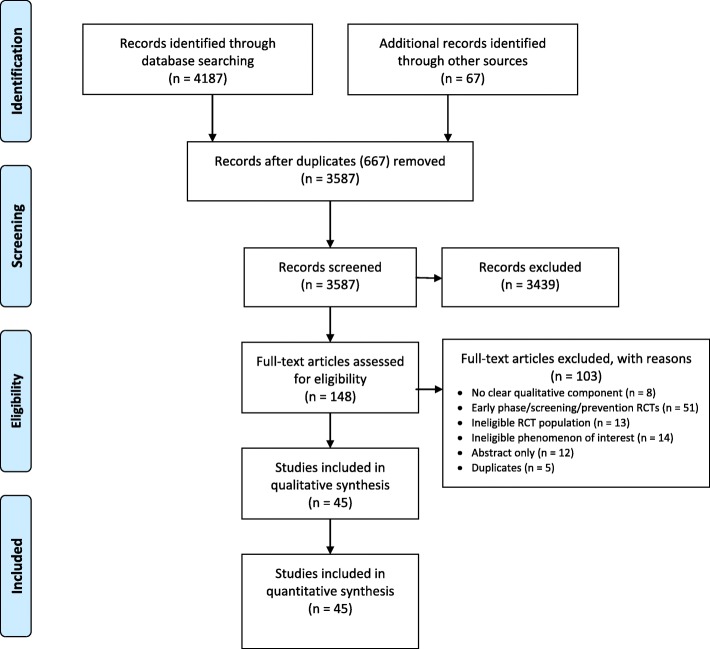
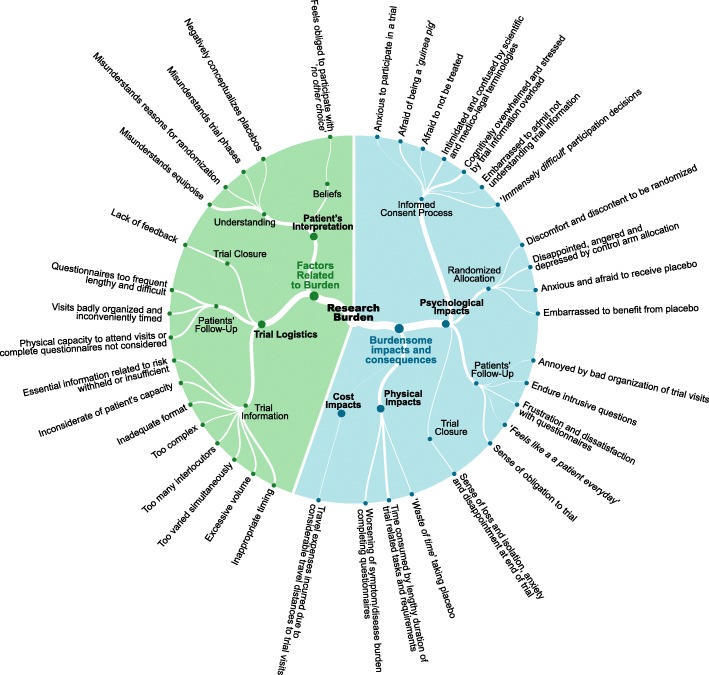
BACKGROUND: Participation in randomized controlled trials (RCTs) may be quite demanding and could represent an important burden for patients. We aimed to explore this research burden (i.e., the psychological, physical, and financial burdens) experienced by patients through their participation in a RCT. METHODS: We conducted a systematic review of qualitative studies exploring adult patients' experiences with RCT participation. We searched MEDLINE (PubMed), CINAHL, PSYCHINFO, and Embase (search date March 2018) for eligible reports. Qualitative data coding and indexing were assisted by NVivo. The quality of reports was assessed by using the Critical Appraisal Skills Program (CASP) tool. RESULTS: We included 45 qualitative studies that involved 1732 RCT participants. Important psychological burdens were identified at every stage of the trial process. Participants reported feeling anxiety and being afraid of "being a 'guinea pig'" and described undergoing randomization and allocation to a placebo as particularly difficult resulting in disappointment, anger, and depression. Patients' follow-up and trial closure were also responsible for a wide range of psychological, physical, and financial burdens. Furthermore, factors related to burdensome impacts and consequences were discerned. These factors involved trial information, poorly organized and too-demanding follow-up, and lack of appropriate management when the patient's participation ended. Trial participation was also associated with beneficial effects such as the satisfaction of feeling "useful," gaining "a sense of control," and receiving special attention. CONCLUSIONS: Our finding provides a detailed description of research burden across the whole RCT process. Many of the burdens described could be anticipated, and some avoided in a movement toward minimally disruptive clinical research. Such an approach could improve trial recruitment and retention. REVIEW REGISTRATION: PROSPERO CRD42018098994.
Overview
The claims and statistics of this paper haven’t been checked yet.
Run the check — free, no account needed. It reads the open-access text and checks the sources it cites.
Integrity signals
Registry
Cites
Statistics
Figures
Verification
Claims the paper makes
The claims and statistics of this paper haven’t been checked yet.
Run the check — free, no account needed. It reads the open-access text and checks the sources it cites.
Claims other papers make about this one
Each is checked against this paper’s own text: does it say what the citing paper says it does?
The source backs part of the claim, not all of it — or backs it for a different population, condition or comparison.
In the citing paper
“The feasibility of participant recruitment and retention in RCTs can differ from that in one-group pretest-posttest design studies due to additional psychological burdens in participants that arise from the RCT process, such as a lack of control and anxiety that result from random allocation and disappointment when allocated to a less favorable control group condition”
From The feasibility and preliminary effects of a pilot randomized controlled trial: Videoconferencing acceptance and commitment therapy in distressed family caregivers of people with dementia. (2023) · cites this paper as Naidoo et al., 2020
Experimental — accuracy not yet measured
Self-check
Percentages, sums and reported differences re-computed from the paper’s own numbers.
The self-check needs the paper’s full text.
Citations
Cites
Preferred Reporting Items for Systematic Reviews and Meta-Analyses: the PRISMA statement
Moher, D., Liberati, A., Tetzlaff, J., Altman, D. G., & for the PRISMA Group (2009) · BMJ · doi:10.1136/bmj.b2535 · Cited by 83,823
Preferred Reporting Items for Systematic Reviews and Meta-Analyses: The PRISMA Statement
Moher, D., Liberati, A., Tetzlaff, J., Altman, D. G., & The PRISMA Group (2009) · PLoS Medicine · doi:10.1371/journal.pmed.1000097 · Cited by 64,042 · cited 1×
“To ensure transparency, we adhered to the reporting guidelines set out by PRISMA [10] and ENTREQ (Additional file 1) [11].”
Preferred reporting items for systematic reviews and meta-analyses: the PRISMA Statement.
(2009) · PubMed Central · Cited by 44,859
Methods for the thematic synthesis of qualitative research in systematic reviews
Thomas, J., & Harden, A. (2008) · BMC Medical Research Methodology · doi:10.1186/1471-2288-8-45 · Cited by 9,312
Enhancing transparency in reporting the synthesis of qualitative research: ENTREQ
Tong, A., Flemming, K., McInnes, E., Oliver, S., & Craig, J. (2012) · BMC Medical Research Methodology · doi:10.1186/1471-2288-12-181 · Cited by 3,569
Qualitative Research: Rigour and qualitative research
Mays, N., & Pope, C. (1995) · BMJ · doi:10.1136/bmj.311.6997.109 · Cited by 2,715
Methley, A. M., Campbell, S., Chew-Graham, C., McNally, R., & Cheraghi-Sohi, S. (2014) · BMC Health Services Research · doi:10.1186/s12913-014-0579-0 · Cited by 2,706
External validity of randomised controlled trials: “To whom do the results of this trial apply?”
Rothwell, P. M. (2005) · The Lancet · doi:10.1016/s0140-6736(04)17670-8 · Cited by 2,544
Chlebowski, R. T., Hendrix, S. L., Langer, R. D., Stefanick, M. L., Gass, M. L. S., Lane, D. S., Rodabough, R. J., Gilligan, M. A., Cyr, M. G., Thomson, C. A., et al. (2003) · JAMA · doi:10.1001/jama.289.24.3243 · Cited by 1,871
Patient engagement in research: a systematic review
Domecq, J. P., Prutsky, G., Elraiyah, T., Wang, Z., Nabhan, M., Shippee, N., Brito, J. P., Boehmer, K., Hasan, R., Firwana, B., et al. (2014) · BMC Health Services Research · doi:10.1186/1472-6963-14-89 · Cited by 1,773
Research works printed but not linked: 2
- Booth A: Chapter 3: searching for studies. In: Supplementary guidance for inclusion of qualitative research in Cochrane systematic reviews of interventions. Edited by Noyes J BA, Hannes K, Harden A, Harris J, Lewin S, Lockwood C, vol. version 1 (updated August 2011): Cochrane Collaboration Qualitative Methods Group, 2011; 2011.
- Lingler JH, Schmidt KL, Gentry AL, Hu L, Terhorst LA. A new measure of research participant burden: brief report. J Empir Res Hum Res Ethics. 2014;9(4):46–9. · DOI
Cited by
Sorted by citations
Qualitative Evidence Synthesis: Where Are We at?
Flemming, K., & Noyes, J. (2021) · International Journal of Qualitative Methods · doi:10.1177/1609406921993276 · Cited by 369
“Exploring patient expectations and experiences of remote monitoring for chronic diseases (Walker et al., 2019) Examining the research burden of randomized controlled trial participation (Naidoo et al., 2020).”
BackgroundTremblay, S. M., Castiglione, S. A., Audet, L., Desmarais, M., Horace, M., & Peláez, S. (2021) · International Journal of Qualitative Methods · doi:10.1177/16094069211009679 · Cited by 221
“The exploration of research burden in quantitative research was undertaken in a recent systematic review of qualitative studies in participants of randomized controlled trials (Naidoo et al., 2020).”
MethodEvidence from ClinicalTrials.gov on the growth of Digital Health Technologies in neurology trials
Masanneck, L., Gieseler, P., Gordon, W. J., Meuth, S. G., & Stern, A. D. (2023) · npj Digital Medicine · doi:10.1038/s41746-023-00767-1 · Cited by 94
Under-Enrollment of Women in Stroke Clinical Trials
Carcel, C., & Reeves, M. J. (2021) · Stroke · doi:10.1161/strokeaha.120.033227 · Cited by 83
Parental Views of Facilitators and Barriers to Research Participation: Systematic Review
Nathe, J. M., Oskoui, T., & Weiss, E. M. (2022) · PEDIATRICS · doi:10.1542/peds.2022-058067 · Cited by 75
Metadata
- Authors
- Naidoo, N., Nguyen, V. T., Ravaud, P., Young, B., Amiel, P., Schanté, D., Clarke, M., & Boutron, I.
- Affiliations
- Inserm (FR)
- University of Liverpool (GB)
- Institut National du Cancer (FR)
- Queen's University Belfast (GB)
- Corresponding author
- Boutron, Isabelle
- ORCID
- Venue
- BMC Medicine
- Published
- 2020-01-20
- Volume
- 18
- Issue
- 1
- Pages
- 6-6
- ISSN
- 1741-7015 (ISSN-L)
- PMC
- PMC6970283
- OpenAlex
- W2999900278
- Cited by
- 144
- References
- 53
- Citations by year
- 2026: 27 · 2025: 22 · 2024: 19 · 2023: 18 · 2022: 22 · 2021: 30 · 2020: 6
- FWCI
- 3.18
- Type
- journal article
- Language
- en
- Open access
- gold
- doi.org
- Locations
- BMC Medicine (publishedVersion, cc-by)
- PubMed Central (publishedVersion, cc-by)
- PubMed (publishedVersion)
- HAL (submittedVersion, cc-by)
- DOAJ (DOAJ: Directory of Open Access Journals) (submittedVersion)
- Columbia Academic Commons (Columbia University)
- Funders
- Institut National Du Cancer
- Topics
- Health Sciences › Medicine › Public Health, Environmental and Occupational Health › Ethics in Clinical Research
- Health Sciences › Health Professions › General Health Professions › Health Policy Implementation Science
- Health Sciences › Health Professions › General Health Professions › Mental Health and Patient Involvement
- Keywords
- research burden, randomized controlled trials, patient experience, psychological burden, physical burden, financial burden, trial follow-up, trial closure, randomization, trial recruitment, trial retention
- MeSH terms
- Humans, Volunteers, Randomized Controlled Trials as Topic, Cost of Illness, Qualitative Research
About these checks
Registry, retraction, Cites and statistics results are computed, not judged, with one exception: a printed reference that no index lists is read once by a model before it counts as a citation error. Claims are extracted by a model and kept only when their quote appears verbatim in the text; each cited source is then checked, with a model’s help, for whether it says what the claim relies on. Those verdicts can be wrong — read the claim’s quote and the cited source before relying on one.
Statistics and arithmetic are recomputed, not judged.
Confidence bands are shown only for fields calibrated on our annotated test set. None is calibrated yet, so no band is shown.
What counts as a claim ›How we measure confidence ›How we check this ›
Are you an author, or do you see a problem with this page? Request a review
