

Association between patterns of alcohol consumption (beverage type, frequency and consumption with food) and risk of adverse health outcomes: a prospective cohort study
Open accessThe DOI matches its Crossref record; 37 of the 39 references it cites were found in a registry or an index.
Abstract
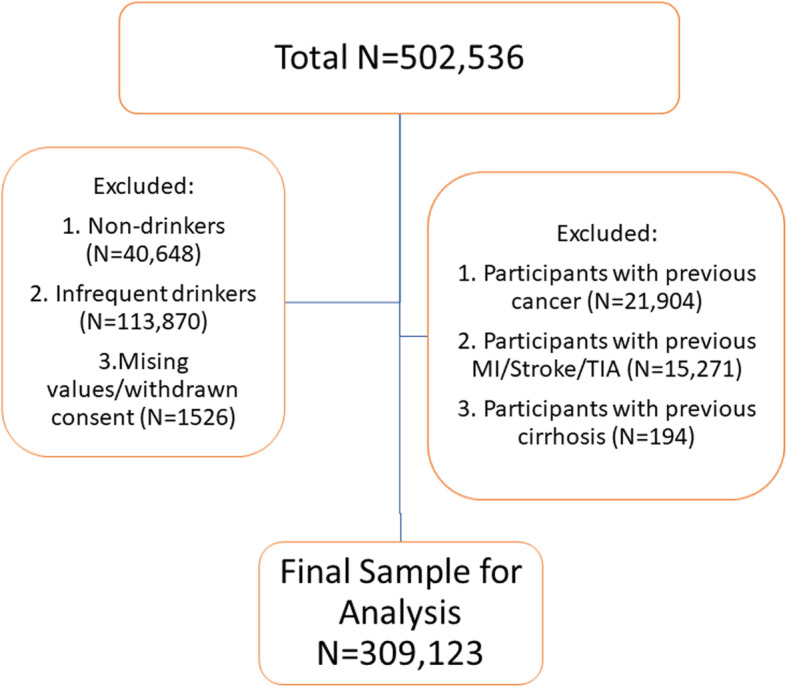
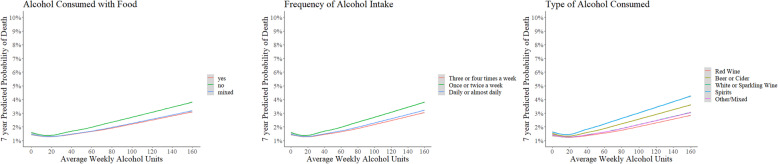
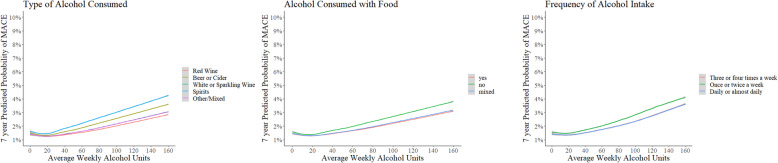
Background: Alcohol consumption is a leading contributor to death and disability worldwide, but previous research has not examined the effects of different patterns of alcohol consumption. The study objective was to understand the relationship between different alcohol consumption patterns and adverse health outcomes risk, adjusting for average amount consumed among regular drinkers. Methods: This was a prospective cohort study of UK Biobank (UKB) participants . Abstainers, infrequent alcohol consumers or those with previous cancer, myocardial infarction (MI), stroke or liver cirrhosis were excluded. We used beverage type, consumption with food and consumption frequency as exposures and adjusted for potential confounding. All-cause mortality, major cardiovascular events-MACE (MI/stroke/cardiovascular death), accidents/injuries, liver cirrhosis, all-cause and alcohol-related cancer incidence over 9-year median follow-up period were outcomes of interest. Results: The final sample size for analysis was N = 309,123 (61.5% of UKB sample). Spirit drinking was associated with higher adjusted mortality (hazard ratio (HR) 1.25; 95% confidence intervals (CI) 1.14–1.38), MACE (HR 1.31; 95% CI 1.15–1.50), cirrhosis (HR 1.48; 95% CI 1.08–2.03) and accident/injuries (HR 1.10; 95% CI 1.03–1.19) risk compared to red wine drinking, after adjusting for the average weekly alcohol consumption amounts. Beer/cider drinkers were also at a higher risk of mortality (HR 1.18; 95% CI 1.10–1.27), MACE (HR 1.16; 95% CI 1.05–1.27), cirrhosis (HR 1.36; 95% CI 1.06–1.74) and accidents/injuries (HR 1.11; 95% CI 1.06–1.17). Alcohol consumption without food was associated with higher adjusted mortality (HR 1.10; 95% CI 1.02–1.17) risk, compared to consumption with food. Alcohol consumption over 1–2 times/week had higher adjusted mortality (HR 1.09; 95% CI 1.03–1.16) and MACE (HR 1.14; 95% CI 1.06–1.23) risk, compared to 3–4 times/week, adjusting for the amount of alcohol consumed. Conclusion: Red wine drinking, consumption with food and spreading alcohol intake over 3–4 days were associated with lower risk of mortality and vascular events among regular alcohol drinkers, after adjusting for the effects of average amount consumed. Selection bias and residual confounding are important possible limitations. These findings, if replicated and validated, have the potential to influence policy and practice advice on less harmful patterns of alcohol consumption.
Overview
The claims and statistics of this paper haven’t been checked yet.
Free: it reads the open-access text and checks the first 5 claims that cite a source we can check. Create a free account to check every claim.
Integrity signals
Registry
Cites
Statistics
Figures
Verification
Claims the paper makes
The claims and statistics of this paper haven’t been checked yet.
Free: it reads the open-access text and checks the first 5 claims that cite a source we can check. Create a free account to check every claim.
Claims other papers make about this one
Each is checked against this paper’s own text: does it say what the citing paper says it does?
The check wasn’t confident either way, so it gives no verdict — never disputed.
In the citing paper
“Although most studies define HED for women as either 40 g or 60 g of absolute alcohol on a single occasion [7, 30], we chose the higher threshold (60 g of absolute alcohol amounts to ≥ five standard drinks) as this is more commonly used in South Africa [6].”
From Associations Between Patterns of Alcohol Use and Viral Load Suppression Amongst Women Living with HIV in South Africa (2021) · cites this paper as [30]
Experimental — accuracy not yet measured
Self-check
Percentages, sums and reported differences re-computed from the paper’s own numbers.
The self-check needs the paper’s full text.
Citations
Cites
Wickham, H. (2016) · Use R! · doi:10.1007/978-3-319-24277-4 · Cited by 33,115
Whelton, P. K., Carey, R. M., Aronow, W. S., Casey, D. E., Collins, K. J., Dennison Himmelfarb, C., DePalma, S. M., Gidding, S., Jamerson, K. A., Jones, D. W., et al. (2018) · Journal of the American College of Cardiology · doi:10.1016/j.jacc.2017.11.006 · Cited by 6,616
mediation:R Package for Causal Mediation Analysis
Tingley, D., Yamamoto, T., Hirose, K., Keele, L., & Imai, K. (2014) · Journal of Statistical Software · doi:10.18637/jss.v059.i05 · Cited by 4,155 · cited 1×
“This analysis was performed using the “mediation package” [31].”
MethodGriswold, M. G., Fullman, N., Hawley, C., Arian, N., Zimsen, S. R. M., Tymeson, H. D., Venkateswaran, V., Tapp, A. D., Forouzanfar, M. H., Salama, J. S., et al. (2018) · The Lancet · doi:10.1016/s0140-6736(18)31310-2 · Cited by 3,524 · cited 1×
“Background Alcohol consumption is one of the leading risk factors for death and disability-adjusted life years (DALY) globally, based on findings from the recent Global Burden of Disease Study that included data from 195 countries [1].”
BackgroundStringhini, S., Carmeli, C., Jokela, M., Avendaño, M., Muennig, P., Guida, F., Ricceri, F., d'Errico, A., Barros, H., Bochud, M., et al. (2017) · The Lancet · doi:10.1016/s0140-6736(16)32380-7 · Cited by 1,319 · cited 1×
“The models in our study were adjusted for the effect of major determinants of health and well-being to minimise the risk of residual confounding [39]; however, it still remains a possibility.”
MethodTownsend, P. (1987) · Journal of Social Policy · doi:10.1017/s0047279400020341 · Cited by 1,294
The relationship between different dimensions of alcohol use and the burden of disease—an update
Rehm, J., Gmel, G. E., Gmel, G., Hasan, O. S. M., Imtiaz, S., Popova, S., Probst, C., Roerecke, M., Room, R., Samokhvalov, A. V., et al. (2017) · Addiction · doi:10.1111/add.13757 · Cited by 1,204 · cited 1×
“A review of 255 systematic reviews and meta-analyses has suggested the need for further research into the health risks associated with different patterns of alcohol consumption (beyond average amount), such as frequency of consumption, consumption of alcohol with or without food and type of alcoholic beverage [2].”
BackgroundWood, A. M., Kaptoge, S., Butterworth, A. S., Willeit, P., Warnakula, S., Bolton, T., Paige, E., Paul, D. S., Sweeting, M., Burgess, S., et al. (2018) · The Lancet · doi:10.1016/s0140-6736(18)30134-x · Cited by 1,188 · cited 1×
“Previous research has suggested that wine drinking (compared to beer or spirit drinking) is associated with lower risk of all-cause mortality [3, 8, 9] and cardiovascular events [3, 8, 10].”
BackgroundKaptoge, S., Pennells, L., De Bacquer, D., Cooney, M. T., Kavousi, M., Stevens, G., Riley, L. M., Savin, S., Khan, T., Altay, S., et al. (2019) · The Lancet Global Health · doi:10.1016/s2214-109x(19)30318-3 · Cited by 1,167
Time-to-Event Analysis of Longitudinal Follow-up of a Survey: Choice of the Time-scale
Korn, E. L., Graubard, B. I., & Midthune, D. (1997) · American Journal of Epidemiology · doi:10.1093/oxfordjournals.aje.a009034 · Cited by 1,007 · cited 1×
“In each of these models, age was used as the underlying time variable [25].”
Method
Research works printed but not linked: 5
- UK Department of Health UK Chief Medical Officers’ Low Risk Drinking Guidelines 2016
- WHO WHO BMI Classification 2004
- National Clinical Guideline Centre (UK). Lipid Modification: Cardiovascular Risk Assessment and the Modification of Blood Lipids for the Primary andSecondary Prevention of Cardiovascular Disease. London: National Institute for Health and Care Excellence (UK); 2014. PMID: 25340243. 25340243
- WHO. International Statistical Classification of Diseases and Related Health Problems (International Classification of Diseases)(ICD) 10th Revision - Version: 2010. Vol. 1, Occupational Health. 2010. p. 1–201.
- Therneau T Package: “survival” 2015
Cited by
Items 101–132 of 132
Aidemise, O. C., Eghoi, A. M., & Moruma, G. (2025) · JOURNAL of SIBERIAN MEDICAL SCIENCES · doi:10.31549/2542-1174-2025-9-1-41-51
Chen, Z., Zhu, X., Guo, J., & Ma, G. (2025) · International Journal of Endocrinology · doi:10.1155/ije/4478977
“Individuals with high SES were also more likely to be moderate drinkers, typically preferring wine, which served to reduce the risk of alcohol-related illness [36].”
Akagi, Y., Kabayama, M., Gondo, Y., Masui, Y., Yasumoto, S., Klinpudtan, N., Srithumsuk, W., Godai, K., Ikebe, K., Akasaka, H., et al. (2022) · Figshare · doi:10.6084/m9.figshare.19246492
Akagi, Y., Kabayama, M., Gondo, Y., Masui, Y., Yasumoto, S., Klinpudtan, N., Srithumsuk, W., Godai, K., Ikebe, K., Akasaka, H., et al. (2022) · Figshare · doi:10.6084/m9.figshare.19246510
Additional file 1 of Social connection and mortality in UK Biobank: a prospective cohort analysis
Foster, H. M. E., Gill, J. M. R., Mair, F. S., Celis-Morales, C. A., Jani, B. D., Nicholl, B. I., Lee, D., & O’Donnell, C. A. (2023) · Figshare · doi:10.6084/m9.figshare.24540719
Self-citationAkagi, Y., Kabayama, M., Gondo, Y., Masui, Y., Yasumoto, S., Klinpudtan, N., Srithumsuk, W., Godai, K., Ikebe, K., Akasaka, H., et al. (2022) · Figshare · doi:10.6084/m9.figshare.19246516
Additional file 2 of Social connection and mortality in UK Biobank: a prospective cohort analysis
Foster, H. M. E., Gill, J. M. R., Mair, F. S., Celis-Morales, C. A., Jani, B. D., Nicholl, B. I., Lee, D., & O’Donnell, C. A. (2024) · Figshare · doi:10.6084/m9.figshare.24540860
Self-citationAkagi, Y., Kabayama, M., Gondo, Y., Masui, Y., Yasumoto, S., Klinpudtan, N., Srithumsuk, W., Godai, K., Ikebe, K., Akasaka, H., et al. (2022) · Figshare · doi:10.6084/m9.figshare.19246498
Akagi, Y., Kabayama, M., Gondo, Y., Masui, Y., Yasumoto, S., Klinpudtan, N., Srithumsuk, W., Godai, K., Ikebe, K., Akasaka, H., et al. (2022) · Figshare · doi:10.6084/m9.figshare.19246504
Combe, K., Smith, L., & Graham, M. (2025) · Repository@Hull (Worktribe) (University of Hull) · doi:10.17605/osf.io/bgu3h
Strategies for Reducing the Risk of Diabetes and Cancer
Kamaladevi, A., Das, M., Kiruthiga, C., & Kulanthaivel, L. (2026) · Springer eBooks · doi:10.1007/978-981-95-5651-9_5
Association between alcohol consumption and aspects related to sleep
Sirtoli, R. (2024) · LA Referencia (Red Federada de Repositorios Institucionales de Publicaciones Científicas)
Martin, T., Llamosas‐Falcón, L., Zhu, Y., Rehm, J. T., Probst, C., & Kilian, C. (2026) · Nutrition Metabolism and Cardiovascular Diseases · doi:10.1016/j.numecd.2026.104580
Lee, S. H., Kang, T. H., Yoo, S., & Kim, K. (2026) · Biomedicines · doi:10.3390/biomedicines14030535
“Then, a sensitivity analysis was performed to further explore the impact of age on sevoflurane requirements, in which mean age was considered a continuous, centered variable rather than a binary moderator [17].”
Li, D.-R., Li, K.-R., Wang, Y., Zheng, J.-Q., Zheng, W.-R., Liu, B.-Q., Liu, J.-C., Bao, R.-H., Gong, T.-T., Sheng, Q., et al. (2026) · Nutrition Journal · doi:10.1186/s12937-026-01297-8
“…accurately reflected habitual intake; (5) excluding individuals with very high alcohol consumption (> 40 g/d for female; >57 g/d for male) [36]; (6) calculated the E-value to assess the impact of residual confounding factors [37]; (7) given that death would preclude observation of MASLD,…”
Mäkelä, P., & Warpenius, K. (2026) · Drugs Education Prevention and Policy · doi:10.1080/09687637.2026.2642021
Fermented Beverages, Ethanol and Health: A Critical Appraisal of Meta-Analytical Studies
Malfeito-Ferreira, J., & Malfeito‐Ferreira, M. (2026) · Fermentation · doi:10.3390/fermentation12030159
Sarich, P., Canfell, K., Egger, S. J., Banks, E., Joshy, G., Wellard‐Cole, L., Hughes, C., Houssami, N., Grogan, P., & Weber, M. F. (2026) · British Journal of Cancer · doi:10.1038/s41416-026-03403-3
Modelling Alcohol Mortality via Machine Learning and Retail Behavioural Data
Derecki, R., Dolan, E. H., O'Shea, B., Harvey, J., & Goulding, J. (2026) · Communications in computer and information science · doi:10.1007/978-3-032-19096-3_10
Beyond ethanol: wine, biological aging, and the Mediterranean context
Medoro, A., Scapagnini, G., & Davinelli, S. (2026) · International Journal of Public Health · doi:10.3389/ijph.2026.1609910
Lee, I., Hong, S., Jang, E., Lee, J., & Lee, J. (2026) · PLoS ONE · doi:10.1371/journal.pone.0350740
“Chronic alcohol use can impair thermoregulation and increase susceptibility to dehydration and heat stroke in hot, enclosed environments [39].”
Wine and mortality – An overview
Surma, S., Jakubiak, G. K., & Gajos, G. (2026) · Elsevier eBooks · doi:10.1016/b978-0-443-29192-0.00066-2
Yimgoua, E. S., Nkondo, E. T., Femoe, U. M., Fassi-Kadji, J. B., Kenfack, M. C., Feussom, N. G., Vázquez, S., Tchuenté, L.-A. T., Sotillo, J., & Jatsa, H. B. (2026) · BMC Infectious Diseases · doi:10.1186/s12879-026-13894-3
“…beyond overall biological alterations, and particularly in chronic conditions such as liver fibrosis, the frequency and regularity of alcohol consumption, as well as the type of alcoholic beverages consumed, are independent determinants of risk, regardless of the total volume ingested [14, 15].”
Cabrera, C. I. B., Wagatsuma, Y., & Sayeed, U. B. (2026) · Cureus · doi:10.7759/cureus.111868
“Some studies have reported lower odds of type 2 diabetes with moderate consumption of alcoholic beverages, particularly when low-grade alcoholic drinks are taken with food [36,37], while high alcohol consumption has been associated with less favorable findings in others [38].”
Tverdal, A., Selmer, R. M., & Thelle, D. S. (2026) · Scandinavian Journal of Public Health · doi:10.1177/14034948261459749
Li, Z., Tan, B., Desjardins, C., Wang, L. C., Khandpur, N., Feng, Y., Oh, H. Y., Li, Q., Qian, F., Zong, G., et al. (2026) · Nutrition Journal · doi:10.1186/s12937-026-01361-3
“Also, a few observational studies reported positive [15] or null associations [35] between spirits consumption with all-cause mortality.”
Bramness, J. G., Mørland, J. G., Lid, T. G., Høye, A., & Høiseth, G. (2026) · Alcohol · doi:10.1016/j.alcohol.2026.07.003
Belo, L., Colivet, J., & Pereira, J. (2026) · Ciência e Natura · doi:10.5902/2179460x87726
“Given this, it is necessary to understand that there must be a national quality In a study carried out by Jani et al (2021) in the United Kingdom on the risks of consuming various alcoholic beverages, the results showed that the consumption of brandies was associated with a 25% higher risk of…”
Okushin, K., Tabuchi, T., Yoshioka, T., Tanaka, T., Kaneko, T., Mabuchi, K., Matsushita, Y., Yamada, T., Nakatsuka, T., Minami, T., et al. (2026) · Addictive Behaviors Reports · doi:10.1016/j.abrep.2026.100735
“Wine consumption was associated with a lower likelihood of alcohol-related self-injury, consistent with a limited number of prior studies suggesting that wine drinkers experience a lower injury risk than drinkers of other beverage types (Jani et al., 2021).”
Bidirectional Association Between Diabetes and Osteoarthritis: A Population‐Based Cohort Study
Wang, J., Fang, H., Wang, J., Cheng, X., Yin, J., Zhang, X., Xing, X., & Cai, G. (2026) · Diabetes Obesity and Metabolism · doi:10.1111/dom.71286
Social isolation and loneliness and mortality among cancer survivors: a prospective cohort study
Ran, R., Tang, M., Liu, R., Yang, J., & Liu, Y. (2026) · Frontiers in Oncology · doi:10.3389/fonc.2026.1908858
Does Alcohol Type Matter? Investigating the Effects of Beer, Wine, and Liquor on Liver Health
Akili, I. S., Orlowski, M., Grenon, J., Sherman, A., Young, C. S., Barbour, W., Pacher, C., & Skinner, R. C. (2026) · Nutrients · doi:10.3390/nu18223749
Metadata
- Authors
- Jani, B. D., McQueenie, R., Nicholl, B. I., Field, R., Hanlon, P., Gallacher, K. I., Mair, F. S., & Lewsey, J.
- Affiliations
- University of Glasgow (GB)
- Corresponding author
- Jani, Bhautesh Dinesh
- ORCID
- Venue
- BMC Medicine
- Published
- 2021-01-12
- Volume
- 19
- Issue
- 1
- Pages
- 8-8
- ISSN
- 1741-7015 (ISSN-L)
- PMC
- PMC7802201
- OpenAlex
- W3112509457
- Cited by
- 124
- References
- 39
- Citations by year
- 2026: 25 · 2025: 22 · 2024: 22 · 2023: 21 · 2022: 24 · 2021: 10
- FWCI
- 12.83
- Type
- journal article
- Language
- en
- Open access
- gold
- doi.org
- Licence
- cc-by
- creativecommons.org/licenses/by/4.0/ (tdm)
- creativecommons.org/licenses/by/4.0/ (vor)
- Locations
- BMC Medicine (publishedVersion, cc-by)
- Europe PMC (PubMed Central) (publishedVersion, other-oa)
- PubMed Central (publishedVersion, cc-by)
- PubMed (publishedVersion)
- ENLIGHTEN (Jurnal Bimbingan dan Konseling Islam) (acceptedVersion, cc-by-sa)
- HRB National Drugs Library (Health Research Board) (submittedVersion)
- DOAJ (DOAJ: Directory of Open Access Journals) (submittedVersion, cc-by-sa)
- Funders
- Chief Scientist Office, Scottish Government Health and Social Care Directorate
- Topics
- Health Sciences › Medicine › Pathology and Forensic Medicine › Alcohol Consumption and Health Effects
- Health Sciences › Medicine › Epidemiology › Substance Abuse Treatment and Outcomes
- Health Sciences › Medicine › Public Health, Environmental and Occupational Health › Nutritional Studies and Diet
- Keywords
- alcohol consumption patterns, red wine, drinking frequency, all-cause mortality, major adverse cardiovascular events, liver cirrhosis, alcohol-related cancer, accidents and injuries, alcohol-related harm, UK Biobank, prospective cohort
- MeSH terms
- Adult, Aged, Alcohol Drinking, Eating, Humans, Male, Middle Aged, Myocardial Infarction, Neoplasms, Prospective Studies, Risk Factors, Wine, Cohort Studies, Incidence, Proportional Hazards Models, Stroke
About these checks
Registry, retraction, Cites and statistics results are computed, not judged, with one exception: a printed reference that no index lists is read once by a model before it counts as a citation error. Claims are extracted by a model and kept only when their quote appears verbatim in the text; each cited source is then checked, with a model’s help, for whether it says what the claim relies on. Those verdicts can be wrong — read the claim’s quote and the cited source before relying on one.
Statistics and arithmetic are recomputed, not judged.
Confidence bands are shown only for fields calibrated on our annotated test set. None is calibrated yet, so no band is shown.
What counts as a claim ›How we measure confidence ›How we check this ›
Are you an author, or do you see a problem with this page? Request a review
Data sources
Bibliographic data: Semantic Scholar, OpenAlex, Crossref.
Contains information from the Semantic Scholar Academic Graph Datasets, made available under the ODC Attribution License (ODC-BY 1.0).
Semantic Scholar’s data is described in: Kinney, R., et al. (2023). The Semantic Scholar Open Data Platform. arXiv:2301.10140.
