

Biological aging mediates the associations between urinary metals and osteoarthritis among U.S. adults
Open accessThe DOI matches its Crossref record; 48 of the 49 references it cites were found in a registry or an index.
Abstract
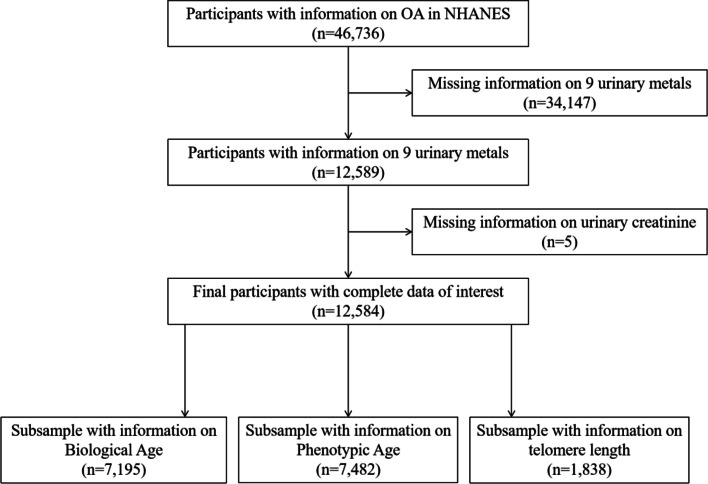
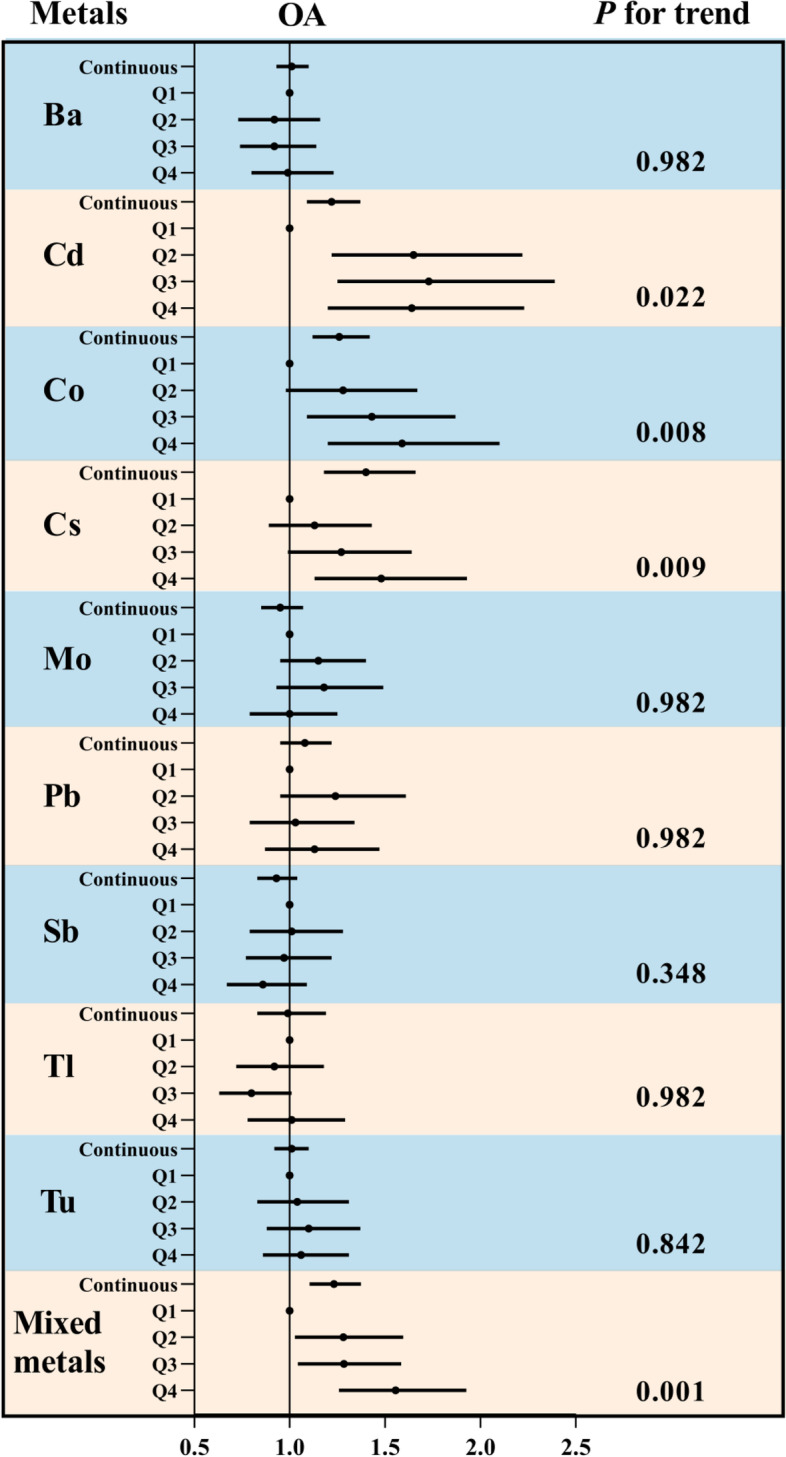
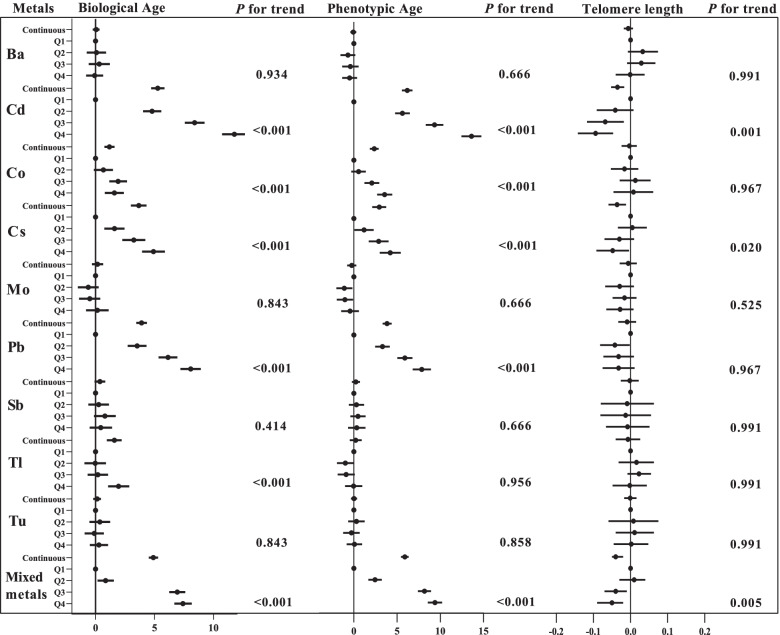
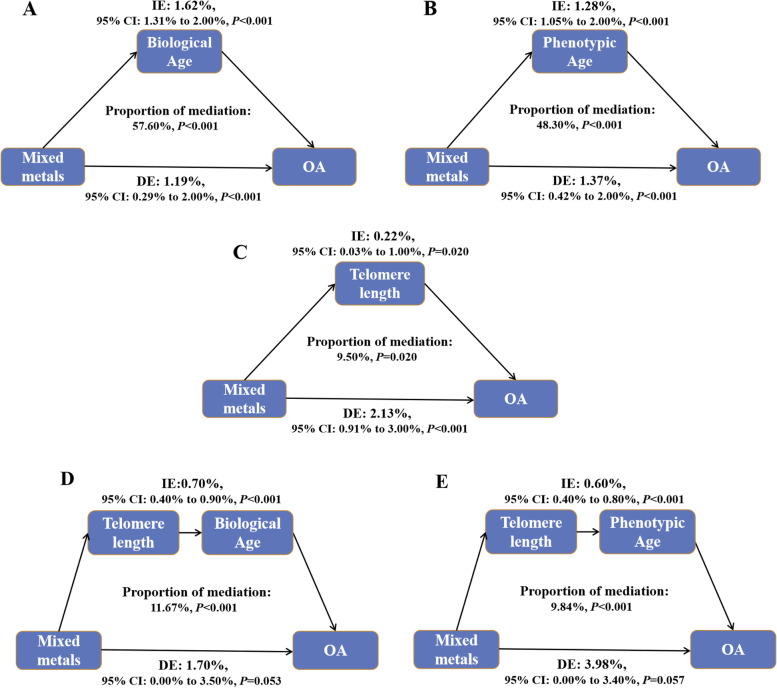
Background: Osteoarthritis (OA) is a worldwide public health concern, mainly afflicting older adults. Although the etiology of OA remains unclear, environmental factors are increasingly considered as non-negligible risk factors. This study aims to evaluate the associations of urinary metals with OA risk and the mediated effect of biological aging. Methods: Nine urinary metal concentrations were detected among 12,584 U.S. adults based on the National Health and Nutrition Examination Survey (NHANES), including barium (Ba), cadmium (Cd), cobalt (Co), cesium (Cs), molybdenum (Mo), lead (Pb), antimony (Sb), thallium (Tl), and uranium (Tu). Multivariable logistic regression and weighted quantile sum (WQS) regression were used to explore the associations of single metal and mixed metals with OA risk, respectively. Furthermore, biological aging was measured from different perspectives, including cell senescence (telomere length) and whole-body aging (phenotypic age and biological age). Mediation analyses were conducted to investigate the mediated effects of aging on the associations of metals with OA risk. Results: In the single-exposure model, Cd, Co, and Cs were identified to be positively associated with OA risk, with odds ratios (OR) ranging from 1.48 to 1.64 (all P < 0.05). Mixed-exposure analyses showed consistent associations (OR 1.23, 95%CI 1.10 to 1.37) and highlighted that Cd, Co, and Cs were responsible for the outcomes. Additionally, Cd, Co, Cs, Pb, and Tl were positively associated with biological aging markers, while all biological aging markers had significant associations with OA risk. Further mediation analyses showed that the associations of single metal (mainly Cd and Cs) and mixed metals with OA risk parallelly mediated by the above biological aging markers, with the proportion of mediation ranging from 16.89 to 69.39% (all P < 0.05). Moreover, such associations were also serially mediated through telomere length-biological age path and telomere length-phenotypic age path (the proportion of mediation: 4.17–11.67%), indicating that metals accelerated cell senescence to lead to whole-body aging and finally aggravated OA progress. Conclusions: These findings suggested that exposure to metals increased OA risk, which was possibly and partly mediated by biological aging.
Overview
The claims and statistics of this paper haven’t been checked yet.
Free: it reads the open-access text and checks the first 5 claims that cite a source we can check. Create a free account to check every claim.
Integrity signals
Registry
Cites
Statistics
Figures
Verification
Claims the paper makes
The claims and statistics of this paper haven’t been checked yet.
Free: it reads the open-access text and checks the first 5 claims that cite a source we can check. Create a free account to check every claim.
Self-check
Percentages, sums and reported differences re-computed from the paper’s own numbers.
The self-check needs the paper’s full text.
Citations
Cites
Hunter, D. J., & Bierma-Zeinstra, S. (2019) · The Lancet · doi:10.1016/s0140-6736(19)30417-9 · Cited by 4,795
An epigenetic biomarker of aging for lifespan and healthspan
Levine, M. E., Lu, A. T., Quach, A., Chen, B. H., Assimes, T. L., Bandinelli, S., Hou, L., Baccarelli, A. A., Stewart, J. D., Li, Y., et al. (2018) · Aging · doi:10.18632/aging.101414 · Cited by 3,675 · cited 1×
“12m � Phenotypic age was calculated by using 9 agingrelated variables [25], including chronological age, albumin, creatinine, glucose, CRP, lymphocyte percent, mean cell volume, red blood cell distribution width, alkaline phosphatase, and white blood cell count.”
MethodCellular senescence: from physiology to pathology
Muñoz-Espín, D., & Serrano, M. (2014) · Nature Reviews Molecular Cell Biology · doi:10.1038/nrm3823 · Cited by 2,818 · cited 1×
“Interestingly, whole-body aging is mainly driven by cell senescence [45].”
BackgroundSenolytics improve physical function and increase lifespan in old age
Xu, M., Pirtskhalava, T., Farr, J. N., Weigand, B. M., Palmer, A. K., Weivoda, M. M., Inman, C. L., Ogrodnik, M. B., Hachfeld, C. M., Fraser, D. G., et al. (2018) · Nature Medicine · doi:10.1038/s41591-018-0092-9 · Cited by 2,287 · cited 1×
“For example, transplantation of senescent cells into young mice caused a decline in whole-body function [46].”
BackgroundSafiri, S., Kolahi, A.-A., Smith, E., Hill, C., Bettampadi, D., Mansournia, M. A., Hoy, D., Ashrafi-Asgarabad, A., Sepidarkish, M., Almasi-Hashiani, A., et al. (2020) · Annals of the Rheumatic Diseases · doi:10.1136/annrheumdis-2019-216515 · Cited by 1,651
Prevalence of exposure of heavy metals and their impact on health consequences
Rehman, K., Fatima, F., Waheed, I., & Akash, M. S. H. (2018) · Journal of Cellular Biochemistry · doi:10.1002/jcb.26234 · Cited by 1,576 · cited 1×
“Most toxic metals are widely distributed in industrial products, soil, food, and drinking water and mainly accumulated in the liver, kidney, muscle, and bone [28, 29].”
BackgroundJeon, O. H., Kim, C., Laberge, R.-M., Demaria, M., Rathod, S., Vasserot, A. P., Chung, J. W., Kim, D. H., Poon, Y., David, N., et al. (2017) · Nature Medicine · doi:10.1038/nm.4324 · Cited by 1,515 · cited 2×
“Importantly, elimination of senescent chondrocytes improved joint degeneration in OA mice, indicating biological aging was responsible for OA development [21].”
BackgroundCarrico, C., Gennings, C., Wheeler, D. C., & Factor-Litvak, P. (2015) · Journal of Agricultural, Biological, and Environmental Statistics · doi:10.1007/s13253-014-0180-3 · Cited by 1,347 · cited 1×
“Weighted quantile sum (WQS) regression was applied to explore the overall effects of metals on OA as it performed well in characterizing environmental mixtures [27].”
MethodSenolytics in idiopathic pulmonary fibrosis: Results from a first-in-human, open-label, pilot study
Justice, J. N., Nambiar, A. M., Tchkonia, T., LeBrasseur, N. K., Pascual, R., Hashmi, S. K., Prata, L., Masternak, M. M., Kritchevsky, S. B., Musi, N., et al. (2019) · EBioMedicine · doi:10.1016/j.ebiom.2018.12.052 · Cited by 1,261 · cited 1×
“, senolytics and senomorphics) offered good effects on age-related diseases, such as idiopathic pulmonary fibrosis and diabetic kidney disease [47, 48].”
BackgroundCadmium, Environmental Exposure, and Health Outcomes
Satarug, S., Garrett, S. H., Sens, M. A., & Sens, D. A. (2010) · Environmental Health Perspectives · doi:10.1289/ehp.0901234 · Cited by 1,164 · cited 1×
“Most toxic metals are widely distributed in industrial products, soil, food, and drinking water and mainly accumulated in the liver, kidney, muscle, and bone [28, 29].”
BackgroundToxic Heavy Metal and Metalloid Accumulation in Crop Plants and Foods
Clemens, S., & Ma, J. F. (2016) · Annual Review of Plant Biology · doi:10.1146/annurev-arplant-043015-112301 · Cited by 1,155 · cited 1×
“Heavy metals are ubiquitously present in various environmental media, such as air, soil, drinking water, and food [5, 6].”
BackgroundLevine, M. E. (2013) · The Journals of Gerontology Series A: Biological Sciences and Medical Sciences · doi:10.1093/gerona/gls233 · Cited by 892 · cited 1×
“Biological age was proposed by Klemera and Doubal [23] based on 8 biomarkers (Ln-C-reactive protein (CRP), serum creatinine, glycosylated hemoglobin, serum albumin, serum total cholesterol, serum urea nitrogen, serum alkaline phosphatase, and systolic blood pressure) [24].”
MethodProjections of US prevalence of arthritis and associated activity limitations
Hootman, J. M., & Helmick, C. G. (2006) · Arthritis & Rheumatism · doi:10.1002/art.21562 · Cited by 886 · cited 1×
“people afflicted by OA will rise to 67 million by 2030 [3, 4].”
BackgroundA new approach to the concept and computation of biological age
Klemera, P., & Doubal, S. (2006) · Mechanisms of Ageing and Development · doi:10.1016/j.mad.2005.10.004 · Cited by 787 · cited 2×
“Biological age was proposed by Klemera and Doubal [23] based on 8 biomarkers (Ln-C-reactive protein (CRP), serum creatinine, glycosylated hemoglobin, serum albumin, serum total cholesterol, serum urea nitrogen, serum alkaline phosphatase, and systolic blood pressure) [24].”
MethodMechanisms and therapeutic implications of cellular senescence in osteoarthritis
Coryell, P. R., Diekman, B. O., & Loeser, R. F. (2021) · Nature Reviews Rheumatology · doi:10.1038/s41584-020-00533-7 · Cited by 761 · cited 1×
“Similarly, experimental studies reported that targeting the elimination of senescent chondrocytes or inhibiting SASP improved OArelated outcomes [21, 42].”
BackgroundLiu, Z., Kuo, P.-L., Horvath, S., Crimmins, E., Ferrucci, L., & Levine, M. (2018) · PLOS Medicine · doi:10.1371/journal.pmed.1002718 · Cited by 754 · cited 1×
“Both of which are useful to identify the unhealthy condition of people caused by multiple system disorders [39].”
BackgroundHeavy metal associated health hazards: An interplay of oxidative stress and signal transduction
Paithankar, J. G., Saini, S., Dwivedi, S., Sharma, A., & Chowdhuri, D. K. (2021) · Chemosphere · doi:10.1016/j.chemosphere.2020.128350 · Cited by 589 · cited 2×
“Compelling toxicological evidence showed that heavy metals were linked to two major pathological changes of OA, including joint damage and inflammation [10, 11].”
BackgroundBiotechnological strategies applied to the decontamination of soils polluted with heavy metals
Kavamura, V. N., & Esposito, E. (2010) · Biotechnology Advances · doi:10.1016/j.biotechadv.2009.09.002 · Cited by 371 · cited 1×
“Heavy metals are ubiquitously present in various environmental media, such as air, soil, drinking water, and food [5, 6].”
BackgroundCisternas, M. G., Murphy, L., Sacks, J. J., Solomon, D. H., Pasta, D. J., & Helmick, C. G. (2016) · Arthritis Care & Research · doi:10.1002/acr.22721 · Cited by 315 · cited 1×
“people afflicted by OA will rise to 67 million by 2030 [3, 4].”
BackgroundClinical validation of self-reported osteoarthritis
March, L. M., Schwarz, J. M., Carfrae, B. H., & Bagge, E. (1998) · Osteoarthritis and Cartilage · doi:10.1053/joca.1997.0098 · Cited by 194
Cellular senescence in knee osteoarthritis: molecular mechanisms and therapeutic implications
Xie, J., Wang, Y., Lu, L., Liu, L., Yu, X., & Pei, F. (2021) · Ageing Research Reviews · doi:10.1016/j.arr.2021.101413 · Cited by 191 · cited 2×
“Researchers emphasized that joint tissues are subject to aging and decay over time and the senescence of joint homeostasis-related cells contributed to the development of OA [19].”
BackgroundShay, J. W. (2018) · Current Opinion in Cell Biology · doi:10.1016/j.ceb.2017.12.001 · Cited by 174 · cited 1×
“Additionally, telomere wear is widely used to evaluate cell senescence [40].”
BackgroundToxicity of cadmium in musculoskeletal diseases
Reyes-Hinojosa, D., Lozada-Pérez, C. A., Zamudio Cuevas, Y., López-Reyes, A., Martínez-Nava, G., Fernández-Torres, J., Olivos-Meza, A., Landa-Solis, C., Gutiérrez-Ruiz, M. C., Rojas del Castillo, E., et al. (2019) · Environmental Toxicology and Pharmacology · doi:10.1016/j.etap.2019.103219 · Cited by 170 · cited 2×
“, cadmium (Cd) and lead (Pb)) were cumulative bone-toxicants with the contribution to musculoskeletal disease [9].”
BackgroundMetals and Alzheimer’s Disease: How Far Have We Come in the Clinic?
Adlard, P. A., & Bush, A. I. (2018) · Journal of Alzheimer’s Disease · doi:10.3233/jad-170662 · Cited by 156 · cited 1×
“Mechanistically, our research interest focused on biological aging as a growing number of studies emphasized the role of metals in age-related diseases [34].”
BackgroundLuo, H., Gu, R., Ouyang, H., Wang, L., Shi, S., Ji, Y., Bao, B., Liao, G., & Xu, B. (2021) · Environmental Pollution · doi:10.1016/j.envpol.2021.118043 · Cited by 153 · cited 1×
“Toxicologically, heavy metals can render cell senescence and body premature aging by mitochondrial dysfunction, oxidative stress, and DNA damage [16, 17].”
BackgroundAssociation between serum heavy metals and prostate cancer risk – A multiple metal analysis
Lim, J. T., Tan, Y., Valeri, L., Lee, J., Geok, P. P., Chia, S. E., Ong, C. N., & Seow, W. J. (2019) · Environment International · doi:10.1016/j.envint.2019.105109 · Cited by 143 · cited 1×
“The widespread exposure to toxic metals leads to illnesses, such as diabetes [7] and cancer [8].”
BackgroundThe aging brain: impact of heavy metal neurotoxicity
Ijomone, O. M., Ifenatuoha, C. W., Aluko, O. M., Ijomone, O. K., & Aschner, M. (2020) · Critical Reviews in Toxicology · doi:10.1080/10408444.2020.1838441 · Cited by 131 · cited 2×
“Toxicologically, heavy metals can render cell senescence and body premature aging by mitochondrial dysfunction, oxidative stress, and DNA damage [16, 17].”
BackgroundKondo, H., Searby, N. D., Mojarrab, R., Phillips, J. A., Alwood, J. S., Yumoto, K., Almeida, E. A. C., Limoli, C. L., & Globus, R. K. (2009) · Radiation Research · doi:10.1667/rr1463.1 · Cited by 121 · cited 1×
“In fact, Cs radiation has long been considered an inducer of premature aging in animals and can cause bone loss [43, 44].”
BackgroundIonizing radiation-induced cellular senescence promotes tissue fibrosis after radiotherapy. A review
Nguyen, H. Q., To, N. H., Zadigue, P., Kerbrat, S., De La Taille, A., Le Gouvello, S., & Belkacemi, Y. (2018) · Critical Reviews in Oncology/Hematology · doi:10.1016/j.critrevonc.2018.06.012 · Cited by 120
Chen, L., Sun, Q., Peng, S., Tan, T., Mei, G., Chen, H., Zhao, Y., Yao, P., & Tang, Y. (2021) · Chemosphere · doi:10.1016/j.chemosphere.2021.133147 · Cited by 114
Self-citationZota, A. R., Needham, B. L., Blackburn, E. H., Lin, J., Park, S. K., Rehkopf, D. H., & Epel, E. S. (2015) · American Journal of Epidemiology · doi:10.1093/aje/kwu293 · Cited by 106 · cited 1×
“Epidemiological research also reported the positive associations of Cd and Pb with telomere wear [18].”
BackgroundSoomro, M. H., Baïz, N., Huel, G., Yazbeck, C. M., Botton, J., Heude, B., Bornehag, C., & Annesi‐Maesano, I. (2018) · The Science of The Total Environment · doi:10.1016/j.scitotenv.2018.11.422 · Cited by 100 · cited 1×
“The widespread exposure to toxic metals leads to illnesses, such as diabetes [7] and cancer [8].”
BackgroundGuo, K. X., Ge, J., Zhang, C., Lv, M., Zhang, Q., Talukder, M., & Li, J. (2020) · Chemosphere · doi:10.1016/j.chemosphere.2020.125858 · Cited by 99
Heavy metals accumulation affects bone microarchitecture in osteoporotic patients
Scimeca, M., Feola, M., Romano, L., Rao, C., Gasbarra, E., Bonanno, E., Brandi, M. L., & Tarantino, U. (2016) · Environmental Toxicology · doi:10.1002/tox.22327 · Cited by 92 · cited 1×
“Compared to patients who suffered other bone injuries, OA patients had a higher heavy metal concentration in bone, such as Cd and Co [30].”
The associations of multiple metals mixture with accelerated DNA methylation aging
Xiao, L., Zan, G., Feng, X., Bao, Y., Huang, S., Luo, X., Xu, X., Zhang, Z., & Yang, X. (2020) · Environmental Pollution · doi:10.1016/j.envpol.2020.116230 · Cited by 59
A systematic review on the role of environmental toxicants in stem cells aging
Hodjat, M., Rezvanfar, M. A., & Abdollahi, M. R. (2015) · Food and Chemical Toxicology · doi:10.1016/j.fct.2015.11.002 · Cited by 56 · cited 1×
“, Co and Cd) [35, 36], as well as accelerate brain aging in animals, shown by damaged molecules and impaired energy metabolism [17].”
BackgroundOsteoarthritis and telomere shortening
Kuszel, L., Trzeciak, T., Richter, M., & Czarny-Ratajczak, M. (2015) · Journal of Applied Genetics · doi:10.1007/s13353-014-0251-8 · Cited by 55 · cited 1×
“Abundant epidemiological studies have reported the inverse associations of telomere length with OA risk, which was consistent with our findings [41].”
ResultWang, J., Pan, H.-J., Lin, Z., Xiong, C., Wei, C., Li, H., Tong, F., & Dong, X. (2020) · Molecular Neurobiology · doi:10.1007/s12035-020-02138-3 · Cited by 55
Möller, P., Wils, R. S., Jensen, D. M., Andersen, M. H. G., & Roursgaard, M. (2018) · Critical Reviews in Toxicology · doi:10.1080/10408444.2018.1538201 · Cited by 45 · cited 1×
“Many investigations on metals and telomere length have reached similar results [38].”
ResultBanach, M., Mazidi, M., Mikhailidis, D. P., Toth, P. P., Jozwiak, J. J., Rysz, J., & Watts, G. F. (2018) · European Heart Journal · doi:10.1093/eurheartj/ehy527 · Cited by 42 · cited 1×
“The measurement method of telomere length has been reported elsewhere [26].”
MethodImpact of cadmium toxicity on cartilage loss in a 3D in vitro model
Zamudio-Cuevas, Y. E., Martínez‐Nava, G. A., Reyes-Hinojosa, D., Mendoza-Soto, L., Fernández‐Torres, J., López-Reyes, A. G., Olivos‐Meza, A., Armienta, M. A., Ruiz‐Huerta, E. A., González‐Guadarrama, M. D. J., et al. (2019) · Environmental Toxicology and Pharmacology · doi:10.1016/j.etap.2019.103307 · Cited by 39
Carbon monoxide alleviates senescence in diabetic nephropathy by improving autophagy
Chen, L., Mei, G., Jiang, C., Cheng, X., Li, D., Zhao, Y., Chen, H., Wan, C., Yao, P., Gao, C., et al. (2021) · Cell Proliferation · doi:10.1111/cpr.13052 · Cited by 34 · cited 1×
“, senolytics and senomorphics) offered good effects on age-related diseases, such as idiopathic pulmonary fibrosis and diabetic kidney disease [47, 48].”
BackgroundSelf-citationCo‐exposure of cadmium and lead on bone health in a southwestern Chinese population aged 40‐75 years
Li, X., Li, R., Yan, J., Song, Y., Huo, J., Lan, Z., Chen, J., & Zhang, L. (2019) · Journal of Applied Toxicology · doi:10.1002/jat.3908 · Cited by 31
Pan, C., Chen, C.-J., Shih, C., Wang, M.-F., Wang, J.-Y., & Wu, C. (2019) · Aging · doi:10.18632/aging.102270 · Cited by 20 · cited 1×
“, Co and Cd) [35, 36], as well as accelerate brain aging in animals, shown by damaged molecules and impaired energy metabolism [17].”
BackgroundToxic Effects of Heavy Metals on Bone Tissue
Akbal, A., Reşorlu, H., & Savaş, Y. (2015) · Turkish Journal of Osteoporosis · doi:10.4274/tod.31644 · Cited by 16 · cited 1×
“Compelling toxicological evidence showed that heavy metals were linked to two major pathological changes of OA, including joint damage and inflammation [10, 11].”
BackgroundThe relationships of blood lead level, body mass index, and osteoarthritis in postmenopausal women
Park, S., & Choi, N. (2019) · Maturitas · doi:10.1016/j.maturitas.2019.04.215 · Cited by 16 · cited 1×
“Also, a cross-sectional study showed blood Pb was significantly associated with knee OA in Korean postmenopausal women [13].”
BackgroundGuillén, R., Otero, F., Mosquera, A., Vázquez-Mosquera, M. E., Rego‐Pérez, I., Blanco, F. J., & Fernández, J. L. (2021) · Scientific Reports · doi:10.1038/s41598-021-95326-7 · Cited by 12 · cited 1×
“Cohort studies also showed a negative correlation between telomere length and OA incidence [20].”
BackgroundBMP ‐7 ameliorates cobalt alloy particle‐induced inflammation by suppressing Th17 responses
Chen, F., Chen, R., Liu, H., Sun, R., Huang, J., Huang, Z., & Jian, G. (2017) · Apmis · doi:10.1111/apm.12730 · Cited by 10
Cited by
Changes in frailty and incident cardiovascular disease in three prospective cohorts
He, D., Wang, Z., Li, J., Yu, K., He, Y., He, X., Liu, Y., Li, Y., Fu, R., Zhou, D., et al. (2024) · European Heart Journal · doi:10.1093/eurheartj/ehad885 · Cited by 385
Chen, L., Wu, B., Mo, L., Chen, H., Zhao, Y., Tan, T., Chen, L., Li, Y., Yao, P., & Tang, Y. (2024) · The Lancet Healthy Longevity · doi:10.1016/s2666-7568(23)00220-9 · Cited by 160
Self-citationYou, Y., Chen, Y., Liu, R., Zhang, Y., Wang, M., Yang, Z., Liu, J., & Ma, X. (2024) · Scientific Reports · doi:10.1038/s41598-024-56316-7 · Cited by 119
Zhang, X., Yang, Q., Huang, J., Lin, H., Luo, N., & Tang, H. (2024) · European Archives of Psychiatry and Clinical Neuroscience · doi:10.1007/s00406-024-01912-x · Cited by 111
Synergistic impact of 25-hydroxyvitamin D concentrations and physical activity on delaying aging
Liu, C., Hua, L., & Zhong, X. (2024) · Redox Biology · doi:10.1016/j.redox.2024.103188 · Cited by 77
“In cardiovascular system, a meta-analysis of 19 prospective studies demonstrated an inverse relationship between serum 25-hydroxyvitamin D [25 (OH)D] levels and risk of cardiovascular disease (CVD) [6].”
BackgroundMethod
Metadata
- Authors
- Chen, L., Zhao, Y., Liu, F., Chen, H., Tan, T., Yao, P., & Tang, Y.
- Affiliations
- Huazhong University of Science and Technology (CN)
- Ministry of Ecology and Environment (CN)
- Corresponding author
- Tang, Yuhan
- Venue
- BMC Medicine
- Published
- 2022-06-17
- Volume
- 20
- Issue
- 1
- Pages
- 207-207
- ISSN
- 1741-7015 (ISSN-L)
- PMC
- PMC9205020
- OpenAlex
- W4283030702
- Cited by
- 211
- References
- 49
- Citations by year
- 2026: 36 · 2025: 81 · 2024: 62 · 2023: 31 · 2022: 1
- FWCI
- 17.17
- Type
- journal article
- Language
- en
- Open access
- gold
- doi.org
- Licence
- cc-by
- creativecommons.org/licenses/by/4.0 (tdm)
- creativecommons.org/licenses/by/4.0 (vor)
- Locations
- BMC Medicine (publishedVersion, cc-by)
- PubMed Central (publishedVersion, cc-by)
- PubMed (publishedVersion)
- DOAJ (DOAJ: Directory of Open Access Journals) (submittedVersion)
- Funders
- National Key Research and Development Project (2018YFC1604000)
- Topics
- Physical Sciences › Environmental Science › Health, Toxicology and Mutagenesis › Heavy Metal Exposure and Toxicity
- Health Sciences › Medicine › Rheumatology › Osteoarthritis Treatment and Mechanisms
- Physical Sciences › Environmental Science › Pollution › Heavy metals in environment
- Keywords
- osteoarthritis, urinary metals, biological aging, cadmium, cobalt, cesium, lead, thallium, cellular senescence, telomere length, phenotypic age, biological age, mediation analysis, combined metal exposure, environmental risk factors, older adults, NHANES adults, uranium, antimony, molybdenum, barium
- MeSH terms
- Aged, Aging, Cadmium, Environmental Exposure, Humans, Lead, Nutrition Surveys, Osteoarthritis, Biomarkers
About these checks
Registry, retraction, Cites and statistics results are computed, not judged, with one exception: a printed reference that no index lists is read once by a model before it counts as a citation error. Claims are extracted by a model and kept only when their quote appears verbatim in the text; each cited source is then checked, with a model’s help, for whether it says what the claim relies on. Those verdicts can be wrong — read the claim’s quote and the cited source before relying on one.
Statistics and arithmetic are recomputed, not judged.
Confidence bands are shown only for fields calibrated on our annotated test set. None is calibrated yet, so no band is shown.
What counts as a claim ›How we measure confidence ›How we check this ›
Are you an author, or do you see a problem with this page? Request a review
Data sources
Bibliographic data: Semantic Scholar, OpenAlex, Crossref.
Contains information from the Semantic Scholar Academic Graph Datasets, made available under the ODC Attribution License (ODC-BY 1.0).
Semantic Scholar’s data is described in: Kinney, R., et al. (2023). The Semantic Scholar Open Data Platform. arXiv:2301.10140.
