

The DOI matches its Crossref record; 66 of the 66 references it cites were found in a registry or an index; 7 of the 9 sources its claims cite were checked for support.
Senolytics improve physical function and increase lifespan in old age
Open accessAbstract
Physical function declines in old age, portending disability, increased health expenditures, and mortality. Cellular senescence, leading to tissue dysfunction, may contribute to these consequences of aging, but whether senescence can directly drive age-related pathology and be therapeutically targeted is still unclear. Here we demonstrate that transplanting relatively small numbers of senescent cells into young mice is sufficient to cause persistent physical dysfunction, as well as to spread cellular senescence to host tissues. Transplanting even fewer senescent cells had the same effect in older recipients and was accompanied by reduced survival, indicating the potency of senescent cells in shortening health- and lifespan. The senolytic cocktail, dasatinib plus quercetin, which causes selective elimination of senescent cells, decreased the number of naturally occurring senescent cells and their secretion of frailty-related proinflammatory cytokines in explants of human adipose tissue. Moreover, intermittent oral administration of senolytics to both senescent cell-transplanted young mice and naturally aged mice alleviated physical dysfunction and increased post-treatment survival by 36% while reducing mortality hazard to 65%. Our study provides proof-of-concept evidence that senescent cells can cause physical dysfunction and decreased survival even in young mice, while senolytics can enhance remaining health- and lifespan in old mice.
Overview
CoChat Summary
TL;DR
Transplanting small numbers of senescent cells into mice caused persistent physical dysfunction and, in older recipients, reduced survival; intermittent senolytics (dasatinib plus quercetin, D+Q) alleviated dysfunction and extended remaining lifespan in old mice. D+Q also reduced senescent-cell markers and SASP cytokine secretion in human adipose tissue explants.
Key findings
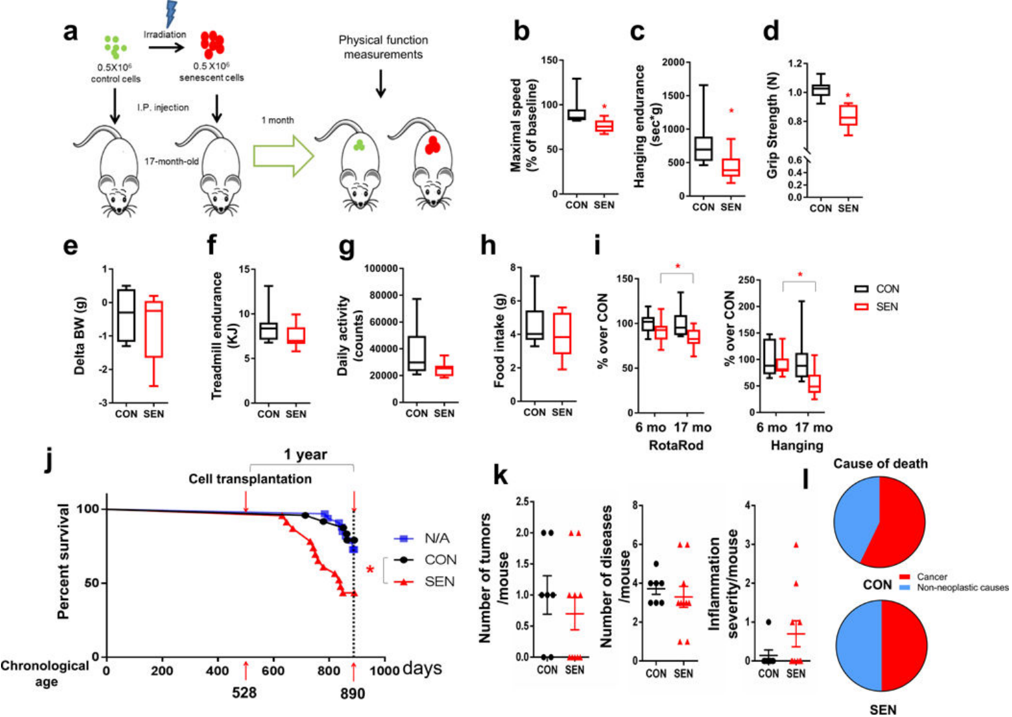
- In young 6-month-old mice, transplanting 10^6 senescent preadipocytes lowered maximal walking speed, hanging endurance, and grip strength by 1 month versus controls; 0.5 × 10^6 senescent cells was sufficient to impair grip strength and walking speed, while 0.2 × 10^6 had no detectable effects. The authors estimate this corresponds to 0.01–0.03% of body cells or 0.28% locally.
- In 17-month-old mice, 0.5 × 10^6 senescent cells caused lower walking speed, hanging endurance, and grip strength, and was associated with a 5.2-fold higher risk of death over the following year (mortality hazard ratio, P = 0.006). High-fat diet exacerbated senescent-cell-induced dysfunction.
- In human omental adipose tissue explants from 8 obese subjects (BMI 45.5 ± 9.1 kg/m²; age 45.7 ± 8.3 years), D+Q (1 μM dasatinib + 20 μM quercetin) for 48 h reduced TAF+, p16INK4A-high, and SA-βgal+ cells, increased apoptosis, and lowered secretion of IL-6, IL-8, MCP-1, PAI-1, and GM-CSF.
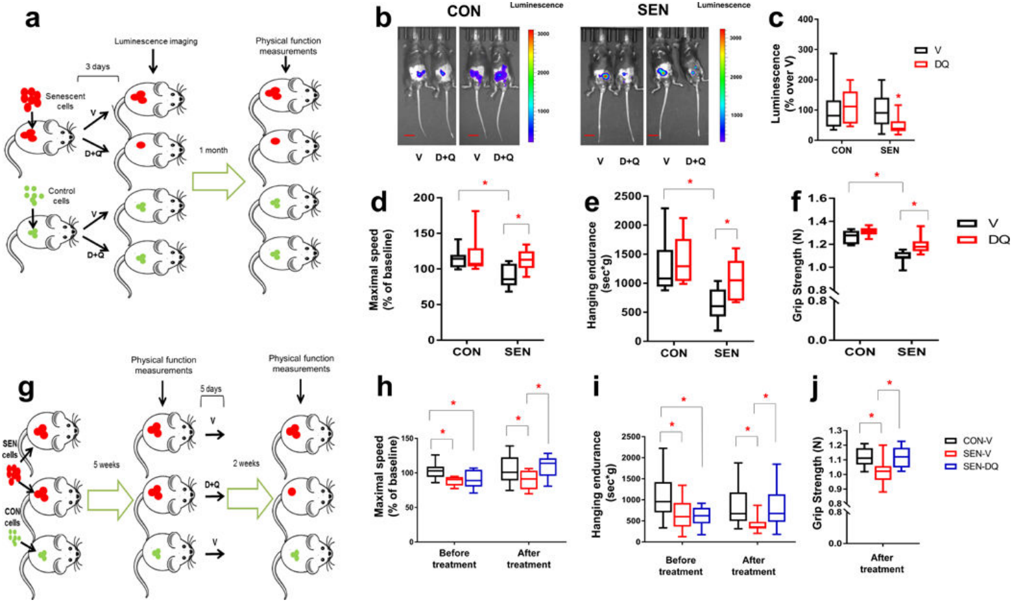
- In aged mice, intermittent D+Q starting at 24–27 months increased median post-treatment lifespan by 36% and reduced mortality hazard to 64.9% (P = 0.01), while physical function in the last 2 months of life was not lower than vehicle-treated mice.
Methods
- Mouse transplantation studies used senescent or control preadipocytes, mainly induced by 10 Gy radiation (>85% senescent), injected intraperitoneally into young (6-month), older (17-month), high-fat-diet, autologous, and SCID-beige models; physical function was assessed by RotaRod, grip strength, hanging test, treadmill, and daily activity/food intake.
- Human omental adipose tissue explants from obese subjects were treated ex vivo with D+Q or vehicle for 48 h, then assessed by SA-βgal, TAF, p16INK4A immunostaining, apoptosis markers, and multiplex cytokine analysis of conditioned medium.
- Aged-mouse studies treated 20-month-old mice with D+Q or vehicle intermittently for 4 months, and 24–27-month-old mice every 2 weeks for 3 consecutive days; survival was analyzed with Cox proportional hazard models, with INK-ATTAC/AP20187 used as a genetic clearance comparison.
Limitations
- The paper states that efficacy of senolytics in tissues from older humans needs to be compared with explants from obese subjects, and that preclinical toxicity studies and optimized regimens are required before trials in relatively healthy humans; it also notes dasatinib can have serious side effects such as pulmonary edema after 8–48 months of daily administration, though mouse side effects may differ from humans.
- The paper states that no statistical power analysis was used; sample sizes were based on previous experiments.
- Evident from the text: the causal transplantation and lifespan evidence is in mice, while the human data are ex vivo adipose explants rather than clinical outcomes; the study also focuses mainly on preadipocytes/adipose tissue and selected senolytic agents.
Model-written summary. Check it against the paper before relying on it.
Integrity signals
Registry
Cites
Statistics
Figures




Verification
Claims the paper makes
3 Valid · 2 Not valid · 1 Not checked · 124 Own results and interpretations
The cited sources support only part of this claim — read each source’s verdict below.
In the paper
“That D+Q can specifically kill senescent cells in human adipose tissue is supported by the following evidence: 1) We previously showed that D+Q induce apoptosis only in senescent human cells, rather than non-senescent control cells in vitro35; 2) D+Q significantly decreased senescent cells by three different assessments, while D+Q did not reduce the overall number of cells in adipose tissue; and 3”
§ Senolytics Improve Physical Function and Increase Lifespan in Old Age > Discussion
What the sources say
- Partly supportedcites [35] Zhu, Y. et al. The Achilles’ heel of senescent cells: from transcriptome to senolytic drugs. Aging Cell 14, 644–658 (2015). sourceExperimental — accuracy not yet measured
In Results, 'Candidate senolytic drugs in vitro' (page unavailable), D+Q selectively reduced the viability of senescent human preadipocytes and endothelial cells, while parallel nonsenescent cultures increased in number. The passage supports selective killing, but does not establish that the cell death was specifically apoptosis or that no nonsenescent control cells underwent apoptosis. (LLM, conf=0.86)
plainstates a cause- Asserted: passes — The authors put it forward as true.
- Checkable: passes — It can be checked against evidence.
- Load-bearing: passes — The paper’s conclusions depend on it.
- Based: passes — The paper gives a reason why it holds.
- Partly supported
The cited sources that could be checked couldn’t confirm or dispute this claim.
In the paper
“We used preadipocytes for transplantation since these cells appear to be less susceptible to immune rejection than other cell types26, a reason for their increasing clinical use in cell transplantation studies.”
§ Senolytics Improve Physical Function and Increase Lifespan in Old Age > Discussion
What the sources say
- Could not verifycites [26] Ryan, J. M., Barry, F. P., Murphy, J. M. & Mahon, B. P. Mesenchymal stem cells avoid allogeneic rejection. J. Inflamm. (Lond.) 2, 8 (2005). sourceExperimental — accuracy not yet measured
The sections “MSC evade allorejection” and “MSC are hypoimmunogenic” discuss reduced immune rejection of mesenchymal stem cells, not preadipocytes. Searches for preadipocytes and adipose-derived cells found no passage in our copy establishing that preadipocytes are less susceptible to rejection than other cell types. (LLM, conf=0.74)
hedgedstates an association- Asserted: passes — The authors put it forward as true.
- Checkable: passes — It can be checked against evidence.
- Load-bearing: passes — The paper’s conclusions depend on it.
- Based: passes — The paper gives a reason why it holds.
- Could not verify
The cited sources support only part of this claim — read each source’s verdict below.
In the paper
“Several studies have shown that the percentage of senescent cells in adipose tissue from aged animals can be up to 2-10%14,15,20, indicating there might be at least 7 million endogenous senescent cells in adipose tissue of aged mice.”
§ Senolytics Improve Physical Function and Increase Lifespan in Old Age > Discussion
What the sources say
- Could not verifycites [14] Xu, M. et al. JAK inhibition alleviates the cellular senescence–associated secretory phenotype and frailty in old age. Proc. Natl. Acad. Sci. USA 112, E6301–E6310 (2015). sourceExperimental — accuracy not yet measured
The paper’s Abstract describes a capillary analog of muscle contraction, not senescent cells in adipose tissue. Searches for senescent cells, aged animals, adipose tissue, and the 2–10% figure found no passage addressing the claim. (LLM, conf=0.78)
- Partly supportedcites [15] Xu, M. et al. Targeting senescent cells enhances adipogenesis and metabolic function in old age. eLife 4, e12997 (2015). sourceExperimental — accuracy not yet measured
The Introduction says senescent cells accumulate in adipose tissue with aging. The Results (Figure 4 caption) say the authors measured the percentage of senescence-marker-positive cells in white adipose tissue from 18-month-old mice, but the available text does not give the claimed 2–10% range. (LLM, conf=0.82)
- Partly supportedcites [20] Baker, D. J. et al. Naturally occurring p16Ink4a-positive cells shorten healthy lifespan. Nature 530, 184–189 (2016). sourceExperimental — accuracy not yet measured
The section “ATTAC clears senescent adipocyte progenitor cells” reports senescence-associated cells in aged mouse adipose tissue, but quantifies X-Gal-positive cells at 1.6% of total inguinal white adipose tissue cells in untreated controls. It does not establish the attributed 2–10% range. (LLM, conf=0.85)
plain- Asserted: passes — The authors put it forward as true.
- Checkable: passes — It can be checked against evidence.
- Load-bearing: unclear — It is unclear whether the paper’s conclusions depend on it.
- Based: passes — The paper gives a reason why it holds.
- Could not verify
The cited sources support only part of this claim — read each source’s verdict below.
In the paper
“D can have side effects, occasionally including serious ones such as pulmonary edema, which can occur after 8-48 months of daily administration55.”
§ Senolytics Improve Physical Function and Increase Lifespan in Old Age > Discussion
What the sources say
- Partly supportedcites [55] Kirkland, J. L., Tchkonia, T., Zhu, Y., Niedernhofer, L. J. & Robbins, P. D. The clinical potential of senolytic drugs. J. Am. Geriatr. Soc. 65, 2297–2301 (2017). sourceExperimental — accuracy not yet measured
The SCAPs section (page not provided) discusses the risk of side effects from continuous senolytic exposure and identifies dasatinib as a senolytic. It does not identify pulmonary edema as a dasatinib side effect or give an 8–48-month timeframe for daily administration. (LLM, conf=0.84)
plainstates a possible cause- Asserted: passes — The authors put it forward as true.
- Checkable: passes — It can be checked against evidence.
- Load-bearing: passes — The paper’s conclusions depend on it.
- Based: passes — The paper gives a reason why it holds.
- Partly supported
A result the paper reports from its own data — it cites no other source for it, so there is none to check. The quote shows it is in the paper.
In the paper
“D+Q increased expression of PPARγ and CEBPα, two key transcription factors that are required for adipose tissue function through regulating adipogenesis and adipose tissue insulin responsiveness15,37 (Fig. 4g).”
§ Senolytics Improve Physical Function and Increase Lifespan in Old Age > Results > D+Q reduces senescent cell burden and decreases pro-inflammatory cytokine secretion in human adipose tissue
plainstates a cause- Asserted: passes — The authors put it forward as true.
- Checkable: passes — It can be checked against evidence.
- Load-bearing: unclear — It is unclear whether the paper’s conclusions depend on it.
- Based: passes — The paper gives a reason why it holds.
78 more claims
Create a free account to see all 130 claims and every source verdict.
- Probably not a substantial claim. 20
- It may state two separate claims as one. 32
Claims other papers make about this one
Each is checked against this paper’s own text: does it say what the citing paper says it does?
The source backs part of the claim, not all of it — or backs it for a different population, condition or comparison.
In the citing paper
“In preclinical studies, co-administration of Dasatinib and Quercetin (DQ) improved aspects related to physical function (e.g., endurance and speed) and cognition (e.g., reduced neurofibrillary tangle density/neuron loss).7,15,24”
From A pilot study of senolytics to improve cognition and mobility in older adults at risk for Alzheimer's disease (2025) · cites this paper as [7]
Experimental — accuracy not yet measuredThe source backs part of the claim, not all of it — or backs it for a different population, condition or comparison.
In the citing paper
“In 30–70% of senescent cells, this SASP entails pro-inflammatory, proapoptotic and pro-fibrotic factors7,31,40,59–64, some of which can cause previously non-senescent cells to become senescent both locally and at a distance in an endocrine manner24,39,47.”
From Cellular senescence and senolytics: the path to the clinic (2022) · cites this paper as [24]
Experimental — accuracy not yet measuredThe source backs part of the claim, not all of it — or backs it for a different population, condition or comparison.
In the citing paper
“Many such stressors activate DNA damage response signaling and activation of the p53/p21CIP1/WAF1, p16INK4a/retinoblastoma protein or other pathways, resulting in cell cycle arrest and the development of a senescence-associated secretory phenotype (SASP)24,40,48−53”
From Cellular senescence and senolytics: the path to the clinic (2022) · cites this paper as [24]
Experimental — accuracy not yet measuredThe source backs part of the claim, not all of it — or backs it for a different population, condition or comparison.
In the citing paper
“However, if a threshold burden of senescent cells is exceeded, senescent cells can accumulate, perhaps because proapoptotic SASP-expressing senescent cells induce paracrine and endocrine spread of senescence at a rate exceeding immune clearance of preexisting and newly formed senescent cells24,62”
From Cellular senescence and senolytics: the path to the clinic (2022) · cites this paper as [24]
Experimental — accuracy not yet measuredThe source backs part of the claim, not all of it — or backs it for a different population, condition or comparison.
In the citing paper
“This sterile inflammatory state can provoke dysfunction of neighboring and distant non-senescent cells, such as progenitor cells, contributing to impaired tissue function and reduced regenerative capacity18,21,24,26,34.”
From Cellular senescence and senolytics: the path to the clinic (2022) · cites this paper as [24]
Experimental — accuracy not yet measured
55 more claims about this paper
Create a free account to see every claim other papers make about this one.
Self-check
Percentages, sums and reported differences re-computed from the paper’s own numbers.
Each contradiction between two passages listed here was confirmed by an independent check.
Rated minor: it would not touch a result — a value no result rests on, a p-value that stays on the same side of the significance level, or a conflict that is clerical, resolved elsewhere in the paper, or outside its own findings.
In the paper
§ Senolytics Improve Physical Function and Increase Lifespan in Old Age > Results > Clearance of senescent cells alleviates physical dysfunction and increases late-life survival without extending morbidity in aged mice
“concordant with lower secretion of SASP factors by human adipose tissue treated by D+Q (Fig. 4g).”
§ Senolytics Improve Physical Function and Increase Lifespan in Old Age > Results > D+Q reduces senescent cell burden and decreases pro-inflammatory cytokine secretion in human adipose tissue
“D+Q increased expression of PPARγ and CEBPα, two key transcription factors that are required for adipose tissue function through regulating adipogenesis and adipose tissue insulin responsiveness15,37 (Fig. 4g).”
Rated minor: it would not touch a result — a value no result rests on, a p-value that stays on the same side of the significance level, or a conflict that is clerical, resolved elsewhere in the paper, or outside its own findings.
In the paper
§ Senolytics Improve Physical Function and Increase Lifespan in Old Age > Results > D+Q reduces senescent cell burden and decreases pro-inflammatory cytokine secretion in human adipose tissue
“BMI 45.5±9.1 kg/m2; age 45.7±8.3 years”
§ Senolytics Improve Physical Function and Increase Lifespan in Old Age > Online Methods > Human Adipose Tissue Explants
“Ages of subjects were 45.8±8.2 years (means ± SD; range 36–58). Mean body mass index (BMI) was 45.5±9.1 kg/m2”
Citations
Cites
Frailty in Older Adults: Evidence for a Phenotype
Fried, L. P., Tangen, C. M., Walston, J., Newman, A. B., Hirsch, C., Gottdiener, J., Seeman, T., Tracy, R., Kop, W. J., Burke, G., et al. (2001) · The Journals of Gerontology Series A: Biological Sciences and Medical Sciences · doi:10.1093/gerona/56.3.m146 · Cited by 24,907
The metabolic phenotype in obesity: Fat mass, body fat distribution, and adipose tissue function
Goossens, G. H. (2017) · Obesity Facts · doi:10.1159/000471488 · Cited by 8,481
Cellular senescence: when bad things happen to good cells
Campisi, J., & d'Adda di Fagagna, F. (2007) · Nature Reviews Molecular Cell Biology · doi:10.1038/nrm2233 · Cited by 4,441
Clearance of p16Ink4a-positive senescent cells delays ageing-associated disorders
Baker, D. J., Wijshake, T., Tchkonia, T., LeBrasseur, N. K., Childs, B. G., van de Sluis, B., Kirkland, J. L., & van Deursen, J. M. (2011) · Nature · doi:10.1038/nature10600 · Cited by 3,670
Self-citationAging, natural death, and the compression of morbidity
Fries, J. F. (1980) · New England Journal of Medicine · doi:10.1056/nejm198007173030304 · Cited by 3,356
Prevalence of frailty in community-dwelling older persons: a systematic review
Collard, R. M., Boter, H., Schoevers, R. A., & Oude Voshaar, R. C. (2012) · Journal of the American Geriatrics Society · doi:10.1111/j.1532-5415.2012.04054.x · Cited by 3,073
Naturally occurring p16Ink4a-positive cells shorten healthy lifespan
Baker, D. J., Childs, B. G., Durik, M., Wijers, M. E., Sieben, C. J., Zhong, J., A. Saltness, R., Jeganathan, K. B., Verzosa, G. C., Pezeshki, A., et al. (2016) · Nature · doi:10.1038/nature16932 · Cited by 2,876
Self-citationThe Achilles' heel of senescent cells: from transcriptome to senolytic drugs
Zhu, Y., Tchkonia, T., Pirtskhalava, T., Gower, A. C., Ding, H., Giorgadze, N., Palmer, A. K., Ikeno, Y., Hubbard, G. B., Lenburg, M., et al. (2015) · Aging Cell · doi:10.1111/acel.12344 · Cited by 2,584
Self-citationA complex secretory program orchestrated by the inflammasome controls paracrine senescence
Acosta, J. C., Banito, A., Wuestefeld, T., Georgilis, A., Janich, P., Morton, J. P., Athineos, D., Kang, T.-W., Lasitschka, F., Andrulis, M., et al. (2013) · Nature Cell Biology · doi:10.1038/ncb2784 · Cited by 2,278
The Frailty Syndrome: Definition and Natural History
Xue, Q.-L. (2011) · Clinics in Geriatric Medicine · doi:10.1016/j.cger.2010.08.009 · Cited by 2,061
Cited by
Hallmarks of aging: An expanding universe
López-Otín, C., Blasco, M. A., Partridge, L., Serrano, M., & Kroemer, G. (2023) · Cell · doi:10.1016/j.cell.2022.11.001 · Cited by 6,549
Cellular Senescence: Defining a Path Forward
Gorgoulis, V., Adams, P. D., Alimonti, A., Bennett, D. C., Bischof, O., Bishop, C., Campisi, J., Collado, M., Evangelou, K., Ferbeyre, G., et al. (2019) · Cell · doi:10.1016/j.cell.2019.10.005 · Cited by 3,225
Self-citationThe cGAS–STING pathway as a therapeutic target in inflammatory diseases
Decout, A., Katz, J. D., Venkatraman, S., & Ablasser, A. (2021) · Nature Reviews Immunology · doi:10.1038/s41577-021-00524-z · Cited by 2,309
Cellular senescence in ageing: from mechanisms to therapeutic opportunities
Di Micco, R., Krizhanovsky, V., Baker, D., & d’Adda di Fagagna, F. (2021) · Nature Reviews Molecular Cell Biology · doi:10.1038/s41580-020-00314-w · Cited by 2,277
From discoveries in ageing research to therapeutics for healthy ageing
Campisi, J., Kapahi, P., Lithgow, G. J., Melov, S., Newman, J. C., & Verdin, E. (2019) · Nature · doi:10.1038/s41586-019-1365-2 · Cited by 1,389
Metadata
- Authors
- Xu, M., Pirtskhalava, T., Farr, J. N., Weigand, B. M., Palmer, A. K., Weivoda, M. M., Inman, C. L., Ogrodnik, M. B., Hachfeld, C. M., Fraser, D. G., Onken, J. L., Johnson, K. O., Verzosa, G. C., Langhi, L. G. P., Weigl, M., Giorgadze, N., LeBrasseur, N. K., Miller, J. D., Jurk, D., Singh, R. J., Allison, D. B., Ejima, K., Hubbard, G. B., Ikeno, Y., Cubro, H., Garovic, V. D., Hou, X., Weroha, S. J., Robbins, P. D., Niedernhofer, L. J., Khosla, S., Tchkonia, T., & Kirkland, J. L.
- Affiliations
- Mayo Clinic (US)
- Newcastle University (GB)
- University of Alabama at Birmingham (US)
- The University of Texas at San Antonio Health Science Center (US)
- Scripps Research Institute (US)
- Corresponding author
- Xu, Ming
- Kirkland, James L.
- ORCID
- Xu, Ming
- Pirtskhalava, Tamar
- Farr, Joshua N.
- Palmer, Allyson K.
- Weivoda, Megan M.
- Ogrodnik, Mikolaj B.
- Johnson, Kurt O.
- Weigl, Moritz
- LeBrasseur, Nathan K.
- Miller, Jordan D.
- Jurk, Diana
- Singh, Ravinder J.
- Allison, David B.
- Ejima, Keisuke
- Ikeno, Yuji
- Garovic, Vesna D.
- Hou, Xiaonan
- Weroha, S. John
- Robbins, Paul D.
- Niedernhofer, Laura J.
- Khosla, Sundeep
- Kirkland, James L.
- Venue
- Nature Medicine
- Published
- 2018-07-09
- Volume
- 24
- Issue
- 8
- Pages
- 1246-1256
- ISSN
- 1078-8956 (ISSN-L)
- 1546-170X
- PMC
- PMC6082705
- OpenAlex
- W2860743873
- Semantic Scholar
- 918fb15a620d71230dc7ee961c0c2cfce924e9a7
- Cited by
- 2,287
- References
- 66
- Citations by year
- 2026: 275 · 2025: 310 · 2024: 327 · 2023: 306 · 2022: 304 · 2021: 275 · 2020: 257 · 2019: 182 · 2018: 47
- FWCI
- 130.81
- Type
- journal article
- Language
- en
- Open access
- green
- www.ncbi.nlm.nih.gov
- Licence
- www.springer.com/tdm (tdm)
- www.springer.com/tdm (vor)
- Locations
- Nature Medicine (publishedVersion)
- PubMed (publishedVersion)
- Europe PMC (PubMed Central) (acceptedVersion)
- PubMed Central (acceptedVersion)
- Newcastle University ePrints (Newcastle Univesity)
- Funders
- National Institutes of Health (UL1TR002377)
- National Institute on Aging (P01AG043376, F30AG046061, R01AG048792, R01AG044376, P01AG004875, R01AG013925, R21AG049182, P30AG013319, R37AG013925, U19AG056278, P30AG050886)
- National Heart, Lung, and Blood Institute (R01HL141819)
- National Institute of Diabetes and Digestive and Kidney Diseases (P30DK050456)
- National Institute of Arthritis and Musculoskeletal and Skin Diseases (K01AR070281, K01AR070241)
- National Center for Advancing Translational Sciences
- Topics
- Life Sciences › Biochemistry, Genetics and Molecular Biology › Cell Biology › Telomeres, Telomerase, and Senescence
- Life Sciences › Biochemistry, Genetics and Molecular Biology › Aging › Genetics, Aging, and Longevity in Model Organisms
- Health Sciences › Medicine › Geriatrics and Gerontology › Sirtuins and Resveratrol in Medicine
- Keywords
- senolytics, cellular senescence, physical function, lifespan extension, aging, dasatinib, quercetin, frailty, inflammatory cytokines, adipose tissue, mortality, healthspan
- MeSH terms
- Dasatinib, Adipose Tissue, Animals, Longevity, Mice, Inbred C57BL, Quercetin, Stress, Physiological, Survival Analysis, Cytokines, Cellular Senescence, Cell Transplantation, Inflammation Mediators, Diet, High-Fat
About these checks
Registry, retraction, Cites and statistics results are computed, not judged, with one exception: a printed reference that no index lists is read once by a model before it counts as a citation error. Claims are extracted by a model and kept only when their quote appears verbatim in the text; each cited source is then checked, with a model’s help, for whether it says what the claim relies on. Those verdicts can be wrong — read the claim’s quote and the cited source before relying on one.
The claim verdicts this report counts are experimental: their accuracy is not yet measured.
A language model drew the claims from the paper on 2026-11-08, under version 3 of the claim definition (model deepseek-v4.1-flash, prompt extract-v3).
A second model labelled each claim on 2026-11-08 (model jev-1.13-20260917, definition revision gold-guideline-v0.2).
Cited sources are checked with a language model’s help (gpt-6-sol).
Statistics and arithmetic are recomputed, not judged.
Confidence bands are shown only for fields calibrated on our annotated test set. None is calibrated yet, so no band is shown.
What counts as a claim ›How we measure confidence ›How we check this ›
Are you an author, or do you see a problem with this page? Request a review
How to cite
Cite CoChat for the checks on this page, and the paper for its own findings.
- This page
- CoChat. (2026). Citation check: Senolytics improve physical function and increase lifespan in old age. https://app.cochat.ai/papers/10.1038/s41591-018-0092-9
- The paper
- Xu, M., Pirtskhalava, T., Farr, J. N., Weigand, B. M., Palmer, A. K., Weivoda, M. M., Inman, C. L., Ogrodnik, M. B., Hachfeld, C. M., Fraser, D. G., Onken, J. L., Johnson, K. O., Verzosa, G. C., Langhi, L. G. P., Weigl, M., Giorgadze, N., LeBrasseur, N. K., Miller, J. D., Jurk, D., . . . Kirkland, J. L. (2018). Senolytics improve physical function and increase lifespan in old age. Nature Medicine. https://doi.org/10.1038/s41591-018-0092-9
Data sources
Bibliographic data: Semantic Scholar, OpenAlex, Crossref.
Contains information from the Semantic Scholar Academic Graph Datasets, made available under the ODC Attribution License (ODC-BY 1.0).
Semantic Scholar’s data is described in: Kinney, R., et al. (2023). The Semantic Scholar Open Data Platform. arXiv:2301.10140.
