

Association of shift work with incident dementia: a community-based cohort study
Open accessThe DOI matches its Crossref record; 53 of the 53 references it cites were found in a registry or an index.
Abstract
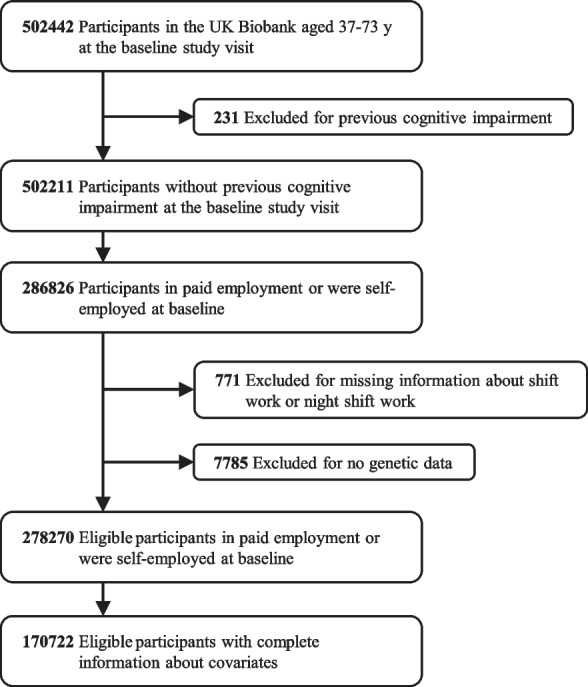
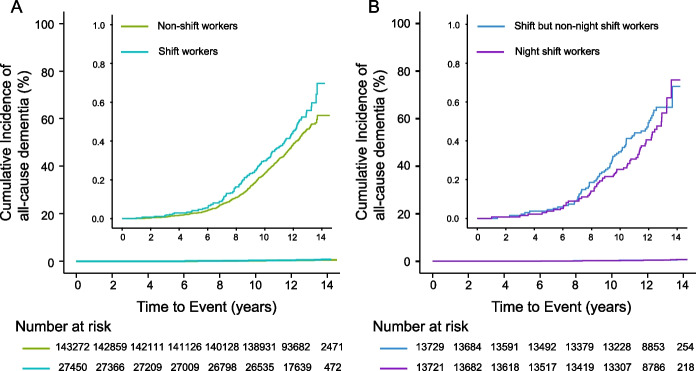
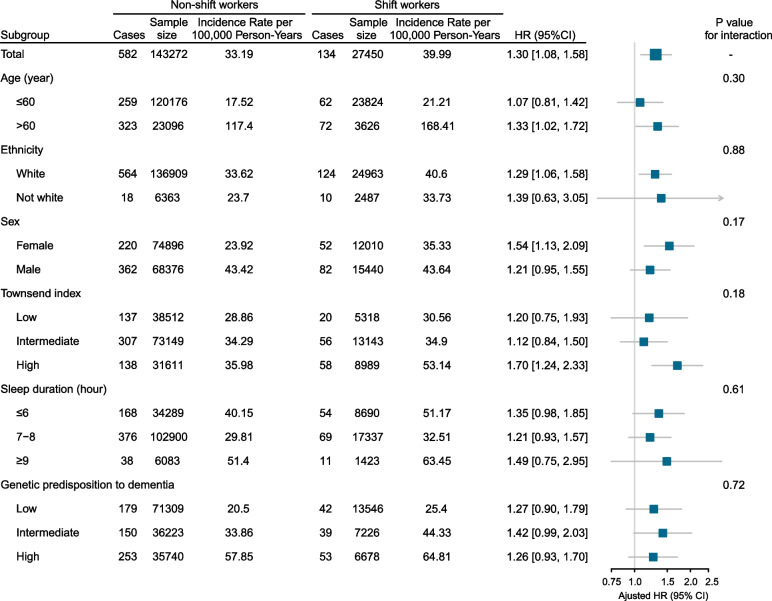
Background: Some observational studies had found that shift work would increase risks of metabolic disorders, cancers, and cardiovascular diseases, but there was no homogeneous evidence of such an association between shift work and incident dementia. This study aimed to investigate whether shift work would increase the risk of dementia in a general population. Methods: One hundred seventy thousand seven hundred twenty-two employed participants without cognitive impairment or dementia at baseline recruited between 2006 and 2010 were selected from the UK Biobank cohort study. Follow-up occurred through June 2021. Shift work status at baseline was self-reported by participants and they were categorized as non-shift workers or shift workers. Among shift workers, participants were further categorized as night shift workers or shift but non-night shift workers. The primary outcome was all-cause dementia in a time-to-event analysis, and the secondary outcomes were subtypes of dementia, including Alzheimer’s disease, vascular dementia, and other types of dementia. Results: In total, 716 dementia cases were observed among 170,722 participants over a median follow-up period of 12.4 years. Shift workers had an increased risk of all-cause dementia as compared with non-shift workers after multivariable adjustment (hazard ratio [HR], 1.30, 95% confidence interval [CI], 1.08–1.58); however, among shift workers, night shift work was not associated with the risk of dementia (HR, 1.04, 95% CI, 0.73–1.47). We found no significant interaction between shift work and genetic predisposition to dementia on the primary outcome ( P for interaction = 0.77). Conclusions: Shift work at baseline was associated with an increased risk of all-cause dementia. Among shift workers, there was no significant association between night shift work and the risk of dementia. The increased incidence of dementia in shift workers did not differ between participants in different genetic risk strata for dementia.
Overview
The claims and statistics of this paper haven’t been checked yet.
Free: it reads the open-access text and checks the first 5 claims that cite a source we can check. Create a free account to check every claim.
Integrity signals
Registry
Cites
Statistics
Figures
Verification
Claims the paper makes
The claims and statistics of this paper haven’t been checked yet.
Free: it reads the open-access text and checks the first 5 claims that cite a source we can check. Create a free account to check every claim.
Claims other papers make about this one
Each is checked against this paper’s own text: does it say what the citing paper says it does?
The source backs part of the claim, not all of it — or backs it for a different population, condition or comparison.
In the citing paper
“but this was not increased further in night shift compared to day shift workers, although the power to detect differences was low. (305)”
From Dementia prevention, intervention, and care: 2024 report of the Lancet standing Commission (2024) · cites this paper as [305]
Experimental — accuracy not yet measuredThe cited source says what the claim attributes to it.
In the citing paper
“A subsequent UKB study examined whether shift work might be related to dementia and followed 170,722 people, aged in their early 50s at baseline, for a median of 12.4 years, of whom 27,450 (16.1%) did shift work. It was associated with an increased risk of dementia (HR 1.30, 1.08 -1.58)”
From Dementia prevention, intervention, and care: 2024 report of the Lancet standing Commission (2024) · cites this paper as [305]
Self-check
Percentages, sums and reported differences re-computed from the paper’s own numbers.
The self-check needs the paper’s full text.
Citations
Cites
Sudlow, C., Gallacher, J., Allen, N., Beral, V., Burton, P., Danesh, J., Downey, P., Elliott, P., Green, J., Landray, M., et al. (2015) · PLOS Medicine · doi:10.1371/journal.pmed.1001779 · Cited by 12,728 · cited 1×
“The UK Biobank is a prospective cohort study with over 500,000 community-dwelling participants across the UK aged 37–73 years when recruited between 2006 and 2010 [26].”
BackgroundFry, A., Littlejohns, T. J., Sudlow, C., Doherty, N., Adamska, L., Sprosen, T., Collins, R., & Allen, N. E. (2017) · American Journal of Epidemiology · doi:10.1093/aje/kwx246 · Cited by 3,979 · cited 1×
“However, given that the UK Biobank has a tremendous sample size and a median follow-up time of over 10 years, it still has the capacity to detect and identify risk factors [50], and our findings also remain of important public health implications in terms of the need for effective public measures to reduce the risk of…”
BackgroundApolipoprotein E and Alzheimer disease: risk, mechanisms and therapy
Liu, C.-C., Kanekiyo, T., Xu, H., & Bu, G. (2013) · Nature Reviews Neurology · doi:10.1038/nrneurol.2012.263 · Cited by 3,459 · cited 1×
“Various genetic and environmental risk factors have been found that would contribute to the development of dementia, such as apolipoprotein E ε4-carriers [6], obesity [7], diabetes [8], and unhealthy lifestyles (e.”
BackgroundAlzheimer Disease Genetics Consortium (ADGC), Kunkle, B. W., The European Alzheimer’s Disease Initiative (EADI), Cohorts for Heart and Aging Research in Genomic Epidemiology Consortium (CHARGE), Genetic and Environmental Risk in AD/Defining Genetic, P. A. E. R. F. A. D. C. (., Grenier-Boley, B., Sims, R., Bis, J. C., Damotte, V., Naj, A. C., et al. (2019) · Nature Genetics · doi:10.1038/s41588-019-0358-2 · Cited by 2,946
Mozaffarian, D. (2016) · Circulation · doi:10.1161/circulationaha.115.018585 · Cited by 2,216
Tutorial: a guide to performing polygenic risk score analyses
Choi, S. W., Mak, T. S.-H., & O’Reilly, P. F. (2020) · Nature Protocols · doi:10.1038/s41596-020-0353-1 · Cited by 1,946 · cited 2×
“The PRS was formulated as the sum of the number of risk alleles at each locus multiplied by the respective regression coefficient, divided by the number of SNPs, using PRSice-2 [29, 30].”
MethodBaumgart, M., Snyder, H. M., Carrillo, M. C., Fazio, S., Kim, H., & Johns, H. (2015) · Alzheimer's & Dementia · doi:10.1016/j.jalz.2015.05.016 · Cited by 1,660
PRSice-2: Polygenic Risk Score software for biobank-scale data
Choi, S. W., & O'Reilly, P. F. (2019) · GigaScience · doi:10.1093/gigascience/giz082 · Cited by 1,532
Cognitive decline and dementia in diabetes mellitus: mechanisms and clinical implications
Biessels, G. J., & Despa, F. (2018) · Nature Reviews Endocrinology · doi:10.1038/s41574-018-0048-7 · Cited by 1,454 · cited 1×
“Various genetic and environmental risk factors have been found that would contribute to the development of dementia, such as apolipoprotein E ε4-carriers [6], obesity [7], diabetes [8], and unhealthy lifestyles (e.”
BackgroundA meta-analysis of the impact of short-term sleep deprivation on cognitive variables
Lim, J., & Dinges, D. F. (2010) · Psychological Bulletin · doi:10.1037/a0018883 · Cited by 1,389 · cited 1×
“And cognitive performance deteriorates with sleep disturbance [38, 39].”
Background
Cited by
Dementia prevention, intervention, and care: 2024 report of the Lancet standing Commission
Livingston, G., Huntley, J., Liu, K. Y., Costafreda, S. G., Selbæk, G., Alladi, S., Ames, D., Banerjee, S., Burns, A., Brayne, C., et al. (2024) · The Lancet · doi:10.1016/s0140-6736(24)01296-0 · Cited by 3,860
Lifestyle Factors in the Association of Shift Work and Depression and Anxiety
Xu, M., Yin, X., & Gong, Y. (2023) · JAMA Network Open · doi:10.1001/jamanetworkopen.2023.28798 · Cited by 115
Social determinants of dementia: A scoping review
Walsh, S., Klee, M., Hui, E. K., Saeed, U., Waters, S., Kuhn, I. L., Siette, J., Orgeta, V., Stafford, J., Smith, L., et al. (2025) · Alzheimer s & Dementia · doi:10.1002/alz.70524 · Cited by 37
Li, J., Yang, L., Yao, Y., Gu, P., Xie, Y., Yin, H., Xue, M., Jiang, Y., Dai, J., & Ma, J. (2024) · BMC Medicine · doi:10.1186/s12916-023-03240-8 · Cited by 30
“With the progress of socioeconomic development in industrialized countries, shift work encompassing evening, night, and rotating shifts has become more prevalent worldwide [8, 9].”
BackgroundŁagowska, K., Kuleta, A., Michalak, M., & Bajerska, J. (2024) · American Journal of Human Biology · doi:10.1002/ajhb.24041 · Cited by 23
Jin, X., Yang, Y., Zhou, F. L., Dong, W., Chang, K., Liu, X., & Yan, Y. (2024) · Sleep Medicine · doi:10.1016/j.sleep.2024.05.031 · Cited by 17
Association of night shift work and biological ageing: the mediating role of body mass index
Shen, W., Cai, L., Li, J., Sun, Y., Wang, B., Wang, N., & Lu, Y. (2024) · Age and Ageing · doi:10.1093/ageing/afae242 · Cited by 13
Re-Evaluating Recommended Optimal Sleep Duration: A Perspective on Sleep Literacy
Kohyama, J. (2024) · Children · doi:10.3390/children11091098 · Cited by 9
“Factors contributing to a decline in “nonrestorative sleep” include chronic conditions such as diabetes, hypertension, cancer, and depression [14], although no global recommendations for “nonrestorative sleep” have been established.”
BackgroundThe Impact of Lifestyle on Brain Health
Potashkin, J. A., Vidyadhara, D. J., & Hunsberger, H. C. (2025) · American Journal of Lifestyle Medicine · doi:10.1177/15598276251411888 · Cited by 7
Chang, J., Liu, Y., Zhao, Y., Gao, P., & Tang, Y. (2024) · Journal of Neurology · doi:10.1007/s00415-024-12580-1 · Cited by 5
Self-citationHuo, F., Liu, Q., Zhang, S., Liu, X., Lv, S., Zhao, M., Liu, Y., Zhu, X., Huang, C., Feng, S., et al. (2025) · Neuroscience Bulletin · doi:10.1007/s12264-025-01552-8 · Cited by 7
Self-citationXu, Y., Zhang, G., Yang, L., Qin, H., Zhou, Z. L., Li, Q., Liu, H., Wang, R., Cai, Z., Jing, L., et al. (2024) · The Journal of Prevention of Alzheimer s Disease · doi:10.14283/jpad.2024.161 · Cited by 3
Self-citationBioClocks UK: driving robust cycles of discovery to impact
Rees, H., Rzechorzek, N. M., Hughes, R. B., Dodd, A. N., Hodge, J. J. L., Stevenson, T. J., von Schantz, M., Lucas, R. J., Reece, S. E., Kyriacou, C. P., et al. (2025) · Philosophical Transactions of the Royal Society B Biological Sciences · doi:10.1098/rstb.2023.0345 · Cited by 3
Li, M., Xu, B., Yu, H., Wan, Y., Zhu, Z., Luo, P., Su, J., Zhou, J., & Fan, X. (2025) · Journal of Health Population and Nutrition · doi:10.1186/s41043-025-01026-7 · Cited by 5
“Tobacco smoking is a widely acknowledged risk factor for COPD; however, recent evidence points out that approximately half of global COPD cases are thought to be caused by non-tobacco-related risk factors, indicating that the pathogenesis of COPD has not yet been fully elucidated [5].”
Li, M., Liao, Y., Luo, Z., Song, H., & Yang, Z. (2023) · Brain and Behavior · doi:10.1002/brb3.3317 · Cited by 4
“The risk of all-cause dementia is increased in the shift-working population (Liao et al., 2022).”
BackgroundDiurnal variation in neurovascular coupling and the impact of sleep quality: a UK Biobank study
Yang, S., & Webb, A. J. S. (2025) · SLEEP · doi:10.1093/sleep/zsaf256 · Cited by 2
Tirani, S. A., Grigorian, A., Lotfi, K., Shahdadian, F., Hajhashemy, Z., Rouhani, P., & Saneei, P. (2025) · BMC Psychiatry · doi:10.1186/s12888-025-07643-0 · Cited by 1
“According to the World Health Organization, in 2019, one in every eight individuals (approximately 970 million people worldwide) were living with a mental disorder, with anxiety and depressive disorders being the most common [1].”
Wang, X.-D., Lu, Y., Li, Q., Sun, B., Zhang, Y., Su, F., Wang, Y., Yunna, F. U., Huang, D., & Zheng, X. (2026) · Journal of Agriculture and Food Research · doi:10.1016/j.jafr.2026.102804 · Cited by 4
Li, J., Yang, L., Yao, Y., Gu, P., Xie, Y., Yin, H., Xue, M., Jiang, Y., Dai, J., & Ma, J. (2024) · Figshare · doi:10.6084/m9.figshare.25001635
Andersen, F. B., Pallesen, S., Egaas, I. T., Vedaa, Ø., Nielsen, M. B., Sunde, E., Holmelid, Ø., Kysnes, B. B., Bjorvatn, B., Waage, S., et al. (2026) · Systematic Reviews · doi:10.1186/s13643-026-03146-5
Circadian disruption induces sex-specific Alzheimer’s pathophysiology and immune cell reprogrammingPreprint
Cordi, C. V., Falkenberg, N. G., Clark, G. T., Allen, N., Chuah, J., Ulbrich, R., Herzog, A. A., Lanka, M., Collins, E. J., Bentley, M., et al. (2026) · bioRxiv (Cold Spring Harbor Laboratory) · doi:10.64898/2026.04.30.721994
“7,10,11 In this study, we evaluated how CD interacts with sex and immune function in an AD-susceptible context.”
Teixeira, K. R., Rossato, L. T., de Branco, F. M. S., Mendes, J. A., de Medeiros, L. A., Cunha, T. M., Balieiro, L. C. T., de Oliveira, E. P., & Crispim, C. A. (2026) · Chronobiology International · doi:10.1080/07420528.2026.2670685
“The advancement of socioeconomic development in industrialized countries has led to a significant increase in the prevalence of night shift work, both fixed and rotating, worldwide (Liao et al. 2022).”
Huang, Y., Xiang, Y., Li, T., Lip, G. Y. H., Gao, Y., & Zhang, J. (2026) · Journal of Global Health · doi:10.7189/jogh.16.04198 · Cited by 1
“Those who reported ‘sometimes, usually, or always’ working shifts were further asked whether their work involved night shifts, defined as working through the normal sleeping hours ( e.g. 12 am to 6 am) [ 22 , 23 ].”
Metadata
- Authors
- Liao, H., Pan, D., Deng, Z., Jiang, J., Cai, J., Liu, Y., He, B., Lei, M., Li, H., Li, Y., Xu, Y., & Tang, Y.
- Affiliations
- Sun Yat-sen University (CN)
- Corresponding author
- Tang, Yamei
- Venue
- BMC Medicine
- Published
- 2022-12-15
- Volume
- 20
- Issue
- 1
- Pages
- 484-484
- ISSN
- 1741-7015 (ISSN-L)
- PMC
- PMC9753386
- OpenAlex
- W4311802670
- Cited by
- 24
- References
- 52
- Citations by year
- 2026: 5 · 2025: 7 · 2024: 10 · 2023: 2
- FWCI
- 4.37
- Type
- journal article
- Language
- en
- Open access
- gold
- doi.org
- Licence
- cc-by
- creativecommons.org/licenses/by/4.0 (tdm)
- creativecommons.org/licenses/by/4.0 (vor)
- Locations
- BMC Medicine (publishedVersion, cc-by)
- PubMed Central (publishedVersion, cc-by)
- PubMed (publishedVersion)
- DOAJ (DOAJ: Directory of Open Access Journals) (submittedVersion, cc-by-sa)
- Funders
- the National Natural Science Foundation of China (81925031, 81820108026, 81872549, 82003389, 81801229)
- the Science and Technology Program of Guangzhou (202007030001)
- the Key-Area Research and Development Program of Guangdong Province (2018B030340001)
- Topics
- Social Sciences › Psychology › Experimental and Cognitive Psychology › Sleep and Work-Related Fatigue
- Health Sciences › Medicine › Psychiatry and Mental health › Dementia and Cognitive Impairment Research
- Life Sciences › Neuroscience › Endocrine and Autonomic Systems › Circadian rhythm and melatonin
- Keywords
- shift work, night shift work, dementia, Alzheimer's disease, vascular dementia, occupational risk factors, UK Biobank
- MeSH terms
- Shift Work Schedule, Alzheimer Disease, Humans, Risk Factors, Cohort Studies, Incidence
About these checks
Registry, retraction, Cites and statistics results are computed, not judged, with one exception: a printed reference that no index lists is read once by a model before it counts as a citation error. Claims are extracted by a model and kept only when their quote appears verbatim in the text; each cited source is then checked, with a model’s help, for whether it says what the claim relies on. Those verdicts can be wrong — read the claim’s quote and the cited source before relying on one.
Statistics and arithmetic are recomputed, not judged.
Confidence bands are shown only for fields calibrated on our annotated test set. None is calibrated yet, so no band is shown.
What counts as a claim ›How we measure confidence ›How we check this ›
Are you an author, or do you see a problem with this page? Request a review
Data sources
Bibliographic data: Semantic Scholar, OpenAlex, Crossref.
Contains information from the Semantic Scholar Academic Graph Datasets, made available under the ODC Attribution License (ODC-BY 1.0).
Semantic Scholar’s data is described in: Kinney, R., et al. (2023). The Semantic Scholar Open Data Platform. arXiv:2301.10140.
