

Increasing adoption rates at animal shelters: a two-phase approach to predict length of stay and optimal shelter allocation
Open accessThe DOI matches its Crossref record; 46 of the 47 references it cites were found in a registry or an index; 5 of the 14 sources its claims cite were checked for support.
Abstract
Among the 6-8 million animals that enter rescue shelters every year, nearly 3-4 million are euthanized, and 10-25% are put to death specifically because of shelter overcrowding each year.
Overview
CoChat Summary
## TL;DR
This study uses animal shelter intake/outcome data to predict animals’ length of stay with machine learning, aiming to reduce euthanization and improve adoption rates. Gradient boosting performed best overall, and the paper proposes a second-phase goal programming model to recommend shelter relocation decisions.
## Key findings
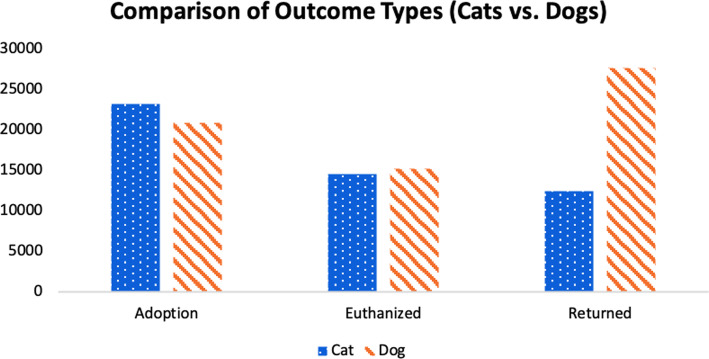
- The cleaned dataset contained 114,256 animal records, including 50,466 cat records and 63,790 dog records.
- Across the tested models, gradient boosting performed best overall, with the highest precision, recall, and F1 score; random forest was generally second best, and logistic regression performed worst.
- For overall average performance across metrics, the paper reports gradient boosting as the most proficient model at almost 60%; the performance gap was nearly 34% for precision, 39% for recall, and 32% for F1 score.
- Important predictors repeatedly identified included age (especially puppy, super senior, senior), size (large and small), and multicolor; gender, animal type, middle age, and medium-sized animals were not significant in their results.
## Methods
- The study used a two-phase design: phase 1 predicts length of stay with machine learning; phase 2 is a proposed goal programming approach for shelter relocation decisions.
- Data were assembled from public state/city shelter datasets and from shelters contacted across the U.S.; the paper says the final study focused on California, Kentucky, Colorado, Arizona, and Indiana and on dogs and cats.
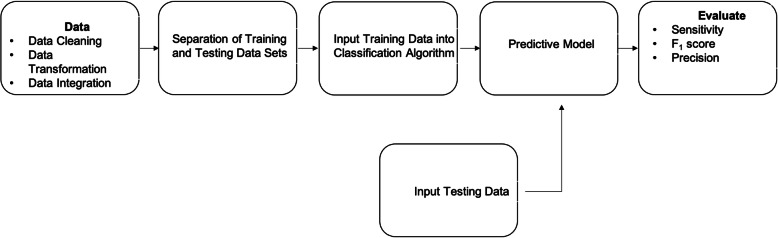
- Four classification algorithms were compared on the cleaned data: logistic regression, artificial neural network, random forest, and gradient boosting; the dataset was split 80% training / 20% testing, with 10-fold cross-validation on training data and tuning via grid search for RF, GB, and ANN.
- Performance was evaluated using precision, recall (sensitivity), and F1 score.
## Limitations
- The paper states three limitations: lack of behavioral data, limited sample size, and use of simple algorithms.
- The text also makes evident that the data are not nationally comprehensive: there is no nationwide database, and only a subset of shelters responded to data requests, which likely limits representativeness.
- The paper notes that many shelters lacked the staff/resources to provide data, which constrained sample collection.
Model-written summary. Check it against the paper before relying on it.
Integrity signals
Registry
Cites
Statistics
Figures
Verification
Claims the paper makes
2 Valid · 4 Not valid · 5 Not checked · 63 Own results and interpretations
A result the paper reports from its own data — it cites no other source for it, so there is none to check. The quote shows it is in the paper.
In the paper
“Finally, the gradient boosting and random forest algorithms perform well when predicting the very high length of stay at around 70–80%.”
§ Increasing adoption rates at animal shelters: a two-phase approach to predict length of stay and optimal shelter allocation > Results > Machine learning results
plainstates an association- Asserted: passes — The authors put it forward as true.
- Checkable: passes — It can be checked against evidence.
- Load-bearing: unclear — It is unclear whether the paper’s conclusions depend on it.
- Based: passes — The paper gives a reason why it holds.
A result the paper reports from its own data — it cites no other source for it, so there is none to check. The quote shows it is in the paper.
In the paper
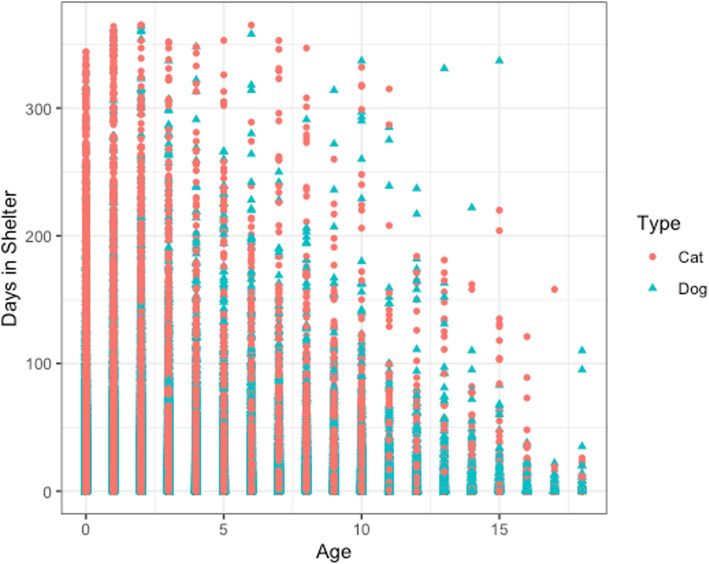
“From Fig. 5, it is observed that the number of days a dog stays in the shelter decreases as the age increases.”
§ Increasing adoption rates at animal shelters: a two-phase approach to predict length of stay and optimal shelter allocation > Results > Exploratory Data results
plainstates an association- Asserted: passes — The authors put it forward as true.
- Checkable: passes — It can be checked against evidence.
- Load-bearing: unclear — It is unclear whether the paper’s conclusions depend on it.
- Based: passes — The paper gives a reason why it holds.
A result the paper reports from its own data — it cites no other source for it, so there is none to check. The quote shows it is in the paper.
In the paper
“Specifically, we observe that older-aged animals (senior and/or super senior) appear as a significant factor for every algorithm.”
§ Increasing adoption rates at animal shelters: a two-phase approach to predict length of stay and optimal shelter allocation > Results > Machine learning results
hedgedstates an association- Asserted: passes — The authors put it forward as true.
- Checkable: passes — It can be checked against evidence.
- Load-bearing: unclear — It is unclear whether the paper’s conclusions depend on it.
- Based: passes — The paper gives a reason why it holds.
A result the paper reports from its own data — it cites no other source for it, so there is none to check. The quote shows it is in the paper.
In the paper
“Female cats that are returned have the highest variance for days spent in the shelter.”
§ Increasing adoption rates at animal shelters: a two-phase approach to predict length of stay and optimal shelter allocation > Results > Exploratory Data results
plainstates an association- Asserted: passes — The authors put it forward as true.
- Checkable: passes — It can be checked against evidence.
- Load-bearing: unclear — It is unclear whether the paper’s conclusions depend on it.
- Based: passes — The paper gives a reason why it holds.
A result the paper reports from its own data — it cites no other source for it, so there is none to check. The quote shows it is in the paper.
In the paper
“However, the performance of these models in predicting the medium length of stay for the given dataset is low for all three-performance metrics.”
§ Increasing adoption rates at animal shelters: a two-phase approach to predict length of stay and optimal shelter allocation > Results > Machine learning results
plain- Asserted: passes — The authors put it forward as true.
- Checkable: passes — It can be checked against evidence.
- Load-bearing: unclear — It is unclear whether the paper’s conclusions depend on it.
- Based: passes — The paper gives a reason why it holds.
15 more claims
Create a free account to see all 74 claims and to verify the 2 references still open.
- Probably not a substantial claim. 36
- It may state two separate claims as one. 27
Citations
Cites
LeCun, Y., Bengio, Y., & Hinton, G. (2015) · Nature · doi:10.1038/nature14539 · Cited by 84,126
Machine learning: Trends, perspectives, and prospects
Jordan, M. I., & Mitchell, T. M. (2015) · Science · doi:10.1126/science.aaa8415 · Cited by 9,955 · cited 9×
“Xl≤ tl;y;s ∀l ð6Þ Equation [21] sets an upper limit on the length of stay category if the shelter l is assigned as the destination location.”
BackgroundInfluentialEnsemble methods in machine learning
Dietterich, T. G. (2000) · Lecture Notes in Computer Science · doi:10.1007/3-540-45014-9_1 · Cited by 8,408
Friedman, J., Hastie, T., & Tibshirani, R. (2000) · The Annals of Statistics · doi:10.1214/aos/1016218223 · Cited by 6,884
Random forests for classification in ecology
Cutler, D. R., Edwards, T. C., Beard, K. H., Cutler, A., Hess, K. T., Gibson, J., & Lawler, J. J. (2007) · Ecology · doi:10.1890/07-0539.1 · Cited by 4,950
Purposeful selection of variables in logistic regression
Bursac, Z., Gauss, C. H., Williams, D. K., & Hosmer, D. W. (2008) · Source Code for Biology and Medicine · doi:10.1186/1751-0473-3-17 · Cited by 4,035 · cited 1×
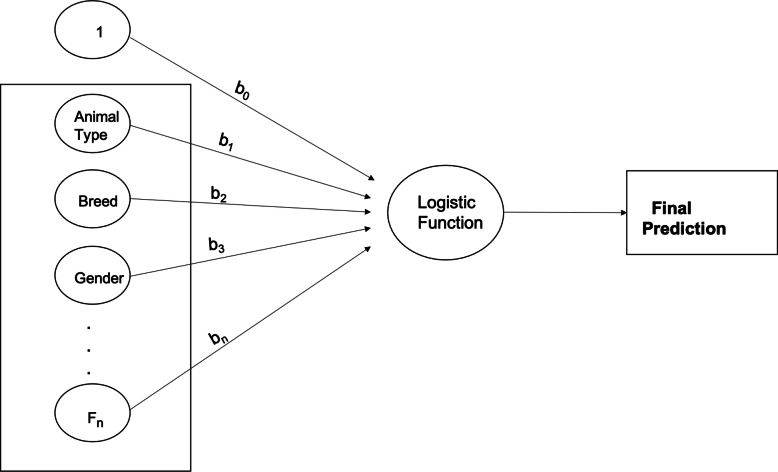
“Logistic regression (LR) is a machine learning algorithm that is used to understand the probability of the occurrence of an event [39].”
MethodRokach, L. (2010) · Artificial Intelligence Review · doi:10.1007/s10462-009-9124-7 · Cited by 2,657 · cited 2×
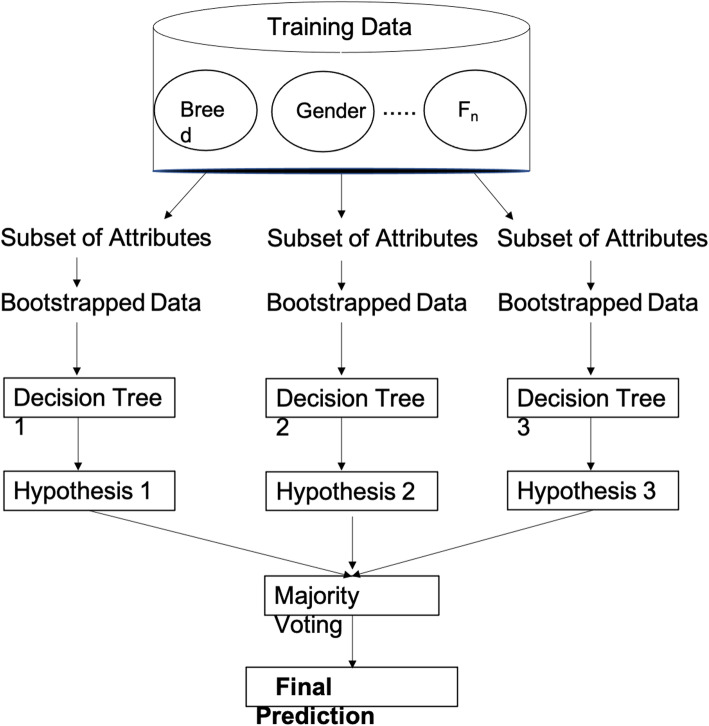
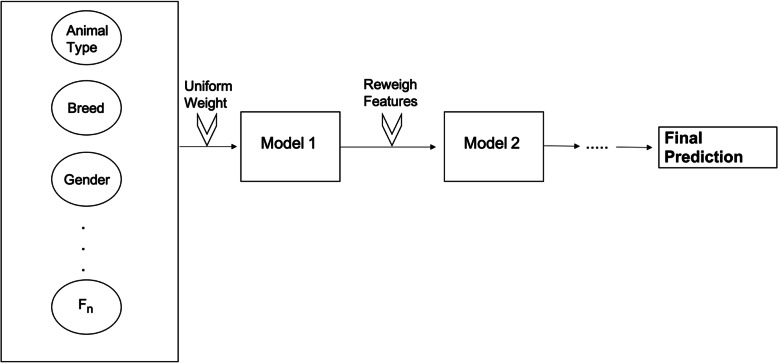
“This process of re-weighing is done until a weighted vote of weak classifiers is combined into a robust classifier that determines the final labels or classification [46].”
BackgroundWaller, M. A., & Fawcett, S. E. (2013) · Journal of Business Logistics · doi:10.1111/jbl.12010 · Cited by 1,522
Machine learning and data mining methods in diabetes research
Kavakiotis, I., Tsave, O., Salifoglou, A., Maglaveras, N., Vlahavas, I., & Chouvarda, I. (2017) · Computational and Structural Biotechnology Journal · doi:10.1016/j.csbj.2016.12.005 · Cited by 1,445 · cited 3×
“Reinforcement learning is where a system is trained through direct interaction with the environment by trial and error [15].”
BackgroundInfluentialData Mining: Concepts, Models, Methods, and Algorithms
(2003) · Technometrics · doi:10.1198/tech.2003.s785 · Cited by 1,369
Predicting breast cancer survivability: a comparison of three data mining methods
Delen, D., Walker, G., & Kadam, A. (2005) · Artificial Intelligence in Medicine · doi:10.1016/j.artmed.2004.07.002 · Cited by 1,218
Data Mining and Analytics in the Process Industry: The Role of Machine Learning
Ge, Z., Song, Z., Ding, S. X., & Huang, B. (2017) · IEEE Access · doi:10.1109/access.2017.2756872 · Cited by 922 · cited 11×
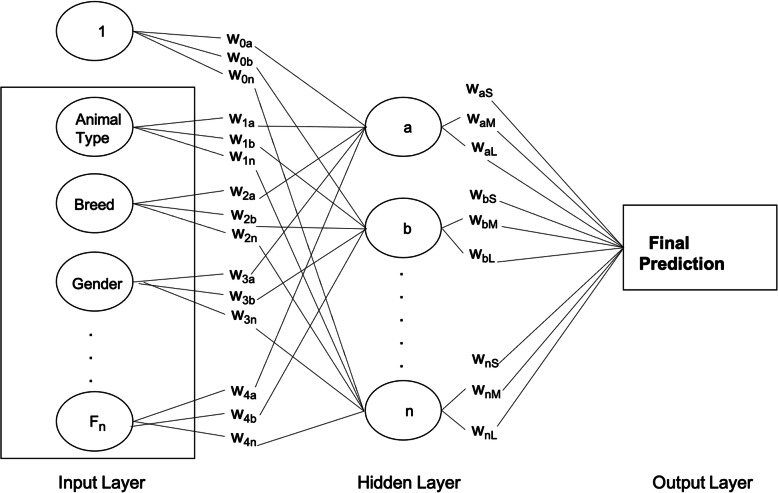
“Each ANN consists of three layers - the input layer, hidden layer, and the output layer [32, 44].”
BackgroundInfluentialNeely, M. N., van Guilder, M. G., Yamada, W. M., Schumitzky, A., & Jelliffe, R. W. (2012) · Therapeutic Drug Monitoring · doi:10.1097/ftd.0b013e31825c4ba6 · Cited by 470
Logistic regression model training based on the approximate homomorphic encryption
Kim, A., Song, Y., Kim, M., Lee, K., & Cheon, J. H. (2018) · BMC Medical Genomics · doi:10.1186/s12920-018-0401-7 · Cited by 203
Hennessy, M. B., Voith, V. L., Mazzei, S. J., Buttram, J., Miller, D. D., & Linden, F. (2001) · Applied Animal Behaviour Science · doi:10.1016/s0168-1591(01)00139-3 · Cited by 179
Shore, E. R. (2005) · Journal of Applied Animal Welfare Science · doi:10.1207/s15327604jaws0803_3 · Cited by 174 · cited 1×
“[7] analyzed the reasons for returning adopted animals by owners and obtained insights for these failed adoptions to attain more successful future approvals.”
BackgroundRajendran, S., & Zack, J. (2019) · Transportation Research Part E: Logistics and Transportation Review · doi:10.1016/j.tre.2019.06.003 · Cited by 156 · cited 1×
“Data cleaning is an essential step for obtaining unbiased results [35, 36].”
BackgroundSelf-citationSrinivas, S., & Ravindran, A. R. (2018) · Expert Systems with Applications · doi:10.1016/j.eswa.2018.02.022 · Cited by 147 · cited 1×
“Artificial Neural Network (ANN) algorithms were inspired by the brain’s neuron, which transmits signals to other nerve cells [40, 42].”
BackgroundThe Caring-Killing Paradox: Euthanasia-Related Strain Among Animal-Shelter Workers1
Reeve, C. L., Rogelberg, S. G., Spitzmuller, C., & Digiacomo, N. (2005) · Journal of Applied Social Psychology · doi:10.1111/j.1559-1816.2005.tb02096.x · Cited by 146
Factors Relevant to Adoption of Cats in an Animal Shelter
Fantuzzi, J. M., Miller, K. A., & Weiss, E. (2010) · Journal of Applied Animal Welfare Science · doi:10.1080/10888700903583467 · Cited by 81
In-Kennel Behavior Predicts Length of Stay in Shelter Dogs
Protopopova, A., Mehrkam, L. R., Boggess, M. M., & Wynne, C. D. L. (2014) · PLoS ONE · doi:10.1371/journal.pone.0114319 · Cited by 80
Shih, H. M., & Rajendran, S. (2019) · Journal of Healthcare Engineering · doi:10.1155/2019/6123745 · Cited by 78
Self-citationThe influence of length of time in a rescue shelter on the behaviour of kennelled dogs
Wells, D. L., Graham, L., & Hepper, P. G. (2002) · Animal Welfare · doi:10.1017/s0962728600024891 · Cited by 70
Srinivas, S., & Salah, H. (2020) · International Journal of Medical Informatics · doi:10.1016/j.ijmedinf.2020.104290 · Cited by 70
Rogelberg, S. G., DiGiacomo, N., Reeve, C. L. L., Spitzmueller, C., Clark, O. L., Teeter, L., Walker, A. G., Carter, N. T., & Starling, P. G. (2007) · Journal of Applied Animal Welfare Science · doi:10.1080/10888700701353865 · Cited by 68
Some factors influencing adoption of sheltered dogs
Normando, S., Stefanini, C., Meers, L., Adamelli, S., Coultis, D., & Bono, G. (2006) · Anthrozoös · doi:10.2752/089279306785415556 · Cited by 66
The influence of length of time spent in a rescue shelter on the behaviour of kennelled dogs
Wells, D. L., Graham, L., & Hepper, P. G. (2002) · Research Portal (Queen's University Belfast) · Cited by 54
Euthanasia in Animal Shelters: Management's Perspective on Staff Reactions and Support Programs
Anderson, K. A., Brandt, J. C., Lord, L. K., & Miles, E. A. (2013) · Anthrozoös · doi:10.2752/175303713x13795775536057 · Cited by 52
Brown, W. P., & Morgan, K. T. (2015) · Journal of Applied Animal Welfare Science · doi:10.1080/10888705.2014.971156 · Cited by 52
(2019) · doi:10.1002/9781119516057 · Cited by 49
Clevenger, J., & Kass, P. H. (2003) · Journal of Veterinary Medical Education · doi:10.3138/jvme.30.4.372 · Cited by 46
A Machine Learning-Based Approach for Predicting Patient Punctuality in Ambulatory Care Centers
Srinivas, S. (2020) · International Journal of Environmental Research and Public Health · doi:10.3390/ijerph17103703 · Cited by 45
A Comparative Study of Ensemble Methods for Students' Performance Modeling
Pandey, M., & Taruna, S. (2014) · International Journal of Computer Applications · doi:10.5120/18095-9151 · Cited by 42
Weiss, E., Gramann, S., Drain, N., Dolan, E., & Slater, M. (2015) · Animals · doi:10.3390/ani5010071 · Cited by 34
Automatic Design of Deep Networks with Neural Blocks
Zhong, G., Jiao, W., Gao, W. J., & Huang, K. (2019) · Cognitive Computation · doi:10.1007/s12559-019-09677-5 · Cited by 33
Kambli, A., Sinha, A. A., & Srinivas, S. (2020) · Journal of Hospitality and Tourism Management · doi:10.1016/j.jhtm.2020.02.008 · Cited by 33
Morris, K. N., & Gies, D. L. (2014) · Journal of Applied Animal Welfare Science · doi:10.1080/10888705.2014.856250 · Cited by 31
Gates, M. C., Zito, S., Thomas, J., & Dale, A. (2018) · Animals · doi:10.3390/ani8060093 · Cited by 26
Rajendran, S., Ansaripour, A., Srinivasan, M. K., & Chandra, M. J. (2019) · IISE Transactions on Healthcare Systems Engineering · doi:10.1080/24725579.2018.1488157 · Cited by 10
Self-citationSrinivas, S., & Rajendran, S. (2017) · CRC Press eBooks · doi:10.1201/9781315152653-8 · Cited by 9
Self-citationZhu, X., Li, D.-P., Fan, W.-G., Lin, M. C., Wang, J.-L., Lin, S.-Q., Huang, J.-Q., & Kung, H. (2010) · BMC Medical Genetics · doi:10.1186/1471-2350-11-83 · Cited by 9
Multi-criteria approach for platelet inventory management in hospitals
Rajendran, S., & Ravindran, A. R. (2020) · International Journal of Operational Research · doi:10.1504/ijor.2020.106360 · Cited by 8
Self-citationMulti-criteria approach for platelet inventory management in hospitals
(2020) · doi:10.1504/ijor.2020.10027956 · Cited by 3
Self-citation
Cited by
Predicting demand for air taxi urban aviation services using machine learning algorithms
Rajendran, S., Srinivas, S., & Grimshaw, T. (2021) · Journal of Air Transport Management · doi:10.1016/j.jairtraman.2021.102043 · Cited by 102
Self-citationRajendran, S., Chamundeswari, S., & Sinha, A. A. (2022) · Social Sciences & Humanities Open · doi:10.1016/j.ssaho.2022.100357 · Cited by 56
Self-citationAbandonment of dogs in Latin America: Strategies and ideas
Mota‐Rojas, D., Maldonado, N. A. C., Lezama-García, K., Sepiurka, L., & Garcia, R. D. C. M. (2021) · Veterinary World · doi:10.14202/vetworld.2021.2371-2379 · Cited by 82
Neuroimmunology of rabies: New insights into an ancient disease
Bastos, V. A. F., da Silva, V. P., Rodrigues, É. D. L., Moraes, C. N. D. S., Nóbile, A. L., Fonseca, D. L. M., Souza, K., do Vale, F. Y. N., Filgueiras, I. S., Schimke, L. F., et al. (2023) · Journal of Medical Virology · doi:10.1002/jmv.29042 · Cited by 46
Rajendran, S. (2021) · Expert Systems with Applications · doi:10.1016/j.eswa.2021.115056 · Cited by 32
Self-citation
Metadata
- Authors
- Bradley, J., & Rajendran, S.
- Affiliations
- University of Missouri (US)
- Corresponding author
- Rajendran, Suchithra
- ORCID
- Rajendran, Suchithra
- Venue
- BMC Veterinary Research
- Published
- 2021-02-05
- Volume
- 17
- Issue
- 1
- Pages
- 70-70
- ISSN
- 1746-6148 (ISSN-L)
- PMC
- PMC7863531
- OpenAlex
- W3127841828
- Semantic Scholar
- 9cb46124bdf7acf55e3a621352b93692ab4ac949
- Cited by
- 55
- References
- 47
- Citations by year
- 2026: 18 · 2025: 11 · 2024: 5 · 2023: 9 · 2022: 7 · 2021: 5
- FWCI
- 4.16
- Type
- journal article
- Language
- en
- Open access
- gold
- doi.org
- Licence
- cc-by
- creativecommons.org/licenses/by/4.0/ (tdm)
- creativecommons.org/licenses/by/4.0/ (vor)
- Locations
- BMC Veterinary Research (publishedVersion, cc-by)
- Europe PMC (PubMed Central) (publishedVersion, other-oa)
- PubMed Central (publishedVersion, cc-by)
- PubMed (publishedVersion)
- DOAJ (DOAJ: Directory of Open Access Journals) (submittedVersion, cc-by-sa)
- Topics
- Physical Sciences › Computer Science › Information Systems › Data Mining and Machine Learning Applications
- Social Sciences › Law › Animal Law and Welfare
- Health Sciences › Health Professions › Health Information Management › Artificial Intelligence in Healthcare
- Keywords
- length of stay prediction, animal euthanasia, gradient boosting, random forest, artificial neural networks, logistic regression
- MeSH terms
- Machine Learning, Age Factors, Animals, Animal Welfare, Cats, Dogs, Female, Length of Stay, Male, Models, Statistical, Euthanasia, Animal
About these checks
Registry, retraction, Cites and statistics results are computed, not judged, with one exception: a printed reference that no index lists is read once by a model before it counts as a citation error. Claims are extracted by a model and kept only when their quote appears verbatim in the text; each cited source is then checked, with a model’s help, for whether it says what the claim relies on. Those verdicts can be wrong — read the claim’s quote and the cited source before relying on one.
The claim verdicts this report counts are experimental: their accuracy is not yet measured.
A language model drew the claims from the paper on 2026-10-10, under version 3 of the claim definition (model deepseek-v4.1-flash, prompt extract-v3).
A second model labelled each claim on 2026-10-10 (model jev-1.13-20260917, definition revision gold-guideline-v0.2).
Statistics and arithmetic are recomputed, not judged.
Confidence bands are shown only for fields calibrated on our annotated test set. None is calibrated yet, so no band is shown.
What counts as a claim ›How we measure confidence ›How we check this ›
Are you an author, or do you see a problem with this page? Request a review
Data sources
Bibliographic data: Semantic Scholar, OpenAlex, Crossref.
Contains information from the Semantic Scholar Academic Graph Datasets, made available under the ODC Attribution License (ODC-BY 1.0).
Semantic Scholar’s data is described in: Kinney, R., et al. (2023). The Semantic Scholar Open Data Platform. arXiv:2301.10140.
