

Liraglutide improves metabolic parameters and carotid intima-media thickness in diabetic patients with the metabolic syndrome: an 18-month prospective study
Open accessThe DOI matches its Crossref record; 46 of the 46 references it cites were found in a registry or an index.
Abstract
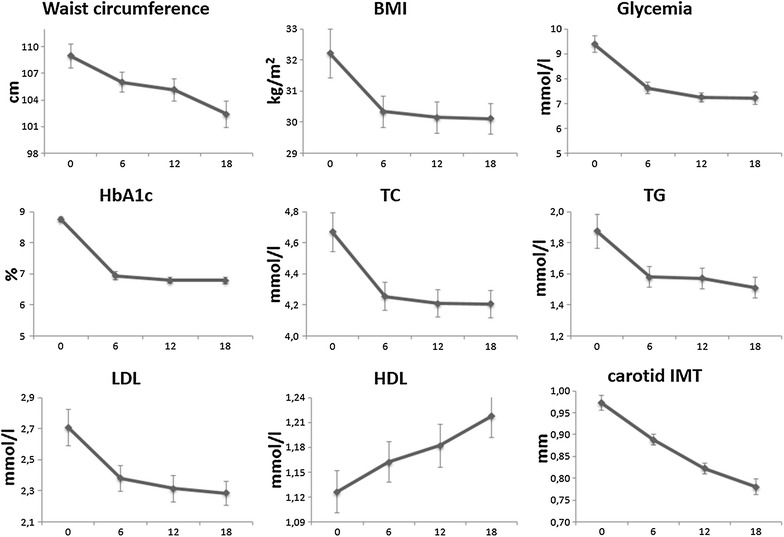
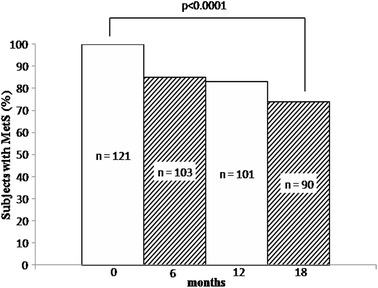
Background: Liraglutide, a GLP-1 analogue, exerts several beneficial non-glycemic effects in patients with type-2 diabetes (T2DM), such as those on body weight, blood pressure, plasma lipids and inflammation markers. However, the effects of liraglutide on cardiovascular (CV) risk markers in subjects with the metabolic syndrome (MetS) are still largely unknown. We herein explored its effects on various cardio-metabolic risk markers of the MetS in subjects with T2DM. Methods: We performed an 18-month prospective, real-world study. All subjects had T2DM and the MetS based on the AHA/NHLBI criteria. Subjects with a history of a major CV event were excluded. One hundred-twenty-one subjects (71 men and 50 women; mean age: 62 ± 9 years) with T2DM and the MetS, who were naïve to incretin-based therapies and treated with metformin only, were included. Liraglutide (1.2 mg/day) was added to metformin (1500–3000 mg/day) for the entire study. Fasting plasma samples for metabolic parameters were collected and carotid-intima media thickness (cIMT) was assessed by B-mode real-time ultrasound at baseline and every 6 months thereafter. Results: There was a significant reduction in waist circumference, body mass index, fasting glycemia, HbA1c, total- and LDL-cholesterol, triglycerides, and cIMT during the 18-month follow-up. Correlation analysis showed a significant association between changes in cIMT and triglycerides (r = 0.362; p < 0.0001). The MetS prevalence significantly reduced during the study, and the 26% of subjects no longer fulfilled the criteria for the MetS after 18 months. Conclusions: Liraglutide improves cardio-metabolic risk factors in subjects with the MetS in a real-world study. Trial Registration ClinicalTrials.gov: NCT01715428.
Overview
The claims and statistics of this paper haven’t been checked yet.
Free: it reads the open-access text and checks the first 5 claims that cite a source we can check. Create a free account to check every claim.
Integrity signals
Registry
Cites
Statistics
Figures
Verification
Claims the paper makes
The claims and statistics of this paper haven’t been checked yet.
Free: it reads the open-access text and checks the first 5 claims that cite a source we can check. Create a free account to check every claim.
Claims other papers make about this one
Each is checked against this paper’s own text: does it say what the citing paper says it does?
The cited source says what the claim attributes to it.
In the citing paper
“For instance, in an 18-month prospective, real-world study conducted in 121 patients with T2DM and metabolic syndrome, liraglutide treatment was associated with a significant reduction in carotid intima-media thickness, a surrogate marker of subclinical atherosclerosis, from a mean of 0.97 mm at baseline to 0.78 mm at 18 months [55].”
From Protection against stroke with glucagon-like peptide-1 receptor agonists: a comprehensive review of potential mechanisms (2022) · cites this paper as [55]
Self-check
Percentages, sums and reported differences re-computed from the paper’s own numbers.
The self-check needs the paper’s full text.
Citations
Cites
Alberti, K. G. M. M., Eckel, R. H., Grundy, S. M., Zimmet, P. Z., Cleeman, J. I., Donato, K. A., Fruchart, J.-C., James, W. P. T., Loria, C. M., & Smith, S. C. (2009) · Circulation · doi:10.1161/circulationaha.109.192644 · Cited by 14,860 · cited 1×
“The presence of abnormal metabolic parameters such as central obesity, dyslipidemia, and hypertension further increase the risk of CVD in both T2DM and MetS [13], which remains elevated despite intensive pharmacological treatment [14].”
Background(2013) · European Heart Journal · doi:10.1093/eurheartj/eht151 · Cited by 13,655
Liraglutide and Cardiovascular Outcomes in Type 2 Diabetes
Marso, S. P., Daniels, G. H., Brown-Frandsen, K., Kristensen, P., Mann, J. F. E., Nauck, M. A., Nissen, S. E., Pocock, S., Poulter, N. R., Ravn, L. S., et al. (2016) · New England Journal of Medicine · doi:10.1056/nejmoa1603827 · Cited by 7,629 · cited 2×
“The recently published liraglutide CV outcome study reported that liraglutide was able to reduce death from CV causes, nonfatal myocardial infarction and nonfatal stroke in patients with T2DM [28].”
Background(2003) · Journal of Hypertension · doi:10.1097/00004872-200306000-00001 · Cited by 3,027
Mancia, G., Rosei, E. A., Cífková, R., DeBacker, G., Erdine, S. E., Fagard, R., Farsang, C., Heagerty, A. M., Kawecka-Jaszcs, K., Kiowski, W., et al. (2003) · Lirias · doi:10.1097/01.hjh.0000059051.65882.32 · Cited by 2,601
Buse, J. B., Rosenstock, J., Sesti, G., Schmidt, W. E., Montanya, E., Brett, J. H., Zychma, M., & Blonde, L. (2009) · The Lancet · doi:10.1016/s0140-6736(09)60659-0 · Cited by 1,503
Seaquist, E. R., Anderson, J., Childs, B., Cryer, P., Dagogo-Jack, S., Fish, L., Heller, S. R., Rodriguez, H., Rosenzweig, J., & Vigersky, R. (2013) · Diabetes Care · doi:10.2337/dc12-2480 · Cited by 1,389 · cited 1×
“Fifteen subjects reported symptomatic hypoglycemia; however, no severe hypoglycemic episodes (based on the joint American Diabetes Association and the Endocrine Society definition) were recorded [11].”
BackgroundAstrup, A., Rössner, S., Van Gaal, L., Rissanen, A., Niskanen, L., Al Hakim, M., Madsen, J., Rasmussen, M. F., & Lean, M. E. (2009) · The Lancet · doi:10.1016/s0140-6736(09)61375-1 · Cited by 1,163 · cited 4×
“[2] reported a significant reduction in body weight after 20 weeks of liraglutide therapy in obese non-diabetic subjects with a dose of 3.”
BackgroundInfluentialZinman, B., Gerich, J., Buse, J. B., Lewin, A., Schwartz, S., Raskin, P., Hale, P. M., Zdravkovic, M., Blonde, L., & the LEAD-4 Study Investigators (2009) · Diabetes Care · doi:10.2337/dc08-2124 · Cited by 848 · cited 1×
“The LEAD studies similarly showed a non-significant increase in HDL-C with liraglutide administration [21, 22].”
Backgroundon behalf of the NN8022-1807 Investigators, Astrup, A., Carraro, R., Finer, N., Harper, A., Kunesova, M., Lean, M. E. J., Niskanen, L., Rasmussen, M. F., Rissanen, A., et al. (2012) · International Journal of Obesity · doi:10.1038/ijo.2011.158 · Cited by 757 · cited 3×
“Liraglutide decreases the prevalence of both MetS and prediabetes in obese, nondiabetic individuals [2, 8], suggesting that this antidiabetic drug might be beneficial in patients with the MetS.”
Background
Cited by
Items 101–138 of 138
Bouzas, C., Pastor, R., García, S., Monserrat-Mesquida, M., Martínez‐González, M. Á., Salas‐Salvadó, J., Corella, D., Goday, A., Martínez, J. A., Alonso‐Gómez, Á. M., et al. (2023) · Biomedicine & Pharmacotherapy · doi:10.1016/j.biopha.2023.114561 · Cited by 6
Rizzo, M., Rizvi, A. A., & Sesti, G. (2017) · Diabetes Obesity and Metabolism · doi:10.1111/dom.12883 · Cited by 6
“Furthermore, in patients with T2DM liraglutide significantly improved cIMT after just 4 months of treatment,(14) with further improvements reported up to 18 months of therapy.(15) Such a rapid improvement by liraglutide on cIMT has been linked to the rapid reduction in oxidative stress (and ultimately in oxidized LDL)…”
Self-citationFerrannini, G., Mellbin, L., Kirabo, F. R., Ramasundarahettige, C. F., Gerstein, H. C., & Rydén, L. (2022) · Diabetes Care · doi:10.2337/dc22-0903 · Cited by 5
Glucagon-Like Peptide-1 Receptor Agonists and Brain Vascular Function
Begić, E., & Čaušević, M. (2021) · Heart Lung and Circulation · doi:10.1016/j.hlc.2021.07.024 · Cited by 5
GLP-1 receptor agonists, carotid atherosclerosis and retinopathy
Rizzo, M., Nikolić, D., Pace, F. D., Παπάνας, Ν., & Montano, N. (2017) · Expert Opinion on Pharmacotherapy · doi:10.1080/14656566.2017.1342810 · Cited by 5
“metabolic syndrome (MetS), as it has been shown recently in an 18-months real-world study [5].”
BackgroundResultInfluentialSelf-citationNew antihyperglycaemic agents and cardiovascular disease: let's be optimistic
Pafili, K., Rizzo, M., & Παπάνας, Ν. (2018) · Current Opinion in Cardiology · doi:10.1097/hco.0000000000000524 · Cited by 6
Self-citationRizzo, M., Cosentino, F., & Mantzoros, C. S. (2022) · Expert Review of Clinical Pharmacology · doi:10.1080/17512433.2022.2108400 · Cited by 4
Self-citationIkonomidis, I., Papageorgiou, A., Pavlidis, G., Georgiopoulos, G. A., Katogiannis, K., Maratou, E., Thymis, J., Pliouta, L., Kountouri, A., Korakas, E., et al. (2026) · American Journal of Physiology-Heart and Circulatory Physiology · doi:10.1152/ajpheart.00996.2025 · Cited by 4
Sandsdal, R. M., Holt, J., Alkhefagie, H. G. A., Jørgensen, J. R., Juhl, C. R., Olsen, L. M., Byberg, S., Thirumathyam, R., Gliemann, L., Stallknecht, B. M., et al. (2026) · Nature Metabolism · doi:10.1038/s42255-026-01554-4 · Cited by 3
“However, the previous studies examined patients with type 2 diabetes, a population characterized by substantially higher baseline cIMT, and did not include an initial standardized weight loss phase 23–25 .”
The Effect of GLP-1 Agonist Treatment On Subclinical Atherosclerosis
Sakız, D., Çalapkulu, M., Sencar, M. E., Bayram, S. M., Ünsal, İ. Ö., Kızılgül, M., Uçan, B., Özbek, M., & Çakal, E. (2022) · Van Medical Journal · doi:10.5505/vtd.2022.09815 · Cited by 3
“Diabetes Mellitus duration (years) (median (min-max)) 9 (1-30)”
BackgroundKobalava, Z. D., & Кохан, Е. В. (2020) · Kardiologiia · doi:10.18087/cardio.2020.9.n1274 · Cited by 4
Mozaffari, N., Bideshki, M. V., Sartang, M. M., & Behzadi, M. (2024) · PharmaNutrition · doi:10.1016/j.phanu.2024.100409 · Cited by 3
Microvascular and macrovascular effects of liraglutide
Cianflone, D., Rizvi, A. A., & Rizzo, M. (2019) · International Journal of Cardiology · doi:10.1016/j.ijcard.2019.02.041 · Cited by 3
Self-citationSánchez-García, D., Luna‐Garza, Y., Saavedra-Castillo, E., Gómez-Martínez, G., Diaz-Sallas, M., Ortega‐Valdez, A. C., Martínez‐Mendoza, Z. F., Reyes‐Valdez, K. R., Huitron‐Ramirez, R. A., Martinez‐Rentería, J. P., et al. (2026) · Diabetic Medicine · doi:10.1111/dme.70222 · Cited by 2
Xanthopoulou, M., Evangelidis, P., Poulis, D., Gavriilaki, E., Kotsiou, N., Antza, C., Kotsis, V., Doxani, C., Mprotsis, T., Zintzaras, E., et al. (2026) · Pharmaceuticals · doi:10.3390/ph19030462 · Cited by 2
“Carotid intima media thickness was normalized when added to metformin treatment in incretin-naive T2DM patients in an 18-month prospective study performed by Rizzo et al. [28].”
Bile acids and incretins as modulators of obesity-associated atherosclerosis
Kirsch, A., Gindlhuber, J., Zabini, D., & Osto, E. (2025) · Frontiers in Cardiovascular Medicine · doi:10.3389/fcvm.2024.1510148 · Cited by 3
The Role of Physicians’ Digital Tools in Pharmacological Management of Type 2 Diabetes Mellitus
Janež, A., Ješe, R., Haluzík, M., & Rizzo, M. (2022) · Medicina · doi:10.3390/medicina58081061 · Cited by 2
“For instance, liraglutide has several non-glycemic pleiotropic effects towards a reduction in the overall cardiovascular risk, such as the reduction in plasma total-cholesterol, triglyceride, and LDL-cholesterol concentrations as well as of carotid intima-media thickness [17]; interestingly, liraglutide has a direct a…”
BackgroundSelf-citationVarra, F., Varras, M. N., Varra, V., & Theodosis‐Nobelos, P. (2025) · Current Clinical Pharmacology · doi:10.2174/0127724328392698250818071803 · Cited by 3
Incretin-Based Therapies, Obesity-Associated Inflammation, and Atherosclerotic Cardiovascular Risk
Kafol, J., Jug, B., & Fras, Z. (2026) · Cells · doi:10.3390/cells15141293 · Cited by 1
“Conversely, non-randomized data with liraglutide suggested improvement in carotid intima-media thickness, but such findings remain vulnerable to confounding [101].”
Lubberding, A. F., Holst, J. J., & Madsbad, S. (2023) · Elsevier eBooks · doi:10.1016/b978-0-323-99991-5.00017-6 · Cited by 1
Pharmacotherapeutic options for the management of obesity in children
Aldhafiri, A. J. (2023) · Journal of advanced Biomedical and Pharmaceutical Sciences · doi:10.21608/jabps.2023.225432.1194 · Cited by 2
“blood pressure, lipid profiles, and markers of inflammation [44, 45].”
BackgroundTeruya-Gibu, A., Yovera-Aldana, M., Urquiza-Salvador, D., & Marcilla-Trullenque, L. (2020) · doi:10.21203/rs.3.rs-101451/v1 · Cited by 1
Xue, S., Ren, Y., Yang, M., Zhan, B., Yang, G., Geng, S., Deng, W., Liu, H., Liu, D., & Li, L. (2020) · doi:10.21203/rs.3.rs-32699/v1 · Cited by 1
“Liraglutide is a GLP-1RA and is used in the therapy of T2DM and obesity, which has bene cial effects on a variety of metabolic parameters and is one of the preferred drugs for improving IR(24,25).”
BackgroundDalan, R. (2024) · DR-NTU (Nanyang Technological University) · doi:10.32657/10356/175011 · Cited by 5
Russo, G. T., Giandalia, A., & Cucinotta, D. (2019) · L Endocrinologo · doi:10.1007/s40619-019-00537-w
Tailoring the Treatment of Type 2 Diabetes Mellitus to the Individual
Peter, P. R., & Inzucchi, S. E. (2023) · Contemporary cardiology · doi:10.1007/978-3-031-13177-6_37
Az arteria carotis intima-media vastagság mérésének szerepe a cukorbeteg-gondozásban
Káplár, M., & Pataki, F. B. (2023) · Diabetologia Hungarica · doi:10.24121/dh.2023.25
AVC, nouveaux traitements : place des agonistes du récepteur du GLP-1
Vergès, B. L. (2024) · Médecine des Maladies Métaboliques · doi:10.1016/j.mmm.2024.07.005
Giglio, R. V., Gambino, C. M., Patti, A. M., Scazzone, C., Maggio, V., MURATORE, E., Agnello, L., RIZZO, M., & Ciaccio, M. (2025) · Biochimica Clinica · doi:10.23736/s0393-0564.25.00059-7
Self-citationSalamah, H. M., Marey, A., Abugdida, M., Abualkhair, K. A., Elshenawy, S., Elhassan, W. A. F., Naguib, M. M., Malnev, D., Durrani, J., Bailey, R., et al. (2024) · Figshare · doi:10.6084/m9.figshare.26733807
Zhang, J., 鲜彤章, Wu, M.-X., Li, C., Pan, Q., & Guo, L.-X. (2020) · Figshare · doi:10.6084/m9.figshare.12197088
Saeed, M. J., & Arif, I. S. (2026) · Pharmaceutical Sciences · doi:10.34172/ps.026.43381
Yau, K. Y. T. (2025) · TSpace (University of Toronto)
Afşar, B., Kanbay, M., & Afşar, R. E. (2026) · Clinical Nutrition · doi:10.1016/j.clnu.2026.106674
Voziki, D., Stergiou, I., Zografou, I., Mavridou, M., Teperikidis, E., Doumas, M. N., Liberopoulos, E. N., Kotsa, K., Florentin, M., & Koufakis, T. (2026) · Journal of Clinical Medicine · doi:10.3390/jcm15124403
“A decrease in METS-IR and an increase in SPISE were interpreted as favorable metabolic changes [15].”
Pagel, P. S., Hang, D., Freed, J. K., & Crystal, G. J. (2026) · Journal of Cardiothoracic and Vascular Anesthesia · doi:10.1053/j.jvca.2026.07.030
Piccini, S., Giuseppe, F., Panico, C., Emanuela, M., Franco, F., Mazziotti, G., Andrea, L., & Mirani, M. (2023) · Zenodo (CERN European Organization for Nuclear Research) · doi:10.5281/zenodo.7533471
Liraglutide in type 1 diabetes: Cardiometabolic benefits and vascular risk assessment
Zhou, H., & Miao, G. (2026) · Diabetic Medicine · doi:10.1111/dme.70524
Metadata
- Authors
- Rizzo, M., Rizvi, A. A., Patti, A. M., Nikolic, D., Giglio, R. V., Castellino, G., Li Volti, G., Caprio, M., Montalto, G., Provenzano, V., Genovese, S., & Ceriello, A.
- Affiliations
- University of South Carolina (US)
- University of Palermo (IT)
- San Raffaele University of Rome (IT)
- Istituto di Biomedicina e di Immunologia Molecolare Alberto Monroy (IT)
- MultiMedica (IT)
- Centro de Investigación Biomédica en Red Diabetes y Enfermedades Metabólicas Asociadas (ES)
- ORCID
- Venue
- Cardiovascular Diabetology
- Published
- 2016-12
- Volume
- 15
- Issue
- 1
- Pages
- 162-162
- ISSN
- 1475-2840 (ISSN-L)
- PMC
- PMC5135832
- OpenAlex
- W2558288750
- Cited by
- 135
- References
- 46
- Citations by year
- 2026: 9 · 2025: 7 · 2024: 15 · 2023: 15 · 2022: 19 · 2021: 18 · 2020: 17 · 2019: 15 · 2018: 14 · 2017: 6
- FWCI
- 11.68
- Type
- journal article
- Language
- en
- Open access
- gold
- doi.org
- Licence
- cc-by
- creativecommons.org/licenses/by/4.0 (tdm)
- creativecommons.org/licenses/by/4.0 (vor, 2 d)
- Locations
- Cardiovascular Diabetology (publishedVersion, cc-by)
- Europe PMC (PubMed Central) (publishedVersion, cc-by)
- PubMed Central (publishedVersion, cc-by)
- PubMed (publishedVersion)
- Nova Science Publishers (Nova Science Publishers, Inc.) (submittedVersion, other-oa)
- CINECA IRIS Institutional Research Information System (University of Bari Aldo Moro) (submittedVersion)
- Funders
- Novo Nordisk
- Topics
- Health Sciences › Medicine › Endocrinology, Diabetes and Metabolism › Diabetes Treatment and Management
- Health Sciences › Medicine › Endocrinology, Diabetes and Metabolism › Diabetes, Cardiovascular Risks, and Lipoproteins
- Health Sciences › Medicine › Cardiology and Cardiovascular Medicine › Cardiovascular Function and Risk Factors
- Keywords
- liraglutide, GLP-1 receptor agonists, type 2 diabetes, metabolic syndrome, carotid intima-media thickness, cardiovascular risk factors, metformin, triglycerides, dyslipidemia, weight loss, HbA1c, cardiovascular risk reduction
- MeSH terms
- Liraglutide, Aged, Carotid Artery Diseases, Diabetes Mellitus, Type 2, Drug Therapy, Combination, Female, Humans, Hypoglycemic Agents, Italy, Male, Metformin, Middle Aged, Predictive Value of Tests, Prospective Studies, Risk Factors, Biomarkers, Prevalence, Treatment Outcome, Echocardiography, Doppler, Color, Metabolic Syndrome, Incretins, Carotid Intima-Media Thickness
About these checks
Registry, retraction, Cites and statistics results are computed, not judged, with one exception: a printed reference that no index lists is read once by a model before it counts as a citation error. Claims are extracted by a model and kept only when their quote appears verbatim in the text; each cited source is then checked, with a model’s help, for whether it says what the claim relies on. Those verdicts can be wrong — read the claim’s quote and the cited source before relying on one.
Statistics and arithmetic are recomputed, not judged.
Confidence bands are shown only for fields calibrated on our annotated test set. None is calibrated yet, so no band is shown.
What counts as a claim ›How we measure confidence ›How we check this ›
Are you an author, or do you see a problem with this page? Request a review
Data sources
Bibliographic data: Semantic Scholar, OpenAlex, Crossref.
Contains information from the Semantic Scholar Academic Graph Datasets, made available under the ODC Attribution License (ODC-BY 1.0).
Semantic Scholar’s data is described in: Kinney, R., et al. (2023). The Semantic Scholar Open Data Platform. arXiv:2301.10140.
