

The DOI matches its Crossref record; 124 of the 124 references it cites were found in a registry or an index.
Regulation of visceral and epicardial adipose tissue for preventing cardiovascular injuries associated to obesity and diabetes
Open accessAbstract
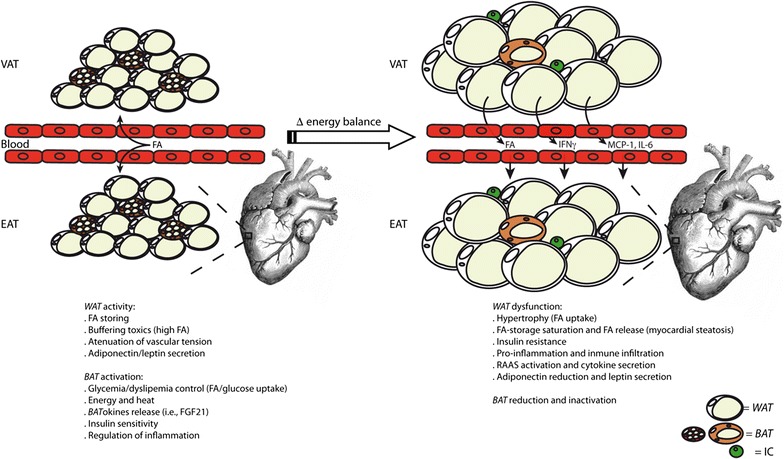
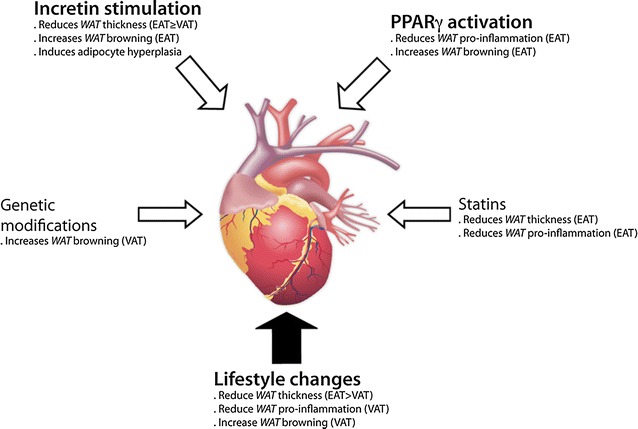
Nowadays, obesity is seriously increasing in most of the populations all over the world, and is associated with the development and progression of high-mortality diseases such as type-2 diabetes mellitus (T2DM) and its subsequent cardiovascular pathologies. Recent data suggest that both body fat distribution and adipocyte phenotype, can be more determinant for fatal outcomes in obese patients than increased general adiposity. In particular, visceral adiposity is significantly linked to long term alterations on different cardiac structures, and in developed forms of myocardial diseases such as hypertensive and ischaemic heart diseases, and diabetic cardiomyopathy. Interestingly, this depot may be also related to epicardial fat accumulation through secretion of lipids, adipokines, and pro-inflammatory and oxidative factors from adipocytes. Thus, visceral adiposity and its white single-lipid-like adipocytes, are risk factors for different forms of heart disease and heart failure, mainly in higher degree obese subjects. However, under specific stimuli, some of these adipocytes can transdifferentiate to brown multi-mitochondrial-like adipocytes with anti-inflammatory and anti-apoptotic proprieties. Accordingly, in order to improve potential cardiovascular abnormalities in obese and T2DM patients, several therapeutic strategies have been addressed to modulate the visceral and epicardial fat volume and phenotypes. In addition to lifestyle modifications, specific genetic manipulations in adipose tissue and administration of PPARγ agonists or statins, have improved fat volume and phenotype, and cardiovascular failures. Furthermore, incretin stimulation reduced visceral and epicardial fat thickness whereas increased formation of brown adipocytes, alleviating insulin resistance and associated cardiovascular pathologies.
Overview
The claims and statistics of this paper haven’t been checked yet.
Run the check — free, no account needed. It reads the open-access text and checks the sources it cites.
Integrity signals
Registry
Cites
Statistics
Figures
Verification
Claims the paper makes
The claims and statistics of this paper haven’t been checked yet.
Run the check — free, no account needed. It reads the open-access text and checks the sources it cites.
Claims other papers make about this one
Each is checked against this paper’s own text: does it say what the citing paper says it does?
In the citing paper
“More specifically, treatments ameliorating the altered composition and distribution of fat stores may produce the best results [117].”
From Dysregulated epicardial adipose tissue as a risk factor and potential therapeutic target of heart failure with preserved ejection fraction in diabetes (2022) · cites this paper as [117]
Self-check
Percentages, sums and reported differences re-computed from the paper’s own numbers.
The self-check needs the paper’s full text.
Citations
Cites
Child abuse: Adolescent records vs. adult recall
Femina, D. D., Yeager, C. A., & Lewis, D. O. (1990) · Child Abuse & Neglect · doi:10.1016/0145-2134(90)90033-p · Cited by 8,820
Brown Adipose Tissue: Function and Physiological Significance
CANNON, B., & NEDERGAARD, J. (2004) · Physiological Reviews · doi:10.1152/physrev.00015.2003 · Cited by 6,433
Mechanisms of fatty acid-induced inhibition of glucose uptake.
Boden, G., Chen, X., Ruiz, J., White, J. V., & Rossetti, L. (1994) · Journal of Clinical Investigation · doi:10.1172/jci117252 · Cited by 3,720
European Guidelines for Obesity Management in Adults
Yumuk, V., Tsigos, C., Fried, M., Schindler, K., Busetto, L., Micic, D., & Toplak, H. (2015) · Obesity Facts · doi:10.1159/000442721 · Cited by 3,432
Fox, C. S., Massaro, J. M., Hoffmann, U., Pou, K. M., Maurovich-Horvat, P., Liu, C.-Y., Vasan, R. S., Murabito, J. M., Meigs, J. B., Cupples, L. A., et al. (2007) · Circulation · doi:10.1161/circulationaha.106.675355 · Cited by 2,882 · cited 1×
“However, excessive VAT was more pathogenic than overloaded subcutaneous fat, since VAT closely linked to cardiometabolic abnormalities [12].”
BackgroundExcess Deaths Associated With Underweight, Overweight, and Obesity
Flegal, K. M. (2005) · JAMA · doi:10.1001/jama.293.15.1861 · Cited by 2,811
Pathophysiology of human visceral obesity: an update
Tchernof, A., & Després, J.-P. (2013) · Physiological Reviews · doi:10.1152/physrev.00033.2011 · Cited by 2,583 · cited 1×
“The main etiological factors include age, gender, sex and growth hormones, the endocannabinoid and hypothalamus–pituitary–adrenal systems, glucocorticoids, nutritional factors, and physical activity [23].”
BackgroundPrdm16 determines the thermogenic program of subcutaneous white adipose tissue in mice
Seale, P., Conroe, H. M., Estall, J. L., Kajimura, S., Frontini, A., Ishibashi, J., Cohen, P., Cinti, S., & Spiegelman, B. M. (2010) · Journal of Clinical Investigation · doi:10.1172/jci44271 · Cited by 1,273 · cited 1×
“Transgenic overexpression of PRDM-16 in subcutaneous WAT protected mice from diet-induced obesity and insulin resistance [84].”
BackgroundWang, Y., Rimm, E. B., Stampfer, M. J., Willett, W. C., & Hu, F. B. (2005) · American Journal of Clinical Nutrition · doi:10.1093/ajcn/81.3.555 · Cited by 1,130 · cited 1×
“In this sense, VAT accumulation has been correlated with increasing incidence of T2DM, T2DM-associated chronic low-grade inflammation, atherogenic dyslipidemia, and hypertension [13, 14].”
BackgroundThe effects of LY2405319, an FGF21 analog, in obese human subjects with type 2 diabetes
Gaich, G., Chien, J. Y., Fu, H., Glass, L. C., Deeg, M. A., Holland, W. L., Kharitonenkov, A., Bumol, T., Schilske, H. K., & Moller, D. E. (2013) · Cell Metabolism · doi:10.1016/j.cmet.2013.08.005 · Cited by 885 · cited 1×
“Also, administration of FGF21 in humans improved hyperlipidemia by lowering plasma TAG and LDL-C levels, while increasing HDL-C levels [61].”
Background
Research works printed but not linked: 1
- Quintero-Castillo D, Luz-Araujo H, Guerra-Velázquez M, Reyna-Villasmil E, Santos Bolívar J, Torres-Cepeda D, et al. Lipid profile in obese and non-obese women with polycystic ovary syndrome treated with metformin. Endocrinol Nutr Organo Soc Espanola Endocrinol Nutr. 2010;57:262–7.
Cited by
Sorted by citations
Items 201–210 of 210
Correlation Between Epicardial Adipose Tissue and PET Cardiac Perfusion: A Systematic Review
Dondi, F., Bellini, P., Bertoli, M., Viganò, G. L., Rinaldi, R., Camoni, L., Cossandi, M., Vizzardi, E., Lombardi, C. M., & Bertagna, F. (2026) · Medical Sciences · doi:10.3390/medsci14020194
“…as overt diabetes, the contribution of EAT may be partially overshadowed by more pervasive and potent mechanisms—including chronic hyperglycemia, advanced glycation end-products, diffuse microvascular remodeling, and autonomic dysfunction—which independently impair coronary flow regulation [32].”
Molani‐Gol, R., Aftabi‐Yousefabad, S., Azarsina, G., Shanehbandi, D., Malekian, M., Jafarabadi, M. A., & Rafraf, M. (2026) · Genes & Nutrition · doi:10.1186/s12263-026-00802-2
de Melo, D. G., Ramos, C. O., Rodrigues, V. C. D. C., Pereira, G. J. D. S., Brícola, R. S., Cintra, D. E., & de Moura, L. P. (2026) · Life Sciences · doi:10.1016/j.lfs.2026.124546
Yin, Y., Guo, S., & Jiao, X. (2026) · Pathology - Research and Practice · doi:10.1016/j.prp.2026.156601
Physiotherapy and Rehabilitation in Menopause
Demirtürk, F. (2026) · Springer eBooks · doi:10.1007/978-3-032-28741-0_21
Đuzel, A., Rotkvić, P. G., Babić, Z., Šipoš, I. H., Bekić, M., Bratičević, M. N., Rotkvić, L., & Berković, M. C. (2026) · Medicina · doi:10.3390/medicina62071402
Assessment of Some Immunological Parameters Among Ischemic Heart Disease in Iraqi Patients
Almadany, Z. M., & Shwaikh, A. K. (2026) · Medical Journal of Babylon · doi:10.4103/mjbl.mjbl_1738_23
Miao, G., Li, Z., Zhang, L., Xu, Y., Wang, Z., Wang, Z. Q., Xian, A., Zheng, L., Chen, J., Han, Y., et al. (2026) · MedComm · doi:10.1002/mco2.71003
“Given the established link between adipocyte dysfunction, obesity, and T2DM, often involving PPAR γ dysregulation [ 31–34 ], we further examined the clinical relevance of this relationship using human adipose single-cell RNA-seq datasets.”
Wang, Q., Yan, Z., Liang, Y., Chen, Q., Yang, M., Cheng, J., Pan, Y., Shao, J., Zheng, Q., & Du, C. (2026) · Research Square · doi:10.21203/rs.3.rs-10624159/v1
Liao, Y., Xu, S., Liao, Z., & Guo, J. (2026) · Frontiers in Immunology · doi:10.3389/fimmu.2026.1895204
“Based on ultrastructure and function, they are primarily classi fi ed into energy-storing WAT and energy-dissipating, thermogenic BAT (36, 37).”
Metadata
- Authors
- González, N., Moreno-Villegas, Z., González-Bris, A., Egido, J., & Lorenzo, Ó.
- Affiliations
- Centro de Investigación Biomédica en Red Diabetes y Enfermedades Metabólicas Asociadas (ES)
- Hospital Universitario Fundación Jiménez Díaz (ES)
- Corresponding author
- Lorenzo, Ó.
- Venue
- Cardiovascular Diabetology
- Published
- 2017-04-04
- Volume
- 16
- Issue
- 1
- Pages
- 44-44
- ISSN
- 1475-2840 (ISSN-L)
- PMC
- PMC5379721
- OpenAlex
- W2604392184
- Cited by
- 211
- References
- 124
- Citations by year
- 2026: 15 · 2025: 12 · 2024: 28 · 2023: 14 · 2022: 29 · 2021: 30 · 2020: 29 · 2019: 22 · 2018: 24 · 2017: 5
- FWCI
- 3.08
- Type
- journal article
- Language
- en
- Open access
- gold
- doi.org
- Licence
- cc-by
- Locations
- Cardiovascular Diabetology (publishedVersion, cc-by)
- PubMed Central (publishedVersion, cc-by)
- PubMed (publishedVersion)
- DOAJ (DOAJ: Directory of Open Access Journals) (submittedVersion)
- Funders
- Banco de Santander-Universidad Autónoma (CEAL-AL/2015-17)
- Esteve Laboratories (2017)
- ISCarlos III (PI14/00386, PIE13/00051)
- Topics
- Health Sciences › Medicine › Cardiology and Cardiovascular Medicine › Cardiovascular Disease and Adiposity
- Health Sciences › Medicine › Endocrinology, Diabetes and Metabolism › Adipokines, Inflammation, and Metabolic Diseases
- Health Sciences › Medicine › Physiology (medical) › Adipose Tissue and Metabolism
- Keywords
- visceral adipose tissue, epicardial adipose tissue, obesity, type 2 diabetes, cardiovascular disease, diabetic cardiomyopathy, adipocyte phenotype, brown adipocytes, adipokines, PPARγ agonists, statins, incretin-based therapy, insulin resistance, heart failure, body fat distribution
- MeSH terms
- Adipose Tissue, Adipose Tissue, Brown, Cardiovascular Diseases, Diabetes Mellitus, Type 2, Humans, Obesity, Pericardium, Intra-Abdominal Fat, Incretins
About these checks
Registry, retraction, Cites and statistics results are computed, not judged, with one exception: a printed reference that no index lists is read once by a model before it counts as a citation error. Claims are extracted by a model and kept only when their quote appears verbatim in the text; each cited source is then checked, with a model’s help, for whether it says what the claim relies on. Those verdicts can be wrong — read the claim’s quote and the cited source before relying on one.
Statistics and arithmetic are recomputed, not judged.
Confidence bands are shown only for fields calibrated on our annotated test set. None is calibrated yet, so no band is shown.
What counts as a claim ›How we measure confidence ›How we check this ›
Are you an author, or do you see a problem with this page? Request a review
