

Cardiovascular risk reduction with once-weekly semaglutide in subjects with type 2 diabetes: a post hoc analysis of gender, age, and baseline CV risk profile in the SUSTAIN 6 trial
Open accessThe DOI matches its Crossref record; 37 of the 37 references it cites were found in a registry or an index.
Abstract
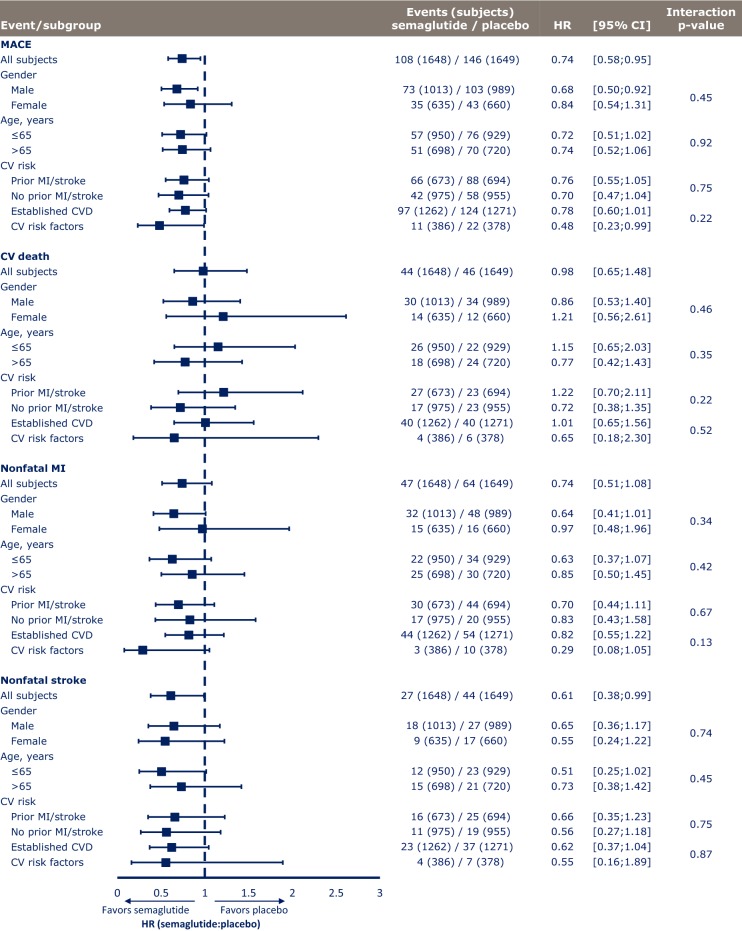
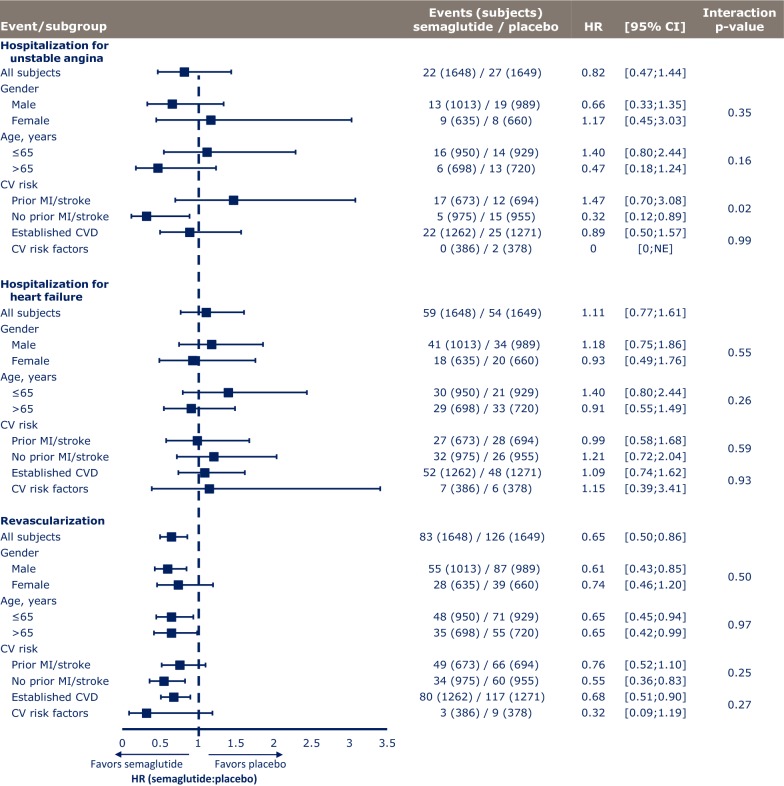
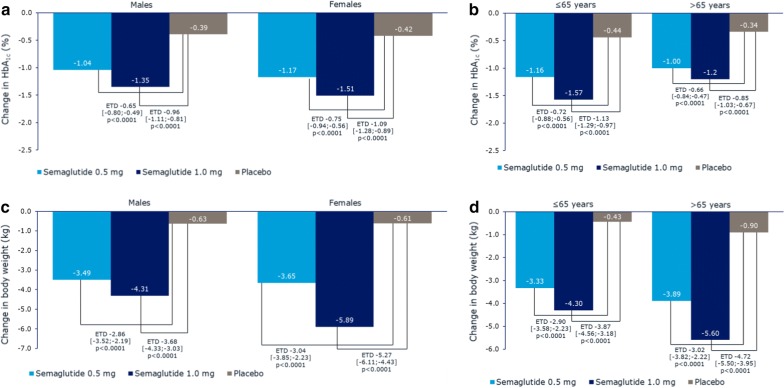
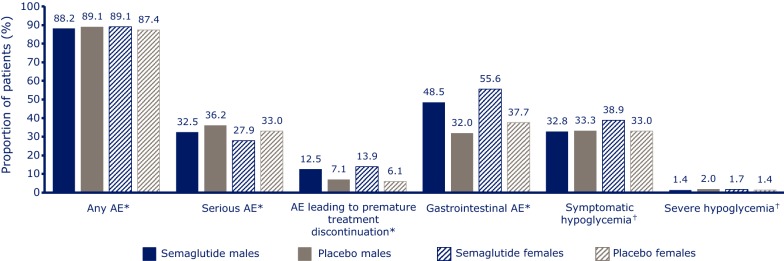
Background: The SUSTAIN 6 trial demonstrated that once-weekly semaglutide (0.5 and 1.0 mg) significantly reduced major adverse cardiovascular (CV) events (MACE) vs placebo in subjects with type 2 diabetes (T2D) and high CV risk. The effects of gender, age and baseline CV risk on outcomes are important considerations for further study. Methods: Subjects were grouped according to gender, age (50–65 years and > 65 years), and CV risk profile at baseline (prior myocardial infarction [MI] or stroke vs no prior MI or stroke, and established CV disease [CVD] vs CV risk factors alone, including subjects with chronic kidney disease). Time to MACE and its individual components (CV death, nonfatal MI, nonfatal stroke), hospitalization for unstable angina or heart failure, and revascularization (coronary and peripheral) were analyzed for all subgroups. Additional analyses were performed for gender and age to investigate change from baseline in HbA 1c and body weight, as well as tolerability. Results: A total of 3297 subjects were included. The majority of subjects (60.7%) were male; 43% were > 65 years of age; 41.5% had a history of MI or stroke; and 76.8% had established CVD. Compared with placebo, semaglutide reduced the risk of the first occurrence of MACE and each MACE component consistently across all subgroups (gender, age, and baseline CV risk profile). Revascularizations, HbA 1c and body weight were also reduced consistently across all subgroups compared with placebo. Gastrointestinal adverse events in all treatment groups were more common among women than men, but rates of premature treatment discontinuation were similar for both genders. Conclusions: In this post hoc analysis of SUSTAIN 6, once-weekly semaglutide vs placebo reduced the risk of MACE in all subjects included in the trial, regardless of gender, age, or baseline CV risk profile. Trial registry Clinicaltrials.gov, Identifying number: NCT01720446, Date of registration: October 29, 2012
Overview
The claims and statistics of this paper haven’t been checked yet.
Free: it reads the open-access text and checks the first 5 claims that cite a source we can check. Create a free account to check every claim.
Integrity signals
Registry
Cites
Statistics
Figures
Verification
Claims the paper makes
The claims and statistics of this paper haven’t been checked yet.
Free: it reads the open-access text and checks the first 5 claims that cite a source we can check. Create a free account to check every claim.
Claims other papers make about this one
Each is checked against this paper’s own text: does it say what the citing paper says it does?
The source backs part of the claim, not all of it — or backs it for a different population, condition or comparison.
In the citing paper
“Data from clinical trials are inconclusive regarding CV protection in men and women treated with GLP-1 RA.”
From Real-world sex differences in type 2 diabetes patients treated with GLP-1 receptor agonists (2024) · cites this paper as [21]
Experimental — accuracy not yet measuredThe cited source says what the claim attributes to it.
In the citing paper
“In a post hoc analysis of the SUSTAIN 6 trial (once weekly semaglutide vs. placebo), in which 76.8 % of the subjects had established CVD, semaglutide reduced the risk of MACE regardless of sex.”
From Real-world sex differences in type 2 diabetes patients treated with GLP-1 receptor agonists (2024) · cites this paper as [21]
In the citing paper
“The effect of semaglutide on nonfatal stroke did not differ according to the participants' age, sex, history of CVD or importantly, MI/stroke history (P interaction =0.75).42”
From Benefits of GLP-1 (Glucagon-Like Peptide 1) Receptor Agonists for Stroke Reduction in Type 2 Diabetes: A Call to Action for Neurologists (2022) · cites this paper as [42]
In the citing paper
“Also, the rate of treatment discontinuation did not differ between men and women [21].”
From Real-world sex differences in type 2 diabetes patients treated with GLP-1 receptor agonists (2024) · cites this paper as [21]
Self-check
Percentages, sums and reported differences re-computed from the paper’s own numbers.
The self-check needs the paper’s full text.
Citations
Cites
Cook, R. J., Dickens, B. M., & Fathalla, M. F. (2003) · Reproductive Health and Human Rights · doi:10.1093/acprof:oso/9780199241323.003.0025 · Cited by 10,769
Standards of Medical Care in Diabetes
Power, D. (2006) · Diabetes Care · doi:10.2337/diacare.29.02.06.dc05-1593 · Cited by 8,673
Liraglutide and Cardiovascular Outcomes in Type 2 Diabetes
Marso, S. P., Daniels, G. H., Brown-Frandsen, K., Kristensen, P., Mann, J. F. E., Nauck, M. A., Nissen, S. E., Pocock, S., Poulter, N. R., Ravn, L. S., et al. (2016) · New England Journal of Medicine · doi:10.1056/nejmoa1603827 · Cited by 7,629 · cited 1×
“All currently approved injectable GLP-1RAs have demonstrated CV safety (non-inferiority) in CVOTs [12, 19–23], but only four have demonstrated both CV safety and superiority relative to standard of care [12, 20, 22, 23].”
BackgroundSemaglutide and Cardiovascular Outcomes in Patients with Type 2 Diabetes
Marso, S. P., Bain, S. C., Consoli, A., Eliaschewitz, F. G., Jódar, E., Leiter, L. A., Lingvay, I., Rosenstock, J., Seufert, J., Warren, M. L., et al. (2016) · New England Journal of Medicine · doi:10.1056/nejmoa1607141 · Cited by 6,900 · cited 7×
“HbA1c and body weight were reported separately for both semaglutide doses following the statistical methods used in the primary SUSTAIN 6 trial [12].”
BackgroundMethodResultInfluentialSelf-citationThe Emerging Risk Factors Collaboration (2010) · The Lancet · doi:10.1016/s0140-6736(10)60484-9 · Cited by 5,125
Davies, M. J., D’Alessio, D. A., Fradkin, J., Kernan, W. N., Mathieu, C., Mingrone, G., Rossing, P., Tsapas, A., Wexler, D. J., & Buse, J. B. (2018) · Diabetes Care · doi:10.2337/dci18-0033 · Cited by 3,518
(2001) · Journal of Obstetrics and Gynaecology Research · doi:10.1111/j.1447-0756.2001.tb01222.x · Cited by 3,461
Lixisenatide in Patients with Type 2 Diabetes and Acute Coronary Syndrome
Pfeffer, M. A., Claggett, B., Diaz, R., Dickstein, K., Gerstein, H. C., Køber, L. V., Lawson, F. C., Ping, L., Wei, X., Lewis, E. F., et al. (2015) · New England Journal of Medicine · doi:10.1056/nejmoa1509225 · Cited by 2,409
Effects of once-weekly exenatide on cardiovascular outcomes in type 2 diabetes
Holman, R. R., Bethel, M. A., Mentz, R. J., Thompson, V. P., Lokhnygina, Y., Buse, J. B., Chan, J. C., Choi, J., Gustavson, S. M., Iqbal, N., et al. (2017) · New England Journal of Medicine · doi:10.1056/nejmoa1612917 · Cited by 2,162
Research works printed but not linked: 2
- International Conference on Harmonisation-World Health Organization Guideline for Good Clinical Practice. ICH harmonised tripartite guideline good clinical practice 2016. https://www.ich.org/products/guidelines/efficacy/efficacy-single/article/integrated-addendum-good-clinical-practice.html. Accessed 22 Mar 2019.
- Eli Lilly Press release, 2018. Trulicity® (dulaglutide) demonstrates superiority in reduction of cardiovascular events for broad range of people with type 2 diabetes. https://investor.lilly.com/node/39796/pdf. Accessed May 2018.
Cited by
Items 101–169 of 169
Toma de posición sobre los agonistas del receptor de GLP-1
Giménez, S., Piskorz, D. L., Demaría, D. M., Nanfara, S. G., Lorenzatti, A. J., Zapata, G., Aguinaga, L., & Perna, E. R. (2021) · Revista de la Federación Argentina de Cardiología · doi:10.63600/2c4sqe18 · Cited by 2
Bain, S. C., Bakhai, A., Evans, M., Green, A., Menown, I. B. A., & Strain, W. D. (2019) · Diabetic Medicine · doi:10.1111/dme.14172 · Cited by 2
Self-citationLandgraf, R., Aberle, J., Birkenfeld, A. L., Gallwitz, B., Kellerer, M., Klein, H., Müller‐Wieland, D., Nauck, M. A., Reuter, H., & Siegel, E. G. (2020) · Der Diabetologe · doi:10.1007/s11428-020-00608-9 · Cited by 2
A sex-specific Mendelian randomization-phenome-wide association study of body mass index
Jiesisibieke, Z. L., Chan, I. I., Ng, J. C. M., & Schooling, C. M. (2025) · eLife · doi:10.1101/2024.09.12.24313524 · Cited by 1
“Trials of incretins have clearly indicated many benefits of weight loss particularly for older people (Leiter et al., 2019; Lincoff et al., 2023).”
BackgroundZhao, W., Niu, X., Zhou, X., Shi, R., & Zhou, X. (2025) · Elsevier eBooks · doi:10.1016/b978-0-443-33885-4.00007-x · Cited by 1
Bogomolov, A. N., Николаевна, К. О., Kozlov, K. L., & Golikova, E. N. (2025) · Russian Journal of Geriatric Medicine · doi:10.37586/2686-8636-4-2025-546-556 · Cited by 1
AGRAWAL, S., Sahu, L., Motiramani, N., Choudhary, A., & Agrawal, A. (2026) · International Journal of Current Pharmaceutical Research · doi:10.22159/ijcpr.2026v18i3.9041 · Cited by 1
Inflammation in atherosclerosis: Drivers, mechanisms and therapies
Su, Z., & Xu, S. (2026) · Acta Pharmaceutica Sinica B · doi:10.1016/j.apsb.2026.06.047 · Cited by 2
Obesity Management and Prevention of Cardiovascular Disease
Gazda, C., & Almandoz, J. P. (2020) · Contemporary cardiology · doi:10.1007/978-3-030-56279-3_7 · Cited by 1
Methods of treatment of obesity in patients with type 2 diabetes
Pasek, I., Wiska, L., Kopytko, P., & Banach, B. (2021) · Farmacja Polska · doi:10.32383/farmpol/142112 · Cited by 1
Pradas, N. C. (2021) · doi:10.52102/paciente_invisible/art-3 · Cited by 1
A diabetic patient at the urological clinic
Piťhová, P. (2021) · Urologie pro praxi · doi:10.36290/uro.2021.032 · Cited by 1
Landgraf, R., Aberle, J., Birkenfeld, A. L., Gallwitz, B., Kellerer, M., Klein, H. H., Müller‐Wieland, D., Nauck, M. A., Wiesner, T., & Siegel, E. G. (2024) · Die Diabetologie · doi:10.1007/s11428-023-01144-y · Cited by 1
“In der kürzlich erschienenen Post-hoc-Analyse der SUSTAIN 6-Studie fand sich für Semaglutid 1-mal wöchentlich s.c. vs.PlaceboeineRisikoreduktionvonMACE in allen Studienteilnehmern unabhängig vonGeschlecht,AlteroderdemzuStudien-beginn vorhandenen kardiovaskulären Ri-sikoprofil [379].”
Ozempic no emagrecimento: um novo paradigma no tratamento da Obesidade
Oliveira, P. R. P. F. D., Siqueira, M. B., Poloni, A. P. B., Maldonado, J. V. D. O., Oliveira, S. M., Lucena, M. T., Santos, L. A., Ferreira, P. F. C. L., Gonçalves, J. M. D. V., Pessôa, F. S., et al. (2024) · Caderno Pedagógico · doi:10.54033/cadpedv21n8-107 · Cited by 1
Hamayal, M., Akhtar, C. H., Ahmad, N., Awwab, M., Shahid, W., Abbasi, H. S., Nadeem, E., Siddiqui, E., Zafar, W., & Hussain, S. (2025) · American Journal of Cardiovascular Drugs · doi:10.1007/s40256-025-00727-y · Cited by 1
“The 2021 American Diabetes Association guidelines recommend that either glucagon-like peptide-1 receptor agonists (GLP-1 RAs) or sodium-glucose cotransporter-2 inhibitors be added to metformin if there is a risk of CVD or CKD or a need for weight control [3, 4].”
A sex-specific Mendelian randomization-phenome-wide association study of body mass indexPreprint
Jiesisibieke, Z. L., Chan, I. I., Ng, J. C. M., & Schooling, C. M. (2025) · eLife · doi:10.7554/elife.102573 · Cited by 1
“Trials of incretins have clearly indicated many benefits of weight loss particularly for older people ( Leiter et al., 2019 ; Lincoff et al., 2023 ).”
New Care and Aging Dynamics in China
Powell, J. L. (2019) · Clinical Research Open Access · doi:10.16966/2469-6714.150
“In several studies, Gender is the risk to develop heart failure (male>female) among T2DM [6].”
Background¿Cómo contribuyen los AR GLP-1 a las poblaciones de mayor riesgo?
Giménez, S. (2021) · Revista de la Federación Argentina de Cardiología · doi:10.63600/7yc0ra48
Allyan, F. (2021) · Israa University Journal for Applied Science · doi:10.52865/fuvr5221
¿Más posibilidades de control para el paciente invisible?
Teixidó, C. H. (2021) · doi:10.52102/paciente_invisible/art-5
Paciente frágil con diabetes durante la pandemia
Rivera, A. M. (2021) · doi:10.52102/paciente_invisible/art-1
Landgraf, R., Aberle, J., Birkenfeld, A. L., Gallwitz, B., Kellerer, M., Klein, H. H., Müller‐Wieland, D., Nauck, M. A., Reuter, H., & Siegel, E. G. (2021) · Der Diabetologe · doi:10.1007/s11428-021-00765-5
Varadhan, L., Saravanan, P., Ali, S. N., Hanif, W., & Patel, V. (2022) · British Journal of Diabetes · doi:10.15277/bjd.2022.385
Alul- és túlkezelés az idős cukorbeteg gondozása során
Domboróczki, Z., & Molnár, G. A. (2022) · Diabetologia Hungarica · doi:10.24121/dh.2022.27
Beneficios cardiovasculares del semaglutide: un nuevo agonista del GLP-1
Ortega, J. P. G., Ramón, S. M. Q., Panamá, J. C. P., Cajas, J. I. P., Pineda, E. G. R., Sacoto, E. P. L., Masache, G. A. R., Delgado, A. M. G., Calle, M. E. R., & Quizhpi, P. F. B. (2023) · Zenodo (CERN European Organization for Nuclear Research) · doi:10.5281/zenodo.7702783
Embedding guidelines into clinical practice
Winter, J. (2023) · Practical Diabetes · doi:10.1002/pdi.2447
Brun, E. (2023) · The Journal of AMD · doi:10.36171/jamd23.26.2.10
Gil, F. M. A. (2023) · Diabetes práctica · doi:10.52102/diabet/pract.proteccionholistica.art3
Diabeteses nők cardiovascularis kockázata
Ábel, T. (2024) · Lege Artis Medicinae · doi:10.33616/lam.34.0033
Davies, M. J., Drexel, H., Jornayvaz, F. R., Pataky, Z., Seferovic, P. M., & Wanner, C. (2022) · Figshare · doi:10.6084/m9.figshare.20438489
A Sex-specific Mendelian Randomization-Phenome-Wide Association Study of Body Mass IndexPreprint
Jiesisibieke, Z. L., Chan, I. I., Ng, J. C. M., & Schooling, C. M. (2024) · eLife · doi:10.7554/elife.102573.1
A Sex-specific Mendelian Randomization-Phenome-Wide Association Study of Body Mass IndexPreprint
Jiesisibieke, Z. L., Chan, I. I., Ng, J. C. M., & Schooling, C. M. (2025) · eLife · doi:10.7554/elife.102573.2
Jiesisibieke, Z. L., Chan, I. I., Ng, J. C. M., & Schooling, C. M. (2025) · eLife · doi:10.7554/elife.102573.3.sa2
Tirzepatide: Responders vs. Non-Responders
Singh, A., & Singh, A. K. (2025) · Clinical Diabetology · doi:10.5603/cd.106515
Consensus Guidelines for the Screening and Management of Diabetic Retinopathy in the Gulf Region
Alawadi, F., Qassimi, N. A., ElBadawi, H., AlBloushi, A. F., Aldhafiri, Y. M., Alessa, T., Malik, R. A., Pai, A., Raef, H., Alsatrawi, A. B., et al. (2025) · Journal of Diabetes and Endocrine Practice · doi:10.1055/s-0045-1814081
“71,72 A retrospective analysis (TriNetX) has shown that GLP1-RA with insulin is associated with a higher risk of DR and DME compared with SGLT2i with insulin.”
Alfayez, O. M., Almohammed, O. A., Alkhezi, O. S., Almutairi, A. R., & Al Yami, M. S. (2020) · Figshare · doi:10.6084/m9.figshare.12545036
Alfayez, O. M., Almohammed, O. A., Alkhezi, O. S., Almutairi, A. R., & Yami, M. S. A. (2020) · Figshare · doi:10.6084/m9.figshare.12544994
Husain, M., Bain, S. C., Holst, A. G., Mark, T., Rasmussen, S., & Lingvay, I. (2020) · Figshare · doi:10.6084/m9.figshare.13031555
Self-citationHusain, M., Bain, S. C., Holst, A. G., Mark, T., Rasmussen, S., & Lingvay, I. (2020) · Figshare · doi:10.6084/m9.figshare.13031567
Self-citationAlfayez, O. M., Almohammed, O. A., Alkhezi, O. S., Almutairi, A. R., & Yami, M. S. A. (2020) · Figshare · doi:10.6084/m9.figshare.12545009
Husain, M., Bain, S. C., Holst, A. G., Mark, T., Rasmussen, S., & Lingvay, I. (2020) · Figshare · doi:10.6084/m9.figshare.13031546
Self-citationHusain, M., Bain, S. C., Holst, A. G., Mark, T., Rasmussen, S., & Lingvay, I. (2020) · Figshare · doi:10.6084/m9.figshare.13031564
Self-citationHusain, M., Bain, S. C., Holst, A. G., Mark, T., Rasmussen, S., & Lingvay, I. (2020) · Figshare · doi:10.6084/m9.figshare.13031558
Self-citationAlfayez, O. M., Almohammed, O. A., Alkhezi, O. S., Almutairi, A. R., & Yami, M. S. A. (2020) · Figshare · doi:10.6084/m9.figshare.12545018
Husain, M., Bain, S. C., Holst, A. G., Mark, T., Rasmussen, S., & Lingvay, I. (2020) · Figshare · doi:10.6084/m9.figshare.13031549
Self-citationDavies, M. J., Drexel, H., Jornayvaz, F. R., Pataky, Z., Seferović, P. M., & Wanner, C. (2022) · Figshare · doi:10.6084/m9.figshare.20438492
Husain, M., Bain, S. C., Holst, A. G., Mark, T., Rasmussen, S., & Lingvay, I. (2020) · Figshare · doi:10.6084/m9.figshare.13031561
Self-citationNatali, A., Nesti, L., Tricò, D., & Ferrannini, E. (2021) · Figshare · doi:10.6084/m9.figshare.16696428
Funck, K. L., Bjerg, L., Isaksen, A. A., Sandbæk, A., & Grove, E. L. (2024) · Figshare · doi:10.6084/m9.figshare.26552839
Ali, M. U., Mancini, G. B. J., Fitzpatrick‐Lewis, D., Connelly, K. A., O’Meara, E., Zieroth, S., & Sherifali, D. (2024) · Figshare · doi:10.6084/m9.figshare.25231240
Funck, K. L., Bjerg, L., Isaksen, A. A., Sandbæk, A., & Grove, E. L. (2024) · Figshare · doi:10.6084/m9.figshare.26552836
Alfayez, O. M., Almohammed, O. A., Alkhezi, O. S., Almutairi, A. R., & Al Yami, M. S. (2020) · Figshare · doi:10.6084/m9.figshare.12545000
Husain, M., Bain, S. C., Holst, A. G., Mark, T., Rasmussen, S., & Lingvay, I. (2020) · Figshare · doi:10.6084/m9.figshare.13031552
Self-citationDagenais, G. R., Rydén, L., Leiter, L. A., Lakshmanan, M. C., Dyal, L., Probstfield, J. L., Atisso, C. M., Shaw, J. E., Conget, I., Cushman, W. C., et al. (2020) · Figshare · doi:10.6084/m9.figshare.13290505
Self-citationAlfayez, O. M., Almohammed, O. A., Alkhezi, O. S., Almutairi, A. R., & Al Yami, M. S. (2020) · Figshare · doi:10.6084/m9.figshare.12544985
Funck, K. L., Bjerg, L., Isaksen, A. A., Sandbæk, A., & Grove, E. L. (2024) · Figshare · doi:10.6084/m9.figshare.26552842
Husain, M., Bain, S. C., Holst, A. G., Mark, T., Rasmussen, S., & Lingvay, I. (2020) · Figshare · doi:10.6084/m9.figshare.13031570
Self-citationAlfayez, O. M., Almohammed, O. A., Alkhezi, O. S., Almutairi, A. R., & Al Yami, M. S. (2020) · Figshare · doi:10.6084/m9.figshare.12545027
Insights into semaglutide cardiovascular research: Mechanisms, trials, and frontiers
Zhang, J. K., Gao, G., He, M., & Sun, T. (2026) · European Journal of Pharmacology · doi:10.1016/j.ejphar.2026.178921
Goldenberg, R., Trinacty, J., & Ibrahim, C. (2026) · Diabetes Obesity and Metabolism · doi:10.1111/dom.70859
Pagel, P. S., Hang, D., Freed, J. K., & Crystal, G. J. (2026) · Journal of Cardiothoracic and Vascular Anesthesia · doi:10.1053/j.jvca.2026.07.032
Alharajin, R., AlTaweel, M., AlSubaiee, M., Almekhloof, S., Almusaad, A., Alarfaj, A. A., Alkhayyal, A. K., Altharman, N. M., Alalawi, A., Almannai, N., et al. (2026) · Journal of the ASEAN Federation of Endocrine Societies · doi:10.15605/jafes.041.02.6171
“12-14 While both agents are recommended for individuals at high CV or renal risk, it is important to note that real-world data on their comparative effectiveness, particularly when used in combination versus monotherapy, are limited.”
Grenet, G., Eskandari, R., Ko, J., Adams, S. P., Salzwedel, D. M., Heran, B. S., Ambasta, A., Bassett, K., & Thompson, W. (2026) · BMJ Open Diabetes Research & Care · doi:10.1136/bmjdrc-2026-006225
Sotzen, M. R., Byun, S., Ibadin, N. O., Knappenberger, M. A., Bento, M. T., Asker, M., Koshkin, S., Díaz, F. J., & Skibicka, K. P. (2026) · Molecular Metabolism · doi:10.1016/j.molmet.2026.102436
“In addition to or because of the effective weight loss, these medications affect many different organs in the body [2,3].”
Guramol Singh Dhillon, D. R. P. R., Ram, R. P., & Tripathi, S. (2025) · Frontiers in Health Informatics
Diretriz Brasileira de Cardiogeriatria – 2026
Helber, I., Zanon, J. C. D. C., Peixoto, J. M., Caixeta, A. M., Nussbacher, A., de Oliveira, D. C., de Freitas, E. V., Cintra, F. D., Garcia, J. S., Miranda, R. D., et al. (2026) · Arquivos Brasileiros de Cardiologia · doi:10.36660/abc.20260795
Metadata
- Authors
- Leiter, L. A., Bain, S. C., Hramiak, I., Jódar, E., Madsbad, S., Gondolf, T., Hansen, T., Holst, I., & Lingvay, I.
- Affiliations
- St. Michael's Hospital (CA)
- Swansea University (GB)
- Western University (CA)
- Hospital Universitario Quirónsalud Madrid (ES)
- University of Copenhagen (DK)
- Novo Nordisk (Denmark) (DK)
- The University of Texas Southwestern Medical Center (US)
- Corresponding author
- Leiter, Lawrence A.
- Venue
- Cardiovascular Diabetology
- Published
- 2019-06-06
- Volume
- 18
- Issue
- 1
- Pages
- 73-73
- ISSN
- 1475-2840 (ISSN-L)
- PMC
- PMC6551895
- OpenAlex
- W2948579396
- Cited by
- 159
- References
- 37
- Citations by year
- 2026: 13 · 2025: 18 · 2024: 22 · 2023: 22 · 2022: 20 · 2021: 26 · 2020: 33 · 2019: 4
- FWCI
- 17.05
- Type
- journal article
- Language
- en
- Open access
- gold
- doi.org
- Licence
- cc-by
- creativecommons.org/licenses/by/4.0 (tdm)
- creativecommons.org/licenses/by/4.0 (vor)
- Locations
- Cardiovascular Diabetology (publishedVersion, cc-by)
- PubMed Central (publishedVersion, cc-by)
- PubMed (publishedVersion)
- Research at the University of Copenhagen (University of Copenhagen) (publishedVersion, cc-by)
- TSpace (University of Toronto) (submittedVersion, cc-by)
- DOAJ (DOAJ: Directory of Open Access Journals) (submittedVersion)
- Funders
- Novo Nordisk
- Topics
- Health Sciences › Medicine › Endocrinology, Diabetes and Metabolism › Diabetes Treatment and Management
- Health Sciences › Medicine › Endocrinology, Diabetes and Metabolism › Diabetes, Cardiovascular Risks, and Lipoproteins
- Health Sciences › Medicine › Cardiology and Cardiovascular Medicine › Heart Failure Treatment and Management
- Keywords
- semaglutide, type 2 diabetes, major adverse cardiovascular events, cardiovascular risk reduction, SUSTAIN 6 trial, subgroup analysis, gender differences, age, baseline cardiovascular risk, myocardial infarction, stroke, revascularization, heart failure hospitalization, gastrointestinal adverse effects, glycemic control, body weight
- MeSH terms
- Semaglutide, Age Factors, Aged, Cardiovascular Diseases, Diabetes Mellitus, Type 2, Drug Administration Schedule, Glucagon-Like Peptides, Female, Humans, Hypoglycemic Agents, Male, Middle Aged, Risk Factors, Sex Factors, Time Factors, Randomized Controlled Trials as Topic, Treatment Outcome, Clinical Trials, Phase III as Topic, Risk Assessment, Incretins, Protective Factors
About these checks
Registry, retraction, Cites and statistics results are computed, not judged, with one exception: a printed reference that no index lists is read once by a model before it counts as a citation error. Claims are extracted by a model and kept only when their quote appears verbatim in the text; each cited source is then checked, with a model’s help, for whether it says what the claim relies on. Those verdicts can be wrong — read the claim’s quote and the cited source before relying on one.
Statistics and arithmetic are recomputed, not judged.
Confidence bands are shown only for fields calibrated on our annotated test set. None is calibrated yet, so no band is shown.
What counts as a claim ›How we measure confidence ›How we check this ›
Are you an author, or do you see a problem with this page? Request a review
Data sources
Bibliographic data: Semantic Scholar, OpenAlex, Crossref.
Contains information from the Semantic Scholar Academic Graph Datasets, made available under the ODC Attribution License (ODC-BY 1.0).
Semantic Scholar’s data is described in: Kinney, R., et al. (2023). The Semantic Scholar Open Data Platform. arXiv:2301.10140.
