

The DOI matches its Crossref record; 178 of the 179 references it cites were found in a registry or an index.
Predictive and diagnostic biomarkers for gestational diabetes and its associated metabolic and cardiovascular diseases
Open accessAbstract
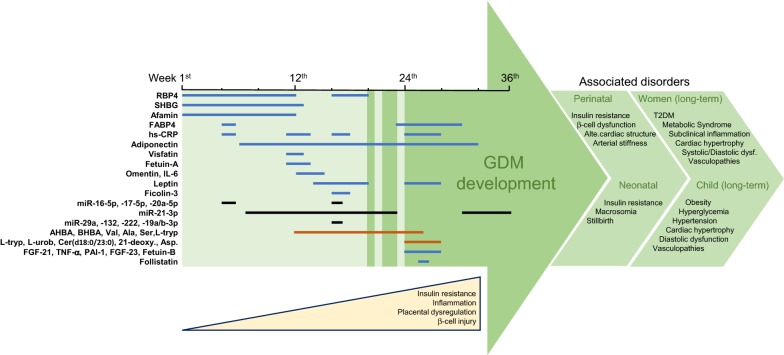
Gestational diabetes mellitus (GDM) is defined as the presence of high blood glucose levels with the onset, or detected for the first time during pregnancy, as a result of increased insulin resistance. GDM may be induced by dysregulation of pancreatic β-cell function and/or by alteration of secreted gestational hormones and peptides related with glucose homeostasis. It may affect one out of five pregnancies, leading to perinatal morbidity and adverse neonatal outcomes, and high risk of chronic metabolic and cardiovascular injuries in both mother and offspring. Currently, GDM diagnosis is based on evaluation of glucose homeostasis at late stages of pregnancy, but increased age and body-weight, and familiar or previous occurrence of GDM, may conditionate this criteria. In addition, an earlier and more specific detection of GDM with associated metabolic and cardiovascular risk could improve GDM development and outcomes. In this sense, 1st–2nd trimester-released biomarkers found in maternal plasma including adipose tissue-derived factors such as adiponectin, visfatin, omentin-1, fatty acid-binding protein-4 and retinol binding-protein-4 have shown correlations with GDM development. Moreover, placenta-related factors such as sex hormone-binding globulin, afamin, fetuin-A, fibroblast growth factors-21/23, ficolin-3 and follistatin, or specific micro-RNAs may participate in GDM progression and be useful for its recognition. Finally, urine-excreted metabolites such as those related with serotonin system, non-polar amino-acids and ketone bodies, may complete a predictive or early-diagnostic panel of biomarkers for GDM.
Overview
The claims and statistics of this paper haven’t been checked yet.
Run the check — free, no account needed. It reads the open-access text and checks the sources it cites.
Integrity signals
Registry
Cites
Statistics
Figures
Verification
Claims the paper makes
The claims and statistics of this paper haven’t been checked yet.
Run the check — free, no account needed. It reads the open-access text and checks the sources it cites.
Claims other papers make about this one
Each is checked against this paper’s own text: does it say what the citing paper says it does?
The source backs part of the claim, not all of it — or backs it for a different population, condition or comparison.
In the citing paper
“The greatest hopes are connected with afamine, adiponectin and 1,5-anhydroglucitol [34,35].”
From Gestational Diabetes Mellitus—Recent Literature Review (2022) · cites this paper as [34]
Experimental — accuracy not yet measured
Self-check
Percentages, sums and reported differences re-computed from the paper’s own numbers.
The self-check needs the paper’s full text.
Citations
Cites
Diagnosis and Classification of Diabetes Mellitus
American Diabetes Association (2010) · Diabetes Care · doi:10.2337/dc11-s062 · Cited by 14,094
Standards of Medical Care in Diabetes
Power, D. V. (2006) · Diabetes Care · doi:10.2337/diacare.29.02.06.dc05-1593 · Cited by 8,676
International Association of Diabetes and Pregnancy Study Groups Consensus Panel (2010) · Diabetes Care · doi:10.2337/dc09-1848 · Cited by 5,390
Type 2 diabetes mellitus after gestational diabetes: a systematic review and meta-analysis
Bellamy, L., Casas, J.-P., Hingorani, A. D., & Williams, D. (2009) · The Lancet · doi:10.1016/s0140-6736(09)60731-5 · Cited by 3,253
Gestational Diabetes and the Incidence of Type 2 Diabetes
Kim, C., Newton, K. M., & Knopp, R. H. (2002) · Diabetes Care · doi:10.2337/diacare.25.10.1862 · Cited by 2,276
ACOG Practice Bulletin No. 190: Gestational Diabetes Mellitus
(2018) · Obstetrics & Gynecology · doi:10.1097/aog.0000000000002501 · Cited by 1,820
Physiological changes in pregnancy
Soma-Pillay, P., Nelson-Piercy, C., Tolppanen, H., & Mebazaa, A. (2016) · Cardiovascular Journal of Africa · doi:10.5830/cvja-2016-021 · Cited by 1,483
Ding, E. L., Song, Y., Malik, V. S., & Liu, S. (2006) · JAMA · doi:10.1001/jama.295.11.1288 · Cited by 1,354
Increasing Prevalence of Gestational Diabetes Mellitus
Ferrara, A. (2007) · Diabetes Care · doi:10.2337/dc07-s206 · Cited by 1,171
Standards of Medical Care in Diabetes—2017 Abridged for Primary Care Providers
American Diabetes Association (2017) · Clinical Diabetes · doi:10.2337/cd16-0067 · Cited by 999
Cited by
Sorted by citations
Gestational Diabetes Mellitus—Recent Literature Review
Modzelewski, R., Stefanowicz-Rutkowska, M. M., Matuszewski, W., & Bandurska-Stankiewicz, E. M. (2022) · Journal of Clinical Medicine · doi:10.3390/jcm11195736 · Cited by 223
Gestational Diabetes Mellitus and Maternal Immune Dysregulation: What We Know So Far
McElwain, C. J., McCarthy, F. P., & McCarthy, C. (2021) · International Journal of Molecular Sciences · doi:10.3390/ijms22084261 · Cited by 134
Placental Regulation of Energy Homeostasis During Human Pregnancy
Armistead, B., Johnson, E., Vanderkamp, R., Kula-Eversole, E., Kadam, L., Drewlo, S., & Kohan‐Ghadr, H. (2020) · Endocrinology · doi:10.1210/endocr/bqaa076 · Cited by 99
Pathirana, M. M., Lassi, Z. S., Alì, A., Arstall, M. A., Roberts, C. T., & Andraweera, P. H. (2020) · Endocrine · doi:10.1007/s12020-020-02492-1 · Cited by 74
McIntyre, D. H., Kapur, A., Divakar, H., & Hod, M. (2020) · Frontiers in Endocrinology · doi:10.3389/fendo.2020.614533 · Cited by 61
Metadata
- Authors
- Lorenzo-Almorós, A., Hang, T., Peiró, C., Soriano-Guillén, L., Egido, J., Tuñón, J., & Lorenzo, Ó.
- Affiliations
- Instituto de Investigación Sanitaria Fundación Jiménez Díaz (ES)
- Universidad Autónoma de Madrid (ES)
- Centro de Investigación Biomédica en Red Diabetes y Enfermedades Metabólicas Asociadas (ES)
- Hospital Universitario Fundación Jiménez Díaz (ES)
- Corresponding author
- Lorenzo, Ó.
- Venue
- Cardiovascular Diabetology
- Published
- 2019-10-30
- Volume
- 18
- Issue
- 1
- Pages
- 140-140
- ISSN
- 1475-2840 (ISSN-L)
- PMC
- PMC6820966
- OpenAlex
- W2982430392
- Cited by
- 202
- References
- 179
- Citations by year
- 2026: 19 · 2025: 33 · 2024: 35 · 2023: 31 · 2022: 24 · 2021: 29 · 2020: 27 · 2019: 2
- FWCI
- 3.52
- Type
- journal article
- Language
- en
- Open access
- gold
- doi.org
- Locations
- Cardiovascular Diabetology (publishedVersion, cc-by)
- Europe PMC (PubMed Central) (publishedVersion, cc-by)
- PubMed Central (publishedVersion, cc-by)
- PubMed (publishedVersion)
- LA Referencia (Red Federada de Repositorios Institucionales de Publicaciones Científicas) (publishedVersion)
- DOAJ (DOAJ: Directory of Open Access Journals) (submittedVersion, cc-by-sa)
- Hispana (submittedVersion)
- Biblos-e Archivo (Universidad Autónoma de Madrid) (submittedVersion, public-domain)
- Funders
- Fondo de Investigación Sanitaria (ISC-III) and Fondo Europeo de Desarrollo Regional (FEDER). (PI17/01495)
- Topics
- Health Sciences › Medicine › Obstetrics and Gynecology › Gestational Diabetes Research and Management
- Health Sciences › Medicine › Pediatrics, Perinatology and Child Health › Birth, Development, and Health
- Health Sciences › Medicine › Obstetrics and Gynecology › Pregnancy and preeclampsia studies
- Keywords
- gestational diabetes mellitus, biomarkers, early diagnosis, insulin resistance, beta-cell dysfunction, adiponectin, visfatin, omentin-1, FABP4, retinol-binding protein 4, placental hormones, sex hormone-binding globulin, afamin, fetuin-A, fibroblast growth factor, ficolin-3, follistatin, microRNA, urinary metabolites, ketone bodies, serotonin, metabolic risk, cardiovascular risk, offspring outcomes
- MeSH terms
- Blood Glucose, Cardiovascular Diseases, Energy Metabolism, Female, Humans, Predictive Value of Tests, Pregnancy, Prognosis, Risk Factors, Biomarkers, Comorbidity, Diabetes, Gestational, Risk Assessment, MicroRNAs
About these checks
Registry, retraction, Cites and statistics results are computed, not judged, with one exception: a printed reference that no index lists is read once by a model before it counts as a citation error. Claims are extracted by a model and kept only when their quote appears verbatim in the text; each cited source is then checked, with a model’s help, for whether it says what the claim relies on. Those verdicts can be wrong — read the claim’s quote and the cited source before relying on one.
Statistics and arithmetic are recomputed, not judged.
Confidence bands are shown only for fields calibrated on our annotated test set. None is calibrated yet, so no band is shown.
What counts as a claim ›How we measure confidence ›How we check this ›
Are you an author, or do you see a problem with this page? Request a review
