

Cost-effectiveness of GLP-1 receptor agonists versus insulin for the treatment of type 2 diabetes: a real-world study and systematic review
Open accessThe DOI matches its Crossref record; 52 of the 52 references it cites were found in a registry or an index.
Abstract
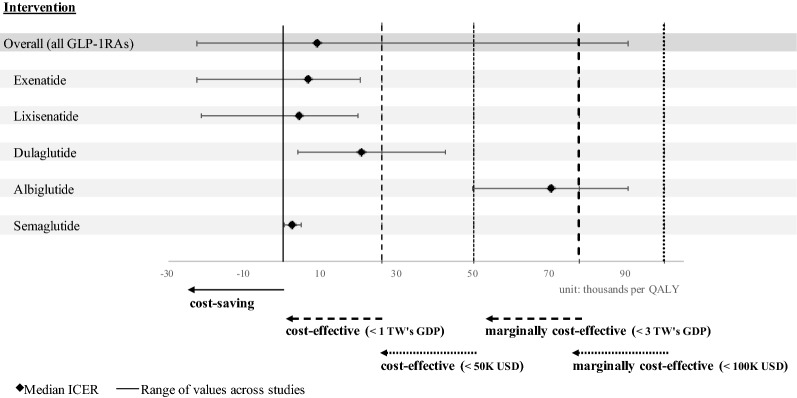
Background: To conduct a real-word-study-based cost-effectiveness analysis of a GLP-1 receptor agonist (GLP-1RA) versus insulin among type 2 diabetes patients requiring intensified injection therapy and a systematic review of cost-effectiveness studies of GLP-1RAs versus insulin. Methods: Individual-level analyses incorporating real-world effectiveness and cost data were conducted for a cohort of 1022 propensity-score-matched pairs of GLP-1RA and insulin users from Taiwan’s National Health Insurance Research Database, 2007–2016. Study outcomes included the number needed to treat (NNT) to prevent one case of clinical events, healthcare costs, and cost per case of event prevented. Costs were in 2019 US dollars. Analyses were performed from a third-party payer and healthcare sector perspectives. Structured systematic review procedures were conducted to synthesize updated evidence on the cost-effectiveness of GLP-1RAs versus insulin. Results: Over a mean follow-up of 2.3 years, the NNT using a GLP-1RA versus insulin to prevent one case of all-cause mortality and hospitalized hypoglycemia was 57 and 30, respectively. Using GLP-1RAs instead of insulin cost US$54,851 and US$29,115 per case of all-cause mortality and hospitalized hypoglycemia prevented, respectively, from the payer perspective, and saved US$19,391 and US$10,293, respectively, from the healthcare sector perspective. Sensitivity analyses showed that the probability of using GLP-1RAs versus insulin being cost-effective for preventing one case of all-cause mortality or hospitalized hypoglycemia ranged from 60 to 100%. The systematic review revealed a cost-effective profile of using GLP-1RAs versus insulin. Conclusions: Using GLP-1RAs versus insulin for type 2 diabetes patients requiring intensified injection therapy in clinical practice is cost-effective.
Overview
The claims and statistics of this paper haven’t been checked yet.
Free: it reads the open-access text and checks the first 5 claims that cite a source we can check. Create a free account to check every claim.
Integrity signals
Registry
Cites
Statistics
Figures
Verification
Claims the paper makes
The claims and statistics of this paper haven’t been checked yet.
Free: it reads the open-access text and checks the first 5 claims that cite a source we can check. Create a free account to check every claim.
Claims other papers make about this one
Each is checked against this paper’s own text: does it say what the citing paper says it does?
The source backs part of the claim, not all of it — or backs it for a different population, condition or comparison.
In the citing paper
“While some pharmacoeconomic studies are available on GLP-1 receptor agonists, the available literature is conflicting and further studies with better economic modeling for data analysis are required.[47][48][49]”
From Tirzepatide: Clinical review of the twincretin injectable (2023) · cites this paper as [48]
Experimental — accuracy not yet measured
Self-check
Percentages, sums and reported differences re-computed from the paper’s own numbers.
The self-check needs the paper’s full text.
Citations
Cites
Cost-Effectiveness in Health and Medicine
(1996) · doi:10.1093/oso/9780195108248.001.0001 · Cited by 7,193
Davies, M. J., D’Alessio, D. A., Fradkin, J., Kernan, W. N., Mathieu, C., Mingrone, G., Rossing, P., Tsapas, A., Wexler, D. J., & Buse, J. B. (2018) · Diabetes Care · doi:10.2337/dci18-0033 · Cited by 3,518 · cited 2×
“and are also the preferred choice for addition to basal insulin for combination injection therapy [3].”
BackgroundResultPertuzumab plus Trastuzumab plus Docetaxel for Metastatic Breast Cancer
Baselga, J., Cortés, J., Kim, S.-B., Im, S.-A., Hegg, R., Im, Y.-H., Roman, L., Pedrini, J. L., Pienkowski, T., Knott, A., et al. (2012) · New England Journal of Medicine · doi:10.1056/nejmoa1113216 · Cited by 2,532
Cost-Effectiveness in Health and Medicine
(2016) · doi:10.1093/acprof:oso/9780190492939.001.0001 · Cited by 1,552
Adjuvant Pertuzumab and Trastuzumab in Early HER2-Positive Breast Cancer
von Minckwitz, G., Procter, M., de Azambuja, E., Zardavas, D., Benyunes, M., Viale, G., Suter, T., Arahmani, A., Rouchet, N., Clark, E., et al. (2017) · New England Journal of Medicine · doi:10.1056/nejmoa1703643 · Cited by 1,411
Taiwan’s National Health Insurance Research Database: past and future
Hsieh, C.-Y., Su, C.-C., Shao, S.-C., Sung, S.-F., Lin, S.-J., Yang Kao, Y.-H., & Lai, E. C.-C. (2019) · Clinical Epidemiology · doi:10.2147/clep.s196293 · Cited by 1,213 · cited 1×
“This database includes patient demographics and all medical service records of disease diagnoses, procedures or surgeries, and prescriptions and medical supplies reimbursed by the NHI program [30].”
MethodCost‐effectiveness acceptability curves – facts, fallacies and frequently asked questions
Fenwick, E., O'Brien, B. J., & Briggs, A. (2004) · Health Economics · doi:10.1002/hec.903 · Cited by 943 · cited 1×
“Cost-effectiveness acceptability curves were then obtained as a summary measure of the joint uncertainty of costs and effectiveness, which indicated the probability of cost-effectiveness at various willingness-to-pay (WTP) thresholds [40].”
Background9. Pharmacologic Approaches to Glycemic Treatment: Standards of Medical Care in Diabetes—2020
American Diabetes Association (2020) · Diabetes Care · doi:10.2337/dc20-s009 · Cited by 914
Heine, R. J., Van Gaal, L. F., Johns, D., Mihm, M. J., Widel, M. H., Brodows, R. G., & for the GWAA Study Group* (2005) · Annals of Internal Medicine · doi:10.7326/0003-4819-143-8-200510180-00006 · Cited by 795
Calculating the number needed to treat for trials where the outcome is time to an event
Altman, D. G., & Andersen, P. K. (1999) · BMJ · doi:10.1136/bmj.319.7223.1492 · Cited by 710
Cited by
Pan, H.-C., Chen, J.-Y., Chen, H.-Y., Yeh, F.-Y., Sun, C.-Y., Huang, T. T.-M., & Wu, V.-C. (2024) · Nature Communications · doi:10.1038/s41467-024-50199-y · Cited by 75
“In addition, the use of GLP-1 RAs has signi fi cantly reduced the risk of mortality, MACE, and MAKE in patients requiring metformin or insulin therapy, suggesting the cost-effectiveness of GLP-1 RAs in these high-risk patients 41 .”
Hamed, K. M., Alosaimi, M. N., Ali, B. A., Alghamdi, A. M., Alkhashi, T., Alkhaldi, S. S., Altowarqi, N. A., Alzahrani, H., Alshehri, A., Alkhaldi, R. K., et al. (2024) · Cureus · doi:10.7759/cureus.68390 · Cited by 96
“This is critical for the long-term viability of these drugs in healthcare [108,117].”
BackgroundAdamou, A. T., Barkas, F., Milionis, H. J., & Ntaios, G. (2024) · International Journal of Stroke · doi:10.1177/17474930241253988 · Cited by 43
“35 Additional cost-effectiveness analyses are needed, including in non-diabetic populations.”
Evans, M., Kuodi, P., Akunna, C. J., McCreedy, N., Donsmark, M., Ren, H., & Nnaji, C. A. (2023) · Diabetes and Vascular Disease Research · doi:10.1177/14791641231221740 · Cited by 33
“39,40 Our evidence, which derives largely from observational, real-world studies, helps to overcome the practical limitations of evidence from RCTs.”
BackgroundYang, C., Yao, W., Ou, H., & Kuo, S. (2023) · Diabetes Research and Clinical Practice · doi:10.1016/j.diabres.2023.110625 · Cited by 18
Self-citationAdamczak, M., Kurnatowska, I., Naumnik, B., Stompór, T. P., Tylicki, L., & Krajewska, M. (2024) · International Journal of Molecular Sciences · doi:10.3390/ijms252312941 · Cited by 21
Longato, E., Camillo, B. D., Sparacino, G., Tramontan, L., Avogaro, A., & Fadini, G. P. (2021) · Cardiovascular Diabetology · doi:10.1186/s12933-021-01414-3 · Cited by 17
“Furthermore, treatment with GLP-1RA could be more cost-effective than insulin therapy [10].”
BackgroundMousavi, A., Shojaei, S., Azarboo, A., Bahri, R. A., Mohammadi, S., Alilou, S., Yousefifar, S., Maleki, S., & Radkhah, H. (2025) · Eating and Weight Disorders - Studies on Anorexia Bulimia and Obesity · doi:10.1007/s40519-025-01770-z · Cited by 14
“Despite the potential benefits of GLP-1RAs, several challenges hinder their implementation in managing WR after bariatric surgery [15, 16].”
Tirzepatide: Clinical review of the twincretin injectable
Krauss, Z., Hintz, A., & Fisk, R. (2023) · American Journal of Health-System Pharmacy · doi:10.1093/ajhp/zxad080 · Cited by 12
Type 2 diabetes and cardiovascular disease: risk reduction and early intervention
Hinnen, D., Kruger, D. F., & MAGWIRE, M. L. (2022) · Postgraduate Medicine · doi:10.1080/00325481.2022.2126235 · Cited by 21
Utilization and cost of non‐insulin glucose‐lowering drugs in Australia from 2013 to 2023
Hamblin, P. S., Earnest, A., Russell, A. W., Talic, S., Zomer, E., & Zoungas, S. (2024) · Diabetes Obesity and Metabolism · doi:10.1111/dom.15893 · Cited by 13
Khan, U., Majeed, Z., Khan, M. H., Elsnhory, A. B., Amin, A. M., Nawaz, A., Raza, A., Siddque, H. M. W., Turkmani, M. M., & Abuelazm, M. T. (2025) · Endocrinology Diabetes & Metabolism · doi:10.1002/edm2.70061 · Cited by 13
“First, they establish pioglitazone as an effective and safe third-line option for patients not achieving glycaemic targets on metformin and SGLT2 inhibitors, particularly when cost considerations preclude using GLP-1 receptor agonists [42].”
Alqifari, S. F., Komi, O. A., Esmail, A., Alkhawami, K., Yousri, S., Muqresh, M. A., Alharbi, N., Khojah, A. A. A., Aljabri, A. M., Allahham, A., et al. (2024) · World Journal of Diabetes · doi:10.4239/wjd.v15.i3.331 · Cited by 11
GLP-1 RAs in Spain: A Short Narrative Review of Their Use in Real Clinical Practice
Romera, I., Santos, M. R., Artola, S., Fernández, C. S., & Conget, I. (2023) · Advances in Therapy · doi:10.1007/s12325-023-02442-z · Cited by 12
Kuan, W.-C., Sim, R., Wong, W. J., Dujaili, J. A., Kasim, S. S., Lee, K. K.-C., & Teoh, S. L. (2023) · Value in Health · doi:10.1016/j.jval.2023.05.011 · Cited by 17
Guo, L., Wang, L.-W., Tian, D.-Z., Xu, F.-M., Huang, W. M., Wu, X., Zhu, W., Chen, J., Zheng, X., Zhou, H., et al. (2024) · Diabetes Therapy · doi:10.1007/s13300-024-01638-y · Cited by 10
Alluri, A. A., Guntupalli, Y., Suvarna, S. S., Prystupa, Y., Khetan, S. P., Vejandla, B., & Swathi, N. L. (2025) · Journal of Basic and Clinical Physiology and Pharmacology · doi:10.1515/jbcpp-2025-0031 · Cited by 12
Majithia, A. R., Erani, D. M., Kusiak, C. M., Layne, J. E., Lee, A. A., Colangelo, F. R., Romanelli, R. J., Robertson, S., Brown, S. M., Dixon, R. F., et al. (2022) · JMIR Formative Research · doi:10.2196/31629 · Cited by 9
Connolly, D. L., Collins, E., Ren, H., Ming, S. W. Y., Davidson, J. A., & Bain, S. C. (2025) · Diabetes Therapy · doi:10.1007/s13300-025-01715-w · Cited by 9
“Moreover, two systematic reviews that included cost-effectiveness comparisons between GLP-1RAs and DPP4 inhibitors [26, 27] or insulin [27] concluded that GLP-1RAs were likely to be more cost-effective than these agents.”
Joshi, N., Baloch, K. M., Rukh, S., Khan, A. M., Muskan, F., Kumari, V., Khan, H., Zeeshan, M., Azam, G., Khalid, S., et al. (2024) · Annals of Medicine and Surgery · doi:10.1097/ms9.0000000000002712 · Cited by 7
“Real-world use of GLP-1 RAs demonstrated cost-effectiveness despite the higher medication costs, with decreased healthcare costs linked to lower death rates and fewer hospitalizations for hypoglycemia [70] .”
Lim, S. K., Nam, G. E., & Sharma, A. M. (2025) · Diabetes & Metabolism Journal · doi:10.4093/dmj.2025.0278 · Cited by 6
“From a cost-effectiveness perspective, many T2DM interven-tions—such as GLP1RAs [53] and prevention programs like the DPP [54]—have shown favorable incremental cost-effectiveness ratios, supporting their widespread adoption and insurance coverage.”
Recent Trends in Peptide Drug Discovery and Development
Madge, H. Y. R., & Muttenthaler, M. (2024) · Royal Society of Chemistry eBooks · doi:10.1039/9781837674541-00023 · Cited by 6
Wang, Y., Liu, J., Verbeke, K., Gasaly, N., Akkerman, R., & de Vos, P. (2026) · Advances in Nutrition · doi:10.1016/j.advnut.2026.100647 · Cited by 11
“In addition, high costs, the burden of frequent injections, and uncertainties regarding the long-term impact of chronic GLP-1R activation on gut physiology, microbiota composition, and immune tolerance may further restrict broader use [13,14].”
Rabbani, S. A., Saini, M., El-Tanani, M. E.-T., Kumar, R., Matalka, I. I., El‐Tanani, Y., Sharma, S., & Rizzo, M. (2026) · Pharmaceuticals · doi:10.3390/ph19050732 · Cited by 5
“The development of oral semaglutide represents a logical progression in addressing these challenges by improving patient acceptance and simplifying long-term therapy [85,86]. https://doi.org/10.3390/ph19050732”
InfluentialKheniser, K. G., Aminian, A., & Kashyap, S. R. (2022) · Metabolic Syndrome and Related Disorders · doi:10.1089/met.2022.0039 · Cited by 4
“68 These findings were paralleled by improvements in PROs, as volunteers perceived that their hypoglycemic risk was reduced and their general health was improved.”
Ng, B. P., Stewart, M. P., Kwon, S., Hawkins, G. T., & Park, C. (2023) · The Science of Diabetes Self-Management and Care · doi:10.1177/26350106231163516 · Cited by 3
The Real-World Costs of GLP-1 Receptor Agonist TreatmentPreprint
Wennberg, D. E., Coetzer, H., Marr, A. L., Margiotta, C., Hashmi, R., Kay, J., Vats, V., Hagen, S., Anatale‐Tardiff, L., Rao, S., et al. (2025) · medRxiv · doi:10.1101/2025.10.24.25338255 · Cited by 8
Economic Evaluation of Medications in Prevention and Treatment of Obesity: A Systematic Review
Afshari, S., Khosravi, M., Zamandi, M., Rezapour, A., Hadian, M., Souresrafil, A., Mazaheri, E., & Gallehzan, N. A. (2025) · International Journal of Preventive Medicine · doi:10.4103/ijpvm.ijpvm_368_24 · Cited by 5
“[21] Despite the growing body of clinical research on the efficacy and safety of antiobesity drugs, there remains a lack of consolidated evidence regarding their cost‑benefit and economic efficiency compared to lifestyle modifications or surgical options.”
Hoog, M. M., Paczkowski, R., Huang, A., Halpern, R., Buysman, E. K., Stackland, S., Zhang, Y., & Dixon, R. W. (2023) · Diabetes Therapy · doi:10.1007/s13300-023-01473-7 · Cited by 2
“Previous studies have reported the cost-effectiveness of dulaglutide as a medication for diabetes [4, 18, 20–22].”
BackgroundHu, Y. C., Chen, X., Zou, H., Zhang, H., Ni, Q., Li, Y., Ung, C. O. L., Hu, H., & Mu, Y. (2024) · Advances in Therapy · doi:10.1007/s12325-024-03082-7 · Cited by 2
“Regarding economic evaluation, past studies have used clinical data to demonstrate OW semaglutide’s cost-effectiveness over other GLP-1 RAs in different countries [54, 55].”
Sashi, Rani, K., Rani, K., Ankita, A., Mittal, V., Kaushik, D. K., Dhall, M., Bamrah, P. K., Kumar, T., Pandey, M., et al. (2024) · Current Drug Therapy · doi:10.2174/0115748855276929231218053337 · Cited by 1
Akpan, N., Zhou, B., Rasu, R. S., & Sambamoorthi, U. (2025) · Journal of Managed Care & Specialty Pharmacy · doi:10.18553/jmcp.2026.32.1.14 · Cited by 2
GLP-1 Receptor Agonists: Therapeutic Potential and Emerging Concerns
Nowak, K., Łupina, K., Kalisz, A., Ilkiewicz, Ł., & Janczura, J. (2026) · Current Pharmacology Reports · doi:10.1007/s40495-026-00459-w · Cited by 2
Cost-effectiveness of empagliflozin for the treatment of heart failure: a systematic review
Liu, J., Liu, D., Gong, X., Wei, A., & You, R. (2023) · Frontiers in Pharmacology · doi:10.3389/fphar.2023.1186579 · Cited by 4
Hospital-Care Utilization and Medical Cost Patterns Among Patients With Insulin-Dependent Diabetes
Alkhaddo, J. B., Zhou, L., Rossi, C., Moheet, A. A., Sonon, K. E., Rayl, K. R., & Holmstrand, E. C. (2022) · Endocrine Practice · doi:10.1016/j.eprac.2022.08.008 · Cited by 1
Crossey, C. D., Garcia, A. J., & Berenbrok, L. A. (2022) · American Journal of Health-System Pharmacy · doi:10.1093/ajhp/zxac230
The GLP-1 receptor agonists: what’s all the (cardiovascular) hype about?
Taylor, J., Mpofu, R., & Blockman, M. (2022) · SA pharmaceutical journal. · doi:10.36303/sagp.2022.3.4.0137
Hoog, M. M., Maldonado, J. M., Dixon, R. W., Halpern, R., Buysman, E. K., Gremel, G. W., Huang, A., & Кониг, М. (2024) · Diabetes Therapy · doi:10.1007/s13300-024-01542-5
Jeter, A. F., Melton, B. L., & Newell, B. J. (2025) · The Senior Care Pharmacist · doi:10.4140/tcp.n.2025.97
Analysis of Prescription Patterns of Antidiabetic Medication in a County From North-Western Romania
Vesa, C. M. (2025) · Internal Medicine · doi:10.2478/inmed-2025-0314
Longato, E., Di Camillo, B., Sparacino, G., Tramontan, L., Avogaro, A., & Fadini, G. P. (2021) · Figshare · doi:10.6084/m9.figshare.17007077
Harnessing the gut-brain axis in the treatment of type 2 diabetes mellitus and obesity
Kotucha, K., Kapłon, K., Moś, M., Fiegler-Rudol, J., Pietryszyn-Bilińska, A., Dynarowicz, K., Aebisher, D., Wiench, R., & Kawczyk‐Krupka, A. (2025) · European Journal of Clinical and Experimental Medicine · doi:10.15584/ejcem.2025.4.24
“29,59,60 In clinical practice, the degree of HbA1c reduction depends on the patient’s initial hemoglobin level.”
Castellana, E., Budau, P. M., & Chiappetta, M. R. (2026) · Journal of Pharmacy Technology · doi:10.1177/87551225261422610 · Cited by 1
“36,37 Consequently, robust cost-effectiveness analyses are essential to guide resource allocation and support evidence-based decision-making across diverse health care settings.”
Mahapatra, H., Gupta, P. K., Paul, A., Nampalliwar, A., Bansal, M., Das, B., & Namboothiri, K. P. (2026) · Cureus · doi:10.7759/cureus.104344 · Cited by 1
“…classes used in combination, with more favourable cardiometabolic and weight profiles observed in regimens incorporating SGLT2 inhibitors or GLP-1 receptor agonists, whereas sulfonylurea-or insulin-containing regimens were associated with higher hypoglycemia and weight-related trade-offs [23,36].”
InfluentialKapoor, N., Shaikh, S. S., Bhattacharya, S., Kalra, S., Das, S., KOTA, S., Khandelwal, V., Naskar, A., Dange, A., Sorate, S., et al. (2026) · Cardiovascular Diabetology – Endocrinology Reports · doi:10.1186/s40842-026-00290-8 · Cited by 1
“Generic semaglutide may improve access and adherence, especially in public health settings [16].”
GLP-1 therapies for obesity: mechanisms, outcomes, and regulatory challenges
Emos, D. D. O., González, J. D. J. M., Diani, L. M., Pinhel, M. A. D. S., Watanabe, L. M., Leca, A. V., Brandao, C. F. C., Nonino, C. B., & Noronha, N. Y. (2026) · Academia Drug Development and Pharmacotherapy · doi:10.20935/acaddrug8360
Ochani, S. (2026) · Asia Pacific Journal of Public Health · doi:10.1177/10105395261465730
Trends in glucagon-like peptide-1 receptor agonist utilization and expenditure in Croatia
Belančić, A., Štiglić, M. K., Fajkić, A., Jelaković, A., Pećin, I., Reiner, Ž., Jelaković, B., & Vitezić, D. (2026) · Journal of International Medical Research · doi:10.1177/03000605261470651
“30,31 Our findings provide a basis for similar evaluations in Croatia, which could support value-based reimbursement strategies.”
Real-world Challenges and Predictors of Success in Glucagon-like Peptide-1 Receptor Agonist Therapy
Patankar, N. M., & Sanghvi, S. J. (2026) · Journal of the Association of Physicians of India · doi:10.59556/japi.74.1627
Kazi, M. A. I., Khan, J., Mufarrih, S. M., Siddiqui, M., Ansari, H. U. H., Ahmed, M., Qureshi, I., Al-Sabban, A. M., Karnik, N. P., Gilman, A. J., et al. (2026) · Journal of Gastrointestinal Cancer · doi:10.1007/s12029-026-01523-w
“Prior studies have shown that higher medication costs can limit initiation and persistence, potentially leading to preferential prescribing among patients with better healthcare access [ 51 ].”
Berikkhanova, K., Inuwa, I., Sultan, Y., Berikkhanov, N., Rakhimova, S., & Akilzhanova, A. R. (2026) · Journal of Clinical Medicine · doi:10.3390/jcm15208190
“Although GLP-1-based therapies may provide substantial benefits for appropriately selected patients, their cost may limit population-level accessibility, particularly in healthcare systems with competing priorities [95].”
Metadata
- Authors
- Yang, C.-Y., Chen, Y.-R., Ou, H.-T., & Kuo, S.
- Affiliations
- National Cheng Kung University (TW)
- National Cheng Kung University Hospital (TW)
- University of Michigan (US)
- Corresponding author
- Ou, Huang-Tz
- Venue
- Cardiovascular Diabetology
- Published
- 2021-01-19
- Volume
- 20
- Issue
- 1
- Pages
- 21-21
- ISSN
- 1475-2840 (ISSN-L)
- PMC
- PMC7816439
- OpenAlex
- W3124422045
- Cited by
- 51
- References
- 52
- Citations by year
- 2026: 12 · 2025: 11 · 2024: 12 · 2023: 8 · 2022: 6 · 2021: 2
- FWCI
- 1.07
- Type
- journal article
- Language
- en
- Open access
- gold
- doi.org
- Licence
- cc-by
- creativecommons.org/licenses/by/4.0/ (tdm)
- creativecommons.org/licenses/by/4.0/ (vor)
- Locations
- Cardiovascular Diabetology (publishedVersion, cc-by)
- Europe PMC (PubMed Central) (publishedVersion, other-oa)
- PubMed Central (publishedVersion, cc-by)
- PubMed (publishedVersion)
- Deep Blue (University of Michigan) (submittedVersion)
- DOAJ (DOAJ: Directory of Open Access Journals) (submittedVersion, cc-by-sa)
- Funders
- Ministry of Science and Technology, Taiwan (MOST 109-2320-B-006-047)
- National Institute of Diabetes and Digestive and Kidney Diseases (P30DK092926)
- Topics
- Health Sciences › Medicine › Endocrinology, Diabetes and Metabolism › Diabetes Treatment and Management
- Social Sciences › Economics, Econometrics and Finance › Economics and Econometrics › Health Systems, Economic Evaluations, Quality of Life
- Health Sciences › Medicine › Endocrinology, Diabetes and Metabolism › Diabetes Management and Research
- Keywords
- GLP-1 receptor agonists, insulin, type 2 diabetes, cost-effectiveness, intensive insulin therapy, all-cause mortality, number needed to treat, health care costs, real-world effectiveness
- MeSH terms
- Glucagon-Like Peptide-1 Receptor, Glucagon-Like Peptide-1 Receptor Agonists, Cost-Benefit Analysis, Diabetes Mellitus, Type 2, Humans, Hypoglycemic Agents, Insulin, Drug Costs, Treatment Outcome, Models, Economic, Incretins
About these checks
Registry, retraction, Cites and statistics results are computed, not judged, with one exception: a printed reference that no index lists is read once by a model before it counts as a citation error. Claims are extracted by a model and kept only when their quote appears verbatim in the text; each cited source is then checked, with a model’s help, for whether it says what the claim relies on. Those verdicts can be wrong — read the claim’s quote and the cited source before relying on one.
Statistics and arithmetic are recomputed, not judged.
Confidence bands are shown only for fields calibrated on our annotated test set. None is calibrated yet, so no band is shown.
What counts as a claim ›How we measure confidence ›How we check this ›
Are you an author, or do you see a problem with this page? Request a review
Data sources
Bibliographic data: Semantic Scholar, OpenAlex, Crossref.
Contains information from the Semantic Scholar Academic Graph Datasets, made available under the ODC Attribution License (ODC-BY 1.0).
Semantic Scholar’s data is described in: Kinney, R., et al. (2023). The Semantic Scholar Open Data Platform. arXiv:2301.10140.
