

Cost-effectiveness of GLP-1 receptor agonists versus insulin for the treatment of type 2 diabetes: a real-world study and systematic review
Open accessThe DOI matches its Crossref record; 52 of the 52 references it cites were found in a registry or an index.
Abstract
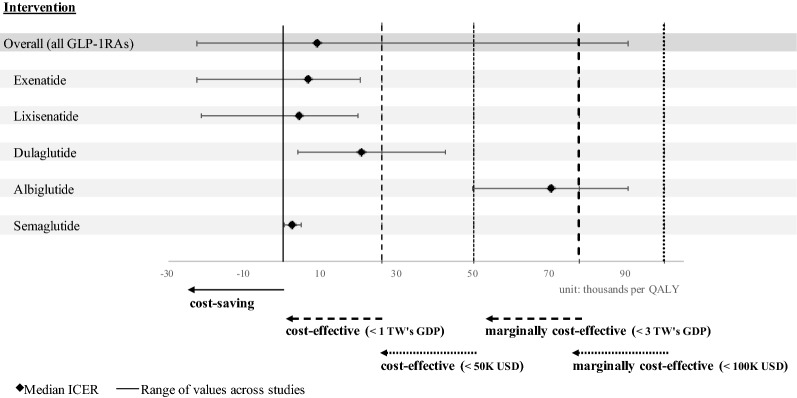
Background: To conduct a real-word-study-based cost-effectiveness analysis of a GLP-1 receptor agonist (GLP-1RA) versus insulin among type 2 diabetes patients requiring intensified injection therapy and a systematic review of cost-effectiveness studies of GLP-1RAs versus insulin. Methods: Individual-level analyses incorporating real-world effectiveness and cost data were conducted for a cohort of 1022 propensity-score-matched pairs of GLP-1RA and insulin users from Taiwan’s National Health Insurance Research Database, 2007–2016. Study outcomes included the number needed to treat (NNT) to prevent one case of clinical events, healthcare costs, and cost per case of event prevented. Costs were in 2019 US dollars. Analyses were performed from a third-party payer and healthcare sector perspectives. Structured systematic review procedures were conducted to synthesize updated evidence on the cost-effectiveness of GLP-1RAs versus insulin. Results: Over a mean follow-up of 2.3 years, the NNT using a GLP-1RA versus insulin to prevent one case of all-cause mortality and hospitalized hypoglycemia was 57 and 30, respectively. Using GLP-1RAs instead of insulin cost US$54,851 and US$29,115 per case of all-cause mortality and hospitalized hypoglycemia prevented, respectively, from the payer perspective, and saved US$19,391 and US$10,293, respectively, from the healthcare sector perspective. Sensitivity analyses showed that the probability of using GLP-1RAs versus insulin being cost-effective for preventing one case of all-cause mortality or hospitalized hypoglycemia ranged from 60 to 100%. The systematic review revealed a cost-effective profile of using GLP-1RAs versus insulin. Conclusions: Using GLP-1RAs versus insulin for type 2 diabetes patients requiring intensified injection therapy in clinical practice is cost-effective.
Overview
The claims and statistics of this paper haven’t been checked yet.
Free: it reads the open-access text and checks the first 5 claims that cite a source we can check. Create a free account to check every claim.
Integrity signals
Registry
Cites
Statistics
Figures
Verification
Claims the paper makes
The claims and statistics of this paper haven’t been checked yet.
Free: it reads the open-access text and checks the first 5 claims that cite a source we can check. Create a free account to check every claim.
Claims other papers make about this one
Each is checked against this paper’s own text: does it say what the citing paper says it does?
The source backs part of the claim, not all of it — or backs it for a different population, condition or comparison.
In the citing paper
“While some pharmacoeconomic studies are available on GLP-1 receptor agonists, the available literature is conflicting and further studies with better economic modeling for data analysis are required.[47][48][49]”
From Tirzepatide: Clinical review of the twincretin injectable (2023) · cites this paper as [48]
Experimental — accuracy not yet measured
Self-check
Percentages, sums and reported differences re-computed from the paper’s own numbers.
The self-check needs the paper’s full text.
Citations
Cites
Cost-Effectiveness in Health and Medicine
(1996) · doi:10.1093/oso/9780195108248.001.0001 · Cited by 7,193
Davies, M. J., D’Alessio, D. A., Fradkin, J., Kernan, W. N., Mathieu, C., Mingrone, G., Rossing, P., Tsapas, A., Wexler, D. J., & Buse, J. B. (2018) · Diabetes Care · doi:10.2337/dci18-0033 · Cited by 3,518 · cited 2×
“and are also the preferred choice for addition to basal insulin for combination injection therapy [3].”
BackgroundResultPertuzumab plus Trastuzumab plus Docetaxel for Metastatic Breast Cancer
Baselga, J., Cortés, J., Kim, S.-B., Im, S.-A., Hegg, R., Im, Y.-H., Roman, L., Pedrini, J. L., Pienkowski, T., Knott, A., et al. (2012) · New England Journal of Medicine · doi:10.1056/nejmoa1113216 · Cited by 2,532
Cost-Effectiveness in Health and Medicine
(2016) · doi:10.1093/acprof:oso/9780190492939.001.0001 · Cited by 1,552
Adjuvant Pertuzumab and Trastuzumab in Early HER2-Positive Breast Cancer
von Minckwitz, G., Procter, M., de Azambuja, E., Zardavas, D., Benyunes, M., Viale, G., Suter, T., Arahmani, A., Rouchet, N., Clark, E., et al. (2017) · New England Journal of Medicine · doi:10.1056/nejmoa1703643 · Cited by 1,411
Taiwan’s National Health Insurance Research Database: past and future
Hsieh, C.-Y., Su, C.-C., Shao, S.-C., Sung, S.-F., Lin, S.-J., Yang Kao, Y.-H., & Lai, E. C.-C. (2019) · Clinical Epidemiology · doi:10.2147/clep.s196293 · Cited by 1,213 · cited 1×
“This database includes patient demographics and all medical service records of disease diagnoses, procedures or surgeries, and prescriptions and medical supplies reimbursed by the NHI program [30].”
MethodCost‐effectiveness acceptability curves – facts, fallacies and frequently asked questions
Fenwick, E., O'Brien, B. J., & Briggs, A. (2004) · Health Economics · doi:10.1002/hec.903 · Cited by 943 · cited 1×
“Cost-effectiveness acceptability curves were then obtained as a summary measure of the joint uncertainty of costs and effectiveness, which indicated the probability of cost-effectiveness at various willingness-to-pay (WTP) thresholds [40].”
Background9. Pharmacologic Approaches to Glycemic Treatment: Standards of Medical Care in Diabetes—2020
American Diabetes Association (2020) · Diabetes Care · doi:10.2337/dc20-s009 · Cited by 914
Heine, R. J., Van Gaal, L. F., Johns, D., Mihm, M. J., Widel, M. H., Brodows, R. G., & for the GWAA Study Group* (2005) · Annals of Internal Medicine · doi:10.7326/0003-4819-143-8-200510180-00006 · Cited by 795
Calculating the number needed to treat for trials where the outcome is time to an event
Altman, D. G., & Andersen, P. K. (1999) · BMJ · doi:10.1136/bmj.319.7223.1492 · Cited by 710
Lee, E. W., Wei, L. J., Amato, D. A., & Leurgans, S. (1992) · Survival Analysis: State of the Art · doi:10.1007/978-94-015-7983-4_14 · Cited by 688
Cost-Effectiveness of Interventions to Prevent and Control Diabetes Mellitus: A Systematic Review
Li, R., Zhang, P., Barker, L. E., Chowdhury, F. M., & Zhang, X. (2010) · Diabetes Care · doi:10.2337/dc10-0843 · Cited by 491 · cited 1×
“They follow those in a previous review of cost-effectiveness studies related to diabetes [43, 44].”
BackgroundDiabetes Prevention Program Research Group (2003) · Diabetes Care · doi:10.2337/diacare.26.9.2518 · Cited by 262
Marsico, F., Paolillo, S., Gargiulo, P., Bruzzese, D., Dell’Aversana, S., Esposito, I., Renga, F., Esposito, L., Marciano, C., Dellegrottaglie, S., et al. (2020) · European Heart Journal · doi:10.1093/eurheartj/ehaa082 · Cited by 191
Diamant, M., Gaal, L. V., Guerci, B., Stranks, S. N., Han, J., Malloy, J. L., Boardman, M. K., & TRAUTMANN, M. E. (2014) · The Lancet Diabetes & Endocrinology · doi:10.1016/s2213-8587(14)70029-4 · Cited by 168
Cost-effectiveness of Interventions to Manage Diabetes: Has the Evidence Changed Since 2008?
Siegel, K. R., Ali, M. K., Zhou, X., Ng, B. P., Jawanda, S., Proia, K., Zhang, X., Gregg, E. W., Albright, A. L., & Zhang, P. (2020) · Diabetes Care · doi:10.2337/dci20-0017 · Cited by 164
Schernthaner, G., Shehadeh, N., Ametov, A. S., Bazarova, A. V., Ebrahimi, F., Fasching, P., Janež, A., Kempler, P., Konrāde, I., Lalić, N. M., et al. (2020) · Cardiovascular Diabetology · doi:10.1186/s12933-020-01154-w · Cited by 164 · cited 1×
“However, the common gastrointestinal symptoms and higher drug acquisition costs of GLP-1RAs have hindered their widespread and continuous use in real-world settings [2, 5].”
BackgroundBlumenthal, G. M., Scher, N. S., Cortazar, P., Chattopadhyay, S., Tang, S., Song, P., Liu, Q., Ringgold, K., Pilaro, A. M., Tilley, A., et al. (2013) · Clinical Cancer Research · doi:10.1158/1078-0432.ccr-13-1212 · Cited by 118 · cited 1×
“As suggested by the World Health Organization [41], an intervention strategy is considered cost-effective or marginally cost-effective in Taiwan if the ICER is less than one time Taiwan’s gross domestic product (GDP) per capita (US$25,893 in 2019) or three times Taiwan’s GDP per capita (US$77,679 in 2019), respectivel…”
BackgroundQuantifying stochastic uncertainty and presenting results of cost-effectiveness analyses
Glick, H. A., Briggs, A. H., & Polsky, D. (2001) · Expert Review of Pharmacoeconomics & Outcomes Research · doi:10.1586/14737167.1.1.25 · Cited by 112 · cited 1×
“To assess the sampling uncertainty in the ICER estimates, the nonparametric bootstrap method was applied to generate 1000 replicated estimates of incremental cost-effectiveness pairs for study patients [39], where the 95% confidence interval (CI) for ICERs was defined as the 2.”
MethodHow to Deal with Cost Differences at Baseline
van Asselt, A. D. I., van Mastrigt, G. A. P. G., Dirksen, C. D., Arntz, A. R., Severens, J. L., & Kessels, A. G. H. (2009) · PharmacoEconomics · doi:10.2165/00019053-200927060-00007 · Cited by 109
Malone, D. C., Brown, M., Hurwitz, J. T., Peters, L., & Graff, J. S. (2017) · Value in Health · doi:10.1016/j.jval.2017.08.3013 · Cited by 74 · cited 1×
“From the perspective of scientific research, existing recommendations for analytic procedures in realworld-study-based CEAs remain insufficient [7, 8, 51].”
BackgroundCost-effectiveness analyses using real-world data: an overview of the literature
Bowrin, K., Brière, J., Lévy, P., Millier, A., Clay, E., & Toumi, M. (2019) · Journal of Medical Economics · doi:10.1080/13696998.2019.1588737 · Cited by 64 · cited 2×
“From the perspective of scientific research, existing recommendations for analytic procedures in realworld-study-based CEAs remain insufficient [7, 8, 51].”
BackgroundRay, J. A., Boye, K. S., Yurgin, N., Valentine, W. J., Roze, S., McKendrick, J., Tucker, D. M. D., FOOS, V., & Palmer, A. J. (2007) · Current Medical Research and Opinion · doi:10.1185/030079907x178685 · Cited by 59
Beaudet, A., Palmer, J. L., Timlin, L., Wilson, B., Bruhn, D. F., Boye, K. S., & Lloyd, A. (2011) · Journal of Medical Economics · doi:10.3111/13696998.2011.579213 · Cited by 49
Yang, C.-T., Yang, C.-Y., Ou, H.-T., & Kuo, S. (2020) · Cardiovascular Diabetology · doi:10.1186/s12933-020-01053-0 · Cited by 48 · cited 2×
“Moreover, given no heterogeneous treatment effects found by age, gender, or diabetes severity for GLP-1RAs versus insulin in our previous analyses [6] and limited study subjects with different patient characteristics in the present study, performing the costeffectiveness analysis stratified by different patient demogr…”
MethodSelf-citationHunt, B., Malkin, S. J. P., Moes, R. G. J., Huisman, E. L., Vandebrouck, T., & Wolffenbuttel, B. H. R. (2019) · BMJ Open Diabetes Research & Care · doi:10.1136/bmjdrc-2019-000705 · Cited by 42
Woehl, A., Evans, M., Tetlow, A., & McEwan, P. (2008) · Cardiovascular Diabetology · doi:10.1186/1475-2840-7-24 · Cited by 41
Samyshkin, Y., Guillermin, A.-L., Best, J. H., Brunell, S. C., & Lloyd, A. (2012) · Journal of Medical Economics · doi:10.3111/13696998.2012.708691 · Cited by 39
Mittendorf, T., Smith‐Palmer, J., Timlin, L., Happich, M., & Goodall, G. (2009) · Diabetes Obesity and Metabolism · doi:10.1111/j.1463-1326.2009.01099.x · Cited by 38
Bagepally, B. S., Chaikledkaew, U., Gurav, Y. K., Anothaisintawee, T., Youngkong, S., Chaiyakunapruk, N., McEvoy, M., Attia, J. R., & Thakkinstian, A. (2020) · BMJ Open Diabetes Research & Care · doi:10.1136/bmjdrc-2019-001020 · Cited by 37
Anyanwagu, U., Mamza, J., Mehta, R., Donnelly, R., & Idris, I. (2016) · Heart · doi:10.1136/heartjnl-2015-309164 · Cited by 34 · cited 1×
“From the perspective of the clinical care of T2D patients who require intensified injection therapy, our findings are consistent with existing treatment guidelines [1, 3] and a real-world study [47], showing that using a GLP-1RA versus insulin therapy has therapeutic benefits in terms of reduced risks of hypoglycemia…”
ResultFonseca, T., Clegg, J., Caputo, G., Norrbacka, K., Dilla, T., & Álvarez, M. (2013) · Journal of Medical Economics · doi:10.3111/13696998.2013.803110 · Cited by 30
Deng, J., Gu, S., Shao, H., Dong, H., Zou, D., & Shi, L. (2015) · Journal of Medical Economics · doi:10.3111/13696998.2015.1067622 · Cited by 29
Use of Number Needed to Treat in Cost-Effectiveness Analyses
Garg, V., Shen, X., Cheng, Y., Nawarskas, J. J., & Raisch, D. W. (2013) · Annals of Pharmacotherapy · doi:10.1345/aph.1r417 · Cited by 28 · cited 1×
“Understanding the relationship between CEA and NNT helps clinicians apply CEA findings in clinical practice [31].”
BackgroundGaebler, J. A., Blickensderfer, Hoogwerf, Han, Gaebler, J. A., Alperin, Cohen, ⁄., Wintle, Maggs, Pencek, et al. (2012) · Vascular Health and Risk Management · doi:10.2147/vhrm.s28744 · Cited by 25
Gu, S., Wang, X., Qiao, Q., Gao, W., Wang, J., & Dong, H. (2017) · Diabetes Obesity and Metabolism · doi:10.1111/dom.12991 · Cited by 24
Alexopoulos, A.-S., & Buse, J. B. (2019) · Metabolism · doi:10.1016/j.metabol.2019.06.012 · Cited by 24 · cited 4×
“However, the common gastrointestinal symptoms and higher drug acquisition costs of GLP-1RAs have hindered their widespread and continuous use in real-world settings [2, 5].”
BackgroundInfluentialSeeger, J. D., Nunes, A., & Loughlin, A. M. (2020) · Diabetes, Obesity and Metabolism · doi:10.1111/dom.14021 · Cited by 20 · cited 1×
“Our real-world evidence of the comparative effectiveness of GLP-1RAs versus insulin complements existing trial evidence by translating the efficacy of GLP-1RAs in clinical trials to its effectiveness in clinical practice among a broader spectrum of real-world patient populations for supporting the rational selection o…”
MethodHuetson, P., Palmer, J. L., Levorsen, A., Fournier, M., Germé, M., & McLeod, E. J. (2015) · Journal of Medical Economics · doi:10.3111/13696998.2015.1038271 · Cited by 19
Lee, T., Kuo, S., Yang, C., & Ou, H. (2020) · British Journal of Clinical Pharmacology · doi:10.1111/bcp.14188 · Cited by 18
Self-citationBruhn, D. F., Martin, A. A., Tavares, R., Hunt, B., & Pollock, R. F. (2016) · Journal of Medical Economics · doi:10.3111/13696998.2016.1154567 · Cited by 16
Lasalvia, P., Baquero, L., Esteban, M. O., Castañeda‐Cardona, C., & Rosselli, D. (2017) · Value in Health Regional Issues · doi:10.1016/j.vhri.2016.10.006 · Cited by 16
Ishii, H., Madin-Warburton, M., Strizek, A., Thornton‐Jones, L., & Suzuki, S. (2018) · Journal of Medical Economics · doi:10.1080/13696998.2018.1431918 · Cited by 16
de Pouvourville, G., Blin, P., & Karam, P. (2019) · The European Journal of Health Economics · doi:10.1007/s10198-019-01123-5 · Cited by 14 · cited 2×
“From the perspective of scientific research, existing recommendations for analytic procedures in realworld-study-based CEAs remain insufficient [7, 8, 51].”
BackgroundTzanetakos, C., Bargiota, A., Kourlaba, G., Gourzoulidis, G., & Maniadakis, N. (2017) · Clinical drug investigation · doi:10.1007/s40261-017-0586-0 · Cited by 13
Pollock, R. F., Norrbacka, K., Cameron, C. G., Mancillas‐Adame, L. G., & Jeddi, M. (2019) · Journal of Comparative Effectiveness Research · doi:10.2217/cer-2018-0073 · Cited by 12
Men, P., Qu, S., Song, Z., Liu, Y., Li, C., & Zhai, S. (2020) · Diabetes Therapy · doi:10.1007/s13300-020-00857-3 · Cited by 12
Gordon, J. P., McEwan, P., Sabale, U., Kartman, B., & Wolffenbuttel, B. H. R. (2016) · Journal of Medical Economics · doi:10.1080/13696998.2016.1208207 · Cited by 11
Afonso, M., Ryan, F., Pitcher, A., & Lew, E. (2017) · Journal of Medical Economics · doi:10.1080/13696998.2017.1304395 · Cited by 10
The Cost-Effectiveness of Preventing Diabetes
Teutsch, S. M. (2003) · Diabetes Care · doi:10.2337/diacare.26.9.2693 · Cited by 8
Wittbrodt, E. T., Kong, A. M., Moore-Schiltz, L. C., & Juneau, P. L. (2017) · Diabetes Obesity and Metabolism · doi:10.1111/dom.13145 · Cited by 7 · cited 1×
“This is supported by recent studies from US and German adults with T2D, which reported that the use of GLP-1RAs versus insulin resulted in lower emergency room visits and inpatient admissions but higher drug acquisition costs after treatment initiation [49, 50].”
ResultWilke, T., Mueller, S., Fuchs, A., Kaltoft, M. S., Kipper, S., & Cel, M. (2020) · Diabetes Therapy · doi:10.1007/s13300-020-00903-0 · Cited by 5 · cited 1×
“This is supported by recent studies from US and German adults with T2D, which reported that the use of GLP-1RAs versus insulin resulted in lower emergency room visits and inpatient admissions but higher drug acquisition costs after treatment initiation [49, 50].”
Result
Cited by
Pan, H.-C., Chen, J.-Y., Chen, H.-Y., Yeh, F.-Y., Sun, C.-Y., Huang, T. T.-M., & Wu, V.-C. (2024) · Nature Communications · doi:10.1038/s41467-024-50199-y · Cited by 75
“In addition, the use of GLP-1 RAs has signi fi cantly reduced the risk of mortality, MACE, and MAKE in patients requiring metformin or insulin therapy, suggesting the cost-effectiveness of GLP-1 RAs in these high-risk patients 41 .”
Hamed, K. M., Alosaimi, M. N., Ali, B. A., Alghamdi, A. M., Alkhashi, T., Alkhaldi, S. S., Altowarqi, N. A., Alzahrani, H., Alshehri, A., Alkhaldi, R. K., et al. (2024) · Cureus · doi:10.7759/cureus.68390 · Cited by 96
“This is critical for the long-term viability of these drugs in healthcare [108,117].”
BackgroundAdamou, A. T., Barkas, F., Milionis, H. J., & Ntaios, G. (2024) · International Journal of Stroke · doi:10.1177/17474930241253988 · Cited by 43
“35 Additional cost-effectiveness analyses are needed, including in non-diabetic populations.”
Evans, M., Kuodi, P., Akunna, C. J., McCreedy, N., Donsmark, M., Ren, H., & Nnaji, C. A. (2023) · Diabetes and Vascular Disease Research · doi:10.1177/14791641231221740 · Cited by 33
“39,40 Our evidence, which derives largely from observational, real-world studies, helps to overcome the practical limitations of evidence from RCTs.”
BackgroundYang, C., Yao, W., Ou, H., & Kuo, S. (2023) · Diabetes Research and Clinical Practice · doi:10.1016/j.diabres.2023.110625 · Cited by 18
Self-citation
Metadata
- Authors
- Yang, C.-Y., Chen, Y.-R., Ou, H.-T., & Kuo, S.
- Affiliations
- National Cheng Kung University (TW)
- National Cheng Kung University Hospital (TW)
- University of Michigan (US)
- Corresponding author
- Ou, Huang-Tz
- Venue
- Cardiovascular Diabetology
- Published
- 2021-01-19
- Volume
- 20
- Issue
- 1
- Pages
- 21-21
- ISSN
- 1475-2840 (ISSN-L)
- PMC
- PMC7816439
- OpenAlex
- W3124422045
- Cited by
- 51
- References
- 52
- Citations by year
- 2026: 12 · 2025: 11 · 2024: 12 · 2023: 8 · 2022: 6 · 2021: 2
- FWCI
- 1.07
- Type
- journal article
- Language
- en
- Open access
- gold
- doi.org
- Licence
- cc-by
- creativecommons.org/licenses/by/4.0/ (tdm)
- creativecommons.org/licenses/by/4.0/ (vor)
- Locations
- Cardiovascular Diabetology (publishedVersion, cc-by)
- Europe PMC (PubMed Central) (publishedVersion, other-oa)
- PubMed Central (publishedVersion, cc-by)
- PubMed (publishedVersion)
- Deep Blue (University of Michigan) (submittedVersion)
- DOAJ (DOAJ: Directory of Open Access Journals) (submittedVersion, cc-by-sa)
- Funders
- Ministry of Science and Technology, Taiwan (MOST 109-2320-B-006-047)
- National Institute of Diabetes and Digestive and Kidney Diseases (P30DK092926)
- Topics
- Health Sciences › Medicine › Endocrinology, Diabetes and Metabolism › Diabetes Treatment and Management
- Social Sciences › Economics, Econometrics and Finance › Economics and Econometrics › Health Systems, Economic Evaluations, Quality of Life
- Health Sciences › Medicine › Endocrinology, Diabetes and Metabolism › Diabetes Management and Research
- Keywords
- GLP-1 receptor agonists, insulin, type 2 diabetes, cost-effectiveness, intensive insulin therapy, all-cause mortality, number needed to treat, health care costs, real-world effectiveness
- MeSH terms
- Glucagon-Like Peptide-1 Receptor, Glucagon-Like Peptide-1 Receptor Agonists, Cost-Benefit Analysis, Diabetes Mellitus, Type 2, Humans, Hypoglycemic Agents, Insulin, Drug Costs, Treatment Outcome, Models, Economic, Incretins
About these checks
Registry, retraction, Cites and statistics results are computed, not judged, with one exception: a printed reference that no index lists is read once by a model before it counts as a citation error. Claims are extracted by a model and kept only when their quote appears verbatim in the text; each cited source is then checked, with a model’s help, for whether it says what the claim relies on. Those verdicts can be wrong — read the claim’s quote and the cited source before relying on one.
Statistics and arithmetic are recomputed, not judged.
Confidence bands are shown only for fields calibrated on our annotated test set. None is calibrated yet, so no band is shown.
What counts as a claim ›How we measure confidence ›How we check this ›
Are you an author, or do you see a problem with this page? Request a review
Data sources
Bibliographic data: Semantic Scholar, OpenAlex, Crossref.
Contains information from the Semantic Scholar Academic Graph Datasets, made available under the ODC Attribution License (ODC-BY 1.0).
Semantic Scholar’s data is described in: Kinney, R., et al. (2023). The Semantic Scholar Open Data Platform. arXiv:2301.10140.
