

Effect of alirocumab on individuals with type 2 diabetes, high triglycerides, and low high-density lipoprotein cholesterol
Open accessThe DOI matches its Crossref record; 41 of the 41 references it cites were found in a registry or an index.
Abstract
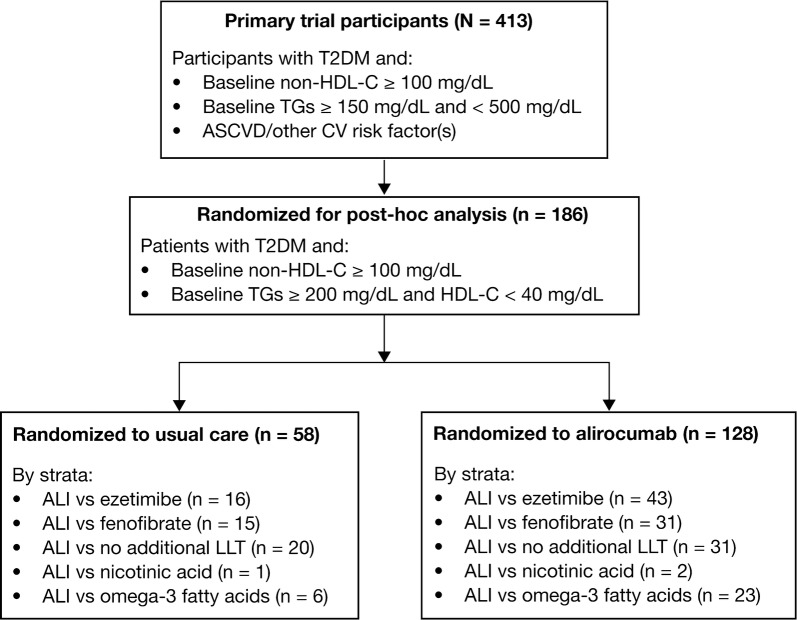
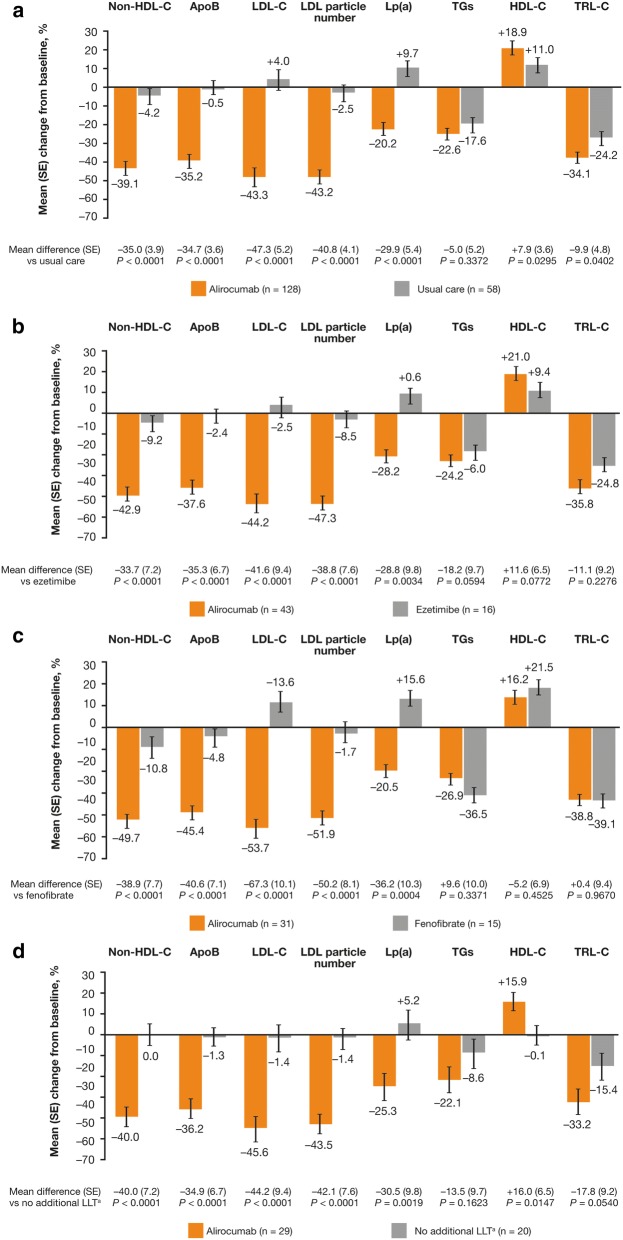
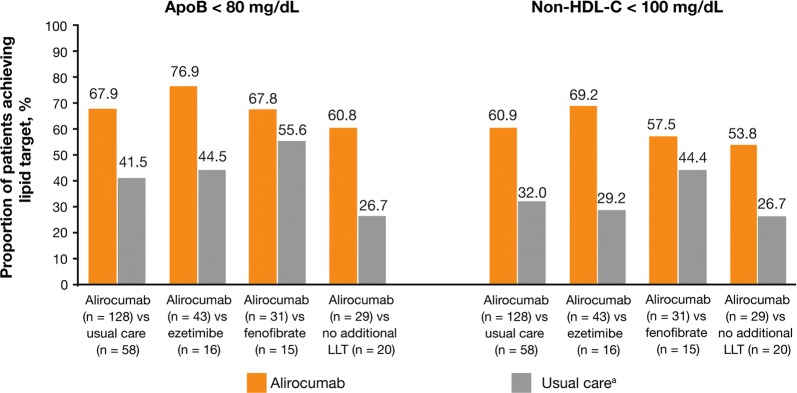
Background: Mixed dyslipidemia [elevated non-high-density lipoprotein cholesterol (non-HDL-C) and triglycerides (TGs), and decreased HDL-C] is common in type 2 diabetes mellitus (T2DM) and is associated with increased cardiovascular risk. Non-HDL-C and apolipoprotein B (ApoB) are the preferred therapeutic targets for mixed dyslipidemia. Alirocumab is a monoclonal antibody to proprotein convertase subtilisin/kexin type 9 (PCSK9) that effectively reduces low-density lipoprotein cholesterol (LDL-C), non-HDL-C, ApoB, and lipoprotein(a) (Lp[a]), and is well-tolerated in individuals with T2DM. Methods: The previously reported open-label ODYSSEY DM-DYSLIPIDEMIA trial data demonstrated the effects of alirocumab on individuals with non‐HDL-C ≥ 100 mg/dL and TGs ≥ 150 and < 500 mg/dL receiving stable maximally tolerated statin (n = 413). This post hoc subgroup analysis of the primary trial investigated the effects of alirocumab [75 mg every 2 weeks (Q2W) with possible increase to 150 mg Q2W at Week 12] versus usual care [ezetimibe, fenofibrate, or no additional lipid-lowering therapy (LLT)] on non-HDL-C and other lipids in individuals with T2DM and baseline TGs ≥ 200 mg/dL and HDL-C < 40 mg/dL (men) or < 50 mg/dL (women). Results: Alirocumab significantly reduced non-HDL-C [LS mean difference (standard error (SE)), − 35.0% (3.9)], ApoB [LS mean difference (SE), − 34.7% (3.6)], LDL-C [LS mean difference (SE), − 47.3% (5.2)], LDL particle number [LS mean difference (SE), − 40.8% (4.1)], and Lp(a) [LS mean difference (SE), − 29.9% (5.4)] versus usual care from baseline to Week 24 (all P < 0.0001). Results were similar for alirocumab versus usual care. TG reductions were similar between alirocumab and usual care (no significant difference), but greater with fenofibrate versus alirocumab (P = 0.3371). Overall, alirocumab significantly increased HDL-C versus usual care [LS mean difference (SE), 7.9% (3.6); P < 0.05], although differences with alirocumab versus ezetimibe or fenofibrate were non-significant. Most individuals receiving alirocumab achieved ApoB < 80 mg/dL (67.9%) and non-HDL-C < 100 mg/dL (60.9%). Adverse event frequency was similar between alirocumab (67.2%) and usual care (70.7%). Additionally, no clinically relevant effect of alirocumab on change in glycemic parameters or use of antihyperglycemic agents was observed. Conclusions: Alirocumab is an effective therapeutic option for individuals with T2DM, TGs ≥ 200 mg/dL, and HDL-C < 40 mg/dL (men) or < 50 mg/dL (women). Atherogenic lipid (ApoB and non-HDL) reductions were greater with alirocumab than ezetimibe, fenofibrate, or no LLT. Consistent with previous studies, alirocumab was generally well tolerated. Trial registration Clinicaltrials.gov, NCT02642159. Registered December 24, 2015, https://clinicaltrials.gov/ct2/show/NCT02642159
Overview
The claims and statistics of this paper haven’t been checked yet.
Free: it reads the open-access text and checks the first 5 claims that cite a source we can check. Create a free account to check every claim.
Integrity signals
Registry
Cites
Statistics
Figures
Verification
Claims the paper makes
The claims and statistics of this paper haven’t been checked yet.
Free: it reads the open-access text and checks the first 5 claims that cite a source we can check. Create a free account to check every claim.
Claims other papers make about this one
Each is checked against this paper’s own text: does it say what the citing paper says it does?
The cited source says what the claim attributes to it.
In the citing paper
“Alirocumab on top of the maximum tolerated statin dose was also more effective than ezetimibe, fenofibrate, or non-lipid-lowering therapy in reducing non-HDL-C and other atherogenic lipids in patients with diabetes enrolled in the ODYSSEY DM-DYSLIPIDEMIA (Efficacy and Safety of Alirocumab Versus Usual Care on Top of Maximally Tolerated Statin Therapy in Patients With Type 2 Diabetes and Mixed Dys”
From 2023 ESC guidelines for the management of cardiovascular disease in patients with diabetes. (2023) · cites this paper as [268]
Self-check
Percentages, sums and reported differences re-computed from the paper’s own numbers.
The self-check needs the paper’s full text.
Citations
Cites
Mach, F., Baigent, C., Catapano, A. L., Koskinas, K. C., Casula, M., Badimon, L., Chapman, M. J., De Backer, G. G., Delgado, V., Ference, B. A., et al. (2020) · European Heart Journal · doi:10.1093/eurheartj/ehz455 · Cited by 8,961
Self-citationGrundy, S. M., Stone, N. J., Bailey, A. L., Beam, C., Birtcher, K. K., Blumenthal, R. S., Braun, L. T., de Ferranti, S., Faiella-Tommasino, J., Forman, D. E., et al. (2019) · Circulation · doi:10.1161/cir.0000000000000625 · Cited by 6,185
Mach, F., Baigent, C., Catapano, A. L., Koskinas, K. C., Casula, M., Badimon, L., Chapman, M. J., De Backer, G. G., Delgado, V., Ference, B. A., et al. (2019) · Atherosclerosis · doi:10.1016/j.atherosclerosis.2019.08.014 · Cited by 4,854
Helsinki Heart Study: Primary-Prevention Trial with Gemfibrozil in Middle-Aged Men with Dyslipidemia
Frick, M. H., Elo, O., Haapa, K., Heinonen, O. P., Heinsalmi, P., Helo, P., Huttunen, J. K., Kaitaniemi, P., Koskinen, P., Manninen, V., et al. (1987) · New England Journal of Medicine · doi:10.1056/nejm198711123172001 · Cited by 3,881
Alirocumab and Cardiovascular Outcomes after Acute Coronary Syndrome
Schwartz, G. G., Steg, P. G., Szarek, M., Bhatt, D. L., Bittner, V. A., Diaz, R., Edelberg, J. M., Goodman, S. G., Hanotin, C., Harrington, R. A., et al. (2018) · New England Journal of Medicine · doi:10.1056/nejmoa1801174 · Cited by 3,634
ESC/EAS Guidelines for the management of dyslipidaemias
Reiner, Ž., Catapano, A. L., De Backer, G., Graham, I., Taskinen, M.-R., Wiklund, O., Agewall, S., Alegria, E., Chapman, M. J., Durrington, P., et al. (2011) · European Heart Journal · doi:10.1093/eurheartj/ehr158 · Cited by 3,549
Cardiovascular Risk Reduction with Icosapent Ethyl for Hypertriglyceridemia
Bhatt, D. L., Steg, P. G., Miller, M., Brinton, E. A., Jacobson, T. A., Ketchum, S. B., Doyle, R. T., Juliano, R. A., Jiao, L., Granowitz, C., et al. (2019) · New England Journal of Medicine · doi:10.1056/nejmoa1812792 · Cited by 3,317
2016 ESC/EAS Guidelines for the Management of Dyslipidaemias
Catapano, A. L., Graham, I., De Backer, G., Wiklund, O., Chapman, M. J., Drexel, H., Hoes, A. W., Jennings, C. S., Landmesser, U., Pedersen, T. R., et al. (2016) · European Heart Journal · doi:10.1093/eurheartj/ehw272 · Cited by 3,162
Effects of Combination Lipid Therapy in Type 2 Diabetes Mellitus
(2010) · New England Journal of Medicine · doi:10.1056/nejmoa1001282 · Cited by 2,837
Einarson, T. R., Acs, A., Ludwig, C., & Panton, U. H. (2018) · Cardiovascular Diabetology · doi:10.1186/s12933-018-0728-6 · Cited by 2,312
(2013) · European Heart Journal · doi:10.1093/eurheartj/eht108 · Cited by 1,955
Grundy, S. M., Stone, N. J., Bailey, A. L., Beam, C., Birtcher, K. K., Blumenthal, R. S., Braun, L. T., de Ferranti, S., Faiella-Tommasino, J., Forman, D. E., et al. (2019) · Journal of the American College of Cardiology · doi:10.1016/j.jacc.2018.11.002 · Cited by 1,751
HDL cholesterol, very low levels of LDL cholesterol, and cardiovascular events
Barter, P., Gotto, A. M., LaRosa, J. C., Maroni, J., Szarek, M., Grundy, S. M., Kastelein, J. J. P., Bittner, V., & Fruchart, J.-C. (2007) · New England Journal of Medicine · doi:10.1056/nejmoa064278 · Cited by 1,610
2016 ESC/EAS Guidelines for the Management of Dyslipidaemias
Catapano, A. L., Graham, I., De Backer, G., Wiklund, O., Chapman, M. J., Drexel, H., Hoes, A. W., Jennings, C. S., Landmesser, U., Pedersen, T. R., et al. (2016) · Atherosclerosis · doi:10.1016/j.atherosclerosis.2016.08.018 · Cited by 1,582
Garber, A. J., Abrahamson, M. J., Barzilay, J. I., Blonde, L., Bloomgarden, Z. T., Bush, M. A., Dagogo-Jack, S., DeFronzo, R. A., Einhorn, D., Fonseca, V. A., et al. (2016) · Endocrine Practice · doi:10.4158/ep151126.cs · Cited by 878
Pathophysiology of diabetic dyslipidaemia: where are we?
Vergès, B. (2015) · Diabetologia · doi:10.1007/s00125-015-3525-8 · Cited by 708
Ference, B. A., Kastelein, J. J. P., Ray, K. K., Ginsberg, H. N., Chapman, M. J., Packard, C. J., Laufs, U., Oliver-Williams, C., Wood, A. M., Butterworth, A. S., et al. (2019) · JAMA · doi:10.1001/jama.2018.20045 · Cited by 703
Self-citationEffects of n−3 Fatty Acid Supplements in Diabetes Mellitus
The ASCEND Study Collaborative Group (2018) · New England Journal of Medicine · doi:10.1056/nejmoa1804989 · Cited by 698
Scott, R., O'Brien, R., Fulcher, G., Pardy, C., d'Emden, M., Tse, D., Taskinen, M.-R., Ehnholm, C., Keech, A., & on behalf of the Fenofibrate Intervention and Event Lowering in Diabetes (FIELD) Study Investigators (2009) · Diabetes Care · doi:10.2337/dc08-1543 · Cited by 551
Pradhan, A. D., Paynter, N. P., Everett, B. M., Glynn, R. J., Amarenco, P., Elam, M., Ginsberg, H., Hiatt, W. R., Ishibashi, S., Koenig, W., et al. (2018) · American Heart Journal · doi:10.1016/j.ahj.2018.09.011 · Cited by 319
Ray, K. K., Colhoun, H. M., Szarek, M., Baccara-Dinet, M., Bhatt, D. L., Bittner, V. A., Budaj, A. J., Diaz, R., Goodman, S. G., Hanotin, C., et al. (2019) · The Lancet Diabetes & Endocrinology · doi:10.1016/s2213-8587(19)30158-5 · Cited by 315
Self-citationGarber, A. J., Abrahamson, M. J., Barzilay, J. I., Blonde, L., Bloomgarden, Z. T., Bush, M. A., Dagogo-Jack, S., DeFronzo, R. A., Einhorn, D., Fonseca, V. A., et al. (2019) · Endocrine Practice · doi:10.4158/cs-2018-0535 · Cited by 297
Vallejo-Vaz, A. J., Fayyad, R., Boekholdt, S. M., Hovingh, G. K., Kastelein, J. J., Melamed, S., Barter, P., Waters, D. D., & Ray, K. K. (2018) · Circulation · doi:10.1161/circulationaha.117.032318 · Cited by 187
Self-citationBhatt, D. L., Steg, P. G., Brinton, E. A., Jacobson, T. A., Miller, M., Tardif, J., Ketchum, S. B., Doyle, R. T., Murphy, S. A., Soni, P. N., et al. (2017) · Clinical Cardiology · doi:10.1002/clc.22692 · Cited by 183
Colhoun, H. M., Ginsberg, H. N., Robinson, J. G., Leiter, L. A., Müller-Wieland, D., Henry, R. R., Cariou, B., Baccara-Dinet, M. T., Pordy, R., Merlet, L., et al. (2016) · European Heart Journal · doi:10.1093/eurheartj/ehw292 · Cited by 172
Self-citationNicholls, S. J., Lincoff, A. M., Bash, D., Ballantyne, C. M., Barter, P. J., Davidson, M. H., Kastelein, J. J. P., Koenig, W., McGuire, D. K., Mozaffarian, D., et al. (2018) · Clinical Cardiology · doi:10.1002/clc.23055 · Cited by 167
Self-citationThanassoulis, G., Williams, K., Ye, K., Brook, R., Couture, P., Lawler, P. R., de Graaf, J., Furberg, C. D., & Sniderman, A. (2014) · Journal of the American Heart Association · doi:10.1161/jaha.113.000759 · Cited by 148
Leiter, L. A., Cariou, B., Müller‐Wieland, D., Colhoun, H. M., Del Prato, S., Tinahones, F. J., Ray, K. K., Bujas‐Bobanovic, M., Domenger, C., Mandel, J., et al. (2017) · Diabetes, Obesity and Metabolism · doi:10.1111/dom.13114 · Cited by 139
Self-citationRobinson (2012) · doi:10.1016/j.amjcard.2012.07.007 · Cited by 137
National lipid association annual summary of clinical lipidology 2016
Bays, H. E., Jones, P. H., Orringer, C. E., Brown, W. V., & Jacobson, T. A. (2016) · Journal of Clinical Lipidology · doi:10.1016/j.jacl.2015.08.002 · Cited by 128
Ray, K. K., Leiter, L. A., Müller‐Wieland, D., Cariou, B., Colhoun, H. M., Henry, R. R., Tinahones, F. J., Bujas‐Bobanovic, M., Domenger, C., Letierce, A., et al. (2018) · Diabetes, Obesity and Metabolism · doi:10.1111/dom.13257 · Cited by 102
Self-citationRosenson, R. S., Daviglus, M. L., Handelsman, Y., Pozzilli, P., Bays, H., Monsalvo, M. L., Elliott-Davey, M., Somaratne, R., & Reaven, P. (2019) · Diabetologia · doi:10.1007/s00125-019-4856-7 · Cited by 73
Fan, W., Philip, S., Granowitz, C., Toth, P. P., & Wong, N. D. (2019) · Journal of Clinical Lipidology · doi:10.1016/j.jacl.2018.11.008 · Cited by 67
Beyond LDL: What Role for PCSK9 in Triglyceride-Rich Lipoprotein Metabolism?
Dijk, W., May, C. L., & Cariou, B. (2018) · Trends in Endocrinology and Metabolism · doi:10.1016/j.tem.2018.03.013 · Cited by 53
Self-citationCaselli, C., Del Turco, S., Ragusa, R., Lorenzoni, V., De Graaf, M., Basta, G., Scholte, A., De Caterina, R., & Neglia, D. (2019) · Cardiovascular Diabetology · doi:10.1186/s12933-019-0949-3 · Cited by 50
Leiter, L. A., Müller‐Wieland, D., Baccara‐Dinet, M. T., Letierce, A., Samuel, R., & Cariou, B. (2017) · Diabetic Medicine · doi:10.1111/dme.13450 · Cited by 34
Self-citationMüller‐Wieland, D., Leiter, L. A., Cariou, B., Letierce, A., Colhoun, H. M., Prato, S. D., Henry, R. R., Tinahones, F. J., Aurand, L. A., Maroni, J. M., et al. (2017) · Cardiovascular Diabetology · doi:10.1186/s12933-017-0552-4 · Cited by 30
Self-citationAlirocumab safety in people with and without diabetes mellitus: pooled data from 14 ODYSSEY trials
Leiter, L. A., Tinahones, F. J., Karalis, D. G., Bujas‐Bobanovic, M., Letierce, A., Mandel, J., Samuel, R., & Jones, P. H. (2018) · Diabetic Medicine · doi:10.1111/dme.13817 · Cited by 25 · cited 13×
“Consistent with previous studies, alirocumab was well tolerated in individuals with T2DM [14, 25, 30, 31].”
ResultInfluentialSelf-citationMancini, G. B. J., Hegele, R. A., & Leiter, L. A. (2013) · Canadian Journal of Diabetes · doi:10.1016/j.jcjd.2013.01.032 · Cited by 24
Self-citationHenry, R. R., Müller‐Wieland, D., Taub, P. R., Bujas‐Bobanovic, M., Louie, M. J., Letierce, A., & Ginsberg, H. N. (2018) · Diabetes Obesity and Metabolism · doi:10.1111/dom.13273 · Cited by 19
Self-citationAlirocumab efficacy and safety by body mass index: A pooled analysis from 10 Phase 3 ODYSSEY trials
Tinahones, F. J., Laufs, U., Cariou, B., Louie, M. J., Yang, J., Thompson, D. E., & Leiter, L. A. (2019) · Diabetes & Metabolism · doi:10.1016/j.diabet.2019.101120 · Cited by 6
Self-citation
Cited by
2023 ESC guidelines for the management of cardiovascular disease in patients with diabetes.
Marx, N., Federici, M., Schütt, K., Müller-Wieland, D., Ajjan, R. A., Antunes, M. J., Christodorescu, R. M., Crawford, C., Di Angelantonio, E., Eliasson, B., et al. (2023) · European Heart Journal · doi:10.1093/eurheartj/ehad192 · Cited by 1,642
Self-citationApolipoprotein B and Cardiovascular Disease: Biomarker and Potential Therapeutic Target
Behbodikhah, J., Ahmed, S., Elyasi, A., Kasselman, L. J., De Leon, J., Glass, A. D., & Reiss, A. B. (2021) · Metabolites · doi:10.3390/metabo11100690 · Cited by 270
“The PCSK9 enzyme enhances degradation of the LDL receptor; therefore, its inhibition allows for greater accumulation of this receptor, enhancing clearance of apoB-containing lipoproteins and reducing the LDL and apoB particle number [229,230].”
BackgroundBanach, M., Surma, S., Reiner, Z., Katsiki, N., Penson, P. E., Fras, Z., Sahebkar, A., Paneni, F., Rizzo, M., & Kastelein, J. (2022) · Cardiovascular Diabetology · doi:10.1186/s12933-022-01684-5 · Cited by 100
“Alirocumab and evolocumab reduce LDL-C by about 60% in patients with diabetes and dyslipidemia, and also have a very positive effect on other lipid fractions in patients with diabetes: TG (− 15–30%), apolipoprotein B (− 35%) and Lp(a) (− 20–30%) [50, 51].”
BackgroundLipoprotein(a): Knowns, unknowns and uncertainties
Ruscica, M., Sirtori, C. R., Corsini, A., Watts, G. F., & Sahebkar, A. (2021) · Pharmacological Research · doi:10.1016/j.phrs.2021.105812 · Cited by 96
Nam, K., Kwon, H., & Lee, Y.-S. (2021) · Scientific Reports · doi:10.1038/s41598-021-94631-5 · Cited by 75
Metadata
- Authors
- Colhoun, H. M., Leiter, L. A., Müller-Wieland, D., Cariou, B., Ray, K. K., Tinahones, F. J., Domenger, C., Letierce, A., Israel, M., Samuel, R., & Del Prato, S.
- Affiliations
- Western General Hospital (GB)
- St. Michael's Hospital (CA)
- Centre National de la Recherche Scientifique (FR)
- Imperial College London (GB)
- Instituto de Salud Carlos III (ES)
- Sanofi (France) (FR)
- Regeneron (United States) (US)
- Corresponding author
- Colhoun, Helen M.
- ORCID
- Venue
- Cardiovascular Diabetology
- Published
- 2020-02-08
- Volume
- 19
- Issue
- 1
- Pages
- 14-14
- ISSN
- 1475-2840 (ISSN-L)
- PMC
- PMC7007683
- OpenAlex
- W3005065383
- Cited by
- 33
- References
- 41
- Citations by year
- 2026: 1 · 2025: 5 · 2024: 2 · 2023: 6 · 2022: 4 · 2021: 7 · 2020: 8
- FWCI
- 5.71
- Type
- journal article
- Language
- en
- Open access
- gold
- doi.org
- Licence
- cc-by
- creativecommons.org/licenses/by/4.0 (tdm)
- creativecommons.org/licenses/by/4.0 (vor)
- Locations
- Cardiovascular Diabetology (publishedVersion, cc-by)
- Europe PMC (PubMed Central) (publishedVersion, cc-by)
- PubMed Central (publishedVersion, cc-by)
- PubMed (publishedVersion)
- TSpace (University of Toronto) (submittedVersion, cc-by)
- RISalud Institutional Health Repository of Andalucía (submittedVersion, cc-by)
- HAL (submittedVersion, cc-by)
- CINECA IRIS Institutial research information system (University of Pisa) (submittedVersion)
- DOAJ (DOAJ: Directory of Open Access Journals) (submittedVersion)
- RWTH Publications (RWTH Aachen) (submittedVersion, other-oa)
- Edinburgh Research Explorer (University of Edinburgh) (submittedVersion, cc-by)
- Spiral (Imperial College London) (submittedVersion, cc-by)
- Funders
- Sanofi
- Regeneron Pharmaceuticals
- Topics
- Health Sciences › Medicine › Cardiology and Cardiovascular Medicine › Lipoproteins and Cardiovascular Health
- Health Sciences › Medicine › Endocrinology, Diabetes and Metabolism › Diabetes, Cardiovascular Risks, and Lipoproteins
- Health Sciences › Medicine › Cardiology and Cardiovascular Medicine › Lipid metabolism and disorders
- Keywords
- alirocumab, PCSK9 inhibition, type 2 diabetes, mixed dyslipidemia, hypertriglyceridemia, low HDL cholesterol, non-HDL cholesterol, apolipoprotein B, LDL particle number, lipoprotein(a), LDL cholesterol, lipid-lowering therapy, ezetimibe, fenofibrate
- MeSH terms
- Proprotein Convertase 9, PCSK9 Inhibitors, Aged, Anticholesteremic Agents, Diabetes Mellitus, Type 2, Female, Humans, Cholesterol, HDL, Male, Middle Aged, Protease Inhibitors, Time Factors, Triglycerides, Biomarkers, Treatment Outcome, Dyslipidemias, Antibodies, Monoclonal, Humanized
About these checks
Registry, retraction, Cites and statistics results are computed, not judged, with one exception: a printed reference that no index lists is read once by a model before it counts as a citation error. Claims are extracted by a model and kept only when their quote appears verbatim in the text; each cited source is then checked, with a model’s help, for whether it says what the claim relies on. Those verdicts can be wrong — read the claim’s quote and the cited source before relying on one.
Statistics and arithmetic are recomputed, not judged.
Confidence bands are shown only for fields calibrated on our annotated test set. None is calibrated yet, so no band is shown.
What counts as a claim ›How we measure confidence ›How we check this ›
Are you an author, or do you see a problem with this page? Request a review
Data sources
Bibliographic data: Semantic Scholar, OpenAlex, Crossref.
Contains information from the Semantic Scholar Academic Graph Datasets, made available under the ODC Attribution License (ODC-BY 1.0).
Semantic Scholar’s data is described in: Kinney, R., et al. (2023). The Semantic Scholar Open Data Platform. arXiv:2301.10140.
