

Protection against stroke with glucagon-like peptide-1 receptor agonists: a comprehensive review of potential mechanisms
Open accessThe DOI matches its Crossref record; 101 of the 101 references it cites were found in a registry or an index; 49 of the 181 sources its claims cite were checked for support.
Abstract
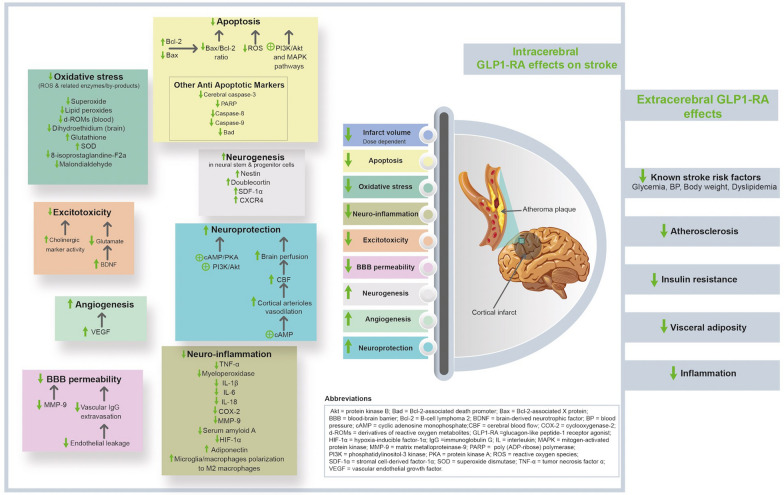
Several randomized controlled trials have demonstrated the benefits of glucagon-like peptide-1 receptor agonists (GLP-1RAs) on ischemic stroke in patients with diabetes. In this review, we summarize and discuss the potential mechanisms of stroke protection by GLP-1RAs. GLP-1RAs exert multiple anti-atherosclerotic effects contributing to stroke prevention such as enhanced plaque stability, reduced vascular smooth muscle proliferation, increased nitric oxide, and improved endothelial function. GLP-1RAs also lower the risk of stroke by reducing traditional stroke risk factors including hyperglycemia, hypertension, and dyslipidemia. Independently of these peripheral actions, GLP-1RAs show direct cerebral effects in animal stroke models, such as reduction of infarct volume, apoptosis, oxidative stress, neuroinflammation, excitotoxicity, blood–brain barrier permeability, and increased neurogenesis, neuroplasticity, angiogenesis, and brain perfusion. Despite these encouraging findings, further research is still needed to understand more thoroughly the mechanisms by which GLP-1RAs may mediate stroke protection specifically in the human diabetic brain.
Overview
CoChat Summary
TL;DR
This comprehensive review summarizes proposed extracerebral and cerebral mechanisms by which GLP-1 receptor agonists may protect against ischemic stroke in type 2 diabetes, including anti-atherosclerotic, risk-factor-lowering, and direct neuroprotective effects. It concludes that animal and clinical evidence is encouraging but still insufficient to fully establish the mechanisms of stroke protection in the human diabetic brain.
Key findings
- Clinical data consistently associate GLP-1RAs with lower stroke risk: a 2020 meta-analysis of seven CVOTs found 15% lower non-fatal stroke, 19% lower fatal stroke, and 16% lower total stroke; an updated meta-analysis of eight CVOTs found 17% lower fatal or non-fatal stroke; and a retrospective cohort found 29% lower non-fatal ischemic stroke versus DPP-4 inhibitors. Semaglutide showed the highest reported reduction in ischemic stroke risk at 28%, whereas no reduction was reported for short-acting lixisenatide.
- Extracerebral mechanisms include glycemic, blood pressure, lipid, and anti-atherosclerotic effects: every 1% HbA1c reduction was associated with 41% lower non-fatal stroke risk; in REWIND, HbA1c reduction accounted for approximately 50% and SBP reduction (mean 1.7 mmHg with dulaglutide) for around 14% of the stroke benefit; liraglutide reduced carotid intima-media thickness from 0.97 mm to 0.78 mm at 18 months and reduced soluble CD163 by 22%.
- In animal stroke models, GLP-1RAs reduced infarct volume, apoptosis, oxidative stress, neuroinflammation, excitotoxicity, and blood–brain barrier permeability, while increasing neurogenesis, neuroplasticity, angiogenesis, and cerebral blood flow; implicated pathways include cAMP/PKA/CREB, PI3K/Akt, MAPK/ERK, Wnt/β-catenin, and Nrf2/HO-1.
- Human studies support anti-inflammatory and antioxidant effects: a meta-analysis of 40 randomized controlled trials found GLP-1RA therapy reduced CRP and TNF-α and increased adiponectin; exenatide reduced TNF-α, IL-1β, IL-6, serum amyloid A, and MMP-9 in 24 obese patients with T2DM; liraglutide reduced pro-inflammatory cytokines and increased adiponectin.
Methods
- Narrative comprehensive review of non-clinical and clinical studies evaluating mechanistic effects of GLP-1 and/or GLP-1RAs in preventing ischemic stroke.
- Evidence synthesized from cardiovascular outcome trials, meta-analyses, retrospective cohort studies, animal models of stroke, and in vitro/ex vivo mechanistic studies.
- No new primary data or systematic meta-analysis; conclusions are based on narrative synthesis of the available literature.
Limitations
- Stated: only very limited studies reported negative results on anti-stroke effects, which, along with publication bias, favors positive outcomes; non-clinical studies were mainly in homogeneous rodent models, limiting representation of heterogeneous human stroke; human infarct progression is presumed 2–3 times slower than in rodents; most non-clinical studies used acute ischemic stroke models with drug administration before, during, or after stroke induction, so long-term preventive mechanisms need further investigation; most clinical studies estimated stroke event risk without mechanistic or functional outcomes.
- Evident: as a narrative review, it does not perform a formal risk-of-bias assessment or quantitative pooling, and it relies heavily on animal models and surrogate endpoints.
Model-written summary. Check it against the paper before relying on it.
Integrity signals
Registry
Cites
Statistics
Figures
Verification
Claims the paper makes
34 Valid · 0 Not valid · 87 Not checked · 15 Own results and interpretations
The cited sources support only part of this claim — read each source’s verdict below.
In the paper
“Independently of these peripheral actions, GLP-1RAs show direct cerebral effects in animal stroke models, such as reduction of infarct volume, apoptosis, oxidative stress, neuroinflammation, excitotoxicity, blood–brain barrier permeability, and increased neurogenesis, neuroplasticity, angiogenesis, and brain perfusion.”
§ Protection against stroke with glucagon-like peptide-1 receptor agonists: a comprehensive review of potential mechanisms > Abstract
What the sources say
- Not checked yetcites [60] Marlet IR Ölmestig JNE Vilsbøll T Rungby J Kruuse C Neuroprotective mechanisms of glucagon-like peptide-1-based therapies in ischaemic stroke: a systematic review based on pre-clinical studies Basic Clin Pharmacol Toxicol 2018 122 6 559 569 29411931 source
- Partly supportedcites [61] Basalay MV Davidson SM Yellon DM Can glucagon-like peptide-1 (GLP-1) analogues make neuroprotection a reality? Neural Regen Res 2020 15 10 1852 1853 32246632 PMC7513965 sourceExperimental — accuracy not yet measured
The main text (page not available) describes inhibition of inflammatory responses as a general effect of GLP-1 and reports reduced infarct volume in animal stroke models. It does not report that neuroinflammation itself was reduced in those models. (LLM, conf=0.85)
- Supportedcites [62] Maskery MP Holscher C Jones SP Price CI Strain WD Watkins CL Glucagon-like peptide-1 receptor agonists as neuroprotective agents for ischemic stroke: a systematic scoping review J Cereb Blood Flow Metab 2021 41 1 14 30 32954901 PMC7747170 source
The Discussion reports reduced inflammation in animal models of acute ischemic stroke treated with GLP-1RAs. The Cellular function section further reports reduced inflammatory markers and microglial activation compared with controls. Page numbers are not provided in our copy. (LLM, conf=0.94)
plainstates a cause- Asserted: passes — The authors put it forward as true.
- Checkable: passes — It can be checked against evidence.
- Load-bearing: passes — The paper’s conclusions depend on it.
- Based: passes — The paper gives a reason why it holds.
The cited sources support only part of this claim — read each source’s verdict below.
In the paper
“Independently of these peripheral actions, GLP-1RAs show direct cerebral effects in animal stroke models, such as reduction of infarct volume, apoptosis, oxidative stress, neuroinflammation, excitotoxicity, blood–brain barrier permeability, and increased neurogenesis, neuroplasticity, angiogenesis, and brain perfusion.”
§ Protection against stroke with glucagon-like peptide-1 receptor agonists: a comprehensive review of potential mechanisms > Abstract
What the sources say
- Not checked yetcites [60] Marlet IR Ölmestig JNE Vilsbøll T Rungby J Kruuse C Neuroprotective mechanisms of glucagon-like peptide-1-based therapies in ischaemic stroke: a systematic review based on pre-clinical studies Basic Clin Pharmacol Toxicol 2018 122 6 559 569 29411931 source
- Could not verifycites [61] Basalay MV Davidson SM Yellon DM Can glucagon-like peptide-1 (GLP-1) analogues make neuroprotection a reality? Neural Regen Res 2020 15 10 1852 1853 32246632 PMC7513965 sourceExperimental — accuracy not yet measured
The paper’s main text reports neurotrophic effects in vitro and reduced infarct volume in animal models of ischemic stroke, but neither establishes increased neuroplasticity in those models. A search for “neuroplasticity” and related terms found no passage reporting that outcome; page numbers were not available in our copy. (LLM, conf=0.77)
- Partly supportedcites [62] Maskery MP Holscher C Jones SP Price CI Strain WD Watkins CL Glucagon-like peptide-1 receptor agonists as neuroprotective agents for ischemic stroke: a systematic scoping review J Cereb Blood Flow Metab 2021 41 1 14 30 32954901 PMC7747170 sourceExperimental — accuracy not yet measured
The Discussion reports increased neurogenesis in animal stroke models treated with GLP-1RAs, and the Neurovascular function section reports increased remodelling after stroke. Those findings are related to neuroplasticity, but our copy does not separately report an increase in neuroplasticity as the citing sentence claims. (LLM, conf=0.78)
plainstates a cause- Asserted: passes — The authors put it forward as true.
- Checkable: passes — It can be checked against evidence.
- Load-bearing: passes — The paper’s conclusions depend on it.
- Based: passes — The paper gives a reason why it holds.
The sources with a verdict support this claim; the rest weren’t checked yet, have no full text we could read, or their verdicts aren’t rated yet.
In the paper
“Independently of these peripheral actions, GLP-1RAs show direct cerebral effects in animal stroke models, such as reduction of infarct volume, apoptosis, oxidative stress, neuroinflammation, excitotoxicity, blood–brain barrier permeability, and increased neurogenesis, neuroplasticity, angiogenesis, and brain perfusion.”
§ Protection against stroke with glucagon-like peptide-1 receptor agonists: a comprehensive review of potential mechanisms > Abstract
What the sources say
- Not checked yetcites [60] Marlet IR Ölmestig JNE Vilsbøll T Rungby J Kruuse C Neuroprotective mechanisms of glucagon-like peptide-1-based therapies in ischaemic stroke: a systematic review based on pre-clinical studies Basic Clin Pharmacol Toxicol 2018 122 6 559 569 29411931 source
- Could not verifycites [61] Basalay MV Davidson SM Yellon DM Can glucagon-like peptide-1 (GLP-1) analogues make neuroprotection a reality? Neural Regen Res 2020 15 10 1852 1853 32246632 PMC7513965 sourceExperimental — accuracy not yet measured
The paper’s main text reports reduced infarct volume in animal stroke models and describes neurotrophic effects and cell-growth mechanisms, but it does not report increased neurogenesis in those models. Searches for neurogenesis, neuronal proliferation, and new neurons found no passage establishing that outcome. (LLM, conf=0.74)
- Supportedcites [62] Maskery MP Holscher C Jones SP Price CI Strain WD Watkins CL Glucagon-like peptide-1 receptor agonists as neuroprotective agents for ischemic stroke: a systematic scoping review J Cereb Blood Flow Metab 2021 41 1 14 30 32954901 PMC7747170 source
The Discussion states that this review of GLP-1RAs in animal models of acute ischemic stroke found increased neurogenesis among the neuroprotective outcomes. The Neurovascular function section also reports increased markers of neurogenesis in a reviewed study. (LLM, conf=0.93)
plainstates a cause- Asserted: passes — The authors put it forward as true.
- Checkable: passes — It can be checked against evidence.
- Load-bearing: passes — The paper’s conclusions depend on it.
- Based: passes — The paper gives a reason why it holds.
The cited sources support only part of this claim — read each source’s verdict below.
In the paper
“Although the mechanisms linking GLP-1 receptor activation to blood pressure control require further investigation in humans, GLP-1RAs have been shown to lower blood pressure by augmenting natriuresis and diuresis, which are mainly mediated by their inhibition of the Na+/H+ exchanger isoform 3, located at the brush border of the renal proximal tubule [23].”
§ Protection against stroke with glucagon-like peptide-1 receptor agonists: a comprehensive review of potential mechanisms > Extracerebral effects of glucagon-like peptide-1 receptor agonists > Blood pressure-lowering effects of GLP-1RAs
What the sources say
- Partly supportedcites [23] Kawanami D Takashi Y GLP-1 receptor agonists in diabetic kidney disease: from clinical outcomes to mechanisms Front Pharmacol 2020 11 967 32694999 PMC7338581 sourceExperimental — accuracy not yet measured
The Natriuresis subsection (Renoprotective Mechanisms of GLP-1RAs) does support the renal part: GLP-1 infusion stimulates diuresis and natriuresis and 'these observations seem to be associated with the inhibition of Na+/H+ exchanger 3 (NHE3) in the proximal tubules,' with GLP-1RAs inducing phosphorylation/inactivation of NHE3 (also Figure 1). However, our copy frames NHE3 inhibition as a hedged association ('seem to be'), never as the main mediator (it equally credits ANP secretion from cardiomyocytes, Kim et al. 2013), and flags that it remains unclear whether the natriuresis is a direct GLP-1RA effect given reported absence of GLP-1R in proximal tubules; it also does not locate NHE3 specifically at the brush border. Crucially, no passage links natriuresis/diuresis to blood-pressure lowering — blood pressure appears only as a separate clinical effect (Limitations section: 'glucose-lowering, weight loss, natriuresis, and blood pressure reduction may account for the renoprotective effects'; systolic BP −3.32 mmHg in a combination meta-analysis), so the causal BP claim attributed here is not stated by this source. (LLM, conf=0.78)
plainstates a cause- Asserted: passes — The authors put it forward as true.
- Checkable: passes — It can be checked against evidence.
- Load-bearing: unclear — It is unclear whether the paper’s conclusions depend on it.
- Based: passes — The paper gives a reason why it holds.
- Partly supported
Every source the paper cites for this claim was checked and supports it.
In the paper
“Furthermore, short-acting GLP-1RAs predominantly affect postprandial glucose levels, mainly by reducing gastric emptying speed, while long-acting GLP-1RAs more strongly affect fasting glucose levels through a combination of increased fasting insulin and reduced hepatic gluconeogenesis [14].”
§ Protection against stroke with glucagon-like peptide-1 receptor agonists: a comprehensive review of potential mechanisms > Glucagon-like peptide-1 receptor agonists and glucagon-like peptide-1 receptors
What the sources say
- Supportedcites [14] Heuvelman VD Van Raalte DH Smits MM Cardiovascular effects of glucagon-like peptide 1 receptor agonists: from mechanistic studies in humans to clinical outcomes Cardiovasc Res 2020 116 5 916 930 31825468 source
The Graphical Abstract states that long-acting GLP-1RAs more strongly affect fasting glucose through increased fasting insulin and reduced hepatic gluconeogenesis. It also states the citing sentence’s contrast: short-acting agents predominantly affect postprandial glucose by slowing gastric emptying. (LLM, conf=0.95)
boostedstates a cause- Asserted: passes — The authors put it forward as true.
- Checkable: passes — It can be checked against evidence.
- Load-bearing: unclear — It is unclear whether the paper’s conclusions depend on it.
- Based: passes — The paper gives a reason why it holds.
- Supported
108 more claims · 25 with their cited sources checked
Create a free account to see all 136 claims and to verify the 132 references still open.
- It may state two separate claims as one. 23
Claims other papers make about this one
Each is checked against this paper’s own text: does it say what the citing paper says it does?
The source backs part of the claim, not all of it — or backs it for a different population, condition or comparison.
In the citing paper
“This involves modulating the cell apoptosis process, for example, by decreasing the Bax/Bcl-2 ratio in cardiomyocytes, reducing cytochrome C release, and caspase activation.438,439”
From Glucagon-like peptide-1 receptor: mechanisms and advances in therapy (2024) · cites this paper as [439]
Experimental — accuracy not yet measured
Self-check
Percentages, sums and reported differences re-computed from the paper’s own numbers.
Each contradiction between two passages listed here was confirmed by an independent check.
Rated minor: it would not touch a result — a value no result rests on, a p-value that stays on the same side of the significance level, or a conflict that is clerical, resolved elsewhere in the paper, or outside its own findings.
In the paper
§ Protection against stroke with glucagon-like peptide-1 receptor agonists: a comprehensive review of potential mechanisms > Cerebral effects of glucagon-like peptide-1 receptor agonists > Effects of GLP-1RAs on angiogenesis, CBF, and infarct volume
“GLP-1RA-induced angiogenesis appears to be mediated through the PI3K/Akt, PKA, and Src pathways [68].”
§ Protection against stroke with glucagon-like peptide-1 receptor agonists: a comprehensive review of potential mechanisms > References
“GLP-1 promotes angiogenesis in human endothelial cells in a dose-dependent manner, through the Akt, Src and PKC pathways”
Citations
Cites
Ettehad, D., Emdin, C. A., Kiran, A., Anderson, S. G., Callender, T., Emberson, J., Chalmers, J., Rodgers, A., & Rahimi, K. (2016) · The Lancet · doi:10.1016/s0140-6736(15)01225-8 · Cited by 3,755 · cited 1×
“Accordingly, in patients with high blood pressure including those with T2DM, protection from stroke increases with the magnitude of blood pressure reduction [22].”
BackgroundSattar, N., Lee, M. M. Y., Kristensen, S. L., Branch, K. R. H., Del Prato, S., Khurmi, N. S., Lam, C. S. P., Lopes, R. D., McMurray, J. J. V., Pratley, R. E., et al. (2021) · The Lancet Diabetes & Endocrinology · doi:10.1016/s2213-8587(21)00203-5 · Cited by 1,599 · cited 1×
“Consistently, in a more recent, updated meta-analysis of eight CVOTs, GLP-1RAs reduced the risk of fatal or non-fatal stroke by 17% [3].”
BackgroundExcitotoxicity and stroke: Identifying novel targets for neuroprotection
Lai, T. W., Zhang, S., & Wang, Y. T. (2014) · Progress in Neurobiology · doi:10.1016/j.pneurobio.2013.11.006 · Cited by 1,106 · cited 1×
“This in turn can lead to intracellular calcium overload that is particularly neurotoxic, ultimately resulting in the degradation of proteins, membranes, and nucleic acids [95].”
BackgroundNeuroinflammatory mechanisms of blood-brain barrier damage in ischemic stroke
Yang, C., Hawkins, K. E., Doré, S., & Candelario-Jalil, E. (2019) · American Journal of Physiology-Cell Physiology · doi:10.1152/ajpcell.00136.2018 · Cited by 871 · cited 1×
“Another pro-inflammatory target of GLP-1RAs is matrix metalloproteinase-9 (MMP-9), an enzyme that increases BBB permeability and promotes BBB breakdown through proteolytic activity [77].”
BackgroundAnimal models of ischemic stroke and their application in clinical research
Kleinschnitz, C., Fluri, F., & Schuhmann, M. (2015) · Drug Design, Development and Therapy · doi:10.2147/dddt.s56071 · Cited by 650 · cited 1×
“Moreover, the nonclinical studies were mainly conducted in homogeneous rodent models, limiting their representation of human stroke, which is a highly heterogeneous, multifactorial disorder [101].”
BackgroundAtrial Fibrillation and Mechanisms of Stroke: Time for a New Model
Kamel, H., Okin, P. M., Elkind, M. S. V., & Iadecola, C. (2016) · Stroke · doi:10.1161/strokeaha.115.012004 · Cited by 627
Arakawa, M., Mita, T., Azuma, K., Ebato, C., Goto, H., Nomiyama, T., Fujitani, Y., Hirose, T., Kawamori, R., & Watada, H. (2010) · Diabetes · doi:10.2337/db09-1694 · Cited by 548 · cited 1×
“Within the cardiovascular system, GLP-1 receptors are expressed on endothelial cells, monocytes, macrophages, and vascular smooth muscle cells (VSMCs) [9].”
BackgroundKim, M., Platt, M. J., Shibasaki, T., Quaggin, S. E., Backx, P. H., Seino, S., Simpson, J. A., & Drucker, D. J. (2013) · Nature Medicine · doi:10.1038/nm.3128 · Cited by 514 · cited 1×
“Using a C57BL/6 mouse model, Kim and colleagues have further identified a gut-heart GLP-1 receptor-dependent and atrial natriuretic peptide-dependent axis that regulates blood pressure [27].”
BackgroundCork, S. C., Richards, J. E., Holt, M. K., Gribble, F. M., Reimann, F., & Trapp, S. (2015) · Molecular Metabolism · doi:10.1016/j.molmet.2015.07.008 · Cited by 478 · cited 1×
“GLP-1 receptors are also widely expressed in the central nervous system, including the brainstem, cerebellum, hippocampus, cortex, hypothalamus, and amygdala [7, 10, 11].”
BackgroundGLP-1 Receptor Agonists: Beyond Their Pancreatic Effects
Zhao, X., Wang, M., Wen, Z., Lu, Z., Cui, L., Fu, C., Xue, H., Liu, Y., & Zhang, Y. (2021) · Frontiers in Endocrinology · doi:10.3389/fendo.2021.721135 · Cited by 463 · cited 2×
“GLP-1RAs have multiple pleiotropic actions, as they bind to GLP-1 receptors expressed in many human tissues including the pancreas, kidneys, lungs, heart, brain, and gastrointestinal tract [5, 6].”
Background
Cited by
Glucagon-like peptide-1 receptor: mechanisms and advances in therapy
Zheng, Z., Zong, Y., Ma, Y., Tian, Y., Pang, Y., Zhang, C., & Gao, J. (2024) · Signal Transduction and Targeted Therapy · doi:10.1038/s41392-024-01931-z · Cited by 1,036
Yang, D.-R., Wang, M.-Y., Zhang, C.-L., & Wang, Y. (2024) · Frontiers in Endocrinology · doi:10.3389/fendo.2024.1359255 · Cited by 280
GLP-1 receptor agonists and atherosclerosis protection: the vascular endothelium takes center stage
Park, B., Bakbak, E., Teoh, H., Krishnaraj, A., Dennis, F., Quan, A., Rotstein, O. D., Butler, J., Hess, D. A., & Verma, S. (2024) · American Journal of Physiology-Heart and Circulatory Physiology · doi:10.1152/ajpheart.00574.2023 · Cited by 131
From metabolism to mind: The expanding role of the GLP-1 receptor in neurotherapeutics
Roy, A., Dawson, V. L., & Dawson, T. M. (2025) · Neurotherapeutics · doi:10.1016/j.neurot.2025.e00712 · Cited by 47
“Beyond neurodegeneration, GLP-1RAs are being investigated for broader neurological conditions, including stroke and traumatic brain injury, due to their neuroprotective and anti-inflammatory properties [69,70].”
McIntyre, R. S., Rasgon, N., Goldberg, J. F., Wong, S., Le, G. H., Mansur, R. B., Rosenblat, J. D., Teopiz, K. M., & Stahl, S. M. (2025) · CNS Spectrums · doi:10.1017/s1092852925000124 · Cited by 40
“7 9 During the past decade, a replicated and convergent body of preclinical evidence also indicates that IRAs activate molecular effectors critical to NNA.”
The promise of GLP-1 receptor agonists for neurodegenerative diseases
Athauda, D. S., Greig, N. H., Meissner, W. G., Foltynie, T., & Gandhi, S. (2026) · Journal of Clinical Investigation · doi:10.1172/jci194745 · Cited by 44
“These effects reflect indirect cardiovascular risk reduction and direct neurovascular actions, including enhanced endothelial function and reduced neuroinflammation (196, 200).”
Xu, Y., Boyle, T. A., Lyu, B., Ballew, S. H., Selvin, E., Chang, A. R., Inker, L. A., Grams, M. E., & Shin, J. (2024) · Journal of General Internal Medicine · doi:10.1007/s11606-023-08589-3 · Cited by 29
Kopp, K. O., Li, Y., Glotfelty, E. J., Tweedie, D., & Greig, N. H. (2024) · Biomolecules · doi:10.3390/biom14070872 · Cited by 27
Ghafoury, R., Malek, M., Ismail‐Beigi, F., & Khamseh, M. E. (2025) · Diabetes Therapy · doi:10.1007/s13300-025-01743-6 · Cited by 31
“Land‑ mark trials including SUSTAIN‑6 (semaglutide), LEADER (liraglutide), and REWIND (dulaglutide) confirmed significant reductions in the risk for stroke [28, 32, 33, 80].”
Liu, T., Fan, Z., Li, Y., Xiao, B., & Chang, H. (2025) · International Journal of Cardiology · doi:10.1016/j.ijcard.2025.133229 · Cited by 25
Zhao, X., Zhang, C., Zhang, H., Guo, Y., Zhao, L., Zhang, C., Ye, P., Zhang, K., Ma, X., & Wu, Q. (2023) · Cardiovascular Drugs and Therapy · doi:10.1007/s10557-023-07456-x · Cited by 25
“The expression of α-SMA decreased as VSMCs shifted from a contractile to a proliferative state [39].”
Incretin-based therapeutics for the treatment of neurodegenerative diseases
Vear, A., Heneka, M. T., & Clemmensen, C. (2025) · Nature Metabolism · doi:10.1038/s42255-025-01263-4 · Cited by 26
“Angiogenesis and increased cerebral blood flow have been reported following treatment with GLP-1R agonists in preclinical models of ischaemic stroke 178 .”
Aristizábal-Colorado, D., Corredor-Rengifo, D., Sierra-Castillo, S., López-Corredor, C., Trujillo, D. A. V., Weir-Restrepo, D., Izquierdo‐Condoy, J. S., Ortiz‐Prado, E., Rico-Fontalvo, J. E., Gomez‐Mesa, J., et al. (2025) · Frontiers in Endocrinology · doi:10.3389/fendo.2025.1605746 · Cited by 37
Scheen, A. J. (2023) · Diabetes & Metabolism · doi:10.1016/j.diabet.2023.101474 · Cited by 22
Rivera, F. B., Chin, M. N. C., Pine, P. L. S., Ruyeras, M. M. J., Galang, D. J. C., Gandionco, K. M., Morales, B. L. F. D., Climaco, Z. M. V., Bantayan, N. R. B., Magalong, J. V., et al. (2024) · Current Medical Research and Opinion · doi:10.1080/03007995.2024.2442027 · Cited by 20
“GLP-1 RAs may enhance the clearance of triglyceride-rich lipoproteins, reduce hepatic secretion of VLDL particles, and influence gene expression related to lipid metabolism 57–59 .”
Zhu, H., Yang, B., Lu, L., Li, Y., Sui, R., Liu, K., Tan, S., Wang, L., Qiu, J., Zhong, J., et al. (2025) · JAMA Internal Medicine · doi:10.1001/jamainternmed.2025.5684 · Cited by 24
Sagris, D., Ntaios, G., & Milionis, H. J. (2023) · Journal of Neurology Neurosurgery & Psychiatry · doi:10.1136/jnnp-2022-329149 · Cited by 13
Type 2 diabetes mellitus in patients with ischemic stroke – A nationwide study
Hastrup, S., Hedegaard, J. N., Andersen, G., Rungby, J., & Johnsen, S. P. (2024) · Diabetic Medicine · doi:10.1111/dme.15337 · Cited by 12
Stroke in the Patient With Type 2 Diabetes
Jerkins, T. W., & Bell, D. S. H. (2025) · Endocrine Practice · doi:10.1016/j.eprac.2025.01.010 · Cited by 11
Systemic Oxidative Stress in Subacute Stroke Patients Undergoing Rehabilitation Treatment
Cocco, C., Siotto, M., Guerrini, A., Germanotta, M., Galluccio, C., Cipollini, V., Cortellini, L., Pavan, A., Lattanzi, S., Insalaco, S., et al. (2024) · Antioxidants · doi:10.3390/antiox13030354 · Cited by 11
Alabdali, M. M., Alrasheed, A. S., Alghirash, F. A., Almaqboul, T. M., Alhashim, A., Aljaafari, D., & AlQarni, M. (2025) · Biomedicines · doi:10.3390/biomedicines13081834 · Cited by 12
“Glucagon-like peptide-1 receptor agonists (GLP-1 RAs) promote insulin secretion and have been shown in preclinical studies to reduce infarct volume, oxidative stress, and BBB permeability, while enhancing angiogenesis and neurogenesis [131].”
Stroke and associated comorbidities in Southeast Asian countries
Datta, A., Akundi, S., Wagh, K., Bhurle, G., Sarmah, D., Sharma, A., Shah, S., Borah, A., Saraf, S., & Bhattacharya, P. (2025) · Neuroprotection/Neuroprotection (Chichester, England. Print) · doi:10.1002/nep3.71 · Cited by 10
Ding, Z., Yang, C., Zhai, X., Xia, Y., Liu, J., & Yu, M. (2025) · International Journal of Molecular Sciences · doi:10.3390/ijms26052367 · Cited by 9
“GLP-1RAs enhance nitric oxide (NO) bioavailability, leading to vasodilation and improved blood flow [6].”
Pasi, M., Bretonnière, A., Lochon, L., Dosda, A., Bisson, A., Boulouis, G., Ducluzeau, P., & Fauchier, L. (2025) · Stroke · doi:10.1161/strokeaha.125.050972 · Cited by 9
Novel cardiovascular metabolic risk factor mechanisms and therapeutic opportunities
Evans, P. C., Vilahur, G., Kleinbongard, P., Osto, E., Remme, C. A., Madonna, R., Aksentijević, D., Sourij, H., Davidson, S. M., Santovito, D., et al. (2026) · European Heart Journal · doi:10.1093/eurheartj/ehag116 · Cited by 10
Diabetes and Stroke: Impact of Novel Therapies for the Treatment of Type 2 Diabetes Mellitus
Vieira, I. H., Carvalho, T., Saraiva, J. C., Gomes, L., & Paiva, I. (2024) · Biomedicines · doi:10.3390/biomedicines12051102 · Cited by 9
“Several mechanisms have been proposed for the neuroprotection conferred by GLP1-Ra, namely a neuroprotective effect with increases in neurogenesis and angiogenesis and decreases in apoptosis, oxidative stress, neuroinflammation, excitotoxicity, and the area of infarction [44].”
BackgroundThe role of glucagon-like peptide-1/GLP-1R and autophagy in diabetic cardiovascular disease
Guo, Z. (2024) · Pharmacological Reports · doi:10.1007/s43440-024-00609-1 · Cited by 8
“Certain anti-atherosclerotic effects were observed after treat-ment with GLP-1RAs, including enhanced plaque stability, reduced vascular smooth muscle proliferation, improved endothelial function, and decreased risk of ischemic stroke in diabetes [94].”
Jogani, V. G., Elfadil, O. M., Varayil, J. E., & Mundi, M. S. (2025) · Current Opinion in Critical Care · doi:10.1097/mcc.0000000000001294 · Cited by 11
Hastrup, S., Hedegaard, J. N., Andersen, G., Rungby, J., & Johnsen, S. P. (2024) · European Journal of Neurology · doi:10.1111/ene.16329 · Cited by 6
“Evidence suggests that GLP-1RAs may have neuroprotective effects, and this may explain the reduction in stroke severity when compared to users of DPP-4i [21].”
Advances in neuroprotective therapy for acute ischemic stroke
Yang, Y., Guo, D., Liu, Y., & Li, Y. (2024) · Exploration of Neuroprotective Therapy · doi:10.37349/ent.2024.00070 · Cited by 7
ARISE II Consensus on the Management of Intracranial Atherosclerotic Disease
Tjoumakaris, S. I., Roy, J. M., Amin‐Hanjani, S., Charbel, F. T., Dabus, G. C., Fisher, M., Gounis, M. J., Hoh, B. L., Liebeskind, D. S., Linfante, I., et al. (2025) · Stroke · doi:10.1161/strokeaha.124.050336 · Cited by 6
To the Brain and Beyond: Neurological Implications of Glucagon-Like Peptide-1 Receptor Agonists
Guevara, L. R. H., Beam, W. B., & Pasternak, J. J. (2024) · Journal of Neurosurgical Anesthesiology · doi:10.1097/ana.0000000000000985 · Cited by 5
邵倩, Xiong, J., Wu, J., Mao, J., & Hu, Q. (2026) · Frontiers in Molecular Biosciences · doi:10.3389/fmolb.2025.1729904 · Cited by 5
Bozkurt, A. K., van Rijn, M. J., Bouskela, E., Gastaldi, G., Glauser, F., Haller, H. G., Rosas-Saucedo, J., Zingg, D., CALABRESE, A., Rabe, E., et al. (2023) · International Angiology · doi:10.23736/s0392-9590.23.05061-7 · Cited by 4
Blossom, V., Ullal, S. D., Rai, R., Hegde, A., Rai, S., & Anita Sherly, A. (2026) · Oxygen · doi:10.3390/oxygen6020006 · Cited by 3
Perng, P.-S., Chang, Y., Chuang, M., Wong, C., Sun, Y., Wang, H., Chi, K., Lee, J., Wang, L., & Huang, C. (2025) · Stroke Vascular and Interventional Neurology · doi:10.1161/svin.125.001933 · Cited by 5
“27 Given that endovascular treatment of UIAs carries a periprocedural stroke risk of approximately 2.52%, as reported in a recent meta-analysis, the cerebrovascular protective properties of GLP-1RAs may contribute to improved posttreatment outcomes and a reduction in neurological complications.”
InfluentialHastrup, S., Hedegaard, J. N., Andersen, G., Osler, M., Rungby, J., & Johnsen, S. P. (2026) · Endocrinology Diabetes & Metabolism · doi:10.1002/edm2.70165 · Cited by 3
“Putative mechanisms that may explain the beneficial properties of GLP-1 RA and SGLT2i inhibitors include weight loss; reduction in blood pressure; off-target pleiotropic effects related to reduced inflammation and oxidative stress; and improved vascular endothelial function [27–29].”
GLP-1 receptor agonists reduce dementia and Alzheimer disease risk in diabetic patients with CKD
Lee, W.-T., Jing Tong, W. A. N. G., Tsai, M., & Fang, Y. (2026) · Nephrology Dialysis Transplantation · doi:10.1093/ndt/gfag032 · Cited by 5
Hanif, M., Nagarajan, J. S., Murphy, R., Sah, S., Ye, S., Perl, A., & Taub, C. C. (2026) · The American Journal of Medicine · doi:10.1016/j.amjmed.2026.02.016 · Cited by 4
Ding, Q., Sico, J. J., Perkins, A. J., Myers, L. J., Daggy, J., Sexson, A. E., Taylor, S., Burrone, L., Waddell, K. J., & Bravata, D. M. (2026) · Cardiovascular Diabetology – Endocrinology Reports · doi:10.1186/s40842-026-00280-w · Cited by 2
Khan, S., Herbst, W., Tajrishi, F. Z., Notani, S., Knight, A., Jamil, Z., & Ferdinand, K. C. (2026) · Biomedicines · doi:10.3390/biomedicines14040743 · Cited by 4
“Although there is no robust data on the stroke outcomes, the available data show potential [15,126,127].”
GLP-1 receptor agonists in stroke prevention: a narrative review on emerging therapeutic frontiers
Chikatimalla, R., Shah, A., Shah, T., Perry, G., Banker, H., Aggarwal, K., & Jain, R. (2026) · Annals of Medicine · doi:10.1080/07853890.2026.2660386 · Cited by 4
“By stabilising plaques, liraglutide reduces the absorption of oxidised low-density lipoprotein (LDL), the production of foam cells and the risk of ischaemic stroke [35].”
Winkler, G., Folyovich, A., Kis, J. T., Dancs, T., & Schandl, L. (2024) · Orvosi Hetilap · doi:10.1556/650.2024.33012 · Cited by 2
Emerging Treatments for Obesity: the Role of GLP1 Receptor Agonists on Stroke
Mariscal, M., & Testai, F. D. (2025) · Current Neurology and Neuroscience Reports · doi:10.1007/s11910-025-01423-9 · Cited by 2
Peptide drugs for obesity and type 2 diabetes mellitus: an overview of clinical trials
Barzgar, H., Darmadi, D., Nafisa, J., Narkulov, S., & Sviridova, M. B. (2025) · Clinica Chimica Acta · doi:10.1016/j.cca.2025.120772 · Cited by 2
Paceana, M.-A., Mititelu-Tarțău, L., Boboc, I. K. Ş., Oancea, C. N., Berbecaru-Iovan, A., Foia, C. I., Tartau, C. G., & Bogdán, M. (2026) · Pharmaceutics · doi:10.3390/pharmaceutics18050620 · Cited by 1
GLP-1 Receptor Agonists in Neurological Disorders: From Mechanisms to Clinical Translation
Li, P., Gao, Y., & (20030), W. L. (2026) · Drug Design Development and Therapy · doi:10.2147/dddt.s613616 · Cited by 2
“90 We still need prospective randomized trials to confirm whether these drugs can improve outcomes in patients with intracerebral hemorrhage.”
Al‐Omar, H. A., Almodaimegh, H., Omaer, A., Alzubaidi, L. M. Y., Al-Harbi, B., Al-Harbi, I., Hassan, M., & Akhtar, O. (2024) · Journal of Medical Economics · doi:10.1080/13696998.2024.2319458 · Cited by 2
Nielsen, T. A. (2023) · VBN Forskningsportal (Aalborg Universitet) · doi:10.54337/aau588597746
AVC, nouveaux traitements : place des agonistes du récepteur du GLP-1
Vergès, B. L. (2024) · Médecine des Maladies Métaboliques · doi:10.1016/j.mmm.2024.07.005
Self-citationWarren, S., McKee, S., & Yakiwchuk, E. (2024) · The Senior Care Pharmacist · doi:10.4140/tcp.n.2024.350
Current methods of treatment of type 2 diabetes mellitus (literature review)
Mineeva, E. A., Zubareva, A. S., & Bontsevich, R. A. (2024) · Glavvrač (Chief Medical Officer) · doi:10.33920/med-03-24012-08
Tan, B. Y., Tan, Y. Y., Lim, S. S., Toh, E. M. S., Tack, R. W. P., Lim, P., Kumari, S., Koh, S. W. C., Khatri, P., Rastogi, S., et al. (2025) · Nephrology · doi:10.1111/nep.70004 · Cited by 1
“GLP-1RAs may exert anti-atherosclerotic effects by stabilising pre-existing plaques and improving endothelial function, while also mitigating traditional stroke risk factors like hypertension, hyperglycemia, and dyslipidemia [34].”
Zhao, Q., Jing, Y., Zan, L., Wang, J., Wang, J., Li, J., Xi, Y., & Zhang, J. (2025) · Advanced Therapeutics · doi:10.1002/adtp.202500045 · Cited by 2
General principles of drug testing
Liu, Y., Peng, J., Jiang, Y. H., & Chen, S. (2025) · Elsevier eBooks · doi:10.1016/b978-0-323-90509-1.00034-5
Glucagon-like peptide-1 receptor agonists to modulate neuroinflammation and neurogenesis
Elvira, R., Tan, E., & Zhou, Z. D. (2025) · Neural Regeneration Research · doi:10.4103/nrr.nrr-d-25-01144
“These actions involve key signaling pathways such as PI3K/Akt, cAMP/PKA/CREB, and nuclear factor kappa-light-chain-enhancer of activated B cells (NF-κB) inhibition, which collectively limit apoptosis and promote neurogenesis (Vergès et al., 2022).”
Harnessing the gut-brain axis in the treatment of type 2 diabetes mellitus and obesity
Kotucha, K., Kapłon, K., Moś, M., Fiegler-Rudol, J., Pietryszyn-Bilińska, A., Dynarowicz, K., Aebisher, D., Wiench, R., & Kawczyk‐Krupka, A. (2025) · European Journal of Clinical and Experimental Medicine · doi:10.15584/ejcem.2025.4.24
“71,75 Furthermore, GLP-1 analogs may exhibit antidepressant effects by improving cognitive function, promoting neuroprotection, and modulating neurotransmitter release.”
Li, S. Y., Sonti, A., Kaelber, D. C., Ben-Israel, D., Bowles, A., Reddy, D., & Kelly, M. L. (2026) · Journal of Clinical Neuroscience · doi:10.1016/j.jocn.2026.111905 · Cited by 2
Biomarkers and Endothelial Damage in Obesity: An Insight into the Pharmacological Modulation
Bojórquez-González, A. Y., Gómez-Sánchez, E., Suárez-Rico, D. O., Beltrán-Ramírez, A., Balleza-Alejandri, L. R., López-Murillo, L. D., Ramírez-Lizardo, E. J., & García-Galindo, J. J. (2026) · International Journal of Molecular Sciences · doi:10.3390/ijms27083694
“Verg è s et al. (2022) confirmed IMT reduction from 0.97 mm to 0.78 mm after 18 months [94].”
InfluentialNegida, Y., Khand, Y., Hawas, Y., Yadav, V., Mohamed, K. M. H., & Saha, R. K. (2026) · medRxiv · doi:10.64898/2026.04.29.26352109
Lu, L., Yang, B. Y., Wang, Y., Zhu, C., Liu, Z., Li, F., Yang, S., Liu, Y., Yang, Y., Liu, X., et al. (2026) · Stroke · doi:10.1161/strokeaha.125.056010 · Cited by 2
“30 These pleiotropic effects may be particularly relevant in patients with pronounced IR, in whom metabolic and vascular derangements are more severe and potentially more amenable to pharmacological modulation, whereas individuals with relatively preserved insulin sensitivity exhibit less metabolic…”
GLP-1 agonist and neuroprotection in Stroke and Parkinson’s disease: A systematic review
Parekh, D. S., Kudaiarov, D., Inban, P., Agrawal, A., Prajjwal, P., & Tariq, H. (2026) · Disease-a-Month · doi:10.1016/j.disamonth.2026.102151
Fenger, A. W., Olsen, M. H., Jensen, H. R., Eskildsen, S. J., Honoré, L. R., Fabritius, M. L., Kondziella, D., Nielsen, S. T., Krogh‐Madsen, R., Riberholt, C. G., et al. (2026) · Neurocritical Care · doi:10.1007/s12028-026-02592-2
He, D., Lv, D., Tang, J., Liao, X., Mao, P., & Tian, Z. (2026) · Frontiers in Cardiovascular Medicine · doi:10.3389/fcvm.2026.1868320
“GLP-1RAs are synthetic analogs of the GLP-1 that regulate blood glucose levels via the GLP-1 receptor (45, 46).”
GLP-1 receptor agonists in diabetes-associated neurological disorders
Rasooli, R., Sharifzadeh, M., Rassouli, A., & Bekheir, S. A. (2026) · Brain Disorders · doi:10.1016/j.dscb.2026.100326
GLP-1 Receptor Agonists, Stroke, and Cognitive Outcomes: Systematic Review and Meta-RegressionPreprint
Danielli, M., Sibal, R., Collett, G., Awan, H., Sharma, C., Steckelmacher, J., Kennedy, C., & Gupta, A. K. (2026) · medRxiv · doi:10.64898/2026.09.18.26363449
Mavridis, A., Abzhandadze, T., Buvarp, D., Simons, K., Eliasson, B., von Euler, M., Viktorisson, A., & Sunnerhagen, K. S. (2026) · EClinicalMedicine · doi:10.1016/j.eclinm.2026.104220
“120,122 In contrast, DPP-4 inhibitors increase endogenous incretin levels only modestly and do not appear to produce the same magnitude of metabolic or vascular effects as GLP-1RA.”
Worrall, B. B., & Ratan, R. R. (2026) · Neurology Genetics · doi:10.1212/nxg.0000000000200450
“10 They have anti-atherosclerotic e ff ects: stabilizing plaque, reducing vascular smooth muscle proliferation, and increasing nitric oxide and, therefore, improving endothelial function.”
Caro, I., Sargurupremraj, M., Yang, C., Akinleye, C. A., Trégouët, D., Akinyemi, R., Shigemizu, D., Coker, M. M., Akinyemi, J. O., Tiwari, H. K., et al. (2026) · Neurology Genetics · doi:10.1212/nxg.0000000000200425 · Cited by 1
Self-citationGlucagon-like-peptide-1 receptor agonists
Zhong, Q., Kruse, C., Glanz, T., Berges, M., & Eri, J. (2026) · Elsevier eBooks · doi:10.1016/b978-0-443-44037-3.01015-0
Lakshmi, S. M., Singh, V., Vanangamudi, M., Taj, T., Shahin, H., Nath, R., Dutta, G., Avvari, S. K., Sridhar, S. B., Panigrahy, U. P., et al. (2026) · European Journal of Neuroscience · doi:10.1111/ejn.70718
Metadata
- Authors
- Vergès, B., Aboyans, V., Angoulvant, D., Boutouyrie, P., Cariou, B., Hyafil, F., Mohammedi, K., & Amarenco, P.
- Affiliations
- Inserm (FR)
- Université de Tours (FR)
- Centre National de la Recherche Scientifique (FR)
- Assistance Publique – Hôpitaux de Paris (FR)
- Université de Bordeaux (FR)
- Université Paris Cité (FR)
- Corresponding author
- Vergès, Bruno
- ORCID
- Venue
- Cardiovascular Diabetology
- Published
- 2022-11-15
- Volume
- 21
- Issue
- 1
- Pages
- 242-242
- ISSN
- 1475-2840 (ISSN-L)
- PMC
- PMC9667639
- OpenAlex
- W4309438512
- Cited by
- 72
- References
- 101
- Citations by year
- 2026: 26 · 2025: 22 · 2024: 19 · 2023: 5
- FWCI
- 1.64
- Type
- journal article
- Language
- en
- Open access
- gold
- doi.org
- Licence
- cc-by
- creativecommons.org/licenses/by/4.0 (tdm)
- creativecommons.org/licenses/by/4.0 (vor)
- Locations
- Cardiovascular Diabetology (publishedVersion, cc-by)
- PubMed Central (publishedVersion, cc-by)
- PubMed (publishedVersion)
- HAL (submittedVersion, cc-by)
- DOAJ (DOAJ: Directory of Open Access Journals) (submittedVersion, cc-by-sa)
- Oskar-Bordeaux (Universite de Bordeaux) (submittedVersion, cc-by)
- Funders
- Novo Nordisk
- Topics
- Health Sciences › Medicine › Endocrinology, Diabetes and Metabolism › Diabetes Treatment and Management
- Health Sciences › Medicine › Clinical Neurology › Acute Ischemic Stroke Management
- Life Sciences › Neuroscience › Neurology › Neuroprotection in Cerebral Ischemia
- Keywords
- GLP-1 receptor agonists, ischemic stroke, stroke prevention, diabetes mellitus, anti-atherosclerotic effects, plaque stability, endothelial function, nitric oxide, vascular smooth muscle cell proliferation, hyperglycemia, hypertension, dyslipidemia, cerebral effects, infarct size, neuroinflammation, oxidative stress, blood-brain barrier permeability, neurogenesis, neuroplasticity, angiogenesis, cerebral perfusion
- MeSH terms
- Glucagon-Like Peptide-1 Receptor Agonists, Animals, Diabetes Mellitus, Type 2, Humans, Hyperglycemia, Hypoglycemic Agents, Stroke
About these checks
Registry, retraction, Cites and statistics results are computed, not judged, with one exception: a printed reference that no index lists is read once by a model before it counts as a citation error. Claims are extracted by a model and kept only when their quote appears verbatim in the text; each cited source is then checked, with a model’s help, for whether it says what the claim relies on. Those verdicts can be wrong — read the claim’s quote and the cited source before relying on one.
The claim verdicts this report counts are experimental: their accuracy is not yet measured.
A language model drew the claims from the paper on 2026-10-04, under version 3 of the claim definition (model deepseek-v4.1-flash, prompt extract-v3).
A second model labelled each claim on 2026-10-04 (model jev-1.13-20260917, definition revision gold-guideline-v0.2).
Cited sources are checked with a language model’s help (gpt-6-sol and qwen3.8-omni-flash).
Statistics and arithmetic are recomputed, not judged.
Confidence bands are shown only for fields calibrated on our annotated test set. None is calibrated yet, so no band is shown.
What counts as a claim ›How we measure confidence ›How we check this ›
Are you an author, or do you see a problem with this page? Request a review
Data sources
Bibliographic data: Semantic Scholar, OpenAlex, Crossref.
Contains information from the Semantic Scholar Academic Graph Datasets, made available under the ODC Attribution License (ODC-BY 1.0).
Semantic Scholar’s data is described in: Kinney, R., et al. (2023). The Semantic Scholar Open Data Platform. arXiv:2301.10140.
