

Combinatorial pathway enzyme engineering and host engineering overcomes pyruvate overflow and enhances overproduction of N-acetylglucosamine in Bacillus subtilis
Open accessThe DOI matches its Crossref record; 36 of the 36 references it cites were found in a registry or an index.
Abstract
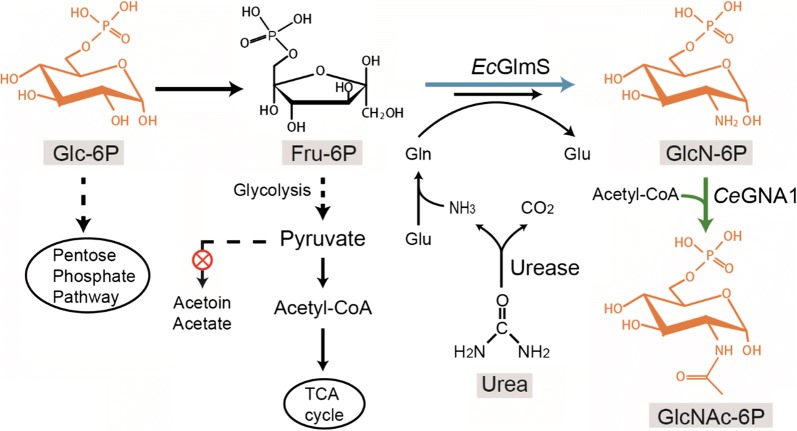
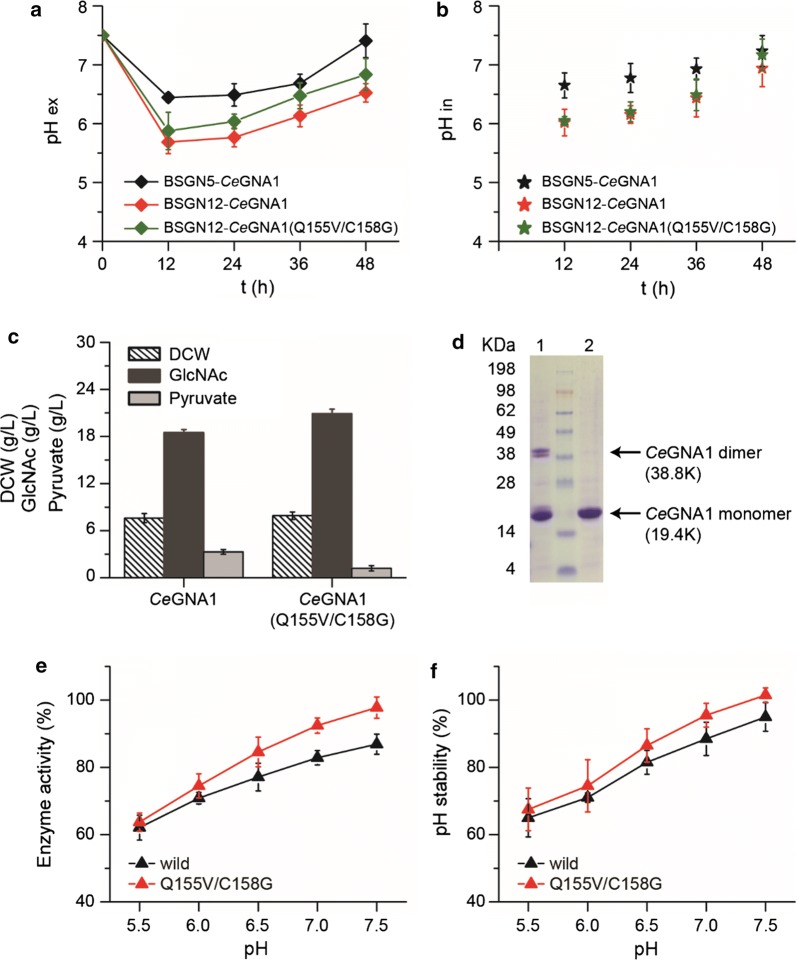
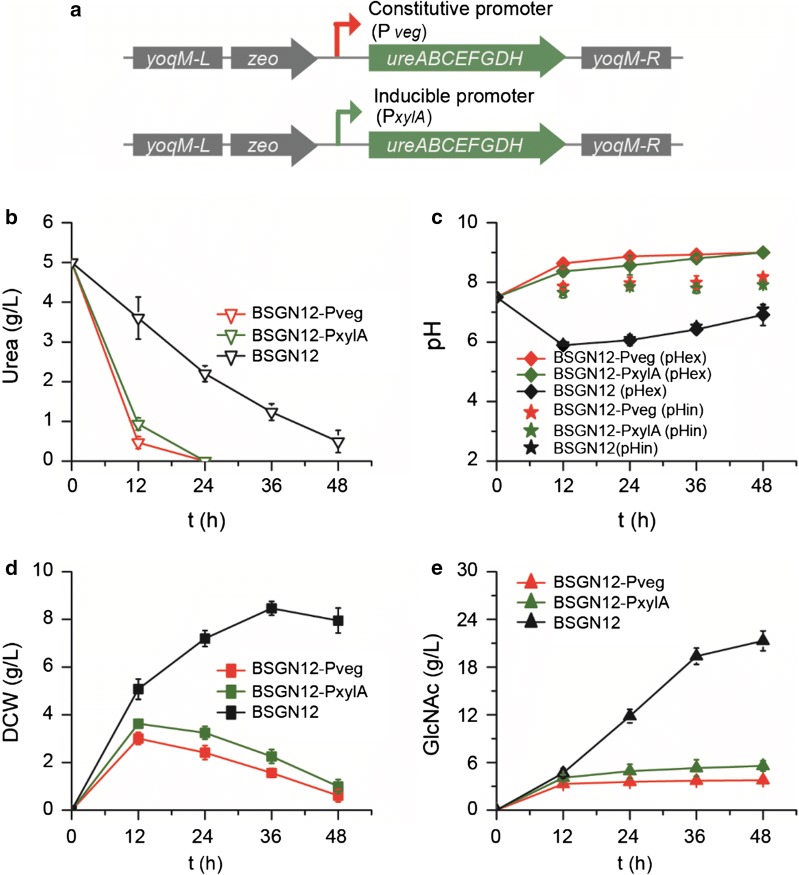
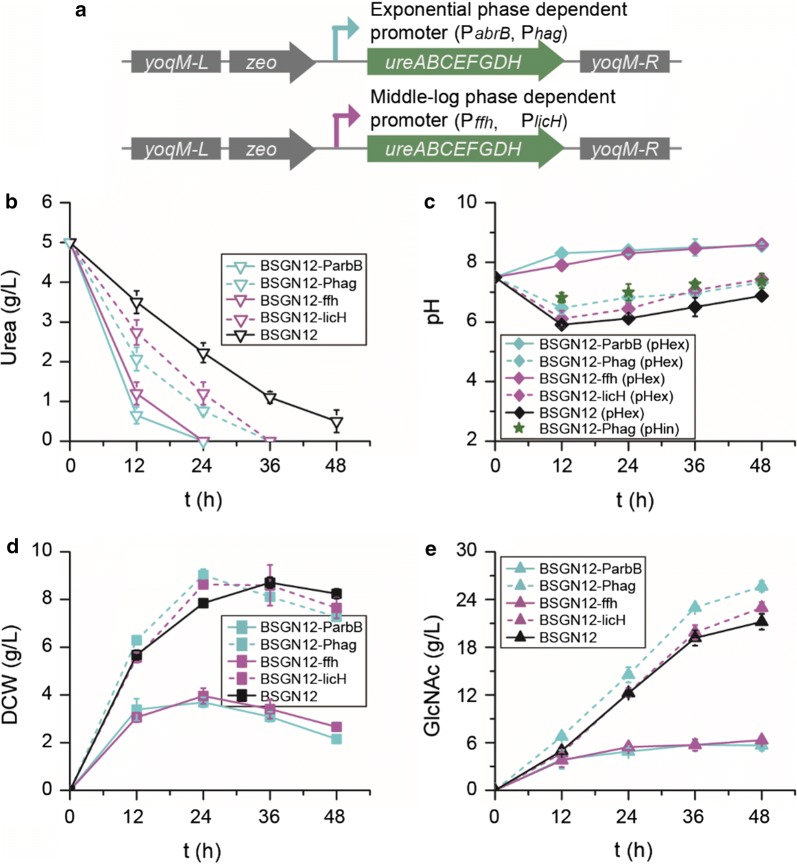
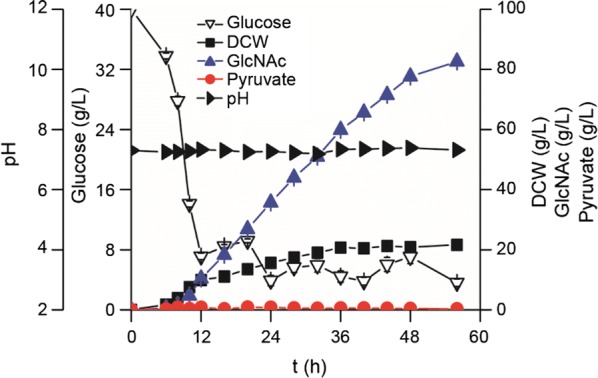
Glucosamine-6-phosphate N -acetyltransferase (GNA1) is the key enzyme that causes overproduction of N -acetylglucosamine in Bacillus subtilis . Previously, we increased GlcNAc production by promoting the expression of GNA1 from Caenorhabditis elegans ( Ce GNA1) in an engineered B. subtilis strain BSGN12. In this strain overflow metabolism to by-products acetoin and acetate had been blocked by mutations, however pyruvate accumulated as an overflow metabolite. Although overexpression of Ce GNA1 drove carbon flux from pyruvate to the GlcNAc synthesis pathway and decreased pyruvate accumulation, the residual pyruvate reduced the intracellular pH, resulting in inhibited Ce GNA1 activity and limited GlcNAc production. In this study, we attempted to further overcome pyruvate overflow by enzyme engineering and host engineering for enhanced GlcNAc production. To this end, the key enzyme Ce GNA1 was evolved through error-prone PCR under pyruvate stress to enhance its catalytic activity. Then, the urease from Bacillus paralicheniformis was expressed intracellularly to neutralize the intracellular pH, making it more robust in growth and more efficient in GlcNAc production. It was found that the activity of mutant Ce GNA1 increased by 11.5% at pH 6.5–7.5, with the catalytic efficiency increasing by 27.5% to 1.25 s −1 µM −1 . Modulated expression of urease increased the intracellular pH from 6.0 to 6.8. The final engineered strain BSGN13 overcame pyruvate overflow, produced 25.6 g/L GlcNAc with a yield of 0.43 g GlcNAc/g glucose in a shake flask fermentation and produced 82.5 g/L GlcNAc with a yield of 0.39 g GlcNAc/g glucose by fed-batch fermentation, which was 1.7- and 1.2-times, respectively, of the yield achieved previously. This study highlights a strategy that combines pathway enzyme engineering and host engineering to resolve overflow metabolism in B. subtilis for the overproduction of GlcNAc. By means of modulated expression of urease reduced pyruvate burden, conferred bacterial survival fitness, and enhanced GlcNAc production, all of which improved our understanding of co-regulation of cell growth and metabolism to construct more efficient B. subtilis cell factories.
Overview
The claims and statistics of this paper haven’t been checked yet.
Free: it reads the open-access text and checks the first 5 claims that cite a source we can check. Create a free account to check every claim.
Integrity signals
Registry
Cites
Statistics
Figures
Verification
Claims the paper makes
The claims and statistics of this paper haven’t been checked yet.
Free: it reads the open-access text and checks the first 5 claims that cite a source we can check. Create a free account to check every claim.
Claims other papers make about this one
Each is checked against this paper’s own text: does it say what the citing paper says it does?
The check wasn’t confident either way, so it gives no verdict — never disputed.
In the citing paper
“Accumulation of oils in microalgae cells is favored during conditions of stress which leads slower growth rate of cells and this aspect is particularly important when the focus is on lipid productivity (Aratboni et al. 2019).”
From Production of microalgae with high lipid content and their potential as sources of nutraceuticals (2023) · cites this paper as Aratboni et al. 2019
Experimental — accuracy not yet measured
Self-check
Percentages, sums and reported differences re-computed from the paper’s own numbers.
The self-check needs the paper’s full text.
Citations
Cites
Liu, H., & Naismith, J. H. (2008) · BMC Biotechnology · doi:10.1186/1472-6750-8-91 · Cited by 1,214
Construction of long DNA molecules using long PCR-based fusion of several fragments simultaneously
Shevchuk, N. A. (2004) · Nucleic Acids Research · doi:10.1093/nar/gnh014 · Cited by 336
Zhu, B., & Stülke, J. (2018) · Nucleic Acids Research · doi:10.1093/nar/gkx908 · Cited by 230
Cre/ lox System and PCR-Based Genome Engineering in Bacillus subtilis
Yan, X., Yu, H.-J., Hong, Q., & Li, S.-P. (2008) · Applied and Environmental Microbiology · doi:10.1128/aem.01156-08 · Cited by 226
Computational redesign of enzymes for regio- and enantioselective hydroamination
Li, R., Wijma, H. J., Song, L., Cui, Y., Otzen, M., Tian, Y., Du, J., Li, T., Niu, D., Chen, Y., et al. (2018) · Nature Chemical Biology · doi:10.1038/s41589-018-0053-0 · Cited by 188
Structure and Functional Diversity of GCN5-Related N-Acetyltransferases (GNAT)
Salah Ud-Din, A., Tikhomirova, A., & Roujeinikova, A. (2016) · International Journal of Molecular Sciences · doi:10.3390/ijms17071018 · Cited by 180
Modular pathway engineering of Bacillus subtilis for improved N-acetylglucosamine production
Liu, Y., Zhu, Y., Li, J., Shin, H., Chen, R. R., Du, G., Liu, L., & Chen, J. (2014) · Metabolic Engineering · doi:10.1016/j.ymben.2014.02.005 · Cited by 155
Self-citationClark, S., Francis, P. S., Conlan, X. A., & Barnett, N. W. (2007) · Journal of Chromatography A · doi:10.1016/j.chroma.2007.05.085 · Cited by 135
Farag, I., Youssef, N. H., & Elshahed, M. S. (2017) · Applied and Environmental Microbiology · doi:10.1128/aem.00521-17 · Cited by 125
Characterization and application of endogenous phase-dependent promoters in Bacillus subtilis
Yang, S., Du, G., Chen, J., & Kang, Z. (2017) · Applied Microbiology and Biotechnology · doi:10.1007/s00253-017-8142-7 · Cited by 124
Self-citation
Cited by
Sustainable advances in SLA/DLP 3D printing materials and processes
Maines, E. M., Porwal, M. K., Ellison, C. J., & Reineke, T. M. (2021) · Green Chemistry · doi:10.1039/d1gc01489g · Cited by 360
Production of microalgae with high lipid content and their potential as sources of nutraceuticals
Udayan, A., Pandey, A. K., Sirohi, R., Sreekumar, N., Sang, B.-I., Sim, S. J., Kim, S. H., & Pandey, A. (2023) · Phytochemistry Reviews · doi:10.1007/s11101-021-09784-y · Cited by 302
Biofuel production from microalgae: challenges and chances
Hoang, A. T., Sirohi, R., Pandey, A., Nižetić, S., Lam, S. S., Chen, W.-H., Luque, R., Thomas, S., Arıcı, M., & Pham, V. V. (2023) · Phytochemistry Reviews · doi:10.1007/s11101-022-09819-y · Cited by 287
Natural products of pentacyclic triterpenoids: from discovery to heterologous biosynthesis
Li, Y., Wang, J., Li, L., Song, W., Li, M., Hua, X., Wang, Y., Yuan, J., & Xue, Z. (2023) · Natural Product Reports · doi:10.1039/d2np00063f · Cited by 237
Pyruvate-responsive genetic circuits for dynamic control of central metabolism
Xu, X., Li, X., Liu, Y., Zhu, Y., Li, J., Du, G., Chen, J., Ledesma-Amaro, R., & Liu, L. (2020) · Nature Chemical Biology · doi:10.1038/s41589-020-0637-3 · Cited by 175
Self-citation
Metadata
- Authors
- Ma, W., Liu, Y., Lv, X., Li, J., Du, G., & Liu, L.
- Affiliations
- Jiangnan University (CN)
- Corresponding author
- Liu, Long
- Venue
- Microbial Cell Factories
- Published
- 2019-01-04
- Volume
- 18
- Issue
- 1
- Pages
- 1-1
- ISSN
- 1475-2859 (ISSN-L)
- PMC
- PMC6318901
- OpenAlex
- W2907630779
- Cited by
- 148
- References
- 36
- Citations by year
- 2026: 3 · 2025: 26 · 2024: 15 · 2023: 28 · 2022: 22 · 2021: 31 · 2020: 15 · 2019: 7
- FWCI
- 6.21
- Type
- journal article
- Language
- en
- Open access
- gold
- doi.org
- Licence
- cc-by
- creativecommons.org/licenses/by/4.0/ (tdm)
- Locations
- Microbial Cell Factories (publishedVersion, cc-by)
- Europe PMC (PubMed Central) (publishedVersion, cc-by)
- PubMed Central (publishedVersion, cc-by)
- PubMed (publishedVersion)
- DOAJ (DOAJ: Directory of Open Access Journals) (submittedVersion)
- Funders
- National Natural Science Foundation of China (31622001, 31671845, 21676119, 31600068)
- Natural Science Foundation of Jiangsu Province (BK20160176)
- Fundamental Research Funds for the Central Universitie (JUSRP11725)
- 111 Projec (111-2-06)
- China Postdoctoral Science Foundation (2016M600363, 2017T100327, 2018M630523)
- Topics
- Life Sciences › Biochemistry, Genetics and Molecular Biology › Molecular Biology › Microbial Metabolic Engineering and Bioproduction
- Life Sciences › Biochemistry, Genetics and Molecular Biology › Molecular Biology › Fungal and yeast genetics research
- Life Sciences › Biochemistry, Genetics and Molecular Biology › Biotechnology › Enzyme Production and Characterization
- Keywords
- Bacillus subtilis, urease, intracellular pH, acetoin, acetate, carbon flux, fed-batch fermentation, host engineering, pathway engineering
- MeSH terms
- Acetoin, Acetylglucosamine, Animals, Bacillus subtilis, Bacterial Proteins, Glucose, Hydrogen-Ion Concentration, Kinetics, Urease, Caenorhabditis elegans, Pyruvic Acid, Caenorhabditis elegans Proteins, Glucosamine 6-Phosphate N-Acetyltransferase, Metabolic Engineering, Batch Cell Culture Techniques
About these checks
Registry, retraction, Cites and statistics results are computed, not judged, with one exception: a printed reference that no index lists is read once by a model before it counts as a citation error. Claims are extracted by a model and kept only when their quote appears verbatim in the text; each cited source is then checked, with a model’s help, for whether it says what the claim relies on. Those verdicts can be wrong — read the claim’s quote and the cited source before relying on one.
Statistics and arithmetic are recomputed, not judged.
Confidence bands are shown only for fields calibrated on our annotated test set. None is calibrated yet, so no band is shown.
What counts as a claim ›How we measure confidence ›How we check this ›
Are you an author, or do you see a problem with this page? Request a review
How to cite
Cite CoChat for the checks on this page, and the paper for its own findings.
- This page
- CoChat. (2026). Citation check: Combinatorial pathway enzyme engineering and host engineering overcomes pyruvate overflow and enhances overproduction of N-acetylglucosamine in Bacillus subtilis. https://app.cochat.ai/papers/10.1186/s12934-018-1049-x
- The paper
- Ma, W., Liu, Y., Lv, X., Li, J., Du, G., & Liu, L. (2019). Combinatorial pathway enzyme engineering and host engineering overcomes pyruvate overflow and enhances overproduction of N-acetylglucosamine in Bacillus subtilis. Microbial Cell Factories. https://doi.org/10.1186/s12934-018-1049-x
Data sources
Bibliographic data: Semantic Scholar, OpenAlex, Crossref.
Contains information from the Semantic Scholar Academic Graph Datasets, made available under the ODC Attribution License (ODC-BY 1.0).
Semantic Scholar’s data is described in: Kinney, R., et al. (2023). The Semantic Scholar Open Data Platform. arXiv:2301.10140.
