

Combinatorial pathway enzyme engineering and host engineering overcomes pyruvate overflow and enhances overproduction of N-acetylglucosamine in Bacillus subtilis
Open accessThe DOI matches its Crossref record; 34 of the 36 references it cites were found in a registry or an index.
Abstract
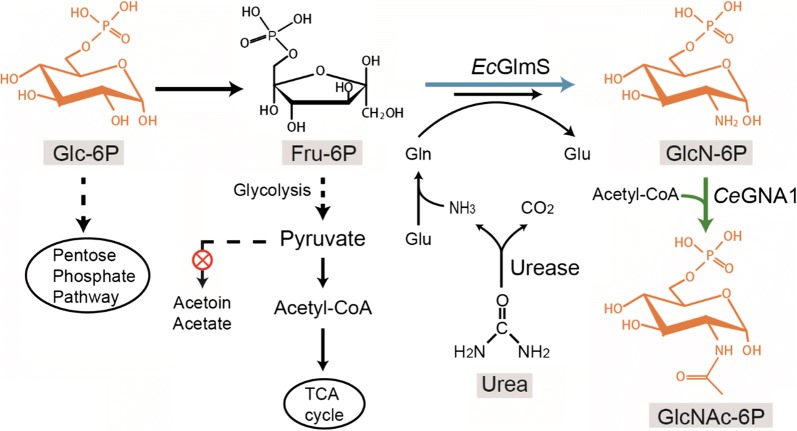
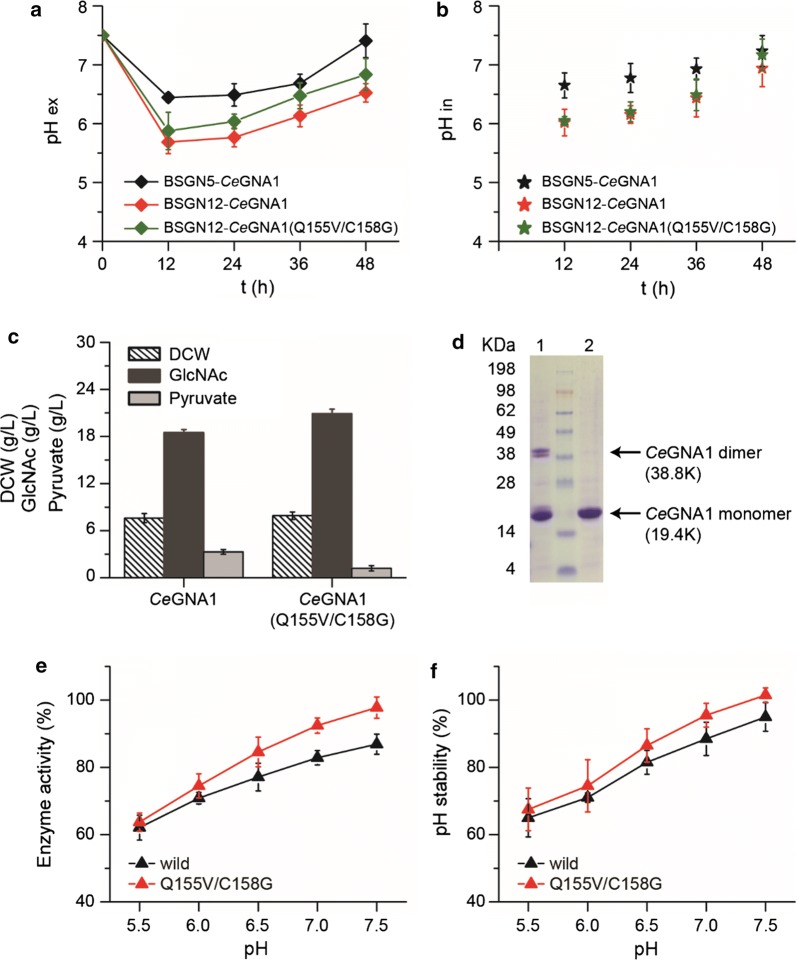
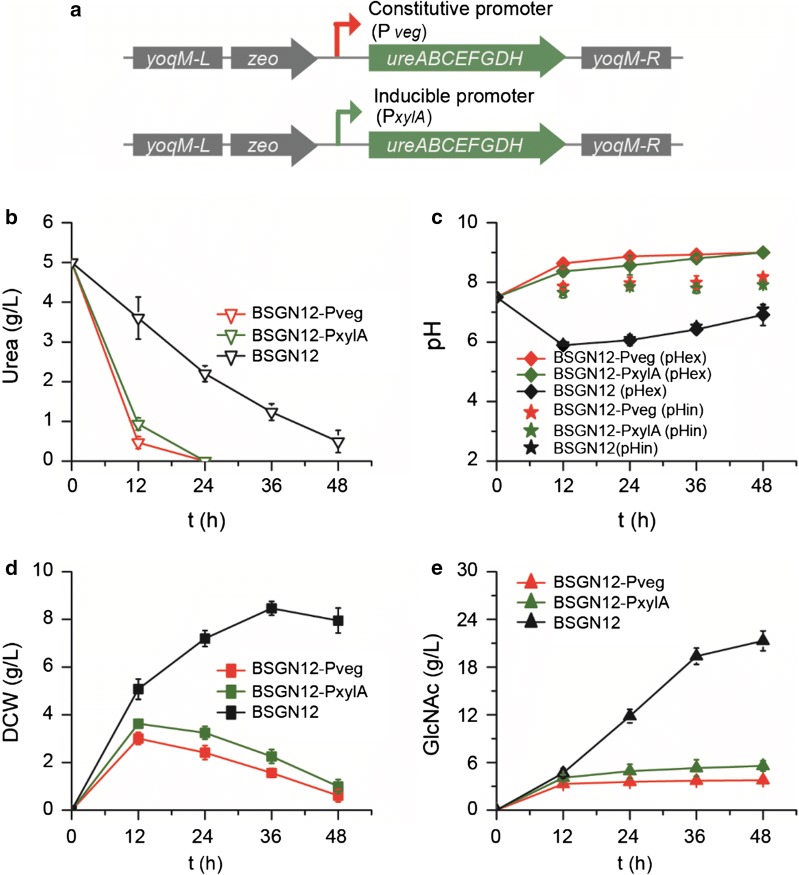
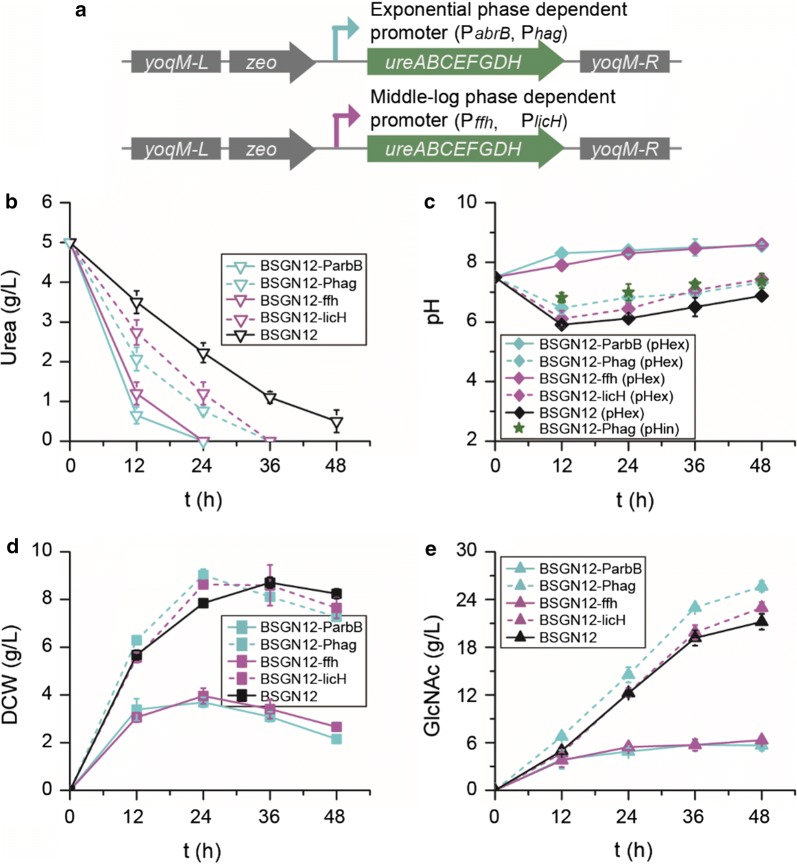
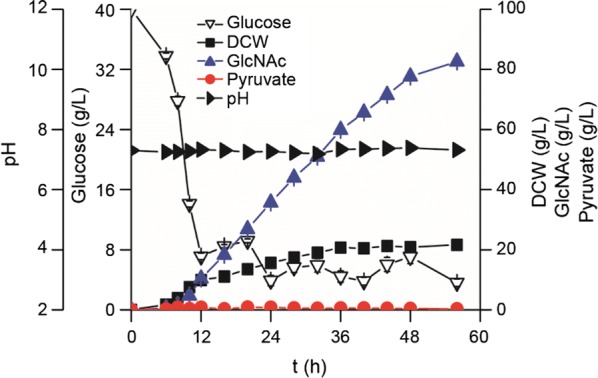
Glucosamine-6-phosphate N -acetyltransferase (GNA1) is the key enzyme that causes overproduction of N -acetylglucosamine in Bacillus subtilis . Previously, we increased GlcNAc production by promoting the expression of GNA1 from Caenorhabditis elegans ( Ce GNA1) in an engineered B. subtilis strain BSGN12. In this strain overflow metabolism to by-products acetoin and acetate had been blocked by mutations, however pyruvate accumulated as an overflow metabolite. Although overexpression of Ce GNA1 drove carbon flux from pyruvate to the GlcNAc synthesis pathway and decreased pyruvate accumulation, the residual pyruvate reduced the intracellular pH, resulting in inhibited Ce GNA1 activity and limited GlcNAc production. In this study, we attempted to further overcome pyruvate overflow by enzyme engineering and host engineering for enhanced GlcNAc production. To this end, the key enzyme Ce GNA1 was evolved through error-prone PCR under pyruvate stress to enhance its catalytic activity. Then, the urease from Bacillus paralicheniformis was expressed intracellularly to neutralize the intracellular pH, making it more robust in growth and more efficient in GlcNAc production. It was found that the activity of mutant Ce GNA1 increased by 11.5% at pH 6.5–7.5, with the catalytic efficiency increasing by 27.5% to 1.25 s −1 µM −1 . Modulated expression of urease increased the intracellular pH from 6.0 to 6.8. The final engineered strain BSGN13 overcame pyruvate overflow, produced 25.6 g/L GlcNAc with a yield of 0.43 g GlcNAc/g glucose in a shake flask fermentation and produced 82.5 g/L GlcNAc with a yield of 0.39 g GlcNAc/g glucose by fed-batch fermentation, which was 1.7- and 1.2-times, respectively, of the yield achieved previously. This study highlights a strategy that combines pathway enzyme engineering and host engineering to resolve overflow metabolism in B. subtilis for the overproduction of GlcNAc. By means of modulated expression of urease reduced pyruvate burden, conferred bacterial survival fitness, and enhanced GlcNAc production, all of which improved our understanding of co-regulation of cell growth and metabolism to construct more efficient B. subtilis cell factories.
Overview
The claims and statistics of this paper haven’t been checked yet.
Free: it reads the open-access text and checks the first 5 claims that cite a source we can check. Create a free account to check every claim.
Integrity signals
Registry
Cites
Statistics
Figures
Verification
Claims the paper makes
The claims and statistics of this paper haven’t been checked yet.
Free: it reads the open-access text and checks the first 5 claims that cite a source we can check. Create a free account to check every claim.
Claims other papers make about this one
Each is checked against this paper’s own text: does it say what the citing paper says it does?
The check wasn’t confident either way, so it gives no verdict — never disputed.
In the citing paper
“Accumulation of oils in microalgae cells is favored during conditions of stress which leads slower growth rate of cells and this aspect is particularly important when the focus is on lipid productivity (Aratboni et al. 2019).”
From Production of microalgae with high lipid content and their potential as sources of nutraceuticals (2023) · cites this paper as Aratboni et al. 2019
Experimental — accuracy not yet measured
Self-check
Percentages, sums and reported differences re-computed from the paper’s own numbers.
The self-check needs the paper’s full text.
Citations
Cites
Liu, H., & Naismith, J. H. (2008) · BMC Biotechnology · doi:10.1186/1472-6750-8-91 · Cited by 1,214
Construction of long DNA molecules using long PCR-based fusion of several fragments simultaneously
Shevchuk, N. A. (2004) · Nucleic Acids Research · doi:10.1093/nar/gnh014 · Cited by 336 · cited 16×
“After screening approximately 104 Ep-PCR clones, 15 mutants with enhanced GlcNAc titer were selected and retested in batch cultures and one evolved mutant, CeGAN1Q155V/C158G, which increased the GlcNAc titer from 18.5 to 20.9 g/L and decreased the extracellular pyruvate from 3.5 to 1.2 g/L, was identified and further…”
MethodInfluentialZhu, B., & Stülke, J. (2018) · Nucleic Acids Research · doi:10.1093/nar/gkx908 · Cited by 230
Cre/ lox System and PCR-Based Genome Engineering in Bacillus subtilis
Yan, X., Yu, H.-J., Hong, Q., & Li, S.-P. (2008) · Applied and Environmental Microbiology · doi:10.1128/aem.01156-08 · Cited by 226
Computational redesign of enzymes for regio- and enantioselective hydroamination
Li, R., Wijma, H. J., Song, L., Cui, Y., Otzen, M., Tian, Y., Du, J., Li, T., Niu, D., Chen, Y., et al. (2018) · Nature Chemical Biology · doi:10.1038/s41589-018-0053-0 · Cited by 188
Structure and Functional Diversity of GCN5-Related N-Acetyltransferases (GNAT)
Salah Ud-Din, A., Tikhomirova, A., & Roujeinikova, A. (2016) · International Journal of Molecular Sciences · doi:10.3390/ijms17071018 · Cited by 180
Modular pathway engineering of Bacillus subtilis for improved N-acetylglucosamine production
Liu, Y., Zhu, Y., Li, J., Shin, H., Chen, R. R., Du, G., Liu, L., & Chen, J. (2014) · Metabolic Engineering · doi:10.1016/j.ymben.2014.02.005 · Cited by 155 · cited 1×
“subtilis 168 derivate, ΔnagPΔgamPΔgamAΔnagAΔnagBΔldh::lox72 [30]”
Self-citationClark, S., Francis, P. S., Conlan, X. A., & Barnett, N. W. (2007) · Journal of Chromatography A · doi:10.1016/j.chroma.2007.05.085 · Cited by 135
Farag, I., Youssef, N. H., & Elshahed, M. S. (2017) · Applied and Environmental Microbiology · doi:10.1128/aem.00521-17 · Cited by 125
Characterization and application of endogenous phase-dependent promoters in Bacillus subtilis
Yang, S., Du, G., Chen, J., & Kang, Z. (2017) · Applied Microbiology and Biotechnology · doi:10.1007/s00253-017-8142-7 · Cited by 124
Self-citation
Cited by
Items 101–150 of 150
Exploring the potential of microalgae cell factories for generation of biofuels
Chettri, D., Verma, A. K., & Verma, A. K. (2023) · Biofuels · doi:10.1080/17597269.2023.2233805 · Cited by 6
State-of-art engineering approaches for ameliorated production of microbial lipid
Mondal, S., Halder, S. K., & Mondal, K. C. (2023) · Systems Microbiology and Biomanufacturing · doi:10.1007/s43393-023-00195-y · Cited by 6
Addressing Evolutionary Questions with Synthetic Biology
Baier, F., & Schaerli, Y. (2021) · Springer eBooks · doi:10.1007/978-3-030-71737-7_7 · Cited by 6
Perylenequinone derivatives from the endolichenic fungus Phialocephala fortinii
Song, J., Xie, F., Luan, X., Xu, K., Qian, L., Lu, J., Chang, W., Wang, X., & Lou, H. (2022) · Natural Product Research · doi:10.1080/14786419.2021.2025366 · Cited by 5
“In recent literature reports, PQDs containing carbon substituents showed significant biological activity (Mulrooney et al. 2012; Ma et al. 2019; Al Subeh et al. 2020), especially cytotoxicity (Li et al. 2012).”
BackgroundPetrovskaya, L. E., Ziganshin, R., Kryukova, E. A., Zlobinov, A. V., Gapizov, S. S., Shingarova, L. N., Mironov, V. A., Lomakina, G. Y., Dolgikh, D. A., & Kirpichnikov, M. P. (2021) · Applied Biochemistry and Biotechnology · doi:10.1007/s12010-021-03634-5 · Cited by 5
Pal, P., Alsuwaidi, S., Edathil, A. A., Othman, I., Show, P. L., & BANAT, F. A. (2021) · Separation Science and Technology · doi:10.1080/01496395.2021.1916033 · Cited by 5
Zarekarizi, A., Burritt, D. J., Stewart, I., Armstrong, E. A., & Hoffmann, L. J. (2025) · New Zealand Journal of Marine and Freshwater Research · doi:10.1080/00288330.2025.2485937 · Cited by 4
Zhu, J., Sun, J., Hu, N., Yang, Z., Li, A., Yao, S., & Li, G. (2026) · Process Biochemistry · doi:10.1016/j.procbio.2026.01.010 · Cited by 5
Mixotrophy for carbon-conserving waste upcycling
Weldon, M., & Euler, C. (2025) · PLoS Computational Biology · doi:10.1371/journal.pcbi.1013379 · Cited by 4
Асатурова, А. М., Gyrnets, E. Y., Allakhverdyan, V. V., Astakhov, M., & Saenko, K. (2020) · BIO Web of Conferences · doi:10.1051/bioconf/20202100015 · Cited by 4
Xu, R., Huang, Q. Y., Shen, W. H., Li, X. P., Zheng, L. P., & Wang, J. (2023) · Synthetic and Systems Biotechnology · doi:10.1016/j.synbio.2023.06.004 · Cited by 4
Wang, P., Peng, C., Li, M., Cheng, M., Fang, X., Deng, Z., Weng, M., Deng, X., & Xie, X. (2024) · Journal of Food Science and Technology · doi:10.1007/s13197-024-06051-8 · Cited by 4
“Jana Kumpfmüller et al. (Kumpfmüller et al. 2016), Sophia Zobel et al. (Zobel et al. 2015), Wenlong Ma et al. (Ma et al. 2019) and Panpan Wu et al. (Wu et al. 2023a, b) whose reports reveal that Bacillus subtilis is an important strain widely used in industrial production, and is an ideal host for…”
Bacillus subtilis-based microbial cell factories
Trabelsi, H., Dhali, D., Yaseen, Y., Leclère, V., Jacques, P., & Coutte, F. (2021) · Elsevier eBooks · doi:10.1016/b978-0-12-821477-0.00002-7 · Cited by 4
Past, present and future of yeast engineering
Chettri, D., Verma, A. K., & Verma, A. K. (2023) · Elsevier eBooks · doi:10.1016/b978-0-323-95449-5.00016-3 · Cited by 4
Eldiehy, K. S. H., Bardhan, P., Borah, D., Rather, M. A., Chutia, H., Raj, G. V. S. B., Mandal, M., & Deka, D. (2022) · Journal of Applied Phycology · doi:10.1007/s10811-022-02836-6 · Cited by 4
Chen, J., Hao, J., & Baganz, F. (2026) · Biotechnology for Biofuels and Bioproducts · doi:10.1186/s13068-025-02720-8 · Cited by 3
Cristiano‐Fajardo, S. A., Barrón‐Reyes, D., Flores, C., Luna‐Bulbarela, A., Soriano-Peña, E. Y., Tinoco‐Valencia, R., Galindo, E., & Serrano‐Carreón, L. (2023) · Journal of Chemical Technology & Biotechnology · doi:10.1002/jctb.7563 · Cited by 3
Microbial Production of Oligosaccharides and Polysaccharides
Tian, R., Liu, Y., & Liu, L. (2019) · Springer eBooks · doi:10.1007/978-981-15-0446-4_4 · Cited by 3
Self-citationApplications of yeast for environmental clean-up and sustainable agriculture
Villena, G. K., Ludeña, Y., & Samolski, I. (2023) · Elsevier eBooks · doi:10.1016/b978-0-323-95449-5.00018-7 · Cited by 3
Anbalagan, L., Serri, N. A., & Kassim, M. A. (2023) · AIP conference proceedings · doi:10.1063/5.0148279 · Cited by 4
Synthetic biology approaches for secondary metabolism engineering
Leitão, A. L., & Enguita, F. J. (2021) · Elsevier eBooks · doi:10.1016/b978-0-12-821477-0.00022-2 · Cited by 3
Janis, M. K., Zou, W., & Zastrow, M. L. (2023) · ChemBioChem · doi:10.1002/cbic.202300358 · Cited by 3
Regioselective Hydration of Terpenes with Cofactor‐Independent Carotenoid 1,2‐Hydratase
Horz, P., Härterich, N., Schneider, A., Travnicek, N. D., Nestl, B. M., Kahler, U., & Hauer, B. (2025) · Angewandte Chemie International Edition · doi:10.1002/anie.202505942 · Cited by 2
Chauhan, A. S., Kumar, C., & Tiwari, R. (2025) · Molecular Biology Reports · doi:10.1007/s11033-025-10850-3 · Cited by 2
Future Prospects and Emerging Technologies
Agarwal, R., Parveen, S., Maratha, S., & Patidar, S. K. (2025) · Springer eBooks · doi:10.1007/978-981-96-8054-2_14 · Cited by 2
Lee, J.-P., Shin, W., Ahn, G., Um, H., Kim, Y., Kim, S. Y., Ahn, J., & Kim, Y. (2021) · Toxicology and Environmental Health Sciences · doi:10.1007/s13530-021-00109-2 · Cited by 2
Biotechnological Approaches to Enhance Algae Biofuel Production
Shahbaz, U., Zubair, S., Younas, A., bin Yu, X., Fatima, N., Babar, S., Basharat, S., Bibi, A., & Hussain, M. I. (2022) · Clean Energy Production Technologies · doi:10.1007/978-981-19-6806-8_1 · Cited by 2
Toxicity study of SARS-CoV-2 Spike protein expressed on Bacillus subtilis spores
Hazan, A., Saperi, A. A., Zulkifli, N., MatRahim, N., Tiong, V., Lee, H. Y., & AbuBakar, S. (2025) · BMC Microbiology · doi:10.1186/s12866-025-04186-y · Cited by 2
Biocatalyzed Carbon–Carbon bond formation in enantioselective synthesis
Gamenara, D., & Seoane, G. A. (2024) · Elsevier eBooks · doi:10.1016/b978-0-443-19057-5.00015-7 · Cited by 2
Kiraz, D., & Özcan, A. (2025) · Antonie van Leeuwenhoek · doi:10.1007/s10482-025-02070-3 · Cited by 1
Beneficial microbes for One Health in Canada: a review of evidence and a policy proposal
Reid, G., Allen‐Vercoe, E., Al, K. F., Burton, J. P., Daisley, B. A., Dixon, B., Mousavi, H., Sølberg, S. Ø., Peixoto, R. S., Silverman, M., et al. (2025) · FACETS · doi:10.1139/facets-2024-0182 · Cited by 1
High-Altitude-Induced Dysbiosis in Gut and Oral Microbiome: Strategies for Restoration of Microbiota
Kumari, M., Yadav, A., Kumari, A., Rai, C., Varshney, R. K., & Meena, R. C. (2025) · Springer eBooks · doi:10.1007/978-981-96-8642-1_6 · Cited by 1
Production of lipids by Tetraselmis sp. grown in palm oil mill effluent
Govindan, N., Chadayam, P., Maniam, G. P., Rahim, M. H. A., Sulaiman, A. Z., & Chisti, Y. (2022) · AIP conference proceedings · doi:10.1063/5.0079106 · Cited by 1
Probiotics and metagenomics’ role in oral health
Tajabadi, F. H., Banakar, M., Azizian, R., Mousavi, S. M., & Lai, C. W. (2024) · Elsevier eBooks · doi:10.1016/b978-0-443-13531-6.00009-4 · Cited by 1
Hajian, Z., Ghasemi, M. F., & Alikhani, F. (2021) · Archives of Microbiology · doi:10.1007/s00203-021-02312-8
Hsp from Lactobacillus plantarum Expression in Lactococcus lactis MG1363
Liu, P., Jia, J., Wu, H., Song, Z., & He, X. (2023) · BIO Web of Conferences · doi:10.1051/bioconf/20236101010
Introduction to Metabolic Engineering
Sivamani, Y., Noorain, S., Fathima, S. K., Muthamma, C. M. T., Kounin, P. A., Sowrabha, T. V., Spandana, A., Spoorthi, S., & Elayaperumal, S. (2025) · Biologically-inspired systems · doi:10.1007/978-3-031-93189-5_1
Regioselective Hydration of Terpenes with Cofactor‐Independent Carotenoid 1,2‐Hydratase
Horz, P., Härterich, N., Schneider, A., Travnicek, N. D., Nestl, B. M., Kahler, U., & Hauer, B. (2025) · Angewandte Chemie · doi:10.1002/ange.202505942
Shakeel, S., Khan, M. Z., Amanullah, S., & Jabin, K. (2025) · Springer eBooks · doi:10.1007/978-981-96-6358-3_6
Yang, L., Henriksen, M. M., Hansen, R. S., Lübeck, M., Vang, J., Andersen, J. E., Bille, S., & Lübeck, P. S. (2020) · Figshare · doi:10.6084/m9.figshare.13467885
Jin, J., Jia, B., & Yuan, Y.-J. (2022) · Figshare · doi:10.6084/m9.figshare.19731789
Bertacchi, S., Bettiga, M., Porro, D., & Branduardi, P. (2020) · Figshare · doi:10.6084/m9.figshare.11972388
Additional file 1 of Biosynthesis of pinene in purple non-sulfur photosynthetic bacteria
Wu, X., Ma, G., Chuanyang, L., Qiu, X.-Y., Min, L., Kuang, J., & Zhu, L. (2021) · Figshare · doi:10.6084/m9.figshare.14608730
Additional file 1 of Tryptophan plays an important role in yeast’s tolerance to isobutanol
Liu, H.-L., Wang, C. H.-T., Chiang, E.-P. I., Huang, C.-C., & Li, W. (2021) · Figshare · doi:10.6084/m9.figshare.16807868
Cho, S., Lee, Y. S., Chai, H., Lim, S. E., Na, J. G., & Lee, J. (2022) · Figshare · doi:10.6084/m9.figshare.18393435
Weber, N., Götz, S., Senger, J., Lutz-Wahl, S., & Fischer, L. (2025) · Microbial Cell Factories · doi:10.1186/s12934-025-02900-z
Wang, N.-K., Yue, S., Chen, J., Su, C., Lu, Z., Gong, J., Huang, W. E., Xu, Z., & Shi, J. (2026) · Nature Communications · doi:10.1038/s41467-026-77406-2
Ametova, L. O., Якубов, А., Абибулаева, С., Сейдаметова, М., Алиева, М., Алпан, А., Ахтеев, Е., Sychev, V., & Хачатрян, М. (2026) · Cifra LLC Journals · doi:10.60797/irj.2026.167.23
Cui, Y., Rasul, F., Jiang, Y., Zhong, Y., Zhang, S., Boruta, T., Riaz, S., & Daroch, M. (2022) · doi:10.3389/fmicb.2022.965968.s001
Metadata
- Authors
- Ma, W., Liu, Y., Lv, X., Li, J., Du, G., & Liu, L.
- Affiliations
- Jiangnan University (CN)
- Corresponding author
- Liu, Long
- Venue
- Microbial Cell Factories
- Published
- 2019-01-04
- Volume
- 18
- Issue
- 1
- Pages
- 1-1
- ISSN
- 1475-2859 (ISSN-L)
- PMC
- PMC6318901
- OpenAlex
- W2907630779
- Cited by
- 148
- References
- 36
- Citations by year
- 2026: 3 · 2025: 26 · 2024: 15 · 2023: 28 · 2022: 22 · 2021: 31 · 2020: 15 · 2019: 7
- FWCI
- 6.21
- Type
- journal article
- Language
- en
- Open access
- gold
- doi.org
- Licence
- cc-by
- creativecommons.org/licenses/by/4.0/ (tdm)
- Locations
- Microbial Cell Factories (publishedVersion, cc-by)
- Europe PMC (PubMed Central) (publishedVersion, cc-by)
- PubMed Central (publishedVersion, cc-by)
- PubMed (publishedVersion)
- DOAJ (DOAJ: Directory of Open Access Journals) (submittedVersion)
- Funders
- National Natural Science Foundation of China (31622001, 31671845, 21676119, 31600068)
- Natural Science Foundation of Jiangsu Province (BK20160176)
- Fundamental Research Funds for the Central Universitie (JUSRP11725)
- 111 Projec (111-2-06)
- China Postdoctoral Science Foundation (2016M600363, 2017T100327, 2018M630523)
- Topics
- Life Sciences › Biochemistry, Genetics and Molecular Biology › Molecular Biology › Microbial Metabolic Engineering and Bioproduction
- Life Sciences › Biochemistry, Genetics and Molecular Biology › Molecular Biology › Fungal and yeast genetics research
- Life Sciences › Biochemistry, Genetics and Molecular Biology › Biotechnology › Enzyme Production and Characterization
- Keywords
- Bacillus subtilis, urease, intracellular pH, acetoin, acetate, carbon flux, fed-batch fermentation, host engineering, pathway engineering
- MeSH terms
- Acetoin, Acetylglucosamine, Animals, Bacillus subtilis, Bacterial Proteins, Glucose, Hydrogen-Ion Concentration, Kinetics, Urease, Caenorhabditis elegans, Pyruvic Acid, Caenorhabditis elegans Proteins, Glucosamine 6-Phosphate N-Acetyltransferase, Metabolic Engineering, Batch Cell Culture Techniques
About these checks
Registry, retraction, Cites and statistics results are computed, not judged, with one exception: a printed reference that no index lists is read once by a model before it counts as a citation error. Claims are extracted by a model and kept only when their quote appears verbatim in the text; each cited source is then checked, with a model’s help, for whether it says what the claim relies on. Those verdicts can be wrong — read the claim’s quote and the cited source before relying on one.
Statistics and arithmetic are recomputed, not judged.
Confidence bands are shown only for fields calibrated on our annotated test set. None is calibrated yet, so no band is shown.
What counts as a claim ›How we measure confidence ›How we check this ›
Are you an author, or do you see a problem with this page? Request a review
Data sources
Bibliographic data: Semantic Scholar, OpenAlex, Crossref.
Contains information from the Semantic Scholar Academic Graph Datasets, made available under the ODC Attribution License (ODC-BY 1.0).
Semantic Scholar’s data is described in: Kinney, R., et al. (2023). The Semantic Scholar Open Data Platform. arXiv:2301.10140.
