

Challenging microalgal vitamins for human health
Open accessThe DOI matches its Crossref record; 232 of the 232 references it cites were found in a registry or an index.
Abstract
Background: Vitamins’ deficiency in humans is an important threat worldwide and requires solutions. In the concept of natural biofactory for bioactive compounds production, microalgae represent one of the most promising targets filling many biotechnological applications, and allowing the development of an eco-sustainable production of natural bioactive metabolites. Vitamins are probably one of the cutting edges of microalgal diversity compounds. Main text: Microalgae can usefully provide many of the required vitamins in humans, more than terrestrial plants, for instance. Indeed, vitamins D and K, little present in many plants or fruits, are instead available from microalgae. The same occurs for some vitamins B (B 12, B 9, B 6), while the other vitamins (A, C, D, E) are also provided by microalgae. This large panel of vitamins diversity in microalgal cells represents an exploitable platform in order to use them as natural vitamins’ producers for human consumption. This study aims to provide an integrative overview on vitamins content in the microalgal realm, and discuss on the great potential of microalgae as sources of different forms of vitamins to be included as functional ingredients in food or nutraceuticals for the human health. We report on the biological roles of vitamins in microalgae, the current knowledge on their modulation by environmental or biological forcing and on the biological activity of the different vitamins in human metabolism and health protection. Conclusion: Finally, we critically discuss the challenges for promoting microalgae as a relevant source of vitamins, further enhancing the interests of microalgal “biofactory” for biotechnological applications, such as in nutraceuticals or cosmeceuticals.
Overview
The claims and statistics of this paper haven’t been checked yet.
Free: it reads the open-access text and checks the first 5 claims that cite a source we can check. Create a free account to check every claim.
Integrity signals
Registry
Cites
Statistics
Figures
Verification
Claims the paper makes
The claims and statistics of this paper haven’t been checked yet.
Free: it reads the open-access text and checks the first 5 claims that cite a source we can check. Create a free account to check every claim.
Self-check
Percentages, sums and reported differences re-computed from the paper’s own numbers.
The self-check needs the paper’s full text.
Citations
Cites
1 retracted
Choudhury, S. R., Singh, S. K., Roy, S., & Sengupta, D. N. (2010) · Journal of Biosciences · doi:10.1007/s12038-010-0032-4 · Cited by 18
RetractedMitochondrial Dysfunction and Oxidative Stress in Neurodegenerative Diseases
Lin, M. T., & Beal, M. F. (2006) · Nature · doi:10.1038/nature05292 · Cited by 6,455
A standardised static in vitro digestion method suitable for food – an international consensus
Minekus, M., Alminger, M., Alvito, P., Ballance, S., Bohn, T., Bourlieu, C., Carrière, F., Boutrou, R., Corredig, M., Dupont, D., et al. (2014) · Food Funct. · doi:10.1039/c3fo60702j · Cited by 5,824
Oxidative stress, aging, and diseases
Liguori, I., Russo, G., Curcio, F., Bulli, G., Aran, L., Della-Morte, D., Gargiulo, G., Testa, G., Cacciatore, F., Bonaduce, D., et al. (2018) · Clinical Interventions in Aging · doi:10.2147/cia.s158513 · Cited by 3,979
Effects of a combination of beta carotene and vitamin A on lung cancer and cardiovascular disease
Omenn, G. S., Goodman, G. E., Thornquist, M. D., Balmes, J., Cullen, M. R., Glass, A., Keogh, J. P., Meyskens, F. L., Valanis, B., Williams, J. H., et al. (1996) · New England Journal of Medicine · doi:10.1056/nejm199605023341802 · Cited by 3,638
Kurutas, E. B. (2015) · Nutrition Journal · doi:10.1186/s12937-016-0186-5 · Cited by 2,152
Bioactive compounds in seaweed: functional food applications and legislation
Holdt, S. L., & Kraan, S. (2011) · Journal of Applied Phycology · doi:10.1007/s10811-010-9632-5 · Cited by 2,135
Distribution of isoprenoid quinone structural types in bacteria and their taxonomic implication
Collins, M. D., & Jones, D. A. (1981) · Microbiological Reviews · doi:10.1128/mmbr.45.2.316-354.1981 · Cited by 1,617
(2008) · Wiley eBooks · doi:10.1002/9781444303254 · Cited by 1,366
Williams, P. J. L. B., & Laurens, L. M. L. (2010) · Energy & Environmental Science · doi:10.1039/b924978h · Cited by 1,223
Research works printed but not linked: 2
- Lalitha N, Dhandapani R. Estimation of vitamin components in selected green algal sea weeds collected from Gulf of Mannar Islands, Tamil Nadu State South India. 2018; 8: 426–33. www.ijpbs.comorwww.ijpbsonline.com.
- Brown MJ, Beier K. Vitamin B6 Deficiency (Pyridoxine). StatPearls. 2018. 29261855
Cited by
Items 201–222 of 222
Slimen, I. B., Bejaoui, B., M’Hamdi, N., & Najar, T. (2026) · Springer eBooks · doi:10.1007/978-3-032-17268-6_4
Nagdalian, A., & Govindarajan, R. K. (2026) · Elsevier eBooks · doi:10.1016/b978-0-12-819533-8.00013-0
Leveraging red microalgae as a potential functional food source: a comprehensive review
Vrinda, P. R., & John, J. A. (2026) · Food Science and Biotechnology · doi:10.1007/s10068-026-02162-4 · Cited by 1
“Vitamins B 1 (thiamine) and B 2 (riboflavin) were detected in moderate amounts in red microalgae extracts (Del Mondo et al., 2020).”
Beiralas, R., Ben-Asher, S., & Segev, E. (2026) · ISME Communications · doi:10.1093/ismeco/ycag126 · Cited by 1
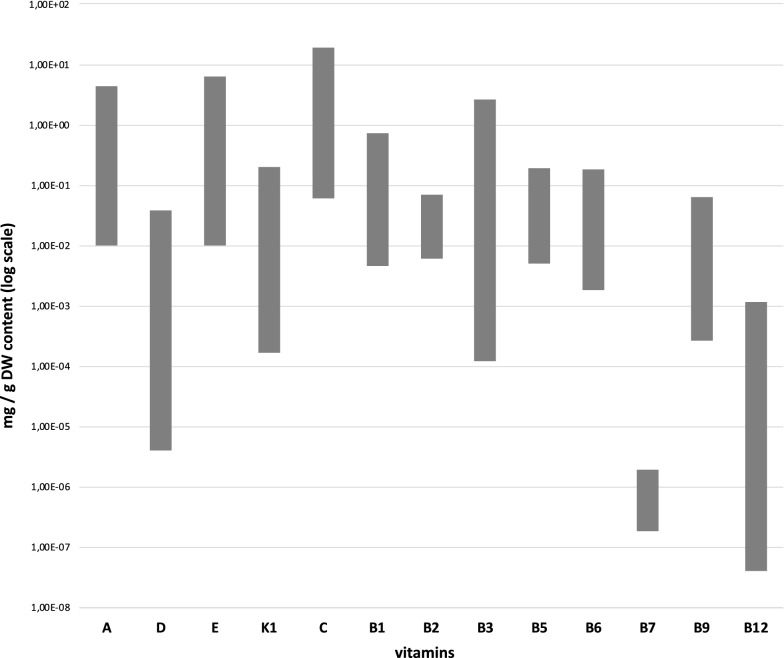
“…intracellular pools of the antioxidant vitamins L-ascorbate and α -tocopherol in microalgae span orders of magnitude (L-ascorbate: 0.06–18.79 mg per g dry weight; α -tocopherol: 0.01–6.32 mg per g dry weight), corresponding to approximate intra-cellular concentrations of 1 μ M to 10 mM [ 38].”
InfluentialRaj, V., Karn, S. K., Vaibhav, V., Tripathi, M., Chauhan, A. K., Prakash, A., & Kumar, A. (2026) · Springer eBooks · doi:10.1007/978-3-032-22521-4_18
Algae in Functional Foods: Enhancing Health Benefits Through Bioactive Components
Fatima, N. (2026) · Springer eBooks · doi:10.1007/978-3-032-22521-4_3
Vitamins from Algae: Sources, Benefits, and Applications in Nutraceuticals
Naeem, Z., Jabeen, A., & Mumtaz, A. S. (2026) · Springer eBooks · doi:10.1007/978-3-032-22521-4_14
Vitamins from Algae in Pharmaceuticals: Therapeutic Applications and Research Advances
De, J., & Dutta, M. (2026) · Springer eBooks · doi:10.1007/978-3-032-22521-4_15
Bioactive Compounds in Algae: Applications in Pharmaceuticals and Therapeutic Uses
Mishra, H., Kushwaha, V. B., & Singh, M. P. (2026) · Springer eBooks · doi:10.1007/978-3-032-22521-4_11
Formulating Algal Feeds: Techniques for Effective Integration and Nutrient Stabilities
Panda, S. K., & Rai, A. (2026) · Springer eBooks · doi:10.1007/978-3-032-22521-4_9
Harnessing Bioactive Compounds from Microalgae and its Harvesting Techniques
Saini, K. C., Saini, N., & Sharma, D. (2026) · Interdisciplinary biotechnological advances · doi:10.1007/978-981-95-8431-4_13
Microalgal Biomass for Food Security: Current Status and Future Perspectives
Sheth, R., Malik, V., & Rawat, S. (2026) · Food bioactive ingredients · doi:10.1007/978-3-032-19955-3_11
Yakoviichuk, O. V., Maltseva, I. А., Kochubey, A., Cherkashina, S., Lysova, E. A., Sheludko, E., Kulikovskiy, M. S., Maltsev, Y., & MALTSEVA, S. Y. (2026) · Phycology · doi:10.3390/phycology6030085
Liu, J., Li, L., Yan, Y., Du, M., & Wang, J. (2026) · Phycology · doi:10.3390/phycology6030087
“However, it should be noted that the bioactivity of algal vitamin B 12 in mammals remains a subject of ongoing investigation, as some algal forms may include inactive analogs [13].”
Marine-based vitamins and future potentials
Medagoda, N., & Wijemanna, B. U. R. (2026) · Elsevier eBooks · doi:10.1016/b978-0-443-29190-6.00014-3
Antioxidant Compounds in Microalgae and Cyanobacteria: A Sustainable Source of Bioactive Molecules
Gómez‐Villegas, P., Díaz‐Santos, E., Rengel, R., Molina-Márquez, A., Rodríguez-González, J. M., Vigara, J., León, R., & Léon-Vaz, A. (2026) · Marine Drugs · doi:10.3390/md24080288 · Cited by 1
Xu, C., Zhang, W., Wang, K., Huo, Y., Zhao, Q., Liu, Y., Lin, X., Xi, L., & Tan, T. (2026) · Green Carbon · doi:10.1016/j.greenca.2026.08.004
Shiels, K., Matias, M., Walshe, J., Murray, P., & Saha, S. K. (2026) · Elsevier eBooks · doi:10.1016/b978-0-443-27500-5.00007-1
Effluent-derived nutrient uptake through algaquaculture concept
Meitei, M. M., Singh, A. B., Monsang, M. W., Kishore, P. S., Syamala, K., Ande, M. P., & Munilkumar, S. (2026) · Elsevier eBooks · doi:10.1016/b978-0-443-34689-7.00003-3
Ma, D., Xia, C., Jia, A., Zhang, G., Zhao, Y., Ren, H., Liu, X., Li, F., Li, L., Jia, R., et al. (2026) · Frontiers in Microbiology · doi:10.3389/fmicb.2026.1966638
Ghelichi, S., McClements, D. J., Hajfathalian, M., & Jacobsen, C. (2026) · Elsevier eBooks · doi:10.1016/b978-0-443-45519-3.00017-0
Introduction to aquatic side streams and valorization of bioactive compounds
Ghelichi, S., García‐Moreno, P. J., & Jacobsen, C. (2026) · Elsevier eBooks · doi:10.1016/b978-0-443-45519-3.00011-x
Metadata
- Authors
- Del Mondo, A., Smerilli, A., Sané, E., Sansone, C., & Brunet, C.
- Affiliations
- Stazione Zoologica Anton Dohrn (IT)
- Corresponding author
- Sansone, Clementina
- Venue
- Microbial Cell Factories
- Published
- 2020-11-02
- Volume
- 19
- Issue
- 1
- Pages
- 201-201
- ISSN
- 1475-2859 (ISSN-L)
- PMC
- PMC7607653
- OpenAlex
- W3095997206
- Semantic Scholar
- 1aec83fcafd4996d21092c7fcef7abe31f23f5e7
- Cited by
- 220
- References
- 231
- Citations by year
- 2026: 36 · 2025: 50 · 2024: 41 · 2023: 43 · 2022: 34 · 2021: 16
- FWCI
- 1.07
- Type
- journal article
- Language
- en
- Open access
- gold
- doi.org
- Licence
- cc-by
- creativecommons.org/licenses/by/4.0/ (tdm)
- creativecommons.org/licenses/by/4.0/ (vor)
- Locations
- Microbial Cell Factories (publishedVersion, cc-by)
- PubMed Central (publishedVersion, cc-by)
- PubMed (publishedVersion)
- DOAJ (DOAJ: Directory of Open Access Journals) (submittedVersion, cc-by-sa)
- Funders
- Regione Campania (PG/2018/0494374)
- Topics
- Physical Sciences › Energy › Renewable Energy, Sustainability and the Environment › Algal biology and biofuel production
- Life Sciences › Agricultural and Biological Sciences › Aquatic Science › Seaweed-derived Bioactive Compounds
- Life Sciences › Agricultural and Biological Sciences › Aquatic Science › Aquaculture Nutrition and Growth
- Keywords
- microalgae, vitamins, vitamin A, vitamin C, vitamin D, vitamin E, vitamin B12, thiamine, vitamin K, nutraceuticals, functional food ingredients, cosmeceuticals, vitamin deficiency, microalgal biotechnology, human health
- MeSH terms
- Biological Products, Biotechnology, Humans, Vitamins, Dietary Supplements, Biofuels, Microalgae
About these checks
Registry, retraction, Cites and statistics results are computed, not judged, with one exception: a printed reference that no index lists is read once by a model before it counts as a citation error. Claims are extracted by a model and kept only when their quote appears verbatim in the text; each cited source is then checked, with a model’s help, for whether it says what the claim relies on. Those verdicts can be wrong — read the claim’s quote and the cited source before relying on one.
Statistics and arithmetic are recomputed, not judged.
Confidence bands are shown only for fields calibrated on our annotated test set. None is calibrated yet, so no band is shown.
What counts as a claim ›How we measure confidence ›How we check this ›
Are you an author, or do you see a problem with this page? Request a review
Data sources
Bibliographic data: Semantic Scholar, OpenAlex, Crossref.
Contains information from the Semantic Scholar Academic Graph Datasets, made available under the ODC Attribution License (ODC-BY 1.0).
Semantic Scholar’s data is described in: Kinney, R., et al. (2023). The Semantic Scholar Open Data Platform. arXiv:2301.10140.
