

Eave tubes for malaria control in Africa: an introduction
Open accessThe DOI matches its Crossref record; 37 of the 37 references it cites were found in a registry or an index.
Abstract
In spite of massive progress in the control of African malaria since the turn of the century, there is a clear and recognized need for additional tools beyond long-lasting insecticide-treated bed nets (LLINs) and indoor residual spraying (IRS) of insecticides, to progress towards elimination. Moreover, widespread and intensifying insecticide resistance requires alternative control agents and delivery systems to enable development of effective insecticide resistance management strategies. This series of articles presents a novel concept for malaria vector control, the 'eave tube', which may fulfil these important criteria. From its conceptualization to laboratory and semi-field testing, to demonstration of potential for implementation, the stepwise development of this new vector control approach is described. These studies suggest eave tubes (which comprise a novel way of delivering insecticides plus screening to make the house more 'mosquito proof') could be a viable, cost-effective, and acceptable control tool for endophilic and endophagic anophelines, and possibly other (nuisance) mosquitoes. The approach could be applicable in a wide variety of housing in sub-Saharan Africa, and possibly beyond, for vectors that use the eave as their primary house entry point. The results presented in these articles were generated during an EU-FP7 funded project, the mosquito contamination device (MCD) project, which ran between 2012 and 2015. This was a collaborative project undertaken by vector biologists, product developers, modellers, materials scientists, and entrepreneurs from five different countries.
Overview
The claims and statistics of this paper haven’t been checked yet.
Free: it reads the open-access text and checks the first 5 claims that cite a source we can check. Create a free account to check every claim.
Integrity signals
Registry
Cites
Statistics
Figures
Verification
Claims the paper makes
The claims and statistics of this paper haven’t been checked yet.
Free: it reads the open-access text and checks the first 5 claims that cite a source we can check. Create a free account to check every claim.
Claims other papers make about this one
Each is checked against this paper’s own text: does it say what the citing paper says it does?
The source backs part of the claim, not all of it — or backs it for a different population, condition or comparison.
In the citing paper
“When combined with screening of doors and windows, preliminary evidence suggests that eave tubes reduce entry of mosquitoes and increase overnight mortality rate, leading to reduced transmission risk at both household and community levels [4–7].”
From Semi-field studies to better understand the impact of eave tubes on mosquito mortality and behaviour (2018) · cites this paper as [4]
Experimental — accuracy not yet measuredThe source backs part of the claim, not all of it — or backs it for a different population, condition or comparison.
In the citing paper
“The dose transferred is sufficiently high that lethal doses of insecticide can be delivered during transient contact, even when the mosquitoes are classified as ‘resistant’ to the active ingredient [4, 5].”
From Semi-field studies to better understand the impact of eave tubes on mosquito mortality and behaviour (2018) · cites this paper as [4]
Experimental — accuracy not yet measuredThe source backs part of the claim, not all of it — or backs it for a different population, condition or comparison.
In the citing paper
“The inserts block the entry of mosquitoes while contact with the netting leads to transfer of insecticidal particles onto the mosquito body [4, 5].”
From Semi-field studies to better understand the impact of eave tubes on mosquito mortality and behaviour (2018) · cites this paper as [4]
Experimental — accuracy not yet measuredThe source backs part of the claim, not all of it — or backs it for a different population, condition or comparison.
In the citing paper
“When combined with screening of doors and windows, preliminary evidence suggests that eave tubes reduce entry of mosquitoes and increase overnight mortality rate, leading to reduced transmission risk at both household and community levels [4–7].”
From Semi-field studies to better understand the impact of eave tubes on mosquito mortality and behaviour (2018) · cites this paper as [4]
Experimental — accuracy not yet measuredThe source backs part of the claim, not all of it — or backs it for a different population, condition or comparison.
In the citing paper
“Mosquitoes entering the tubes are blocked by the inserts and upon contact insecticidal particles are transferred onto the mosquito body, delivering sufficiently high dose to potentially overcome insecticide resistance [14, 16, 19, 26].”
From Semi-field evaluation of the cumulative effects of a "Lethal House Lure" on malaria mosquito mortality (2019) · cites this paper as [14]
Experimental — accuracy not yet measured
7 more claims about this paper
Create a free account to see every claim other papers make about this one.
Self-check
Percentages, sums and reported differences re-computed from the paper’s own numbers.
The self-check needs the paper’s full text.
Citations
Cites
The Millennium Development Goals Report
(2018) · Human Rights Documents Online · doi:10.1163/2210-7975_hrd-9927-2015002 · Cited by 3,592
The effect of malaria control on Plasmodium falciparum in Africa between 2000 and 2015
Bhatt, S., Weiss, D. J., Cameron, E., Bisanzio, D., Mappin, B., Dalrymple, U., Battle, K. E., Moyes, C. L., Henry, A., Eckhoff, P. A., et al. (2015) · Nature · doi:10.1038/nature15535 · Cited by 3,225
Insecticide-treated bed nets and curtains for preventing malaria
Lengeler, C. (2004) · Cochrane Database of Systematic Reviews · doi:10.1002/14651858.cd000363.pub2 · Cited by 1,700 · cited 2×
“Pyrethroid-treated eave curtains have been shown to reduce malaria morbidity and mortality [20, 40], which clearly demonstrates that the eave is an effective place to target host-seeking mosquitoes when they try to enter [41].”
BackgroundRespiratory risks from household air pollution in low and middle income countries
Gordon, S. B., Bruce, N. G., Grigg, J., Hibberd, P. L., Kurmi, O. P., Lam, K.-B. H., Mortimer, K., Asante, K. P., Balakrishnan, K., Balmes, J., et al. (2014) · The Lancet Respiratory Medicine · doi:10.1016/s2213-2600(14)70168-7 · Cited by 953 · cited 1×
“This results in a reduction in indoor comfort, which may result in reduced use of LLINs (these being too hot to sleep under [28]) and an increase in smoke-induced ailments when cooking is done indoors [29].”
BackgroundMalaria: Principles and Practice of Malariology
Wernsdorfer, W. H., & McGregor, I. A. (1989) · Medical Entomology and Zoology · Cited by 794
ODOR-MEDIATED BEHAVIOR OF AFROTROPICAL MALARIA MOSQUITOES
Takken, W., & Knols, B. G. J. (1999) · Annual Review of Entomology · doi:10.1146/annurev.ento.44.1.131 · Cited by 711 · cited 1×
“they would respond to host odours [42] emanating from the tubes (at eave height) and fly into these.”
BackgroundSelf-citationRussell, T. L., Govella, N. J., Azizi, S., Drakeley, C. J., Kachur, S. P., & Killeen, G. F. (2011) · Malaria Journal · doi:10.1186/1475-2875-10-80 · Cited by 698 · cited 1×
“Although, due to intensified use of LLINs, it has been observed that certain vectors are evading fatal exposure to insecticides indoors by feeding outdoors [23, 24], it has also been determined that outdoor feeding is almost always preceded by attempts to feed indoors [25].”
BackgroundAverting a malaria disaster: will insecticide resistance derail malaria control?
Hemingway, J., Ranson, H., Magill, A., Kolaczinski, J., Fornadel, C., Gimnig, J., Coetzee, M., Simard, F., Roch, D. K., Hinzoumbe, C. K., et al. (2016) · The Lancet · doi:10.1016/s0140-6736(15)00417-1 · Cited by 562 · cited 1×
“Without novel public health insecticides [8] and strategies to manage insecticide resistance [9, 10], it will be difficult to sustain the gains of the last decade [11].”
BackgroundCharacterizing, controlling and eliminating residual malaria transmission
Killeen, G. F. (2014) · Malaria Journal · doi:10.1186/1475-2875-13-330 · Cited by 506
Indoor residual spraying for preventing malaria
Pluess, B., Tanser, F. C., Lengeler, C., & Sharp, B. L. (2010) · Cochrane Database of Systematic Reviews · doi:10.1002/14651858.cd006657.pub2 · Cited by 482
Ecology: A Prerequisite for Malaria Elimination and Eradication
Ferguson, H. M., Dornhaus, A., Beeche, A., Borgemeister, C., Gottlieb, M., Mulla, M. S., Gimnig, J. E., Fish, D., & Killeen, G. F. (2010) · PLoS Medicine · doi:10.1371/journal.pmed.1000303 · Cited by 374 · cited 1×
“Rationale For several years it has been argued that the development of novel tools for anopheline vector control should be guided by a thorough understanding of their ecology and life history behaviours [19].”
BackgroundThe evidence for improving housing to reduce malaria: a systematic review and meta-analysis
Tusting, L. S., Ippolito, M. M., Willey, B. A., Kleinschmidt, I., Dorsey, G., Gosling, R. D., & Lindsay, S. W. (2015) · Malaria Journal · doi:10.1186/s12936-015-0724-1 · Cited by 355 · cited 1×
“It was concluded that, although only one housing intervention study has produced positive clinical outcomes to date [17], further studies on house improvement are warranted [18].”
BackgroundKirby, M. J., Ameh, D., Bottomley, C., Green, C., Jawara, M., Milligan, P. J., Snell, P. C., Conway, D. J., & Lindsay, S. W. (2009) · The Lancet · doi:10.1016/s0140-6736(09)60871-0 · Cited by 293 · cited 1×
“It was concluded that, although only one housing intervention study has produced positive clinical outcomes to date [17], further studies on house improvement are warranted [18].”
BackgroundThe Innovative Vector Control Consortium: improved control of mosquito-borne diseases
Hemingway, J., Beaty, B. J., Rowland, M., Scott, T. W., & Sharp, B. L. (2006) · Trends in Parasitology · doi:10.1016/j.pt.2006.05.003 · Cited by 287 · cited 1×
“Without novel public health insecticides [8] and strategies to manage insecticide resistance [9, 10], it will be difficult to sustain the gains of the last decade [11].”
BackgroundChanges in house design reduce exposure to malaria mosquitoes
Lindsay, S. W., Jawara, M., Paine, K., Pinder, M., Walraven, G. E. L., & Emerson, P. M. (2003) · Tropical Medicine & International Health · doi:10.1046/j.1365-3156.2003.01059.x · Cited by 249 · cited 1×
“Eaves, which constitute the gap between the roof and the walls of houses, have long been incriminated as the primary entry point into houses for malaria vectors [32–36], and have formed the basis for malaria control”
BackgroundSougoufara, S., Diédhiou, S. M., Doucouré, S., Diagne, N., Sembène, P. M., Harry, M., Trape, J.-F., Sokhna, C., & Ndiath, M. O. (2014) · Malaria Journal · doi:10.1186/1475-2875-13-125 · Cited by 245
The role of vector control in stopping the transmission of malaria: threats and opportunities
Hemingway, J. (2014) · Philosophical Transactions of the Royal Society B: Biological Sciences · doi:10.1098/rstb.2013.0431 · Cited by 243 · cited 1×
“classes of public health insecticides recommended by the World Health Organization, is already widespread and increasing in intensity [6, 7].”
BackgroundImplications of temperature variation for malaria parasite development across Africa
Blanford, J. I., Blanford, S., Crane, R. G., Mann, M. E., Paaijmans, K. P., Schreiber, K. V., & Thomas, M. B. (2013) · Scientific Reports · doi:10.1038/srep01300 · Cited by 243 · cited 1×
“Given the poikilothermic nature of mosquitoes, changes in indoor climate will affect their survival, blood meal digestion and egg development, as well as parasite development [26, 27].”
BackgroundSelf-citationKilleen, G. F., Govella, N. J., Lwetoijera, D. W., & Okumu, F. O. (2016) · Malaria Journal · doi:10.1186/s12936-016-1280-z · Cited by 166 · cited 1×
“Although, due to intensified use of LLINs, it has been observed that certain vectors are evading fatal exposure to insecticides indoors by feeding outdoors [23, 24], it has also been determined that outdoor feeding is almost always preceded by attempts to feed indoors [25].”
BackgroundRisk factors for house-entry by malaria vectors in a rural town and satellite villages in The Gambia
Kirby, M. J., Green, C., Milligan, P. M., Sismanidis, C., Jasseh, M., Conway, D. J., & Lindsay, S. W. (2008) · Malaria Journal · doi:10.1186/1475-2875-7-2 · Cited by 148 · cited 1×
“Eaves, which constitute the gap between the roof and the walls of houses, have long been incriminated as the primary entry point into houses for malaria vectors [32–36], and have formed the basis for malaria control”
BackgroundMind the Gap: House Structure and the Risk of Malaria in Uganda
Wanzirah, H., Tusting, L. S., Arinaitwe, E., Katureebe, A., Maxwell, K., Rek, J., Bottomley, C., Staedke, S. G., Kamya, M., Dorsey, G., et al. (2015) · PLOS ONE · doi:10.1371/journal.pone.0117396 · Cited by 140
Importance of Eaves to House Entry by Anopheline, But Not Culicine, Mosquitoes
Njie, M., Dilger, E., Lindsay, S. W., & Kirby, M. J. (2009) · Journal of Medical Entomology · doi:10.1603/033.046.0314 · Cited by 139 · cited 1×
“Eaves, which constitute the gap between the roof and the walls of houses, have long been incriminated as the primary entry point into houses for malaria vectors [32–36], and have formed the basis for malaria control”
BackgroundToé, K. H., N’Falé, S., Dabiré, R. K., Ranson, H., & Jones, C. M. (2015) · BMC Genomics · doi:10.1186/s12864-015-1342-6 · Cited by 136 · cited 1×
“classes of public health insecticides recommended by the World Health Organization, is already widespread and increasing in intensity [6, 7].”
BackgroundThe influence of mosquito resting behaviour and associated microclimate for malaria risk
Paaijmans, K. P., & Thomas, M. B. (2011) · Malaria Journal · doi:10.1186/1475-2875-10-183 · Cited by 131 · cited 1×
“Given the poikilothermic nature of mosquitoes, changes in indoor climate will affect their survival, blood meal digestion and egg development, as well as parasite development [26, 27].”
BackgroundSelf-citationThe trouble with eaves; house entry by vectors of malaria
Lindsay, S. W., & Snow, R. W. (1988) · Transactions of the Royal Society of Tropical Medicine and Hygiene · doi:10.1016/0035-9203(88)90546-9 · Cited by 119 · cited 1×
“Eaves, which constitute the gap between the roof and the walls of houses, have long been incriminated as the primary entry point into houses for malaria vectors [32–36], and have formed the basis for malaria control”
BackgroundCountry-level operational implementation of the Global Plan for Insecticide Resistance Management
Hemingway, J., Vontas, J., Poupardin, R., Raman, J., Lines, J., Schwabe, C., Matias, A., & Kleinschmidt, I. (2013) · Proceedings of the National Academy of Sciences · doi:10.1073/pnas.1307656110 · Cited by 97 · cited 1×
“Without novel public health insecticides [8] and strategies to manage insecticide resistance [9, 10], it will be difficult to sustain the gains of the last decade [11].”
BackgroundAndriessen, R., Snetselaar, J., Suer, R. A., Osinga, A. J., Deschietere, J., Lyimo, I. N., Mnyone, L. L., Brooke, B. D., Ranson, H., Knols, B. G. J., et al. (2015) · Proceedings of the National Academy of Sciences · doi:10.1073/pnas.1510801112 · Cited by 86 · cited 1×
“A secondary reason for focusing on tubes was the reduced requirements for netting compared to eave curtains, and since one of the partners (In2Care BV) had developed a novel electrostatic coating for application on netting that is pyrethroidresistance breaking [43], the authors wanted to use only minimal quantities of…”
BackgroundSelf-citationBradley, J., Rehman, A. M., Schwabe, C., Vargas, D., Monti, F., Ela, C., Riloha, M., & Kleinschmidt, I. (2013) · PLoS ONE · doi:10.1371/journal.pone.0080626 · Cited by 81 · cited 1×
“Pyrethroid-treated eave curtains have been shown to reduce malaria morbidity and mortality [20, 40], which clearly demonstrates that the eave is an effective place to target host-seeking mosquitoes when they try to enter [41].”
BackgroundExperimental Proof of the Mosquitomalaria Theory
Manson, P. (1900) · BMJ · doi:10.1136/bmj.2.2074.949 · Cited by 70
Airflow attenuation and bed net utilization: observations from Africa and Asia
von Seidlein, L., Ikonomidis, K., Bruun, R., Jawara, M., Pinder, M., Knols, B. G., & Knudsen, J. B. (2012) · Malaria Journal · doi:10.1186/1475-2875-11-200 · Cited by 46 · cited 1×
“This results in a reduction in indoor comfort, which may result in reduced use of LLINs (these being too hot to sleep under [28]) and an increase in smoke-induced ailments when cooking is done indoors [29].”
BackgroundSelf-citationEave Screening and Push-Pull Tactics to Reduce House Entry by Vectors of Malaria
Menger, D. J., Omusula, P., Wouters, K., Oketch, C., Carreira, A. S., Durka, M., Derycke, J.-L., Loy, D. E., Hahn, B. H., Mukabana, W. R., et al. (2016) · The American Society of Tropical Medicine and Hygiene · doi:10.4269/ajtmh.15-0632 · Cited by 46 · cited 1×
“interventions, notably through the use of eave curtains [37, 38] and, more recently, push–pull interventions [39].”
BackgroundEXPERIMENTAL PROOF OF THE MOSQUITO-MALARIA THEORY.
Manson, P. (1900) · The Lancet · doi:10.1016/s0140-6736(01)86862-8 · Cited by 45 · cited 1×
“Although house improvement for malaria control has a long history [14, 15] and contributed significantly to malaria elimination in Europe and the USA [16], its role in developing countries remains surprisingly small.”
BackgroundCuzin-Ouattara, N., Van den Broek, A. H. A., Habluetzel, A., Diabaté, A., Sanogo-Ilboudo, E., Diallo, D. A., Cousens, S. N., & Esposito, F. (1999) · Transactions of the Royal Society of Tropical Medicine and Hygiene · doi:10.1016/s0035-9203(99)90343-7 · Cited by 44 · cited 1×
“interventions, notably through the use of eave curtains [37, 38] and, more recently, push–pull interventions [39].”
BackgroundVisualization of house-entry behaviour of malaria mosquitoes
Spitzen, J., Koelewijn, T., Mukabana, W. R., & Takken, W. (2016) · Malaria Journal · doi:10.1186/s12936-016-1293-7 · Cited by 43 · cited 1×
“Pyrethroid-treated eave curtains have been shown to reduce malaria morbidity and mortality [20, 40], which clearly demonstrates that the eave is an effective place to target host-seeking mosquitoes when they try to enter [41].”
BackgroundTHE NEW PROPHYLAXIS AGAINST MALARIA: AN ACCOUNT OF EXPERIMENTS IN LATIUM.
Celli, A. (1900) · The Lancet · doi:10.1016/s0140-6736(01)89058-9 · Cited by 19
Da, D., Habluetzel, A., Cuzin‐Ouattara, N., Nébié, I., Sanogo, E., Cousens, S. N., & Esposito, F. (1999) · PubMed · Cited by 15
Experimental proof of the mosquito-malaria theory. 1900.
Manson, P. (2002) · PubMed · Cited by 14
Cited by
The importance of vector control for the control and elimination of vector-borne diseases
Wilson, A. L., Courtenay, O., Kelly-Hope, L. A., Scott, T. W., Takken, W., Torr, S. J., & Lindsay, S. W. (2020) · PLOS Neglected Tropical Diseases · doi:10.1371/journal.pntd.0007831 · Cited by 874
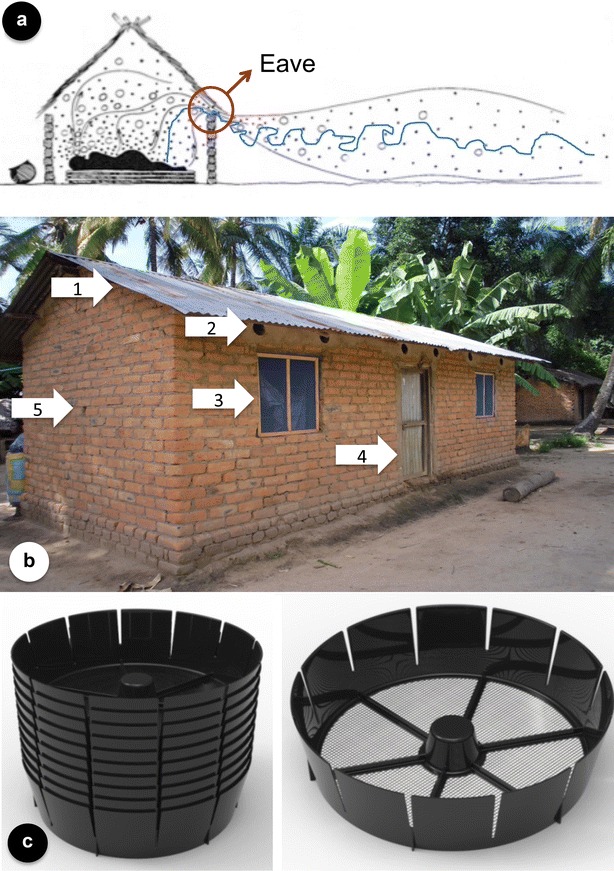
“Eave tubes are small plastic tubes with insecticide-laden electrostatic netting that are inserted into the house wall, below the roof [19].”
BackgroundPiret, J., & Boivin, G. (2021) · Frontiers in Microbiology · doi:10.3389/fmicb.2020.631736 · Cited by 725
“, Wolbachia) (Flores and O’Neill, 2018) and eave tubes with insecticide-laden electrostatic netting (Knols et al., 2016).”
BackgroundCurrent vector control challenges in the fight against malaria
Benelli, G., & Beier, J. C. (2017) · Acta Tropica · doi:10.1016/j.actatropica.2017.06.028 · Cited by 313
Controlling mosquitoes with semiochemicals: a review
Wooding, M., Naudé, Y., Rohwer, E. R., & Bouwer, M. C. (2020) · Parasites & Vectors · doi:10.1186/s13071-020-3960-3 · Cited by 143
Implicating Cryptic and Novel Anophelines as Malaria Vectors in Africa
Stevenson, J. C., & Norris, D. E. (2016) · Insects · doi:10.3390/insects8010001 · Cited by 126
Metadata
- Authors
- Knols, B. G. J., Farenhorst, M., Andriessen, R., Snetselaar, J., Suer, R. A., Osinga, A. J., Knols, J. M. H., Deschietere, J., Ng’habi, K. R., Lyimo, I. N., Kessy, S. T., Mayagaya, V. S., Sperling, S., Cordel, M., Sternberg, E. D., Hartmann, P., Mnyone, L. L., Rose, A., & Thomas, M. B.
- Affiliations
- Ifakara Health Institute (TZ)
- Pennsylvania State University (US)
- Corresponding author
- Knols, Bart G. J.
- ORCID
- Venue
- Malaria Journal
- Published
- 2016-08-11
- Volume
- 15
- Issue
- 1
- Pages
- 404-404
- ISSN
- 1475-2875 (ISSN-L)
- PMC
- PMC4982263
- OpenAlex
- W2517796671
- Cited by
- 81
- References
- 37
- Citations by year
- 2025: 6 · 2024: 13 · 2023: 6 · 2022: 5 · 2021: 14 · 2020: 11 · 2019: 6 · 2018: 9 · 2017: 8 · 2016: 3
- FWCI
- 8.59
- Type
- journal article
- Language
- en
- Open access
- gold
- doi.org
- Licence
- cc-by
- Locations
- Malaria Journal (publishedVersion, cc-by)
- PubMed Central (publishedVersion, cc-by)
- PubMed (publishedVersion)
- White Rose Research Online (University of Leeds, The University of Sheffield, University of York) (acceptedVersion)
- LSHTM Research Online (London School of Hygiene and Tropical Medicine) (acceptedVersion)
- University of Regensburg Publication Server (University of Regensburg) (submittedVersion)
- Funders
- European Commission (FP7-HEALTH-2012-INNOVATION-1, 306105)
- FP7 Health
- Topics
- Health Sciences › Medicine › Public Health, Environmental and Occupational Health › Malaria Research and Control
- Health Sciences › Medicine › Public Health, Environmental and Occupational Health › Dengue and Mosquito Control Research
- Life Sciences › Agricultural and Biological Sciences › Plant Science › Insect Pest Control Strategies
- Keywords
- malaria vector control, insecticide resistance management, anophelines, sub-Saharan Africa, malaria elimination
- MeSH terms
- Animals, Female, Housing, Humans, Malaria, Mosquito Control, Africa South of the Sahara, Disease Transmission, Infectious
About these checks
Registry, retraction, Cites and statistics results are computed, not judged, with one exception: a printed reference that no index lists is read once by a model before it counts as a citation error. Claims are extracted by a model and kept only when their quote appears verbatim in the text; each cited source is then checked, with a model’s help, for whether it says what the claim relies on. Those verdicts can be wrong — read the claim’s quote and the cited source before relying on one.
Statistics and arithmetic are recomputed, not judged.
Confidence bands are shown only for fields calibrated on our annotated test set. None is calibrated yet, so no band is shown.
What counts as a claim ›How we measure confidence ›How we check this ›
Are you an author, or do you see a problem with this page? Request a review
Data sources
Bibliographic data: Semantic Scholar, OpenAlex, Crossref.
Contains information from the Semantic Scholar Academic Graph Datasets, made available under the ODC Attribution License (ODC-BY 1.0).
Semantic Scholar’s data is described in: Kinney, R., et al. (2023). The Semantic Scholar Open Data Platform. arXiv:2301.10140.
