

Conceptual framework of equity-focused implementation research for health programs (EquIR)
Open accessThe DOI matches its Crossref record; 46 of the 50 references it cites were found in a registry or an index; 10 of the 47 sources its claims cite were checked for support.
Abstract
BACKGROUND: Implementation research is increasingly used to identify common implementation problems and key barriers and facilitators influencing efficient access to health interventions. OBJECTIVE: To develop and propose an equity-based framework for Implementation Research (EquIR) of health programs, policies and systems. METHODS: A systematic search of models and conceptual frameworks involving equity in the implementation of health programs, policies and systems was conducted in Medline (PubMed), Embase, LILACS, Scopus and grey literature. Key characteristics of models and conceptual frameworks were summarized. We identified key aspects of equity in the context of seven Latin American countries-focused health programs We gathered information related to the awareness of inequalities in health policy, systems and programs, the potential negative impact of increasing inequalities in disadvantaged populations, and the strategies used to reduce them. RESULTS: A conceptual framework of EquIR was developed. It includes elements of equity-focused implementation research, but it also links the population health status before and after the implementation, including relevant aspects of health equity before, during and after the implementation. Additionally, health sectors were included, linked with social determinants of health through the "health in all policies" proposal affecting universal health and the potential impact of the public health and public policies. CONCLUSION: EquIR is a conceptual framework that is proposed for use by decision makers and researchers during the implementation of programs, policies or health interventions, with a focus on equity, which aims to reduce or prevent the increase of existing inequalities during implementation.
Overview
CoChat Summary
TL;DR
The paper proposes EquIR, an equity-focused conceptual framework for implementation research of health programs, policies, and systems. It aims to help decision-makers and researchers identify and monitor disadvantaged populations before, during, and after implementation so that interventions reduce or do not increase existing health inequalities.
Key findings
- The systematic review found 19 articles on models/frameworks involving equity in implementation: 12 general models, 5 related to ethnic/racial disparities, and 2 related to children’s health; no consolidated model explicitly included equity issues in implementation research.
- In the stakeholder analysis of seven Latin American health programs, all 7 initially included disadvantaged populations in their proposals, but only two groups maintained an equity focus throughout the entire project and in the research protocol.
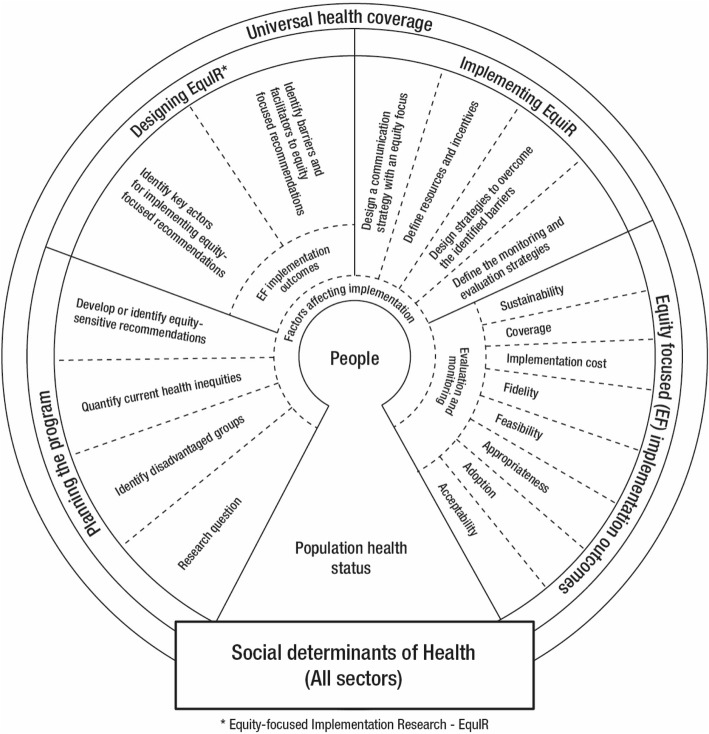
- EquIR was developed as an iterative framework with suggested steps: identify population health status, equity-focused planning, design, implementation, equity-focused implementation outcomes, and a new equity-focused population health status that becomes the next starting point.
- The framework includes equity-focused definitions for implementation outcomes such as acceptability, adoption, appropriateness, feasibility, fidelity, implementation cost, coverage, and sustainability, and links health sectors with social determinants of health through “health in all policies” and universal health.
Methods
- Phase 1: a systematic review of conceptual frameworks/models incorporating health equity into implementation research, searching Medline (PubMed), Embase, LILACS (1965–2016), Scopus (1998–2016), and grey literature, with no language limit and no exclusion criteria; three independent reviewers categorized articles.
- Phase 2: a stakeholder analysis involving decision-makers and researchers from seven Latin American health programs funded through the iPIER call during 2016–17, with mentor follow-up, protocol review under an equity perspective, and in-person workshops.
- Phase 3: the implementation research group and health equity experts built EquIR from the review and country-team experience; face validity was assessed by key experts and stakeholders, and a practical example used the “Mi Salud” program in Bolivia.
Limitations
- The paper states that the quality of articles describing models and frameworks was not evaluated because they were descriptive reports.
- The paper states that future evaluation of EquIR’s effectiveness to improve implementation outcomes or health outcomes in disadvantaged populations is needed.
- Evident from the text: EquIR is a conceptual proposal with face-validity assessment only, based on a small stakeholder sample of seven programs, and the paper reports no empirical testing of the framework’s impact.
Model-written summary. Check it against the paper before relying on it.
Integrity signals
Registry
Cites
Statistics
Figures
Verification
Claims the paper makes
3 Valid · 2 Not valid · 23 Not checked · 24 Own results and interpretations
The cited sources support only part of this claim — read each source’s verdict below.
In the paper
“This framework is based on the available evidence (Phase 1) where the relevant components and processes were identified, such as methodological steps and program planning [20, 28–30], identification of vulnerable groups [30, 34], the identification of barriers and facilitators [21, 33, 34], the design of implementation programs and tools [30, 32, 33] and monitoring and evaluation of implementation”
§ Conceptual framework of equity-focused implementation research for health programs (EquIR) > Discussion
What the sources say
- Partly supportedcites [20] Kitson AL Rycroft-Malone J Harvey G McCormack B Seers K Titchen A Evaluating the successful implementation of evidence into practice using the PARiHS framework: theoretical and practical challenges Implement Sci 2008 3 1 10.1186/1748-5908-3-1 18179688 PMC2235887 sourceExperimental — accuracy not yet measured
Split into 2 atoms — 0 confirmed, 2 partially supported, 0 disputed, 0 misattributed, 0 unverifiable. Expand the claim to see per-atom verdicts.
- Not checked yetcites [28] Mann G Squire SB Bissell K Eliseev P Du Toit E Hesseling A Beyond accuracy: creating a comprehensive evidence base for TB diagnostic tools [State of the art] Int J Tuberc Lung Dis 2010 14 1518 1524 21144235
- Not checked yetcites [29] Mann GH Thomson R Jin C Phiri M Vater MC Sinanovic E The role of health economics research in implementation research for health systems strengthening Int J Tuberc Lung Dis 2011 15 715 721 10.5588/ijtld.10.0749 21575290 source
- Partly supportedcites [30] Rudan I Setting health research priorities using the CHNRI method: IV. Key conceptual advances J Glob Heal 2016 6 10501 10.7189/jogh.06.010501 PMC4938380 27418959 sourceExperimental — accuracy not yet measured
Split into 2 atoms — 0 confirmed, 2 partially supported, 0 disputed, 0 misattributed, 0 unverifiable. Expand the claim to see per-atom verdicts.
- Not checked yetcites [34] Bowen S, Botting I, Roy J. Promoting action on equity issues: a knowledgeto-action handbook. Edmonton: School of Public Health, University of Alberta; 2011. Available from: http://nccdh.ca/resources/entry/promoting-action-on-equity-issues.
- Partly supportedcites [21] Chin MH Goddu AP Ferguson MJ Peek ME Expanding and sustaining integrated health care-community efforts to reduce diabetes disparities Heal Promot Pr 2014 15 29s 39s 10.1177/1524839914532649 PMC4415354 25359247 sourceExperimental — accuracy not yet measured
The Results sections on demographic context, implementation, and sustainability describe a population facing diabetes disparities, challenges to expanding an intervention, and program activities. They support several components of the citing sentence, but the paper presents a case study rather than a set of methodological steps or a general process for identifying vulnerable groups and designing implementation programs and tools. The cited paper does not identify those items as components of the citing authors’ Phase 1 framework. (LLM, conf=0.82)
- Not checked yetcites [33] Zamora G, Flores-Urrutia MC, Mayen AL, Mayén AL. Large-scale fortification of condiments and seasonings as a public health strategy: equity considerations for implementation. Ann N Y Acad Sci; 2016. Available from: https://nyaspubs.onlinelibrary.wiley.com/doi/full/10.1111/nyas.13183. Accessed 17 July 2017. 27525672 source
plain- Asserted: passes — The authors put it forward as true.
- Checkable: passes — It can be checked against evidence.
- Load-bearing: passes — The paper’s conclusions depend on it.
- Based: passes — The paper gives a reason why it holds.
- Partly supported
The cited sources support only part of this claim — read each source’s verdict below.
In the paper
“It is evident that there is still a gap in the implementation of highly effective strategies in controlled studies, which fail to demonstrate such effectiveness after their implementation [15–17]”
§ Conceptual framework of equity-focused implementation research for health programs (EquIR) > Background > Why is IR research different in general?
What the sources say
- Partly supportedcites [15] Damschroder LJ, Aron DC, Keith RE, Kirsh SR, Alexander JA, Lowery JC. Fostering implementation of health services research findings into practice: a consolidated framework for advancing implementation science. Implement Sci. 2009;4:50 Available from: https://implementationscience.biomedcentral.com/articles/10.1186/1748-5908-4-50. PMC2736161 19664226 sourceExperimental — accuracy not yet measured
The Background states that many interventions effective in health services research studies fail to translate into meaningful patient care outcomes across contexts. It does not specify that the studies were controlled or that the interventions were highly effective, so those details are not supported by this source. (LLM, conf=0.83)
- Partly supportedcites [16] Curran Geoffrey M. Bauer Mark Mittman Brian Pyne Jeffrey M. Stetler Cheryl Effectiveness-implementation Hybrid Designs Medical Care 2012 50 3 217 226 10.1097/MLR.0b013e3182408812 22310560 PMC3731143 sourceExperimental — accuracy not yet measured
The Conclusions describe a gap between research and routine practice, and ‘Challenges in Linking Clinical and Implementation Research Designs’ says controlled trials pay little attention to implementation in general practice. But the paper does not establish that strategies shown to be highly effective in controlled studies fail to retain that effectiveness after implementation; it notes that implementation studies often do not assess patient outcomes. Page numbers are unavailable in our copy. (LLM, conf=0.85)
- Partly supportedcites [17] Weiss CH Why do we fail to deliver evidence-based practice in critical care medicine? Curr Opin Crit Care 2017 23 400 405 10.1097/MCC.0000000000000436 28858917 PMC5784774 sourceExperimental — accuracy not yet measured
The Introduction (page not provided) says evidence-based practice often fails to translate into clinical practice, supporting an implementation gap. The paper does not say that strategies shown to be highly effective in controlled studies lose their effectiveness after implementation; its focus is on barriers to adoption. (LLM, conf=0.85)
boosted- Asserted: passes — The authors put it forward as true.
- Checkable: passes — It can be checked against evidence.
- Load-bearing: passes — The paper’s conclusions depend on it.
- Based: passes — The paper gives a reason why it holds.
- Partly supported
A result the paper reports from its own data — it cites no other source for it, so there is none to check. The quote shows it is in the paper.
In the paper
“However, in the course of developing an implementation research project, only two groups maintained an equity focus throughout the entire project and maintained this focus in the development of the research protocol.”
§ Conceptual framework of equity-focused implementation research for health programs (EquIR) > Results > Second phase
plain- Asserted: passes — The authors put it forward as true.
- Checkable: passes — It can be checked against evidence.
- Load-bearing: unclear — It is unclear whether the paper’s conclusions depend on it.
- Based: passes — The paper gives a reason why it holds.
A result the paper states — it cites no source for it, so there is none to check. The quote shows it is in the paper.
In the paper
“Initially, all 7 projects included disadvantaged population in their proposals.”
§ Conceptual framework of equity-focused implementation research for health programs (EquIR) > Results > Second phase
plain- Asserted: passes — The authors put it forward as true.
- Checkable: passes — It can be checked against evidence.
- Load-bearing: unclear — It is unclear whether the paper’s conclusions depend on it.
- Based: passes — The paper gives a reason why it holds.
In the paper
“Although there was no consolidated model to explicitly include equity issues in implementation research [26], the models included essential characteristics that were further incorporated into our framework.”
§ Conceptual framework of equity-focused implementation research for health programs (EquIR) > Results > First phase
What the sources say
- Not checked yetcites [26] Eslava-Schmalbach J Elias V Reveiz L G-ON. Incorporating health equity into implementation research: review of conceptual models Rev Panam Salud Publica 2017 41 e126 PMC6645188 31384259
plain- Asserted: passes — The authors put it forward as true.
- Checkable: passes — It can be checked against evidence.
- Load-bearing: passes — The paper’s conclusions depend on it.
- Based: passes — The paper gives a reason why it holds.
11 more claims
Create a free account to see all 52 claims and to verify the 37 references still open.
- Probably not a substantial claim. 28
- It may state two separate claims as one. 16
Claims other papers make about this one
Each is checked against this paper’s own text: does it say what the citing paper says it does?
The source backs part of the claim, not all of it — or backs it for a different population, condition or comparison.
In the citing paper
“Increasing use of implementation frameworks may offer a more systematic evaluation of newborn care packages while clarifying equitable service delivery in vulnerable populations often present in LMIC settings (35, 36).”
From Born too soon in a resource-limited setting: A 10-year mixed methods review of a special care baby unit for refugees and migrants on the Myanmar-Thailand border (2023) · cites this paper as [35]
Experimental — accuracy not yet measured
Self-check
Percentages, sums and reported differences re-computed from the paper’s own numbers.
Each contradiction between two passages listed here was confirmed by an independent check.
Rated minor: it would not touch a result — a value no result rests on, a p-value that stays on the same side of the significance level, or a conflict that is clerical, resolved elsewhere in the paper, or outside its own findings.
In the paper
§ Conceptual framework of equity-focused implementation research for health programs (EquIR) > Results > Third phase
“Marmot M. Social determinants of health inequalities. Lancet. 2005 Mar;365(9464):1099–104. DOI: 10.1016/S0140-6736(05)71146-6”
§ Conceptual framework of equity-focused implementation research for health programs (EquIR) > References
“36. Marmot M Social determinants of health inequalities Lancet 2005 365 1099 1104 10.1016/S0140-6736(05)74234-3 15781105”
Citations
Cites
Damschroder, L. J., Aron, D. C., Keith, R. E., Kirsh, S. R., Alexander, J. A., & Lowery, J. C. (2009) · Implementation Science · doi:10.1186/1748-5908-4-50 · Cited by 14,496 · cited 3×
“Several frameworks have been used in implementation sciences, including the Quality Implementation Framework [19], the Consolidated Framework for Implementation Research (CFIR) [15] and Promoting Action on Research Implementation in Health Services (PARISH) [20].”
MethodSocial determinants of health inequalities
Marmot, M. (2005) · The Lancet · doi:10.1016/s0140-6736(05)71146-6 · Cited by 5,086
Making sense of implementation theories, models and frameworks
Nilsen, P. (2015) · Implementation Science · doi:10.1186/s13012-015-0242-0 · Cited by 4,447 · cited 1×
“Implementation is “the process of putting to use or integrating new practices within a setting” [1] and includes within its considerations relevant aspects such as the communities where it is thought to be carried out, the barriers and facilitators for it, the specific needs of the population, which differ for each in…”
BackgroundCurran, G. M., Bauer, M., Mittman, B., Pyne, J. M., & Stetler, C. (2012) · Medical Care · doi:10.1097/mlr.0b013e3182408812 · Cited by 4,058
The Concepts and Principles of Equity and Health
Whitehead, M. (1992) · International Journal of Health Services · doi:10.2190/986l-lhq6-2vte-yrrn · Cited by 2,284 · cited 1×
“Implementation research is, in this case, an approach that could diminish the negative impact of implementing new interventions on health inequalities (differences in health among individuals or groups) or health inequities (differences in health, that are avoidable, unjust and unneeded) [9, 25]; or it could even be u…”
O'Neill, J., Tabish, H., Welch, V., Petticrew, M., Pottie, K., Clarke, M., Evans, T., Pardo Pardo, J., Waters, E., White, H., et al. (2014) · Journal of Clinical Epidemiology · doi:10.1016/j.jclinepi.2013.08.005 · Cited by 1,657 · cited 2×
“One example is the PROGRESS Plus framework, which focuses on highlighting unfair differences in disease burden and interventions in order to reduce these differential effects, but which does not explicitly involve implementation considerations [37, 42].”
BackgroundAn introduction to implementation science for the non-specialist
Bauer, M. S., Damschroder, L., Hagedorn, H., Smith, J., & Kilbourne, A. M. (2015) · BMC Psychology · doi:10.1186/s40359-015-0089-9 · Cited by 1,611 · cited 1×
“This makes it very difficult to study it scientifically, which has motivated the progress of Implementation Science (IS) [3, 6], which is defined as “the systematic study of how to design and evaluate a set of activities to facilitate successful uptake of an evidence-based health intervention” [7].”
BackgroundKitson, A. L., Rycroft-Malone, J., Harvey, G., McCormack, B., Seers, K., & Titchen, A. (2008) · Implementation Science · doi:10.1186/1748-5908-3-1 · Cited by 1,314 · cited 3×
“Promoting Action on Research Implementation in Health Services (PARISH) [20] Race/Ethnic • Program Planning: A diagnostic and evaluative measure of evidence and context elements.”
BackgroundMethodPeters, D. H., Adam, T., Alonge, O., Agyepong, I. A., & Tran, N. (2014) · British Journal of Sports Medicine · doi:10.1136/bmj.f6753 · Cited by 1,109
Self-citationThe Quality Implementation Framework: A Synthesis of Critical Steps in the Implementation Process
Meyers, D. C., Durlak, J. A., & Wandersman, A. (2012) · American Journal of Community Psychology · doi:10.1007/s10464-012-9522-x · Cited by 1,102 · cited 1×
“Several frameworks have been used in implementation sciences, including the Quality Implementation Framework [19], the Consolidated Framework for Implementation Research (CFIR) [15] and Promoting Action on Research Implementation in Health Services (PARISH) [20].”
Method
Cited by
Items 101–159 of 159
Groom, L. L., Schoenthaler, A., Budhrani, R., Mann, D. M., & Brody, A. A. (2025) · Telemedicine Journal and e-Health · doi:10.1177/15305627251362373 · Cited by 1
Implementation Lessons of a Water Insecurity Intervention During a Drought in Mexico
Gaitán‐Rossi, P., Beltrán, L. F., García-Ruiz, X., & Young, S. L. (2025) · Annals of Global Health · doi:10.5334/aogh.4758 · Cited by 1
Lim, S. S., Thapa, R., & Boyle, J. A. (2025) · Proceedings of The Nutrition Society · doi:10.1017/s002966512510178x · Cited by 1
“Addressing health inequity solutions requires partnership between key actors, including researchers, service providers, community leaders and end-users (71) .”
Alshahrani, N. Z., Awaidy, S. T. A., Koul, P. A., Parker, S., Baklola, M. I., Terra, M., Shukri, A. K., Furuya‐Kanamori, L., Rashid, H., & Assiri, A. M. (2025) · Mass gathering medicine. · doi:10.1016/j.mgmed.2025.100043 · Cited by 2
Morand-Grondin, D., Berthod, J., Sigouin, J., Beaulieu‐Bonneau, S., & Kairy, D. (2026) · Health Informatics Journal · doi:10.1177/14604582261431026 · Cited by 1
Improving Pediatric Patient-Reported Outcome Measure Accessibility—A Call to Action
Zigler, C. K., Rader, A., & Chhina, H. (2026) · Archives of Pediatrics and Adolescent Medicine · doi:10.1001/jamapediatrics.2026.0256 · Cited by 1
Muellmann, S., Jahnel, T., Barnils, N. P., Pan, C.-C., & Gerhardus, A. (2026) · BMC Public Health · doi:10.1186/s12889-026-27174-x · Cited by 2
“Fewer frameworks aimed at validating (i.e., ensuring feasibility of intervention prior to or during early implementation) ( n = 5) [33, 45, 47, 62, 66] or implementing interventions ( n = 4) [32, 40, 48, 63].”
InfluentialMarshall, S., Frolov, E., Corôa, R. D. C., Koorts, H., Milat, A., & Lee, K. (2026) · Health Promotion International · doi:10.1093/heapro/daag059 · Cited by 1
Steenkamp, D., Fantasia, K. L., & Wolpert, H. A. (2023) · Endocrinology and Metabolism Clinics of North America · doi:10.1016/j.ecl.2023.07.001 · Cited by 1
Health Equity in Dissemination and Implementation Science
Fitzpatrick, S. L., Glenn, B. A., Duru, O. K., & Ford, C. L. (2023) · Oxford University Press eBooks · doi:10.1093/oso/9780197660690.003.0025 · Cited by 2
Marshall, S. K., Love, P., Kuswara, K., Lee, K., Downes, H., & Laws, R. (2025) · Maternal and Child Nutrition · doi:10.1111/mcn.70046 · Cited by 3
Mixed-methods assessment of barriers to physical activity for middle school Latina girls
McDaniel, M. D., Ocegueda, A. S., Morales-Campos, D., & Parra-Medina, D. M. (2022) · Health Behavior Research · doi:10.4148/2572-1836.1154
“Cost can include the overall burden to the community, the cost of time for individuals who may be working multiple jobs and juggling various responsibilities, the cost of transportation, and rehashing historical trauma (Eslava-Schmalbach et al., 2019).”
Using implementation research to understand lessons in reducing child mortality
Binagwaho, A., & Hirschhorn, L. R. (2024) · BMC Pediatrics · doi:10.1186/s12887-023-04472-6 · Cited by 1
“Ntawukuriryayo and colleagues [15], using facility-based delivery, focus on the important equity lens of implementation research [16, 17] to better understand the success and challenges in reducing inequity by wealth and by geographic region in each of the countries.”
BackgroundBarracchia, M., Allen, J., Jones, D., Peden, J. K., Sonmez, O. F., Czabanowska, K., & Pavlova, M. (2025) · Research Square · doi:10.21203/rs.3.rs-7494799/v1 · Cited by 1
Placing equity at the heart of eHealth implementation: A qualitative pilot studyPreprint
Heinsch, M., Tickner, C., & KAY‐LAMBKIN, F. J. (2021) · Research Square · doi:10.21203/rs.3.rs-1083627/v1
Porroche‐Escudero, A., & Popay, J. (2022) · Springer eBooks · doi:10.1007/978-3-030-97212-7_45
Do Canadians Support Tailored And Targeted Public Health Programs? A Discrete Choice ExperimentPreprint
Card, K. G., Adshade, M., Hogg, R. S., Jollimore, J., & Lachowsky, N. J. (2021) · Research Square · doi:10.21203/rs.3.rs-1129112/v1
Do Canadians Support Tailored and Targeted Public Health Programs? A Discrete Choice ExperimentPreprint
Card, K. G., Adshade, M., Hogg, R. S., Jollimore, J., & Lachowsky, N. J. (2022) · Research Square · doi:10.21203/rs.3.rs-1129112/v2
Placing equity at the heart of eHealth implementation: A qualitative pilot studyPreprint
Heinsch, M., Tickner, C., & KAY‐LAMBKIN, F. J. (2021) · Research Square · doi:10.21203/rs.3.rs-1083627/v2
McLoughlin, G. M., Allen, P. M., Walsh‐Bailey, C., & Brownson, R. C. (2021) · Research Square · doi:10.21203/rs.3.rs-206237/v1
Saine, M. E., Re, V. L., Barg, F. K., & Szymczak, J. E. (2020) · Research Square · doi:10.21203/rs.3.rs-47724/v1
“Implementation strategies that do not account for health disparities have the potential to widen inequalities and further marginalize vulnerable patients (2, 4, 5).”
BackgroundAzañedo, C. M. G., Alvarado, B. G. R., Castillo, Á. L. L. F. M., Pollack, W. E. I., & Puscán, M. W. V. (2022) · LACCEI International Multiconference on Entrepreneurship, Innovation and Regional Development (LEIRD) · doi:10.18687/leird2022.1.1.17
Valenzi, N. (2023) · Western Journal of Emergency Medicine · doi:10.5811/westjem.61977
Special Issue on Social Emergency Medicine
Saucedo, C. (2023) · Western Journal of Emergency Medicine · doi:10.5811/westjem.62279 · Cited by 1
Implementation Science in Healthcare
Hamilton, A. B., & Brown, A. F. (2023) · Oxford University Press eBooks · doi:10.1093/oso/9780197660690.003.0021
Establishing a Pediatric Health Equity, Diversity, and Inclusion Research Review Process
Katz‐Wise, S. L., Shah, S. N., Melvin, P. R., Boskey, E. R., Grice, A. W., Kornetsky, S. Z., Poussaint, T. Y., Whitley, M. Y., Stack, A. M., Emans, S. J., et al. (2024) · PEDIATRICS · doi:10.1542/peds.2023-062946 · Cited by 1
Deforche, B. I., & Verloigne, M. (2023) · Springer eBooks · doi:10.1007/978-1-4614-6625-3_82-1 · Cited by 1
7. Behavioral Research to Reduce and Eliminate Health Disparities
McDaniel, M. D., & Parra-Medina, D. M. (2024) · American Public Health Association eBooks · doi:10.2105/9780875533476ch07
Equity-focused Monitoring and Evaluation and Performance of School-based Health Projects
Mwanza, P. M. (2024) · The African journal of monitoring and evaluation. · doi:10.69562/afrijme.v2i1.18
“…and achievements in advancing equity in health, efforts to bridge the equity gaps persist and have been increasingly complicated by measurement challenges such lack of timely, reliable, disaggregated data to inform policies and implementation of interventions(Eslava-Schmalbach et al., 2019).”
BackgroundMethodInfluentialLane, S. J., Basrai, Z., Yoon, C., Scales, K., Farnham, T., Carson, E., & Boucher, N. A. (2024) · Journal of Applied Gerontology · doi:10.1177/07334648241292964
“Regular workgroup meetings with the diverse collaborators, provided continuous communication and idea sharing across sectors and kept our team aligned with social justice principles as we tackled a challenging issue (Eldredge et al., 2016; Eslava-Schmalbach et al., 2019).”
A racial equity approach to nonprofit hospitals’ community benefit programs: an exploratory study
Conley, C., Lewis, C. N., & Singh, S. R. (2025) · Frontiers in Public Health · doi:10.3389/fpubh.2025.1514085
“The proposed project is guided by Browne’s racial equity approach to community benefit program implementation (13) and the Conceptual framework of equity-focused implementation research for health (EquIR) (14) (Figure 1).”
Structural inequalities and chronic disease health outcomes: Implementing evidence-based strategies
Ekwunife, O. I., & Nwanne, G. (2025) · Elsevier eBooks · doi:10.1016/b978-0-443-23750-8.00027-8 · Cited by 1
How to Leverage Implementation Science to Achieve Equity in Nephrology Care Delivery
Reddy, Y. N. V., Ashcraft, L. E., & Mendu, M. L. (2025) · American Journal of Kidney Diseases · doi:10.1053/j.ajkd.2025.03.029 · Cited by 1
Earland, D. E., Andreae, L. J., Austin, J. D., Gollust, S. E., Japuntich, S. J., Theis-Mahon, N. R., Reardon, E. E., Abdikeir, K., Crusan, A. C., Overcash, F. M., et al. (2025) · BMJ Open · doi:10.1136/bmjopen-2025-100055
Santarossa, S., Haley, E. N., Coyne, P., Pappas, C., Braciszewski, J. M., Miller-Matero, L. R., Zreik, M., Hicks, L. M., & Loree, A. M. (2025) · BMC Pregnancy and Childbirth · doi:10.1186/s12884-025-08383-5
“The equity-based framework for Implementation Research (EquIR) guides the equity-focused implementation of health interventions, from the early stages of intervention development to later stages of implementation [17].”
Naiditch, H., Talisa, V. B., Magnani, J. W., Nouraie, M. S., Yende, S. P., & Mayr, F. (2025) · BMJ Open · doi:10.1136/bmjopen-2025-102801
Heinsch, M., Tickner, C., & KAY‐LAMBKIN, F. J. (2022) · Figshare · doi:10.6084/m9.figshare.19386652
Heinsch, M., Tickner, C., & KAY‐LAMBKIN, F. J. (2022) · Figshare · doi:10.6084/m9.figshare.19386655
Varallyay, N. I., Langlois, É. V., Tran, N., Elias, V., & Reveiz, L. (2020) · Figshare · doi:10.6084/m9.figshare.12463163
Self-citationMcLoughlin, G. M., Allen, P., Walsh‐Bailey, C., & Brownson, R. C. (2021) · Figshare · doi:10.6084/m9.figshare.14853441
Łobczowska, K., Banik, A., Romaniuk, P., Forberger, S., Kubiak, T., Meshkovska, B., Neumann‐Podczaska, A., Kaczmarek, K., Scheidmeir, M., Wendt, J., et al. (2022) · Figshare · doi:10.6084/m9.figshare.19166876
Gaitán-Rossi, P., Vilar‐Compte, M., & Bustamante, A. V. (2023) · Figshare · doi:10.6084/m9.figshare.23751892
Gaitán-Rossi, P., Vilar‐Compte, M., & Bustamante, A. V. (2023) · Figshare · doi:10.6084/m9.figshare.23751895
Woodward, E. N., Singh, R. S., Ndebele‐Ngwenya, P., Melgar Castillo, A., Dickson, K. S., & Kirchner, J. E. (2021) · Figshare · doi:10.6084/m9.figshare.14738859
Baumann, A. A., Woodward, E. N., Singh, R. S., Adsul, P., & Shelton, R. C. (2022) · Figshare · doi:10.6084/m9.figshare.19959757
Varallyay, N. I., Langlois, É. V., Tran, N. T., Elias, V., & Reveiz, L. (2020) · Figshare · doi:10.6084/m9.figshare.12463151
Self-citationVarallyay, N. I., Langlois, É. V., Tran, N., Elias, V., & Reveiz, L. (2020) · Figshare · doi:10.6084/m9.figshare.12463154
Self-citationHelová, A., Owuor, K. O., Durham, C., Tech, E., & Alonge, O. (2026) · medRxiv · doi:10.64898/2026.02.03.26345525
Castellanos, A., & Bracho‐Sanchez, E. (2026) · Springer eBooks · doi:10.1007/978-3-032-16480-3_13
Sanuade, O. A., Baatiema, L., Kretchy, I. A., Velazquez, A. I., Kpolar, W. Y., Ogundare, O., Samed, F. A., Yalley, R. P., Carroll, A. J., & Smith, J. D. (2026) · Implementation Science Communications · doi:10.1186/s43058-026-00908-z
“This convergence reinforces the relevance of our strategy package and signals opportunities for harmonizing implementation strategies across similar settings to advance equity-focused hypertension care globally [43].”
Franke, T., Nettlefold, L., Sims‐Gould, J., Khan, K., & McKay, H. A. (2026) · Implementation Science Communications · doi:10.1186/s43058-026-00918-x
“Support systems must redress power imbalances and work in harmony with community organizations to integrate their voices throughout the process (collaborative decision making) [25], from initial planning to program delivery (e.g., engage, assess, prioritize, prepare and support) [69].”
7E Model: integration of management frameworks in the perioperative context
Rincón‐Valenzuela, D. A. (2026) · Colombian Journal of Anesthesiology · doi:10.5554/22562087.e1181
“…esta dimensión exige que los sistemas de salud evalúen de forma trans-versal cómo distribuyen recursos, priorizan intervenciones y miden sus resultados, in-corporando indicadores capaces de revelar brechas relevantes por sexo y género, edad, etnia, nivel socioeconómico o territorio (14).”
Horrill, T. C., Bourgeois, A., Breik, N., Kleijberg, M., Linton, J., Stirling, M., & Stajduhar, K. (2026) · SSM - Health Systems · doi:10.1016/j.ssmhs.2026.100238
Bourke, J. A., Layton, N. A., & Martin, R. (2026) · International Journal of Evidence-Based Healthcare · doi:10.1097/xeb.0000000000000602
Helová, A., Owuor, K., Durham, C., Tech, E., & Alonge, O. (2026) · PLOS Global Public Health · doi:10.1371/journal.pgph.0006007
“These frameworks and worksheets make equity considerations explicit in IR design and reporting, ensuring equity across different populations, inclusion of vulnerable populations, and integration of structural and contextual factors as part of IR research/practice agenda [16].”
Hikaka, J., McIntosh, B., Parore, N., Anderson, A., Brown, R., & Haua, R. (2026) · Elsevier eBooks · doi:10.1016/b978-0-443-44607-8.00015-7
Équité et politiques publiques en santé mentale : évaluation normative à partir de l’outil EquiFrame
Gabet, M., Kim, A., Cailhol, A., Gautier, L., & Mac-Seing, M. (2026) · Santé Publique · doi:10.3917/spub.hs1.2026.0109
Decision tree for improving the impact of equity-focused public health service delivery and research
Lane, C., Groombridge, D., Byaruhanga, J., McFadyen, T., & Wolfenden, L. (2026) · Frontiers in Health Services · doi:10.3389/frhs.2026.1948535
“Various tools and resources have been developed to support efforts aimed at addressing health disparities (39, 40) and improving health equity (23, 28, 41 – 44).”
Muralidharan, S., Sweeney‐Magee, M., Charbonneau, K. D., McKee, S., Zachariuk, C., Tamana, S. K., Dominguez-Menéndez, G., Tang, T. S., Borycki, E. M., Kushniruk, A. W., et al. (2026) · JMIR Research Protocols · doi:10.2196/107634
Metadata
- Authors
- Eslava-Schmalbach, J., Garzón-Orjuela, N., Elias, V., Reveiz, L., Tran, N., & Langlois, E. V.
- Affiliations
- Universidad Nacional de Colombia (CO)
- World Health Organization Regional Office for the Americas (US)
- World Health Organization (CH)
- Venue
- International Journal for Equity in Health
- Published
- 2019-05-31
- Volume
- 18
- Issue
- 1
- Pages
- 80-80
- ISSN
- 1475-9276 (ISSN-L)
- PMC
- PMC6544990
- OpenAlex
- W2947399739
- Cited by
- 160
- References
- 50
- Citations by year
- 2026: 19 · 2025: 30 · 2024: 22 · 2023: 27 · 2022: 28 · 2021: 22 · 2020: 10 · 2019: 2
- FWCI
- 21.10
- Type
- journal article
- Language
- en
- Open access
- gold
- doi.org
- Licence
- cc-by
- creativecommons.org/licenses/by/4.0/ (tdm)
- creativecommons.org/licenses/by/4.0/ (vor)
- Locations
- International Journal for Equity in Health (publishedVersion, cc-by)
- PubMed Central (publishedVersion, cc-by)
- PubMed (publishedVersion)
- DOAJ (DOAJ: Directory of Open Access Journals) (submittedVersion, cc-by-sa)
- Funders
- World Health Organization
- Topics
- Health Sciences › Health Professions › General Health Professions › Health Policy Implementation Science
- Health Sciences › Medicine › Public Health, Environmental and Occupational Health › Public Health Policies and Education
- Health Sciences › Medicine › Public Health, Environmental and Occupational Health › Healthcare Systems and Reforms
- Keywords
- health equity, conceptual framework, health program implementation, health policy implementation, health care system, social determinants of health, Health in All Policies, health disparities, disadvantaged groups, Latin America
- MeSH terms
- Health Equity, Concept Formation, Delivery of Health Care, Health Policy, Health Promotion, Health Services, Humans, Latin America, Poverty, Research, Socioeconomic Factors, Universal Health Insurance, Vulnerable Populations, Healthcare Disparities, Social Determinants of Health
About these checks
Registry, retraction, Cites and statistics results are computed, not judged, with one exception: a printed reference that no index lists is read once by a model before it counts as a citation error. Claims are extracted by a model and kept only when their quote appears verbatim in the text; each cited source is then checked, with a model’s help, for whether it says what the claim relies on. Those verdicts can be wrong — read the claim’s quote and the cited source before relying on one.
The claim verdicts this report counts are experimental: their accuracy is not yet measured.
A language model drew the claims from the paper on 2026-10-05, under version 3 of the claim definition (model deepseek-v4.1-flash, prompt extract-v3).
A second model labelled each claim on 2026-10-05 (model jev-1.13-20260917, definition revision gold-guideline-v0.2).
Cited sources are checked with a language model’s help (gpt-6-sol).
Statistics and arithmetic are recomputed, not judged.
Confidence bands are shown only for fields calibrated on our annotated test set. None is calibrated yet, so no band is shown.
What counts as a claim ›How we measure confidence ›How we check this ›
Are you an author, or do you see a problem with this page? Request a review
Data sources
Bibliographic data: Semantic Scholar, OpenAlex, Crossref.
Contains information from the Semantic Scholar Academic Graph Datasets, made available under the ODC Attribution License (ODC-BY 1.0).
Semantic Scholar’s data is described in: Kinney, R., et al. (2023). The Semantic Scholar Open Data Platform. arXiv:2301.10140.
