

Conceptual framework of equity-focused implementation research for health programs (EquIR)
Open accessThe DOI matches its Crossref record; 46 of the 50 references it cites were found in a registry or an index; 10 of the 47 sources its claims cite were checked for support.
Abstract
BACKGROUND: Implementation research is increasingly used to identify common implementation problems and key barriers and facilitators influencing efficient access to health interventions. OBJECTIVE: To develop and propose an equity-based framework for Implementation Research (EquIR) of health programs, policies and systems. METHODS: A systematic search of models and conceptual frameworks involving equity in the implementation of health programs, policies and systems was conducted in Medline (PubMed), Embase, LILACS, Scopus and grey literature. Key characteristics of models and conceptual frameworks were summarized. We identified key aspects of equity in the context of seven Latin American countries-focused health programs We gathered information related to the awareness of inequalities in health policy, systems and programs, the potential negative impact of increasing inequalities in disadvantaged populations, and the strategies used to reduce them. RESULTS: A conceptual framework of EquIR was developed. It includes elements of equity-focused implementation research, but it also links the population health status before and after the implementation, including relevant aspects of health equity before, during and after the implementation. Additionally, health sectors were included, linked with social determinants of health through the "health in all policies" proposal affecting universal health and the potential impact of the public health and public policies. CONCLUSION: EquIR is a conceptual framework that is proposed for use by decision makers and researchers during the implementation of programs, policies or health interventions, with a focus on equity, which aims to reduce or prevent the increase of existing inequalities during implementation.
Overview
CoChat Summary
TL;DR
The paper proposes EquIR, an equity-focused conceptual framework for implementation research of health programs, policies, and systems. It aims to help decision-makers and researchers identify and monitor disadvantaged populations before, during, and after implementation so that interventions reduce or do not increase existing health inequalities.
Key findings
- The systematic review found 19 articles on models/frameworks involving equity in implementation: 12 general models, 5 related to ethnic/racial disparities, and 2 related to children’s health; no consolidated model explicitly included equity issues in implementation research.
- In the stakeholder analysis of seven Latin American health programs, all 7 initially included disadvantaged populations in their proposals, but only two groups maintained an equity focus throughout the entire project and in the research protocol.
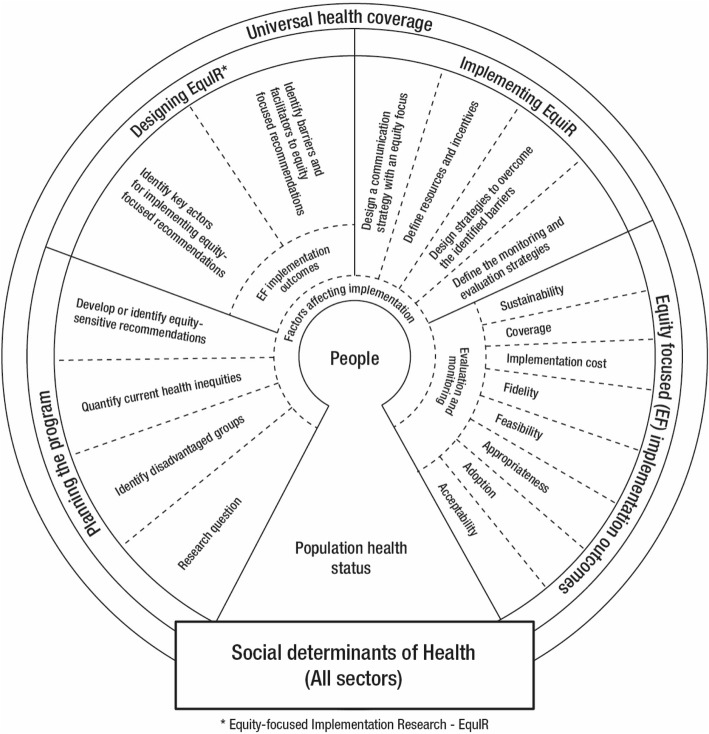
- EquIR was developed as an iterative framework with suggested steps: identify population health status, equity-focused planning, design, implementation, equity-focused implementation outcomes, and a new equity-focused population health status that becomes the next starting point.
- The framework includes equity-focused definitions for implementation outcomes such as acceptability, adoption, appropriateness, feasibility, fidelity, implementation cost, coverage, and sustainability, and links health sectors with social determinants of health through “health in all policies” and universal health.
Methods
- Phase 1: a systematic review of conceptual frameworks/models incorporating health equity into implementation research, searching Medline (PubMed), Embase, LILACS (1965–2016), Scopus (1998–2016), and grey literature, with no language limit and no exclusion criteria; three independent reviewers categorized articles.
- Phase 2: a stakeholder analysis involving decision-makers and researchers from seven Latin American health programs funded through the iPIER call during 2016–17, with mentor follow-up, protocol review under an equity perspective, and in-person workshops.
- Phase 3: the implementation research group and health equity experts built EquIR from the review and country-team experience; face validity was assessed by key experts and stakeholders, and a practical example used the “Mi Salud” program in Bolivia.
Limitations
- The paper states that the quality of articles describing models and frameworks was not evaluated because they were descriptive reports.
- The paper states that future evaluation of EquIR’s effectiveness to improve implementation outcomes or health outcomes in disadvantaged populations is needed.
- Evident from the text: EquIR is a conceptual proposal with face-validity assessment only, based on a small stakeholder sample of seven programs, and the paper reports no empirical testing of the framework’s impact.
Model-written summary. Check it against the paper before relying on it.
Integrity signals
Registry
Cites
Statistics
Figures
Verification
Claims the paper makes
3 Valid · 2 Not valid · 23 Not checked · 24 Own results and interpretations
The cited sources support only part of this claim — read each source’s verdict below.
In the paper
“This framework is based on the available evidence (Phase 1) where the relevant components and processes were identified, such as methodological steps and program planning [20, 28–30], identification of vulnerable groups [30, 34], the identification of barriers and facilitators [21, 33, 34], the design of implementation programs and tools [30, 32, 33] and monitoring and evaluation of implementation”
§ Conceptual framework of equity-focused implementation research for health programs (EquIR) > Discussion
What the sources say
- Partly supportedcites [20] Kitson AL Rycroft-Malone J Harvey G McCormack B Seers K Titchen A Evaluating the successful implementation of evidence into practice using the PARiHS framework: theoretical and practical challenges Implement Sci 2008 3 1 10.1186/1748-5908-3-1 18179688 PMC2235887 sourceExperimental — accuracy not yet measured
Split into 2 atoms — 0 confirmed, 2 partially supported, 0 disputed, 0 misattributed, 0 unverifiable. Expand the claim to see per-atom verdicts.
- Not checked yetcites [28] Mann G Squire SB Bissell K Eliseev P Du Toit E Hesseling A Beyond accuracy: creating a comprehensive evidence base for TB diagnostic tools [State of the art] Int J Tuberc Lung Dis 2010 14 1518 1524 21144235
- Not checked yetcites [29] Mann GH Thomson R Jin C Phiri M Vater MC Sinanovic E The role of health economics research in implementation research for health systems strengthening Int J Tuberc Lung Dis 2011 15 715 721 10.5588/ijtld.10.0749 21575290 source
- Partly supportedcites [30] Rudan I Setting health research priorities using the CHNRI method: IV. Key conceptual advances J Glob Heal 2016 6 10501 10.7189/jogh.06.010501 PMC4938380 27418959 sourceExperimental — accuracy not yet measured
Split into 2 atoms — 0 confirmed, 2 partially supported, 0 disputed, 0 misattributed, 0 unverifiable. Expand the claim to see per-atom verdicts.
- Not checked yetcites [34] Bowen S, Botting I, Roy J. Promoting action on equity issues: a knowledgeto-action handbook. Edmonton: School of Public Health, University of Alberta; 2011. Available from: http://nccdh.ca/resources/entry/promoting-action-on-equity-issues.
- Partly supportedcites [21] Chin MH Goddu AP Ferguson MJ Peek ME Expanding and sustaining integrated health care-community efforts to reduce diabetes disparities Heal Promot Pr 2014 15 29s 39s 10.1177/1524839914532649 PMC4415354 25359247 sourceExperimental — accuracy not yet measured
The Results sections on demographic context, implementation, and sustainability describe a population facing diabetes disparities, challenges to expanding an intervention, and program activities. They support several components of the citing sentence, but the paper presents a case study rather than a set of methodological steps or a general process for identifying vulnerable groups and designing implementation programs and tools. The cited paper does not identify those items as components of the citing authors’ Phase 1 framework. (LLM, conf=0.82)
- Not checked yetcites [33] Zamora G, Flores-Urrutia MC, Mayen AL, Mayén AL. Large-scale fortification of condiments and seasonings as a public health strategy: equity considerations for implementation. Ann N Y Acad Sci; 2016. Available from: https://nyaspubs.onlinelibrary.wiley.com/doi/full/10.1111/nyas.13183. Accessed 17 July 2017. 27525672 source
plain- Asserted: passes — The authors put it forward as true.
- Checkable: passes — It can be checked against evidence.
- Load-bearing: passes — The paper’s conclusions depend on it.
- Based: passes — The paper gives a reason why it holds.
- Partly supported
The cited sources support only part of this claim — read each source’s verdict below.
In the paper
“It is evident that there is still a gap in the implementation of highly effective strategies in controlled studies, which fail to demonstrate such effectiveness after their implementation [15–17]”
§ Conceptual framework of equity-focused implementation research for health programs (EquIR) > Background > Why is IR research different in general?
What the sources say
- Partly supportedcites [15] Damschroder LJ, Aron DC, Keith RE, Kirsh SR, Alexander JA, Lowery JC. Fostering implementation of health services research findings into practice: a consolidated framework for advancing implementation science. Implement Sci. 2009;4:50 Available from: https://implementationscience.biomedcentral.com/articles/10.1186/1748-5908-4-50. PMC2736161 19664226 sourceExperimental — accuracy not yet measured
The Background states that many interventions effective in health services research studies fail to translate into meaningful patient care outcomes across contexts. It does not specify that the studies were controlled or that the interventions were highly effective, so those details are not supported by this source. (LLM, conf=0.83)
- Partly supportedcites [16] Curran Geoffrey M. Bauer Mark Mittman Brian Pyne Jeffrey M. Stetler Cheryl Effectiveness-implementation Hybrid Designs Medical Care 2012 50 3 217 226 10.1097/MLR.0b013e3182408812 22310560 PMC3731143 sourceExperimental — accuracy not yet measured
The Conclusions describe a gap between research and routine practice, and ‘Challenges in Linking Clinical and Implementation Research Designs’ says controlled trials pay little attention to implementation in general practice. But the paper does not establish that strategies shown to be highly effective in controlled studies fail to retain that effectiveness after implementation; it notes that implementation studies often do not assess patient outcomes. Page numbers are unavailable in our copy. (LLM, conf=0.85)
- Partly supportedcites [17] Weiss CH Why do we fail to deliver evidence-based practice in critical care medicine? Curr Opin Crit Care 2017 23 400 405 10.1097/MCC.0000000000000436 28858917 PMC5784774 sourceExperimental — accuracy not yet measured
The Introduction (page not provided) says evidence-based practice often fails to translate into clinical practice, supporting an implementation gap. The paper does not say that strategies shown to be highly effective in controlled studies lose their effectiveness after implementation; its focus is on barriers to adoption. (LLM, conf=0.85)
boosted- Asserted: passes — The authors put it forward as true.
- Checkable: passes — It can be checked against evidence.
- Load-bearing: passes — The paper’s conclusions depend on it.
- Based: passes — The paper gives a reason why it holds.
- Partly supported
A result the paper reports from its own data — it cites no other source for it, so there is none to check. The quote shows it is in the paper.
In the paper
“However, in the course of developing an implementation research project, only two groups maintained an equity focus throughout the entire project and maintained this focus in the development of the research protocol.”
§ Conceptual framework of equity-focused implementation research for health programs (EquIR) > Results > Second phase
plain- Asserted: passes — The authors put it forward as true.
- Checkable: passes — It can be checked against evidence.
- Load-bearing: unclear — It is unclear whether the paper’s conclusions depend on it.
- Based: passes — The paper gives a reason why it holds.
A result the paper states — it cites no source for it, so there is none to check. The quote shows it is in the paper.
In the paper
“Initially, all 7 projects included disadvantaged population in their proposals.”
§ Conceptual framework of equity-focused implementation research for health programs (EquIR) > Results > Second phase
plain- Asserted: passes — The authors put it forward as true.
- Checkable: passes — It can be checked against evidence.
- Load-bearing: unclear — It is unclear whether the paper’s conclusions depend on it.
- Based: passes — The paper gives a reason why it holds.
In the paper
“Although there was no consolidated model to explicitly include equity issues in implementation research [26], the models included essential characteristics that were further incorporated into our framework.”
§ Conceptual framework of equity-focused implementation research for health programs (EquIR) > Results > First phase
What the sources say
- Not checked yetcites [26] Eslava-Schmalbach J Elias V Reveiz L G-ON. Incorporating health equity into implementation research: review of conceptual models Rev Panam Salud Publica 2017 41 e126 PMC6645188 31384259
plain- Asserted: passes — The authors put it forward as true.
- Checkable: passes — It can be checked against evidence.
- Load-bearing: passes — The paper’s conclusions depend on it.
- Based: passes — The paper gives a reason why it holds.
11 more claims
Create a free account to see all 52 claims and to verify the 37 references still open.
- Probably not a substantial claim. 28
- It may state two separate claims as one. 16
Claims other papers make about this one
Each is checked against this paper’s own text: does it say what the citing paper says it does?
The source backs part of the claim, not all of it — or backs it for a different population, condition or comparison.
In the citing paper
“Increasing use of implementation frameworks may offer a more systematic evaluation of newborn care packages while clarifying equitable service delivery in vulnerable populations often present in LMIC settings (35, 36).”
From Born too soon in a resource-limited setting: A 10-year mixed methods review of a special care baby unit for refugees and migrants on the Myanmar-Thailand border (2023) · cites this paper as [35]
Experimental — accuracy not yet measured
Self-check
Percentages, sums and reported differences re-computed from the paper’s own numbers.
Each contradiction between two passages listed here was confirmed by an independent check.
Rated minor: it would not touch a result — a value no result rests on, a p-value that stays on the same side of the significance level, or a conflict that is clerical, resolved elsewhere in the paper, or outside its own findings.
In the paper
§ Conceptual framework of equity-focused implementation research for health programs (EquIR) > Results > Third phase
“Marmot M. Social determinants of health inequalities. Lancet. 2005 Mar;365(9464):1099–104. DOI: 10.1016/S0140-6736(05)71146-6”
§ Conceptual framework of equity-focused implementation research for health programs (EquIR) > References
“36. Marmot M Social determinants of health inequalities Lancet 2005 365 1099 1104 10.1016/S0140-6736(05)74234-3 15781105”
Citations
Cites
Damschroder, L. J., Aron, D. C., Keith, R. E., Kirsh, S. R., Alexander, J. A., & Lowery, J. C. (2009) · Implementation Science · doi:10.1186/1748-5908-4-50 · Cited by 14,496 · cited 3×
“Several frameworks have been used in implementation sciences, including the Quality Implementation Framework [19], the Consolidated Framework for Implementation Research (CFIR) [15] and Promoting Action on Research Implementation in Health Services (PARISH) [20].”
MethodSocial determinants of health inequalities
Marmot, M. (2005) · The Lancet · doi:10.1016/s0140-6736(05)71146-6 · Cited by 5,086
Making sense of implementation theories, models and frameworks
Nilsen, P. (2015) · Implementation Science · doi:10.1186/s13012-015-0242-0 · Cited by 4,447 · cited 1×
“Implementation is “the process of putting to use or integrating new practices within a setting” [1] and includes within its considerations relevant aspects such as the communities where it is thought to be carried out, the barriers and facilitators for it, the specific needs of the population, which differ for each in…”
BackgroundCurran, G. M., Bauer, M., Mittman, B., Pyne, J. M., & Stetler, C. (2012) · Medical Care · doi:10.1097/mlr.0b013e3182408812 · Cited by 4,058
The Concepts and Principles of Equity and Health
Whitehead, M. (1992) · International Journal of Health Services · doi:10.2190/986l-lhq6-2vte-yrrn · Cited by 2,284 · cited 1×
“Implementation research is, in this case, an approach that could diminish the negative impact of implementing new interventions on health inequalities (differences in health among individuals or groups) or health inequities (differences in health, that are avoidable, unjust and unneeded) [9, 25]; or it could even be u…”
O'Neill, J., Tabish, H., Welch, V., Petticrew, M., Pottie, K., Clarke, M., Evans, T., Pardo Pardo, J., Waters, E., White, H., et al. (2014) · Journal of Clinical Epidemiology · doi:10.1016/j.jclinepi.2013.08.005 · Cited by 1,657 · cited 2×
“One example is the PROGRESS Plus framework, which focuses on highlighting unfair differences in disease burden and interventions in order to reduce these differential effects, but which does not explicitly involve implementation considerations [37, 42].”
BackgroundAn introduction to implementation science for the non-specialist
Bauer, M. S., Damschroder, L., Hagedorn, H., Smith, J., & Kilbourne, A. M. (2015) · BMC Psychology · doi:10.1186/s40359-015-0089-9 · Cited by 1,611 · cited 1×
“This makes it very difficult to study it scientifically, which has motivated the progress of Implementation Science (IS) [3, 6], which is defined as “the systematic study of how to design and evaluate a set of activities to facilitate successful uptake of an evidence-based health intervention” [7].”
BackgroundKitson, A. L., Rycroft-Malone, J., Harvey, G., McCormack, B., Seers, K., & Titchen, A. (2008) · Implementation Science · doi:10.1186/1748-5908-3-1 · Cited by 1,314 · cited 3×
“Promoting Action on Research Implementation in Health Services (PARISH) [20] Race/Ethnic • Program Planning: A diagnostic and evaluative measure of evidence and context elements.”
BackgroundMethodPeters, D. H., Adam, T., Alonge, O., Agyepong, I. A., & Tran, N. (2014) · British Journal of Sports Medicine · doi:10.1136/bmj.f6753 · Cited by 1,109
Self-citationThe Quality Implementation Framework: A Synthesis of Critical Steps in the Implementation Process
Meyers, D. C., Durlak, J. A., & Wandersman, A. (2012) · American Journal of Community Psychology · doi:10.1007/s10464-012-9522-x · Cited by 1,102 · cited 1×
“Several frameworks have been used in implementation sciences, including the Quality Implementation Framework [19], the Consolidated Framework for Implementation Research (CFIR) [15] and Promoting Action on Research Implementation in Health Services (PARISH) [20].”
MethodExplaining trends in inequities: evidence from Brazilian child health studies
Victora, C. G., Vaughan, J. P., Barros, F. C., Silva, A. C., & Tomasi, E. (2000) · The Lancet · doi:10.1016/s0140-6736(00)02741-0 · Cited by 768
Implementation Research in Health: A Practical Guide
Peters, D. H., Tran, N. T., & Adam, T. (2013) · Virtual Defense Library (Ministerio de Defensa) · Cited by 745
Self-citationInequalities in health: definitions, concepts, and theories
Arcaya, M. C., Arcaya, A. L., & Subramanian, S. V. (2015) · Global Health Action · doi:10.3402/gha.v8.27106 · Cited by 696 · cited 1×
“Implementation research is, in this case, an approach that could diminish the negative impact of implementing new interventions on health inequalities (differences in health among individuals or groups) or health inequities (differences in health, that are avoidable, unjust and unneeded) [9, 25]; or it could even be u…”
BackgroundMacDonald, K., Thomas, M. L., Sciolla, A. F., Schneider, B., Pappas, K., Bleijenberg, G., Bohus, M., Bekh, B., Carpenter, L., Carr, A., et al. (2016) · PLOS ONE · doi:10.1371/journal.pone.0146058 · Cited by 372
Assessing health system performance in developing countries: A review of the literature
Kruk, M. E., & Freedman, L. P. (2008) · Health Policy · doi:10.1016/j.healthpol.2007.09.003 · Cited by 332 · cited 1×
“Equity in health is an issue usually related with the development of health systems and their performance [40, 41].”
BackgroundInterventions to Reduce Racial and Ethnic Disparities in Health Care
Chin, M. H., Walters, A. E., Cook, S. C., & Huang, E. S. (2007) · Medical Care Research and Review · doi:10.1177/1077558707305413 · Cited by 309 · cited 1×
“Conceptual Model for Racial and Ethnic Disparities in Healthcare [31] Race/Ethnic • Program Planning: make recommendations for future interventions to reduce disparities”
BackgroundMonitoring equity in health and healthcare: a conceptual framework.
Braveman, P. (2003) · PubMed · Cited by 293
Outcomes of a Partnered Facilitation Strategy to Implement Primary Care–Mental Health
Kirchner, J. E., Ritchie, M. J., Pitcock, J. A., Parker, L. E., Curran, G. M., & Fortney, J. C. (2014) · Journal of General Internal Medicine · doi:10.1007/s11606-014-3027-2 · Cited by 255
Doctors' health: taking the lifecycle approach
Peters, M., Hasan, O., Puddester, D., Garelick, A., Holliday, C., Rapanakis, T., & Ryan, A. L. (2013) · BMJ · doi:10.1136/bmj.f7086 · Cited by 245
Strategies for implementing implementation science: a methodological overview
Handley, M. A., Gorukanti, A., & Cattamanchi, A. (2016) · Emergency Medicine Journal · doi:10.1136/emermed-2015-205461 · Cited by 186 · cited 1×
“This makes it very difficult to study it scientifically, which has motivated the progress of Implementation Science (IS) [3, 6], which is defined as “the systematic study of how to design and evaluate a set of activities to facilitate successful uptake of an evidence-based health intervention” [7].”
BackgroundEmbrett, M. G., & Randall, G. E. (2014) · Social Science & Medicine · doi:10.1016/j.socscimed.2014.03.004 · Cited by 176 · cited 1×
“This allowed the construction of this framework which can be used as a tool to integrate equity considerations in implementation research, and making sure that equity is considered an essential outcome in health interventions, programs and policies [39].”
MethodThe Inverse Equity Hypothesis: Analyses of Institutional Deliveries in 286 National Surveys
Victora, C. G., Joseph, G., Silva, I. C. M., Maia, F. S., Vaughan, J. P., Barros, F. C., & Barros, A. J. D. (2018) · American Journal of Public Health · doi:10.2105/ajph.2017.304277 · Cited by 166 · cited 1×
“IR offers the possibility of evaluating this effect during implementation, and in the case of this proposal, equity-focused IR offers the possibility of intervening and evaluating the effect on equity with the IR [11, 18].”
BackgroundChopra, M., Sharkey, A., Dalmiya, N., Anthony, D., & BINKIN, N. J. (2012) · The Lancet · doi:10.1016/s0140-6736(12)61423-8 · Cited by 153 · cited 1×
“IR offers the possibility of evaluating this effect during implementation, and in the case of this proposal, equity-focused IR offers the possibility of intervening and evaluating the effect on equity with the IR [11, 18].”
BackgroundFriederichs, S. A., Bolman, C., Oenema, A., & Lechner, L. (2015) · BMC Psychology · doi:10.1186/s40359-015-0059-2 · Cited by 153
Welch, V. A., Akl, E. A., Guyatt, G., Pottie, K., Eslava-Schmalbach, J., Ansari, M. T., de Beer, H., Briel, M., Dans, T., Dans, I., et al. (2017) · Journal of Clinical Epidemiology · doi:10.1016/j.jclinepi.2017.01.014 · Cited by 131
Self-citationStrengthening health systems by health sector reforms
Senkubuge, F., Modisenyane, M., & Bishaw, T. (2014) · Global Health Action · doi:10.3402/gha.v7.23568 · Cited by 126 · cited 1×
“Equity in health is an issue usually related with the development of health systems and their performance [40, 41].”
BackgroundImplementation science in healthcare: Introduction and perspective
Wensing, M. (2015) · Zeitschrift für Evidenz Fortbildung und Qualität im Gesundheitswesen · doi:10.1016/j.zefq.2015.02.014 · Cited by 104 · cited 1×
“This makes it very difficult to study it scientifically, which has motivated the progress of Implementation Science (IS) [3, 6], which is defined as “the systematic study of how to design and evaluate a set of activities to facilitate successful uptake of an evidence-based health intervention” [7].”
BackgroundSetting health research priorities using the CHNRI method: IV. Key conceptual advances
Rudan, I. (2016) · Journal of Global Health · doi:10.7189/jogh.06.010501 · Cited by 91
Waters, E., Hall, B. J., Armstrong, R., Doyle, J., Pettman, T. L., & de Silva-Sanigorski, A. (2011) · Journal of Public Health · doi:10.1093/pubmed/fdr064 · Cited by 89 · cited 1×
“In addition, the implementation is different for preventive and curative services, which in many countries are carried out by different funding sources and participants, which makes the implementation and systematic evaluation of it even more complex [8].”
BackgroundWelch, V. A., Akl, E. A., Pottie, K., Ansari, M. T., Briel, M., Christensen, R., Dans, A., Dans, L., Eslava-Schmalbach, J., Guyatt, G., et al. (2017) · Journal of Clinical Epidemiology · doi:10.1016/j.jclinepi.2017.01.015 · Cited by 88
Self-citationPottie, K., Welch, V., Morton, R., Akl, E. A., Eslava-Schmalbach, J. H., Katikireddi, V., Singh, J., Moja, L., Lang, E., Magrini, N., et al. (2017) · Journal of Clinical Epidemiology · doi:10.1016/j.jclinepi.2017.08.001 · Cited by 80
Self-citationAkl, E. A., Welch, V., Pottie, K., Eslava-Schmalbach, J., Darzi, A., Sola, I., Katikireddi, S. V., Singh, J., Murad, M. H., Meerpohl, J., et al. (2017) · Journal of Clinical Epidemiology · doi:10.1016/j.jclinepi.2017.01.017 · Cited by 79
Self-citationVogel, J. P., Moore, J. E., Timmings, C., Khan, S., Khan, D. N., Defar, A., Hadush, A., Minwyelet Terefe, M., Teshome, L., Ba-Thike, K., et al. (2016) · PLOS ONE · doi:10.1371/journal.pone.0160020 · Cited by 68
Health promotion, inequalities and young people's health: a systematic review of research
Oliver, S. R., Kavanagh, J., Caird, J., Lorenc, T., Oliver, K. A., Harden, A., Thomas, J., Greaves, A. E., & Oakley, A. (2011) · IOE EPrints · doi:10.17037/pubs.00002603 · Cited by 68
Beyond accuracy: creating a comprehensive evidence base for TB diagnostic tools.
Mann, G. H., Squire, S. B., Bissell, K., Eliseev, P., Toit, E. D., Hesseling, A. C., Nicol, M. P., Detjen, A., & Kritski, A. L. (2010) · UWA Profiles and Research Repository (UWA) · Cited by 64
Khan, F., Owolabi, M. O., Amatya, B., Hamzat, T. K., Ogunniyi, A. O., Oshinowo, H., Elmalik, A., & Galea, M. P. (2017) · Journal of Rehabilitation Medicine · doi:10.2340/16501977-2276 · Cited by 47
Morgan, R. L., Kelley, L., Guyatt, G. H., Johnson, A., & Lavis, J. N. (2018) · Journal of Clinical Epidemiology · doi:10.1016/j.jclinepi.2017.09.023 · Cited by 44 · cited 1×
“, developed a decision-making framework to inform coverage decisions for healthcare interventions [48], involving a proposal of equal distribution of the intervention in the target region or population, using only two implementation outcomes (acceptability and feasibility).”
MethodEmbedding research to improve program implementation in Latin America and the Caribbean.
Tran, N. T., Langlois, É. V., Revéiz, L., Varallyay, I., Elias, V. M., Mancuso, A., Becerra-Posada, F., & Ghaffar, A. (2017) · PubMed Central · doi:10.26633/rpsp.2017.75 · Cited by 43 · cited 1×
“Since 2014, the Alliance for Health Policy and Systems Research (AHPSR), an international partnership hosted by the World Health Organization (WHO), in collaboration with the Pan-American Health Organization (PAHO), has worked to facilitate the implementation process of programs, policies or health interventions, usin…”
BackgroundSelf-citationWhy do we fail to deliver evidence-based practice in critical care medicine?
Weiss, C. H. (2017) · Current Opinion in Critical Care · doi:10.1097/mcc.0000000000000436 · Cited by 37
Implementing health promotion tools in Australian Indigenous primary health care
Percival, N., McCalman, J., Armit, C., O’Donoghue, L., Bainbridge, R. G., Rowley, K., Doyle, J., & Tsey, K. (2016) · Health Promotion International · doi:10.1093/heapro/daw049 · Cited by 29 · cited 2×
“Implementing health promotion tools in Australian Indigenous primary healthcare [32] Race/Ethnic • Program Planning: Participation agreements, orientations, and training.”
BackgroundLee, J. T., Huang, Z., Basu, S., & Millett, C. (2015) · Journal of Epidemiology and Community Health · doi:10.1136/jech-2014-204355 · Cited by 27
Expanding and Sustaining Integrated Health Care–Community Efforts to Reduce Diabetes Disparities
Chin, M. H., Goddu, A. P., Ferguson, M. J., & Peek, M. E. (2014) · Health Promotion Practice · doi:10.1177/1524839914532649 · Cited by 27 · cited 1×
“where the relevant components and processes were identified, such as methodological steps and program planning [20, 28–30], identification of vulnerable groups [30, 34], the identification of barriers and facilitators [21, 33, 34], the design of implementation programs and tools [30, 32, 33] and monitoring and evaluat…”
BackgroundGuthmann, J.-P., Pelat, C., Célant, N., Parent du Chatelet, I., Duport, N., Rochereau, T., & Lévy-Bruhl, D. (2017) · Revue d'Épidémiologie et de Santé Publique · doi:10.1016/j.respe.2017.01.100 · Cited by 25
Bosch-Capblanch, X., Zuske, M.-K., & Auer, C. (2017) · International Journal for Equity in Health · doi:10.1186/s12939-017-0587-x · Cited by 25 · cited 1×
“One example is the PROGRESS Plus framework, which focuses on highlighting unfair differences in disease burden and interventions in order to reduce these differential effects, but which does not explicitly involve implementation considerations [37, 42].”
BackgroundEslava-Schmalbach, J. H., Orjuela, N. G., Elias, V. M., & Revéiz, L. (2017) · Revista Panamericana de Salud Pública · doi:10.26633/rpsp.2017.126 · Cited by 12
Self-citationMann, G. H., Thomson, R., Jin, C., Phiri, M., Vater, M. C., Sinanovic, E., & Squire, S. B. (2011) · The International Journal of Tuberculosis and Lung Disease · doi:10.5588/ijtld.10.0749 · Cited by 9 · cited 1×
“Framework for strengthening health systems [29] General • Program Planning: Benefits for strengthening health systems”
BackgroundAlzate Granados, J. P., Eslava-Schmalbach, J. H., Welch, V. A., Tugwell, P., Amaya-Arias, A. C., Gaitan-Duarte, H. G., Mosquera, P., Molina, F., Peralta, F., Romero-Vanegas, S. J., et al. (2016) · Revista de Salud Pública · doi:10.15446/rsap.v18n1.45002 · Cited by 7
Self-citationZamora, G., Flores‐Urrutia, M. C., & Mayén, A. (2016) · Annals of the New York Academy of Sciences · doi:10.1111/nyas.13183 · Cited by 6 · cited 2×
“where the relevant components and processes were identified, such as methodological steps and program planning [20, 28–30], identification of vulnerable groups [30, 34], the identification of barriers and facilitators [21, 33, 34], the design of implementation programs and tools [30, 32, 33] and monitoring and evaluat…”
Background
Cited by
Implementation science should give higher priority to health equity
Brownson, R. C., Kumanyika, S. K., Kreuter, M. W., & Haire-Joshu, D. (2021) · Implementation Science · doi:10.1186/s13012-021-01097-0 · Cited by 551
Woodward, E. N., Singh, R. S., Ndebele-Ngwenya, P., Melgar Castillo, A., Dickson, K. S., & Kirchner, J. E. (2021) · Implementation Science Communications · doi:10.1186/s43058-021-00146-5 · Cited by 270
Macias-Konstantopoulos, W. L., Collins, K. A., Diaz, R., Duber, H. C., Edwards, C. D., Hsu, A. P., Ranney, M. L., Riviello, R. J., Wettstein, Z. S., & Sachs, C. J. (2023) · Western Journal of Emergency Medicine · doi:10.5811/westjem.58408 · Cited by 218
Shelton, R. C., Adsul, P., Oh, A., Moise, N., & Griffith, D. M. (2021) · Implementation Research and Practice · doi:10.1177/26334895211049482 · Cited by 171
“Gaps and Opportunities for Addressing Racism through Implementation Science: There is growing interest in health equity within IS (Annie E. Casey Foundation, Summer 2021; Brownson et al., 2021; Cooper et al., 2021; Eslava-Schmalbach et al., 2019; Galaviz et al., 2020).”
BackgroundWang, D. Y., Wong, E. L., Nilsén, P., Chung, V. C., Tian, Y., & Yeoh, E. (2023) · Implementation Science · doi:10.1186/s13012-023-01296-x · Cited by 175
Metadata
- Authors
- Eslava-Schmalbach, J., Garzón-Orjuela, N., Elias, V., Reveiz, L., Tran, N., & Langlois, E. V.
- Affiliations
- Universidad Nacional de Colombia (CO)
- World Health Organization Regional Office for the Americas (US)
- World Health Organization (CH)
- Venue
- International Journal for Equity in Health
- Published
- 2019-05-31
- Volume
- 18
- Issue
- 1
- Pages
- 80-80
- ISSN
- 1475-9276 (ISSN-L)
- PMC
- PMC6544990
- OpenAlex
- W2947399739
- Cited by
- 160
- References
- 50
- Citations by year
- 2026: 19 · 2025: 30 · 2024: 22 · 2023: 27 · 2022: 28 · 2021: 22 · 2020: 10 · 2019: 2
- FWCI
- 21.10
- Type
- journal article
- Language
- en
- Open access
- gold
- doi.org
- Licence
- cc-by
- creativecommons.org/licenses/by/4.0/ (tdm)
- creativecommons.org/licenses/by/4.0/ (vor)
- Locations
- International Journal for Equity in Health (publishedVersion, cc-by)
- PubMed Central (publishedVersion, cc-by)
- PubMed (publishedVersion)
- DOAJ (DOAJ: Directory of Open Access Journals) (submittedVersion, cc-by-sa)
- Funders
- World Health Organization
- Topics
- Health Sciences › Health Professions › General Health Professions › Health Policy Implementation Science
- Health Sciences › Medicine › Public Health, Environmental and Occupational Health › Public Health Policies and Education
- Health Sciences › Medicine › Public Health, Environmental and Occupational Health › Healthcare Systems and Reforms
- Keywords
- health equity, conceptual framework, health program implementation, health policy implementation, health care system, social determinants of health, Health in All Policies, health disparities, disadvantaged groups, Latin America
- MeSH terms
- Health Equity, Concept Formation, Delivery of Health Care, Health Policy, Health Promotion, Health Services, Humans, Latin America, Poverty, Research, Socioeconomic Factors, Universal Health Insurance, Vulnerable Populations, Healthcare Disparities, Social Determinants of Health
About these checks
Registry, retraction, Cites and statistics results are computed, not judged, with one exception: a printed reference that no index lists is read once by a model before it counts as a citation error. Claims are extracted by a model and kept only when their quote appears verbatim in the text; each cited source is then checked, with a model’s help, for whether it says what the claim relies on. Those verdicts can be wrong — read the claim’s quote and the cited source before relying on one.
The claim verdicts this report counts are experimental: their accuracy is not yet measured.
A language model drew the claims from the paper on 2026-10-05, under version 3 of the claim definition (model deepseek-v4.1-flash, prompt extract-v3).
A second model labelled each claim on 2026-10-05 (model jev-1.13-20260917, definition revision gold-guideline-v0.2).
Cited sources are checked with a language model’s help (gpt-6-sol).
Statistics and arithmetic are recomputed, not judged.
Confidence bands are shown only for fields calibrated on our annotated test set. None is calibrated yet, so no band is shown.
What counts as a claim ›How we measure confidence ›How we check this ›
Are you an author, or do you see a problem with this page? Request a review
Data sources
Bibliographic data: Semantic Scholar, OpenAlex, Crossref.
Contains information from the Semantic Scholar Academic Graph Datasets, made available under the ODC Attribution License (ODC-BY 1.0).
Semantic Scholar’s data is described in: Kinney, R., et al. (2023). The Semantic Scholar Open Data Platform. arXiv:2301.10140.
