

Prevalence and gender disparities of type 2 diabetes mellitus and obesity in Esmeraldas, Ecuador: a population-based survey in a hard-to-reach setting
Open accessThe DOI matches its Crossref record; 35 of the 35 references it cites were found in a registry or an index; none of the 37 sources its claims cite is checked for support yet.
Abstract
Background: Type 2 Diabetes (T2DM) prevalence is increasing in low- and middle-income countries along with high levels of obesity which vary according to socioeconomic and contextual characteristics. We aim to estimate the prevalence of T2DM and obesity in men and women in a hard-to-reach rural area in northern Ecuador considering socio-demographic characteristics. Methods: Cross-sectional descriptive study based on a population-based survey in the Eloy Alfaro health district of Esmeraldas between October 2020 and January 2022. We collected sociodemographic information and risk factors for non-communicable diseases with an adapted version of the STEPS survey, performed oral glucose tolerance tests, biochemistry and took physical measurements. We estimated the prevalence of T2DM, obesity, and calculated Odds Ratios (OR) with confidence intervals by logistic regression in Stata v.15. Results: The overall prevalence of T2DM was 6.8% (CI95%: 4.9–8.7), markedly higher among women compared to men (10.4%, CI95% 7.3–13.4%, compared 2.0%, CI95% 0.4–3.7% respectively). The risk of having T2DM in women was 5 times higher than in men adjusting for age, ethnicity, employment, household earnings and obesity (OR: 5.03; 95%CI: 1.68–15.01). Regarding age, the risk of T2DM increased by 6% per year (adjusted OR: 1.06; 95%CI: 1.03–1.08). Obesity prevalence was 30.8% (CI95%: 27.3–34.3), in women was nearly three times higher than in men (43.2% CI95%: 38.2–48.2, compared to 14.7% prevalence, CI95%: 10.6–18.8). Indigenous women had a lower prevalence of obesity compared with the Afro-Ecuadorian women (OR: 0.05; 95%CI: 0.02–0.18) after adjusting for age, employment status, household earnings and setting. Conclusion: We found alarming differences between the prevalence of T2DM and obesity in women and men that may be explained by gender roles, exacerbated in the rural context. Health promotion measures with a gender perspective should be adapted according to the characteristics of isolated rural contexts.
Overview
CoChat Summary
TL;DR
In a hard-to-reach rural district of Esmeraldas, Ecuador, women had a 10.4% prevalence of type 2 diabetes and 43.2% prevalence of obesity, far exceeding men’s 2.0% and 14.7%, respectively. Adjusted analyses showed women had about five times the odds of T2DM and indigenous women had much lower obesity odds than Afro-Ecuadorian women.
Key findings
- Overall T2DM prevalence was 6.8% (95% CI 4.9–8.7); 47.8% of the 46 cases were unaware of their condition. Women’s prevalence was 10.4% (95% CI 7.3–13.4) versus men’s 2.0% (95% CI 0.4–3.7); adjusted OR for women vs men was 5.03 (95% CI 1.68–15.01) after adjusting for age, ethnicity, employment, household earnings and BMI. Age increased T2DM odds by 6% per year (adjusted OR 1.06, 95% CI 1.03–1.08), and obesity was associated with T2DM (unadjusted OR 3.46, 95% CI 1.58–7.57; adjusted OR 2.63, 95% CI 1.03–6.73).
- Overall obesity prevalence was 30.8% (95% CI 27.3–34.3); women’s prevalence was 43.2% (95% CI 38.2–48.2) versus men’s 14.7% (95% CI 10.6–18.8). Among women, over half aged 40–64 were obese (50.3%) and 42.4% of those aged 18–39 were obese; among men, no socioeconomic or cultural factors studied appeared associated with obesity.
- Indigenous women had lower obesity prevalence than Afro-Ecuadorian women (adjusted OR 0.05, 95% CI 0.02–0.18) after adjusting for age, employment status, household earnings and setting. Overall, 82.8% reported unhealthy diets, and 73% consumed fewer than two portions of fruit and vegetables per day.
Methods
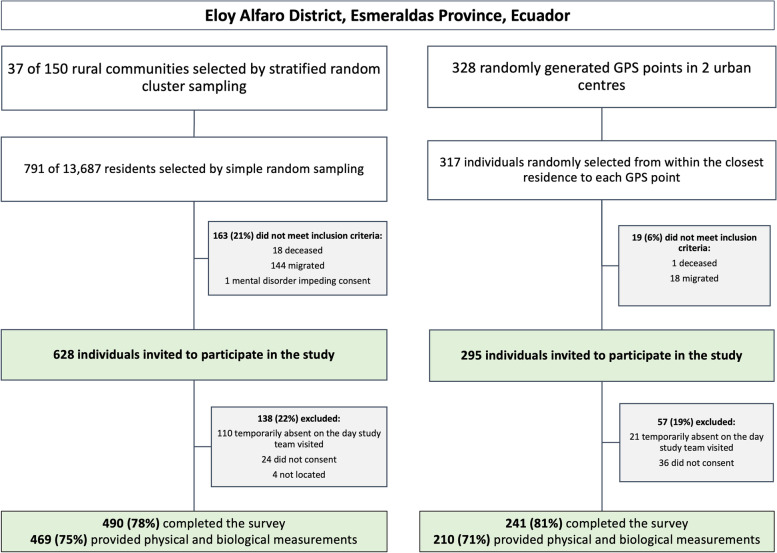
- Population-based cross-sectional study in the Eloy Alfaro health district, Esmeraldas Province, Ecuador, conducted October 2020–January 2022. Eligible participants were residents aged over 18; sampling used geospatial sampling in urban centres and multistage stratified cluster sampling in rural communities. In total, 731 people completed the survey, and 680 also completed physical and biochemical measurements.
- Data collection used an adapted WHO STEPS questionnaire, physical measurements, fasting blood samples, and an oral glucose tolerance test (OGTT) for those with capillary glucose <144 mg/dl. T2DM was diagnosed primarily by OGTT (2-h blood glucose ≥200 mg/dl) or, if no OGTT, fasting plasma glucose ≥126 mg/dl; obesity was BMI ≥30.
- Analyses in Stata v.15 estimated prevalence with 95% confidence intervals by sex, compared characteristics using Fisher’s exact test and Student’s t-test, and used logistic regression to estimate odds ratios, including multivariable models with backward elimination.
Limitations
- Stated: the COVID-19 pandemic lengthened data collection, required protocol adjustments, and increased the time lag between census and data collection, possibly affecting displacement, death, migration, household income reporting, physical activity and diet. The sample did not detect socioeconomic differences in T2DM or obesity, possibly due to homogeneity, sensitive income reporting, inability to assume proportional distribution between partners, and low obesity cases among men reducing statistical power. Results may not be generalisable to other rural populations, and missing data were excluded from logistic regression.
- Evident from the text: the cross-sectional design cannot establish causality; behavioural and dietary variables were self-reported; participants with diabetes or pregnant women did not undergo the OGTT, so their diagnosis relied on fasting plasma glucose.
Model-written summary. Check it against the paper before relying on it.
Integrity signals
Registry
Cites
Statistics
Figures
Verification
Claims the paper makes
0 Valid · 0 Not valid · 19 Not checked · 53 Own results and interpretations
A result the paper reports from its own data — it cites no other source for it, so there is none to check. The quote shows it is in the paper.
In the paper
“Our study shows important differences in the prevalence of diabetes and obesity between men and women in this rural area of Ecuador.”
§ Prevalence and gender disparities of type 2 diabetes mellitus and obesity in Esmeraldas, Ecuador: a population-based survey in a hard-to-reach setting > Discussion
plainstates an association- Asserted: passes — The authors put it forward as true.
- Checkable: passes — It can be checked against evidence.
- Load-bearing: passes — The paper’s conclusions depend on it.
- Based: passes — The paper gives a reason why it holds.
A result the paper reports from its own data — it cites no other source for it, so there is none to check. The quote shows it is in the paper.
In the paper
“a higher percentage of women had no formal employment and reported household earnings of less than $100, compared to men.”
§ Prevalence and gender disparities of type 2 diabetes mellitus and obesity in Esmeraldas, Ecuador: a population-based survey in a hard-to-reach setting > Results
plainstates an association- Asserted: passes — The authors put it forward as true.
- Checkable: passes — It can be checked against evidence.
- Load-bearing: unclear — It is unclear whether the paper’s conclusions depend on it.
- Based: passes — The paper gives a reason why it holds.
- Rests on 2 assumptions not shown here.
A result the paper reports from its own data — it cites no other source for it, so there is none to check. The quote shows it is in the paper.
In the paper
“This contrasted with men, where there were no marked differences in obesity in the different age groups (Table 4).”
§ Prevalence and gender disparities of type 2 diabetes mellitus and obesity in Esmeraldas, Ecuador: a population-based survey in a hard-to-reach setting > Results > Obesity prevalence and associated factors
plainn = 43- Asserted: passes — The authors put it forward as true.
- Checkable: passes — It can be checked against evidence.
- Load-bearing: unclear — It is unclear whether the paper’s conclusions depend on it.
- Based: passes — The paper gives a reason why it holds.
A result the paper reports from its own data — it cites no other source for it, so there is none to check. The quote shows it is in the paper.
In the paper
“individuals in formal employment showed a reduction in the risk of T2DM by 57% (OR: 0.43; 95CI%: 0.23–0.80).”
§ Prevalence and gender disparities of type 2 diabetes mellitus and obesity in Esmeraldas, Ecuador: a population-based survey in a hard-to-reach setting > Results > Diabetes prevalence and associated factors
plainstates a cause- Asserted: passes — The authors put it forward as true.
- Checkable: passes — It can be checked against evidence.
- Load-bearing: unclear — It is unclear whether the paper’s conclusions depend on it.
- Based: passes — The paper gives a reason why it holds.
- Rests on 2 assumptions not shown here.
A result the paper reports from its own data — it cites no other source for it, so there is none to check. The quote shows it is in the paper.
In the paper
“Compared with the Afro-Ecuadorian, the Indigenous ethnicity was a protective factor against T2DM (OR: 0.1; 95%CI: 0.01–0.74).”
§ Prevalence and gender disparities of type 2 diabetes mellitus and obesity in Esmeraldas, Ecuador: a population-based survey in a hard-to-reach setting > Results > Diabetes prevalence and associated factors
plainstates an association- Asserted: passes — The authors put it forward as true.
- Checkable: passes — It can be checked against evidence.
- Load-bearing: unclear — It is unclear whether the paper’s conclusions depend on it.
- Based: passes — The paper gives a reason why it holds.
- Rests on 2 assumptions not shown here.
25 more claims
Create a free account to see all 72 claims and to verify the 36 references still open.
- Probably not a substantial claim. 22
- It may state two separate claims as one. 29
- The quote only partly states this claim. 1
Self-check
Percentages, sums and reported differences re-computed from the paper’s own numbers.
Each contradiction between two passages listed here was confirmed by an independent check.
Rated minor: it would not touch a result — a value no result rests on, a p-value that stays on the same side of the significance level, or a conflict that is clerical, resolved elsewhere in the paper, or outside its own findings.
In the paper
§ Prevalence and gender disparities of type 2 diabetes mellitus and obesity in Esmeraldas, Ecuador: a population-based survey in a hard-to-reach setting > Results
“more than three in four individuals having less than two portions”
§ Prevalence and gender disparities of type 2 diabetes mellitus and obesity in Esmeraldas, Ecuador: a population-based survey in a hard-to-reach setting > Results
“532 individuals, 73%”
Citations
Cites
Sun, H., Saeedi, P., Karuranga, S., Pinkepank, M., Ogurtsova, K., Duncan, B. B., Stein, C., Basit, A., Chan, J. C. N., Mbanya, J. C., et al. (2022) · Diabetes Research and Clinical Practice · doi:10.1016/j.diabres.2021.109119 · Cited by 10,123 · cited 3×
“Moreover, prevalence is expected to continue to increase rapidly (21% in middle-income countries) until 2045 due to population ageing [2].”
BackgroundInfluentialZhou, B., Lu, Y., Hajifathalian, K., Bentham, J., Di Cesare, M., Danaei, G., Bixby, H., Cowan, M., Ali, M., Taddei, C., et al. (2016) · The Lancet · doi:10.1016/s0140-6736(16)00618-8 · Cited by 4,311
Sex and Gender Differences in Risk, Pathophysiology and Complications of Type 2 Diabetes Mellitus
Kautzky-Willer, A., Harreiter, J., & Pacini, G. (2016) · Endocrine Reviews · doi:10.1210/er.2015-1137 · Cited by 2,043 · cited 1×
“Several studies report differences in the prevalence of diabetes between men and women [1, 4, 8–10], which, as with other diseases, are determined by both sex, biological differences, and gender, predominant psychosocial influences [9].”
BackgroundHealth Organization World, Unwin, N., & of guideline steering group and WHO secretariat) (member (2006) · Newcastle University ePrints (Newcastle Univesity) · doi:10.25405/ncl.34586235 · Cited by 1,208
The Roots of Gender Inequality in Developing Countries
Jayachandran, S. (2015) · Annual Review of Economics · doi:10.1146/annurev-economics-080614-115404 · Cited by 1,028
Type 2 diabetes incidence and socio-economic position: a systematic review and meta-analysis
Agardh, E., Allebeck, P., Hallqvist, J., Moradi, T., & Sidorchuk, A. (2011) · International Journal of Epidemiology · doi:10.1093/ije/dyr029 · Cited by 1,014
A glossary for social epidemiology
Krieger, N. (2001) · Journal of Epidemiology and Community Health · doi:10.1136/jech.55.10.693 · Cited by 852 · cited 1×
“Both factors interrelate and interact throughout people’s lives, so when we talk about gender inequalities, we are referring to how gender (understood as culture-bound conventions, roles, and behaviours for, as well as relationships between and among, women and men) influences existing differences in the development o…”
BackgroundThe commercial determinants of health
Kickbusch, I., Allen, L., & Franz, C. (2016) · The Lancet Global Health · doi:10.1016/s2214-109x(16)30217-0 · Cited by 782
Sex/gender differences in obesity prevalence, comorbidities, and treatment
Cooper, A. J., Gupta, S. R., Moustafa, A. F., & Chao, A. M. (2021) · Current Obesity Reports · doi:10.1007/s13679-021-00453-x · Cited by 483
Socio‐economic status, obesity and prevalence of Type 1 and Type 2 diabetes mellitus
Evans, J. M. M., Newton, R. W., Ruta, D. A., MacDonald, T. M., & Morris, A. D. (2000) · Diabetic Medicine · doi:10.1046/j.1464-5491.2000.00309.x · Cited by 342
Research works printed but not linked: 2
- Lucio R Villacrés N Henríquez R Sistema de salud de Ecuador Salud Publica Mex 2011 53 177 187 21877083
- World Health Organization The WHO STEPwise Approach to Noncommunicable Disease Risk Factor Surveillance 2017 Geneva, Switzerland WHO
Cited by
Forray, A. I., Coman, M. A., Simonescu-Colan, R., Mazga, A. I., Cherecheș, R. M., & Borzan, C. M. (2023) · Nutrients · doi:10.3390/nu15214613 · Cited by 50
Chacón, M. G., Ster, I. C., Veloz, T., Granadillo, E., Llangarí, L. M., Rodríguez, A., Critchley, J., Whincup, P. H., Martin, M. L., Romero, N., et al. (2024) · PLoS ONE · doi:10.1371/journal.pone.0307403 · Cited by 23
Sánchez-Calavera, M. A., Navarro, R. G., Otal, E. A., González, I. B., Pardo, D. E., Celma, L. H., Lamarre, M., Esteban, P. L., del Hoyo, M. L. L., Mahulea, L., et al. (2024) · Primary care diabetes · doi:10.1016/j.pcd.2024.06.006 · Cited by 9
Morales-Garzón, S., Vásconez, J. F., Delgado, J. P., Barrera-Guarderas, F., Chilet‐Rosell, E., Puig‐García, M., Peralta, A., Rivadeneira, M. F., Torres-Castillo, A. L., & Parker, L. A. (2025) · PLoS ONE · doi:10.1371/journal.pone.0332159 · Cited by 8
Self-citationJordan, J. M., Manski-Nankervis, J.-A. E., Read, M., Skinner, T. C., Speight, J., & Holmes‐Truscott, E. (2025) · Diabetic Medicine · doi:10.1111/dme.70027 · Cited by 7
Metadata
- Authors
- Puig-García, M., Caicedo-Montaño, C., Márquez-Figueroa, M., Chilet-Rosell, E., Montalvo-Villacis, G., Benazizi-Dahbi, I., Peralta, A., Torres-Castillo, A. L., & Parker, L. A.
- Affiliations
- Universidad San Francisco de Quito (EC)
- Pontificia Universidad Católica del Ecuador (EC)
- Universitat de Miguel Hernández d'Elx (ES)
- Venue
- International Journal for Equity in Health
- Published
- 2023-07-01
- Volume
- 22
- Issue
- 1
- Pages
- 124-124
- ISSN
- 1475-9276 (ISSN-L)
- PMC
- PMC10314375
- OpenAlex
- W4382796333
- Cited by
- 38
- References
- 35
- Citations by year
- 2026: 19 · 2025: 13 · 2024: 5 · 2023: 1
- FWCI
- 5.40
- Type
- journal article
- Language
- en
- Open access
- gold
- doi.org
- Licence
- cc-by
- creativecommons.org/licenses/by/4.0 (tdm)
- creativecommons.org/licenses/by/4.0 (vor)
- Locations
- International Journal for Equity in Health (publishedVersion, cc-by)
- PubMed Central (publishedVersion, cc-by)
- DIGITAL.CSIC (Spanish National Research Council (CSIC)) (publishedVersion, cc-by)
- PubMed (publishedVersion)
- DOAJ (DOAJ: Directory of Open Access Journals) (submittedVersion)
- Zenodo (CERN European Organization for Nuclear Research) (submittedVersion, cc-by)
- Funders
- European Research Council (804761)
- Topics
- Health Sciences › Medicine › Endocrinology, Diabetes and Metabolism › Diabetes, Cardiovascular Risks, and Lipoproteins
- Health Sciences › Medicine › Public Health, Environmental and Occupational Health › Indigenous Health and Education
- Health Sciences › Medicine › Public Health, Environmental and Occupational Health › Obesity, Physical Activity, Diet
- Keywords
- type 2 diabetes, obesity, prevalence, gender disparities, rural population, hard-to-reach populations, indigenous women, Afro-Ecuadorian women, non-communicable diseases, risk factors, Esmeraldas, Ecuador, socioeconomic factors, age as risk factor, oral glucose tolerance test, STEPS survey, household earnings, employment status, ethnicity
- MeSH terms
- Cross-Sectional Studies, Diabetes Mellitus, Type 2, Ecuador, Female, Humans, Male, Obesity, Prevalence
About these checks
Registry, retraction, Cites and statistics results are computed, not judged, with one exception: a printed reference that no index lists is read once by a model before it counts as a citation error. Claims are extracted by a model and kept only when their quote appears verbatim in the text; each cited source is then checked, with a model’s help, for whether it says what the claim relies on. Those verdicts can be wrong — read the claim’s quote and the cited source before relying on one.
A language model drew the claims from the paper on 2026-11-23, under version 3 of the claim definition (model deepseek-v4.1-flash, prompt extract-v3).
A second model labelled each claim on 2026-11-23 (model jev-1.13-20260917, definition revision gold-guideline-v0.2).
Statistics and arithmetic are recomputed, not judged.
Confidence bands are shown only for fields calibrated on our annotated test set. None is calibrated yet, so no band is shown.
What counts as a claim ›How we measure confidence ›How we check this ›
Are you an author, or do you see a problem with this page? Request a review
How to cite
Cite CoChat for the checks on this page, and the paper for its own findings.
- This page
- CoChat. (2026). Citation check: Prevalence and gender disparities of type 2 diabetes mellitus and obesity in Esmeraldas, Ecuador: a population-based survey in a hard-to-reach setting. https://app.cochat.ai/papers/10.1186/s12939-023-01939-x
- The paper
- Puig-García, M., Caicedo-Montaño, C., Márquez-Figueroa, M., Chilet-Rosell, E., Montalvo-Villacis, G., Benazizi-Dahbi, I., Peralta, A., Torres-Castillo, A. L., & Parker, L. A. (2023). Prevalence and gender disparities of type 2 diabetes mellitus and obesity in Esmeraldas, Ecuador: a population-based survey in a hard-to-reach setting. International Journal for Equity in Health. https://doi.org/10.1186/s12939-023-01939-x
Data sources
Bibliographic data: Semantic Scholar, OpenAlex, Crossref.
Contains information from the Semantic Scholar Academic Graph Datasets, made available under the ODC Attribution License (ODC-BY 1.0).
Semantic Scholar’s data is described in: Kinney, R., et al. (2023). The Semantic Scholar Open Data Platform. arXiv:2301.10140.
