

Assessment of two brands of fentanyl test strips with 251 synthetic opioids reveals “blind spots” in detection capabilities
Open accessPublished version of a preprint
The DOI matches its Crossref record; 24 of the 24 references it cites were found in a registry or an index.
Abstract
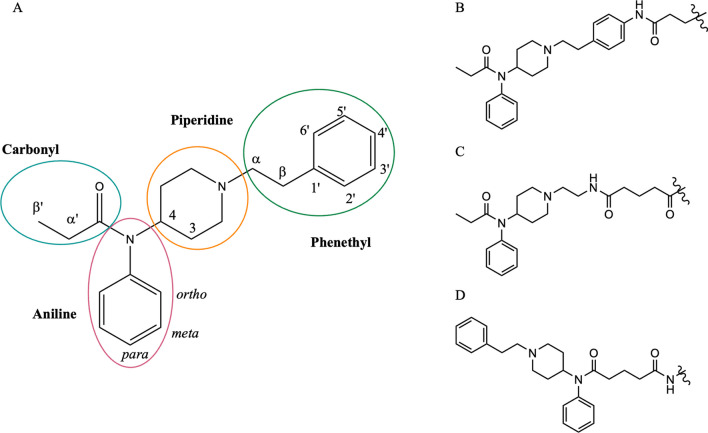
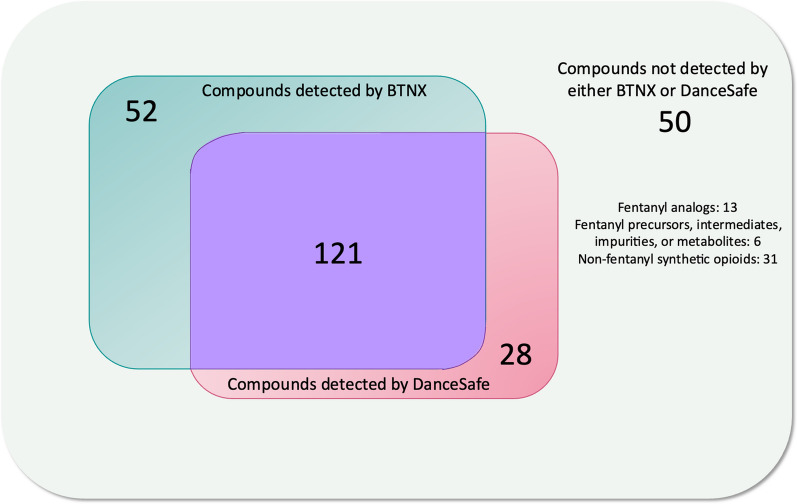
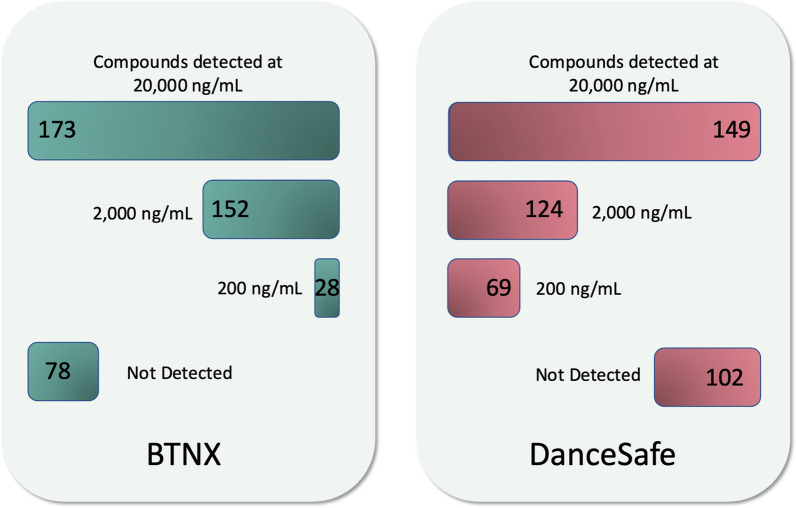
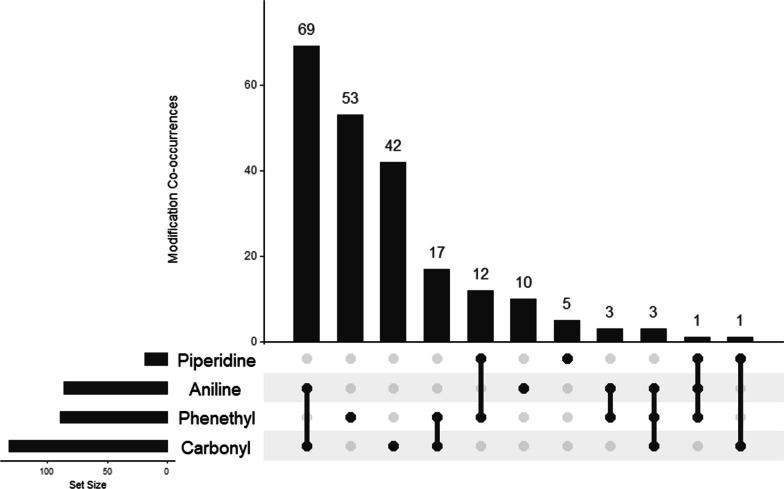
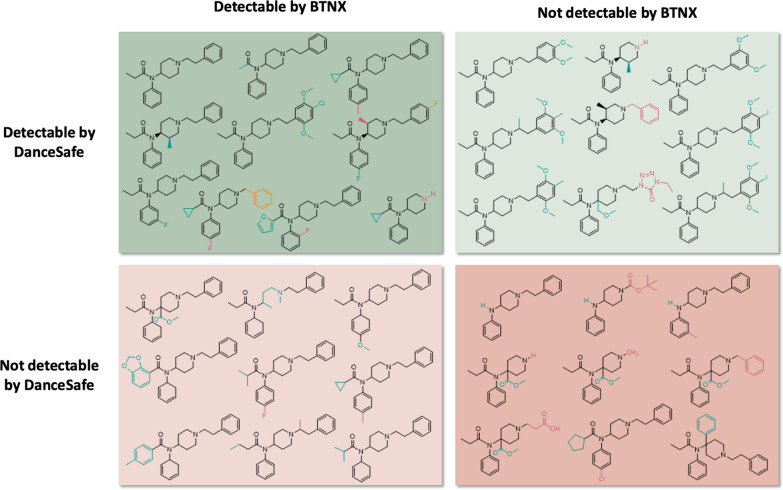
Background: Fentanyl test strips (FTS) are a commonly deployed tool in drug checking, used to test for the presence of fentanyl in street drug samples prior to consumption. Previous reports indicate that in addition to fentanyl, FTS can also detect fentanyl analogs like acetyl fentanyl and butyryl fentanyl, with conflicting reports on their ability to detect fentanyl analogs like Carfentanil and furanyl fentanyl. Yet with hundreds of known fentanyl analogs, there has been no large-scale study rationalizing FTS reactivity to different fentanyl analogs. Methods: In this study, 251 synthetic opioids—including 214 fentanyl analogs—were screened on two brands of fentanyl test strips to (1) assess the differences in the ability of two brands of fentanyl test strips to detect fentanyl-related compounds and (2) determine which moieties in fentanyl analog chemical structures are most crucial for FTS detection. Two FTS brands were assessed in this study: BTNX Rapid Response and WHPM DanceSafe. Results: Of 251 screened compounds assessed, 121 compounds were detectable at or below 20,000 ng/mL by both BTNX and DanceSafe FTS, 50 were not detectable by either brand, and 80 were detectable by one brand but not the other ( n = 52 BTNX, n = 28 DanceSafe). A structural analysis of fentanyl analogs screened revealed that in general, bulky modifications to the phenethyl moiety inhibit detection by BTNX FTS while bulky modifications to the carbonyl moiety inhibit detection by DanceSafe FTS. Conclusions: The different “blind spots” are caused by different haptens used to elicit the antibodies for these different strips. By utilizing both brands of FTS in routine drug checking, users could increase the chances of detecting fentanyl analogs in the “blind spot” of one brand.
Overview
The claims and statistics of this paper haven’t been checked yet.
Free: it reads the open-access text and checks the first 5 claims that cite a source we can check. Create a free account to check every claim.
Integrity signals
Registry
Cites
Statistics
Figures
Verification
Claims the paper makes
The claims and statistics of this paper haven’t been checked yet.
Free: it reads the open-access text and checks the first 5 claims that cite a source we can check. Create a free account to check every claim.
Claims other papers make about this one
Each is checked against this paper’s own text: does it say what the citing paper says it does?
The source backs part of the claim, not all of it — or backs it for a different population, condition or comparison.
In the citing paper
“both lots were obtained in a relatively short time span of approximately four months, making it less likely that major alterations to the manufacturing process would have occurred [52].”
From Nitazene test strips: a laboratory evaluation (2024) · cites this paper as [52]
Experimental — accuracy not yet measured
Self-check
Percentages, sums and reported differences re-computed from the paper’s own numbers.
The self-check needs the paper’s full text.
Citations
Cites
Fentanyl, fentanyl analogs and novel synthetic opioids: A comprehensive review
Armenian, P., Vo, K. T., Barr-Walker, J., & Lynch, K. L. (2018) · Neuropharmacology · doi:10.1016/j.neuropharm.2017.10.016 · Cited by 710
Stanley, T. H. (2014) · The Journal of Pain · doi:10.1016/j.jpain.2014.08.010 · Cited by 352
Green, T. C., Park, J. N., Gilbert, M., McKenzie, M., Struth, E., Lucas, R., Clarke, W., & Sherman, S. G. (2020) · International Journal of Drug Policy · doi:10.1016/j.drugpo.2020.102661 · Cited by 211
Designer Drugs: Past History and Future Prospects
Henderson, G. (1988) · Journal of Forensic Sciences · doi:10.1520/jfs11976j · Cited by 191
Acetyl Fentanyl, a Novel Fentanyl Analog, Causes 14 Overdose Deaths in Rhode Island, March–May 2013
Lozier, M., Boyd, M., Stanley, C., Ogilvie, L., King, E., Martin, C. A., & Lewis, L. S. (2015) · Journal of Medical Toxicology · doi:10.1007/s13181-015-0477-9 · Cited by 151
Fentanyl-Related Deaths: Demographics, Circumstances, and Toxicology of 112 Cases
Henderson, G. L. (1991) · Journal of Forensic Sciences · doi:10.1520/jfs13045j · Cited by 148
McCrae, K., Tobias, S., Grant, C., Lysyshyn, M., Laing, R., Wood, E., & Ti, L. (2020) · Drug and Alcohol Review · doi:10.1111/dar.13004 · Cited by 98
Raleigh, M. D., Baruffaldi, F., Peterson, S. J., Naour, M. L., Harmon, T. M., Vigliaturo, J. R., Pentel, P. R., & Pravetoni, M. (2018) · Journal of Pharmacology and Experimental Therapeutics · doi:10.1124/jpet.118.253674 · Cited by 92
An Outbreak of Designer Drug—Related Deaths in Pennsylvania
Hibbs, J. (1991) · JAMA: The Journal of the American Medical Association · doi:10.1001/jama.1991.03460080081037 · Cited by 87
Lockwood, T.-L. E., Vervoordt, A., & Lieberman, M. (2021) · Harm Reduction Journal · doi:10.1186/s12954-021-00478-4 · Cited by 85
Self-citation
Cited by
Nitazene test strips: a laboratory evaluation
De Vrieze, L. M., Stove, C. P., & Vandeputte, M. M. (2024) · Harm Reduction Journal · doi:10.1186/s12954-024-01078-8 · Cited by 34
“…our findings show that both lots had largely similar reactivities for isotonita-zene, it should be noted that both lots were obtained in a relatively short time span of approximately four months, making it less likely that major alterations to the manufacturing process would have occurred [52].”
BackgroundHollerbach, A. L., Lin, V. S., Ibrahim, Y. M., Ewing, R. G., Metz, T. O., & Rodda, K. E. (2024) · Journal of the American Society for Mass Spectrometry · doi:10.1021/jasms.4c00200 · Cited by 18
Estrada, Y., Sauer, J., Dominguez, L., Zaidi, I., Trinidad, A. J., Helmy, H. L., & Harocopos, A. (2025) · Drug and Alcohol Dependence · doi:10.1016/j.drugalcdep.2025.112578 · Cited by 18
Three Candidates, Two Peaks: Addressing Conflicting Assignments of Fentanyl Protomers with DMS-UVPD
Ieritano, C., Fry, A. N., Dodds, J. N., Baker, E. S., & Hopkins, W. S. (2025) · Journal of the American Society for Mass Spectrometry · doi:10.1021/jasms.5c00130 · Cited by 14
Trends in novel opioid use and detections in exposures and police drug seizures in New South Wales
Smith, J. L., Brown, J. A., Atefi, D., Jiranantakan, T., Shaw, V., Ewers, C., du Toit‐Prinsloo, L., & Roberts, D. M. (2025) · Drug and Alcohol Review · doi:10.1111/dar.14057 · Cited by 12
Metadata
- Authors
- Hayes, K. L., & Lieberman, M.
- Affiliations
- University of Notre Dame (US)
- Corresponding author
- Lieberman, Marya
- Venue
- Harm Reduction Journal
- Published
- 2023-12-06
- Volume
- 20
- Issue
- 1
- Pages
- 175-175
- ISSN
- 1477-7517 (ISSN-L)
- PMC
- PMC10702106
- OpenAlex
- W4389399751
- Cited by
- 21
- References
- 23
- Citations by year
- 2026: 5 · 2025: 8 · 2024: 8
- FWCI
- 3.73
- Type
- journal article
- Language
- en
- Open access
- gold
- doi.org
- Licence
- cc-by
- creativecommons.org/licenses/by/4.0 (tdm)
- creativecommons.org/licenses/by/4.0 (vor)
- Locations
- Harm Reduction Journal (publishedVersion, cc-by)
- Research Square (acceptedVersion, cc-by)
- PubMed Central (publishedVersion, cc-by)
- PubMed (publishedVersion)
- DOAJ (DOAJ: Directory of Open Access Journals) (submittedVersion, cc-by-sa)
- Funders
- National Science Foundation (IIP-2016516)
- Topics
- Life Sciences › Pharmacology, Toxicology and Pharmaceutics › Toxicology › Forensic Toxicology and Drug Analysis
- Health Sciences › Medicine › Public Health, Environmental and Occupational Health › Opioid Use Disorder Treatment
- Health Sciences › Medicine › Epidemiology › HIV, Drug Use, Sexual Risk
- Keywords
- fentanyl test strips, fentanyl analogs, synthetic opioids, drug checking, fentanyl detection, carfentanil
- MeSH terms
- Analgesics, Opioid, Fentanyl, Humans, Illicit Drugs, Drug Overdose
About these checks
Registry, retraction, Cites and statistics results are computed, not judged, with one exception: a printed reference that no index lists is read once by a model before it counts as a citation error. Claims are extracted by a model and kept only when their quote appears verbatim in the text; each cited source is then checked, with a model’s help, for whether it says what the claim relies on. Those verdicts can be wrong — read the claim’s quote and the cited source before relying on one.
Statistics and arithmetic are recomputed, not judged.
Confidence bands are shown only for fields calibrated on our annotated test set. None is calibrated yet, so no band is shown.
What counts as a claim ›How we measure confidence ›How we check this ›
Are you an author, or do you see a problem with this page? Request a review
How to cite
Cite CoChat for the checks on this page, and the paper for its own findings.
- This page
- CoChat. (2026). Citation check: Assessment of two brands of fentanyl test strips with 251 synthetic opioids reveals “blind spots” in detection capabilities. https://app.cochat.ai/papers/10.1186/s12954-023-00911-w
- The paper
- Hayes, K. L., & Lieberman, M. (2023). Assessment of two brands of fentanyl test strips with 251 synthetic opioids reveals “blind spots” in detection capabilities. Harm Reduction Journal. https://doi.org/10.1186/s12954-023-00911-w
Data sources
Bibliographic data: Semantic Scholar, OpenAlex, Crossref.
Contains information from the Semantic Scholar Academic Graph Datasets, made available under the ODC Attribution License (ODC-BY 1.0).
Semantic Scholar’s data is described in: Kinney, R., et al. (2023). The Semantic Scholar Open Data Platform. arXiv:2301.10140.
