

The DOI matches its Crossref record; 35 of the 35 references it cites were found in a registry or an index; 17 of the 45 sources its claims cite were checked for support.
Nitazene test strips: a laboratory evaluation
Open accessAbstract
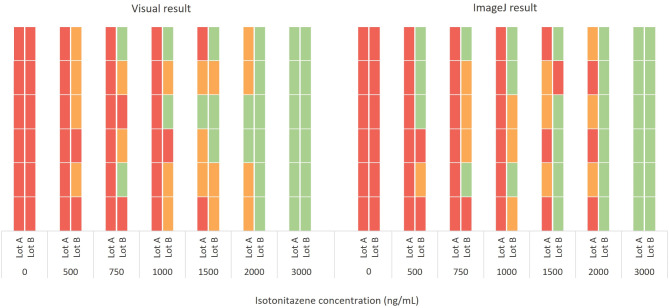
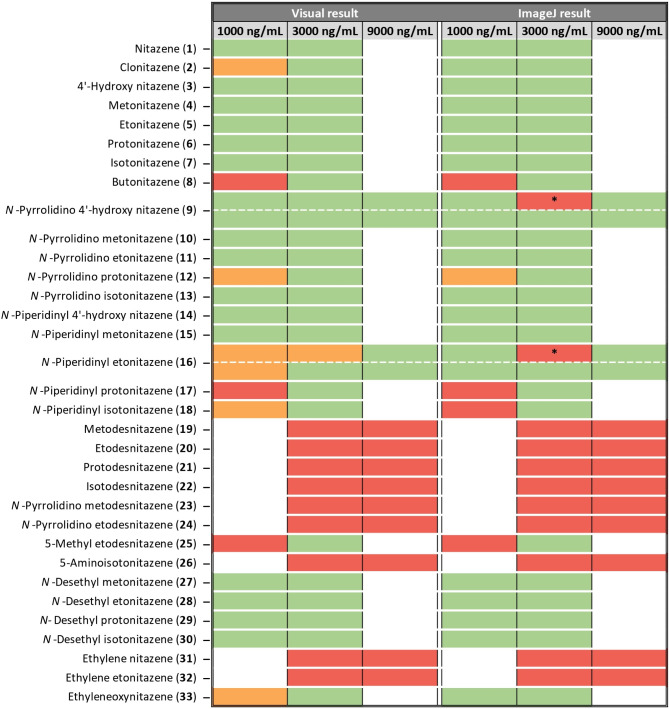
BACKGROUND: 2-Benzylbenzimidazole 'nitazene' opioids pose a growing threat to public health. Nitazene analogues are increasingly found mixed with or (mis)sold as heroin and in falsified (non-)opioid medications, posing a great risk of intoxication in users (un)knowingly exposed to these potent opioids. Lateral flow immunoassay nitazene test strips (NTS; BTNX Rapid Response™) became commercially available in Q1 2024, with the aim to enable rapid detection of nitazene analogues in drug samples. As only limited independent data is available on the performance of these strips, this lab-based study aimed at evaluating their potential for drug checking applications. METHODS: Following dilution of drug standards in water, the NTS readouts were analyzed independently by two individuals and by ImageJ. The limit of detection for isotonitazene was determined using two manufacturing lots of NTS. Cross-reactivity with 32 other nitazene analogues was evaluated. Six sourced drug samples were tested to explore the ability of NTS to detect the presence of a nitazene analogue in authentic samples. RESULTS: The limits of detection for isotonitazene were 2000 or 3000 ng/mL, depending on the lot. Twenty-four of the 33 tested nitazene analogues cross-reacted with the NTS at concentrations ≤ 9000 ng/mL. Structural analysis indicated that either substitution or removal of the 5-nitro group, or lengthening the linker between the two aromatic rings, generally hampered detection. All six authentic drug samples consistently tested positive, with no observed false negatives. CONCLUSIONS: This study provides a better understanding of the potential of NTS for drug checking purposes. Our findings indicate that NTS can theoretically alert to the presence of most nitazene analogues that have emerged on recreational drug markets. However, 'desnitazenes' (lacking the 5-nitro group) may yield false negative results due to low cross-reactivity. Although factors like specificity, lot-to-lot variability, nitazene analogue content in drug samples, solubility, and different testing conditions should be considered, our study results indicate that, at least under the conditions evaluated here (using reference standards and sourced powders), NTS are capable of detecting the presence of a wide range of nitazene analogues. Hence, NTS may alert users of the presence of nitazene analogues in drug samples.
Overview
CoChat Summary
TL;DR
This laboratory evaluation found that BTNX Rapid Response™ nitazene test strips detected isotonitazene at 2000–3000 ng/mL depending on lot and cross-reacted with 24 of 33 tested nitazene analogues at ≤9000 ng/mL. All six authentic powder samples tested positive, but desnitazenes and some linker-modified analogues may be missed.
Key findings
- The isotonitazene limit of detection was 3000 ng/mL for lot A and 2000 ng/mL for lot B, based on both visual and ImageJ scoring; the manufacturer lists a 2000 ng/mL cut-off.
- Twenty-four of 33 nitazene analogues cross-reacted at concentrations ≤9000 ng/mL, while 9 were not detectable at 9000 ng/mL.
- Structural analysis indicated that removal/substitution of the 5-nitro group (desnitazenes) or lengthening the linker between aromatic rings generally hampered detection; modifications at the para-benzyl position or amine side chain did not.
- All six authentic powder samples containing metonitazene, protonitazene, isotonitazene, butonitazene, or N-pyrrolidino etonitazene tested positive, with no observed false negatives; LC-QTOF-MS estimated the nitazene analogue as the major compound with >90% purity.
Methods
- BTNX Rapid Response™ NTS from two manufacturing lots were tested with isotonitazene standards in water at 500–3000 ng/mL, with six replicates per concentration across three days; readouts were scored by two blinded raters and by ImageJ, using 10-min results.
- Cross-reactivity was evaluated for 32 additional nitazene analogues plus isotonitazene, initially at 3000 ng/mL, then at 1000 and/or 9000 ng/mL depending on the result; each compound was tested once per specified concentration.
- Six sourced powder samples were tested by adding 1 mg powder to 1 mL tap water, then a 1/10 dilution, and comparing NTS results with LC-QTOF-MS characterization.
Limitations
- The paper states that visual strip interpretation is subjective, that competitive NTS results can be misinterpreted, that test lines were consistently fainter than control lines, and that lot-to-lot variability exists; both lots were obtained within about four months, and cross-reactivity/authentic testing used only lot B.
- The paper states that the authentic powders were likely highly pure and may not represent real-world samples, that incomplete dissolution occurred, that no NMR or salt-form characterization was performed, and that selectivity testing was not repeated except for brorphine at 1 mg/mL.
- The paper states that trace nitazene amounts below the cut-off may be missed, desnitazenes may yield false negatives, and a negative result does not mean a sample is safe; evident from the text, the cross-reactivity panel used n = 1 per concentration and the authentic sample set was small (n = 6).
Model-written summary. Check it against the paper before relying on it.
Integrity signals
Registry
Cites
Statistics
Figures


Verification
Claims the paper makes
8 Valid · 3 Not valid · 14 Not checked · 65 Own results and interpretations
Some cited sources support this claim and some don’t — read each source’s verdict below.
In the paper
“it has been demonstrated that high concentrations (≥ 1 mg/mL) of MDMA, methamphetamine, levamisole, and diphenhydramine produce false positive results with FTS [39, 45, 57].”
§ Nitazene test strips: a laboratory evaluation > Discussion
What the sources say
- Partly supportedcites [39] Halifax JC, Lim L, Ciccarone D, Lynch KL. Testing the test strips: laboratory performance of fentanyl test strips. Harm Reduct J. 2024;21:14. sourceExperimental — accuracy not yet measured
The Results section ('Fentanyl test strip interferences'; page not provided) reports false positives for MDMA, d-methamphetamine, and diphenhydramine at tested concentrations. It also reports that levamisole showed no cross-reactivity up to 100 mg/mL, contrary to that part of the claim. Diphenhydramine's response was not consistent across all concentrations of at least 1 mg/mL. (LLM, conf=0.91)
- Disputedcites [45] Norman C, Marland V, McKenzie C, Ménard H. Nic Daéid N. Evaluation of fentanyl immunoassay test strips for rapid in-situ detection of fentanyl and fentanyl analogs in seized samples and alternative matrices. Int J Drug Policy. 2023;118:104102. sourceExperimental — accuracy not yet measured
The Discussion (p. 9) says all four substances tested negative even at high concentrations when the strips were read according to the manufacturer’s instructions. It acknowledges that previous studies interpreted weak test lines as slight positives, but does not find that these substances produce false positives under its test interpretation. (LLM, conf=0.88)
Checked by a reasoning model — may be wrong.
- Partly supportedcites [57] Lockwood T-LE, Vervoordt A, Lieberman M. High concentrations of illicit stimulants and cutting agents cause false positives on fentanyl test strips. Harm Reduct J. 2021;18:30. sourceExperimental — accuracy not yet measured
The Results (Interference study; page unavailable) report false positives for MDMA, methamphetamine, and diphenhydramine, but do not report testing levamisole. The stated critical concentrations are 2 mg/mL for MDMA, 1.5 mg/mL for methamphetamine, and 1 or 2.5 mg/mL for the diphenhydramine formulations, so ≥1 mg/mL is not a valid threshold for all the listed substances. (LLM, conf=0.91)
boostedstates a cause- Asserted: passes — The authors put it forward as true.
- Checkable: passes — It can be checked against evidence.
- Load-bearing: unclear — It is unclear whether the paper’s conclusions depend on it.
- Based: passes — The paper gives a reason why it holds.
- Partly supported
The cited sources support only part of this claim — read each source’s verdict below.
In the paper
“It should be noted that a limitation of this procedure is the difficulty in directly comparing the relative abundance of drugs within a sample due to the varying ionization efficiencies of each compound [49].”
§ Nitazene test strips: a laboratory evaluation > Materials and methods > Methods
What the sources say
- Partly supportedcites [49] Timmerman A, Balcaen M, Coopman V, Degreef M, Pottie E, Stove CP. Activity-based detection of synthetic cannabinoid receptor agonists in plant materials. Harm Reduct J. 2024;21:127. sourceExperimental — accuracy not yet measured
The LC-QTOF-MS Materials and methods section describes peak intensities as providing only a “rough estimation” of each compound’s relative contribution within a Spice product. It does not state that differing ionization efficiencies are the reason direct comparisons are difficult. (LLM, conf=0.79)
plainstates a cause- Asserted: passes — The authors put it forward as true.
- Checkable: passes — It can be checked against evidence.
- Load-bearing: unclear — It is unclear whether the paper’s conclusions depend on it.
- Based: passes — The paper gives a reason why it holds.
- Partly supported
The cited sources support only part of this claim — read each source’s verdict below.
In the paper
“The current study is the first to independently assess, in a laboratory context and using drug standards, the potential of the first commercially available BTNX Rapid Response™ NTS for drug checking purposes.”
§ Nitazene test strips: a laboratory evaluation > Introduction
What the sources say
- Not matchedcites [41] BTNX Inc. BTNX Rapid Reponse nitazene white paper [Internet]. 2024. https://cloudfront.exchangesupplies.org/pdfs/BTNX%20Rapid%20Response%20Nitazene%20White%20Paper%202024-03%20V3%201%20(1).pdf
Couldn’t be matched to a paper in Crossref, so it can’t be checked.
- Partly supportedcites [42] Sisco E, Appley MG, Pyfrom EM, Banta-Green CJ, Shover CL, Molina CA et al. Beyond fentanyl test strips: investigating other urine drug test strips for drug checking applications. Forensic Chem. 2024;40:100594. sourceExperimental — accuracy not yet measured
The Materials & Methods section describes laboratory testing of BTNX strips in solutions containing known analytes, and the Results and Discussion section reports testing nitazene strips against specific nitazenes for drug-checking applications. Our copy does not establish that the strips were the first commercially available BTNX Rapid Response™ NTS, or that this was the first independent assessment of them. (LLM, conf=0.82)
plain- Asserted: passes — The authors put it forward as true.
- Checkable: passes — It can be checked against evidence.
- Load-bearing: passes — The paper’s conclusions depend on it.
- Based: passes — The paper gives a reason why it holds.
- Not matched
The cited sources that could be checked couldn’t confirm or dispute this claim.
In the paper
“As only limited independent data is available on the performance of these strips, this lab-based study aimed at evaluating their potential for drug checking applications.”
- Also stated in: § Discussion · plain
“At the time of writing (Q3 2024), limited third-party evaluations of these NTS had been conducted [41, 42], providing some insight into the sensitivity (LOD), cross-reactivity with other nitazene analogues, and performance with authentic drug samples.”
§ Nitazene test strips: a laboratory evaluation > Abstract > Background
What the sources say
- Not matchedcites [41] BTNX Inc. BTNX Rapid Reponse nitazene white paper [Internet]. 2024. https://cloudfront.exchangesupplies.org/pdfs/BTNX%20Rapid%20Response%20Nitazene%20White%20Paper%202024-03%20V3%201%20(1).pdf
Couldn’t be matched to a paper in Crossref, so it can’t be checked.
- Could not verifycites [42] Sisco E, Appley MG, Pyfrom EM, Banta-Green CJ, Shover CL, Molina CA et al. Beyond fentanyl test strips: investigating other urine drug test strips for drug checking applications. Forensic Chem. 2024;40:100594. sourceExperimental — accuracy not yet measured
The Introduction (page unavailable) says the study evaluates nitazene test strips for drug checking, and Materials & Methods identifies the strips as BTNX products. Neither passage says that independent performance data on BTNX nitazene test strips was limited at the time; searches for prior nitazene-strip research and limited independent data found no such statement in our copy. (LLM, conf=0.70)
plain- Asserted: passes — The authors put it forward as true.
- Checkable: passes — It can be checked against evidence.
- Load-bearing: passes — The paper’s conclusions depend on it.
- Based: passes — The paper gives a reason why it holds.
- Also stated in: § Discussion · plain
The cited sources support only part of this claim — read each source’s verdict below.
In the paper
“the presence of a nitazene analogue even at trace amounts, which could be below the cut-off for detection with NTS, may readily give rise to dangerous opioid effects in (unknowing) users.”
§ Nitazene test strips: a laboratory evaluation > Discussion
What the sources say
- Partly supportedcites [7] Vandeputte MM, Van Uytfanghe K, Layle NK, St. Germaine DM, Iula DM, Stove CP. Synthesis, chemical characterization, and µ-opioid receptor activity assessment of the emerging group of nitazene 2-benzylbenzimidazole synthetic opioids. ACS Chem Neurosci. 2021;12:1241–51. sourceExperimental — accuracy not yet measured
The Results & Discussion (page not provided) says even small quantities of nitazenes have high harm potential and calls for highly sensitive detection methods. The Introduction (page not provided) adds that these compounds may occur at very low concentrations and be missed in screening. The paper does not establish a detection cut-off for NTS or show that harmful amounts fall below it. (LLM, conf=0.86)
- Partly supportedcites [12] Malcolm NJ, Palkovic B, Sprague DJ, Calkins MM, Lanham JK, Halberstadt AL, et al. Mu-opioid receptor selective superagonists produce prolonged respiratory depression. iScience. 2023;26:107121. sourceExperimental — accuracy not yet measured
The Discussion says nitazenes can cause severe, potentially lethal respiratory depression in humans, and the Results report respiratory depression at low doses of N-desethyl isotonitazene in a rabbit model. The paper does not establish that trace amounts below a nitazene test strip (NTS) detection cut-off cause dangerous effects, or discuss that cut-off. (LLM, conf=0.86)
- Partly supportedcites [13] De Vrieze LM, Walton SE, Pottie E, Papsun D, Logan BK, Krotulski AJ et al. In vitro structure–activity relationships and forensic case series of emerging 2-benzylbenzimidazole ‘nitazene’ opioids. Arch Toxicol. 2024;98:2999–3018. sourceExperimental — accuracy not yet measured
The Discussion reports low or sub-ng/mL blood concentrations and warns that nitazenes in tablets sold as diazepam pose a danger of fatal accidental overdose to unsuspecting users. The Conclusion also notes the high potency of many nitazenes. Neither passage establishes that trace amounts in a drug sample can fall below the detection cut-off of nitazene test strips (NTS); the paper discusses laboratory analysis of blood instead. Page numbers were not available in our copy. (LLM, conf=0.86)
- Not checked — no full text of the sourcecites [14] Vandeputte MM, Tsai M-HM, Chen L, Glatfelter GC, Walther D, Stove CP, et al. Comparative neuropharmacology of structurally distinct non-fentanyl opioids that are appearing on recreational drug markets worldwide. Drug Alcohol Depend. 2023;249:109939. source
- Partly supportedcites [15] Glatfelter GC, Vandeputte MM, Chen L, Walther D, Tsai M-HM, Shi L et al. Alkoxy chain length governs the potency of 2-benzylbenzimidazole ‘nitazene’ opioids associated with human overdose. Psychopharmacology (Berl). 2023;240:2573–84. sourceExperimental — accuracy not yet measured
The Discussion reports potent opioid-like effects in mice at low doses, and the Introduction links nitazene exposure to drug-related accidents and fatalities. But the paper does not establish that trace amounts below an NTS detection cut-off cause dangerous effects in people, or evaluate NTS detection limits (searched: NTS, detection cut-off, trace amounts, test strips). (LLM, conf=0.85)
hedgedstates a possible cause- Asserted: passes — The authors put it forward as true.
- Checkable: passes — It can be checked against evidence.
- Load-bearing: passes — The paper’s conclusions depend on it.
- Based: passes — The paper gives a reason why it holds.
- Partly supported
48 more claims
Create a free account to see all 90 claims and every source verdict.
- Probably not a substantial claim. 17
- It may state two separate claims as one. 25
- The quote only partly states this claim. 1
Claims other papers make about this one
Each is checked against this paper’s own text: does it say what the citing paper says it does?
The source backs part of the claim, not all of it — or backs it for a different population, condition or comparison.
In the citing paper
“Identification relies on advanced analytical techniques such as LC-MS/MS, LC-QTOF-MS, or LC-HRMS, which are required for accurate detection of the analogs in biological and seized material samples [42].”
From Novel 2-Benzylbenzimidazole Opioids: Emerging Drugs of Abuse and Pharmacological Considerations with Nitazene Analogs (2026) · cites this paper as [42]
Experimental — accuracy not yet measuredThe cited source says what the claim attributes to it.
In the citing paper
“Recent laboratory evaluations found that test strips were able to detect 24 of 33 nitazene analogs at concentrations ≤9000 ng/mL, indicating broad but incomplete cross‐reactivity with currently circulating analogs [42].”
From Temporal and geographical patterns of nitazene detections in drug samples and biospecimens in the United States, 2019–2024 (2026) · cites this paper as [42]
The cited source says what the claim attributes to it.
In the citing paper
“Certain structurally distinct nitazene analogs, such as desnitazenes lacking the 5‐nitro group, were not detected.”
From Temporal and geographical patterns of nitazene detections in drug samples and biospecimens in the United States, 2019–2024 (2026) · cites this paper as [42]
The cited source says what the claim attributes to it.
In the citing paper
“Further, testing was conducted using high‐purity samples, which may not reflect the complexity of real‐world polysubstance mixtures.”
From Temporal and geographical patterns of nitazene detections in drug samples and biospecimens in the United States, 2019–2024 (2026) · cites this paper as [42]
The cited source says what the claim attributes to it.
In the citing paper
“Finally, test strips are only able to detect the presence of a nitazene, but cannot provide information on specific analog identity, dosage or the presence of adulterants.”
From Temporal and geographical patterns of nitazene detections in drug samples and biospecimens in the United States, 2019–2024 (2026) · cites this paper as [42]
3 more claims about this paper
Create a free account to see every claim other papers make about this one.
Citations
Cites
Peiper, N. C., Clarke, S. D., Vincent, L. B., Ciccarone, D., Kral, A. H., & Zibbell, J. E. (2019) · International Journal of Drug Policy · doi:10.1016/j.drugpo.2018.08.007 · Cited by 317 · cited 2×
“Various studies have shown that FTS are deemed as acceptable harm reduction and overdose-prevention tools, associated with positive changes in drug use behavior among PWUD [32–37].”
BackgroundFairbairn, N., Coffin, P. O., & Walley, A. Y. (2017) · International Journal of Drug Policy · doi:10.1016/j.drugpo.2017.06.005 · Cited by 274 · cited 1×
“While strategies like overdose prevention education and an increased availability of the opioid antagonist naloxone, which can rapidly reverse an opioid overdose, are crucial [30], also approaches involving the use of immunoassay test strips have been put forward.”
BackgroundGreen, T. C., Park, J. N., Gilbert, M., McKenzie, M., Struth, E., Lucas, R., Clarke, W., & Sherman, S. G. (2020) · International Journal of Drug Policy · doi:10.1016/j.drugpo.2020.102661 · Cited by 211 · cited 1×
“In line with other reports [42, 44–46], this study defined the LOD as the lowest concentration at which all replicate measurements produced a positive readout.”
ResultVandeputte, M. M., Van Uytfanghe, K., Layle, N. K., St. Germaine, D. M., Iula, D. M., & Stove, C. P. (2021) · ACS Chemical Neuroscience · doi:10.1021/acschemneuro.1c00064 · Cited by 161
Self-citationDARK Classics in Chemical Neuroscience: Etonitazene and Related Benzimidazoles
Ujváry, I., Christie, R., Evans-Brown, M., Gallegos, A., Jorge, R., de Morais, J., & Sedefov, R. (2021) · ACS Chemical Neuroscience · doi:10.1021/acschemneuro.1c00037 · Cited by 141 · cited 1×
“In response to legislative measures targeting fentanyl analogues [3–5], opioids belonging to the 2-benzylbenzimidazole ‘nitazene’ class have emerged on recreational drug markets world-wide and have become the predominant class of non-fentanyl derived NSO in most markets [6–9].”
BackgroundBlanckaert, P., Cannaert, A., Van Uytfanghe, K., Hulpia, F., Deconinck, E., Van Calenbergh, S., & Stove, C. (2020) · Drug Testing and Analysis · doi:10.1002/dta.2738 · Cited by 116 · cited 3×
“…containing isotoni-tazene, metonitazene, protonitazene, butonitazene, or N -pyrrolidino etonitazene were obtained in the context of prior routine drug market monitoring by the Belgian Early Warning System on Drugs (BEWSD), part of Sci-ensano (the Belgian Institute for Public Health) [10, 43].”
BackgroundMethodSelf-citationMardal, M., Andreasen, M. F., Mollerup, C. B., Stockham, P. C., Telving, R., Τhomaidis, Ν. S., Diamanti, K. S., Línnet, K., & Dalsgaard, P. W. (2019) · Journal of Analytical Toxicology · doi:10.1093/jat/bkz030 · Cited by 115 · cited 1×
“This purity estimate was defined as the ratio of the peak intensity of the nitazene analogue in question to the overall peak intensities of all substances detected in a given sample, using the HighResNPS library [48] with a cut-off set at 50 (data not shown).”
MethodLockwood, T.-L. E., Vervoordt, A., & Lieberman, M. (2021) · Harm Reduction Journal · doi:10.1186/s12954-021-00478-4 · Cited by 85 · cited 1×
“For instance, it has been demonstrated that high concentrations ( ≥ 1 mg/mL) of MDMA, meth-amphetamine, levamisole, and diphenhydramine produce false positive results with FTS [39, 45, 57].”
BackgroundThoren, K. L., Colby, J. M., Shugarts, S. B., Wu, A. H. B., & Lynch, K. L. (2015) · Clinical Chemistry · doi:10.1373/clinchem.2015.241315 · Cited by 84 · cited 1×
“Liquid chromatography coupled to time-of-flight mass spectrometry (LC-QTOF-MS) analysis of the powder samples was performed as previously described [47].”
MethodThe Rise and Fall of Isotonitazene and Brorphine: Two Recent Stars in the Synthetic Opioid Firmament
Vandeputte, M. M., Krotulski, A. J., Papsun, D. M., Logan, B. K., & Stove, C. P. (2022) · Journal of Analytical Toxicology · doi:10.1093/jat/bkab082 · Cited by 71 · cited 2×
“…7 ), butonitazene ( 8 ), N -pyrrolidino 4’-hydroxy nitazene citrate ( 9 ), N -pyrrolidino metonitazene citrate ( 10 ), N -pyrrolidino etonitazene ( 11 ), N -pyrrolidino protonitazene ( 12 ), N -pyrrolidino isotonitazene citrate ( 13 ), N -piperidinyl 4’-hydroxy nitazene citrate ( 14 ), N…”
BackgroundSelf-citation
Research works printed but not linked: 1
- Krotulski A, Shinefeld J, DeBord J, Teixeira da Silva D, Logan B. Evaluation of xylazine test strips (BTNX) for drug checking purposes. United States: Center for Forensic Science Research and Education; 2023.
Cited by
Vandeputte, M. M., & Stove, C. P. (2025) · Neuropharmacology · doi:10.1016/j.neuropharm.2025.110470 · Cited by 36
Self-citationThe emergence of nitazenes: a new chapter in the synthetic opioid crisis
Caprari, C., Ferri, E., Rossetti, P., Gregori, A., Citti, C., & Cannazza, G. (2025) · Archives of Toxicology · doi:10.1007/s00204-025-04102-3 · Cited by 19
Curtis, B., Lawes, D. J., Caldicott, D., & McLeod, M. D. (2025) · Drug Testing and Analysis · doi:10.1002/dta.3910 · Cited by 19
“[25, 26].”
Nitazenes: The Emergence of a Potent Synthetic Opioid Threat
Pereira, J. R. P., Quintas, A., & Neng, N. R. (2025) · Molecules · doi:10.3390/molecules30193890 · Cited by 21
“…available, they present limitations, such as an inability to differentiate between nitazene analogues, potential issues with solubility in drug samples, and limited cross-reactivity with certain desnitazene analogues, which can give users a false sense of safety if not correctly interpreted [49].”
Responding to reports of nitazene toxicity in Australia
Clifford, B., Peacock, A., Siefried, K. J., Gobeil, J., Smith, J. L., & Ezard, N. (2025) · Medical Journal of Australia · doi:10.5694/mja2.52605 · Cited by 16
Metadata
- Authors
- De Vrieze, L. M., Stove, C. P., & Vandeputte, M. M.
- Affiliations
- Ghent University (BE)
- Corresponding author
- Stove, Christophe P.
- Vandeputte, Marthe M.
- Venue
- Harm Reduction Journal
- Published
- 2024-08-28
- Volume
- 21
- Issue
- 1
- Pages
- 159-159
- ISSN
- 1477-7517 (ISSN-L)
- PMC
- PMC11350930
- OpenAlex
- W4401968264
- Cited by
- 34
- References
- 34
- Citations by year
- 2026: 15 · 2025: 19
- FWCI
- 8.03
- Type
- journal article
- Language
- en
- Open access
- gold
- doi.org
- Licence
- cc-by-nc-nd
- creativecommons.org/licenses/by-nc-nd/4.0 (tdm)
- creativecommons.org/licenses/by-nc-nd/4.0 (vor)
- Locations
- Harm Reduction Journal (publishedVersion, cc-by-nc-nd)
- PubMed Central (publishedVersion, cc-by-nc-nd)
- PubMed (publishedVersion)
- Ghent University Academic Bibliography (Ghent University) (submittedVersion, cc-by-nc-nd)
- DOAJ (DOAJ: Directory of Open Access Journals) (submittedVersion, cc-by-sa)
- Funders
- Fonds Wetenschappelijk Onderzoek (11I5623N)
- Topics
- Life Sciences › Pharmacology, Toxicology and Pharmaceutics › Toxicology › Forensic Toxicology and Drug Analysis
- Physical Sciences › Engineering › Biomedical Engineering › Biosensors and Analytical Detection
- Health Sciences › Medicine › Public Health, Environmental and Occupational Health › Opioid Use Disorder Treatment
- Keywords
- nitazenes, isotonitazene, lateral flow immunoassay, drug checking, cross-reactivity, detection limit, heroin adulteration, opioid toxicity
- MeSH terms
- Analgesics, Opioid, Humans, Immunoassay, Nitro Compounds, Reagent Strips, Substance Abuse Detection, Limit of Detection
About these checks
Registry, retraction, Cites and statistics results are computed, not judged, with one exception: a printed reference that no index lists is read once by a model before it counts as a citation error. Claims are extracted by a model and kept only when their quote appears verbatim in the text; each cited source is then checked, with a model’s help, for whether it says what the claim relies on. Those verdicts can be wrong — read the claim’s quote and the cited source before relying on one.
The claim verdicts this report counts are experimental: their accuracy is not yet measured.
A language model drew the claims from the paper on 2026-10-10, under version 3 of the claim definition (model deepseek-v4.1-flash, prompt extract-v3).
A second model labelled each claim on 2026-10-10 (model jev-1.13-20260917, definition revision gold-guideline-v0.2).
Cited sources are checked with a language model’s help (gpt-6-sol).
Statistics and arithmetic are recomputed, not judged.
Confidence bands are shown only for fields calibrated on our annotated test set. None is calibrated yet, so no band is shown.
What counts as a claim ›How we measure confidence ›How we check this ›
Are you an author, or do you see a problem with this page? Request a review
How to cite
Cite CoChat for the checks on this page, and the paper for its own findings.
- This page
- CoChat. (2026). Citation check: Nitazene test strips: a laboratory evaluation. https://app.cochat.ai/papers/10.1186/s12954-024-01078-8
- The paper
- De Vrieze, L. M., Stove, C. P., & Vandeputte, M. M. (2024). Nitazene test strips: a laboratory evaluation. Harm Reduction Journal. https://doi.org/10.1186/s12954-024-01078-8
Data sources
Bibliographic data: Semantic Scholar, OpenAlex, Crossref.
Contains information from the Semantic Scholar Academic Graph Datasets, made available under the ODC Attribution License (ODC-BY 1.0).
Semantic Scholar’s data is described in: Kinney, R., et al. (2023). The Semantic Scholar Open Data Platform. arXiv:2301.10140.
