

Testing the test strips: laboratory performance of fentanyl test strips
Open accessThe DOI matches its Crossref record; 54 of the 54 references it cites were found in a registry or an index.
Abstract
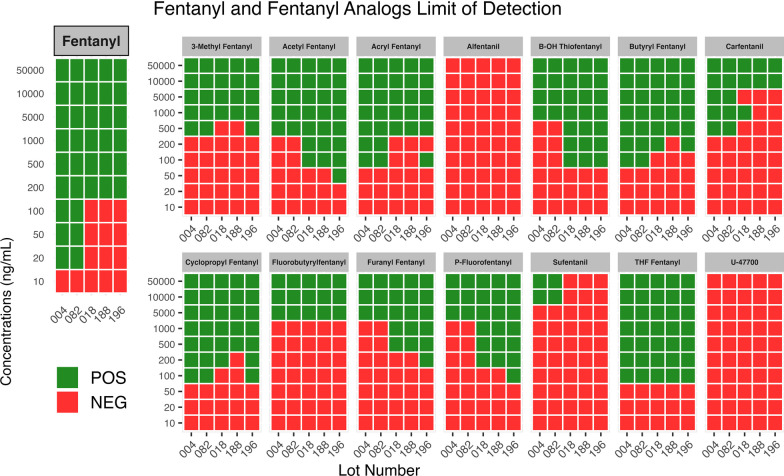
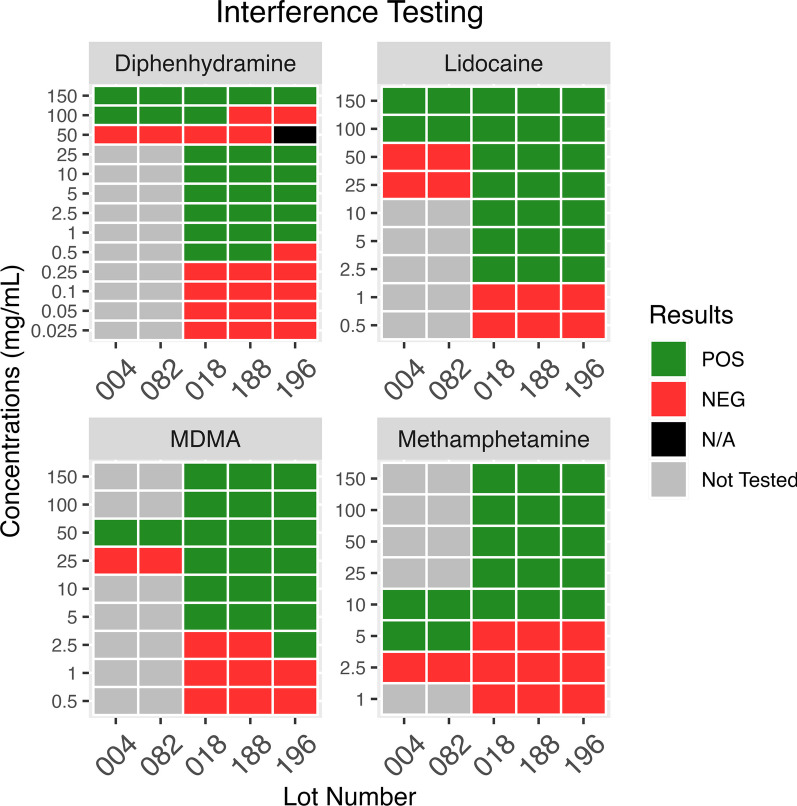
Background: The overdose crisis driven by synthetic opioids continues to escalate in the USA. We evaluated the efficacy of multiple manufacturing lots of a fentanyl test strip (FTS) to detect fentanyl and fentanyl analogs and assessed cross-reactivity with possible interferences. Methods: Drug standards were dissolved in water in a laboratory setting and serially diluted. Drug dilutions were tested using five different manufacturing lots of BTNX Rapid Response (20 ng/mL cutoff) lateral flow chromatographic immunoassay strips to assess lot-to-lot variability for FTS sensitivity and cross-reactivity for the analytes of interest. Results: All five manufacturing lots cross-reacted with fentanyl and eleven fentanyl analogs. Diphenhydramine, lidocaine, MDMA, and methamphetamine were found to cause false positives with the strips. There was notable lot-to-lot variability in the sensitivity of the strips for fentanyl, fentanyl analogs, and known interferences. Discussion: FTS remains an important overdose prevention tool, but lot-to-lot variability in performance complicates robust instructions that balance the prevention of false positives and false negatives. Continued lot-to-lot performance assessment is recommended to ensure health education for FTS remains accurate. More sophisticated drug checking technologies and services are needed in the community landscape to augment personal FTS use to facilitate informed consumption and overdose risk mitigation.
Overview
The claims and statistics of this paper haven’t been checked yet.
Free: it reads the open-access text and checks the first 5 claims that cite a source we can check. Create a free account to check every claim.
Integrity signals
Registry
Cites
Statistics
Figures
Verification
Claims the paper makes
The claims and statistics of this paper haven’t been checked yet.
Free: it reads the open-access text and checks the first 5 claims that cite a source we can check. Create a free account to check every claim.
Claims other papers make about this one
Each is checked against this paper’s own text: does it say what the citing paper says it does?
The source backs part of the claim, not all of it — or backs it for a different population, condition or comparison.
In the citing paper
“it has been demonstrated that high concentrations (≥ 1 mg/mL) of MDMA, methamphetamine, levamisole, and diphenhydramine produce false positive results with FTS [39, 45, 57].”
From Nitazene test strips: a laboratory evaluation (2024) · cites this paper as [39]
Experimental — accuracy not yet measuredThe cited source says what the claim attributes to it.
In the citing paper
“it has been previously shown for FTS that certain lots exhibited LODs up to 10 times higher than the manufacturer’s specified cut-off, leading to a reduced performance of specific lots [39].”
From Nitazene test strips: a laboratory evaluation (2024) · cites this paper as [39]
Self-check
Percentages, sums and reported differences re-computed from the paper’s own numbers.
The self-check needs the paper’s full text.
Citations
Cites
European Monitoring Centre for Drugs and Drug Addiction
Anderson, M. (2014) · European Union regulations | European Encyclopedia of law · Cited by 1,213
The rise of illicit fentanyls, stimulants and the fourth wave of the opioid overdose crisis
Ciccarone, D. (2021) · Current Opinion in Psychiatry · doi:10.1097/yco.0000000000000717 · Cited by 987 · cited 2×
“Accurate fentanyl detection in stimulant samples is increasingly important as the overdose crisis enters a “fourth wave” characterized by an increase in stimulant-related overdoses [48].”
BackgroundSelf-citationFentanyl, fentanyl analogs and novel synthetic opioids: A comprehensive review
Armenian, P., Vo, K. T., Barr-Walker, J., & Lynch, K. L. (2018) · Neuropharmacology · doi:10.1016/j.neuropharm.2017.10.016 · Cited by 710 · cited 1×
“There is a 4-log range of potencies for the fentanyl analogs: from 1.5 to 10,000 times that of morphine [14, 15].”
BackgroundInfluentialSelf-citationThe triple wave epidemic: Supply and demand drivers of the US opioid overdose crisis
Ciccarone, D. (2019) · International Journal of Drug Policy · doi:10.1016/j.drugpo.2019.01.010 · Cited by 677 · cited 1×
“The triple wave epidemic of overdose deaths due to prescription opioids, heroin, and illicitly manufactured fen-tanyls (IMF) in the USA has reached historic proportions [1].”
BackgroundSelf-citation(2022) · doi:10.15620/cdc:122556 · Cited by 562 · cited 2×
“The fastest growing overdose wave is due to synthetic opioids other than methadone—largely IMF, i.e., fentanyl and fentanyl analogs—accounting for 70,601 reported deaths in 2021, representing a 1,173% increase from 2014[2].”
BackgroundInfluentialFentanyl in the US heroin supply: A rapidly changing risk environment
Ciccarone, D. (2017) · International Journal of Drug Policy · doi:10.1016/j.drugpo.2017.06.010 · Cited by 450 · cited 2×
“In relation to morphine, fentanyl is 100 times as potent by weight and thus estimated to be 40 times more potent than heroin[13].”
BackgroundSelf-citationA review: Fentanyl and non-pharmaceutical fentanyls
Suzuki, J., & El-Haddad, S. (2017) · Drug and Alcohol Dependence · doi:10.1016/j.drugalcdep.2016.11.033 · Cited by 445 · cited 1×
“There is a 4-log range of potencies for the fentanyl analogs: from 1.5 to 10,000 times that of morphine [14, 15].”
BackgroundInfluentialGladden, R. M., Martinez, P., & Seth, P. (2016) · MMWR. Morbidity and Mortality Weekly Report · doi:10.15585/mmwr.mm6533a2 · Cited by 426 · cited 1×
“Beginning in 2014, deaths attributed to IMF have risen alongside seizures [4–6].”
BackgroundDeaths Involving Fentanyl, Fentanyl Analogs, and U-47700 — 10 States, July–December 2016
O’Donnell, J. K., Halpin, J., Mattson, C. L., Goldberger, B. A., & Gladden, R. M. (2017) · MMWR. Morbidity and Mortality Weekly Report · doi:10.15585/mmwr.mm6643e1 · Cited by 387
Harper, L., Powell, J., & Pijl, E. M. (2017) · Harm Reduction Journal · doi:10.1186/s12954-017-0179-5 · Cited by 337 · cited 3×
“A range of testing options suitable for harm reduction services are available [28].”
BackgroundMethod
Cited by
National and regional trends in fentanyl seizures in the United States, 2017–2023
Palamar, J. J., Fitzgerald, N. D., Carr, T. H., Cottler, L. B., & Ciccarone, D. (2024) · International Journal of Drug Policy · doi:10.1016/j.drugpo.2024.104417 · Cited by 53
Self-citationNitazene test strips: a laboratory evaluation
De Vrieze, L. M., Stove, C. P., & Vandeputte, M. M. (2024) · Harm Reduction Journal · doi:10.1186/s12954-024-01078-8 · Cited by 34
“Moreover, it is important to consider lot-to-lot variability of test strip sensitivity, as it has been previously shown for FTS that certain lots exhibited LODs up to 10 times higher than the manufacturer’s specified cut-off, leading to a reduced performance of specific lots [39].”
BackgroundInfluentialHollerbach, A. L., Lin, V. S., Ibrahim, Y. M., Ewing, R. G., Metz, T. O., & Rodda, K. E. (2024) · Journal of the American Society for Mass Spectrometry · doi:10.1021/jasms.4c00200 · Cited by 18
Estrada, Y., Sauer, J., Dominguez, L., Zaidi, I., Trinidad, A. J., Helmy, H. L., & Harocopos, A. (2025) · Drug and Alcohol Dependence · doi:10.1016/j.drugalcdep.2025.112578 · Cited by 18
Three Candidates, Two Peaks: Addressing Conflicting Assignments of Fentanyl Protomers with DMS-UVPD
Ieritano, C., Fry, A. N., Dodds, J. N., Baker, E. S., & Hopkins, W. S. (2025) · Journal of the American Society for Mass Spectrometry · doi:10.1021/jasms.5c00130 · Cited by 14
Metadata
- Authors
- Halifax, J. C., Lim, L., Ciccarone, D., & Lynch, K. L.
- Affiliations
- University of California, San Francisco (US)
- Corresponding author
- Halifax, John C.
- Venue
- Harm Reduction Journal
- Published
- 2024-01-18
- Volume
- 21
- Issue
- 1
- Pages
- 14-14
- ISSN
- 1477-7517 (ISSN-L)
- PMC
- PMC10795297
- OpenAlex
- W4390975978
- Cited by
- 45
- References
- 54
- Citations by year
- 2026: 14 · 2025: 20 · 2024: 11
- FWCI
- 10.66
- Type
- journal article
- Language
- en
- Open access
- gold
- doi.org
- Licence
- cc-by
- creativecommons.org/licenses/by/4.0 (tdm)
- creativecommons.org/licenses/by/4.0 (vor)
- Locations
- Harm Reduction Journal (publishedVersion, cc-by)
- PubMed Central (publishedVersion, cc-by)
- PubMed (publishedVersion)
- eScholarship (California Digital Library) (submittedVersion, cc-by)
- DOAJ (DOAJ: Directory of Open Access Journals) (submittedVersion, cc-by-sa)
- Funders
- National Institutes of Health (DA037820)
- National Institute on Drug Abuse (DA054190)
- Topics
- Life Sciences › Pharmacology, Toxicology and Pharmaceutics › Toxicology › Forensic Toxicology and Drug Analysis
- Health Sciences › Medicine › Public Health, Environmental and Occupational Health › Opioid Use Disorder Treatment
- Health Sciences › Medicine › Epidemiology › HIV, Drug Use, Sexual Risk
- Keywords
- fentanyl test strips, drug checking, synthetic opioids, fentanyl analogs, lot-to-lot variation, cross-reactivity, false positives, overdose prevention, lateral flow immunoassay, harm reduction
- MeSH terms
- Analgesics, Opioid, Fentanyl, Humans, Drug Overdose
About these checks
Registry, retraction, Cites and statistics results are computed, not judged, with one exception: a printed reference that no index lists is read once by a model before it counts as a citation error. Claims are extracted by a model and kept only when their quote appears verbatim in the text; each cited source is then checked, with a model’s help, for whether it says what the claim relies on. Those verdicts can be wrong — read the claim’s quote and the cited source before relying on one.
Statistics and arithmetic are recomputed, not judged.
Confidence bands are shown only for fields calibrated on our annotated test set. None is calibrated yet, so no band is shown.
What counts as a claim ›How we measure confidence ›How we check this ›
Are you an author, or do you see a problem with this page? Request a review
How to cite
Cite CoChat for the checks on this page, and the paper for its own findings.
- This page
- CoChat. (2026). Citation check: Testing the test strips: laboratory performance of fentanyl test strips. https://app.cochat.ai/papers/10.1186/s12954-023-00921-8
- The paper
- Halifax, J. C., Lim, L., Ciccarone, D., & Lynch, K. L. (2024). Testing the test strips: laboratory performance of fentanyl test strips. Harm Reduction Journal. https://doi.org/10.1186/s12954-023-00921-8
Data sources
Bibliographic data: Semantic Scholar, OpenAlex, Crossref.
Contains information from the Semantic Scholar Academic Graph Datasets, made available under the ODC Attribution License (ODC-BY 1.0).
Semantic Scholar’s data is described in: Kinney, R., et al. (2023). The Semantic Scholar Open Data Platform. arXiv:2301.10140.
