

Confirmatory factor analysis of the thyroid-related quality of life questionnaire ThyPRO
Open accessThe DOI matches its Crossref record; 49 of the 51 references it cites were found in a registry or an index.
Abstract
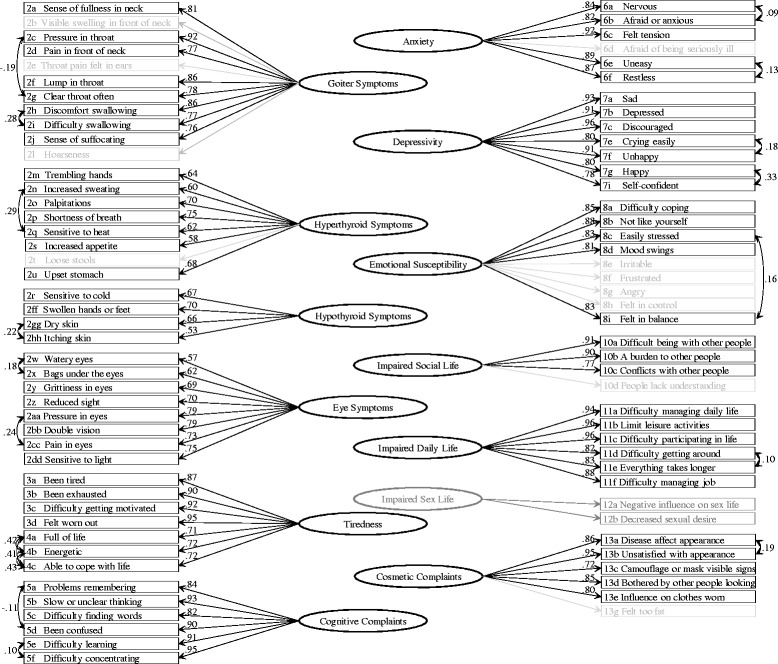
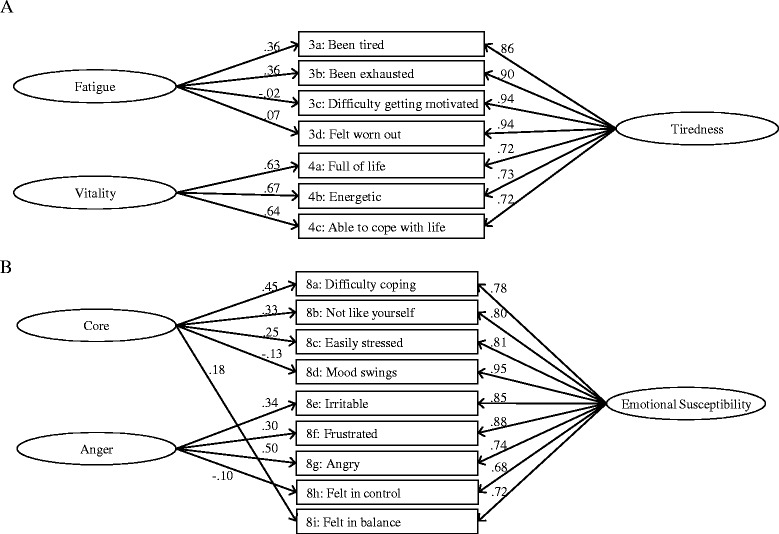
BACKGROUND AND AIM: Thyroid diseases are prevalent and chronic. With treatment, quality of life is restored in most, but not all patients. Construct validity of the thyroid-related quality of life questionnaire, ThyPRO, has been established by multi-trait scaling, but not evaluated with more elaborate methods. The purpose of the present study was to evaluate dimensionality of the ThyPRO scales and to attempt to understand possible item misfit through structural equation modeling for categorical data. METHODS: The current 85-item version of ThyPRO consists of 13 scales, covering domains of physical (4 scales) and mental (2 scales) symptoms, function and well-being (3 scales) and participation/social function (4 scales). The data were collected from a cross-sectional sample of 907 thyroid patients. One-factor confirmatory models were fitted to each scale, and evaluated by model fit statistics (comparative fit index >0.95, root mean square error of approximation <0.08), magnitude of factor loadings, model residual correlations and modification indices (MI). Indications of multi-dimensionality were tested in bi-factor models. Possible item misfit was evaluated in a combined, investigational model. RESULTS: Each ThyPRO scale was adequately represented by a unidimensional model after minor revisions. Eleven items were identified in the unidimensional models as potentially misfitting and were investigated further by multidimensional modeling. CONCLUSION: Elaborate psychometric modeling supported the construct validity of the ThyPRO. However, 11 potentially misfitting items and 18 items with local dependence to other items are candidates for removal in future item reduction processes.
Overview
The claims and statistics of this paper haven’t been checked yet.
Free: it reads the open-access text and checks the first 5 claims that cite a source we can check. Create a free account to check every claim.
Integrity signals
Registry
Cites
Statistics
Figures
Verification
Claims the paper makes
The claims and statistics of this paper haven’t been checked yet.
Free: it reads the open-access text and checks the first 5 claims that cite a source we can check. Create a free account to check every claim.
Claims other papers make about this one
Each is checked against this paper’s own text: does it say what the citing paper says it does?
The cited source says what the claim attributes to it.
In the citing paper
“Validated versions include the full 85-item ThyPRO (64,94–97) and the 39-item ThyPRO-39 scale with the 22-item ThyPRO Composite QoL scale (98).”
From Evidence-Based Use of Levothyroxine/Liothyronine Combinations in Treating Hypothyroidism: A Consensus Document (2021) · cites this paper as [96]
The cited source says what the claim attributes to it.
In the citing paper
“Validated versions include the full 85-item ThyPRO [64, 94-97] and the 39-item ThyPRO-39 scale with the 22-item ThyPRO Composite QoL scale [98].”
From Evidence-Based Use of Levothyroxine/Liothyronine Combinations in Treating Hypothyroidism: A Consensus Document (2021) · cites this paper as [96]
In the citing paper
“These thyroid-specific PROMs fulfil two important criteria: content validity (relevant and acceptable to patients and physicians) and responsiveness (detecting subtle changes over time) (21, 27–29).”
Self-check
Percentages, sums and reported differences re-computed from the paper’s own numbers.
The self-check needs the paper’s full text.
Citations
Cites
Hu, L., & Bentler, P. M. (1999) · Structural Equation Modeling A Multidisciplinary Journal · doi:10.1080/10705519909540118 · Cited by 108,788
Alternative Ways of Assessing Model Fit
Browne, M. W., & Cudeck, R. (1992) · Sociological Methods & Research · doi:10.1177/0049124192021002005 · Cited by 27,200
Comparative fit indexes in structural models.
Bentler, P. M. (1990) · Psychological Bulletin · doi:10.1037/0033-2909.107.2.238 · Cited by 25,266
Convergent and discriminant validation by the multitrait-multimethod matrix.
Campbell, D. T., & Fiske, D. W. (1959) · Psychological Bulletin · doi:10.1037/h0046016 · Cited by 17,116 · cited 1×
“However, within such a framework, it is not possible to test the overall fit of a model [14], nor can misfit of items be modeled specifically.”
BackgroundTesting Structural Equation Models.
Mueller, C. W., Bollen, K. A., & Long, J. S. (1994) · Contemporary Sociology · doi:10.2307/2074955 · Cited by 14,120
The structure of psychological well-being revisited.
Ryff, C. D., & Keyes, C. L. M. (1995) · Journal of Personality and Social Psychology · doi:10.1037//0022-3514.69.4.719 · Cited by 10,285
Structural model evaluation and modification: An interval estimation approach
Steiger, J. H. (1990) · Multivariate Behavioral Research · doi:10.1207/s15327906mbr2502_4 · Cited by 7,408 · cited 1×
“08 were regarded as appropriate fit [30-34]; 2) magnitude of factor loadings; 3) model residual correlations (RC) and 4) modification indices (MI) [28,35].”
BackgroundReporting Structural Equation Modeling and Confirmatory Factor Analysis Results: A Review
Schreiber, J. B., Nora, A., Stage, F. K., Barlow, E. A., & King, J. (2006) · The Journal of Educational Research · doi:10.3200/joer.99.6.323-338 · Cited by 6,937 · cited 1×
“08 were regarded as appropriate fit [30-34]; 2) magnitude of factor loadings; 3) model residual correlations (RC) and 4) modification indices (MI) [28,35].”
BackgroundTest Theory: A Unified Treatment
Zwick, R., & McDonald, R. P. (2000) · Journal of the American Statistical Association · doi:10.2307/2669496 · Cited by 3,603 · cited 1×
“A bifactor model specifies that each item is regressed on both a general and a group (secondary) factor, and the general and group factors are uncorrelated with each other [34,36-39].”
BackgroundWilson, I. B. (1995) · JAMA · doi:10.1001/jama.1995.03520250075037 · Cited by 3,027 · cited 1×
“Content and scale structure were derived from a literature search [8] and from expert and patient interviews [10] and the development was conducted within a classical health-related quality of life theoretical framework [22-25].”
MethodThe Colorado Thyroid Disease Prevalence Study
Canaris, G. J., Manowitz, N. R., Mayor, G., & Ridgway, E. C. (2000) · Archives of Internal Medicine · doi:10.1001/archinte.160.4.526 · Cited by 2,824 · cited 1×
“Thyroid diseases are prevalent, affecting approximately 15% of individuals of all ages, with a 4 to 1 women/men ratio [1,2].”
Background(1999) · Cited by 2,653
(1993) · Cited by 2,269
Muthén, B. (1984) · Psychometrika · doi:10.1007/bf02294210 · Cited by 1,544
Reeve, B. B., Hays, R. D., Bjorner, J. B., Cook, K. F., Crane, P. K., Teresi, J. A., Thissen, D., Revicki, D. A., Weiss, D. J., Hambleton, R. K., et al. (2007) · Medical Care · doi:10.1097/01.mlr.0000250483.85507.04 · Cited by 1,491 · cited 2×
“08 were regarded as appropriate fit [30-34]; 2) magnitude of factor loadings; 3) model residual correlations (RC) and 4) modification indices (MI) [28,35].”
BackgroundBeauducel, A., & Herzberg, P. Y. (2006) · Structural Equation Modeling: A Multidisciplinary Journal · doi:10.1207/s15328007sem1302_2 · Cited by 1,272 · cited 1×
“variance adjustment (WLSMV) [28,29].”
The epidemiology of thyroid disease
Vanderpump, M. P. J. (2011) · British Medical Bulletin · doi:10.1093/bmb/ldr030 · Cited by 1,179
Latent Variable Modeling in Heterogeneous Populations
Muthén, B. O. (1989) · Psychometrika · doi:10.1007/bf02296397 · Cited by 1,008
The role of the bifactor model in resolving dimensionality issues in health outcomes measures
Reise, S. P., Morizot, J., & Hays, R. D. (2007) · Quality of Life Research · doi:10.1007/s11136-007-9183-7 · Cited by 747 · cited 1×
“A bifactor model specifies that each item is regressed on both a general and a group (secondary) factor, and the general and group factors are uncorrelated with each other [34,36-39].”
BackgroundFull-Information Item Bi-Factor Analysis
Gibbons, R. D., & Hedeker, D. R. (1992) · Psychometrika · doi:10.1007/bf02295430 · Cited by 595 · cited 1×
“A bifactor model specifies that each item is regressed on both a general and a group (secondary) factor, and the general and group factors are uncorrelated with each other [34,36-39].”
BackgroundRosenberg's self‐esteem scale: Two factors or method effects
Tomas, J. M., & Oliver, A. (1999) · Structural Equation Modeling: A Multidisciplinary Journal · doi:10.1080/10705519909540120 · Cited by 310 · cited 1×
“Similar studies with other outcome measures have previously found substantial influence of the value of the wording [36,42-44], whereas other studies either did not identify such an effect [45] or the identified effect had only minor influence on the results regarding the substantive factor [46].”
ResultUsing structural equation modeling to detect response shifts and true change
Oort, F. J. (2005) · Quality of Life Research · doi:10.1007/s11136-004-0830-y · Cited by 289
Brown, T. A. (2003) · Behaviour Research and Therapy · doi:10.1016/s0005-7967(03)00059-7 · Cited by 274 · cited 1×
“Similar studies with other outcome measures have previously found substantial influence of the value of the wording [36,42-44], whereas other studies either did not identify such an effect [45] or the identified effect had only minor influence on the results regarding the substantive factor [46].”
ResultConceptualization and measurement of health-related quality of life: Comments on an evolving field
Ware, J. E. (2003) · Archives of Physical Medicine and Rehabilitation · doi:10.1053/apmr.2003.50246 · Cited by 256
Estimation of IRT graded response models: Limited versus full information methods.
Forero, C. G., & Maydeu-Olivares, A. (2009) · Psychological Methods · doi:10.1037/a0015825 · Cited by 233 · cited 1×
“In order to examine the stability of the model across various estimation techniques, the overall final model was compared with graded response multidimensional IRT models [40], fitted with the Mplus program [28].”
MethodQuality of life in patients with benign thyroid disorders. A review
Watt, T., Groenvold, M., Rasmussen, A. K., Bonnema, S. J., Hegedüs, L., Bjorner, J. B., & Feldt-Rasmussen, U. (2006) · European Journal of Endocrinology · doi:10.1530/eje.1.02124 · Cited by 228
Self-citationPatrick, D. L., & Chiang, Y.-P. (2000) · Medical Care · doi:10.1097/00005650-200009002-00005 · Cited by 218 · cited 1×
“Content and scale structure were derived from a literature search [8] and from expert and patient interviews [10] and the development was conducted within a classical health-related quality of life theoretical framework [22-25].”
MethodValidity and reliability of the novel thyroid-specific quality of life questionnaire, ThyPRO
Watt, T., Hegedüs, L., Groenvold, M., Bjorner, J. B., Rasmussen, Å. K., Bonnema, S. J., & Feldt-Rasmussen, U. (2010) · European Journal of Endocrinology · doi:10.1530/eje-09-0521 · Cited by 210
Self-citationTreatment for primary hypothyroidism: current approaches and future possibilities
Vaidya, B., Chakera, & Pearce (2011) · Drug Design, Development and Therapy · doi:10.2147/dddt.s12894 · Cited by 199
Wording Effects in Self-Esteem Scales: Methodological Artifact or Response Style?
Horan, P. M., DiStefano, C., & Motl, R. W. (2003) · Structural Equation Modeling: A Multidisciplinary Journal · doi:10.1207/s15328007sem1003_6 · Cited by 184
Health-related quality of life in patients with thyroid disorders
Bianchi, G. P., Zaccheroni, V., Solaroli, E., Vescini, F., Cerutti, R., Zoli, M., & Marchesini, G. (2004) · Quality of Life Research · doi:10.1023/b:qure.0000015315.35184.66 · Cited by 171 · cited 1×
“Therefore, thyroid diseases may go un-diagnosed for many years in some patients and at the time of diagnosis, most patients have reduced quality of life [3,4].”
BackgroundWainer, H., & Thissen, D. (1996) · Educational Measurement: Issues and Practice · doi:10.1111/j.1745-3992.1996.tb00803.x · Cited by 155
Long-term residual complaints and psychosocial sequelae after remission of hyperthyroidism
Fahrenfort, J. J., Wilterdink, A. M. L., & van der Veen, E. A. (2000) · Psychoneuroendocrinology · doi:10.1016/s0306-4530(99)00050-5 · Cited by 144 · cited 1×
“a substantial minority do not regain their premorbid level of well-being and function [8,9].”
BackgroundImpaired health-related quality of life in Graves' disease. A prospective study
Elberling, T., Rasmussen, A., Feldt-Rasmussen, U., Hording, M., Perrild, H., & Waldemar, G. (2004) · European Journal of Endocrinology · doi:10.1530/eje.0.1510549 · Cited by 119 · cited 2×
“Therefore, thyroid diseases may go un-diagnosed for many years in some patients and at the time of diagnosis, most patients have reduced quality of life [3,4].”
BackgroundSelf-citationWatt, T., Bjorner, J. B., Groenvold, M., Rasmussen, Å. K., Bonnema, S. J., Hegedüs, L., & Feldt-Rasmussen, U. (2009) · Quality of Life Research · doi:10.1007/s11136-009-9460-8 · Cited by 112 · cited 3×
“Further, the ThyPRO’s dimensionality or construct validity has been established by multi-trait scaling [12].”
BackgroundMethodInfluentialSelf-citationWatt, T., Hegedüs, L., Rasmussen, Å. K., Groenvold, M., Bonnema, S. J., Bjorner, J. B., & Feldt-Rasmussen, U. (2007) · Thyroid · doi:10.1089/thy.2007.0069 · Cited by 89 · cited 3×
“It is, however, an important aspect according to the patients and a prominent feature particularly among patients with thyroid autoimmunity [10].”
BackgroundMethodSelf-citationWatt, T., Rasmussen, Å. K., Grøenvold, M., Bjørner, J. B., Watt, S. K., Bonnema, S. J., Hegedűs, L. D., & Feldt‐Rasmussen, U. (2008) · Quality of Life Research · doi:10.1007/s11136-008-9364-z · Cited by 84
Self-citationThvilum, M., Brandt, F., Almind, D., Christensen, K., Hegedüs, L., & Brix, T. H. (2013) · The Journal of Clinical Endocrinology & Metabolism · doi:10.1210/jc.2012-3375 · Cited by 83 · cited 1×
“In general though, there is a lag in treatment effect for thyroid diseases of up to several months and population-based studies document excess morbidity and mortality, also when adequately treated [5,6].”
BackgroundSelf-citationBrandt, F., Almind, D., Christensen, K., Green, A., Brix, T. H., & Hegedüs, L. (2012) · The Journal of Clinical Endocrinology & Metabolism · doi:10.1210/jc.2012-2268 · Cited by 83 · cited 1×
“In general though, there is a lag in treatment effect for thyroid diseases of up to several months and population-based studies document excess morbidity and mortality, also when adequately treated [5,6].”
BackgroundSelf-citationvan de Ven, M. O. M., & Engels, R. C. M. E. (2011) · Journal of Psychosomatic Research · doi:10.1016/j.jpsychores.2011.03.002 · Cited by 76 · cited 1×
“, structural part of the models) [17-21].”
Watt, T., Hegedüs, L., Bjorner, J. B., Groenvold, M., Bonnema, S. J., Rasmussen, Å. K., & Feldt-Rasmussen, U. (2012) · European Thyroid Journal · doi:10.1159/000342623 · Cited by 75
Self-citationMishra, A., Mayilvaganan, S., Chand, G., Agarwal, G., Agarwal, A., Verma, A. K., & Mishra, S. K. (2013) · World Journal of Surgery · doi:10.1007/s00268-013-2133-3 · Cited by 71 · cited 2×
“The growing interest in applying the ThyPRO in clinical studies [7,15,16] and even in daily clinical practice has motivated efforts to develop shorter versions of the instrument as well as versions applicable to ecological momentary assessments.”
BackgroundWatt, T., Cramon, P., Bjorner, J., Bonnema, S., Feldt-Rasmussen, U., Gluud, C., Gram, J., Hansen, J., Heged�s, L., Knudsen, N., et al. (2013) · Trials · doi:10.1186/1745-6215-14-119 · Cited by 69 · cited 1×
“The growing interest in applying the ThyPRO in clinical studies [7,15,16] and even in daily clinical practice has motivated efforts to develop shorter versions of the instrument as well as versions applicable to ecological momentary assessments.”
BackgroundSelf-citationDiStefano, C., & Motl, R. W. (2009) · Structural Equation Modeling A Multidisciplinary Journal · doi:10.1080/10705510802565403 · Cited by 61 · cited 1×
“Similar studies with other outcome measures have previously found substantial influence of the value of the wording [36,42-44], whereas other studies either did not identify such an effect [45] or the identified effect had only minor influence on the results regarding the substantive factor [46].”
ResultKing‐Kallimanis, B. L., Oort, F. J., Nolte, S., Schwartz, C. E., & Sprangers, M. A. G. (2011) · Quality of Life Research · doi:10.1007/s11136-010-9844-9 · Cited by 51 · cited 1×
“, structural part of the models) [17-21].”
Annett, R. D., Turner, C., Brody, J. L., Sedillo, D., & Dalen, J. (2009) · Journal of Pediatric Psychology · doi:10.1093/jpepsy/jsp121 · Cited by 21 · cited 1×
“, structural part of the models) [17-21].”
Chen, W. J., Chen, C., Ho, C., Chou, F. H., Lee, M., Lung, F., Lin, G., Teng, C., Chung, Y., Wang, Y.-C., et al. (2010) · American Journal of Geriatric Psychiatry · doi:10.1097/jgp.0b013e3181faec0e · Cited by 17 · cited 1×
“, structural part of the models) [17-21].”
Assessing the factor structure of a role functioning item bank
Anatchkova, M., Ware, J. E., & Bjørner, J. B. (2010) · Quality of Life Research · doi:10.1007/s11136-010-9807-1 · Cited by 15 · cited 2×
“Similar studies with other outcome measures have previously found substantial influence of the value of the wording [36,42-44], whereas other studies either did not identify such an effect [45] or the identified effect had only minor influence on the results regarding the substantive factor [46].”
BackgroundResult
Research works printed but not linked: 2
- Giusti M Mortara L Cecoli F Pera G Caorsi V Minuto F Evaluation of quality of life with the ThyPRO questionnaire in patients with disease-free differentiated thyroid carcinoma EndocrRev 2012 33 3 MON-436
- Muthen B Muthen L Mplus User Guide 2010 6 Los Angeles Muthen & Muthen
Cited by
Jonklaas, J., Bianco, A. C., Cappola, A. R., Celi, F. S., Fliers, E., Heuer, H., McAninch, E. A., Moeller, L. C., Nygaard, B., Sawka, A. M., et al. (2021) · Thyroid® · doi:10.1089/thy.2020.0720 · Cited by 172
Self-citationWinther, K. H., Cramon, P., Watt, T., Bjorner, J. B., Ekholm, O., Feldt-Rasmussen, U., Groenvold, M., Rasmussen, Å. K., Hegedüs, L., & Bonnema, S. J. (2016) · PLOS ONE · doi:10.1371/journal.pone.0156925 · Cited by 152
Self-citationPrimary hypothyroidism and quality of life
Hegedüs, L., Bianco, A. C., Jonklaas, J., Pearce, S. H., Weetman, A. P., & Perros, P. (2022) · Nature Reviews Endocrinology · doi:10.1038/s41574-021-00625-8 · Cited by 144
Self-citationDevelopment of a Short Version of the Thyroid-Related Patient-Reported Outcome ThyPRO
Watt, T., Bjorner, J. B., Groenvold, M., Cramon, P., Winther, K. H., Hegedüs, L., Bonnema, S. J., Rasmussen, Å. K., Ware, J. E., & Feldt-Rasmussen, U. (2015) · Thyroid · doi:10.1089/thy.2015.0209 · Cited by 132
“Scales measuring mental and social well-being and function have previously been shown to be highly correlated (16,27) (i.e., the scales concerning Tiredness, Cognitive Complaints, Anxiety, Depressivity, Emotional Susceptibility, Impaired Social Life, Impaired Daily Life, as well as the single…”
Self-citationWong, C. K. H., Lang, B. H. H., & Lam, C. L. K. (2016) · Journal of Clinical Epidemiology · doi:10.1016/j.jclinepi.2016.03.006 · Cited by 78
Metadata
- Authors
- Watt, T., Groenvold, M., Deng, N., Gandek, B., Feldt-Rasmussen, U., Rasmussen, Å. K., Hegedüs, L., Bonnema, S. J., & Bjorner, J. B.
- Affiliations
- University of Copenhagen (DK)
- University of Massachusetts Chan Medical School (US)
- Copenhagen University Hospital (DK)
- Odense University Hospital (DK)
- Corresponding author
- Watt, Torquil
- Venue
- Health and Quality of Life Outcomes
- Published
- 2014-09-10
- Volume
- 12
- Issue
- 1
- Pages
- 126-126
- ISSN
- 1477-7525 (ISSN-L)
- PMC
- PMC4172819
- OpenAlex
- W2163546118
- Cited by
- 46
- References
- 51
- Citations by year
- 2025: 1 · 2024: 2 · 2023: 4 · 2022: 6 · 2021: 4 · 2020: 5 · 2019: 2 · 2018: 11 · 2017: 4 · 2016: 3 · 2015: 3 · 2014: 1
- FWCI
- 4.62
- Type
- journal article
- Language
- en
- Open access
- gold
- doi.org
- Locations
- Health and Quality of Life Outcomes (publishedVersion, cc-by)
- PubMed Central (publishedVersion, cc-by)
- PubMed (publishedVersion)
- University of Southern Denmark Research Portal (University of Southern Denmark) (publishedVersion)
- eScholarship@UMassChan (submittedVersion, cc-by)
- Research at the University of Copenhagen (University of Copenhagen) (submittedVersion)
- Funders
- Sundhed og Sygdom, Det Frie Forskningsråd
- Novo Nordisk
- Novo Nordisk Fonden
- Medical Research Council
- Topics
- Social Sciences › Decision Sciences › Management Science and Operations Research › Psychometric Methodologies and Testing
- Health Sciences › Medicine › Endocrinology, Diabetes and Metabolism › Thyroid Disorders and Treatments
- Health Sciences › Medicine › Surgery › Thyroid and Parathyroid Surgery
- Keywords
- thyroid dysfunction, construct validity, dimensionality, item misfit, local dependence, bifactor model, unidimensional model, scale development, patient-reported outcome measures
- MeSH terms
- Activities of Daily Living, Adult, Aged, Cross-Sectional Studies, Factor Analysis, Statistical, Female, Humans, Male, Middle Aged, Personal Satisfaction, Psychometrics, Quality of Life, Surveys and Questionnaires, Thyroid Diseases, Models, Statistical, Social Participation, Patient Outcome Assessment
About these checks
Registry, retraction, Cites and statistics results are computed, not judged, with one exception: a printed reference that no index lists is read once by a model before it counts as a citation error. Claims are extracted by a model and kept only when their quote appears verbatim in the text; each cited source is then checked, with a model’s help, for whether it says what the claim relies on. Those verdicts can be wrong — read the claim’s quote and the cited source before relying on one.
Statistics and arithmetic are recomputed, not judged.
Confidence bands are shown only for fields calibrated on our annotated test set. None is calibrated yet, so no band is shown.
What counts as a claim ›How we measure confidence ›How we check this ›
Are you an author, or do you see a problem with this page? Request a review
Data sources
Bibliographic data: Semantic Scholar, OpenAlex, Crossref.
Contains information from the Semantic Scholar Academic Graph Datasets, made available under the ODC Attribution License (ODC-BY 1.0).
Semantic Scholar’s data is described in: Kinney, R., et al. (2023). The Semantic Scholar Open Data Platform. arXiv:2301.10140.
