

Understanding polycystic ovary syndrome from the patient perspective: a concept elicitation patient interview study
Open accessThe DOI matches its Crossref record; 37 of the 38 references it cites were found in a registry or an index.
Abstract
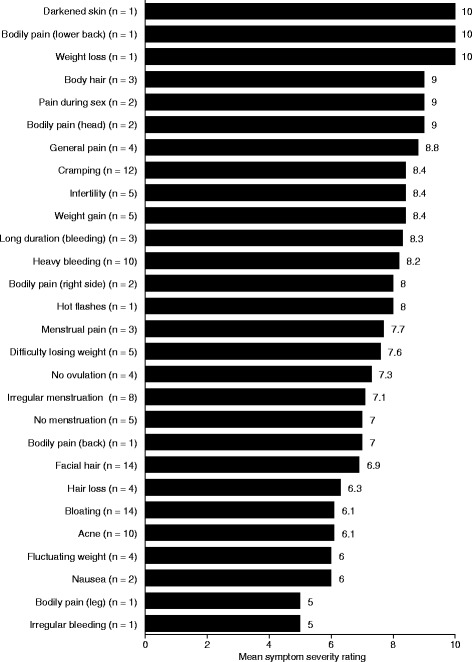
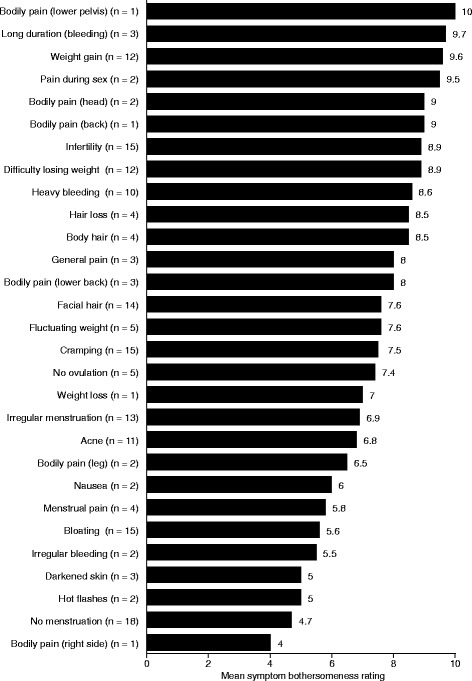
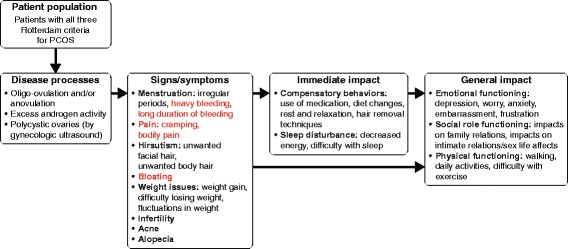
BACKGROUND: The aim of this study was to explore the need for a new disease-specific patient reported outcome (PRO) measure for use in clinical trials of drugs designed to target the underlying causes of polycystic ovary syndrome (PCOS), and in the process contribute to our understanding of the symptoms and impacts that define the patient experience with PCOS. METHODS: Semi-structured interviews were conducted in 20 women diagnosed with PCOS according to the Rotterdam criteria who had not menstruated in the previous month. The relative importance of PCOS symptoms and impact concepts to patients was determined by analyzing the frequency of their expression in the interview transcripts. These insights were compared to clinicians' perceptions of PCOS. RESULTS: Pain- and discomfort-related symptoms accounted for the highest proportion (27.6%) of the 735 patient expressions, although clinicians did not consider pain to be important to patients with PCOS. The most frequently expressed individual symptoms were cramping (70% of patients; 14.7% of concepts), irregular menstruation (95% of patients; 12.2% of concepts), facial hair growth (75% of patients; 10.6% of concepts), heavy bleeding (70% of patients; 8.8% of concepts), infertility (70% of patients; 5.4% of concepts), and bloating (60% of patients; 5.2% of concepts). Cramping, heavy bleeding, and bloating were not identified by clinicians as being important to patients with PCOS. The impacts most frequently reported by patients with PCOS related to emotional well-being (e.g. anxiety/stress) and coping behaviors (e.g. acne medication, hair removal). CONCLUSIONS: The only validated PCOS-specific PRO, the PCOSQ, does not capture some key PCOS symptoms and impacts expressed by patients with PCOS, most notably those related to pain and discomfort, bleeding intensity and coping behaviours. Furthermore, some key PCOS symptoms may be under-recognized in the clinic.
Overview
The claims and statistics of this paper haven’t been checked yet.
Free: it reads the open-access text and checks the first 5 claims that cite a source we can check. Create a free account to check every claim.
Integrity signals
Registry
Cites
Statistics
Figures
Verification
Claims the paper makes
The claims and statistics of this paper haven’t been checked yet.
Free: it reads the open-access text and checks the first 5 claims that cite a source we can check. Create a free account to check every claim.
Claims other papers make about this one
Each is checked against this paper’s own text: does it say what the citing paper says it does?
The source backs part of the claim, not all of it — or backs it for a different population, condition or comparison.
In the citing paper
“In addition, they experience decreased psychological and emotional well-being, anxiety, depression, eating disorders, negative self-image and impaired sexual function [8, 16–19].”
From Challenges in diagnosis and health care in polycystic ovary syndrome in Canada: a patient view to improve health care (2023) · cites this paper as [19]
Experimental — accuracy not yet measured
Self-check
Percentages, sums and reported differences re-computed from the paper’s own numbers.
The self-check needs the paper’s full text.
Citations
Cites
(2004) · Fertility and Sterility · doi:10.1016/j.fertnstert.2003.10.004 · Cited by 9,050
U.S. Department of Health and Human Services FDA Center for Drug Evaluation and Research, U.S. Department of Health and Human Services FDA Center for Biologics Evaluation and Research, & U.S. Department of Health and Human Services FDA Center for Devices and Radiological Health (2006) · Health and Quality of Life Outcomes · doi:10.1186/1477-7525-4-79 · Cited by 2,856
The Prevalence and Features of the Polycystic Ovary Syndrome in an Unselected Population
Azziz, R., Woods, K. S., Reyna, R., Key, T. J., Knochenhauer, E. S., & Yildiz, B. O. (2004) · The Journal of Clinical Endocrinology & Metabolism · doi:10.1210/jc.2003-032046 · Cited by 2,712
March, W. A., Moore, V. M., Willson, K. J., Phillips, D. I. W., Norman, R. J., & Davies, M. J. (2010) · Human Reproduction · doi:10.1093/humrep/dep399 · Cited by 1,799 · cited 1×
“Background Polycystic ovary syndrome (PCOS) is one of the most common endocrine disorders in women, with prevalence estimates of 4–8% reported among those of reproductive age [1–4], although underdiagnosis means that the true prevalence may be much higher [5].”
BackgroundTeede, H., Deeks, A., & Moran, L. (2010) · BMC Medicine · doi:10.1186/1741-7015-8-41 · Cited by 1,565 · cited 1×
“broadly based on its reproductive (hyperandrogenism, hirsutism, ovulatory and menstrual dysfunction, infertility), metabolic (increased type 2 diabetes and cardiovascular risks), and psychological (anxiety, depression, negative body image) consequences [19].”
Knochenhauer, E. S., Key, T. J., Kahsar-Miller, M., Waggoner, W., Boots, L. R., & Azziz, R. (1998) · The Journal of Clinical Endocrinology & Metabolism · doi:10.1210/jcem.83.9.5090 · Cited by 1,516
Asunción, M., Calvo, R. M., San Millán, J. L., Sancho, J., Avila, S., & Escobar-Morreale, H. F. (2000) · The Journal of Clinical Endocrinology & Metabolism · doi:10.1210/jcem.85.7.6682 · Cited by 1,318
Diamanti‐Kandarakis, E., Kouli, C., Bergiele, A. T., Filandra, F. A., Tsianateli, T. C., Spina, G., Zapanti, E. D., & Bartzis, M. I. (1999) · The Journal of Clinical Endocrinology & Metabolism · doi:10.1210/jc.84.11.4006 · Cited by 1,110
Patrick, D. L., Burke, L. B., Gwaltney, C. J., Leidy, N. K., Martin, M. L., Molsen, E., & Ring, L. (2011) · Value in Health · doi:10.1016/j.jval.2011.06.014 · Cited by 1,095 · cited 1×
“This work was initiated with the goal of developing a PCOS-specific PRO with demonstrable content-validity for use in clinical trials of AZD4901, in line with industry best-practice [28].”
MethodSelf-citation‘The thief of womanhood’: women's experience of polycystic ovarian syndrome
Kitzinger, C., & Willmott, J. (2002) · Social Science & Medicine · doi:10.1016/s0277-9536(01)00034-x · Cited by 392
Quality of life and psychological well being in polycystic ovary syndrome
Barnard, L., Ferriday, D., Guenther, N., Strauss, B., Balen, A. H., & Dye, L. (2007) · Human Reproduction · doi:10.1093/humrep/dem108 · Cited by 388 · cited 1×
“The most widely used disease-specific patient reported outcome (PRO) instrument available for PCOS is the Polycystic Ovary Syndrome Health-Related Quality of Life Questionnaire (PCOSQ) [20], of which a modified version also exists [21], as well as several languagespecific adaptations [22–25].”
MethodClinical and psychological correlates of quality-of-life in polycystic ovary syndrome
Hahn, S., Janssen, O. E., Tan, S., Pleger, K., Mann, K., Schedlowski, M., Kimmig, R., Benson, S., Balamitsa, E., & Elsenbruch, S. (2005) · European Journal of Endocrinology · doi:10.1530/eje.1.02024 · Cited by 387 · cited 2×
“The second most predominant impact was compensatory behaviors, which was also highlighted by clinicians as a key impact of PCOS and has also been described as a key theme in qualitative studies [9, 18].”
BackgroundVgontzas, A. N., Legro, R. S., Bixler, E. O., Grayev, A., Kales, A., & Chrousos, G. P. (2001) · The Journal of Clinical Endocrinology & Metabolism · doi:10.1210/jcem.86.2.7185 · Cited by 371
Cronin, L., Guyatt, G., Griffith, L., Wong, E., Azziz, R., Futterweit, W., Cook, D., & Dunaif, A. (1998) · The Journal of Clinical Endocrinology & Metabolism · doi:10.1210/jcem.83.6.4990 · Cited by 314 · cited 13×
“Health-related quality of life questionnaire for polycystic ovary syndrome (PCOSQ-50): development and psychometric properties.”
MethodInfluentialFogel, R. B., Malhotra, A., Pillar, G., Pittman, S. D., Dunaif, A., & White, D. P. (2001) · The Journal of Clinical Endocrinology & Metabolism · doi:10.1210/jcem.86.3.7316 · Cited by 274
Molecular progress in infertility: polycystic ovary syndrome
Legro, R. S., & Strauss, J. F. (2002) · Fertility and Sterility · doi:10.1016/s0015-0282(02)03275-2 · Cited by 180
Gopal, M., Duntley, S. P., Uhles, M., & Attarian, H. P. (2002) · Sleep Medicine · doi:10.1016/s1389-9457(02)00033-3 · Cited by 163
Health-related quality of life among adolescents with polycystic ovary syndrome
Jones, G. L., Hall, J. M., Lashen, H. L., Balen, A. H., & Ledger, W. L. (2011) · Journal of Obstetric, Gynecologic & Neonatal Nursing · doi:10.1111/j.1552-6909.2011.01279.x · Cited by 124 · cited 1×
“Other qualitative interview studies have identified pain in various forms as being part of the patient experience with PCOS, including bodily, abdominal, pelvic or belly pain [8, 10, 12, 15], sexual pain [8] and headaches [10].”
BackgroundThe Lived Experience of Women Diagnosed With Polycystic Ovary Syndrome
Snyder, B. S. (2006) · Journal of Obstetric, Gynecologic & Neonatal Nursing · doi:10.1111/j.1552-6909.2006.00047.x · Cited by 116
Vgontzas, A. N., Legro, R. S., Bixler, E. O., Grayev, A., Kales, A., & Chrousos, G. P. (2001) · Obstetric and Gynecologic Survey · doi:10.1097/00006254-200107000-00017 · Cited by 80
“It Is Always on My Mind”: Women's Experiences of Their Bodies When Living With Hirsutism
Ekbäck, M., Wijma, K., & Benzein, E. (2009) · Health Care for Women International · doi:10.1080/07399330902785133 · Cited by 77
Young women's experiences living with polycystic ovary syndrome
Weiss, T. R., & Bulmer, S. M. (2011) · Journal of Obstetric, Gynecologic & Neonatal Nursing · doi:10.1111/j.1552-6909.2011.01299.x · Cited by 73
Nurse‐led peer support group: experiences of women with polycystic ovary syndrome
Percy, C. A., Gibbs, T., Potter, L., & Boardman, S. (2009) · Journal of Advanced Nursing · doi:10.1111/j.1365-2648.2009.05061.x · Cited by 71
Managing Polycystic Ovary Syndrome: What Our Patients Are Telling Us
Crete, J., & Adamshick, P. (2011) · Journal of Holistic Nursing · doi:10.1177/0898010111398660 · Cited by 61 · cited 1×
“Other qualitative interview studies have identified pain in various forms as being part of the patient experience with PCOS, including bodily, abdominal, pelvic or belly pain [8, 10, 12, 15], sexual pain [8] and headaches [10].”
BackgroundThe Experience of Women Affected by Polycystic Ovary Syndrome: A Qualitative Study From Iran
Nasiri Amiri, F., Ramezani Tehrani, F., Simbar, M., Montazeri, A., & Mohammadpour Thamtan, R. A. (2014) · International Journal of Endocrinology and Metabolism · doi:10.5812/ijem.13612 · Cited by 58 · cited 1×
“Other qualitative interview studies have identified pain in various forms as being part of the patient experience with PCOS, including bodily, abdominal, pelvic or belly pain [8, 10, 12, 15], sexual pain [8] and headaches [10].”
BackgroundHashimoto, D. M., Schmid, J., Martins, F. M., Fonseca, A. M., Andrade, L. H. B., Kirchengast, S., & Eggers, S. (2003) · Anthropologischer Anzeiger · doi:10.1127/anthranz/61/2003/297 · Cited by 56
Hadjiconstantinou, M., Mani, H., Patel, N., Levy, M., Davies, M., Khunti, K., & Stone, M. (2017) · Endocrine Connections · doi:10.1530/ec-17-0053 · Cited by 55 · cited 1×
“The second most predominant impact was compensatory behaviors, which was also highlighted by clinicians as a key impact of PCOS and has also been described as a key theme in qualitative studies [9, 18].”
BackgroundAmiri, F. N., Tehrani, F. R., Simbar, M., Montazeri, A., & Mohammadpour, R. A. (2016) · Quality of Life Research · doi:10.1007/s11136-016-1232-7 · Cited by 52 · cited 1×
“Pain items are also not included in PCOSQ-50, which was recently developed based on interviews with Iranian women [30].”
BackgroundMalik-Aslam, A., Reaney, M. D., & Speight, J. (2010) · Value in Health · doi:10.1111/j.1524-4733.2010.00696.x · Cited by 45 · cited 1×
“Finally, the ability of this instrument to detect treatment-related change varies in the literature and a minimal clinically important difference has not been established [27].”
BackgroundHealth-related quality of life in Iranian women with polycystic ovary syndrome: a qualitative study
Taghavi, S. A., Bazarganipour, F., Hugh-Jones, S., & Hosseini, N. (2015) · BMC Women's Health · doi:10.1186/s12905-015-0272-4 · Cited by 38 · cited 1×
“Other qualitative interview studies have identified pain in various forms as being part of the patient experience with PCOS, including bodily, abdominal, pelvic or belly pain [8, 10, 12, 15], sexual pain [8] and headaches [10].”
BackgroundBazarganipour, F., Ziaei, S., Montazeri, A., Foroozanfard, F., & Faghihzadeh, S. (2013) · Europe PMC (PubMed Central) · Cited by 37
Billhult, A., & Stener‐Victorin, E. (2012) · BMC Complementary and Alternative Medicine · doi:10.1186/1472-6882-12-32 · Cited by 30
Ou, H., Wu, M., Lin, C., & Chen, P.-C. (2015) · PLoS ONE · doi:10.1371/journal.pone.0137772 · Cited by 29
Pfister, G., & Rømer, K. (2017) · Health Care for Women International · doi:10.1080/07399332.2016.1236108 · Cited by 29
Jedel, E., Kowalski, J. H., & Stener‐Victorin, E. (2008) · Acta Obstetricia Et Gynecologica Scandinavica · doi:10.1080/00016340802444762 · Cited by 28
Practice patterns of screening for sleep apnea in physicians treating PCOS patients
Subramanian, S., Desai, A. D., Joshipura, M., & Surani, S. (2007) · Sleep And Breathing · doi:10.1007/s11325-007-0120-3 · Cited by 26
Ovarian steroids modulate neuroendocrine dysfunction in polycystic ovary syndrome
Doi, S. A. R., Al-Zaid, M., Towers, P. A., Scott, C. J., & Al-Shoumer, K. A. S. (2005) · Journal of Endocrinological Investigation · doi:10.1007/bf03345319 · Cited by 26
Cited by
Determinants of Quality of Life and Satisfaction with Life in Women with Polycystic Ovary Syndrome
Rzońca, E., Bień, A., Wdowiak, A., Szymański, R., & Iwanowicz-Palus, G. (2018) · International Journal of Environmental Research and Public Health · doi:10.3390/ijerph15020376 · Cited by 59
“PCOS is a disease with a complex symptomatology and diverse clinical presentations, which significantly affects the patients’ life and functioning [2,3,8].”
BackgroundSydora, B. C., Wilke, M. S., McPherson, M., Chambers, S., Ghosh, M., & Vine, D. F. (2023) · BMC Women's Health · doi:10.1186/s12905-023-02732-2 · Cited by 60
“” prompt referral to specialists 26 [19.0] ◦ “I think that there should be faster referrals to OB’s or GYN’S for any reproductive issue.”
BackgroundInfluentialWright, P. J., Dawson, R. M., & Corbett, C. F. (2020) · Journal of Advanced Nursing · doi:10.1111/jan.14371 · Cited by 53
Ismayilova, M., & Yaya, S. (2022) · BMC Women's Health · doi:10.1186/s12905-022-01734-w · Cited by 40
“, pain was the most common concern for patients which clinicians did not consider to be important) [38].”
Naz, M. S. G., Tehrani, F. R., Behroozi-Lak, T., Mohammadzadeh, F., Nasiri, M., Badr, F. K., & Ozgoli, G. (2020) · Psychology Research and Behavior Management · doi:10.2147/prbm.s241192 · Cited by 47
“The experience of PCOS women reveals that the discomfort related to menstrual abnormality should be considered as a part of patient-reported outcome measures.(38) Depression in adolescence period is a threat throughout the developmental phases of adolescence life.”
Background
Metadata
- Authors
- Martin, M. L., Halling, K., Eek, D., Krohe, M., & Paty, J.
- Affiliations
- AstraZeneca (Sweden) (SE)
- IQVIA (United States) (US)
- Corresponding author
- Martin, Mona L.
- Venue
- Health and Quality of Life Outcomes
- Published
- 2017-08-18
- Volume
- 15
- Issue
- 1
- Pages
- 162-162
- ISSN
- 1477-7525 (ISSN-L)
- PMC
- PMC5562990
- OpenAlex
- W2747646757
- Cited by
- 40
- References
- 38
- Citations by year
- 2026: 7 · 2025: 4 · 2024: 9 · 2023: 2 · 2022: 8 · 2021: 5 · 2020: 3 · 2018: 2
- FWCI
- 1.59
- Type
- journal article
- Language
- en
- Open access
- gold
- doi.org
- Licence
- cc-by
- Locations
- Health and Quality of Life Outcomes (publishedVersion, cc-by)
- Europe PMC (PubMed Central) (publishedVersion, cc-by)
- PubMed Central (publishedVersion, cc-by)
- PubMed (publishedVersion)
- DOAJ (DOAJ: Directory of Open Access Journals) (submittedVersion)
- Funders
- AstraZeneca
- Topics
- Health Sciences › Medicine › Reproductive Medicine › Ovarian function and disorders
- Health Sciences › Medicine › Reproductive Medicine › Reproductive Health and Technologies
- Health Sciences › Medicine › Reproductive Medicine › Endometriosis Research and Treatment
- Keywords
- polycystic ovary syndrome, patient-reported outcome measures, patient experience, PCOS symptoms, symptom burden, menstrual irregularity, menorrhagia, infertility, hirsutism, pain and discomfort, coping behaviour, emotional well-being, concept elicitation
- MeSH terms
- Patient Reported Outcome Measures, Adult, Female, Humans, Interviews as Topic, Menstruation Disturbances, Pain, Polycystic Ovary Syndrome, Quality of Life, Qualitative Research, Young Adult
About these checks
Registry, retraction, Cites and statistics results are computed, not judged, with one exception: a printed reference that no index lists is read once by a model before it counts as a citation error. Claims are extracted by a model and kept only when their quote appears verbatim in the text; each cited source is then checked, with a model’s help, for whether it says what the claim relies on. Those verdicts can be wrong — read the claim’s quote and the cited source before relying on one.
Statistics and arithmetic are recomputed, not judged.
Confidence bands are shown only for fields calibrated on our annotated test set. None is calibrated yet, so no band is shown.
What counts as a claim ›How we measure confidence ›How we check this ›
Are you an author, or do you see a problem with this page? Request a review
Data sources
Bibliographic data: Semantic Scholar, OpenAlex, Crossref.
Contains information from the Semantic Scholar Academic Graph Datasets, made available under the ODC Attribution License (ODC-BY 1.0).
Semantic Scholar’s data is described in: Kinney, R., et al. (2023). The Semantic Scholar Open Data Platform. arXiv:2301.10140.
