

The DOI matches its Crossref record; 78 of the 91 references it cites were found in a registry or an index.
Quality of life assessment instruments for adults: a systematic review of population-based studies
Open accessAbstract
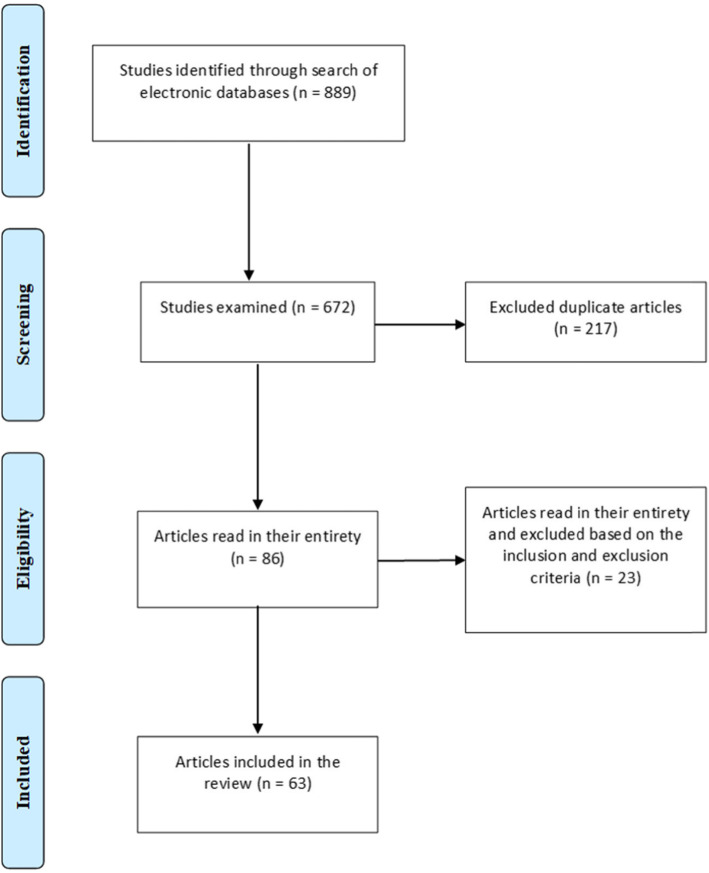
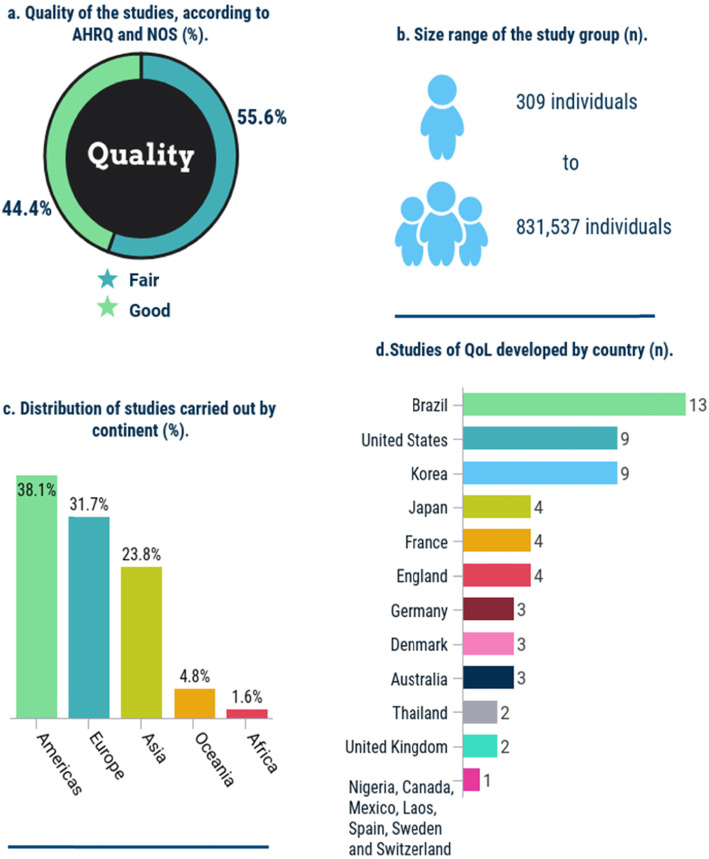
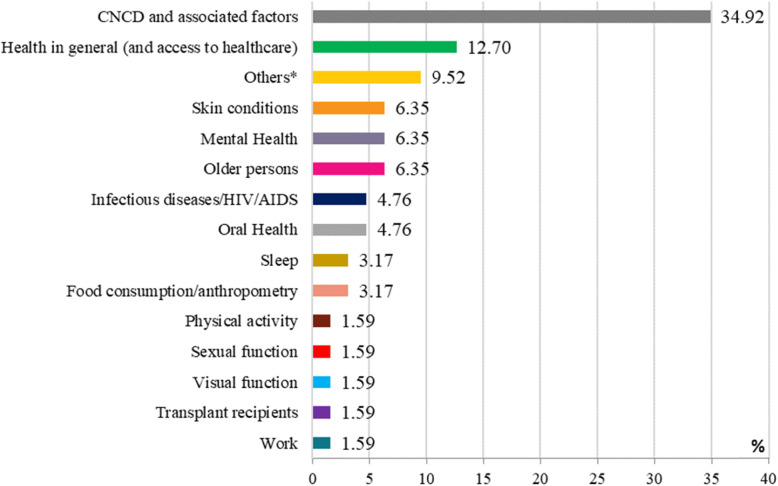
Background: Against a backdrop of population aging and improving survival rates for chronic noncommunicable diseases (CNCD), researchers are placing growing emphasis on health-related quality of life (HRQoL). The aim of this study was to identify the QoL assessment instruments used in population-based studies with adults conducted around the world. Methods: A systematic review of original research published in all languages between 2008 and 2018 was conducted. Systematic reviews and meta-analyses were excluded. Results: Sixty-three articles (38.1% conducted in the Americas) fitted the eligibility criteria. Based on the AHRQ checklist for cross-sectional studies and the Newcastle-Ottawa scale for cohort studies, methodological quality was shown to be fair in the majority of studies (55.6%) and good in 44.4%. The country with the highest number of publications was Brazil (20.6%). Twelve types of generic instruments and 11 specific instruments were identified. The generic instrument SF-36 was the most frequently used measure (33.3% of studies). In-home interviewing was exclusively used by 47.6% of the studies, while 39 studies (61.9%) reported the use of self-administered questionnaires. Over two-thirds of the studies (34.9%) used questionnaires to investigate the association between chronic diseases and/or associated factors. Conclusions: It was concluded that the wide range of instruments and modes of questionnaire administration used by the studies may hinder comparisons between population groups with the same characteristics or needs. There is a lack of research on QoL and the factors affecting productive capacity. Studies of QoL in older persons should focus not only on the effects of disease and treatment, but also on the determinants of active aging and actions designed to promote it. Further research is recommended to determine which QoL instruments are best suited for population-based studies.
Overview
The claims and statistics of this paper haven’t been checked yet.
Run the check — free, no account needed. It reads the open-access text and checks the sources it cites.
Integrity signals
Registry
Cites
Statistics
Figures
Verification
Claims the paper makes
The claims and statistics of this paper haven’t been checked yet.
Run the check — free, no account needed. It reads the open-access text and checks the sources it cites.
Claims other papers make about this one
Each is checked against this paper’s own text: does it say what the citing paper says it does?
The cited source says what the claim attributes to it.
In the citing paper
“Measures of quality of life are praised to be multi-dimensional and broadly applicable, but are often criticized for not being sensitive to specific aspects of quality of life for different health conditions (Pequeno et al., 2020).”
From A Systematic Review and Meta-Analysis Exploring Effects of Third-Wave Psychological Therapies on Hearing-Related Distress, Depression, Anxiety, and Quality of Life in People With Audiological Problems. (2022) · cites this paper as Pequeno et al., 2020
Self-check
Percentages, sums and reported differences re-computed from the paper’s own numbers.
The self-check needs the paper’s full text.
Citations
Cites
van der Togt, H. (2003) · Journal of Network and Computer Applications · doi:10.1016/s1084-8045(02)00061-9 · Cited by 302,642
PRISMA-P Group, Moher, D., Shamseer, L., Clarke, M., Ghersi, D., Liberati, A., Petticrew, M., Shekelle, P., & Stewart, L. A. (2015) · Systematic Reviews · doi:10.1186/2046-4053-4-1 · Cited by 26,223
The Whoqol Group (1998) · Social Science & Medicine · doi:10.1016/s0277-9536(98)00009-4 · Cited by 3,802
Measuring Health-Related Quality of Life
Guyatt, G., Feeny, D., & Patrick, D. (1993) · Annals of Internal Medicine · doi:10.7326/0003-4819-118-8-199304150-00009 · Cited by 2,168
Conceptual Model of Health‐Related Quality of Life
Ferrans, C. E., Zerwic, J. J., Wilbur, J. E., & Larson, J. L. (2005) · Journal of Nursing Scholarship · doi:10.1111/j.1547-5069.2005.00058.x · Cited by 1,069
A Comparative Review of Generic Quality-of-Life Instruments
Coons, S. J., Rao, S. R., Keininger, D. L., & Hays, R. D. (2000) · PharmacoEconomics · doi:10.2165/00019053-200017010-00002 · Cited by 834
Physical activity and health related quality of life
Anokye, N., Trueman, P., Green, C., Pavey, T., & Taylor, R. S. (2012) · BMC Public Health · doi:10.1186/1471-2458-12-624 · Cited by 379
Chronic pain and other sequelae in long-term breast cancer survivors: nationwide survey in Denmark.
Peuckmann, V., Ekholm, O., Rasmussen, N. K., Groenvold, M., Christiansen, P., Møller, S., Eriksen, J., & Sjøgren, P. (2009) · European Journal of Pain · doi:10.1016/j.ejpain.2008.05.015 · Cited by 264
Muehlhausen, W., Doll, H., Quadri, N., Fordham, B., O'Donohoe, P., Dogar, N., & Wild, D. (2015) · Health and Quality of Life Outcomes · doi:10.1186/s12955-015-0362-x · Cited by 259
Mújica-Mota, R., Roberts, M. J., Abel, G., Elliott, M. N., Lyratzopoulos, G., Roland, M. O., & Campbell, J. (2014) · Quality of Life Research · doi:10.1007/s11136-014-0820-7 · Cited by 244
Masood, M., Newton, T., Bakri, N. N., Khalid, T., & Masood, Y. (2017) · E -journal of dentistry · doi:10.1016/j.jdent.2016.11.002 · Cited by 179
Prevalence of Psoriasis Among Adults in the U.S.
Helmick, C. G., Lee-Han, H., Hirsch, S. C., Baird, T. L., & Bartlett, C. L. (2014) · American Journal of Preventive Medicine · doi:10.1016/j.amepre.2014.02.012 · Cited by 170
Patient-reported Outcomes in a French Nationwide Survey of Inflammatory Bowel Disease Patients
Williet, N., Sarter, H., Gower‐Rousseau, C., Adrianjafy, C., Olympie, A., Buisson, A., Beaugerie, L., & Peyrin‐Biroulet, L. (2016) · Journal of Crohn s and Colitis · doi:10.1093/ecco-jcc/jjw145 · Cited by 162
Huang, C.-J., Hu, H.-T., Fan, Y.-C., Liao, Y.-M., & Tsai, P.-S. (2010) · International Journal of Obesity · doi:10.1038/ijo.2009.285 · Cited by 157
Health related quality of life among the elderly: a population-based study using SF-36 survey
Lima, M. G., Barros, M. B. D. A., César, C. L. G., Goldbaum, M., Carandina, L., & Ciconelli, R. M. (2009) · Cadernos de Saúde Pública · doi:10.1590/s0102-311x2009001000007 · Cited by 150
Hypoactive Sexual Desire Disorder in Postmenopausal Women: Quality of Life and Health Burden
Biddle, A. K., West, S. L., D’Aloisio, A. A., Wheeler, S. B., Borisov, N. N., & Thorp, J. M. (2009) · Value in Health · doi:10.1111/j.1524-4733.2008.00483.x · Cited by 141
Park, B., Kim, S. Y., Shin, J., Sanson‐Fisher, R., Shin, D. W., Cho, J., & Park, J. H. (2013) · Supportive Care in Cancer · doi:10.1007/s00520-013-1852-1 · Cited by 138
Cho, S. J., Hong, J. P., Hahm, B., Jeon, H. J., Chang, S. M., Cho, M. J., & Lee, H. B. (2009) · SLEEP · doi:10.1093/sleep/32.8.1069 · Cited by 125 · cited 3×
“Korean Epidemiological Catchment Area – KECA-R [25]”
Gentile, S., Beauger, D., Speyer, É., Jouve, É., Dussol, B., Jacquelinet, C., & Briançon, S. (2013) · Health and Quality of Life Outcomes · doi:10.1186/1477-7525-11-88 · Cited by 104
Kim, Y., & Lee, E. (2019) · Health and Quality of Life Outcomes · doi:10.1186/s12955-019-1191-0 · Cited by 102
Chen, X., Gelaye, B., & Williams, M. A. (2014) · Quality of Life Research · doi:10.1007/s11136-013-0475-9 · Cited by 99
Cruz, L., Fleck, M. P. D. A., Oliveira, M. R., Camey, S., Hoffmann, J. F., Bagattini, Â., & Polanczyk, C. (2013) · Ciência & Saúde Coletiva · doi:10.1590/s1413-81232013000700006 · Cited by 87
Parslow, R., Lewis, V. J., & Nay, R. (2011) · Journal of the American Geriatrics Society · doi:10.1111/j.1532-5415.2011.03665.x · Cited by 87
Impacto da doença crônica na qualidade de vida de idosos da comunidade em São Paulo (SP, Brasil)
Campolina, A. G., Dini, P. S., & Ciconelli, R. M. (2011) · doi:10.1590/s1413-81232011000600029 · Cited by 79
Almeida-Brasil, C., Silveira, M. R., Silva, K. R., Lima, M. G., Faria, C. D. C. D. M., Cardoso, C. L., Menzel, H., & das Graças, B. C. M. (2017) · Ciência & Saúde Coletiva · doi:10.1590/1413-81232017225.20362015 · Cited by 77
Rawsthorne, P. E., Clara, I. P., Graff, L. A., Bernstein, K. I., Carr, R., Walker, J. R., Ediger, J. P., Rogala, L., Miller, N., & Bernstein, C. N. (2011) · Gut · doi:10.1136/gutjnl-2011-300219 · Cited by 66
Park, J. H., Hong, J., Han, K., Suh, S.-W., Park, S.-Y., Yang, J. H., & Han, S.-W. (2017) · Medicine · doi:10.1097/md.0000000000006372 · Cited by 66
The Burden of Illness for Patients with Viral Hepatitis C: Evidence from a National Survey in Japan
Liu, G. G., DiBonaventura, M., Yuan, Y., Wagner, J.-S., L'Italien, G. J., Langley, P. C., & Kamae, I. (2012) · Value in Health · doi:10.1016/j.jval.2011.11.012 · Cited by 65
Thomas, G. P. A., Saunders, C. L., Roland, M. O., & Paddison, C. A. M. (2015) · BMC Family Practice · doi:10.1186/s12875-015-0277-y · Cited by 65
Social networks and health-related quality of life: a population based study among older adults
Gallegos-Carrillo, K., Mudgal, J., Sánchez‐García, S., Wagner, F. A., Gallo, J. J., Salmerón, J., & García‐Peña, C. (2009) · Salud Pública de México · doi:10.1590/s0036-36342009000100004 · Cited by 62
Peuckmann‐Post, V., Ekholm, O., Sjøgren, P., Rasmussen, N. K., Christiansen, P., Möller, S., & Grøenvold, M. (2008) · European Journal of Cancer · doi:10.1016/j.ejca.2008.09.027 · Cited by 60
[The impact of risk factors of non-communicable chronic diseases on quality of life].
Oliveira-Campos, M., Rodrigues-neto, J., Silveira, M. F., Neves, D., Vilhena, J. M., Oliveira, J., Magalhães, J. C., & Drumond, D. (2013) · Ciência & Saúde Coletiva · doi:10.1590/s1413-81232013000800033 · Cited by 55 · cited 5×
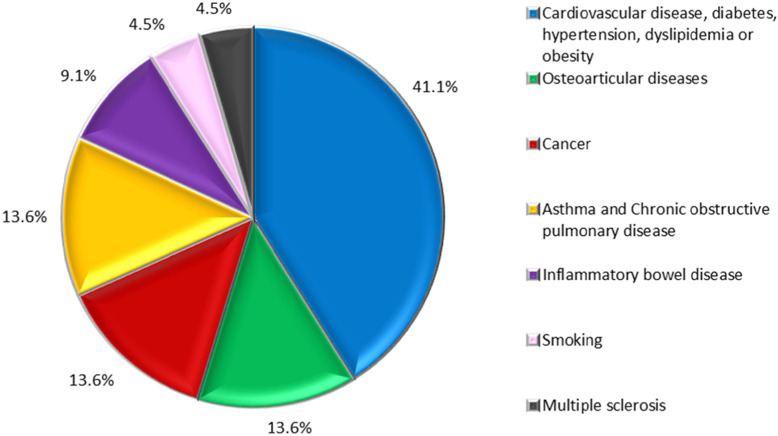
“Of the 22 studies that investigated the association between QoL and CNCDs, 41,1% addressed cardiovascular disease, diabetes, hypertension, dyslipidemia, and/or obesity [11, 15, 31, 55, 57, 59, 62, 64, 67] (Fig.”
BackgroundInfluentialLuthy, C., Cedraschi, C., Allaz, A., Herrmann, F. R., & Ludwig, C. (2014) · Quality of Life Research · doi:10.1007/s11136-014-0894-2 · Cited by 54
Cross-Sectional Survey of Workload and Burnout Among Japanese Physicians Working in Stroke Care
Nishimura, K., Nakamura, F., Takegami, M., Fukuhara, S., Nakagawara, J., Ogasawara, K., Ono, J., Shiokawa, Y., Miyachi, S., Nagata, I., et al. (2014) · Circulation Cardiovascular Quality and Outcomes · doi:10.1161/circoutcomes.113.000159 · Cited by 53
Burden of Visual Impairment and Chronic Diseases.
Park, S., Ahn, S., & Park, K. (2016) · JAMA ophthalmology · doi:10.1001/jamaophthalmol.2016.1158 · Cited by 53
Cordasco, K., Mengeling, M., Yano, E., & Washington, D. L. (2016) · Journal of Rural Health · doi:10.1111/jrh.12197 · Cited by 49
Bingefors, K., Lindberg, M., & Isacson, D. (2011) · Acta Dermato-Venereologica · doi:10.2340/00015555-1111 · Cited by 49
Quality of psoriasis care in Germany: results of the national health care study “PsoHealth3”
Langenbruch, A., Radtke, M., Jacobi, A., Purwins, S., Haack, K., Reich, K., Stroemer, K., Mrowietz, U., & Augustin, M. (2016) · Archives of Dermatological Research · doi:10.1007/s00403-016-1651-x · Cited by 46
Vagetti, G., Moreira, N. B., Barbosa, V., de Oliveira, V., Cancian, C. F., Mazzardo, O., & de Campos, W. (2013) · doi:10.1590/s1413-81232013001200005 · Cited by 43
Audureau, E., Pouchot, J., & Coste, J. (2016) · Circulation. Cardiovascular Quality and Outcomes · doi:10.1161/circoutcomes.115.002127 · Cited by 41
de Queiroz, F. A., Pace, A. E., & dos Santos, C. B. (2009) · Revista Latino-Americana de Enfermagem · doi:10.1590/s0104-11692009000500018 · Cited by 41
Fernández‐Mayoralas, G., Giráldez‐García, C., Forjaz, M. J., Rojo‐Pérez, F., Martínez‐Martín, P., & Prieto-Flores, M.-E. (2011) · International Psychogeriatrics · doi:10.1017/s1041610211002018 · Cited by 38
Revisão sistemática dos estudos sobre qualidade de vida indexados na base de dados SciELO
Landeiro, G. M. B., Pedrozo, C. C. R., Gomes, M., & Oliveira, E. R. D. A. (2011) · doi:10.1590/s1413-81232011001100031 · Cited by 36
Wu, R. C., Thorpe, K., Ross, H., Micevski, V., Marquez, C., & Straus, S. (2009) · Journal of Medical Internet Research · doi:10.2196/jmir.1106 · Cited by 36 · cited 1×
“However, for online administration of questionnaires to provide results that are equally valid as pen-and-paper administration, each questionnaire should be validated for internet administration [79].”
BackgroundNoronha, D. D., Martins, A. M. E. D. B. L., Dias, D. D. S., Silveira, M. F., de Paula, A. M. B., & Haikal, D. S. (2016) · Ciência & Saúde Coletiva · doi:10.1590/1413-81232015212.01102015 · Cited by 35
Kim, M., Kim, J., & Won, C. W. (2018) · Experimental Gerontology · doi:10.1016/j.exger.2018.02.027 · Cited by 33
Schunk, M., Reitmeir, P., Schipf, S., Völzke, H., Meisinger, C., Ladwig, K.-H., Kluttig, A., Greiser, K. H., Berger, K., Müller, G., et al. (2015) · Journal of Diabetes and its Complications · doi:10.1016/j.jdiacomp.2014.11.010 · Cited by 31
Douab, T., Marcellin, F., Vilotitch, A., Protopopescu, C., Préau, M., Suzan-Monti, M., Sagaon-Teyssier, L., Lert, F., Carrieri, M., Dray-Spira, R., et al. (2014) · AIDS Care · doi:10.1080/09540121.2014.906553 · Cited by 31
Beauger, D., Gentile, S., Jouve, E., Dussol, B., Jacquelinet, C., & Briançon, S. (2013) · Health and Quality of Life Outcomes · doi:10.1186/1477-7525-11-148 · Cited by 30
Health-related quality of life and comorbidity among older women veterans in the United States
Der-Martirosian, C., Cordasco, K., & Washington, D. L. (2013) · Quality of Life Research · doi:10.1007/s11136-013-0424-7 · Cited by 30
Dhamane, A., Witt, E., & Su, J. (2016) · Journal of Occupational and Environmental Medicine · doi:10.1097/jom.0000000000000735 · Cited by 29
The Impact of Symptoms and Impairments on Overall Health in US National Health Data
Stewart, S. T., Woodward, R. M., Rosen, A. B., & Cutler, D. (2008) · Medical Care · doi:10.1097/mlr.0b013e318179199f · Cited by 29
Hoopman, R., Terwee, C., Devillé, W., Knol, D., & Aaronson, N. (2009) · Quality of Life Research · doi:10.1007/s11136-009-9491-1 · Cited by 26
Kim, H. J., Lee, J., Kim, T., & Lee, J. (2015) · Health and Quality of Life Outcomes · doi:10.1186/s12955-015-0245-1 · Cited by 25
Contextual and individual determinants of oral health-related quality of life in older Brazilians
Souza, J. G. S., Oliveira, B. E. C., & Martins, A. M. E. D. B. L. (2017) · Quality of Life Research · doi:10.1007/s11136-016-1447-7 · Cited by 25
Silqueira, S. M. D. F. (2005) · doi:10.11606/t.22.2005.tde-17052007-160822 · Cited by 25
Tran, H., Mahdi, A. M., Sivasubramaniam, S., Gudlavalleti, M. V. S., Gilbert, C., Shah, S. P., Ezelum, C., Abubakar, T., & Bankole, O. (2011) · British Journal of Ophthalmology · doi:10.1136/bjo.2011.204693 · Cited by 24
Neil, A., Carr, V., Mackinnon, A., Foley, D., & Morgan, V. (2018) · Value in Health · doi:10.1016/j.jval.2018.02.012 · Cited by 22
Influence of Knee Pain and Low Back Pain on the Quality of Life in Adults Older Than 50 Years of Age
Kim, W., Jin, Y., Lee, C.-S., Bin, S.-I., Lee, S. Y., & Choi, K. (2015) · PM & R : the journal of injury, function, and rehabilitation · doi:10.1016/j.pmrj.2015.03.002 · Cited by 22
Langenbruch, A., Radtke, M., & Augustin, M. (2012) · EJD. European journal of dermatology · doi:10.1684/ejd.2012.1740 · Cited by 22
Vietri, J., Otsubo, T., Montgomery, W., Tsuji, T., & Harada, E. (2015) · Neuropsychiatric Disease and Treatment · doi:10.2147/ndt.s71768 · Cited by 20
Patterns of Chronic Conditions and Their Associations With Behaviors and Quality of Life, 2010.
Barile, J. P., Mitchell, S. A., Thompson, W., Zack, M. M., Reeve, B. B., Cella, D. F., & Smith, A. W. (2015) · PubMed Central · doi:10.5888/pcd12.150179 · Cited by 19 · cited 13×
“Instruments used to measure health-related QoL (HRQoL) generally contain questions divided into groups (domains or components) and are designed to assess specific problems that limit health and well-being [11].”
BackgroundInfluentialRasmussen, S. L., Rejnmark, L., Ebbehøj, E., Feldt‐Rasmussen, U., Rasmussen, Å. K., Bjørner, J. B., & Watt, T. (2016) · European Thyroid Journal · doi:10.1159/000443609 · Cited by 18
Backes, V., Olinto, M. T. A., Henn, R., Cremonese, C., & Pattussi, M. P. (2011) · Cadernos de Saúde Pública · doi:10.1590/s0102-311x2011000300017 · Cited by 18
Flor, L. S., Campos, M. R., & Laguardia, J. (2013) · Revista Brasileira de Epidemiologia · doi:10.1590/s1415-790x2013000300018 · Cited by 18
Broering, J. M., Paciorek, A. T., Carroll, P. R., Wilson, L., Litwin, M. S., & Miaskowski, C. A. (2013) · Quality of Life Research · doi:10.1007/s11136-013-0493-7 · Cited by 17
Quality of life among the Brazilian adult population using the generic SF-8 questionnaire.
Campolina, A., Pinheiro, M., Ciconelli, R., & Ferraz, M. (2011) · Cadernos de Saúde Pública · doi:10.1590/s0102-311x2011000600009 · Cited by 17
Asthma-specific health-related quality of life of people in Great Britain: A national survey
Upton, J., Lewis, C., Humphreys, E., Price, D., & Walker, S. (2016) · Journal of Asthma · doi:10.3109/02770903.2016.1166383 · Cited by 16
Madsen, U. R., Groenvold, M., Petersen, M., & Johnsen, A. T. (2015) · Quality of Life Research · doi:10.1007/s11136-015-0962-2 · Cited by 15
Mishra, G. D., Black, S., Stafford, M., Cooper, R., Kuh, D. J., & for the National Survey of Health and Development scientific and data collection team (2014) · PLoS ONE · doi:10.1371/journal.pone.0088524 · Cited by 14
Health related quality of life in relation to asthma – Data from a cross sectional study
Chung, J.-H., & Han, C. H. (2018) · Journal of Asthma · doi:10.1080/02770903.2017.1387266 · Cited by 14 · cited 2×
“The most commonly used instruments were the Medical Outcomes Study Short-Form 36 (MOS SF-36), found in 21 publications [8, 13, 15, 16, 18, 21, 30, 33, 36, 45, 48– 50, 52–54, 59–63], EuroQol EQ-5D, used by 17 studies [12, 20, 25, 26, 32, 35, 38–41, 51, 55, 57, 64–67], 12Item Short-Form Health Survey (SF-12), found in 1…”
MethodHong, J.-Y., Han, K., Shin, D., & Chun, E. (2016) · PLoS ONE · doi:10.1371/journal.pone.0151315 · Cited by 10 · cited 1×
“The most commonly used instruments were the Medical Outcomes Study Short-Form 36 (MOS SF-36), found in 21 publications [8, 13, 15, 16, 18, 21, 30, 33, 36, 45, 48– 50, 52–54, 59–63], EuroQol EQ-5D, used by 17 studies [12, 20, 25, 26, 32, 35, 38–41, 51, 55, 57, 64–67], 12Item Short-Form Health Survey (SF-12), found in 1…”
MethodWill improving access to dental care improve oral health-related quality of life?
Crocombe, L. A., Mahoney, G., Spencer, A., & Waller, M. (2013) · Australian dental journal · doi:10.1111/adj.12060 · Cited by 9
The impact of heavy drinkers on others’ health and well-being in Lao PDR and Thailand
Jankhotkaew, J., Chaiyasong, S., Waleewong, O., Siengsounthone, L., Sengngam, K., Douangvichit, D., & Thamarangsi, T. (2017) · doi:10.1080/14659891.2017.1296037 · Cited by 8
Ser trabalhadora remunerada ou dona de casa associa-se à qualidade de vida relacionada à saúde?
Senicato, C., Lima, M., & Barros, M. B. D. A. (2016) · doi:10.1590/0102-311x00085415 · Cited by 8
Marques, L. P., Schneider, I. J. C., & d'Orsi, E. (2016) · Cadernos de Saúde Pública · doi:10.1590/0102-311x00143615 · Cited by 8
Comportamentos relacionados a saúde e qualidade de vida em idosos: um estudo de base populacional
Lima, M., Barros, M. B. D. A., Cesar, C. L. G., Goldbaum, M., Carandina, L., & Alves, M. C. G. P. (2011) · Revista de Saúde Pública · doi:10.1590/s0034-89102011000300006 · Cited by 7
Cinoto, R., Berezovsky, A., Belfort, R., & Salomão, S. R. (2006) · doi:10.1590/s0004-27492006000100004 · Cited by 7
Research works printed but not linked: 7
- AHRQ. Agency for Healthcare Research and Quality. Newcastle-Ottawa Quality Assessment Form for Cohort Studies. Available at: https://www.ncbi.nlm.nih.gov/books/NBK115843/bin/appe-fm3.pdf.
- Cichy KE, et al. Non-vocational health-related correlates of quality of life for older adults living with multiple sclerosis. J Rehabil. 2016;82(3):36–44.
- El Khoury AC, Vietri J, Prajapati G. Health-related quality of life in patients with hepatitis C virus infection in Brazil. Rev Panam Salud Publica. 2014;35(3):200–6.
- Pavão A, Ploubidis G, Werneck G, Campos M, Werneck G, Rodrigues Campos M. Racial Discrimination and health in Brazil: evidence from a population-based survey. Ethn Dis. 2012;22:353–9.
- Kim Y, Cho W-K. Factors associated with successful smoking cessation in Korean adult males: findings from a National Survey. Iran J Public Health. 2014;43(11):1486–96.
- Lima MG. Barros, M.B.d.A. and Alves MCGP, Rio. Sllep Duration And Health Status Self-Assessment in the elderly 2012;28(9):1674–1684. · DOI
- Gomes JRAA, Hamann EM, Gutierrez MMU. Aplicação do WHOQOL-BREF em segmento da comunidade como subsídio para ações de promoção da saúde. Rev Bras Epidemiol. 2014:495–516. · DOI
Cited by
Sorted by citations
Impact of Covid-19 on health-related quality of life of patients: A structured review
Poudel, A. N., Zhu, S., Cooper, N. J., Roderick, P. J., Alwan, N. A., Tarrant, C., Ziauddeen, N., & Yao, G. (2021) · PLoS ONE · doi:10.1371/journal.pone.0259164 · Cited by 279
“SF-36 (36-item Short-Form Health Survey), SF-6D (Short-Form 6 Dimension) derived from the SF-36, and EQ-5D (EuroQol- 5 Dimension)) are widely used to assess multi-dimensional domains of the health and well-being of different populations [15].”
MethodThe rates and factors of perceived insufficient milk supply: A systematic review
Huang, Y., Liu, Y., Yu, X.-Y., & Zeng, T.-Y. (2021) · Maternal and Child Nutrition · doi:10.1111/mcn.13255 · Cited by 132
Reliability and Validity of the Turkish Version of SF-12 Health Survey.
Soylu, C., & Kütük, B. (2022) · Turk psikiyatri dergisi = Turkish journal of psychiatry · doi:10.5080/u25700 · Cited by 127
“Another systematic review of 63 studies using generic measurement tools to assess quality of life among adults in the general population pointed out that 33.3% of the research had used the SF-36 (Pequeno et al. 2020).”
BackgroundMethodInfluentialLatent profile analysis for quality of life in older patients
Băjenaru, L., Balog, A., Dobre, C., Drăghici, R., & Prada, G. I. (2022) · BMC Geriatrics · doi:10.1186/s12877-022-03518-1 · Cited by 105
Jin, Y., Sha, S., Tian, T., Wang, Q., Liang, S., Wang, Z., Liu, Y., Cheung, T. C. C., Su, Z., Ng, C. H., et al. (2022) · Journal of Affective Disorders · doi:10.1016/j.jad.2022.06.051 · Cited by 95
“various factors such as physical and psychological health, social relationships, educational level, employment, sense of security and others (Pequeno et al., 2020; The WHOQOL Group, 1998).”
Metadata
- Authors
- Pequeno, N. P. F., Cabral, N. L. D. A., Marchioni, D. M., Lima, S. C. V. C., & Lyra, C. D. O.
- Affiliations
- Universidade Federal do Rio Grande do Norte (BR)
- Universidade de São Paulo (BR)
- Corresponding author
- Pequeno, Nila Patrícia Freire
- ORCID
- Venue
- Health and Quality of Life Outcomes
- Published
- 2020-06-30
- Volume
- 18
- Issue
- 1
- Pages
- 208-208
- ISSN
- 1477-7525 (ISSN-L)
- PMC
- PMC7329518
- OpenAlex
- W3039908902
- Cited by
- 252
- References
- 91
- Citations by year
- 2026: 30 · 2025: 43 · 2024: 60 · 2023: 50 · 2022: 44 · 2021: 23 · 2020: 2
- FWCI
- 4.84
- Type
- journal article
- Language
- en
- Open access
- gold
- doi.org
- Locations
- Health and Quality of Life Outcomes (publishedVersion, cc-by)
- PubMed Central (publishedVersion, cc-by)
- PubMed (publishedVersion)
- LA Referencia (Red Federada de Repositorios Institucionales de Publicaciones Científicas) (publishedVersion, cc-by)
- LA Referencia (Red Federada de Repositorios Institucionales de Publicaciones Científicas) (publishedVersion, other-oa)
- DOAJ (DOAJ: Directory of Open Access Journals) (submittedVersion, cc-by-sa)
- Funders
- Postgraduate Program in Public Health at Federal University of Rio Grande do Norte (23077.014305/2019-29)
- Coordenação de Aperfeiçoamento de Pessoal de Nível Superior (Finance Code 001)
- Topics
- Social Sciences › Economics, Econometrics and Finance › Economics and Econometrics › Health Systems, Economic Evaluations, Quality of Life
- Health Sciences › Nursing › Research and Theory › Health Education and Validation
- Health Sciences › Medicine › Public Health, Environmental and Occupational Health › Aging, Health, and Disability
- Keywords
- health-related quality of life, quality of life instruments, population-based study, adults, SF-36, questionnaire administration mode, non-communicable diseases, active ageing, older adults, methodological quality
- MeSH terms
- Adult, Aged, Aged, 80 and over, Cross-Sectional Studies, Female, Humans, Male, Psychometrics, Quality of Life, Surveys and Questionnaires
About these checks
Registry, retraction, Cites and statistics results are computed, not judged, with one exception: a printed reference that no index lists is read once by a model before it counts as a citation error. Claims are extracted by a model and kept only when their quote appears verbatim in the text; each cited source is then checked, with a model’s help, for whether it says what the claim relies on. Those verdicts can be wrong — read the claim’s quote and the cited source before relying on one.
Statistics and arithmetic are recomputed, not judged.
Confidence bands are shown only for fields calibrated on our annotated test set. None is calibrated yet, so no band is shown.
What counts as a claim ›How we measure confidence ›How we check this ›
Are you an author, or do you see a problem with this page? Request a review
