

Efficacy, safety and recurrence of new progestins and selective progesterone receptor modulator for the treatment of endometriosis: a comparison study in mice
Open accessThe DOI matches its Crossref record; 79 of the 80 references it cites were found in a registry or an index.
Abstract
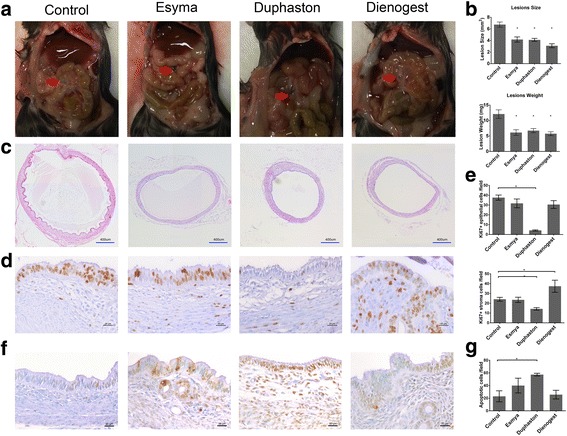
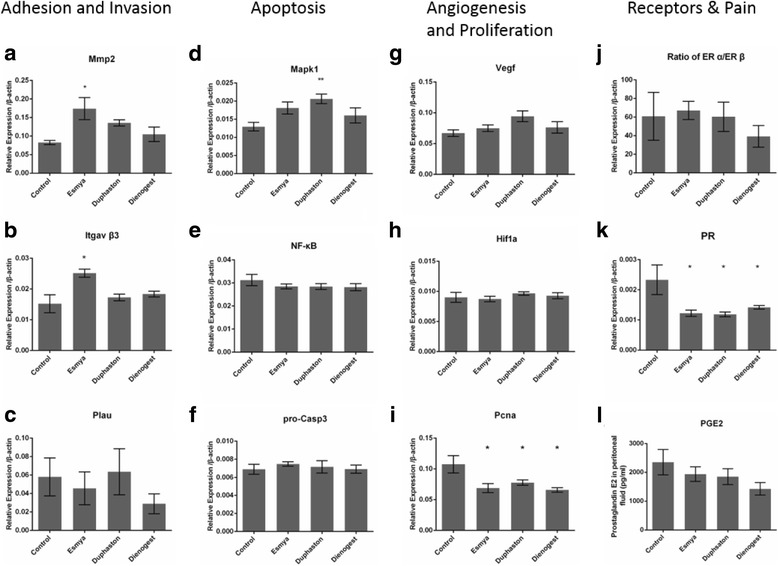
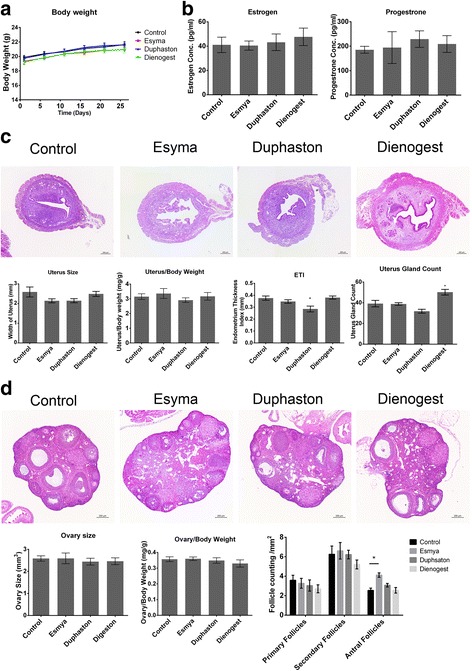
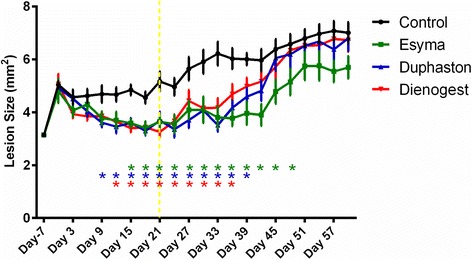
BACKGROUND: Current medical treatments for endometriosis are very limited. Progestin and selective progesterone receptor modulators (SPRM) are developed but their efficacy, safety, mechanism and recurrence in endometriosis are not fully studied. METHODS: In order to compare therapeutic, side effects and therapeutic actions of Esmya, Duphaston and Dienogest in endometriosis. Experimental endometriosis was induced by either intraperitoneal or subcutaneous mouse endometrium transplantation. Lesion size, weight and histology at the end of intervention were compared. Expression of related markers in the endometriotic lesions were examined. Body, uterus and ovary weights, endometrial glands and thickness (ETI), and follicle count were measured. For recurrent study, lesion growth before and after intervention was monitored. RESULTS: After Esmya, Duphaston, Dienogest treatment, lesion size and weight were significantly decreased. Proliferation Pcna expression was significantly decreased in all groups, but proliferation cells were significantly decreased only in Duphaston group. Apoptosis Mapk1 expression and TUNEL-positive cells were significantly increased in Duphaston group. Adhesion Mmp2 and Itgavβ3 expression were significantly increased in Esmya group. Plau, Hif1α and Vegfa expression, peritoneal fluid PGE2 levels, and ERα and ERβ expression were not affected; while PR expression was significantly lower in all groups. Endometrial gland count in uterus was significantly increased in Dienogest group, ETI was significantly decreased in Duphaston group, and AFC were significantly increased in Esmya group. Upon treatment cessation, lesion growth rebound quickly in Dienogest and Duphaston groups, but slowly in Esmya group. CONCLUSION: Esmya, Duphaston and Dienogest are effective anti-endometriosis drugs targeting proliferation, apoptosis and adhesion. Esmya, Duphaston and Dienogest are all well tolerable, although endometrial glandular hyperplasia was found in Dienogest, endometrial atrophy in Duphaston, follicle accumulation in Esmya.
Overview
The claims and statistics of this paper haven’t been checked yet.
Free: it reads the open-access text and checks the first 5 claims that cite a source we can check. Create a free account to check every claim.
Integrity signals
Registry
Cites
Statistics
Figures
Verification
Claims the paper makes
The claims and statistics of this paper haven’t been checked yet.
Free: it reads the open-access text and checks the first 5 claims that cite a source we can check. Create a free account to check every claim.
Claims other papers make about this one
Each is checked against this paper’s own text: does it say what the citing paper says it does?
The source backs part of the claim, not all of it — or backs it for a different population, condition or comparison.
In the citing paper
“UPA decreases lesion size, attenuates cell proliferation, and induces apoptosis in murine endometriosis models (Huniadi et al., 2013;Liang et al., 2018).”
From Endometriosis and nuclear receptors (2019) · cites this paper as Liang et al., 2018
Experimental — accuracy not yet measured
Self-check
Percentages, sums and reported differences re-computed from the paper’s own numbers.
The self-check needs the paper’s full text.
Citations
Cites
The Ki-67 protein: From the known and the unknown
Scholzen, T., & Gerdes, J. (2000) · Journal of Cellular Physiology · doi:10.1002/(sici)1097-4652(200003)182:3<311::aid-jcp1>3.0.co;2-9 · Cited by 4,646 · cited 1×
“Although cells proliferation markers Pcna and Ki67 specifically correlated with each other [55, 56], Ki67 positive cells in endometriotic lesions were significantly decreased in Duphaston group only.”
BackgroundThe ImageJ ecosystem: An open platform for biomedical image analysis
Schindelin, J., Rueden, C. T., Hiner, M. C., & Eliceiri, K. W. (2015) · Molecular Reproduction and Development · doi:10.1002/mrd.22489 · Cited by 2,636 · cited 1×
“Briefly, the area of endometrium (Ae) and uterus cavity (Auc) was measured using Image J [44].”
MethodSampson, J. A. (1927) · American Journal of Obstetrics and Gynecology · doi:10.1016/s0002-9378(15)30003-x · Cited by 2,334 · cited 1×
“characteristics of endometriotic lesions [4, 7].”
ESHRE guideline: management of women with endometriosis
Dunselman, G. A. J., Vermeulen, N., Becker, C., Calhaz-Jorge, C., D'Hooghe, T., De Bie, B., Heikinheimo, O., Horne, A. W., Kiesel, L., Nap, A., et al. (2014) · Human Reproduction · doi:10.1093/humrep/det457 · Cited by 2,211 · cited 1×
“Current available treatment of endometriosis, including removal surgery and hormonal medication [11], are still not ideal for reproductive women who would like to preserve their fecundity without any side-effect and recurrence.”
BackgroundPCNA, the Maestro of the Replication Fork
Moldovan, G.-L., Pfander, B., & Jentsch, S. (2007) · Cell · doi:10.1016/j.cell.2007.05.003 · Cited by 1,796 · cited 1×
“Although cells proliferation markers Pcna and Ki67 specifically correlated with each other [55, 56], Ki67 positive cells in endometriotic lesions were significantly decreased in Duphaston group only.”
BackgroundHall, P. A., Levison, D. A., Woods, A. L., Yu, C. C. ‐., Kellock, D. B., Watkins, J. A., Barnes, D. M., Gillett, C. E., Camplejohn, R., Dover, R., et al. (1990) · The Journal of Pathology · doi:10.1002/path.1711620403 · Cited by 1,438 · cited 1×
“Proliferating cell nuclear antigen (Pcna) is a protein associated with cell proliferation [42].”
BackgroundMitogen-activated protein kinases in apoptosis regulation
Wada, T., & Penninger, J. M. (2004) · Oncogene · doi:10.1038/sj.onc.1207556 · Cited by 1,432 · cited 1×
“Unlike caspase related apoptosis, Mapks involved in the pathophysiological process of endometrium decidualisation [52] and upregulated NF-κB p105 [53, 54].”
Background(1927) · PubMed Central · Cited by 1,008
Manual Hematoxylin and Eosin Staining of Mouse Tissue Sections
Cardiff, R. D., Miller, C. H., & Munn, R. J. (2014) · Cold Spring Harbor Protocols · doi:10.1101/pdb.prot073411 · Cited by 922 · cited 1×
“every 10th section to confirm the microscopic structures in the lesions, uterus and ovary [34].”
BackgroundBcl-2 prolongs cell survival after Bax-induced release of cytochrome c
Rossé, T., Olivier, R., Monney, L., Rager, M., Conus, S., Fellay, I., Jansen, B., & Borner, C. (1998) · Nature · doi:10.1038/35160 · Cited by 870 · cited 1×
“It has been shown that ulipristal acetate increased Bax/Bcl-2 ratio and cytochrome c expression [50] which activated capase-3 and increased apoptosis in the endometriotic lesions [51].”
Background
Research works printed but not linked: 1
- Rockville Guidance for industry: estimating the maximum safe starting dose in initial clinical trials for therapeutics in adult healthy volunteers Center for Drug Evaluation and Research (CDER) 2005
Cited by
Endometriosis and nuclear receptors
Yilmaz, B. D., & Bulun, S. E. (2019) · Human Reproduction Update · doi:10.1093/humupd/dmz005 · Cited by 243
“UPA decreases lesion size, attenuates cell proliferation, and induces apoptosis in murine endometriosis models (Huniadi et al., 2013; Liang et al., 2018).”
BackgroundReis, F. M., Coutinho, L. M., Vannuccini, S., Batteux, F., Chapron, C., & Petraglia, F. (2020) · Human Reproduction Update · doi:10.1093/humupd/dmaa009 · Cited by 166
“and development of endometriotic implants in mice (Liang et al., 2018).”
BackgroundInfluentialSelective Progesterone Receptor Modulators—Mechanisms and Therapeutic Utility
Islam, M. S., Afrin, S., Jones, S. I., & Segars, J. (2020) · Endocrine Reviews · doi:10.1210/endrev/bnaa012 · Cited by 143
“The antiendometriosis effect of UPA has been reported in female Wistar albino rats (329) and female C57BL/6 mice (330).”
BackgroundNew Therapeutics in Endometriosis: A Review of Hormonal, Non-Hormonal, and Non-Coding RNA Treatments
Brichant, G., Laraki, I., Henry, L., Munaut, C., & Nisolle, M. (2021) · International Journal of Molecular Sciences · doi:10.3390/ijms221910498 · Cited by 113
The role of mitogen‐activated protein kinase signaling pathway in endometriosis
Bora, G., & Yaba, A. (2021) · Journal of obstetrics and gynaecology research · doi:10.1111/jog.14710 · Cited by 80
Giacomini, E., Minetto, S., Piani, L. L., Pagliardini, L., Somigliana, E., & Viganò, P. (2021) · International Journal of Molecular Sciences · doi:10.3390/ijms22169033 · Cited by 76
“In particular, hyperactivation of the MAPK pathways is thought to suppress progesterone receptor activity via proteasome-dependent degradation, impairing endometrial decidualization and increasing the establishment of ectopic endometrial implants [50].”
BackgroundEndometriosis and Uterine Fibroids (Leiomyomata): Comorbidity, Risks and Implications
Uimari, O., Nazri, H. M., & Tapmeier, T. T. (2021) · Frontiers in Reproductive Health · doi:10.3389/frph.2021.750018 · Cited by 59
Caruso, S., Cianci, A., Iraci, M., Panella, M. M., Caruso, G., & Cianci, S. (2022) · BMC Women s Health · doi:10.1186/s12905-022-01737-7 · Cited by 40
“In fact, progestins and combined hormonal contraceptives do not eliminate endometriotic lesions but induce their quiescence [35].”
BackgroundMelatonin in Endometriosis: Mechanistic Understanding and Clinical Insight
Li, Y., Hung, S. W., Zhang, R., Man, G. C. W., Zhang, T., Chung, J. P. W., Fang, L., & Wang, C. C. (2022) · Nutrients · doi:10.3390/nu14194087 · Cited by 40
Self-citationZhang, T., Gao, X., Luo, X. G., Li, L., Ma, M., Zhu, Y., Zhao, L., & Li, R. (2019) · Chemico-Biological Interactions · doi:10.1016/j.cbi.2019.108792 · Cited by 39
Nuñez‐Badinez, P., Leo, B. D., Laux‐Biehlmann, A., Hoffmann, A., Zollner, T. M., Saunders, P. T. K., Simitsidellis, I., Charrua, A., Cruz, F., Gómez, R., et al. (2021) · Pain · doi:10.1097/j.pain.0000000000002248 · Cited by 36
Niu, X., Luo, Q., Wang, C., Zhu, L. J., & Huang, L. (2021) · Medicine · doi:10.1097/md.0000000000024597 · Cited by 27
“However, upon treatment cessation, lesion growth rebound in all the 3 groups.([20]) Furthermore, the LNG-IUS is an effective treatment for adenomyosis and endometriosis particularly on dysmenorrhea and heavy menstrual bleeding.”
BackgroundSelf-citationHe, Y., Hung, S. W., Liang, B., Zhang, R., Gao, Y., Chu, C. Y., Zhang, T., Xu, H., Chung, J. P. W., & Wang, C. C. (2021) · Frontiers in Immunology · doi:10.3389/fimmu.2021.641206 · Cited by 24
Self-citationResearch progress of dydrogesterone in the treatment of endometriosis
Tang, W., Zhu, X., Bian, L., & Zhang, B. (2024) · European Journal of Obstetrics & Gynecology and Reproductive Biology · doi:10.1016/j.ejogrb.2024.02.034 · Cited by 21
Baicalein Is a Phytohormone that Signals Through the Progesterone and Glucocorticoid Receptors
Austin, J. R., Kirkpatrick, B. J., Rodríguez, R. R., Johnson, M. E., Lantvit, D. D., & Burdette, J. E. (2020) · Hormones and Cancer · doi:10.1007/s12672-020-00382-6 · Cited by 19
Male-biased zebrafish sex differentiation and metabolomics profile changes caused by dydrogesterone
Jiang, Y., Shi, W., Ma, D.-D., Zhang, J., Ying, G., Zhang, H., & Ong, C. N. (2019) · Aquatic Toxicology · doi:10.1016/j.aquatox.2019.105242 · Cited by 15
Xie, L., Zhong, Y., Chen, Y., Wang, Y., Xian, P., Liu, S., Xin, X., Chen, Y., Guan, Y., & Li, K. (2024) · Phytomedicine · doi:10.1016/j.phymed.2024.156227 · Cited by 14
Progesterone receptor ligands for the treatment of endometriosis
Clemenza, S., Capezzuoli, T., Eren, E., GARCIA, J. M. G., Vannuccini, S., & Petraglia, F. (2022) · Minerva Obstetrics and Gynecology · doi:10.23736/s2724-606x.22.05157-0 · Cited by 13
Evaluation and Medical Management of Chronic Pelvic Pain
Carey, E. T., & McClurg, A. B. (2023) · Seminars in Interventional Radiology · doi:10.1055/s-0043-1770715 · Cited by 12
Burns, K. A., Peterse, D., Appleyard, C. B., Chandler, R. L., Guo, S., Pearson, A. M., Persoons, E., Anglesio, M. S., Rogers, M. S., Sharpe-Timms, K. L., et al. (2025) · Molecular Human Reproduction · doi:10.1093/molehr/gaaf021 · Cited by 13
“Lesion size/volume has been shown to increase over time in the homologous mouse model (Duan et al. , 2018), mainly due to oestrogen-driven epithelial proliferation (Burns et al. , 2012; Liang et al. , 2018; Dorning et al. , 2021).”
The Flavonoid Baicalein Negatively Regulates Progesterone Target Genes in the Uterus in Vivo
Li, K., Diakite, D., Austin, J. R., Lee, J.-H., Lantvit, D. D., Murphy, B. T., & Burdette, J. E. (2021) · Journal of Natural Products · doi:10.1021/acs.jnatprod.1c01008 · Cited by 11
Endometriosis: impact on fertility and pregnancy outcomes
Gabidullina, R. I., Артуровна, К. Е., Николаевна, Ш. Т., Анатольевич, М. Е., Нурсаидовна, К. Г., & Игоревна, К. А. (2021) · GYNECOLOGY · doi:10.26442/20795696.2021.1.200477 · Cited by 10
Harvey, M. E., Shi, M., Oh, Y., Page, T. M., Mitchell, D., Luo, A., Slayden, O. D., MacLean, J. A., Sharma, A., & Hayashi, K. (2026) · Journal of Clinical Investigation · doi:10.1172/jci194136 · Cited by 9
“Based on previous studies in the mouse model of endometriosis (60, 61), a dose of 1 mg/kg/b.w. oral administration was selected for this study.”
Thieffry, C., Wynendaele, M. V., Samain, L., Tyteca, D., Pierreux, C. E., Marbaix, É., & Henriet, P. (2022) · The Journal of Steroid Biochemistry and Molecular Biology · doi:10.1016/j.jsbmb.2022.106153 · Cited by 9
Sophonsritsuk, A., Tantanavipas, S., Tingthanatikul, Y., Lertvikool, S., Dittharot, K., & Waiyaput, W. (2021) · Journal of Family & Reproductive Health · doi:10.18502/jfrh.v15i1.6077 · Cited by 8
“Similar to Minami et al and Miyashita et al, Bo et al demonstrated that the progestin Duphaston decreased the proliferation of isolated endometriotic cells in the mouse model of endometriosis (24).”
ResultNon-invasive diagnosis and non-surgical treatment of endometriosis: A review
Podzolkova, N. M., Fadeev, I. E., Евгеньевна, М. Е., Poletova, T. N., Вячеславовна, С. Л., & Denisova, T. V. (2022) · GYNECOLOGY · doi:10.26442/20795696.2022.3.201508 · Cited by 8
Chen, M., Wang, L., Chen, Y., Wang, T., Jiang, G., & Chen, Q. (2025) · Frontiers in Medicine · doi:10.3389/fmed.2025.1641982 · Cited by 7
Pharmacological Management of Endometriosis-related Pain: The Expert Opinion
Олеговна, Д. С., Berlim, Y. D., Bezhenar, V. F., Станиславович, Г. В., & Baranov, I. I. (2021) · Journal of South Asian Federation of Obstetrics and Gynaecology · doi:10.5005/jp-journals-10006-1838 · Cited by 7
An integrated approach to the treatment of pelvic pain associated with adenomyosis
Татарчук, Т. Ф., Kaluginа, L. V., Danylova, A. О., & Pavlova, K. S. (2021) · Reproductive Endocrinology · doi:10.18370/2309-4117.2021.59.53-60 · Cited by 5
Liu, W., Shen, J., You, J., Wang, T., Yang, P., Miao, Y., Peng, X., Yu, Y., Liu, C., Li, A., et al. (2025) · Materials Today Bio · doi:10.1016/j.mtbio.2025.102041 · Cited by 4
“The reduction in ROS and inflammation, through a synergistic effect, may enhance the efficacy of dydrogesterone, potentially allowing for a lower dosage and mitigating its side effects [56 – 59].”
Redaktsiia (2018) · Russian Journal of Human Reproduction · doi:10.17116/repro20182405141 · Cited by 4
Endometriosis - Recent Advances, New Perspectives and Treatments
Gonçalves, G. (2021) · IntechOpen eBooks · doi:10.5772/intechopen.95742 · Cited by 2
Matrix Metalloproteinases as Biomarkers of Endometriosis and the Role of Progesterone Receptors
Singh, B. (2019) · Biomedical Journal of Scientific & Technical Research · doi:10.26717/bjstr.2019.21.003636 · Cited by 2
“All of these drugs have controversial usage and recurrence of endometriosis after use of these drugs were not studied before this experiment [12].”
BackgroundMethodRussu, M. C. (2022) · IntechOpen eBooks · doi:10.5772/intechopen.100039 · Cited by 2
Sima, R., Albu, D. N., Ionescu, A. C., Dimitriu, M. C. T., Popescu, M., Tomescu, D. R., Chicea, R., Ceauşu, I., Iordache, I.-I., Poenaru, M. O., et al. (2019) · Revista de Chimie · doi:10.37358/rc.19.4.7158 · Cited by 1
Progestin Selectivity in Clinical Applications
Arab, H. (2024) · IntechOpen eBooks · doi:10.5772/intechopen.1004820 · Cited by 1
Rai, S. K., Kumar, R., Khan, M. I., & Kumar, A. (2026) · Obstetrics and Gynecology International · doi:10.1155/ogi/5464578 · Cited by 1
“The dosage of each medication for the mice was based on the FDA-approvedclinicaldoseforhumanandthenconvertedtoanimaldose according to the guidelines of the FDA calculator based on the surface area of humans and experimental animals [22, 23].”
Endometrial Stem Cells and Endometriosis
Canosa, S., Carosso, A. R., Sestero, M., Revelli, A., & Bussolati, B. (2022) · Stem cell biology and regenerative medicine · doi:10.1007/978-3-030-90111-0_8 · Cited by 1
Progestogens and Endometriosis
Zolti, M., & Carp, H. (2021) · Springer eBooks · doi:10.1007/978-3-030-52508-8_9 · Cited by 1
Эндометриоз: время сделать больше. Краткий обзор исследования «ОРХИДЕЯ»
Гутикова, Л. В., Doshchanova, A. M., Захаренко, Н. Ф., Кухарчик, Ю. В., Педаченко, Н. Н., Тутченко, Т. Н., Татарчук, Т. Ф., Тойлыева, Э. А., Тулетова, А. С., Ukybassova, T., et al. (2020) · Reproductive Endocrinology · doi:10.18370/2309-4117.2020.54.118-122
Casais, M., Zabala, A. S., & Rolla, E. D. (2021) · Elsevier eBooks · doi:10.1016/b978-0-12-820472-6.00119-5
Alsarraje, H. A., Alhyali, L. K., & Aldabbagh, E. H. (2023) · Military Medical Science Letters · doi:10.31482/mmsl.2022.051
Medicina traslacional en el manejo de la endometriosis: Nuevos esquemas terapéuticos
Serna–Trejos, J. S., Bermúdez–Moyano, S. G., Rodríguez, K. J. G. , & Muñoz, J. M. (2024) · Revista Médica Herediana · doi:10.20453/rmh.v35i2.5049
Sato, S., Sakai, T., Tamehisa, T., Shiroshita, A., Takasaki, H., Kajimura, T., Tamura, I., Maekawa, R., & Sugino, N. (2025) · Scientific Reports · doi:10.1038/s41598-025-23721-5
Ni, Z., Zhao, Q., Li, Y., Mei, S., Yu, J., Ding, J., Liang, X., Sun, S., Wang, Y., Cheng, W., et al. (2026) · Phytomedicine · doi:10.1016/j.phymed.2026.158343
Urbanek, O., Osial, M. E., Zaszczyńska, A., Lustyk, Ł., & Pavone, M. (2026) · Biomedicine & Pharmacotherapy · doi:10.1016/j.biopha.2026.119734 · Cited by 1
BindingDB (2023) · UC San Diego · doi:10.7270/q2w95f2z
Metadata
- Authors
- Liang, B., Wu, L., Xu, H., Cheung, C. W., Fung, W. Y., Wong, S. W., & Wang, C. C.
- Affiliations
- Chinese University of Hong Kong (HK)
- Corresponding author
- Wang, Chi Chiu
- Venue
- Reproductive Biology and Endocrinology
- Published
- 2018-04-03
- Volume
- 16
- Issue
- 1
- Pages
- 32-32
- ISSN
- 1477-7827 (ISSN-L)
- PMC
- PMC5883298
- OpenAlex
- W2796429112
- Cited by
- 41
- References
- 80
- Citations by year
- 2026: 3 · 2025: 4 · 2024: 3 · 2023: 2 · 2022: 6 · 2021: 14 · 2020: 4 · 2019: 4 · 2018: 1
- FWCI
- 6.13
- Type
- journal article
- Language
- en
- Open access
- gold
- doi.org
- Licence
- cc-by
- creativecommons.org/licenses/by/4.0/ (tdm)
- Locations
- Reproductive Biology and Endocrinology (publishedVersion, cc-by)
- PubMed Central (publishedVersion, cc-by)
- PubMed (publishedVersion)
- DOAJ (DOAJ: Directory of Open Access Journals) (submittedVersion, cc-by-sa)
- Topics
- Health Sciences › Medicine › Reproductive Medicine › Endometriosis Research and Treatment
- Health Sciences › Medicine › Obstetrics and Gynecology › Ectopic Pregnancy Diagnosis and Management
- Health Sciences › Medicine › Obstetrics and Gynecology › Endometrial and Cervical Cancer Treatments
- Keywords
- endometriosis, progestins, selective progesterone receptor modulators, dienogest, endometriosis recurrence, endometriotic lesion growth, apoptosis, cell proliferation, adhesion molecules, follicle count, mouse model of endometriosis
- MeSH terms
- Animals, Atrophy, Dydrogesterone, Endometrial Hyperplasia, Endometriosis, Endometrium, Female, Mice, Inbred C57BL, Nandrolone, Norpregnadienes, Progestins, Receptors, Progesterone, Recurrence, Apoptosis, Cell Proliferation, Mice
About these checks
Registry, retraction, Cites and statistics results are computed, not judged, with one exception: a printed reference that no index lists is read once by a model before it counts as a citation error. Claims are extracted by a model and kept only when their quote appears verbatim in the text; each cited source is then checked, with a model’s help, for whether it says what the claim relies on. Those verdicts can be wrong — read the claim’s quote and the cited source before relying on one.
Statistics and arithmetic are recomputed, not judged.
Confidence bands are shown only for fields calibrated on our annotated test set. None is calibrated yet, so no band is shown.
What counts as a claim ›How we measure confidence ›How we check this ›
Are you an author, or do you see a problem with this page? Request a review
Data sources
Bibliographic data: Semantic Scholar, OpenAlex, Crossref.
Contains information from the Semantic Scholar Academic Graph Datasets, made available under the ODC Attribution License (ODC-BY 1.0).
Semantic Scholar’s data is described in: Kinney, R., et al. (2023). The Semantic Scholar Open Data Platform. arXiv:2301.10140.
