

Performance of community health workers: situating their intermediary position within complex adaptive health systems
Open accessThe DOI matches its Crossref record; 39 of the 40 references it cites were found in a registry or an index.
Abstract
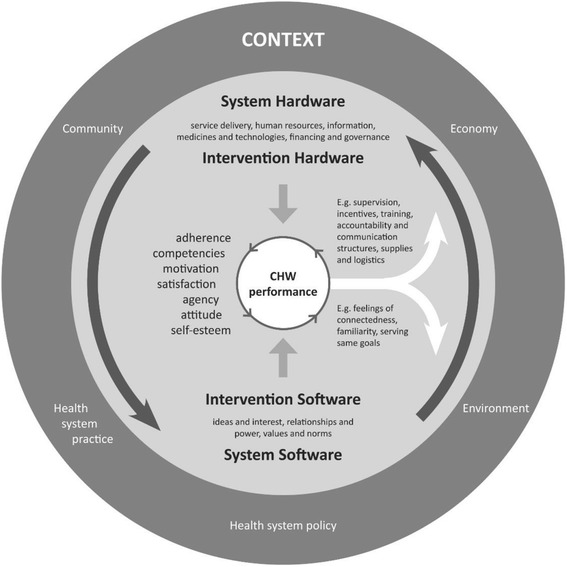
Health systems are social institutions, in which health worker performance is shaped by transactional processes between different actors.This analytical assessment unravels the complex web of factors that influence the performance of community health workers (CHWs) in low- and middle-income countries. It examines their unique intermediary position between the communities they serve and actors in the health sector, and the complexity of the health systems in which they operate. The assessment combines evidence from the international literature on CHW programmes with research outcomes from the 5-year REACHOUT consortium, undertaking implementation research to improve CHW performance in six contexts (two in Asia and four in Africa). A conceptual framework on CHW performance, which explicitly conceptualizes the interface role of CHWs, is presented. Various categories of factors influencing CHW performance are distinguished in the framework: the context, the health system and intervention hardware and the health system and intervention software. Hardware elements of CHW interventions comprise the supervision systems, training, accountability and communication structures, incentives, supplies and logistics. Software elements relate to the ideas, interests, relationships, power, values and norms of the health system actors. They influence CHWs' feelings of connectedness, familiarity, self-fulfilment and serving the same goals and CHWs' perceptions of support received, respect, competence, honesty, fairness and recognition.The framework shines a spotlight on the need for programmes to pay more attention to ideas, interests, relationships, power, values and norms of CHWs, communities, health professionals and other actors in the health system, if CHW performance is to improve.
Overview
The claims and statistics of this paper haven’t been checked yet.
Free: it reads the open-access text and checks the first 5 claims that cite a source we can check. Create a free account to check every claim.
Integrity signals
Registry
Cites
Statistics
Figures
Verification
Claims the paper makes
The claims and statistics of this paper haven’t been checked yet.
Free: it reads the open-access text and checks the first 5 claims that cite a source we can check. Create a free account to check every claim.
Claims other papers make about this one
Each is checked against this paper’s own text: does it say what the citing paper says it does?
In the citing paper
“In many settings, however, Primary Health Care Providers are fully occupied with existing medical duties (Kok et al., 2017), while effective care requires multiple intervention sessions of an hour or more each.”
From Expanding mental health services in low- and middle-income countries: A task-shifting framework for delivery of comprehensive, collaborative, and community-based care (2023) · cites this paper as Kok et al., 2017
Self-check
Percentages, sums and reported differences re-computed from the paper’s own numbers.
The self-check needs the paper’s full text.
Citations
Cites
Lewin, S., Munabi-Babigumira, S., Glenton, C., Daniels, K., Bosch-Capblanch, X., van Wyk, B. E., Odgaard-Jensen, J., Johansen, M., Aja, G. N., Zwarenstein, M., et al. (2010) · Cochrane Database of Systematic Reviews · doi:10.1002/14651858.cd004015.pub3 · Cited by 985 · cited 3×
“conditions in which CHWs work, in order to support them in improving their performance and realizing their potential [1, 8].”
BackgroundPerry, H. B., Zulliger, R., & Rogers, M. M. (2014) · Annual Review of Public Health · doi:10.1146/annurev-publhealth-032013-182354 · Cited by 944 · cited 2×
“brought to scale, resulting in sub-optimal effectiveness [5, 8].”
BackgroundHealth sector reform and public sector health worker motivation: a conceptual framework
Franco, L. M., Bennett, S., & Kanfer, R. (2002) · Social Science & Medicine · doi:10.1016/s0277-9536(01)00094-6 · Cited by 710 · cited 2×
“Thus, performance is shaped by transactional social processes between CHWs and their environment—both at the community level and in interactions with colleagues within health service delivery [13].”
BackgroundKok, M. C., Dieleman, M., Taegtmeyer, M., Broerse, J. E., Kane, S. S., Ormel, H., Tijm, M. M., & de Koning, K. A. (2015) · Health Policy and Planning · doi:10.1093/heapol/czu126 · Cited by 569 · cited 6×
“The complexity of CHW performance lies not only in the multitude of influencing factors but also in the fact that performance—at the individual level—is the sum of different interrelated attributes, such as self-esteem, motivation, attitudes, competencies, guideline adherence, job satisfaction and capacity to facilita…”
BackgroundMethodSelf-citationUnderstanding pathways for scaling up health services through the lens of complex adaptive systems
Paina, L., & Peters, D. H. (2012) · Health Policy and Planning · doi:10.1093/heapol/czr054 · Cited by 534 · cited 1×
“science that takes into account that health systems are complex and adaptive systems [41], thriving on mutual”
BackgroundGilmore, B., & McAuliffe, E. (2013) · BMC Public Health · doi:10.1186/1471-2458-13-847 · Cited by 460
Glenton, C., Colvin, C., Carlsen, B., Swartz, A., Lewin, S., Noyes, J., & Rashidian, A. (2013) · Cochrane Database of Systematic Reviews · doi:10.1002/14651858.cd010414.pub2 · Cited by 454 · cited 2×
“conditions in which CHWs work, in order to support them in improving their performance and realizing their potential [1, 8].”
BackgroundBuilding the field of health policy and systems research: framing the questions
Sheikh, K., Gilson, L., Agyepong, I. A., Hanson, K., Ssengooba, F., & Bennett, S. (2011) · PLoS Medicine · doi:10.1371/journal.pmed.1001073 · Cited by 443 · cited 2×
“factors are divided into “hardware” and “software” [19] and are coupled with hardware and software elements of”
BackgroundMethodTask shifting in HIV/AIDS: opportunities, challenges and proposed actions for sub-Saharan Africa
Zachariah, R., Ford, N., Philips, M., S.Lynch, Massaquoi, M., Janssens, V., & Harries, A. D. (2009) · Transactions of the Royal Society of Tropical Medicine and Hygiene · doi:10.1016/j.trstmh.2008.09.019 · Cited by 393 · cited 1×
“Several studies support remuneration of CHWs when they have multiple tasks that require substantial time investments and are often formerly conducted by health professionals [32].”
BackgroundJaskiewicz, W., & Tulenko, K. (2012) · Human Resources for Health · doi:10.1186/1478-4491-10-38 · Cited by 381
Research works printed but not linked: 4
- Lehmann U Sanders D Community health workers: what do we know about them? The state of the evidence on programmes, activities, costs and impact on health outcomes of using community health workers 2007 Geneva World Health Organization
- WHO Working together for health: the World Health Report 2006 2006 Geneva World Health Organization
- Bhutta ZA Lassi ZS Pariyo G Huicho L Global experience of community health workers for delivery of health-related Millennium Development Goals: a systematic review, country case studies and recommendations for scaling up 2010 Geneva Global Health Workforce Alliance
- WHO Everybody’s business—strengthening health systems to improve health outcomes: WHO's framework for action 2007 Geneva World Health Organization
Cited by
Raviola, G., Naslund, J. A., Smith, S. L., & Patel, V. (2019) · Current Psychiatry Reports · doi:10.1007/s11920-019-1028-x · Cited by 258
Ormel, H., Kok, M., Kane, S., Ahmed, R., Chikaphupha, K., Rashid, S. F., Gemechu, D., Otiso, L., Sidat, M., Theobald, S., et al. (2019) · Human Resources for Health · doi:10.1186/s12960-019-0387-z · Cited by 179
Self-citationWoldie, M., Feyissa, G. T., Admasu, B., Hassen, K., Mitchell, K., Mayhew, S., McKee, M., & Balabanova, D. (2018) · Health Policy and Planning · doi:10.1093/heapol/czy094 · Cited by 171
“While Kok et al. have argued that CHWs sit between the community and the health system (Kok et al. , 2017), our review suggests that CHVs may serve a similar intermediary role while being even closer to their communities.”
BackgroundO’Donovan, J., O’Donovan, C., Kuhn, I., Sachs, S. E., & Winters, N. (2018) · BMJ Open · doi:10.1136/bmjopen-2017-021467 · Cited by 163
Agarwal, S., Sripad, P., Johnson, C., Kirk, K., Bellows, B., Ana, J., Blaser, V., Kumar, M. B., Buchholz, K., Casseus, A., et al. (2019) · Human Resources for Health · doi:10.1186/s12960-019-0422-0 · Cited by 136
“Supervision and performance appraisal Consistent and continued support for problem solving, service delivery and skill development, including evaluation and supportive feedback on the work performed by the CHW in a set period [10, 14, 18, 46, 47]”
BackgroundKok, M. C., Vallières, F., Tulloch, O., Kumar, M. B., Kea, A. Z., Karuga, R., Ndima, S. D., Chikaphupha, K. R., Theobald, S., & Taegtmeyer, M. (2018) · Health Policy and Planning · doi:10.1093/heapol/czy082 · Cited by 157
“These findings are consistent with recent studies, which found that the intermediary position of CHWs makes trust and relationships important determinants of performance (Ndima et al., 2015; Kok et al., 2017).”
BackgroundResultSelf-citationGive, C., Ndima, S., Steege, R., Ormel, H., McCollum, R., Theobald, S., Taegtmeyer, M., Kok, M., & Sidat, M. (2019) · BMC Health Services Research · doi:10.1186/s12913-019-4076-3 · Cited by 109
Self-citationBolton, P., West, J., Whitney, C., Jordans, M. J. D., Bass, J., Thornicroft, G., Murray, L., Snider, L., Eaton, J., Collins, P. Y., et al. (2023) · Cambridge Prisms: Global Mental Health · doi:10.1017/gmh.2023.5 · Cited by 110
“In many settings, however, Primary Health Care Providers are fully occupied with existing medical duties (Kok et al., 2017), while effective care requires multiple intervention sessions of an hour or more each.”
BackgroundHodgins, S., Kok, M. C., Musoke, D., Lewin, S. A., Crigler, L., LeBan, K., & Perry, H. B. (2021) · Health Research Policy and Systems · doi:10.1186/s12961-021-00752-8 · Cited by 127
“[31] also point to the intermediary position occupied by CHWs, belonging to both the community and the formal healthcare system.”
BackgroundSelf-citationTopp, S. M., Edelman, A., & Taylor, S. (2018) · International Journal for Equity in Health · doi:10.1186/s12939-018-0779-z · Cited by 113
McCollum, R., Limato, R., Otiso, L., Theobald, S., & Taegtmeyer, M. (2018) · BMJ Global Health · doi:10.1136/bmjgh-2018-000939 · Cited by 111
Self-citationMcCollum, R., Theobald, S., Otiso, L., Martineau, T., Karuga, R., Barasa, E., Molyneux, S. C., & Taegtmeyer, M. (2018) · Health Policy and Planning · doi:10.1093/heapol/czy043 · Cited by 74
“CHWs, positioned at the interface between the community and the health system, are potentially key actors in the process of pursuing UHC both in terms of extending services and as ‘agents of change’ with regard to social determinants as culturally and socially embedded members of their community (R McCollum et al. 201…”
BackgroundSelf-citationCommunity health workers at the dawn of a new era: 2. Planning, coordination, and partnerships
Afzal, M. M., Pariyo, G. W., Lassi, Z. S., & Perry, H. B. (2021) · Health Research Policy and Systems · doi:10.1186/s12961-021-00753-7 · Cited by 91
Assegaai, T., & Schneider, H. M. (2019) · Human Resources for Health · doi:10.1186/s12960-019-0360-x · Cited by 71
Lusambili, A. M., Nyanja, N., Chabeda, S. V., Temmerman, M., Nyaga, L., Obure, J., & Ngugi, A. K. (2021) · BMC Health Services Research · doi:10.1186/s12913-021-06693-w · Cited by 73
Raven, J., Wurie, H. R., Idriss, A., Bah, A. J., Baba, A., Nallo, G. E., Kollie, K., Dean, L., Steege, R., Martineau, T., et al. (2020) · Human Resources for Health · doi:10.1186/s12960-020-00494-8 · Cited by 63
“[21] and the HRM approach defined by Armstrong [31] as “a strategic approach to acquiring, developing, managing, motivating and gaining the commitment of .”
MethodSelf-citationJohn, A., Nisbett, N., Barnett, I., Avula, R., & Menon, P. (2020) · PLoS ONE · doi:10.1371/journal.pone.0242460 · Cited by 72
“We adapted previous conceptual frameworks pertaining to CHW performance to the AWW context [4, 7, 8].”
BackgroundMethodNyirenda, L. J., Kumar, M. B., Theobald, S., Sarker, M., Simwinga, M., Kumwenda, M., Johnson, C., Hatzold, K., Corbett, E. L., Sibanda, E. L., et al. (2020) · BMC Medical Research Methodology · doi:10.1186/s12874-019-0895-5 · Cited by 154
Self-citationKawade, A. S., Gore, M. N., Lele, P., Chavan, U., Pinnock, H., Smith, P. A., & Juvekar, S. K. (2021) · Human Resources for Health · doi:10.1186/s12960-020-00546-z · Cited by 61
Maes, K. C., Closser, S., Tesfaye, Y. A., Gilbert, Y., & Abesha, R. (2018) · BMC Public Health · doi:10.1186/s12889-018-5159-5 · Cited by 65
Measuring client trust in community health workers: A multi-country validation study
Sripad, P., McClair, T. L., Casseus, A., Hossain, S., Abuya, T., & Gottert, A. (2021) · Journal of Global Health · doi:10.7189/jogh.11.07009 · Cited by 49
Lehmann, U., Twum-Danso, N. A. Y., & Nyoni, J. (2019) · BMJ Global Health · doi:10.1136/bmjgh-2018-001046 · Cited by 56
Musoke, D., Nyashanu, M., Bugembe, H., Lubega, G. B., O’Donovan, J., Halage, A. A., & Gibson, L. M. (2022) · Human Resources for Health · doi:10.1186/s12960-021-00701-0 · Cited by 55
Performance-based incentives and community health workers’ outputs, a systematic review
Gadsden, T., Mabunda, S. A., Palagyi, A., Maharani, A., Sujarwoto, S., Baddeley, M. C., & Jan, S. (2021) · Bulletin of the World Health Organization · doi:10.2471/blt.20.285218 · Cited by 73
Macfarlane, C. L., Dean, L., Thomson, R., & Garner, P. (2019) · Journal of Global Health · doi:10.7189/jogh.09.020414 · Cited by 38
Mahmood, H., McKinstry, B., Luz, S. F., Fairhurst, K., Nasim, S., & Hazir, T. (2020) · Journal of Global Health · doi:10.7189/jogh.10.020438 · Cited by 55
“affordable, and effective healthcare through CHWs [18] and is gaining momentum [12-21].”
BackgroundCarmichael, S. L., Mehta, K. M., Raheel, H., Srikantiah, S., Chaudhuri, I., Trehan, S., Mohanty, S., Borkum, E., Mahapatra, T., Weng, Y., et al. (2019) · BMJ Global Health · doi:10.1136/bmjgh-2018-001146 · Cited by 44
Dodd, W., Kipp, A., Nicholson, B., Lau, L. L., Little, M., Walley, J. D., & Wei, X. (2021) · BMC Health Services Research · doi:10.1186/s12913-021-06452-x · Cited by 48
“, anti-malaria campaigns, tuberculosis testing) [6].”
BackgroundInfluentialNdambo, M. K., Munyaneza, F., Aron, M. B., Makungwa, H., Michaelis, A., Nhlema, B., & Connolly, E. (2022) · Global Health Action · doi:10.1080/16549716.2022.2090123 · Cited by 44
Ndambo, M. K., Munyaneza, F., Aron, M. B., Nhlema, B., & Connolly, E. (2022) · BMC Health Services Research · doi:10.1186/s12913-022-07558-6 · Cited by 47
Nandagiri, R. (2019) · Social Science & Medicine · doi:10.1016/j.socscimed.2019.112525 · Cited by 33
Development and validation of a multi-dimensional scale to assess community health worker motivation
Gottert, A., McClair, T. L., Hossain, S., Dakouo, S. P., Abuya, T., Kirk, K., Bellows, B., Agarwal, S., Kennedy, S., Warren, C., et al. (2021) · Journal of Global Health · doi:10.7189/jogh.11.07008 · Cited by 35
Ogutu, M., Muraya, K., Mockler, D., & Darker, C. D. (2021) · Human Resources for Health · doi:10.1186/s12960-021-00691-z · Cited by 42
Baratieri, T., Lentsck, M. H., Falavina, L. P., Soares, L. G., Prezotto, K. H., & Pitilin, É. D. B. (2022) · Cadernos de Saúde Pública · doi:10.1590/0102-311x00103221 · Cited by 75
Munar, W. A., Snilstveit, B., Aranda, L. E., Biswas, N., Baffour, T., & Stevenson, J. (2019) · BMJ Global Health · doi:10.1136/bmjgh-2019-001451 · Cited by 38
Sharma, S., Arora, K., ., C., Sinha, R. K., Akhtar, F., & Mehra, S. (2021) · BMC Health Services Research · doi:10.1186/s12913-020-06025-4 · Cited by 37
How can mobile phones be used to improve nutrition service delivery in rural Bangladesh?
Khan, N. U. Z., Rasheed, S., Sharmin, T., Siddique, A., Dibley, M., & Alam, A. (2018) · BMC Health Services Research · doi:10.1186/s12913-018-3351-z · Cited by 28
“Our study showed that substantial work needs to be done to improve the implementation of nutrition services through CHWs by using some of the global best practices that improve CHWs motivation such as increasing their skills, providing incentives, and ensuring adequate monitoring and supervision [39].”
BackgroundAbuya, T., Mwanga, D. M., Obadha, M., Ndwiga, C., Odwe, G., Kavoo, D., Wanyugu, J., Warren, C., & Agarwal, S. (2021) · BMJ Open · doi:10.1136/bmjopen-2020-048059 · Cited by 44
Indiana community health workers: challenges and opportunities for workforce development
Rodriguez, N. M., Ruiz, Y., Meredith, A. H., Kimiecik, C., Adeoye‐Olatunde, O. A., Kimera, L. F., & Gonzalvo, J. D. (2022) · BMC Health Services Research · doi:10.1186/s12913-022-07469-6 · Cited by 28
“CHW services are provided throughout Indiana’s 92 counties and triangulated data supported existing literature [21, 22] that CHWs serve clients who face a myriad of economic, social, physical, and environmental challenges (Tables 2 and 5).”
BackgroundKok, M. C., Tolani, M., Mtonga, W., Salamba, T., Mwabungulu, T., Munthali, A. W., Smet, E., & Chinsakaso, B. (2020) · Reproductive Health · doi:10.1186/s12978-020-0906-3 · Cited by 30
“other, because health systems are complex social institutions [24].”
BackgroundSelf-citationGlenn, J. D., Moucheraud, C., Payán, D. D., Crook, A., Stagg, J., Sarma, H., Ahmed, T., Epstein, A., Luies, S. K., Rahman, M., et al. (2021) · BMC Health Services Research · doi:10.1186/s12913-021-06996-y · Cited by 30
“The effectiveness of CHW programs relies heavily on the quality of the CHWs’ relationships with the communities they serve [10, 11].”
BackgroundNanda, P., Newton-Lewis, T., Das, P., & Krishnan, S. (2020) · Sexual and Reproductive Health Matters · doi:10.1080/26410397.2020.1837413 · Cited by 27
“More fundamentally, CHWs need to be trusted and respected to influence and mobilise community members whilst navigating the complexity inherent in communities.(8,9) Women have been recruited as CHWs precisely because of their ability to access and reach other COMMENTARY”
BackgroundMeans, Motives and Opportunity: determinants of community health worker performance
John, A., Newton-Lewis, T., & Srinivasan, S. (2019) · BMJ Global Health · doi:10.1136/bmjgh-2019-001790 · Cited by 32
Daka, D. W., Wordofa, M. A., Woldie, M. K., Persson, L. Å., & Berhanu, D. (2020) · PLoS ONE · doi:10.1371/journal.pone.0239361 · Cited by 24
Gebremeskel, A. T., Omonaiye, O., & Yaya, S. (2022) · BMJ Global Health · doi:10.1136/bmjgh-2021-008162 · Cited by 34
“At the individual level, CHWs need sustainable empowerment to enhance their professional capability and to deliver improved MCH services through continuous professional development strategy, and digitally supported approach.”
Kaptchuk, R. P., Kennedy, C. E., Hutton, H. E., Mulamba, J., Mbabali, I., Anok, A., Nakyanjo, N., Chang, L. W., & Amico, K. R. (2021) · AIDS and Behavior · doi:10.1007/s10461-021-03391-w · Cited by 20
Waweru, E., Smekens, T., Orne‐Gliemann, J., Ssengooba, F., Broerse, J. E. W., & Criel, B. (2020) · PLoS ONE · doi:10.1371/journal.pone.0236524 · Cited by 31
“Furthermore, research on the performance of community health workers convey that common understanding, trusting relationships and balanced power between different actors in the health system are essential to the functioning of community health systems within the wider complex adaptive health system [71].”
BackgroundSelf-citationMabetha, D., Ojewola, T., van der Merwe, M., Mabika, R., Goosen, G., Sigudla, J., Hove, J., Witter, S., & D’Ambruoso, L. (2023) · International Journal for Equity in Health · doi:10.1186/s12939-023-01894-7 · Cited by 30
“CHWs everywhere are denied fair pay, safe working conditions and basic recognition and value [98, 99].”
BackgroundBetrian, M., Umans, D., Vanna, M., Ol, S., Adhikari, B., Davoeung, C., Callery, J. J., Sovann, Y., Peto, T. J., Maude, R. J., et al. (2023) · PLoS ONE · doi:10.1371/journal.pone.0283405 · Cited by 19
Datiko, D. G., Bunte, E. M., Birrie, G. B., Kea, A. Z., Steege, R., Taegtmeyer, M., Kumar, M. B., & Kok, M. C. (2019) · Journal of Global Health Reports · doi:10.29392/joghr.3.e2019027 · Cited by 22
Self-citationMcCarville, E. E., Martin, M. A., Pratap, P. L., Pinkser, E., Seweryn, S. M., & Peters, K. (2021) · Journal of Ambulatory Care Management · doi:10.1097/jac.0000000000000396 · Cited by 22
Sarma, H., Tariqujjaman, M., Mbuya, M. N. N., Askari, S., Banwell, C. L., Bossert, T. J., D’Este, C. A., & Ahmed, T. (2020) · Public Health Nutrition · doi:10.1017/s1368980019003768 · Cited by 20
“Supportive supervision and regular monitoring of CHW may be positively associated with more home visits(4,21,31).”
BackgroundOptimising scale and deployment of community health workers in Sierra Leone: a geospatial analysis
Oliphant, N. P., Ray, N., Curtis, A., Musa, E., Sesay, M., Kandeh, J., Kamara, A. R. Y., Hassen, K., O’Connor, S., Suehiro, Y., et al. (2022) · BMJ Global Health · doi:10.1136/bmjgh-2021-008141 · Cited by 21
Munar, W. A., Wahid, S. S., & Curry, L. A. (2018) · Gates Open Research · doi:10.12688/gatesopenres.12782.1 · Cited by 17
Ludwick, T., Endriyas, M., Morgan, A., Kane, S. S., Kelaher, M., & McPake, B. (2021) · International Journal of Health Policy and Management · doi:10.34172/ijhpm.2021.52 · Cited by 27
Getting more than “claps”: incentive preferences of voluntary community-based mobilizers in Tanzania
Kok, M. C., Abdella, D., Mwangi, R., Ntinginya, M., Rood, E. J. J., Gassner, J., Church, K., & Wheatley, N. (2019) · Human Resources for Health · doi:10.1186/s12960-019-0438-5 · Cited by 21
Self-citationOgutu, M., Kamui, E., Abuya, T., & Muraya, K. (2023) · PLOS Global Public Health · doi:10.1371/journal.pgph.0001815 · Cited by 20
Labour exploitation among community health workers
Wennerstrom, A., & Smith, D. O. (2023) · The Lancet Global Health · doi:10.1016/s2214-109x(23)00409-6 · Cited by 14
Community-level integration of health services and community health workers’ agency in Malawi
Ngwira, C., Mayhew, S., & Hutchinson, E. (2021) · Social Science & Medicine · doi:10.1016/j.socscimed.2021.114463 · Cited by 15
Yahemba, D., Chowdhury, S., Olorunfemi, T., Dubukumah, L., David, A., Umunnakwe, C. U., Dalumo, V., Haruna, S., & Dean, L. (2023) · International Health · doi:10.1093/inthealth/ihad005 · Cited by 17
Nguyen, P. H., Kim, S. S., Tran, L. M., Menon, P., & Frongillo, E. A. (2019) · Current Developments in Nutrition · doi:10.1093/cdn/nzz070 · Cited by 16
“Contextual factors (including the community, political and economic contexts, environment, and health systems) were found to interact with each other to influence FLW performance as well as program performance (6, 8, 9).”
BackgroundAron, M. B., Ndambo, M. K., Munyaneza, F., Mulwafu, M., Makungwa, H., Nhlema, B., & Connolly, E. (2023) · Human Resources for Health · doi:10.1186/s12960-023-00839-z · Cited by 22
Kweku, M., Amu, H., Adjuik, M., Aku, F. Y., Manu, E., Tarkang, E. E., Komesuor, J., Asalu, G. A., Amuna, N. N., Boateng, L. A., et al. (2020) · BMC Health Services Research · doi:10.1186/s12913-020-05678-5 · Cited by 13
Newton-Lewis, T., & Nanda, P. (2021) · BMJ Global Health · doi:10.1136/bmjgh-2021-005942 · Cited by 14
Harrison, L., Kumwenda, M., Nyirenda, L. J., Chilongosi, R., Corbett, E. L., Hatzold, K., Johnson, C., Simwinga, M., Desmond, N., & Taegtmeyer, M. (2022) · BMC Infectious Diseases · doi:10.1186/s12879-022-07231-7 · Cited by 12
“Our findings on the importance of the CBDA cadres give further evidence how it is vital to understand the local context to address issues of professional distrust or unfamiliarity which affect upon service delivery performance and impact [31, 32].”
BackgroundSelf-citationJoshi, A., Marasini, S., Sharma, S., Paneru, B., Kunwar, S., Shrestha, A., Shrestha, A., & Karmacharya, B. M. (2024) · BMJ Open · doi:10.1136/bmjopen-2023-082363 · Cited by 14
Raven, J., Arjyal, A., Baral, S., Chand, O., Hawkins, K., Kallon, L. H., Mansour, W., Parajuli, A., Than, K. K., Wurie, H. R., et al. (2022) · Social Sciences · doi:10.3390/socsci11090415 · Cited by 14
“This is in keeping with other research that shows CTC providers’ workloads stretching across multiple vertical programmes (Raven et al. 2015; Oluwole et al. 2019; Kok et al. 2017).”
ResultSelf-citationOliphant, N. P., Sy, Z., Koné, B., Berthé, M., Beebe, M., Samaké, M., Diabaté, M., Tounkara, S., Diarra, B., Diarra, A. B., et al. (2022) · PLOS Global Public Health · doi:10.1371/journal.pgph.0000626 · Cited by 13
Chen, W. T., He, H. G., & Chow, Y. L. (2022) · International Journal of Integrated Care · doi:10.5334/ijic.5838 · Cited by 18
Randell, M., Li, M., Rachmi, C. N., Jusril, H., Abímbọ́lá, Ṣ., Tama, A. Y., Aswitama, T., Phebe, N., Sulasmi, Alam, A., et al. (2024) · Discover Health Systems · doi:10.1007/s44250-024-00069-7 · Cited by 28
McCarville, E. E., Martin, M. A., Pratap, P. L., Pinsker, E., Seweryn, S. M., & Peters, K. E. (2022) · BMC Health Services Research · doi:10.1186/s12913-022-08723-7 · Cited by 9
The missing piece: quality in community health programmes
Otiso, L., Gitahi, G., Nambiar, B., Kumar, M. B., & Doyle, V. (2019) · The Lancet Global Health · doi:10.1016/s2214-109x(18)30538-2 · Cited by 9
Molla, S. D., Tsehay, C. T., & Haile, T. G. (2020) · Risk Management and Healthcare Policy · doi:10.2147/rmhp.s253847 · Cited by 9
“Introduction The health extension program (HEP) is a new community-based healthcare delivery approach which is intended to improve the health of the community in Ethiopia, focusing on promotive, preventive, and few selected curative health services.(1,2) There are four main themes in the program: disease prevention an…”
BackgroundKapilashrami, A., & Aziz, R. (2023) · The International Journal of Health Planning and Management · doi:10.1002/hpm.3677 · Cited by 14
Pallikkuth, R., Kumar, T. M., Dictus, C. T., & Bunders, J. (2023) · Community Mental Health Journal · doi:10.1007/s10597-023-01161-7 · Cited by 18
“…maintaining the performance and motivation of formal health workers and LMHWs, there is a critical need for knowledge about effective peer-supervision strategies and their implementation (Aftab et al., 2018; Assegaai & Schneider, 2019; Kok et al., 2017; Roberton et al., 2015; Schwarz et al., 2019).”
BackgroundMunar, W. A., Wahid, S. S., Mookherji, S., Innocenti, C., & Curry, L. A. (2018) · Gates Open Research · doi:10.12688/gatesopenres.12878.1 · Cited by 11
Ratshidi, L., Grobbelaar, S. S. S., & Botha, A. (2022) · Sustainability · doi:10.3390/su14148930 · Cited by 13
“Safety and security-related factors Access control and availability Accessibility of security and emergency services Adequate access to health- and safety-related technology features Security and confidentiality of the data contained [31,43,75]”
BackgroundKumar, M. B., Madan, J. J., Mireku, M., Limato, R., Ndima, S. D., Kea, A. Z., Chikaphupha, K. R., Barasa, E., & Taegtmeyer, M. (2019) · BMJ Global Health · doi:10.1136/bmjgh-2019-001390 · Cited by 8
“11 However, CTC providers face numerous challenges working at the interface between communities and health systems due to factors such as: working remotely (where it can be difficult to maintain standards), lower literacy rates, higher attrition rates, less education and fewer support structures than other professiona…”
BackgroundSelf-citationJenkins, C. R., Rutledge, M., Hudson, L., Vanderford, N. L., & Schoenberg, N. E. (2022) · Journal of Cancer Education · doi:10.1007/s13187-021-02120-0 · Cited by 8
Riang’a, R. M., Nyanja, N., Lusambili, A. M., Mwangi, E. M., Ehrlich, J. R., CLYDE, P. S., Mostert, C. M., & Ngugi, A. K. (2024) · BMC Health Services Research · doi:10.1186/s12913-023-10514-7 · Cited by 12
“Therefore, they are highly likely to be more vulnerable to exploitation, hence the need to be supported by the health system considering the important role they play in promoting community health [5, 42, 43].”
BackgroundGopalakrishnan, L., Patil, S. R., Fernald, L. C. H., Walker, D. M., & Diamond‐Smith, N. (2025) · PLoS ONE · doi:10.1371/journal.pone.0326971 · Cited by 13
Social determinants of multimorbidity in older adults in sub-saharan Africa: A systematic review
Folorunsho, S. A., Abdullateef, R., Suleiman, M. A., & Sanmori, M. (2025) · Palliative & Supportive Care · doi:10.1017/s1478951525100576 · Cited by 9
“(Kok et al 2017).”
Buthelezi, U. E., van Rensburg, A. J., Moshabela, M., Bucibo, S., Radebe, N., Luvuno, Z., Kathree, T., Bhana, A., & Petersen, I. (2025) · PLOS Global Public Health · doi:10.1371/journal.pgph.0004926 · Cited by 11
Mallaiah, J., Leon, R. D., Williams, O. A., & Allegrante, J. P. (2022) · Health Promotion Practice · doi:10.1177/15248399221120809 · Cited by 6
“…the fact that while CHWs are trained on the same level as other health paraprofessionals, their training and assessment methods fall short of meeting clinical standards, especially in chronic disease prevention (Allen et al., 2018; Brownstein et al., 2005; Kim et al., 2016; Kok et al., 2017).”
BackgroundResultYahner, M., Muriuki, A., Mangieri, A., Nitu, S. N. A., Shafinaz, S., & Sarriot, E. (2022) · Global Health Science and Practice · doi:10.9745/ghsp-d-22-00023 · Cited by 6
“As in many LMICs, interventions relying on underresourced community health worker cadres in Bangladesh face threats to sustainability, 35 underscoring the urgency of deeper investment in human resources for health.”
Burger, N., & Gilson, L. (2025) · Health Policy and Planning · doi:10.1093/heapol/czaf001 · Cited by 9
“…2023) Trust in providers (Hamon et al. 2022) Patients trust in medicines and health services (Aivalli et al. 2018) Relationships (Hernández 2014; Kok et al. 2017; Reddy et al. 2022; Wanyama et al. 2022; Karamagi et al. 2023; Serge et al. 2023) Peer networks (Reddy et al. 2022; Wanyama et al.…”
InfluentialMale Prisoners’ Perspectives of Access to Quality Health Care at a Prison Infirmary in Ghana
Adomah-Afari, A., Ntow, S. K., Awuah-Werekoh, K., & Baffoe-Bonnie, T. (2021) · The Prison Journal · doi:10.1177/00328855211060334 · Cited by 5
“The World Health Organization (WHO, 2018; Kok et al., 2017) defined a health system as a social institution in which health worker performance is shaped by transactional processes between different actors.”
BackgroundSantosh, S., & Kane, S. S. (2023) · Community Health Equity Research & Policy · doi:10.1177/2752535x231222654 · Cited by 10
Hill, Z. E., Scheelbeek, P., Hamza, Y. A., Amare, Y., & Schellenberg, J. (2020) · Global Health Science and Practice · doi:10.9745/ghsp-d-19-00410 · Cited by 6
“, 20 – 24, 26, 51 – 53 We the”
Majid, U., Zahid, Harold, Zain, & Sood (2021) · Rural and Remote Health · doi:10.22605/rrh6774 · Cited by 12
Sanou, H., Korbéogo, G., Meyrowitsch, D. W., & Samuelsen, H. (2024) · BMC Health Services Research · doi:10.1186/s12913-024-11853-9 · Cited by 7
Goh, H., Dary, C., Ung, M., Oy, S., Lee, Y. L., Mam, S., Chhorn, S., Ny, C., Chhay, S. C. A., Khim, C., et al. (2025) · Human Resources for Health · doi:10.1186/s12960-025-01002-6 · Cited by 6
“To be considered effective health workers, VHSGs must operate in ways that are responsive, equitable, and efficient to achieve optimal health outcomes for the communities they serve [15].”
Community members’ perceptions of community health workers in Melusi, Tshwane, South Africa
Madzivhandila, R. K., & Ngcobo, S. (2024) · African Journal of Primary Health Care & Family Medicine · doi:10.4102/phcfm.v16i1.4573 · Cited by 6
“14 Participants in the study expressed expectations for CHWs to provide access to health services, advocate for health issues, offer guidance on maintaining well-being and assist with educational support for children.”
BackgroundInterventions for Child Drowning Reduction in the Indian Sundarbans: Perspectives from the Ground
Gupta, M., Roy, S. B., Panda, R. K., Konwar, P., & Jagnoor, J. (2020) · Children · doi:10.3390/children7120291 · Cited by 7
Preston, A., Okebe, J., Balen, J., Ribera, J. M., Masunaga, Y., Bah, A. S., Dabira, E. D., & D’Alessandro, U. (2019) · Journal of Global Health Reports · doi:10.29392/joghr.3.e2019084 · Cited by 5
Masunaga, Y., Ribera, J. M., Jaiteh, F., de Vries, D. H., & Grietens, K. P. (2022) · BMC Health Services Research · doi:10.1186/s12913-021-07431-y · Cited by 9
“Often they are perceived as being a ‘facilitator’, ‘mediator’, or ‘broker’ to deliver health care on behalf of health systems or vertical health interventions [6, 14, 69].”
BackgroundA Mixed Method Study on Supportive Supervision of Community Health Workers From Central India
Gouroumourty, R., Joshi, A., & Pakhare, A. P. (2024) · Indian Journal of Community Medicine · doi:10.4103/ijcm.ijcm_48_23 · Cited by 6
Hunter, B. M. (2018) · Social Science & Medicine · doi:10.1016/j.socscimed.2018.03.004 · Cited by 5
Mahmud, I., Siddiqua, S., Akhter, I., Sarker, M., Theobald, S., & Rashid, S. F. (2023) · PLoS ONE · doi:10.1371/journal.pone.0279110 · Cited by 13
Self-citationSingh, A., Ndiath, M. M., Touré, D., Dissieka, R., Bazira, L. K., Wanyonyi, C., & Klemm, R. D. W. (2025) · BMC Health Services Research · doi:10.1186/s12913-025-13044-6 · Cited by 8
Metadata
- Authors
- Kok, M. C., Broerse, J. E. W., Theobald, S., Ormel, H., Dieleman, M., & Taegtmeyer, M.
- Affiliations
- Royal Tropical Institute (NL)
- Vrije Universiteit Amsterdam (NL)
- Liverpool School of Tropical Medicine (GB)
- Corresponding author
- Kok, Maryse C.
- ORCID
- Venue
- Human Resources for Health
- Published
- 2017-09-02
- Volume
- 15
- Issue
- 1
- Pages
- 59-59
- ISSN
- 1478-4491 (ISSN-L)
- PMC
- PMC5581474
- OpenAlex
- W2751158531
- Semantic Scholar
- 8dff28d240722cc1d7cb3c9f3e7635e674b04789
- Cited by
- 201
- References
- 40
- Citations by year
- 2026: 11 · 2025: 29 · 2024: 17 · 2023: 28 · 2022: 30 · 2021: 33 · 2020: 20 · 2019: 20 · 2018: 13
- FWCI
- 3.88
- Type
- journal article
- Language
- en
- Open access
- gold
- doi.org
- Licence
- cc-by
- creativecommons.org/licenses/by/4.0/ (tdm)
- Locations
- Human Resources for Health (publishedVersion, cc-by)
- PubMed Central (publishedVersion, cc-by)
- PubMed (publishedVersion)
- VU Research Portal (publishedVersion, other-oa)
- LSTM Online Archive (Liverpool School of Tropical Medicine) (acceptedVersion)
- DOAJ (DOAJ: Directory of Open Access Journals) (submittedVersion, cc-by-sa)
- Zenodo (CERN European Organization for Nuclear Research) (submittedVersion, cc-by)
- Data Archiving and Networked Services (DANS) (submittedVersion, other-oa)
- Funders
- European Union Seventh Framework Programme (306090)
- Topics
- Health Sciences › Medicine › Public Health, Environmental and Occupational Health › Global Health Workforce Issues
- Health Sciences › Health Professions › General Health Professions › Health Policy Implementation Science
- Health Sciences › Medicine › Public Health, Environmental and Occupational Health › Healthcare Systems and Reforms
- Keywords
- community health workers, health worker performance, intermediary role, health system actors, supervision system, CHW training, accountability, incentives, power and norms, low- and middle-income countries, implementation research
- MeSH terms
- Work Performance, Africa, Asia, Attitude of Health Personnel, Community Health Workers, Community Health Services, Cooperative Behavior, Humans, Personnel Management, Professional Competence, Qualitative Research
About these checks
Registry, retraction, Cites and statistics results are computed, not judged, with one exception: a printed reference that no index lists is read once by a model before it counts as a citation error. Claims are extracted by a model and kept only when their quote appears verbatim in the text; each cited source is then checked, with a model’s help, for whether it says what the claim relies on. Those verdicts can be wrong — read the claim’s quote and the cited source before relying on one.
Statistics and arithmetic are recomputed, not judged.
Confidence bands are shown only for fields calibrated on our annotated test set. None is calibrated yet, so no band is shown.
What counts as a claim ›How we measure confidence ›How we check this ›
Are you an author, or do you see a problem with this page? Request a review
Data sources
Bibliographic data: Semantic Scholar, OpenAlex, Crossref.
Contains information from the Semantic Scholar Academic Graph Datasets, made available under the ODC Attribution License (ODC-BY 1.0).
Semantic Scholar’s data is described in: Kinney, R., et al. (2023). The Semantic Scholar Open Data Platform. arXiv:2301.10140.
