

Performance of community health workers: situating their intermediary position within complex adaptive health systems
Open accessThe DOI matches its Crossref record; 39 of the 40 references it cites were found in a registry or an index.
Abstract
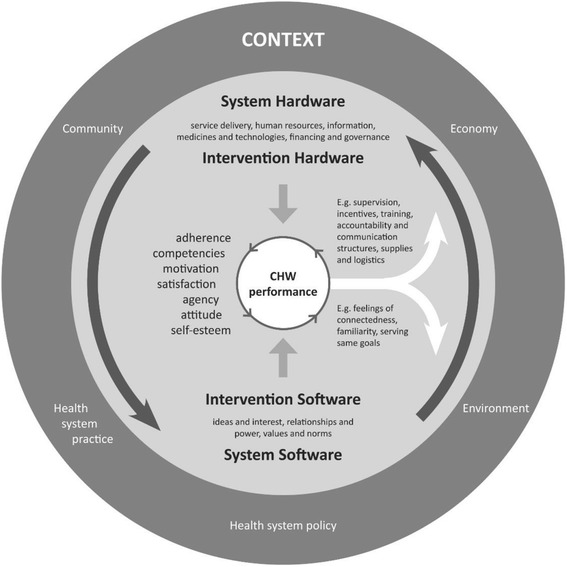
Health systems are social institutions, in which health worker performance is shaped by transactional processes between different actors.This analytical assessment unravels the complex web of factors that influence the performance of community health workers (CHWs) in low- and middle-income countries. It examines their unique intermediary position between the communities they serve and actors in the health sector, and the complexity of the health systems in which they operate. The assessment combines evidence from the international literature on CHW programmes with research outcomes from the 5-year REACHOUT consortium, undertaking implementation research to improve CHW performance in six contexts (two in Asia and four in Africa). A conceptual framework on CHW performance, which explicitly conceptualizes the interface role of CHWs, is presented. Various categories of factors influencing CHW performance are distinguished in the framework: the context, the health system and intervention hardware and the health system and intervention software. Hardware elements of CHW interventions comprise the supervision systems, training, accountability and communication structures, incentives, supplies and logistics. Software elements relate to the ideas, interests, relationships, power, values and norms of the health system actors. They influence CHWs' feelings of connectedness, familiarity, self-fulfilment and serving the same goals and CHWs' perceptions of support received, respect, competence, honesty, fairness and recognition.The framework shines a spotlight on the need for programmes to pay more attention to ideas, interests, relationships, power, values and norms of CHWs, communities, health professionals and other actors in the health system, if CHW performance is to improve.
Overview
The claims and statistics of this paper haven’t been checked yet.
Free: it reads the open-access text and checks the first 5 claims that cite a source we can check. Create a free account to check every claim.
Integrity signals
Registry
Cites
Statistics
Figures
Verification
Claims the paper makes
The claims and statistics of this paper haven’t been checked yet.
Free: it reads the open-access text and checks the first 5 claims that cite a source we can check. Create a free account to check every claim.
Claims other papers make about this one
Each is checked against this paper’s own text: does it say what the citing paper says it does?
In the citing paper
“In many settings, however, Primary Health Care Providers are fully occupied with existing medical duties (Kok et al., 2017), while effective care requires multiple intervention sessions of an hour or more each.”
From Expanding mental health services in low- and middle-income countries: A task-shifting framework for delivery of comprehensive, collaborative, and community-based care (2023) · cites this paper as Kok et al., 2017
Self-check
Percentages, sums and reported differences re-computed from the paper’s own numbers.
The self-check needs the paper’s full text.
Citations
Cites
Lewin, S., Munabi-Babigumira, S., Glenton, C., Daniels, K., Bosch-Capblanch, X., van Wyk, B. E., Odgaard-Jensen, J., Johansen, M., Aja, G. N., Zwarenstein, M., et al. (2010) · Cochrane Database of Systematic Reviews · doi:10.1002/14651858.cd004015.pub3 · Cited by 985 · cited 3×
“conditions in which CHWs work, in order to support them in improving their performance and realizing their potential [1, 8].”
BackgroundPerry, H. B., Zulliger, R., & Rogers, M. M. (2014) · Annual Review of Public Health · doi:10.1146/annurev-publhealth-032013-182354 · Cited by 944 · cited 2×
“brought to scale, resulting in sub-optimal effectiveness [5, 8].”
BackgroundHealth sector reform and public sector health worker motivation: a conceptual framework
Franco, L. M., Bennett, S., & Kanfer, R. (2002) · Social Science & Medicine · doi:10.1016/s0277-9536(01)00094-6 · Cited by 710 · cited 2×
“Thus, performance is shaped by transactional social processes between CHWs and their environment—both at the community level and in interactions with colleagues within health service delivery [13].”
BackgroundKok, M. C., Dieleman, M., Taegtmeyer, M., Broerse, J. E., Kane, S. S., Ormel, H., Tijm, M. M., & de Koning, K. A. (2015) · Health Policy and Planning · doi:10.1093/heapol/czu126 · Cited by 569 · cited 6×
“The complexity of CHW performance lies not only in the multitude of influencing factors but also in the fact that performance—at the individual level—is the sum of different interrelated attributes, such as self-esteem, motivation, attitudes, competencies, guideline adherence, job satisfaction and capacity to facilita…”
BackgroundMethodSelf-citationUnderstanding pathways for scaling up health services through the lens of complex adaptive systems
Paina, L., & Peters, D. H. (2012) · Health Policy and Planning · doi:10.1093/heapol/czr054 · Cited by 534 · cited 1×
“science that takes into account that health systems are complex and adaptive systems [41], thriving on mutual”
BackgroundGilmore, B., & McAuliffe, E. (2013) · BMC Public Health · doi:10.1186/1471-2458-13-847 · Cited by 460
Glenton, C., Colvin, C., Carlsen, B., Swartz, A., Lewin, S., Noyes, J., & Rashidian, A. (2013) · Cochrane Database of Systematic Reviews · doi:10.1002/14651858.cd010414.pub2 · Cited by 454 · cited 2×
“conditions in which CHWs work, in order to support them in improving their performance and realizing their potential [1, 8].”
BackgroundBuilding the field of health policy and systems research: framing the questions
Sheikh, K., Gilson, L., Agyepong, I. A., Hanson, K., Ssengooba, F., & Bennett, S. (2011) · PLoS Medicine · doi:10.1371/journal.pmed.1001073 · Cited by 443 · cited 2×
“factors are divided into “hardware” and “software” [19] and are coupled with hardware and software elements of”
BackgroundMethodTask shifting in HIV/AIDS: opportunities, challenges and proposed actions for sub-Saharan Africa
Zachariah, R., Ford, N., Philips, M., S.Lynch, Massaquoi, M., Janssens, V., & Harries, A. D. (2009) · Transactions of the Royal Society of Tropical Medicine and Hygiene · doi:10.1016/j.trstmh.2008.09.019 · Cited by 393 · cited 1×
“Several studies support remuneration of CHWs when they have multiple tasks that require substantial time investments and are often formerly conducted by health professionals [32].”
BackgroundJaskiewicz, W., & Tulenko, K. (2012) · Human Resources for Health · doi:10.1186/1478-4491-10-38 · Cited by 381
Research works printed but not linked: 4
- Lehmann U Sanders D Community health workers: what do we know about them? The state of the evidence on programmes, activities, costs and impact on health outcomes of using community health workers 2007 Geneva World Health Organization
- WHO Working together for health: the World Health Report 2006 2006 Geneva World Health Organization
- Bhutta ZA Lassi ZS Pariyo G Huicho L Global experience of community health workers for delivery of health-related Millennium Development Goals: a systematic review, country case studies and recommendations for scaling up 2010 Geneva Global Health Workforce Alliance
- WHO Everybody’s business—strengthening health systems to improve health outcomes: WHO's framework for action 2007 Geneva World Health Organization
Cited by
Items 101–200 of 200
Physical rehabilitation delivery by community health workers: Views of the users and caregivers
Mapulanga, M., & Dlungwane, T. P. (2025) · African Journal of Primary Health Care & Family Medicine · doi:10.4102/phcfm.v17i1.4852 · Cited by 4
“11,12 Through task shifting, community health workers have played roles in various health areas, including communicable diseases and maternal health.”
Ludwick, T., Endriyas, M., Morgan, A., Kane, S. S., & McPake, B. (2021) · Health Policy and Planning · doi:10.1093/heapol/czab112 · Cited by 7
Matte, M., Ntaro, M., Kenney, J., Wesuta, A. C., Kawungezi, P. C., Bwambale, S., Ayebare, D. S., Baguma, S., Bagenda, F. N., Stone, G. S., et al. (2024) · BMC Health Services Research · doi:10.1186/s12913-024-10598-9 · Cited by 4
Thomas, L. S., Pillay, Y. G., & Buch, E. (2024) · South African Medical Journal · doi:10.7196/samj.2024.v114i2.1334 · Cited by 5
“…elements influencing performance are reasonably documented in health system support in the form of resources, training, supervision and so on, some of the more intangibles, especially community perceptions, referred to by Kok [6] as ‘software’ elements, are often not as clearly understood.”
BackgroundKaruga, R., Karim, O. A., Jahan, S., Ngunjiri, A. S. W., Kabaria, C. W., Oduor, C., Omanga, E., Wairiuko, J., Seekles, M. L., Dean, L., et al. (2025) · SSM - Health Systems · doi:10.1016/j.ssmhs.2025.100147 · Cited by 9
Audibert, C., Hugo, P., Gosling, R. D., Eddis, C., & Tchouatieu, A.-M. (2025) · Malaria Journal · doi:10.1186/s12936-025-05355-0 · Cited by 3
“However, health worker shortages in the areas of most need and multilevel contextual barriers may limit the efficiency of CHWs in delivering PMC [27–29].”
GENDER SEGREGATION OF HEALTH MANAGERS IN DISTRICT HEALTH OFFICERS IN INDONESIA
Shofi, K. N. M., & Putri, N. K. (2023) · The Indonesian Journal of Public Health · doi:10.20473/ijph.v18i2.2023.265-275 · Cited by 10
Depression and Burnout among Health Extension Workers in Ethiopia: A Cross-Sectional Study.
Birhane, R., Medhin, G., Demissie, M., Tassew, B., Gebru, T., Tadesse, B. A., Jebena, M. G., Teklu, A. M., & Deyessa, N. (2023) · PubMed Central · doi:10.4314/ejhs.v33i1.7s · Cited by 8
“Instead, studies on HEWs focused on improving job performance (45-47).”
BackgroundResultSithi, D., Govender, S., & Ntuli, T. S. (2024) · South African Journal of Communication Disorders · doi:10.4102/sajcd.v71i1.1020 · Cited by 3
“Community health workers also serve as important links between communities, facilities and services (Kok et al., 2017; Murphy et al., 2021; Smithwick et al., 2023).”
BackgroundHashmi, F. A., Bürger, O., Mondal, S., & Legare, C. H. (2025) · Global Public Health · doi:10.1080/17441692.2025.2537697 · Cited by 5
“ASHAs serve as a crucial link between formal health systems and communities, and they are ideally positioned to harness their understanding of cultural and social context to promote open dialogues and motivate their clients towards better health practices (Adams, 2020; Kok et al., 2017).”
Masters Program in Public Health, U. S. M., Cahyandaru, Z., Tamtomo, D. G., & Soemanto, R. (2019) · Journal of Health Policy and Management · doi:10.26911/thejhpm.2019.04.01.02 · Cited by 2
“Kok et al. (2017) stated that health personnels needed to feel empowered and got supports through the environment, one of them was supervision.”
BackgroundTuberculosis Case Finding Practice: The Intention of Cadres
Lepuen, A. P., Bratajaya, C. N. A., & Rasmada, S. (2020) · Jurnal Keperawatan Indonesia · doi:10.7454/jki.v23i2.1050 · Cited by 3
Lar, L., Stewart, M., Isiyaku, S., Dean, L., Ozano, K., Mpyet, C. D., & Theobald, S. (2022) · Conflict and Health · doi:10.1186/s13031-022-00472-y · Cited by 7
“This broad, analytical transactional framework is based on existing models [13, 16, 17] and findings that have been used by others to validate the framework to support improvement of healthcare services through policy development [15, 16, 18].”
MethodSelf-citationBigirimana, J. B., & Luginaah, I. (2020) · Research Square · doi:10.21203/rs.3.rs-44141/v1 · Cited by 3
Jacobs, I., Bossche, D. V., Willems, S. J. T., & Vanthomme, K. (2025) · International Journal for Equity in Health · doi:10.1186/s12939-025-02508-0 · Cited by 2
“Secondly, to gain deeper insights from our QCA, the findings were subsequently coded according to the attributes defined in the framework of CHW performance by Kok et al. [40] (see Fig.”
Agwu, P., Orjiakor, C. T., Odii, A., Ogbozor, P. A., Hutchinson, E., McKee, M., Onwujekwe, O. E., & Balabanova, D. (2026) · Health Systems & Reform · doi:10.1080/23288604.2026.2630426 · Cited by 6
Kok, M. C., Lucas, S., Otege, J., Mkwazu, Z., Zuleta-Marin, I., Smet, E., & Ngalesoni, F. N. (2021) · Journal of Public Health in Africa · doi:10.4081/jphia.2021.1319 · Cited by 4
“This variation in access to incentives is unethical and, as stated above, can lead to demotivation and ultimately underperformance of CHWs – also in the field of family planning (26).”
BackgroundSelf-citationCommunity health workers’ experiences of supervision by nurses at clinics in Limpopo Province
Matsi, M. M., Lekalakala‐Mokgele, E., & Madumo, M. M. (2023) · Health SA Gesondheid · doi:10.4102/hsag.v28i0.2330 · Cited by 2
“Community health workers are regarded as the first point of contact of the community to the health system (Kok et al. 2017:1).”
BackgroundInfluentialLourdes, T. G. R., Hasani, W. S. R., Yusoff, M. F. M., Hamid, H. A. A., Rifin, H. M., Ismail, H., Saminathan, T. A., Ling, M. Y. J., Majid, N. L. A., Riyadzi, M. R., et al. (2021) · International Journal of Public Health Research · doi:10.17576/ijphr.1102.2021.03 · Cited by 5
Babalola, O., Goudge, J., Levin, J., Brown, C., & Griffiths, F. E. (2022) · Frontiers in Public Health · doi:10.3389/fpubh.2022.868252 · Cited by 3
“However, despite this limited educational background, CHWs are required to work within complex inter-relating environments of community and health sector within which are multiple layers of actors whose actions have effect on CHW performance (71).”
BackgroundOPIMBI, O. A., Kathuri‐Ogola, L., & Muriithi, J. K. (2021) · Strategic Journal of Business & Change Management · doi:10.61426/sjbcm.v8i2.1996 · Cited by 1
Factors of labor productivity of employees of a cardiology medical organization
Popsuyko, A. N., Алексеевна, Б. Е., Макаров, С. А., MOROZOVA, E. A., & Artamonova, G. V. (2022) · Lomonosov Economics Journal · doi:10.38050/01300105202239 · Cited by 1
Rahman, R., Chesna, S., Brown, L., Patel, R., & Ross, A. M. (2024) · Human Services Organizations Management Leadership & Governance · doi:10.1080/23303131.2024.2319212 · Cited by 2
“This approach fosters stronger relationships within the CHW organization, emphasizing collaborative problem-solving for optimal resource allocation (Kok et al., 2017).”
Calarco, R., Prévot-Monsacré, P., Paternoster, M., Vignier, N., Trevidy, F., & Cailhol, J. (2025) · Global Health Promotion · doi:10.1177/17579759241290781 · Cited by 1
“There is a gap in the literature regarding how CHW programs can improve relationships and balance power among different actors in the health system (6).”
Mwaniki, A. W., Nyaboga, J. M., Mecha, E. O., & Oyugi, B. (2025) · Primary Health Care Research & Development · doi:10.1017/s1463423625100248 · Cited by 3
“Similarly, Kok et al. (2017) and Bhaumik et al. (2020) identified such non-financial incentives as vital for motivating CHVs and sustaining their commitment to healthcare delivery.”
Buthelezi, U. E., Bhana, A., Luvuno, Z., Kathree, T., Bucibo, S., Radebe, N., Moshabela, M., Petersen, I., & van Rensburg, A. J. (2026) · Social Science & Medicine · doi:10.1016/j.socscimed.2026.119190 · Cited by 1
Bhandari, S., Frongillo, E. A., Suwal, R., Schreinemachers, P., Gupta, A. S., Blake, C. E., Tiwari, N. P., & Cunningham, K. (2022) · Food and Nutrition Bulletin · doi:10.1177/03795721221106588 · Cited by 2
Mupara, L. M., Mogaka, J., Brieger, W. R., & Tsoka-Gwegweni, J. M. (2022) · Frontiers in Public Health · doi:10.3389/fpubh.2022.907451 · Cited by 1
Prasastin, O. V., Noor, F. A., Prastyoningsih, A., Gita, A. P. A., Surya, N. T., Pinto, S., & Moreira, A. (2023) · JURNAL KREATIVITAS PENGABDIAN KEPADA MASYARAKAT (PKM) · doi:10.33024/jkpm.v6i7.10040 · Cited by 1
Kibe, L. W., Muia, D., Mbogo, C. M., & Kamau, A. (2023) · Open Journal of Social Sciences · doi:10.4236/jss.2023.119011 · Cited by 1
Zawolo, G., Nyaaba, G. N., Nallo, G. E., Kollie, K., Thomson, R., Raven, J., Theobald, S., & Dean, L. (2024) · Health Research Policy and Systems · doi:10.1186/s12961-024-01211-w · Cited by 3
“Our study is guided by key elements of Kok et al.’s conceptual framework on CHW performance [19] (Fig.”
BackgroundMethodSelf-citationCommunity perspectives on foot care interventions delivered by community health workers
Okatiranti, O., Windle, R. J., Perry, H. B., & Goldberg, S. E. (2025) · Discover Public Health · doi:10.1186/s12982-025-00494-w · Cited by 3
Bigirimana, J. B. (2019) · Scholarship@Western (Western University) · Cited by 1
Masters Program in Public Health, U. S. M., Chasanah, E. S., Sulaeman, E. S., & Rahardjo, S. S. (2020) · Journal of Health Policy and Management · doi:10.26911/thejhpm.2020.05.03.06 · Cited by 1
Development and Validation of a Stroke Literacy Assessment Test for Community Health Workers
Mallaiah, J. (2021) · doi:10.7916/d8-nynz-dq08 · Cited by 1
Enhancing mental health practice in Sierra Leone : a social intervention development study
Fendt-Newlin, M. (2018) · White Rose eTheses Online (University of Leeds, The University of Sheffield, University of York) · Cited by 2
Ndambo, M. K., Munyaneza, F., Aron, M. B., Makungwa, H., Michaelis, A. P., Nhlema, B., & Connolly, E. (2020) · doi:10.21203/rs.3.rs-81409/v1 · Cited by 1
“Typically they have no formal professional training or degree in tertiary education and are locally trained in the context of the intervention and community in which they serve (22,23).”
BackgroundZawolo, G. V. K., Nyaaba, G. N., Nallo, G. E., Kollie, K., Thomson, R., Raven, J., Theobal, S., & Dean, L. (2022) · Research Square · doi:10.21203/rs.3.rs-1206036/v1 · Cited by 1
Bolton, P. A. (2023) · Cambridge Prisms Global Mental Health · doi:10.1017/gmh.2023.5.pr6 · Cited by 2
Migisha, R., Mutesi, C., Asiimwe, D., Byaruhanga, A., Muhwezi, A., Kavuma, P. D., Achiro, S., Monje, F., Ario, A. R., & Walekhwa, A. W. (2025) · Research Square · doi:10.21203/rs.3.rs-7353666/v1 · Cited by 1
Kissinger, A. (2020) · eScholarship (California Digital Library)
Community Health Workers as Key Contributors to Self-Management Programs
Frantz, J. M., Johnson, L. J., Mvelase, Z. N., & Marais, J. E. (2021) · Springer eBooks · doi:10.1007/978-3-030-69736-5_9 · Cited by 1
Sustainable healthcare within the strategy of regional development
Nekrasov, M., Kalina, S. A., Veprentsova, S. Y., & Kekteeva, Y. I. (2021) · E3S Web of Conferences · doi:10.1051/e3sconf/202125004013
Understanding community health volunteer incentive preferences in Kenya
Frontline Health Project (2021) · doi:10.31899/sbsr2021.1050
Sharma, S., Arora, K., Chandrashekhar, C., Sinha, R. K., Akhtar, F., & Mehra, S. (2020) · Research Square · doi:10.21203/rs.3.rs-34698/v1 · Cited by 1
Abuga, M. M., Tenambergen, W. M., & Njoroge, K. M. (2022) · Research Square · doi:10.21203/rs.3.rs-1722305/v1
Medina, M. I. S., Montaño, C. A. C., Ardila-Sierra, A., Barrera, J. A. C., Rodríguez, M. A. M., & Rivera-Triana, D. (2021) · Revista Repertorio de Medicina y Cirugía · doi:10.31260/repertmedcir.01217372.1152
Khumalo, G. E., Lutge, E. E., & Mashamba-Thompson, T. P. (2022) · African Journal of AIDS Research · doi:10.2989/16085906.2022.2060841 · Cited by 2
“Community HIV interventions by CHWs have been seen as an important predictor of HIV treatment success (Daviaud et al., 2018) and these interventions include linking people living with HIV (PLWH) to health care, promoting ART adherence and improving retention in care (Johnson et al., 2017; Loeliger et al., 2016b; Naido…”
BackgroundResultInfluentialRiang’a, R. M., Nyanja, N., Lusambili, A. M., Mwangi, E. M., Ehrlich, J. R., Clayde, P., Mostert, C. M., & Ngugi, A. K. (2023) · Research Square · doi:10.21203/rs.3.rs-2504570/v1
West, J. C. (2022) · Cambridge Prisms Global Mental Health · doi:10.1017/gmh.2023.5.pr1
Amedari, M. I., & Ejidike, I. C. (2023) · South Eastern European Journal of Public Health · doi:10.56801/seejph.vi.216
Suviani, A., Pramono, J. S., & Mustaming, M. (2023) · Formosa Journal of Science and Technology · doi:10.55927/fjst.v2i5.4107
“Kader kesehatan menjadi bagian dari system kesehatan(WHO, 2018) (Kok et al., 2017).”
Prasastin, O. V., Noor, F. A., Pinto, S., & Anggraini, A. N. (2023) · JURNAL KREATIVITAS PENGABDIAN KEPADA MASYARAKAT (PKM) · doi:10.33024/jkpm.v6i10.11443
Ngabirano, A., & Igwe, M. C. (2024) · Research Square · doi:10.21203/rs.3.rs-4381923/v1
Das, P., Shukla, S. K., Bhatia, M., Kothari, N., Jandu, H. S., Monga, D., & Aggarwal, M. K. (2025) · doi:10.12688/verixiv.1055.1
Srinivasan, S., John, A., & Newton-Lewis, T. (2025) · Journal of Health Management · doi:10.1177/09720634251344748
“Global literature also illustrates how the constraints on performance are context specific, given that they operate at the interface of complex adaptive health systems and complex, heterogeneous community ecosystems (George et al., 2018; Kok et al., 2017).”
Muhumuza, N., Ssegujja, E., Walekhwa, A. W., Kisakye, A. N., Nakazibwe, B., Nakito, P., Mutesi, C., Nyamar, C., Paige, S., & Kiwanuka, S. N. (2025) · Journal of Interventional Epidemiology and Public Health · doi:10.37432/jieph-d-24-02003
Assessment of the Pharmaceutical-Related Scope of Practice of Community Healthcare Workers
Mayimele, N. N., & Katerere, D. R. (2025) · Health Economics and Management Review · doi:10.61093/hem.2025.2-10
Capturing the most significant change after a work-training program for community health workers
Hoens, S., D’Hooghe, S., Kint, O., Quintiens, B., Brosens, D., Donder, L. D., & Smetcoren, A. S. (2025) · Evaluation and Program Planning · doi:10.1016/j.evalprogplan.2025.102667
Ali, T. S., Merchant, A., Qamar, W., Memon, Z., Barolia, R., & Bhutta, Z. A. (2025) · BMC Health Services Research · doi:10.1186/s12913-025-13041-9 · Cited by 1
“Life skills such as communication, problem-solving, and decision-making are vital for patient care and professional growth [22].”
Goh, H., Lee, Y. L., Sao, K., Yoon, S., Østbye, T., & Yi, S. (2025) · SSRN Electronic Journal · doi:10.2139/ssrn.5350627 · Cited by 3
An integrated support model for lay health care workers to improve clients’ retention in HIV care
Pitse, S. B., & Risenga, P. R. (2025) · South African Family Practice · doi:10.4102/safp.v67i1.6115 · Cited by 1
“10 In addition, software elements include ideas, interests, relationships, power and norms of the health system factors that influence CHWs’ feelings of self-fulfilment, familiarity and connectedness, as well as perceptions of support, respect, competence, honesty, fairness and recognition – all of…”
Ndalama, F., Mulenga, D., Arnzen, A., Akalalambili, S., Tobolo, T., Maluma, C., Chishya, C., Saili, K., Ashton, R. A., Miller, J., et al. (2025) · Malaria Journal · doi:10.1186/s12936-025-05503-6 · Cited by 2
“High-quality supportive supervision: Regular, high-quality supportive supervision can play an important role in CHW success [14, 30].”
Beggs, B., Brubacher, L. J., Bustos, M., Lau, L. L., Liu, J., & Dodd, W. (2025) · SSM - Health Systems · doi:10.1016/j.ssmhs.2025.100130 · Cited by 1
Yong, N. B., Flore, N. N., Niba, L. L., & Teke, G. N. (2025) · medRxiv · doi:10.1101/2025.08.28.25334621
Das, P., Shukla, S. K., Bhatia, M., Kothari, N., Jandu, H. S., Monga, D., & Aggarwal, M. K. (2025) · BMC Public Health · doi:10.1186/s12889-025-25318-z
“Many Accredited Social Health Activist (ASHAs) and Auxiliary Nurse Midwife (ANMs), despite their crucial role in community mobilisation and vaccine administration, lack required communication skills to effectively address caregiver concerns or counter vaccine hesitancy [8].”
Kawade, A. S., Gore, M., Lele, P., Chavan, U., Pinnock, H., Smith, P., & Juvekar, S. K. (2021) · Figshare · doi:10.6084/m9.figshare.13532152
Ogutu, M., Muraya, K., Mockler, D., & Darker, C. (2021) · Figshare · doi:10.6084/m9.figshare.17087860
Kweku, M., Amu, H., Adjuik, M., Aku, F. Y., Manu, E., Tarkang, E. E., Komesuor, J., Asalu, G. A., Amuna, N. N., Boateng, L. A., et al. (2020) · Figshare · doi:10.6084/m9.figshare.12936332
Kawade, A. S., Gore, M., Lele, P., Chavan, U., Pinnock, H., Smith, P., & Juvekar, S. K. (2021) · Figshare · doi:10.6084/m9.figshare.13532155
Mabetha, D., Ojewola, T., van der Merwe, M., Mabika, R., Goosen, G., Sigudla, J., Hove, J., Witter, S., & D’Ambruoso, L. (2024) · Figshare · doi:10.6084/m9.figshare.26590089
Aron, M. B., Ndambo, M. K., Munyaneza, F., Mulwafu, M., Makungwa, H., Nhlema, B., & Connolly, E. (2023) · Figshare · doi:10.6084/m9.figshare.23583702
Mabetha, D., Ojewola, T., van der Merwe, M., Mabika, R., Goosen, G., Sigudla, J., Hove, J., Witter, S., & D’Ambruoso, L. (2024) · Figshare · doi:10.6084/m9.figshare.26590083
Ndambo, M. K., Munyaneza, F., Aron, M. B., Nhlema, B., & Connolly, E. (2022) · Figshare · doi:10.6084/m9.figshare.19164398
Riang’a, R. M., Nyanja, N., Lusambili, A. M., Mwangi, E. M., Ehrlich, J. R., CLYDE, P. S., Mostert, C. M., & Ngugi, A. (2024) · Figshare · doi:10.6084/m9.figshare.26672352
Mabetha, D., Ojewola, T., van der Merwe, M., Mabika, R., Goosen, G., Sigudla, J., Hove, J., Witter, S., & D’Ambruoso, L. (2024) · Figshare · doi:10.6084/m9.figshare.26590092
Mabetha, D., Ojewola, T., van der Merwe, M., Mabika, R., Goosen, G., Sigudla, J., Hove, J., Witter, S., & D’Ambruoso, L. (2024) · Figshare · doi:10.6084/m9.figshare.26590086
Kawade, A. S., Gore, M., Lele, P., Chavan, U., Pinnock, H., Smith, P., & Juvekar, S. K. (2021) · Figshare · doi:10.6084/m9.figshare.13532158
Ndambo, M. K., Munyaneza, F., Aron, M. B., Nhlema, B., & Connolly, E. (2022) · Figshare · doi:10.6084/m9.figshare.19164395
McCarville, E. E., Martin, M. A., Pratap, P. L., Pinsker, E. C., Seweryn, S. M., & Peters, K. (2024) · Figshare · doi:10.6084/m9.figshare.26557673
Lusambili, A. M., Nyanja, N., Chabeda, S. V., Temmerman, M., Nyaga, L., Obure, J., & Ngugi, A. (2021) · Figshare · doi:10.6084/m9.figshare.14905957
Yohan, Z., Toé, Y. A. K., Fournet, F., Pennetier, C., Koffi, A. A., Somé, F. A., Toé, P., & Fleuret, S. (2025) · Revue francophone sur la santé et les territoires · doi:10.4000/14nh6 · Cited by 1
Ravololohanitra, O. G., Razanamiarana, A., Harison, M. T., Nafeno, J., Raveloarisoa, L., Andriamasy, H. E., Razafimanantsoa, H., Neumann, A., & Muller, N. (2025) · medRxiv · doi:10.64898/2025.12.23.25342944
Diara, J. C., Ugwueke, I. V., & Uneke, C. J. (2026) · Research Square · doi:10.21203/rs.3.rs-9389883/v1
Basha, K.-D. I., Abdul-Basit, A., & Kubuga, C. K. (2026) · Advances in Public Health · doi:10.1155/adph/8390661
Onyejesi, C. D., Kebede, A. F., Abady, E. M. A., Shahid, M. A., Ogbuji, C. O., Salahaldin, R. R., Mohamed, Z. I., Okesanya, O. J., Aponte, Y., & Alsabri, M. (2026) · International Journal of Pediatrics · doi:10.1155/ijpe/6683096
“Addressing common misconceptions surrounding emergency care—while leveraging trusted community figures to disseminate information—has significantly improved early treatment-seeking behavior [47, 48].”
Community Implementers as Dual Agents in an Oral Health Programme: A Qualitative Exploration
Mohan, D. S. R., Chelladorai, K., Abdullah, Z., Zubairi, K. S. M., & Nordin, A. A. (2026) · INQUIRY The Journal of Health Care Organization Provision and Financing · doi:10.1177/00469580261469866
“38,39 Due to the absence of role clarity amongst these participants, the sense of accountability and ownership towards the intervention could be absent.”
Kimemia, G. W., Mohamud, A. M., Kozuki, N., Omar, M. A., Jama, M. P., Macharia, T., Abdullahi, H., Abdi, H. A., Abdi, A., Dalmar, A., et al. (2026) · Research Square · doi:10.21203/rs.3.rs-10766904/v1
Harjana, N. P. A., Basuki, A. D., Miranda, A. V., Mufida, R., & Sophiani, L. (2026) · Research Square · doi:10.21203/rs.3.rs-10869530/v1
Ravololohanitra, O. G., Razafimanantsoa, H., Hecht, L., Harison, M. T., Rakotoherimora, N. A., Andriamasy, H. E., & Muller, N. (2026) · Frontiers in Health Services · doi:10.3389/frhs.2026.1910840
“Closing this gap requires approaches that account for health-system complexity and align actors operating under different mandates (11).”
Explaining immunisation inequality in the rural and urban Barak Valley, India
Barlaskar, U. R., & Hassan, M. F. (2026) · Development in Practice · doi:10.1080/09614524.2026.2725052
Ravololohanitra, O. G., Razanamiarana, A., Harison, M. T., Nafeno, J., Raveloarisoa, L., Andriamasy, H. E., Razafimanantsoa, H., Neumann, A., & Müller, N. (2026) · PLOS Global Public Health · doi:10.1371/journal.pgph.0005797
Metadata
- Authors
- Kok, M. C., Broerse, J. E. W., Theobald, S., Ormel, H., Dieleman, M., & Taegtmeyer, M.
- Affiliations
- Royal Tropical Institute (NL)
- Vrije Universiteit Amsterdam (NL)
- Liverpool School of Tropical Medicine (GB)
- Corresponding author
- Kok, Maryse C.
- ORCID
- Venue
- Human Resources for Health
- Published
- 2017-09-02
- Volume
- 15
- Issue
- 1
- Pages
- 59-59
- ISSN
- 1478-4491 (ISSN-L)
- PMC
- PMC5581474
- OpenAlex
- W2751158531
- Semantic Scholar
- 8dff28d240722cc1d7cb3c9f3e7635e674b04789
- Cited by
- 201
- References
- 40
- Citations by year
- 2026: 11 · 2025: 29 · 2024: 17 · 2023: 28 · 2022: 30 · 2021: 33 · 2020: 20 · 2019: 20 · 2018: 13
- FWCI
- 3.88
- Type
- journal article
- Language
- en
- Open access
- gold
- doi.org
- Licence
- cc-by
- creativecommons.org/licenses/by/4.0/ (tdm)
- Locations
- Human Resources for Health (publishedVersion, cc-by)
- PubMed Central (publishedVersion, cc-by)
- PubMed (publishedVersion)
- VU Research Portal (publishedVersion, other-oa)
- LSTM Online Archive (Liverpool School of Tropical Medicine) (acceptedVersion)
- DOAJ (DOAJ: Directory of Open Access Journals) (submittedVersion, cc-by-sa)
- Zenodo (CERN European Organization for Nuclear Research) (submittedVersion, cc-by)
- Data Archiving and Networked Services (DANS) (submittedVersion, other-oa)
- Funders
- European Union Seventh Framework Programme (306090)
- Topics
- Health Sciences › Medicine › Public Health, Environmental and Occupational Health › Global Health Workforce Issues
- Health Sciences › Health Professions › General Health Professions › Health Policy Implementation Science
- Health Sciences › Medicine › Public Health, Environmental and Occupational Health › Healthcare Systems and Reforms
- Keywords
- community health workers, health worker performance, intermediary role, health system actors, supervision system, CHW training, accountability, incentives, power and norms, low- and middle-income countries, implementation research
- MeSH terms
- Work Performance, Africa, Asia, Attitude of Health Personnel, Community Health Workers, Community Health Services, Cooperative Behavior, Humans, Personnel Management, Professional Competence, Qualitative Research
About these checks
Registry, retraction, Cites and statistics results are computed, not judged, with one exception: a printed reference that no index lists is read once by a model before it counts as a citation error. Claims are extracted by a model and kept only when their quote appears verbatim in the text; each cited source is then checked, with a model’s help, for whether it says what the claim relies on. Those verdicts can be wrong — read the claim’s quote and the cited source before relying on one.
Statistics and arithmetic are recomputed, not judged.
Confidence bands are shown only for fields calibrated on our annotated test set. None is calibrated yet, so no band is shown.
What counts as a claim ›How we measure confidence ›How we check this ›
Are you an author, or do you see a problem with this page? Request a review
Data sources
Bibliographic data: Semantic Scholar, OpenAlex, Crossref.
Contains information from the Semantic Scholar Academic Graph Datasets, made available under the ODC Attribution License (ODC-BY 1.0).
Semantic Scholar’s data is described in: Kinney, R., et al. (2023). The Semantic Scholar Open Data Platform. arXiv:2301.10140.
