

Nurses and midwives demographic shift in Ghana—the policy implications of a looming crisis.
Open accessThe DOI matches its Crossref record; 18 of the 18 references it cites were found in a registry or an index.
Abstract
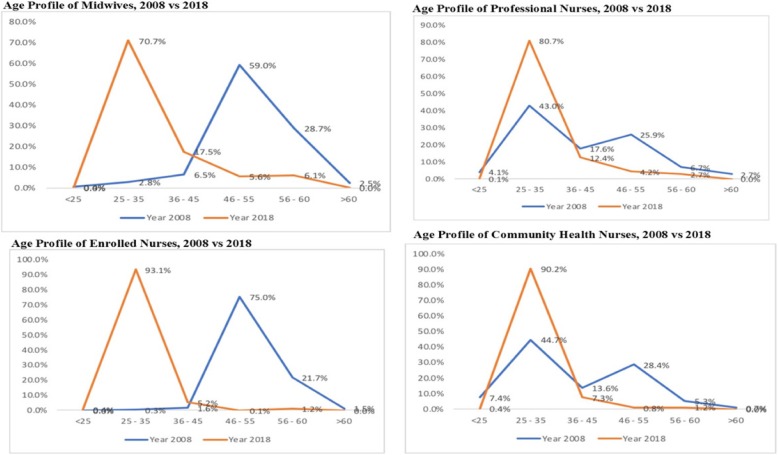
As part of measures to address severe shortage of nurses and midwives, Ghana embarked on massive scale-up of the production of nurses and midwives which has yielded remarkable improvements in nurse staffing levels. It has, however, also resulted in a dramatic demographic shift in the nursing and midwifery workforce in which 71 to 93% of nurses and midwives by 2018 were 35 years or younger, as compared with 2.8 to 44% in 2008. In this commentary, we examine how the drastic generational transition could adversely impact on the quality of nursing care and how the educational advancement needs of the young generation of the nursing and midwifery workforce are not being met. We propose the institution of a national nursing and midwifery mentorship programme and a review of the study leave policy to make it flexible and be based on a comprehensive training needs assessment of the nursing and midwifery workforce. We further advocate that policymakers should also consider upgrading all professional nursing and midwifery programmes to bachelor degrees as this would not only potentially enhance the quality of training but also address the phenomenon of large numbers of nurses and midwives seeking bachelor degree training soon after employment-sometimes putting them at the offending side of organisational policy.
Overview
The claims and statistics of this paper haven’t been checked yet.
Free: it reads the open-access text and checks the first 5 claims that cite a source we can check. Create a free account to check every claim.
Integrity signals
Registry
Cites
Statistics
Figures
Verification
Claims the paper makes
The claims and statistics of this paper haven’t been checked yet.
Free: it reads the open-access text and checks the first 5 claims that cite a source we can check. Create a free account to check every claim.
Claims other papers make about this one
Each is checked against this paper’s own text: does it say what the citing paper says it does?
The source backs part of the claim, not all of it — or backs it for a different population, condition or comparison.
In the citing paper
“Many studies conducted in Ghana, highlight the shortage of SBAs as an eminent problem of the health system [15,18,19,22,25–27].”
From A scoping review of the residual barriers to skilled birth attendance in Ghana: A conceptual framework and a fish bone analysis (2024) · cites this paper as [25]
Experimental — accuracy not yet measuredThe source backs part of the claim, not all of it — or backs it for a different population, condition or comparison.
In the citing paper
“Also, the density of SBAs thus, doctors, nurses and midwives has improved significantly from 1.07 per 1000 population to 2.5 per 1000 population between 2005 and 2017 [25].”
From A scoping review of the residual barriers to skilled birth attendance in Ghana: A conceptual framework and a fish bone analysis (2024) · cites this paper as [25]
Experimental — accuracy not yet measuredThe source backs part of the claim, not all of it — or backs it for a different population, condition or comparison.
In the citing paper
“Notwithstanding, the distribution of SBAs remain a major challenge [24,25].”
From A scoping review of the residual barriers to skilled birth attendance in Ghana: A conceptual framework and a fish bone analysis (2024) · cites this paper as [25]
Experimental — accuracy not yet measuredThe source backs part of the claim, not all of it — or backs it for a different population, condition or comparison.
In the citing paper
“This is further aggravated by limited access to in-service trainings and workshops for SBAs to enhance practical proficiency in managing maternal conditions and complications [19,25,26].”
From A scoping review of the residual barriers to skilled birth attendance in Ghana: A conceptual framework and a fish bone analysis (2024) · cites this paper as [25]
Experimental — accuracy not yet measuredThe source backs part of the claim, not all of it — or backs it for a different population, condition or comparison.
In the citing paper
“Appiah-Denkyira, Herbst [24] and Asamani, Amertil [25] concur with the above, further stating that, the quality of training nurses and midwives is deficient in infrastructure and technical capacities, thus contributing to the lack of competencies.”
From A scoping review of the residual barriers to skilled birth attendance in Ghana: A conceptual framework and a fish bone analysis (2024) · cites this paper as [25]
Experimental — accuracy not yet measured
8 more claims about this paper
Create a free account to see every claim other papers make about this one.
Self-check
Percentages, sums and reported differences re-computed from the paper’s own numbers.
The self-check needs the paper’s full text.
Citations
Cites
The World Health report 2006 1 : Working together for health 2
Guilbert, J.-J. (2006) · Education for Health: Change in Learning & Practice · doi:10.1080/13576280600937911 · Cited by 2,654
Aiken, L. H., Sloane, D. M., Bruyneel, L., Van den Heede, K., Griffiths, P., Busse, R., Diomidous, M., Kinnunen, J., Kózka, M., Lesaffre, E., et al. (2014) · The Lancet · doi:10.1016/s0140-6736(13)62631-8 · Cited by 2,223
Cummings, G. G., MacGregor, T., Davey, M., Lee, H., Wong, C. A., Lo, E., Muise, M., & Stafford, E. (2010) · International Journal of Nursing Studies · doi:10.1016/j.ijnurstu.2009.08.006 · Cited by 1,104
Kane, R. L., Shamliyan, T. A., Mueller, C., Duval, S., & Wilt, T. J. (2007) · Medical Care · doi:10.1097/mlr.0b013e3181468ca3 · Cited by 1,097 · cited 1×
“Indeed, evidence from the international literature suggests that patients are much more safer under the care of nurses and midwives who are highly trained at least at the level of bachelors [25, 26].”
BackgroundThe relationship between nursing leadership and patient outcomes: a systematic review update
Wong, C. A., Cummings, G. G., & Ducharme, L. (2013) · Journal of Nursing Management · doi:10.1111/jonm.12116 · Cited by 846
The relationship between nursing leadership and patient outcomes: a systematic review
WONG, C. A., & CUMMINGS, G. G. (2007) · Journal of Nursing Management · doi:10.1111/j.1365-2834.2007.00723.x · Cited by 355
Human resources for health and universal health coverage: fostering equity and effective coverage
Campbell, J., Buchan, J., Cometto, G., David, B., Dussault, G., Fogstad, H., Fronteira, I., Lozano, R., Nyonator, F., Pablos-Méndez, A., et al. (2013) · Bulletin of the World Health Organization · doi:10.2471/blt.13.118729 · Cited by 349 · cited 4×
“The 2006 World Health Report classified Ghana among 36 countries in sub-Saharan Africa facing Human Resources for Health (HRH) crisis [3] which became a clarion call for concerted efforts to address a myriad of health workforce challenges notably, inadequate production, excessive out-migration and low wages among othe…”
BackgroundInfluentialThe Contribution of Hospital Nursing Leadership Styles to 30-day Patient Mortality
Cummings, G. G., Midodzi, W. K., Wong, C. A., & Estabrooks, C. A. (2010) · Nursing Research · doi:10.1097/nnr.0b013e3181ed74d5 · Cited by 151
Scheffler, R. M., Mahoney, C. B., Fulton, B. D., Dal Poz, M. R., & Preker, A. S. (2009) · Health Affairs · doi:10.1377/hlthaff.28.5.w849 · Cited by 112 · cited 1×
“shortages and inequitable distribution [10, 11] alongside a publicly acknowledged challenge of trained but un-”
BackgroundLeadership styles in nursing management: implications for staff outcomes
Asamani, J. A., Naab, F., & Ofei, A. M. A. (2016) · Journal of Health Sciences · doi:10.17532/jhsci.2016.266 · Cited by 73
Self-citation
Research works printed but not linked: 3
- MOH Human resource policies and strategies for the health sector, 2007–2011 [Internet] 2007 Ghana Ministry of Health
- Sagoe K Human resources for health - challenges and strategies to address them in sub-Saharan Africa 2013
- GHS Human resource annual report - 2018 2019 Accra Ghana Health Service
Cited by
Developing the health workforce for universal health coverage
Cometto, G., Buchan, J., & Dussault, G. (2019) · Bulletin of the World Health Organization · doi:10.2471/blt.19.234138 · Cited by 197
“requirements for skills and competencies in the health and social care workforce (United Kingdom of Great Britain and Northern Ireland),(9) improve the distribution of pharmacists (Lebanon)(10) and assess the planning implications of demographic change in the nursing workforce (Ghana).(11)”
BackgroundAdatara, P., Amooba, P. A., Afaya, A., Salia, S. M., Avane, M. A., Kuug, A. K., Maalman, R. S.-E., Atakro, C. A., Attachie, I. T., & Atachie, C. (2021) · BMC Pregnancy and Childbirth · doi:10.1186/s12884-021-03762-0 · Cited by 101
Alhassan, R. K., Owusu‐Agyei, S., Ansah, E., & Gyapong, M. (2021) · Human Resources for Health · doi:10.1186/s12960-021-00657-1 · Cited by 61
Clinical learning environment of nursing and midwifery students in Ghana
Ziba, F. A., Yakong, V. N., & Ali, Z. (2021) · BMC Nursing · doi:10.1186/s12912-020-00533-8 · Cited by 65
Burnout syndrome among healthcare workers during COVID-19 Pandemic in Accra, Ghana
Konlan, K. D., Asampong, E., Dako‐Gyeke, P., & Glozah, F. N. (2022) · PLoS ONE · doi:10.1371/journal.pone.0268404 · Cited by 56
“A significant proportion of the global workforces are made up of health workers who contribute immensely towards effective healthcare delivery [1].”
BackgroundResultInfluentialIsmaila, Y., Bayes, S. J., & Geraghty, S. (2021) · BMC Health Services Research · doi:10.1186/s12913-021-07049-0 · Cited by 34
“One measure adopted to improve outcomes for women and neonates is the improvement of skilled attendance at birth by the training and recruitment of more midwives, but the country still faces a shortage of midwives [9, 30].”
BackgroundAtatsi, E. A., Azila-Gbettor, E. M., & Mensah, C. (2021) · Cogent Business & Management · doi:10.1080/23311975.2021.1917483 · Cited by 34
“Four hundred and thirty-eight (438) nurses working across 25 district, municipal and regional health facilities in the Volta Region of Ghana participated in the study.”
BackgroundInfluentialA Comparative Analysis of Student and Practising Nurses’ Health Literacy Knowledge in Ghana
Koduah, A. O., Amoah, P. A., Nkansah, J. O., & Leung, A. Y. M. (2021) · Healthcare · doi:10.3390/healthcare9010038 · Cited by 24
“Some argue that the current young nurses in Ghana are relatively inexperienced because there are too few clinical mentors to guide them [6].”
BackgroundInfluentialAfaya, A., Bam, V. B., Azongo, T. B., Afaya, R. A., Yakong, V. N., Kpodo, G. K., Alhassan, R. K., Zinle, D. A. N., Tayuu, D. K., Asantewaa, S., et al. (2021) · PLoS ONE · doi:10.1371/journal.pone.0247062 · Cited by 38
Staffing the unit with nurses: the role of nurse managers
Ofei, A. M. A., Paarima, Y., Barnes, T. C., & Kwashie, A. A. (2021) · Journal of Health Organization and Management · doi:10.1108/jhom-04-2020-0134 · Cited by 29
Nurses’ attitudes towards hospitalized older adults in a tertiary care setting in Ghana
Yakubu, Y. H., Fuseini, A., & Holroyd, E. A. (2022) · Nursing Open · doi:10.1002/nop2.1216 · Cited by 26
“All these pieces of training have been set up to ensure quality health care since nurses in Ghana form 58% of all healthcare workers (Asamani et al., 2019).”
BackgroundKonlan, K. D., Asampong, E., Dako‐Gyeke, P., & Glozah, F. N. (2022) · BMC Health Services Research · doi:10.1186/s12913-022-08539-5 · Cited by 31
Mijakoski, D., Atanasovska, A., Bislimovska, D., Brborović, H., Brborović, O., Kezunović, L. C., Milošević, M., Минов, Ј., Önal, B., Pranjić, N., et al. (2023) · Frontiers in Psychology · doi:10.3389/fpsyg.2023.1258226 · Cited by 22
Wyk, J. V., Wolvaardt, L., & Nyoni, C. N. (2020) · African Journal of Health Professions Education · doi:10.7196/ajhpe.2020.v12i4.1389 · Cited by 16
“[10] The lack of capacity development programmes that are tailored to the needs of nurse educators, inadequate numbers of qualified nurse educators,[11] and lack of self-directedness among nurse educators in Africa[12] compromise the quality of nursing education and consequently the competencies of graduates of nursin…”
BackgroundAsante, K. P., Iwelunmor, J., Apusiga, K., Gyamfi, J., Nyame, S., Adjei, K. G. A., Aifah, A. A., Adjei, K. K., Onakomaiya, D. O., Chaplin, W. F., et al. (2020) · Trials · doi:10.1186/s13063-020-04667-7 · Cited by 16
Adjei, C. A., Adjorlolo, S., Kyei, J. M., Ohene, L. A., Dzansi, G., Acheampong, A. K., Asante, I. N. A., Woolley, P., Nyante, F., & Aziato, L. (2022) · Nursing Open · doi:10.1002/nop2.1342 · Cited by 14
“Many African higher learning institutions have recently begun to complement traditional education with online distance education (Andoh et al., 2020 ; Asunka, 2014; Kotoua et al., 2015 ; Letseka et al., 2018 ; Tagoe & Cole, 2020 ).”
BackgroundExamining toxic leadership, pay satisfaction and LMX among nurses: evidence from Ghana
Dartey‐Baah, K., Quartey, S. H., & Asante, K. G. (2023) · Industrial and Commercial Training · doi:10.1108/ict-07-2022-0050 · Cited by 20
Aziato, L., Pwavra, J. B. P., Paarima, Y., & Konlan, K. D. (2021) · Frontiers in Psychology · doi:10.3389/fpsyg.2021.549766 · Cited by 14
Ending discrimination in healthcare
Amon, J. J. (2020) · Journal of the International AIDS Society · doi:10.1002/jia2.25471 · Cited by 13
“While Ghana has invested significantly in increasing the number of nurses and midwives and exceeds the WHO’s recommended nurse to population ratio, many challenges to ensuring quality care remain, including the training and mentoring of newly trained nurses [1].”
BackgroundAmuasi, J., Agbogbatey, M., Sarfo, F. S., Beyuo, A., Duah, K., Agasiya, P., Arthur, A., Appiah, L. T., Nguah, S. B., Bockarie, A. S., et al. (2022) · Journal of the Neurological Sciences · doi:10.1016/j.jns.2022.120304 · Cited by 14
The Image of Nurses and Midwives in Ghana: Patient and Family Perspectives
Ohene, L. A., Acheampong, A. K., Dzansi, G., Kyei, J. M., Adjei, C. A., Adjorlolo, S., Asante, I. N. A., Woolley, P., Nyante, F., & Aziato, L. (2022) · Global Qualitative Nursing Research · doi:10.1177/23333936221137584 · Cited by 17
“For example, over the past two decades, Ghana has witnessed considerable private sector involvement in nursing and midwifery practice, especially concerning providing training to improve the human resource element of healthcare delivery (Asamani et al., 2019).”
BackgroundBawafaa, E. (2023) · Nursing Inquiry · doi:10.1111/nin.12614 · Cited by 14
Coping, health anxiety, and stress among health professionals during Covid-19, Cape Coast, Ghana
Nkyi, A. K., & Baaba, B. (2024) · PLoS ONE · doi:10.1371/journal.pone.0296720 · Cited by 15
Clinical education in undergraduate nursing in Ghana: a gap analysis
Hobenu, K. A., Adefuye, A. O., Naab, F., & Nyoni, C. N. (2025) · BMC Nursing · doi:10.1186/s12912-025-03167-w · Cited by 14
“Ghana battles with a complex disease burden [28], a shortage of health professionals [29], and limited opportunities for post-registration mentorship and induction for newly qualified nurses [30].”
Anthony, D., Alosaimi, D. N., Dyson, S., Korsah, K. A., & Saleh, M. (2020) · Nurse Education in Practice · doi:10.1016/j.nepr.2020.102857 · Cited by 10
Perception of Ghanaian healthcare students towards the learning of sign language as course
Adade, R., Appau, O., Peprah, P., Serwaa, P. M., Fobi, D., & Tawiah, R. (2023) · Cogent Public Health · doi:10.1080/27707571.2023.2192999 · Cited by 12
Leadership competencies of first-line nurse managers: a quantitative study
Paarima, Y., Kwashie, A. A., Asamani, J. A., & Ofei, A. M. A. (2021) · Leadership in health services · doi:10.1108/lhs-05-2021-0047 · Cited by 23
Self-citationA qualitative document analysis of policies influencing preeclampsia management by midwives in Ghana
Garti, I., Gray, M., Bromley, A., & Tan, J.-Y. B. (2022) · Women and Birth · doi:10.1016/j.wombi.2022.01.006 · Cited by 15
Konlan, K. D., Pwavra, J. B. P., Armah‐Mensah, M. A. S., Konlan, K. D., Aryee, R., & Narkotey, S. (2022) · Nursing Open · doi:10.1002/nop2.1296 · Cited by 10
“In Ghana, more than 60% of women in formal employment are in their fertile ages and these women are likely to get pregnant (Asamani et al., 2019).”
BackgroundResultInfluentialExploring the governance practices of nurse managers in the Greater Accra Region of Ghana
Ofei, A. M. A., & Paarima, Y. (2021) · Journal of Nursing Management · doi:10.1111/jonm.13288 · Cited by 13
Agyei, F. B., Nti, F., Anago, E. K., & Avinu, E. S. (2022) · Journal of Client-centered Nursing Care · doi:10.32598/jccnc.8.3.434.1 · Cited by 11
Asamani, J. A., Kwesiga, B., Okoroafor, S. C., Chagina, E., Gondi, J., Gura, Z., Motiri, F. O., Jumba, N., Ogumbo, T., Mutungi, N., et al. (2025) · PLOS Global Public Health · doi:10.1371/journal.pgph.0003966 · Cited by 11
Self-citationKanligi, D. A., Boah, M., & Adokiya, M. N. (2022) · PLoS ONE · doi:10.1371/journal.pone.0274049 · Cited by 6
Nyande, F. K., Ricks, E. J., Williams, M. H., & Jardien‐Baboo, S. (2024) · BMC Nursing · doi:10.1186/s12912-024-01811-5 · Cited by 5
Perception of nurse managers’ care coordination practices among nurses at the unit level
Ofei, A. M. A., & Paarima, Y. (2021) · International Journal of Care Coordination · doi:10.1177/2053434521999978 · Cited by 8
“Globally, clients seeking healthcare services are required to navigate their way through and around a multifaceted healthcare system.1 This is often a difficult and unfamiliar environment for clients who usually require some level of social and health literacy.1,2 Given this, it is imperative for healthcare providers…”
BackgroundResultInfluentialAbredu, J., Dwumfour, C. K., Alipitio, B., Alordey, M., Dzomeku, V. M., & Witter, S. (2024) · PLOS Global Public Health · doi:10.1371/journal.pgph.0002902 · Cited by 4
Burnout is a predictor of high ten-year risk of cardiovascular disease among health workers in Ghana
Konlan, K. D. (2025) · BMC Public Health · doi:10.1186/s12889-025-23834-6 · Cited by 7
Dartey, A. F., Tackie, V., Lotse, C. W., Dodoo, L., & Sagbo, F. M. (2024) · SAGE Open Nursing · doi:10.1177/23779608241275323 · Cited by 7
“This shift arrangement involves the morning shift, afternoon shift, day shift, and night shift; within a four-week (28-day) roster period (Asamani et al., 2019).”
BackgroundBoakye, D. S., Konadu, E., & Mavhandu‐Mudzusi, A. H. (2022) · International Journal of Africa Nursing Sciences · doi:10.1016/j.ijans.2022.100519 · Cited by 4
“This was not surprising because a demographic survey in Ghana showed about 71 – 93 % of nurses and midwives in 2018 were 35 years or less (Asamani et al., 2019).”
Hinneh, T. K., Baah, F. O., Amoako, E., Baptiste, D., Turkson‐Ocran, R., Agore, A., Adombire, S., Decker, M., Apau, D., Fankah, I., et al. (2023) · Nursing Open · doi:10.1002/nop2.1997 · Cited by 4
“Between 2008 and 2018, the nursing and midwifery workforce increased by almost 370% due to a Human Resources for Health (HRH) strategy implemented by the Ministry of Health between 2007 and 2011 in response to the human resource crisis in the African region (Asamani et al., 2019).”
BackgroundInfluentialGarti, I., Gray, M., Bromley, A., & Tan, J.-Y. B. (2023) · Women and Birth · doi:10.1016/j.wombi.2023.11.001 · Cited by 8
Pre-eclampsia training needs of midwives in a Ghanaian tertiary hospital: A cross-sectional study
Garti, I., Gray, M., Bromley, A., & Tan, J.-Y. B. (2024) · Nurse Education in Practice · doi:10.1016/j.nepr.2024.103872 · Cited by 8
Pwavra, J. B. P., Donkor, E. S., Ani–Amponsah, M., & Konlan, K. D. (2022) · International Journal of Africa Nursing Sciences · doi:10.1016/j.ijans.2022.100516 · Cited by 2
Puplampu, G. L., LeMay, L. M., Ampofo, E. A., & Caine, V. (2023) · Nursing Open · doi:10.1002/nop2.1787 · Cited by 2
“Ghana's programme on Prevention from Mother- to- Child- Transmission (PMTCT) is mainly carried out by midwives and nurses (Asamani et al., 2019).”
BackgroundInfluentialBibliometric Analysis of Research Trends and Novelty of Midwifery Policy
Damayanti, F. N., Lutfitasari, A., Santosa, B., Prakasiwi, S. I., Suparman, S., & Anggraini, N. N. (2024) · Africa Journal of Nursing and Midwifery · doi:10.25159/2520-5293/14031 · Cited by 3
Nortey, M. A., & Asampong, E. (2024) · Nursing & Midwifery Research Journal · doi:10.1177/0974150x241296600 · Cited by 2
“Nurses are highly trained healthcare professionals 23,24 ; they are well-placed to enhance timely identification, triaging, and management of perinatal depression 16–18 ; and are expected to be adequately knowledgeable.”
Dartey, A. F., Tackie, V., Lotse, C. W., Ofori, J. Y., Bansford, E. T. M., & Hamenu, P. Y. (2024) · Heliyon · doi:10.1016/j.heliyon.2024.e32046 · Cited by 1
Nyame, S., Iwelunmor, J., Asante, K. P., Gyamfi, J., Adjei, K. K., Apusiga, K., Onakomaiya, D. O., Adjei, K. G. A., Aifah, A. A., Plange‐Rhule, J., et al. (2021) · Research Square · doi:10.21203/rs.3.rs-155327/v1 · Cited by 1
Nyame, S., Iwelunmor, J., Asante, K. P., Gyamfi, J., Adjei, K. K., Apusiga, K., Onakomaiya, D. O., Adjei, K. G. A., Aifah, A. A., Plange‐Rhule, J., et al. (2021) · Research Square · doi:10.21203/rs.3.rs-155327/v2 · Cited by 1
Zuuri, C. N., Nyarko, R., Dotse, B. P., Dzamenu, P., Gyamfi, S., Munufie, E., Darko, F. M., Mensah, G. K., Kyei, L., & Gyeng, B. B. (2025) · Research Square · doi:10.21203/rs.3.rs-7095575/v1 · Cited by 1
Dzansi, G., Kyei, J. M., Ohene, L. A., Acheampong, A. K., Adjei, C. A., Adjorlolo, S., Asante, I. N. A., Woolley, P., Nyante, F., & Aziato, L. (2020) · Research Square · doi:10.21203/rs.3.rs-105362/v1
“Firm and fair leaders serve as role models in guiding the younger generation to adopt the right attitude to work through mentoring [22].”
BackgroundComprehensive Analysis of the Level of Knowledge, Stigma in an HIV/AIDS Program
Purba, I. E., Sinaga, T. R., & Adiansyah, A. (2023) · International Journal Of Science Technology & Management · doi:10.46729/ijstm.v4i5.947
“Due to a lack of HIV services, 1.7 million people acquired the virus for the first time in 2019, and 690,000 people died from HIV-related causes [1,2].”
BackgroundInfluentialPerformance execution practices of nurse managers: Evidence from a teaching hospital
Barnes, T., & Boohene, D. (2024) · Majallah-i dānishkadah-i pizishkī.Dānishgāh-i ̒ulūm-i pizishkī va khadamāt-i bihdāshtī- darmānī-i Tihrān./Majallah-i dānishkadah-i pizishkī.Dānishgāh-i ̒ulūm-i pizishkī va khadamāt-i bihdāshtī- darmānī-i Tihrān. · doi:10.61186/edcj.17.54.111
Taiko, W., & Muriu, S. M. (2025) · Journal of Human Resource &Leadership · doi:10.53819/81018102t2491
Mensah, J., Mpuan, C. B., & Nanteer-Oteng, E. (2025) · International Journal of Africa Nursing Sciences · doi:10.1016/j.ijans.2025.100868 · Cited by 2
Ismaila, Y., Bayes, S. J., & Geraghty, S. (2021) · Figshare · doi:10.6084/m9.figshare.16928418
Asante, K. P., Iwelunmor, J., Apusiga, K., Gyamfi, J., Nyame, S., Adjei, K. G. A., Aifah, A. A., Adjei, K., Onakomaiya, D. O., Chaplin, W. F., et al. (2020) · Figshare · doi:10.6084/m9.figshare.13047327
Bodden, K. H., Pérez, N., Chacon, A. D., Challinor, J. M., & Olarte‐Sierra, M. F. (2026) · Seminars in Oncology Nursing · doi:10.1016/j.soncn.2026.152245
Mensah, O. N., Takro-Turkson, S., Boateng, J., Lampinley, A., Amoah, W. W., & Eshun, E. G. (2026) · BMC Medical Education · doi:10.1186/s12909-026-09908-y
“This finding supports previous studies indicating that gender stereotypes are associated with career aspirations and the underrepresentation of men in nursing [7, 12, 13].”
Metadata
- Authors
- Asamani, J. A., Amertil, N. P., Ismaila, H., Francis, A. A., Chebere, M. M., & Nabyonga-Orem, J.
- Affiliations
- World Health Organization - Zimbabwe (ZW)
- Valley View University (GH)
- Ghana Health Service (GH)
- Corresponding author
- Asamani, James Avoka
- Venue
- Human Resources for Health
- Published
- 2019-05-22
- Volume
- 17
- Issue
- 1
- Pages
- 32-32
- ISSN
- 1478-4491 (ISSN-L)
- PMC
- PMC6530167
- OpenAlex
- W2946593899
- Cited by
- 59
- References
- 18
- Citations by year
- 2026: 2 · 2025: 6 · 2024: 9 · 2023: 8 · 2022: 12 · 2021: 15 · 2020: 6 · 2019: 1
- FWCI
- 12.48
- Type
- journal article
- Language
- en
- Open access
- gold
- doi.org
- Licence
- cc-by
- creativecommons.org/licenses/by/4.0/ (tdm)
- creativecommons.org/licenses/by/4.0/ (vor)
- Locations
- Human Resources for Health (publishedVersion, cc-by)
- PubMed Central (publishedVersion, cc-by)
- PubMed (publishedVersion)
- DOAJ (DOAJ: Directory of Open Access Journals) (submittedVersion, cc-by-sa)
- Funders
- World Health Organization
- Topics
- Health Sciences › Medicine › Public Health, Environmental and Occupational Health › Global Health Workforce Issues
- Health Sciences › Nursing › Research and Theory › Nursing education and management
- Health Sciences › Nursing › Issues, ethics and legal aspects › Nursing Education, Practice, and Leadership
- Keywords
- nursing shortage, midwife shortage, generational change, nurse staffing, nursing care quality, mentoring programs, training needs assessment, nursing education policy, Ghana
- MeSH terms
- Adult, Age Factors, Demography, Education, Nursing, Ghana, Humans, Middle Aged, Midwifery, Nurses, Young Adult
About these checks
Registry, retraction, Cites and statistics results are computed, not judged, with one exception: a printed reference that no index lists is read once by a model before it counts as a citation error. Claims are extracted by a model and kept only when their quote appears verbatim in the text; each cited source is then checked, with a model’s help, for whether it says what the claim relies on. Those verdicts can be wrong — read the claim’s quote and the cited source before relying on one.
Statistics and arithmetic are recomputed, not judged.
Confidence bands are shown only for fields calibrated on our annotated test set. None is calibrated yet, so no band is shown.
What counts as a claim ›How we measure confidence ›How we check this ›
Are you an author, or do you see a problem with this page? Request a review
Data sources
Bibliographic data: Semantic Scholar, OpenAlex, Crossref.
Contains information from the Semantic Scholar Academic Graph Datasets, made available under the ODC Attribution License (ODC-BY 1.0).
Semantic Scholar’s data is described in: Kinney, R., et al. (2023). The Semantic Scholar Open Data Platform. arXiv:2301.10140.
