

Employment and working conditions of nurses: where and how health inequalities have increased during the COVID-19 pandemic?
Open accessThe DOI matches its Crossref record; 57 of the 60 references it cites were found in a registry or an index.
Abstract
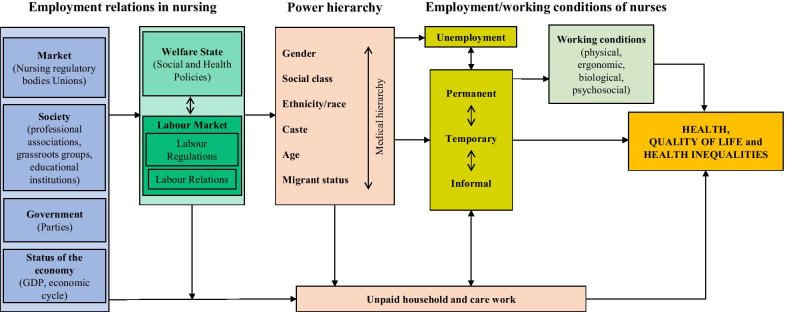
Background: Nurses and midwives play a critical role in the provision of care and the optimization of health services resources worldwide, which is particularly relevant during the current COVID-19 pandemic. However, they can only provide quality services if their work environment provides adequate conditions to support them. Today the employment and working conditions of many nurses worldwide are precarious, and the current pandemic has prompted more visibility to the vulnerability to health-damaging factors of nurses’ globally. This desk review explores how employment relations, and employment and working conditions may be negatively affecting the health of nurses in countries such as Brazil, Croatia, India, Ireland, Italy, México, Nepal, Spain, and the United Kingdom. Main body: Nurses’ health is influenced by the broader social, economic, and political system and the redistribution of power relations that creates new policies regarding the labour market and the welfare state. The vulnerability faced by nurses is heightened by gender inequalities, in addition to social class, ethnicity/race (and caste), age and migrant status, that are inequality axes that explain why nurses’ workers, and often their families, are exposed to multiple risks and/or poorer health. Before the COVID-19 pandemic, informalization of nurses’ employment and working conditions were unfair and harmed their health. During COVID-19 pandemic, there is evidence that the employment and working conditions of nurses are associated to poor physical and mental health. Conclusion: The protection of nurses’ health is paramount. International and national enforceable standards are needed, along with economic and health policies designed to substantially improve employment and working conditions for nurses and work–life balance. More knowledge is needed to understand the pathways and mechanisms on how precariousness might affect nurses’ health and monitor the progress towards nurses’ health equity.
Overview
The claims and statistics of this paper haven’t been checked yet.
Free: it reads the open-access text and checks the first 5 claims that cite a source we can check. Create a free account to check every claim.
Integrity signals
Registry
Cites
Statistics
Figures
Verification
Claims the paper makes
The claims and statistics of this paper haven’t been checked yet.
Free: it reads the open-access text and checks the first 5 claims that cite a source we can check. Create a free account to check every claim.
Claims other papers make about this one
Each is checked against this paper’s own text: does it say what the citing paper says it does?
The source backs part of the claim, not all of it — or backs it for a different population, condition or comparison.
In the citing paper
“Escalating this issue are high rates of absence and turnover, driven by an unprecedented level of physician and nurse burnout due to psychosocial stressors and occupational hazards such as exposure to infectious diseases, shiftwork, or ergonomic challenges, that place health care workers at risk for long-term mental and physical health consequences [6-9].”
From AI Interventions to Alleviate Healthcare Shortages and Enhance Work Conditions in Critical Care: Qualitative Analysis (2025) · cites this paper as [8]
Experimental — accuracy not yet measuredIn the citing paper
“Other vulnerable groups not identified in our review included the migrant HCWs who have been separated from their families since the start of pandemic and were unable to visit their country of origin due to travel or hospital administration restrictions [94].”
From A global overview of healthcare workers’ turnover intention amid COVID-19 pandemic: a systematic review with future directions (2022) · cites this paper as [94]
Self-check
Percentages, sums and reported differences re-computed from the paper’s own numbers.
The self-check needs the paper’s full text.
Citations
Cites
Pappa, S., Ntella, V., Giannakas, T., Giannakoulis, V. G., Papoutsi, E., & Katsaounou, P. (2020) · Brain Behavior and Immunity · doi:10.1016/j.bbi.2020.05.026 · Cited by 3,617 · cited 1×
“Moreover, this systematic review also found gender and occupational differences, where female and nurses had higher rates of affective symptoms [10].”
BackgroundNguyen, L. H., Drew, D. A., Graham, M. S., Joshi, A. D., Guo, C.-G., Ma, W., Mehta, R. S., Warner, E. T., Sikavi, D. R., Lo, C.-H., et al. (2020) · The Lancet Public Health · doi:10.1016/s2468-2667(20)30164-x · Cited by 2,395
The experiences of health-care providers during the COVID-19 crisis in China: a qualitative study
Liu, Q., Luo, D., Haase, J. E., Guo, Q., Wang, X. Q., Liu, S., Xia, L., Liu, Z., Yang, J., & Yang, B. X. (2020) · The Lancet Global Health · doi:10.1016/s2214-109x(20)30204-7 · Cited by 1,552 · cited 1×
“This responsibility has turned to be particularly relevant during the current COVID-19 pandemic, where nurses in the public and private sectors are leading COVID-19 care, testing, triage, and management [1], placing them to a unique position able to deal Open Access”
BackgroundFernandez, R., Lord, H., Halcomb, E., Moxham, L., Middleton, R., Alananzeh, I., & Ellwood, L. (2020) · International Journal of Nursing Studies · doi:10.1016/j.ijnurstu.2020.103637 · Cited by 728 · cited 4×
“During COVID-19 pandemic, nurses, as other healthcare workers, have been working longer hours and/or with different shift patterns, and nursing staff has been reassigned from other clinical areas to, for example, ICU [34], current employment and working conditions of nurses are associated to poor physical and mental i…”
BackgroundResultInfluentialThe neglected health of international migrant workers in the COVID-19 epidemic
Liem, A., Wang, C., Wariyanti, Y., Latkin, C. A., & Hall, B. J. (2020) · The Lancet Psychiatry · doi:10.1016/s2215-0366(20)30076-6 · Cited by 373 · cited 1×
“Countries are failing to evaluate and respond to the impact of COVID-19 on the physical and mental wellbeing of migrant workers [77] and data on SARS-CoV-2 infection and COVID-19 deaths in migrant nurses is not systematically collected.”
BackgroundMoss, M., Good, V. S., Gozal, D., Kleinpell, R., & Sessler, C. N. (2016) · American Journal of Respiratory and Critical Care Medicine · doi:10.1164/rccm.201604-0708st · Cited by 327 · cited 1×
“Under usual employment and working conditions, health care workers are known to be at risk for depression, stress, anxiety, burnout or insomnia [9].”
BackgroundMonitoring approaches for health-care workers during the COVID-19 pandemic
Bielicki, J. A., Duval, X., Gobat, N., Goossens, H., Koopmans, M., Tacconelli, E., & van der Werf, S. (2020) · The Lancet Infectious Diseases · doi:10.1016/s1473-3099(20)30458-8 · Cited by 315 · cited 15×
“For example, the country’s purchasing capacity, the availability of PPE or vaccine production capacities, and the international dispute over scarce health workers.”
BackgroundInfluentialRacial Disparities in COVID‐19 Mortality Among Essential Workers in the United States
Rogers, T. N., Rogers, C. R., VanSant‐Webb, E., Gu, L. Y., Yan, B., & Qeadan, F. (2020) · World Medical & Health Policy · doi:10.1002/wmh3.358 · Cited by 309 · cited 1×
“It has also been shown that Black workers were nearly three times more likely than White workers to hold support roles in health care, such as nurse aides or orderlies [73].”
BackgroundMoss, M., Good, V. S., Gozal, D., Kleinpell, R., & Sessler, C. N. (2016) · Chest · doi:10.1016/j.chest.2016.02.649 · Cited by 302
CARACTERISTICAS GERAIS DA ENFERMAGEM: O PERFIL SÓCIO DEMOGRÁFICO
Machado, M. H., Filho, W. A., De Lacerda, W. F., De Oliveira, E., Lemos, W., Wermelinger, M., Vieira, M., Dos Santos, M. R., Junior, P. B. D. S., Justino, E., et al. (2016) · Enfermagem em Foco · doi:10.21675/2357-707x.2016.v7.nesp.686 · Cited by 217 · cited 7×
“Evidence from countries in South Africa [20], Kenya, Tanzania and Uganda [21], Catalonia [17, 22], Brazil [23], Chile [24], Colombia [25], Mexico [26–28], and Thailand [29] show that employment and working conditions of nurses before this pandemic were already associated to poor physical and mental health, and in some…”
BackgroundInfluential
Research works printed but not linked: 5
- Julià Pérez M. Precarització de les condicions d'ocupació a la Unió Europea: Precarietat, informalitat, i associació amb la salut (Ph.D. Thesis). TDX (Tesis Doctorals en Xarxa). Universitat Pompeu Fabra; 2016 (cited 2020 Nov 26). http:// www. tdx. cat/ handle/ 10803/ 406084.
- Paudel S, Menge J. Under pressure: health care workers fighting at the frontlines in Nepal. The Friedrich-Ebert-Stiftung; 2020. https:// www. fes- asia. org/ news/ alrea dy-under-press ure-health-care-worke rs-fight ing-at- the-front lines-in-nepal/.
- The Guardian. Pregnant nurse's death adds to concern among health workers. the Guardian. 2020 (cited 2020 Nov 26); http:// www. thegu ardian. com/ world/ 2020/ apr/ 15/ pregn ant-healt hcare-worke rs-press ured- into-covid-19-front line.
- Baru RV. Privatisation of Health services: a South Asian perspective. Eco- nomic Political Weekly. 2003;38:4433-7.
- Sørensen A. Kvindefag i historisk skruetvinge: En analyse af tjenest- emandsreformens betydning for hierarkiet i offentlige lønninger fra 1969 til 2019. Copenhagen: Institut for Menneskerettigheder; 2020.
Cited by
Items 101–140 of 140
Loepfe, J., Schlunegger, M. C., Renggli, F., & Golz, C. (2025) · HeilberufeScience · doi:10.1007/s16024-025-00428-1 · Cited by 2
Montes-Orozco, E., Mora-Gutiérrez, R. A., de-los-Cobos-Silva, S. G., Bernal-Jaquez, R., Rincón-García, E. A., Andrade, M. Á. G., & Lara-Velázquez, P. (2022) · Research Square · doi:10.21203/rs.3.rs-2288756/v1 · Cited by 1
Nurses Learning to be Powerful Leaders: What Will it Take?
Stilwell, B., & Newman, C. (2022) · Creative Nursing · doi:10.1891/cn-2021-0062
MODELOS DE GESTÃO EM ENFERMAGEM: UM DISPOSITIVO DE (DES)ENCONTROS NO CAMPO HOSPITALAR
da Silva, G. T. R., Silva, I. N. C., Lima, J. M. M., Veiga, K. B., Teixeira, G. A. D. S., & de Almeida, D. B. (2022) · Ciencia y enfermería/Ciencia y enfermería · doi:10.29393/ce28-25mggd60025
Improving care for older people: A special issue
Zisberg, A., Lickiewicz, J., & Squires, A. P. (2023) · International Journal of Nursing Studies · doi:10.1016/j.ijnurstu.2023.104475
Troops on the Front Line of a Health Battle: Filipino Nurses’ Lived Experiences in the Pandemic
Bunghanoy, R. I. R., & Lemana, H. (2023) · Journal of Health and Medical Sciences · doi:10.31014/aior.1994.06.01.258
Dallı, Ö. E., & Yıldırım, Y. (2023) · Ege Üniversitesi Hemşirelik Fakültesi Dergisi · doi:10.53490/egehemsire.1155800 · Cited by 1
Park, H., Lee, M. S., Lee, G. M., Oh, H., Hwangbo, S., Roh, S., & Kim, H. H. (2023) · Journal of Multiculture and Education · doi:10.31041/jme.2023.8.1.127
Борисовна, Т. А., Гришина, Н. К., & Egorov, M. S. (2023) · Russian Journal of Preventive Medicine · doi:10.17116/profmed20232607138
Strengthen and Protect Nurses Well-Being
Willetts, G., & Ward, K. (2023) · Springer eBooks · doi:10.1007/978-3-031-29746-5_4 · Cited by 3
Work and Health Conditions among Nursing Workers in BrazilPreprint
de Ornellas, T. C. F., & Monteiro, M. I. (2023) · Research Square · doi:10.21203/rs.3.rs-3314874/v1
COVID-19 Pandemic Exacerbated Food Insecurity Across South AmericaPreprint
Neto, C. F. A. D. V., Jacob, M. C. M., Tregidgo, D., do Valle, D. R., Bizri, H. R. E., Morcatty, T. Q., Monteiro, F. O. B., Scofield, A., Matte, A., Chaves, W. A., et al. (2023) · SSRN Electronic Journal · doi:10.2139/ssrn.4569556
Perceived Stress During COVID-19 Pandemic: The Malaysian Nurses Experience
Pasi, H., Kamaruzaman, N. A., & Nasreen, H. E. (2023) · JURNAL INFO KESEHATAN · doi:10.31965/infokes.vol21.iss3.1114 · Cited by 1
Opiniões de estudantes de graduação em Enfermagem sobre condições de trabalho
Aydoğdu, A. L. F. (2023) · Investigación en Enfermería Imagen y Desarrollo · doi:10.11144/javeriana.ie25.oege
“Participantes relataram que mesmo depois do advento da pandemia de Covid-19, momento em que os enfermeiros foram fundamentais para a prevenção e promoção da saúde da população, não houve uma devida valorização da enfermagem.”
El diálogo político sanitario para el fortalecimiento de enfermería en Uruguay
Umpiérrez, A. F., Pérez, M., Valli, C., Garbero, L. G., Olivera, C., Dias, B. M., & Cassiani, S. H. D. B. (2023) · Revista Panamericana de Salud Pública · doi:10.26633/rpsp.2023.147
“También, como efecto de la pandemia del COVID-19, se evi-denciaron problemas como el multiempleo, la informalización del trabajo y las precarias condiciones laborales de los profesio-nales, con un impacto negativo en la salud física y mental de estos profesionales (25).”
BackgroundReconstrucción del bienestar en salud de enfermería en la pandemia COVID-19: Teoría de rango medio
Lara-Esquivel, E. C., López-Ramos, M. D. J., Cruz-Zúñiga, N., & González-Sánchez, D. L. (2023) · Horizon Interdisciplinary Journal · doi:10.56935/hij.v1i2.10
Stress and Burnout Among Nursing Staff Working In Forensic Services
Alkhaqani, A. L., & Al-tayee, D. R. O. (2024) · Maaen Journal for Medical Sciences · doi:10.55810/2789-9136.1043
“[20], and Microsoft Excel (2016) The chi-square test ( c 2) is used to fi nd out the relationship between the burnout, stress, and performance levels of the nurses and their population data.”
BackgroundMethodOgungbe, O., Jabakhanji, S. B., Mehta, R., McCaffrey, J., Byrne, D., Hurley, S. M., Rosman, L. M., Bansah, E. C., Ibukun, F. A., Quarshie, I. A., et al. (2024) · medRxiv · doi:10.1101/2024.04.17.24305997
Crowdfunding for health care expenses: Concerns and implications
Radovanović, B., Kupsjak, J., & Pantović, L. (2024) · Sociologija · doi:10.2298/soc2402268r
As competências de enfermagem no transporte aeromédico na Força Aérea Brasileira: estudo descritivo
Borges, L. L., Aguiar, B. G. C., Haberland, D. F., Guimarães, C. C. V., de Lima, R. A., & de Souza, B. B. S. (2024) · Revista da Escola de Enfermagem da USP · doi:10.1590/1980-220x-reeusp-2024-0129pt
Risks, demands, and health damages faced by nursing workers in confronting Covid-19
Souza, D. D. O., Flores, R. A. R., de Magalhães, A. P. N., Abagaro, C. P., Cruz, S. Â. F. D. S., & Ericson, S. (2024) · Theoretical Issues in Ergonomics Science · doi:10.1080/1463922x.2024.2405681 · Cited by 1
“In the midst of the pandemic, this issue gained prominence, which further reinforces the associations observed here (Llop-Gironés et al. 2021).”
Chaufan, C., Hemsing, N., & Moncrieffe, R. (2024) · medRxiv · doi:10.1101/2024.12.09.24318733
Exploring the Gender Gap in the Workplace
Ortiz, M. V. R., Ramos, F. M., & Reyes, J. C. T. (2025) · IGI Global eBooks · doi:10.4018/979-8-3373-6345-5.ch001
Emotional Intelligence and Post-Pandemic Resilience: A Framework for Public Health Nursing
da Silva, T. M. H. R. (2025) · IGI Global eBooks · doi:10.4018/979-8-3373-1992-6.ch007 · Cited by 1
Jalali, A., Naghibzadeh, A., Mohammadi, M. M., Rahmani, S., Moradi, P., Taghvostani, N. M., & Moradi, K. (2025) · BMC Medical Education · doi:10.1186/s12909-025-07867-4
Improving working conditions in response to skills shortages
Tkachenko, V. S., Середа, О., Lutsenko, О. Y., Musiienko, O. L., & Івчук, Ю. Ю. (2025) · European Public & Social Innovation Review · doi:10.31637/epsir-2026-1962
“Work procedures can be facilitated, for example, with adaptable technology solutions such as remote work platforms (Llop-Gironés et al., 2021).”
Cornish, J., Qiu, Y., Sheppard‐Law, S., & Levett-Jones, T. L. (2025) · Nurse Education Today · doi:10.1016/j.nedt.2025.106908 · Cited by 4
Beller, J., Graßhoff, J., & Safieddine, B. (2024) · Figshare · doi:10.6084/m9.figshare.26011848
Benavente, P., Ronda, E., & Diaz, E. (2023) · Figshare · doi:10.6084/m9.figshare.24329721
Demirezen, M., & Torun, N. (2025) · Balkan Journal of Social Sciences Balkan Sosyal Bilimler Dergisi · doi:10.55589/bsbd.1809015
Sharma, N., & Chhabra, D. (2026) · Advances in Integrative Medicine · doi:10.1016/j.aimed.2026.100651
Rahman, H. A., & Zaim, S. N. N. (2026) · BMC Health Services Research · doi:10.1186/s12913-026-14633-9
“The COVID-19 pandemic highlighted these tensions when the government temporarily banned the deployment of nurses abroad to address domestic shortages, sparking significant professional and political debate [36, 37].”
Perceived professional preparedness of final-year nursing students in Iran: a cross-sectional study
Mohammadi, M., Safari-Faramani, R., Nayeri, N. D., & Ghobadi, A. (2026) · BMC Nursing · doi:10.1186/s12912-026-04960-x
Thapa, P. P., & Sharma, P. (2026) · Research Square · doi:10.21203/rs.3.rs-10791860/v1
Self-citationHow Do Professional Nurses Practice Happiness in the Unstable Work Environment? Qualitative Inquiry
Kawalya, C., Mulira, F., Gukiina, J., & Lwanga, F. (2026) · Hospital Topics · doi:10.1080/00185868.2026.2724241
No es amor, sino trabajo de reproducción social: el cuidado y la enfermería a la luz de Nancy Fraser
Pires, M. R. G. M., & Mundim, G. D. A. (2026) · Revista da Escola de Enfermagem da USP · doi:10.1590/1980-220x-reeusp-2026-0127es
Não é amor, mas trabalho de reprodução social: cuidado e enfermagem à luz de Nancy Fraser
Pires, M. R. G. M., & Mundim, G. D. A. (2026) · Revista da Escola de Enfermagem da USP · doi:10.1590/1980-220x-reeusp-2026-0127pt
It is not love, but social reproduction labor: nursing care in light of Nancy Fraser
Pires, M. R. G. M., & Mundim, G. D. A. (2026) · Revista da Escola de Enfermagem da USP · doi:10.1590/1980-220x-reeusp-2026-0127en
“Readers will likely agree that this view of nursing is completely disconnected from the reality of care work and, moreover, is politically harmful to efforts aimed at confronting social inequalities within the profession (10–20) .”
InfluentialFactors Influencing Nurses’ Perceptions of Patient Rounding: A Cross-sectional Study
Lee, Y., & Noh, W. (2026) · Journal of Korean Academy of Nursing Administration · doi:10.11111/jkana.2025.0071
“A prior study recommended improving nurses’ working conditions [36].”
D’Aoust, A.-M., & Brethomé, C. (2026) · Critical Studies on Security · doi:10.1080/21624887.2026.2732405
Metadata
- Authors
- Llop-Gironés, A., Vračar, A., Llop-Gironés, G., Benach, J., Angeli-Silva, L., Jaimez, L., Thapa, P., Bhatta, R., Mahindrakar, S., Bontempo Scavo, S., Nar Devi, S., Barria, S., Marcos Alonso, S., & Julià, M.
- Affiliations
- Johns Hopkins University (US)
- Universitat Pompeu Fabra (ES)
- Corresponding author
- Llop-Gironés, Gisela
- ORCID
- Venue
- Human Resources for Health
- Published
- 2021-09-16
- Volume
- 19
- Issue
- 1
- Pages
- 112-112
- ISSN
- 1478-4491 (ISSN-L)
- PMC
- PMC8444178
- OpenAlex
- W3200721359
- Cited by
- 140
- References
- 60
- Citations by year
- 2026: 12 · 2025: 24 · 2024: 37 · 2023: 45 · 2022: 22
- FWCI
- 5.36
- Type
- journal article
- Language
- en
- Open access
- gold
- doi.org
- Licence
- cc-by
- creativecommons.org/licenses/by/4.0 (tdm)
- creativecommons.org/licenses/by/4.0 (vor)
- Locations
- Human Resources for Health (publishedVersion, cc-by)
- Europe PMC (PubMed Central) (publishedVersion, other-oa)
- PubMed Central (publishedVersion, cc-by)
- PubMed (publishedVersion)
- Dipòsit Digital de Documents de la UAB (Universitat Autònoma de Barcelona) (submittedVersion, cc-by)
- DOAJ (DOAJ: Directory of Open Access Journals) (submittedVersion, cc-by-sa)
- Repositori digital de la UPF (Universitat Pompeu Fabra) (submittedVersion, cc-by)
- Topics
- Health Sciences › Health Professions › General Health Professions › Healthcare Systems and Challenges
- Health Sciences › Medicine › Public Health, Environmental and Occupational Health › Occupational Health and Burnout
- Health Sciences › Medicine › Public Health, Environmental and Occupational Health › Employment and Welfare Studies
- Keywords
- working conditions, health disparities, COVID-19 pandemic, precarious employment, nurses' health, mental health, physical health, gender inequality, caste, migrant status, work-life balance, health equity, labour market policy, welfare state
- MeSH terms
- COVID-19, SARS-CoV-2, Employment, Humans, Nurses, Health Status Disparities, Pandemics
About these checks
Registry, retraction, Cites and statistics results are computed, not judged, with one exception: a printed reference that no index lists is read once by a model before it counts as a citation error. Claims are extracted by a model and kept only when their quote appears verbatim in the text; each cited source is then checked, with a model’s help, for whether it says what the claim relies on. Those verdicts can be wrong — read the claim’s quote and the cited source before relying on one.
Statistics and arithmetic are recomputed, not judged.
Confidence bands are shown only for fields calibrated on our annotated test set. None is calibrated yet, so no band is shown.
What counts as a claim ›How we measure confidence ›How we check this ›
Are you an author, or do you see a problem with this page? Request a review
Data sources
Bibliographic data: Semantic Scholar, OpenAlex, Crossref.
Contains information from the Semantic Scholar Academic Graph Datasets, made available under the ODC Attribution License (ODC-BY 1.0).
Semantic Scholar’s data is described in: Kinney, R., et al. (2023). The Semantic Scholar Open Data Platform. arXiv:2301.10140.
