

Characterising support and care assistants in formal hospital settings: a scoping review
Open accessThe DOI matches its Crossref record; 80 of the 80 references it cites were found in a registry or an index; none of the 211 sources its claims cite is checked for support yet.
Abstract
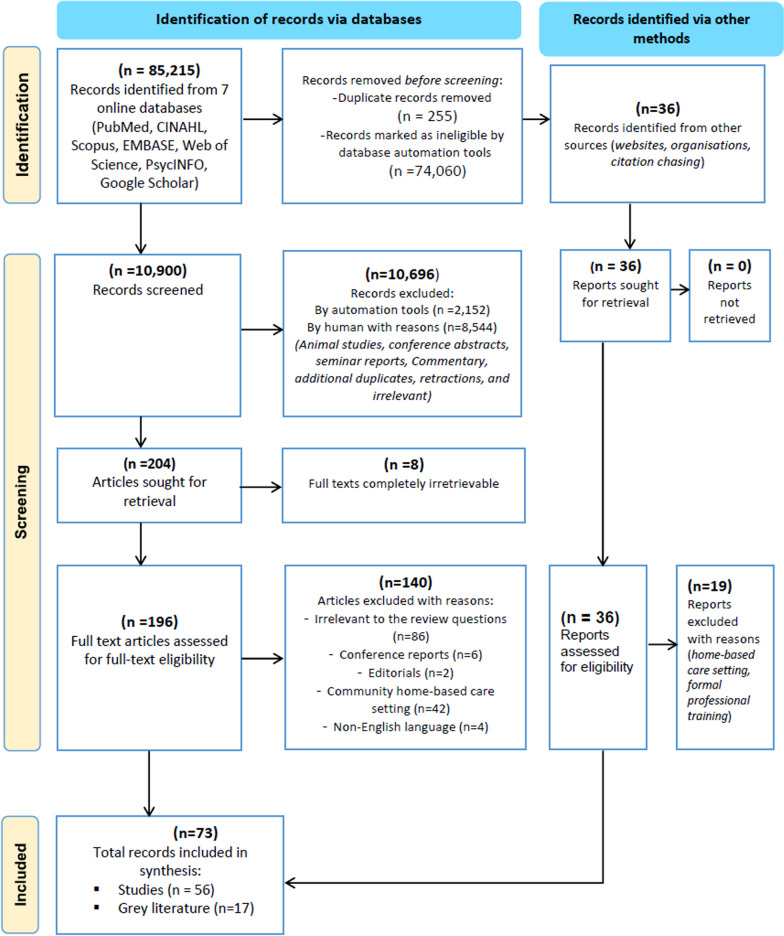
Background: A 15 million health workforce shortage is still experienced globally leading to a sub-optimal healthcare worker-to-population ratio in most countries. The use of low-skilled care assistants has been suggested as a cost-saving human resource for health strategy that can significantly reduce the risks of rationed, delayed, or missed care. However, the characterisation, role assignment, regulation, and clinical governance mechanisms for unlicensed assistive workforce remain unclear or inconsistent. The purpose of this study was to map and collate evidence of how care assistants are labelled, utilised, regulated, and managed in formal hospital settings as well as their impact on patient care. Methods: We conducted a scoping review of literature from PUBMED, CINAHL, PsychINFO, EMBASE, Web of Science, Scopus, and Google Scholar. Searches and eligibility screening were conducted using the Participants–Context–Concepts framework. Thematic content analysis guided the synthesis of the findings. Results: 73 records from a total of 15 countries were included in the final full-text review and synthesis. A majority (78%) of these sources were from high-income countries. Many titles are used to describe care assistants, and these vary within and across countries. On ascribed roles, care assistants perform direct patient care, housekeeping, clerical and documentation, portering, patient flow management, ordering of laboratory tests, emergency response and first aid duties. Additional extended roles that require higher competency levels exist in the United States, Australia, and Canada. There is a mixture of both positive and negative sentiments on their impact on patient care or nurses’ perception and experiences. Clinical and organisational governance mechanisms vary substantially across the 15 countries. Licensure, regulatory mechanisms, and task-shifting policies are largely absent or not reported in these countries. Conclusions: The nomenclature used to describe care assistants and the tasks they perform vary substantially within countries and across healthcare systems. There is, therefore, a need to review and update the international and national classification of occupations for clarity and more meaningful nomenclature for care assistants. In addition, the association between care assistants and care outcomes or nurses’ experience remains unclear. Furthermore, there is a dearth of empirical evidence on this topic from low- and middle-income countries.
Overview
CoChat Summary
TL;DR
This scoping review maps how hospital-based care assistants are labelled, used, regulated, and governed across 15 countries, finding substantial variation in nomenclature, roles, training, and oversight. Evidence on their impact on patient care and nurses’ experiences is mixed, and empirical literature from low- and middle-income countries is scarce.
Key findings
- The review included 73 records from 15 countries; 57 (78%) were from high-income countries, with the UK contributing 19 (25%), the USA 13 (17%), and Australia 7 (9%); Japan, Israel, Benin, Hong Kong, Malawi, Brazil, and Uganda had 1 report each.
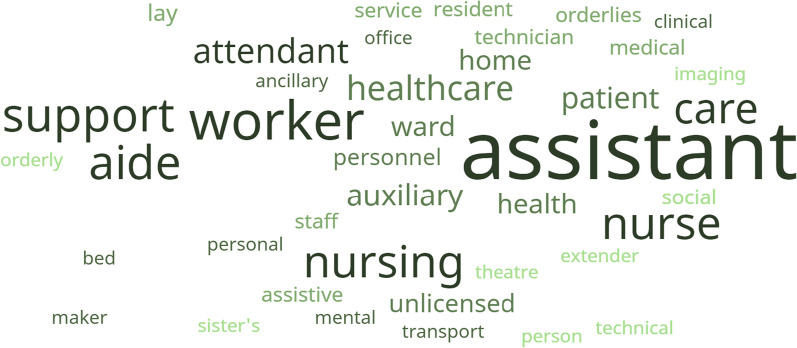
- Many titles describe care assistants and vary within and across countries: the UK had >21 term variations, Australia and Canada >11 each, and the USA and Hong Kong China >7 each; “Assistant” was the most common stem word, followed by “support staff/worker.”
- Care assistants performed 58 charted tasks grouped into 7 broad categories: direct patient care was reported in 53 records, housekeeping in 26, clerical and portering in 19 each, patient flow management and ordering laboratory tests in 4 each, and emergency response/first aid in 2 records; extended roles such as vaccination, injections, catheterisation, phlebotomy, ECG monitoring, wound/colostomy care, resuscitation, and requesting laboratory tests were mainly in Australia, Canada, the UK, and the USA.
- Only 20 (27%) papers reported patient care outcomes and 23 (32%) reported nurses’ experiences, with mixed positive and negative sentiments; only 33 (45%) mentioned organisational regulatory or clinical governance mechanisms, and nearly all countries (93%) lacked a task-shifting/sharing policy, with licensure and regulatory mechanisms largely absent or not reported.
Methods
- Scoping review following Joanna Briggs Institute and PRISMA–ScR guidance, with a protocol registered on the Open Science Framework; searches were conducted in PUBMED, CINAHL, PsychINFO, EMBASE, Web of Science, Scopus, and Google Scholar, with the last search on 20 June 2022, no time limitation, and English-language restriction.
- Eligibility used the Participants–Context–Concepts framework: included papers reported on hospital-based care assistants who support healthcare professionals with non-clinical, low-skilled basic tasks, mainly supporting nurses, and who ordinarily had no formal professional/technical pre-service training, licensing, or regulatory requirements; excluded community/home-based care, theses, conference abstracts, case reports/series, and animal studies.
- Two reviewers independently screened and charted data; thematic content analysis was conducted in NVIVO 12 Plus, with sentiment labels for patient care impact and nurses’ experiences, frequencies/word clouds for titles, task categories, and tabulation of governance mechanisms; quality and risk of bias assessment were not undertaken.
Limitations
- Stated by the paper: as a review, the methodology cannot make causal inferences about how care assistants affect patient care outcomes; eligibility was limited to English-language records; and despite an open search period and multiple databases, literature was retrieved from only 15 countries, suggesting the topic remains under-studied elsewhere.
- Stated by the paper: quality and risk of bias assessment were not undertaken because eligible papers were heterogeneous in methodology, region, care setting, participant selection, and reporting, and quality assessment is not mandatory for scoping reviews.
- Evident from the text: most sources were from high-income countries (78%), limiting generalisability to low- and middle-income settings; many records did not report outcomes, nurses’ experiences, or governance mechanisms (only 20/73, 23/73, and 33/73 respectively), so the association between care assistants and care outcomes or nurses’ experience remains unclear.
Model-written summary. Check it against the paper before relying on it.
Integrity signals
Registry
Cites
Statistics
Figures
Verification
Claims the paper makes
0 Valid · 1 Not valid · 87 Not checked · 71 Own results and interpretations
A result the paper reports from its own data — it cites no other source for it, so there is none to check. The quote shows it is in the paper.
In the paper
“High-income countries | 57 (78)”
§ Characterising support and care assistants in formal hospital settings: a scoping review > Results > Summary statistics
plain- Asserted: passes — The authors put it forward as true.
- Checkable: passes — It can be checked against evidence.
- Load-bearing: unclear — It is unclear whether the paper’s conclusions depend on it.
- Based: passes — The paper gives a reason why it holds.
A result the paper reports from its own data — it cites no other source for it, so there is none to check. The quote shows it is in the paper.
In the paper
“Only 47 (n = 64%) of the papers described the type of care setting.”
§ Characterising support and care assistants in formal hospital settings: a scoping review > Results > The hospital setting
plainn = 64- Asserted: passes — The authors put it forward as true.
- Checkable: passes — It can be checked against evidence.
- Load-bearing: unclear — It is unclear whether the paper’s conclusions depend on it.
- Based: passes — The paper gives a reason why it holds.
None of the sources cited for this claim have been checked yet.
In the paper
“-Increased patient satisfaction [51, 55, 61]”
§ Characterising support and care assistants in formal hospital settings: a scoping review > Results > Objective 2a: Impact of CAs on patient care and their experiences
What the sources say
- Not checked yetcites [51] Duffield C Twigg D Roche M Williams A Wise S Uncovering the disconnect between nursing workforce policy intentions, implementation, and outcomes: lessons learned from the addition of a nursing assistant role Policy Polit Nurs Pract 2019 20 4 228 238 10.1177/1527154419877571 31615328 source
- Not checked yetcites [55] MacKay FD Anderson JE Klein MC Berkowitz J MacKay JT Gailius J The modified medical office assistant role in rural diabetes care Can J Rural Med 2014 19 2 49 56 24698753
- Not checked yetcites [61] Faulkner K Sutton S Jamison J Sloan M Boase S Naughton F Are nurses and auxiliary healthcare workers equally effective in delivering smoking cessation support in primary care? Nicotine Tob Res 2016 18 5 1054 1060 10.1093/ntr/ntv206 26453668 PMC4826488 source
plainstates an association- Asserted: passes — The authors put it forward as true.
- Checkable: passes — It can be checked against evidence.
- Load-bearing: unclear — It is unclear whether the paper’s conclusions depend on it.
- Based: passes — The paper gives a reason why it holds.
None of the sources cited for this claim have been checked yet.
In the paper
“-Risk to patient safety [42, 50, 68]”
§ Characterising support and care assistants in formal hospital settings: a scoping review > Results > Objective 2a: Impact of CAs on patient care and their experiences
What the sources say
- Not checked yetcites [42] McKenna HP Hasson F Keeney S Patient safety and quality of care: the role of the health care assistant J Nurs Manage 2004 12 6 452 459 10.1111/j.1365-2834.2004.00514.x 15509275 source
- Not checked yetcites [50] Spilsbury K Meyer J Use, misuse and non-use of health care assistants: understanding the work of health care assistants in a hospital setting J Nurs Manage 2004 12 6 411 418 10.1111/j.1365-2834.2004.00515.x 15509270 source
- Not checked yetcites [68] Peduzzi M Anselmi ML França I Jr dos Santos CB Quality of procedures delivered by nursing assistants Rev Saude Publica 2006 40 5 843 850 10.1590/S0034-89102006000600014 17301906 source
plainstates an association- Asserted: passes — The authors put it forward as true.
- Checkable: passes — It can be checked against evidence.
- Load-bearing: unclear — It is unclear whether the paper’s conclusions depend on it.
- Based: passes — The paper gives a reason why it holds.
A result the paper reports from its own data — it cites no other source for it, so there is none to check. The quote shows it is in the paper.
In the paper
“It was noted that vital signs monitoring, patient hygiene, and feeding are top of the list of direct care duties”
§ Characterising support and care assistants in formal hospital settings: a scoping review > Results > Objective 1: Duties performed to CAs in hospital settings
plain- Asserted: passes — The authors put it forward as true.
- Checkable: passes — It can be checked against evidence.
- Load-bearing: unclear — It is unclear whether the paper’s conclusions depend on it.
- Based: passes — The paper gives a reason why it holds.
103 more claims
Create a free account to see all 159 claims and to verify the 204 references still open.
- It may state two separate claims as one. 33
- Probably not a substantial claim. 19
- The quote only partly states this claim. 5
Self-check
Percentages, sums and reported differences re-computed from the paper’s own numbers.
Rated minor: it would not touch a result — a value no result rests on, a p-value that stays on the same side of the significance level, or a conflict that is clerical, resolved elsewhere in the paper, or outside its own findings.
In the paper
“| 2011–2015 | 22 (29) |”
§ Characterising support and care assistants in formal hospital settings: a scoping review > Results > Summary statistics
Reported 29 · recomputed 30.136986
Rated minor: it would not touch a result — a value no result rests on, a p-value that stays on the same side of the significance level, or a conflict that is clerical, resolved elsewhere in the paper, or outside its own findings.
In the paper
“| 2016–2020 | 18 (24) |”
§ Characterising support and care assistants in formal hospital settings: a scoping review > Results > Summary statistics
Reported 24 · recomputed 24.657534
Rated minor: it would not touch a result — a value no result rests on, a p-value that stays on the same side of the significance level, or a conflict that is clerical, resolved elsewhere in the paper, or outside its own findings.
In the paper
“Australia (n = 7 [9%])”
§ Characterising support and care assistants in formal hospital settings: a scoping review > Results > Characteristics of sources
Reported 9 · recomputed 9.589041
Citations
Cites
The PRISMA 2020 statement: An updated guideline for reporting systematic reviews
Page, M. J., McKenzie, J. E., Bossuyt, P. M., Boutron, I., Hoffmann, T. C., Mulrow, C. D., Shamseer, L., Tetzlaff, J. M., Akl, E. A., Brennan, S. E., et al. (2021) · BMJ · doi:10.1136/bmj.n71 · Cited by 108,283
PRISMA Extension for Scoping Reviews (PRISMA-ScR): Checklist and Explanation
Tricco, A. C., Lillie, E., Zarin, W., O'Brien, K. K., Colquhoun, H., Levac, D., Moher, D., Peters, M. D. J., Horsley, T., Weeks, L., et al. (2018) · Annals of Internal Medicine · doi:10.7326/m18-0850 · Cited by 43,565
Munn, Z., Peters, M. D. J., Stern, C., Tufanaru, C., McArthur, A., & Aromataris, E. (2018) · BMC Medical Research Methodology · doi:10.1186/s12874-018-0611-x · Cited by 11,385
(2020) · JBI Manual for Evidence Synthesis · doi:10.46658/jbimes-20-12 · Cited by 2,545
Peters, M., Godfrey, C., McInerney, P., Munn, Z., Tricco, A., & Khalil, H. (2019) · JBI Reviewer's Manual · doi:10.46658/jbirm-20-01 · Cited by 2,222 · cited 2×
“We conducted a scoping review following the Joanna Briggs Institute and PRISMA–ScR evidence synthesis and reporting guidelines [28–30].”
MethodState of the world's nursing 2020: investing in education, jobs and leadership
McCarthy, C. F. (2020) · Cited by 845
International Labour Organisation
(1998) · United Nations Treaty Series · doi:10.18356/8ad162f0-en-fr · Cited by 636
Nurse staffing, nursing assistants and hospital mortality: retrospective longitudinal cohort study
Griffiths, P., Maruotti, A., Recio Saucedo, A., Redfern, O. C., Ball, J. E., Briggs, J., Dall'Ora, C., Schmidt, P. E., & Smith, G. B. (2019) · BMJ Quality & Safety · doi:10.1136/bmjqs-2018-008043 · Cited by 374
Invisible no more: a scoping review of the health care aide workforce literature
Hewko, S. J., Cooper, S. L., Huynh, H., Spiwek, T. L., Carleton, H. L., Reid, S., & Cummings, G. G. (2015) · BMC Nursing · doi:10.1186/s12912-015-0090-x · Cited by 217
Castle, N. G., & Anderson, R. A. (2011) · Medical Care · doi:10.1097/mlr.0b013e31820fbca9 · Cited by 197
Research works printed but not linked: 6
- World Health Organization Health workforce requirements for universal health coverage and the sustainable development goals 2016 Geneva WHO
- Baratto MAM Seidel EJ Morais BX Munhoz OL Silva SCd de Souza MCZTSB Patient safety culture: perspective of health and support workers Acta Paul Enferm. 2021 34 4 1 8
- Cavendish C. The Cavendish Review: An Independent Review into Healthcare Assistants and Support Workers in the NHS and social care settings. online: Department of Health and Social Care; 2013 10 July 2013.
- Hewko SJ Cooper SL Huynh H Spiwek TL Carleton HL Reid S Invisible no more: a scoping review of the health care aide workforce literature BMC Nurs 2015 14 1 38 10.1186/s12912-015-0090-x 26203297 PMC4511030 · DOI · Paper page
- World Health Organisation. WHO recommendations: Optimizing health worker roles to improve access to key maternal and newborn health interventions through task shifting. In: WHO, editor.: WHO Optimize MNH; 2012, 2014. p. 98. 23844452
- Gray MF Coleman K Walsh-Bailey C Girard S Lozano P An expanded role for the medical asssitant in primary care: evaluating a training pilot Perm J 2021 25 4 1 9 10.7812/TPP/20.091 PMC8784025 35348053 · DOI · Paper page
Cited by
Maina, M., Odinga, N., Kagonya, V., Ngaiza, G., Fuller, S., Onyango, O., Waithira, C., Oluoch, D., Gathara, D., Mwangi, P., et al. (2025) · Antimicrobial Resistance and Infection Control · doi:10.1186/s13756-025-01575-w · Cited by 14
Self-citationImam, A., Maina, M., Aluvaala, J., Kagonya, V., Onyango, O., Were, F., Fuller, S., Karumba, K., Mwangi, P., Kinyua, L., et al. (2025) · EClinicalMedicine · doi:10.1016/j.eclinm.2025.103434 · Cited by 9
Self-citationOnyango, O., Kagonya, V., Maina, M., Karumba, K., Imam, A., Fuller, S., Gathara, D., & English, M. (2025) · International Journal of Nursing Studies · doi:10.1016/j.ijnurstu.2025.105204 · Cited by 8
Self-citationMaina, M., Molyneux, S. C., Were, F., Oluoch, D., Mutua, E., Gathara, D., English, M., Imam, A., Ngaiza, G., Rababeh, A., et al. (2025) · Global Health Action · doi:10.1080/16549716.2025.2558267 · Cited by 8
Self-citationKagonya, V., Odinga, N., Onyango, O., Waithira, C., Imam, A., Mutua, E., Oluoch, D., Maina, M., Karumba, K., Amadi, I., et al. (2025) · International Journal of Nursing Studies · doi:10.1016/j.ijnurstu.2025.105176 · Cited by 9
Self-citationOdinga, N., Waithira, C., Maluni, J., Ngaiza, G., Kagonya, V., Onyango, O., Imam, A., Gathara, D., Maina, M., Karumba, K., et al. (2025) · International Journal of Nursing Studies · doi:10.1016/j.ijnurstu.2025.105202 · Cited by 6
Self-citationCilluffo, S., Caruso, R., Bassola, B., Vellone, E., Pucciarelli, G., Terzoni, S., Ripari, C., & Lusignani, M. (2025) · Journal of Advanced Nursing · doi:10.1111/jan.70426 · Cited by 3
From compliance to risk: A paradigm for nursing and midwifery regulation in Ireland
Duignan, M., Langins, M., Healy, R., Greene, K., Shannon, M., & Kearns, T. (2025) · Journal of Nursing Regulation · doi:10.1016/j.jnr.2025.10.002 · Cited by 3
Alreshidi, N. M., Alrimali, A. M., Alshammari, W. D., Gonzales, K. A., Alawad, M., Alshammari, E. H., Al‐Shammari, M. K., ALreshidi, O. A. S., Alrashedi, F. N., Alrashidi, A. E., et al. (2026) · Healthcare · doi:10.3390/healthcare14020269 · Cited by 3
The Evolving Role of Nurses in Hospital Settings—A Scoping Review
Björk, M., Eriksson, I., Ekström, A., & Nyman, V. (2025) · Journal of Advanced Nursing · doi:10.1111/jan.70345 · Cited by 2
Manchev, L., Hailu, G. G., Brain, M. M. C., Ratt, P., & Chertenko, T. (2026) · Journal of Health Innovation and Environmental Education. · doi:10.37251/jhiee.v3i1.2916 · Cited by 2
Wang, M., Zhu, H., Duan, S., Ma, Y., & Cui, W. (2026) · Frontiers in Public Health · doi:10.3389/fpubh.2026.1791172 · Cited by 2
Understanding and Addressing Healthcare Workforce Shortages
Gruson, D. (2024) · doi:10.62772/apfcb-news.2024.1.3 · Cited by 2
Exploring the core characteristics of competence in healthcare assistants: a scoping review protocol
Cui, N., Liang, R., Yan, X., Song, Y., Meng, L., Zhang, H., & Chu, Y. (2025) · BMJ Open · doi:10.1136/bmjopen-2025-107248 · Cited by 1
Integration of Care Assistants Into Intensive Care Nursing Teams: A Multimethod Study
van Esch, A., Stalpers, D., & van Mol, M. M. C. (2026) · Nursing Research and Practice · doi:10.1155/nrp/8153123 · Cited by 1
Visual Analysis of Research on Medical Caregivers in China Based on CiteSpace
王, 健. (2024) · Advances in Clinical Medicine · doi:10.12677/acm.2024.1472095
Ambulatory Technician Residency Program: A Key Component in Safe Patient Delivery
Chahal, N., Gorman, J., Eichorn, F., & Qualls, B. W. (2025) · Journal for Nurses in Professional Development · doi:10.1097/nnd.0000000000001133
Assessing The Quality Nursing Care Provided by Nurse Assistant at Shalamar Hospital Lahore
Tabassum, S., Ali, H., Rafiq, N., Asghar, A., Asghar, A., Sikandar, M., & Asif, F. (2025) · Mader-e-Milat International Journal of Nursing and Allied Sciences · doi:10.5281/zenodo.17161312
Aulin, T. (2025) · Theseus (Ammattikorkeakoulujen)
Fedor, I., Chertenko, T., & Kim, J. (2026) · Journal of Health Innovation and Environmental Education. · doi:10.37251/jhiee.v3i1.2671
Thanjangreed, W., & Malaluan, L. A. (2025) · Journal of Health Innovation and Environmental Education. · doi:10.37251/jhiee.v2i2.2879
Alex, V., & Zah, N. M. (2026) · Journal of Health Innovation and Environmental Education. · doi:10.37251/jhiee.v3i1.2979
Experiences of Iranian Nurses in Employing Nurse Assistants: A Descriptive Phenomenological Study
Piri, S., Khatony, A., & Jalali, R. (2026) · Iranian Journal of Nursing and Midwifery Research · doi:10.4103/ijnmr.ijnmr_319_24
Eestis abiõena töötavate üliõpilaste hinnangud oma patsiendiohutuspädevusele: läbilõikeuuring
Heinsaar, J. (2026) · DSpace repository (University of Tartu)
Construction of a pre-service training program for nursing assistants in China
Feng, H., Ding, W., Chen, X. W., Caoli, W. E. N., Li, M., Hu, F., & Feng, B. (2026) · BMC Medical Education · doi:10.1186/s12909-026-09925-x
Comparación del cuidado básico y especializado entre auxiliares y profesionales de enfermería
Espinosa, Á. F., Torres, S. M. T., del Valle, A. M., Murillo, A. L. C., & Quintero, A. D. P. P. (2026) · Revista CUIDARTE · doi:10.15649/cuidarte.5555
Emrouzi, R., Janati, A., Gholizadeh, M., Yousefi, M., & Ahmadi, S. (2026) · Journal of Health Management · doi:10.1177/09720634261466361
Stigma experienced by hospital nursing assistants : A qualitative studyPreprint
Li, H., Li, M., 王瑞欣, Lv, Y., & Zhang, Q. (2026) · Research Square · doi:10.21203/rs.3.rs-10543365/v1
Omar Alawi Ali Alsaiari, A. A. A. (2025) · Cultura
Li, J., Zhao, Y., Zhou, S., Lv, G., Huang, W., Hu, J., Chong, J., & Li, F. (2026) · Scientific Reports · doi:10.1038/s41598-026-74721-y
Ivziku, D., Vollero, L., Alciati, V., Ferramosca, F. M. P., Cotichini, V., Reato, F., Lommi, M., & Tartaglini, D. (2026) · Nursing Reports · doi:10.3390/nursrep16100372
Alotaibi, M. S. A., Alotaibi, A. N., Alshaibani, Z. S. N., Al-Qahtani, M. F. M., Alotaibi, H. M. L., Alotaibi, B. S. S., Alamri, G. H. A., Nujaifan, N. A. M. B., Alshammari, Z. K. T., Alotaibi, S. M. S., et al. (2025) · Acta Innovations · doi:10.62441/actainnovations.v57i.501
Metadata
- Authors
- Kagonya, V. A., Onyango, O. O., Maina, M., Gathara, D., English, M., & Imam, A.
- Affiliations
- Kenya Medical Research Institute (KE)
- University of Oxford (GB)
- Corresponding author
- Kagonya, Vincent A.
- ORCID
- Venue
- Human Resources for Health
- Published
- 2023-11-27
- Volume
- 21
- Issue
- 1
- Pages
- 90-90
- ISSN
- 1478-4491 (ISSN-L)
- PMC
- PMC10680191
- OpenAlex
- W4389049409
- Cited by
- 33
- References
- 80
- Citations by year
- 2026: 14 · 2025: 16 · 2024: 3
- FWCI
- 1.03
- Type
- journal article
- Language
- en
- Open access
- gold
- doi.org
- Licence
- cc-by
- creativecommons.org/licenses/by/4.0 (tdm)
- creativecommons.org/licenses/by/4.0 (vor)
- Locations
- Human Resources for Health (publishedVersion, cc-by)
- Research Square (submittedVersion, cc-by-nc-sa)
- PubMed Central (publishedVersion, cc-by-nc-sa)
- PubMed (publishedVersion)
- LSHTM Research Online (London School of Hygiene and Tropical Medicine) (acceptedVersion, cc-by-nc-sa)
- DOAJ (DOAJ: Directory of Open Access Journals) (submittedVersion, cc-by-sa)
- Funders
- National Institute for Health and Care Research Applied Research Collaboration Oxford and Thames Valley (NIHR130812)
- Wellcome (207522)
- Wellcome Trust (092654)
- Topics
- Health Sciences › Health Professions › General Health Professions › Nursing Roles and Practices
- Health Sciences › Nursing › Research and Theory › Nursing education and management
- Health Sciences › Medicine › Public Health, Environmental and Occupational Health › Global Health Workforce Issues
- Keywords
- care assistants, unlicensed assistive personnel, hospital staff, task shifting, workforce shortage, clinical governance, patient outcomes, nurses' perceptions, health workforce policy
- MeSH terms
- Australia, Canada, Delivery of Health Care, Health Personnel, Hospitals, Humans
About these checks
Registry, retraction, Cites and statistics results are computed, not judged, with one exception: a printed reference that no index lists is read once by a model before it counts as a citation error. Claims are extracted by a model and kept only when their quote appears verbatim in the text; each cited source is then checked, with a model’s help, for whether it says what the claim relies on. Those verdicts can be wrong — read the claim’s quote and the cited source before relying on one.
A language model drew the claims from the paper on 2026-11-17, under version 3 of the claim definition (model deepseek-v4.1-flash, prompt extract-v3).
A second model labelled each claim on 2026-11-17 (model jev-1.13-20260917, definition revision gold-guideline-v0.2).
Statistics and arithmetic are recomputed, not judged.
Confidence bands are shown only for fields calibrated on our annotated test set. None is calibrated yet, so no band is shown.
What counts as a claim ›How we measure confidence ›How we check this ›
Are you an author, or do you see a problem with this page? Request a review
Data sources
Bibliographic data: Semantic Scholar, OpenAlex, Crossref.
Contains information from the Semantic Scholar Academic Graph Datasets, made available under the ODC Attribution License (ODC-BY 1.0).
Semantic Scholar’s data is described in: Kinney, R., et al. (2023). The Semantic Scholar Open Data Platform. arXiv:2301.10140.
