

Characterising support and care assistants in formal hospital settings: a scoping review
Open accessThe DOI matches its Crossref record; 80 of the 80 references it cites were found in a registry or an index; none of the 211 sources its claims cite is checked for support yet.
Abstract
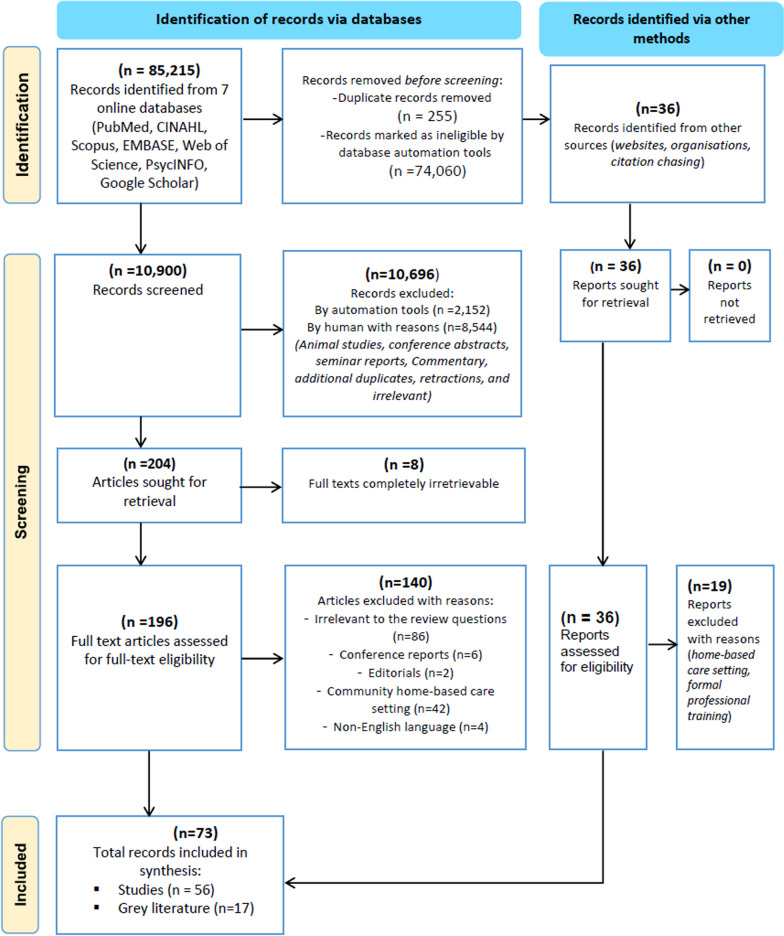
Background: A 15 million health workforce shortage is still experienced globally leading to a sub-optimal healthcare worker-to-population ratio in most countries. The use of low-skilled care assistants has been suggested as a cost-saving human resource for health strategy that can significantly reduce the risks of rationed, delayed, or missed care. However, the characterisation, role assignment, regulation, and clinical governance mechanisms for unlicensed assistive workforce remain unclear or inconsistent. The purpose of this study was to map and collate evidence of how care assistants are labelled, utilised, regulated, and managed in formal hospital settings as well as their impact on patient care. Methods: We conducted a scoping review of literature from PUBMED, CINAHL, PsychINFO, EMBASE, Web of Science, Scopus, and Google Scholar. Searches and eligibility screening were conducted using the Participants–Context–Concepts framework. Thematic content analysis guided the synthesis of the findings. Results: 73 records from a total of 15 countries were included in the final full-text review and synthesis. A majority (78%) of these sources were from high-income countries. Many titles are used to describe care assistants, and these vary within and across countries. On ascribed roles, care assistants perform direct patient care, housekeeping, clerical and documentation, portering, patient flow management, ordering of laboratory tests, emergency response and first aid duties. Additional extended roles that require higher competency levels exist in the United States, Australia, and Canada. There is a mixture of both positive and negative sentiments on their impact on patient care or nurses’ perception and experiences. Clinical and organisational governance mechanisms vary substantially across the 15 countries. Licensure, regulatory mechanisms, and task-shifting policies are largely absent or not reported in these countries. Conclusions: The nomenclature used to describe care assistants and the tasks they perform vary substantially within countries and across healthcare systems. There is, therefore, a need to review and update the international and national classification of occupations for clarity and more meaningful nomenclature for care assistants. In addition, the association between care assistants and care outcomes or nurses’ experience remains unclear. Furthermore, there is a dearth of empirical evidence on this topic from low- and middle-income countries.
Overview
CoChat Summary
TL;DR
This scoping review maps how hospital-based care assistants are labelled, used, regulated, and governed across 15 countries, finding substantial variation in nomenclature, roles, training, and oversight. Evidence on their impact on patient care and nurses’ experiences is mixed, and empirical literature from low- and middle-income countries is scarce.
Key findings
- The review included 73 records from 15 countries; 57 (78%) were from high-income countries, with the UK contributing 19 (25%), the USA 13 (17%), and Australia 7 (9%); Japan, Israel, Benin, Hong Kong, Malawi, Brazil, and Uganda had 1 report each.
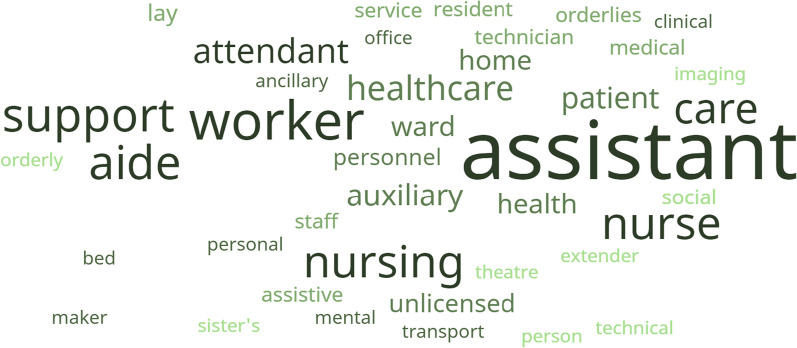
- Many titles describe care assistants and vary within and across countries: the UK had >21 term variations, Australia and Canada >11 each, and the USA and Hong Kong China >7 each; “Assistant” was the most common stem word, followed by “support staff/worker.”
- Care assistants performed 58 charted tasks grouped into 7 broad categories: direct patient care was reported in 53 records, housekeeping in 26, clerical and portering in 19 each, patient flow management and ordering laboratory tests in 4 each, and emergency response/first aid in 2 records; extended roles such as vaccination, injections, catheterisation, phlebotomy, ECG monitoring, wound/colostomy care, resuscitation, and requesting laboratory tests were mainly in Australia, Canada, the UK, and the USA.
- Only 20 (27%) papers reported patient care outcomes and 23 (32%) reported nurses’ experiences, with mixed positive and negative sentiments; only 33 (45%) mentioned organisational regulatory or clinical governance mechanisms, and nearly all countries (93%) lacked a task-shifting/sharing policy, with licensure and regulatory mechanisms largely absent or not reported.
Methods
- Scoping review following Joanna Briggs Institute and PRISMA–ScR guidance, with a protocol registered on the Open Science Framework; searches were conducted in PUBMED, CINAHL, PsychINFO, EMBASE, Web of Science, Scopus, and Google Scholar, with the last search on 20 June 2022, no time limitation, and English-language restriction.
- Eligibility used the Participants–Context–Concepts framework: included papers reported on hospital-based care assistants who support healthcare professionals with non-clinical, low-skilled basic tasks, mainly supporting nurses, and who ordinarily had no formal professional/technical pre-service training, licensing, or regulatory requirements; excluded community/home-based care, theses, conference abstracts, case reports/series, and animal studies.
- Two reviewers independently screened and charted data; thematic content analysis was conducted in NVIVO 12 Plus, with sentiment labels for patient care impact and nurses’ experiences, frequencies/word clouds for titles, task categories, and tabulation of governance mechanisms; quality and risk of bias assessment were not undertaken.
Limitations
- Stated by the paper: as a review, the methodology cannot make causal inferences about how care assistants affect patient care outcomes; eligibility was limited to English-language records; and despite an open search period and multiple databases, literature was retrieved from only 15 countries, suggesting the topic remains under-studied elsewhere.
- Stated by the paper: quality and risk of bias assessment were not undertaken because eligible papers were heterogeneous in methodology, region, care setting, participant selection, and reporting, and quality assessment is not mandatory for scoping reviews.
- Evident from the text: most sources were from high-income countries (78%), limiting generalisability to low- and middle-income settings; many records did not report outcomes, nurses’ experiences, or governance mechanisms (only 20/73, 23/73, and 33/73 respectively), so the association between care assistants and care outcomes or nurses’ experience remains unclear.
Model-written summary. Check it against the paper before relying on it.
Integrity signals
Registry
Cites
Statistics
Figures
Verification
Claims the paper makes
0 Valid · 1 Not valid · 87 Not checked · 71 Own results and interpretations
A result the paper reports from its own data — it cites no other source for it, so there is none to check. The quote shows it is in the paper.
In the paper
“High-income countries | 57 (78)”
§ Characterising support and care assistants in formal hospital settings: a scoping review > Results > Summary statistics
plain- Asserted: passes — The authors put it forward as true.
- Checkable: passes — It can be checked against evidence.
- Load-bearing: unclear — It is unclear whether the paper’s conclusions depend on it.
- Based: passes — The paper gives a reason why it holds.
A result the paper reports from its own data — it cites no other source for it, so there is none to check. The quote shows it is in the paper.
In the paper
“Only 47 (n = 64%) of the papers described the type of care setting.”
§ Characterising support and care assistants in formal hospital settings: a scoping review > Results > The hospital setting
plainn = 64- Asserted: passes — The authors put it forward as true.
- Checkable: passes — It can be checked against evidence.
- Load-bearing: unclear — It is unclear whether the paper’s conclusions depend on it.
- Based: passes — The paper gives a reason why it holds.
None of the sources cited for this claim have been checked yet.
In the paper
“-Increased patient satisfaction [51, 55, 61]”
§ Characterising support and care assistants in formal hospital settings: a scoping review > Results > Objective 2a: Impact of CAs on patient care and their experiences
What the sources say
- Not checked yetcites [51] Duffield C Twigg D Roche M Williams A Wise S Uncovering the disconnect between nursing workforce policy intentions, implementation, and outcomes: lessons learned from the addition of a nursing assistant role Policy Polit Nurs Pract 2019 20 4 228 238 10.1177/1527154419877571 31615328
- Not checked yetcites [55] MacKay FD Anderson JE Klein MC Berkowitz J MacKay JT Gailius J The modified medical office assistant role in rural diabetes care Can J Rural Med 2014 19 2 49 56 24698753
- Not checked yetcites [61] Faulkner K Sutton S Jamison J Sloan M Boase S Naughton F Are nurses and auxiliary healthcare workers equally effective in delivering smoking cessation support in primary care? Nicotine Tob Res 2016 18 5 1054 1060 10.1093/ntr/ntv206 26453668 PMC4826488
plainstates an association- Asserted: passes — The authors put it forward as true.
- Checkable: passes — It can be checked against evidence.
- Load-bearing: unclear — It is unclear whether the paper’s conclusions depend on it.
- Based: passes — The paper gives a reason why it holds.
None of the sources cited for this claim have been checked yet.
In the paper
“-Risk to patient safety [42, 50, 68]”
§ Characterising support and care assistants in formal hospital settings: a scoping review > Results > Objective 2a: Impact of CAs on patient care and their experiences
What the sources say
- Not checked yetcites [42] McKenna HP Hasson F Keeney S Patient safety and quality of care: the role of the health care assistant J Nurs Manage 2004 12 6 452 459 10.1111/j.1365-2834.2004.00514.x 15509275
- Not checked yetcites [50] Spilsbury K Meyer J Use, misuse and non-use of health care assistants: understanding the work of health care assistants in a hospital setting J Nurs Manage 2004 12 6 411 418 10.1111/j.1365-2834.2004.00515.x 15509270
- Not checked yetcites [68] Peduzzi M Anselmi ML França I Jr dos Santos CB Quality of procedures delivered by nursing assistants Rev Saude Publica 2006 40 5 843 850 10.1590/S0034-89102006000600014 17301906
plainstates an association- Asserted: passes — The authors put it forward as true.
- Checkable: passes — It can be checked against evidence.
- Load-bearing: unclear — It is unclear whether the paper’s conclusions depend on it.
- Based: passes — The paper gives a reason why it holds.
A result the paper reports from its own data — it cites no other source for it, so there is none to check. The quote shows it is in the paper.
In the paper
“It was noted that vital signs monitoring, patient hygiene, and feeding are top of the list of direct care duties”
§ Characterising support and care assistants in formal hospital settings: a scoping review > Results > Objective 1: Duties performed to CAs in hospital settings
plain- Asserted: passes — The authors put it forward as true.
- Checkable: passes — It can be checked against evidence.
- Load-bearing: unclear — It is unclear whether the paper’s conclusions depend on it.
- Based: passes — The paper gives a reason why it holds.
103 more claims
Create a free account to see all 159 claims and to verify the 204 references still open.
- It may state two separate claims as one. 33
- Probably not a substantial claim. 19
- The quote only partly states this claim. 5
Self-check
Percentages, sums and reported differences re-computed from the paper’s own numbers.
Rated minor: it would not touch a result — a value no result rests on, a p-value that stays on the same side of the significance level, or a conflict that is clerical, resolved elsewhere in the paper, or outside its own findings.
In the paper
“| 2011–2015 | 22 (29) |”
§ Characterising support and care assistants in formal hospital settings: a scoping review > Results > Summary statistics
Reported 29 · recomputed 30.136986
Rated minor: it would not touch a result — a value no result rests on, a p-value that stays on the same side of the significance level, or a conflict that is clerical, resolved elsewhere in the paper, or outside its own findings.
In the paper
“| 2016–2020 | 18 (24) |”
§ Characterising support and care assistants in formal hospital settings: a scoping review > Results > Summary statistics
Reported 24 · recomputed 24.657534
Rated minor: it would not touch a result — a value no result rests on, a p-value that stays on the same side of the significance level, or a conflict that is clerical, resolved elsewhere in the paper, or outside its own findings.
In the paper
“Australia (n = 7 [9%])”
§ Characterising support and care assistants in formal hospital settings: a scoping review > Results > Characteristics of sources
Reported 9 · recomputed 9.589041
Citations
Cites
The PRISMA 2020 statement: An updated guideline for reporting systematic reviews
Page, M. J., McKenzie, J. E., Bossuyt, P. M., Boutron, I., Hoffmann, T. C., Mulrow, C. D., Shamseer, L., Tetzlaff, J. M., Akl, E. A., Brennan, S. E., et al. (2021) · BMJ · doi:10.1136/bmj.n71 · Cited by 108,283
PRISMA Extension for Scoping Reviews (PRISMA-ScR): Checklist and Explanation
Tricco, A. C., Lillie, E., Zarin, W., O'Brien, K. K., Colquhoun, H., Levac, D., Moher, D., Peters, M. D. J., Horsley, T., Weeks, L., et al. (2018) · Annals of Internal Medicine · doi:10.7326/m18-0850 · Cited by 43,565
Munn, Z., Peters, M. D. J., Stern, C., Tufanaru, C., McArthur, A., & Aromataris, E. (2018) · BMC Medical Research Methodology · doi:10.1186/s12874-018-0611-x · Cited by 11,385
(2020) · JBI Manual for Evidence Synthesis · doi:10.46658/jbimes-20-12 · Cited by 2,545
Peters, M., Godfrey, C., McInerney, P., Munn, Z., Tricco, A., & Khalil, H. (2019) · JBI Reviewer's Manual · doi:10.46658/jbirm-20-01 · Cited by 2,222 · cited 2×
“We conducted a scoping review following the Joanna Briggs Institute and PRISMA–ScR evidence synthesis and reporting guidelines [28–30].”
MethodState of the world's nursing 2020: investing in education, jobs and leadership
McCarthy, C. F. (2020) · Cited by 845
International Labour Organisation
(1998) · United Nations Treaty Series · doi:10.18356/8ad162f0-en-fr · Cited by 636
Nurse staffing, nursing assistants and hospital mortality: retrospective longitudinal cohort study
Griffiths, P., Maruotti, A., Recio Saucedo, A., Redfern, O. C., Ball, J. E., Briggs, J., Dall'Ora, C., Schmidt, P. E., & Smith, G. B. (2019) · BMJ Quality & Safety · doi:10.1136/bmjqs-2018-008043 · Cited by 374
Invisible no more: a scoping review of the health care aide workforce literature
Hewko, S. J., Cooper, S. L., Huynh, H., Spiwek, T. L., Carleton, H. L., Reid, S., & Cummings, G. G. (2015) · BMC Nursing · doi:10.1186/s12912-015-0090-x · Cited by 217
Castle, N. G., & Anderson, R. A. (2011) · Medical Care · doi:10.1097/mlr.0b013e31820fbca9 · Cited by 197
Dawson, A. J., Buchan, J., Duffield, C., Homer, C. S. E., & Wijewardena, K. (2014) · Health Policy and Planning · doi:10.1093/heapol/czt026 · Cited by 168
Thornley, C. (2000) · Journal of Clinical Nursing · doi:10.1046/j.1365-2702.2000.00398.x · Cited by 159
Wilkins, L. W., & Kluwer, W. (2020) · Lippincott Williams & Wilkins eBooks · Cited by 156
The Influence of Nurse Staffing Levels on Quality of Care in Nursing Homes
Hyer, K., Thomas, K. S., Branch, L. G., Harman, J. S., Johnson, C. E., & Weech-Maldonado, R. (2011) · The Gerontologist · doi:10.1093/geront/gnr050 · Cited by 150
Patient safety and quality of care: the role of the health care assistant
McKenna, H. P., Hasson, F., & Keeney, S. (2004) · Journal of Nursing Management · doi:10.1111/j.1365-2834.2004.00514.x · Cited by 127
Missed nursing care in newborn units: a cross-sectional direct observational study
Gathara, D., Serem, G., Murphy, G. A. V., Obengo, A., Tallam, E., Jackson, D., Brownie, S., & English, M. (2020) · BMJ Quality & Safety · doi:10.1136/bmjqs-2019-009363 · Cited by 112
Self-citationIn no uncertain terms: the importance of a defined objective in scoping reviews
Peters, M. D. J. (2016) · JBI Database of Systematic Reviews and Implementation Reports · doi:10.11124/jbisrir-2016-2838 · Cited by 108 · cited 1×
“We used the Participants–Concept–Context framework [32, 33] to describe the inclusion and exclusion criteria.”
MethodHealthcare assistants in general practice: practical and conceptual issues of skill-mix change
Bosley, S., & Dale, J. (2008) · British Journal of General Practice · doi:10.3399/bjgp08x277032 · Cited by 105
A systematic review of activities undertaken by the unregulated Nursing Assistant
Blay, N., & Roche, M. A. (2020) · Journal of Advanced Nursing · doi:10.1111/jan.14354 · Cited by 99
Task shifting in maternal and newborn health care: Key components from policy to implementation
Deller, B., Tripathi, V., Stender, S. C., Otolorin, E. '., Johnson, P., & Carr, C. (2015) · International Journal of Gynecology & Obstetrics · doi:10.1016/j.ijgo.2015.03.005 · Cited by 96
Allied health assistants and what they do: A systematic review of the literature
Kumar (2010) · Journal of Multidisciplinary Healthcare · doi:10.2147/jmdh.s12106 · Cited by 95
Spilsbury, K., & Meyer, J. (2004) · Journal of Nursing Management · doi:10.1111/j.1365-2834.2004.00515.x · Cited by 94
5?20: a model of minimum nurse-to-patient ratios in Victoria, Australia
Gerdtz, M. F., & Nelson, S. (2006) · Journal of Nursing Management · doi:10.1111/j.1365-2934.2006.00657.x · Cited by 90
Griffiths, P., Ball, J., Murrells, T., Jones, S., & Rafferty, A. M. (2016) · BMJ Open · doi:10.1136/bmjopen-2015-008751 · Cited by 90
New Roles for Medical Assistants in Innovative Primary Care Practices
Chapman, S. A., & Blash, L. K. (2017) · Health Services Research · doi:10.1111/1475-6773.12602 · Cited by 90
Health care aides use of time in a residential long-term care unit: A time and motion study
Mallidou, A. A., Cummings, G. G., Schalm, C., & Estabrooks, C. A. (2013) · International Journal of Nursing Studies · doi:10.1016/j.ijnurstu.2012.12.009 · Cited by 82
Task shifting in maternal and child health care: An evidence brief for Uganda
Nabudere, H., Asiimwe, D., & Mijumbi, R. (2011) · International Journal of Technology Assessment in Health Care · doi:10.1017/s0266462311000055 · Cited by 72
Denton, M. A., Brookman, C., Zeytinoglu, I. U., Plenderleith, J. M., & Barken, R. (2014) · Health & Social Care in the Community · doi:10.1111/hsc.12168 · Cited by 72
Olson, D., Preidis, G. A., Milazi, R., Spinler, J. K., Lufesi, N., Mwansambo, C., Hosseinipour, M. C., & McCollum, E. D. (2013) · Tropical Medicine & International Health · doi:10.1111/tmi.12114 · Cited by 71
National Guidelines for Nursing Delegation
(2016) · Journal of Nursing Regulation · doi:10.1016/s2155-8256(16)31035-3 · Cited by 69
Mijovic, H., McKnight, J., & English, M. (2016) · Journal of Clinical Nursing · doi:10.1111/jocn.13349 · Cited by 67
Self-citationMayo‐Wilson, L. J., Yebadokpo, A. S., Affo, J., Agbogbe, M., & Tankoano, A. (2011) · Implementation Science · doi:10.1186/1748-5908-6-2 · Cited by 61
Role redesign in a modernised NHS: the case of health care assistants
Bach, S., Kessler, I., & Heron, P. (2008) · Human Resource Management Journal · doi:10.1111/j.1748-8583.2007.00066.x · Cited by 60
Perceived functions and usefulness of health service support workers
Chang, A. M. (1995) · Journal of Advanced Nursing · doi:10.1046/j.1365-2648.1995.21010064.x · Cited by 52
CNA Training Requirements and Resident Care Outcomes in Nursing Homes
Trinkoff, A. M., Storr, C. L., Lerner, N. B., Yang, B. K., & Han, K. (2016) · The Gerontologist · doi:10.1093/geront/gnw049 · Cited by 50
Mapping the introduction of Assistant Practitioner roles in Acute NHS (Hospital) Trusts in England
Spilsbury, K., Stuttard, L., Adamson, J., Atkin, K. M., Borglin, G., McCaughan, D., McKenna, H., Wakefield, A. B., & Carr‐Hill, R. (2008) · Journal of Nursing Management · doi:10.1111/j.1365-2834.2008.00943.x · Cited by 49
Craftman, Å. G., Grape, C., Ringnell, K., & Westerbotn, M. (2016) · Journal of Clinical Nursing · doi:10.1111/jocn.13335 · Cited by 48
The Use of Unregulated Staff: Time for Regulation?
Duffield, C. M., Twigg, D. E., Pugh, J. D., Evans, G., Dimitrelis, S., & Roche, M. A. (2014) · Policy, Politics, & Nursing Practice · doi:10.1177/1527154414529337 · Cited by 46
Home Care Workers’ Skills in the Context of Task Shifting: Complexities in Care Work
Barken, R., Denton, M. A., Plenderleith, J. M., Zeytinoglu, I. U., & Brookman, C. (2015) · Canadian Review of Sociology/Revue canadienne de sociologie · doi:10.1111/cars.12078 · Cited by 45
Spilsbury, K., & Meyer, J. (2005) · Journal of Research in Nursing · doi:10.1177/136140960501000104 · Cited by 43
Roche, M. A., Friedman, S., Duffield, C., Twigg, D. E., & Cook, R. (2017) · Journal of Advanced Nursing · doi:10.1111/jan.13224 · Cited by 40
Roche, M. A., Duffield, C. M., Friedman, S., Dimitrelis, S., & Rowbotham, S. J. (2015) · Journal of Clinical Nursing · doi:10.1111/jocn.13118 · Cited by 39
Nursing assistants' perceptions of their role in the resident experience
Abrahamson, K. A., Fox, R. L., Roundtree, A. K., & Farris, K. L. (2019) · Nursing and Health Sciences · doi:10.1111/nhs.12649 · Cited by 38
Experiences and perceptions of newly prepared Health Care Assistants (Level 3 NVQ)
Warr, J. G. (2002) · Nurse Education Today · doi:10.1054/nedt.2002.0696 · Cited by 37
Investigating missed care by nursing aides in Taiwanese long‐term care facilities
Tou, Y., Liu, M. F., Chen, S., Lee, P., Kuo, L., & Lin, P. (2019) · Journal of Nursing Management · doi:10.1111/jonm.12873 · Cited by 36
Roles of Nurse Aides and Family Members in Acute Patient Care in Taiwan
Tzeng, H. (2004) · Journal of Nursing Care Quality · doi:10.1097/00001786-200404000-00015 · Cited by 35
McCloskey, R., Donovan, C., Stewart, C., & Donovan, A. (2015) · International Journal of Nursing Studies · doi:10.1016/j.ijnurstu.2015.05.007 · Cited by 34
Certified Nurse Aide Scope of Practice: State-by-State Differences in Allowable Delegated Activities
McMullen, T. L., Resnick, B., Chin-Hansen, J., Geiger-Brown, J. M., Miller, N., & Rubenstein, R. (2015) · Journal of the American Medical Directors Association · doi:10.1016/j.jamda.2014.07.003 · Cited by 30
Clinical Supervision for Support Workers in Paediatric Palliative Care: A Literature Review
Beavis, J., Davis, L., & McKenzie, S. (2020) · Clinical Child Psychology and Psychiatry · doi:10.1177/1359104520961431 · Cited by 30
Opportunity for change: is it time to redefine the role of paramedics in healthcare?
Drennan, I. R., Blanchard, I. E., & Buick, J. E. (2021) · Canadian Journal of Emergency Medicine · doi:10.1007/s43678-021-00105-y · Cited by 30
More ward nursing staff improves inpatient outcomes, but how much is enough?
Needleman, J., & Shekelle, P. G. (2019) · BMJ Quality & Safety · doi:10.1136/bmjqs-2018-009266 · Cited by 29
Developing the role of the healthcare assistant
Hancock, H. C., & Campbell, S. J. (2006) · Nursing Standard · doi:10.7748/ns.20.49.35.s51 · Cited by 27
An Expanded Role for the Medical Assistant in Primary Care: Evaluating a Training Pilot
Gray, M. F., Coleman, K., Walsh‐Bailey, C., Girard, S., & Lozano, P. (2021) · The Permanente Journal · doi:10.7812/tpp/20.091 · Cited by 27
A training programme for healthcare support workers
Arblaster, G. M., Streather, C., Hugill, L., McKenzie, M., & Missenden, J. (2004) · Nursing Standard · doi:10.7748/ns2004.07.18.43.33.c3640 · Cited by 25
Task shifting policy in Ontario, Canada: Does it help personal support workers’ intention to stay?
Zeytinoglu, I. U., Denton, M., Brookman, C., & Plenderleith, J. (2014) · Health Policy · doi:10.1016/j.healthpol.2014.01.004 · Cited by 24
Adding unregulated nursing support workers to ward staffing: Exploration of a natural experiment
Duffield, C., Roche, M., Twigg, D., Williams, A., Rowbotham, S., & Clarke, S. (2018) · Journal of Clinical Nursing · doi:10.1111/jocn.14632 · Cited by 24
Omondi, G. B., Murphy, G. A. V., Jackson, D. W., Brownie, S. M., English, M., & Gathara, D. (2020) · Nursing Open · doi:10.1002/nop2.463 · Cited by 24
Self-citationDuffield, C., Twigg, D., Roche, M., Williams, A., & Wise, S. (2019) · Policy, Politics, & Nursing Practice · doi:10.1177/1527154419877571 · Cited by 21
Health care assistants in general practice
Burns, S., & Blair, V. (2007) · Primary Health Care · doi:10.7748/phc2007.07.17.6.35.c4427 · Cited by 18
Cartwright, A. K., Pain, T., & Heslop, D. J. (2021) · Australian Health Review · doi:10.1071/ah20118 · Cited by 17
Understanding the debate around regulation of support workers
Vaughan, S., Melling, K., O'Reilly, L., & Cooper, D. (2014) · British Journal of Nursing · doi:10.12968/bjon.2014.23.5.260 · Cited by 16
Faulkner, K., Sutton, S., Jamison, J., Sloan, M., Boase, S., & Naughton, F. (2016) · Nicotine & Tobacco Research · doi:10.1093/ntr/ntv206 · Cited by 16
Educating Certified Nursing Assistants Educational Offerings on the Run and More
Ward, S., Stewart, D., Ford, D., Mullen, A. M., & Makic, M. B. F. (2014) · Journal for Nurses in Professional Development · doi:10.1097/nnd.0000000000000102 · Cited by 14
Healthcare assistants in the children’s intensive care unit
King, P., & Crawford, D. A. (2009) · Nursing Children and Young People · doi:10.7748/paed.21.1.48.s31 · Cited by 14
Are health care assistants part of the long-term solution to the nursing workforce deficit in Kenya?
Fitzgerald, L., Gathara, D., McKnight, J., Nzinga, J., & English, M. (2020) · Human Resources for Health · doi:10.1186/s12960-020-00523-6 · Cited by 14
Self-citationHirose, N., Morita, K., Matsui, H., Fushimi, K., & Yasunaga, H. (2022) · Nursing and Health Sciences · doi:10.1111/nhs.12924 · Cited by 14
Effect of a training programme on the work of GP-based HCAs
Weir, J. (2015) · Practice Nursing · doi:10.12968/pnur.2015.26.7.351 · Cited by 13
Arnon, Z., Ben‐Arye, E., Attias, S., Levy, O., & Schiff, E. (2018) · European Journal of Integrative Medicine · doi:10.1016/j.eujim.2018.01.004 · Cited by 13
Just, D. T., O’Rourke, H. M., Berta, W. B., Variath, C., & Cranley, L. A. (2021) · International Journal of Older People Nursing · doi:10.1111/opn.12353 · Cited by 13
Smith, D. A. B. (2001) · Journal of the American Medical Directors Association · doi:10.1016/s1525-8610(04)70193-0 · Cited by 12
The modified medical office assistant role in rural diabetes care.
MacKay, F. D., Anderson, J. E., Klein, M. C., Berkowitz, J., Jt, M., & Gailius, J. (2014) · PubMed · Cited by 12
Role of the health care support worker in the A & E department
The, N.-W., Accident, E., & Forum, M. (1997) · Accident and Emergency Nursing · doi:10.1016/s0965-2302(97)90003-5 · Cited by 11
The impact of three nursing staffing models on nursing outcomes
Yang, P., Hung, C., & Chen, Y. (2015) · Journal of Advanced Nursing · doi:10.1111/jan.12643 · Cited by 10
Health care assistants' and mental attendants' daily work tasks in acute hospital care
FurÅker, C. (2008) · Journal of Research in Nursing · doi:10.1177/1744987107085240 · Cited by 7
Peduzzi (2006) · doi:10.1590/s0034-89102006000600014 · Cited by 6
Hasson, F., McKenna, H., Keeney, S., & Gillen, P. A. (2005) · PubMed · Cited by 5
Ulsenheimer, K. (2009) · Der Anaesthesist · doi:10.1007/s00101-009-1546-8 · Cited by 3
Kirschner (2013) · doi:10.1007/s00101-013-2181-y · Cited by 3
Onyango, O., Maina, M., Kagonya, V., Gathara, D., Imam, A., & English, M. (2022) · OSF Preprints (OSF Preprints) · doi:10.17605/osf.io/eqtpu · Cited by 2
Self-citationAn Orientation Program for Unlicensed Assistive Personnel
Nyberg, D. B., & Campbell, J. L. (1997) · AORN Journal · doi:10.1016/s0001-2092(06)62689-6 · Cited by 1
Research works printed but not linked: 6
- World Health Organization Health workforce requirements for universal health coverage and the sustainable development goals 2016 Geneva WHO
- Baratto MAM Seidel EJ Morais BX Munhoz OL Silva SCd de Souza MCZTSB Patient safety culture: perspective of health and support workers Acta Paul Enferm. 2021 34 4 1 8
- Cavendish C. The Cavendish Review: An Independent Review into Healthcare Assistants and Support Workers in the NHS and social care settings. online: Department of Health and Social Care; 2013 10 July 2013.
- Hewko SJ Cooper SL Huynh H Spiwek TL Carleton HL Reid S Invisible no more: a scoping review of the health care aide workforce literature BMC Nurs 2015 14 1 38 10.1186/s12912-015-0090-x 26203297 PMC4511030 · DOI · Paper page
- World Health Organisation. WHO recommendations: Optimizing health worker roles to improve access to key maternal and newborn health interventions through task shifting. In: WHO, editor.: WHO Optimize MNH; 2012, 2014. p. 98. 23844452
- Gray MF Coleman K Walsh-Bailey C Girard S Lozano P An expanded role for the medical asssitant in primary care: evaluating a training pilot Perm J 2021 25 4 1 9 10.7812/TPP/20.091 PMC8784025 35348053 · DOI
Cited by
Maina, M., Odinga, N., Kagonya, V., Ngaiza, G., Fuller, S., Onyango, O., Waithira, C., Oluoch, D., Gathara, D., Mwangi, P., et al. (2025) · Antimicrobial Resistance and Infection Control · doi:10.1186/s13756-025-01575-w · Cited by 14
Self-citationImam, A., Maina, M., Aluvaala, J., Kagonya, V., Onyango, O., Were, F., Fuller, S., Karumba, K., Mwangi, P., Kinyua, L., et al. (2025) · EClinicalMedicine · doi:10.1016/j.eclinm.2025.103434 · Cited by 9
Self-citationOnyango, O., Kagonya, V., Maina, M., Karumba, K., Imam, A., Fuller, S., Gathara, D., & English, M. (2025) · International Journal of Nursing Studies · doi:10.1016/j.ijnurstu.2025.105204 · Cited by 8
Self-citationMaina, M., Molyneux, S. C., Were, F., Oluoch, D., Mutua, E., Gathara, D., English, M., Imam, A., Ngaiza, G., Rababeh, A., et al. (2025) · Global Health Action · doi:10.1080/16549716.2025.2558267 · Cited by 8
Self-citationKagonya, V., Odinga, N., Onyango, O., Waithira, C., Imam, A., Mutua, E., Oluoch, D., Maina, M., Karumba, K., Amadi, I., et al. (2025) · International Journal of Nursing Studies · doi:10.1016/j.ijnurstu.2025.105176 · Cited by 9
Self-citation
Metadata
- Authors
- Kagonya, V. A., Onyango, O. O., Maina, M., Gathara, D., English, M., & Imam, A.
- Affiliations
- Kenya Medical Research Institute (KE)
- University of Oxford (GB)
- Corresponding author
- Kagonya, Vincent A.
- ORCID
- Venue
- Human Resources for Health
- Published
- 2023-11-27
- Volume
- 21
- Issue
- 1
- Pages
- 90-90
- ISSN
- 1478-4491 (ISSN-L)
- PMC
- PMC10680191
- OpenAlex
- W4389049409
- Cited by
- 33
- References
- 80
- Citations by year
- 2026: 14 · 2025: 16 · 2024: 3
- FWCI
- 1.03
- Type
- journal article
- Language
- en
- Open access
- gold
- doi.org
- Licence
- cc-by
- creativecommons.org/licenses/by/4.0 (tdm)
- creativecommons.org/licenses/by/4.0 (vor)
- Locations
- Human Resources for Health (publishedVersion, cc-by)
- Research Square (submittedVersion, cc-by-nc-sa)
- PubMed Central (publishedVersion, cc-by-nc-sa)
- PubMed (publishedVersion)
- LSHTM Research Online (London School of Hygiene and Tropical Medicine) (acceptedVersion, cc-by-nc-sa)
- DOAJ (DOAJ: Directory of Open Access Journals) (submittedVersion, cc-by-sa)
- Funders
- National Institute for Health and Care Research Applied Research Collaboration Oxford and Thames Valley (NIHR130812)
- Wellcome (207522)
- Wellcome Trust (092654)
- Topics
- Health Sciences › Health Professions › General Health Professions › Nursing Roles and Practices
- Health Sciences › Nursing › Research and Theory › Nursing education and management
- Health Sciences › Medicine › Public Health, Environmental and Occupational Health › Global Health Workforce Issues
- Keywords
- care assistants, unlicensed assistive personnel, hospital staff, task shifting, workforce shortage, clinical governance, patient outcomes, nurses' perceptions, health workforce policy
- MeSH terms
- Australia, Canada, Delivery of Health Care, Health Personnel, Hospitals, Humans
About these checks
Registry, retraction, Cites and statistics results are computed, not judged, with one exception: a printed reference that no index lists is read once by a model before it counts as a citation error. Claims are extracted by a model and kept only when their quote appears verbatim in the text; each cited source is then checked, with a model’s help, for whether it says what the claim relies on. Those verdicts can be wrong — read the claim’s quote and the cited source before relying on one.
A language model drew the claims from the paper on 2026-11-17, under version 3 of the claim definition (model deepseek-v4.1-flash, prompt extract-v3).
A second model labelled each claim on 2026-11-17 (model jev-1.13-20260917, definition revision gold-guideline-v0.2).
Statistics and arithmetic are recomputed, not judged.
Confidence bands are shown only for fields calibrated on our annotated test set. None is calibrated yet, so no band is shown.
What counts as a claim ›How we measure confidence ›How we check this ›
Are you an author, or do you see a problem with this page? Request a review
Data sources
Bibliographic data: Semantic Scholar, OpenAlex, Crossref.
Contains information from the Semantic Scholar Academic Graph Datasets, made available under the ODC Attribution License (ODC-BY 1.0).
Semantic Scholar’s data is described in: Kinney, R., et al. (2023). The Semantic Scholar Open Data Platform. arXiv:2301.10140.
