

Individual, health system, and contextual barriers and facilitators for the implementation of clinical practice guidelines: a systematic metareview
Open accessThe DOI matches its Crossref record; 37 of the 37 references it cites were found in a registry or an index.
Abstract
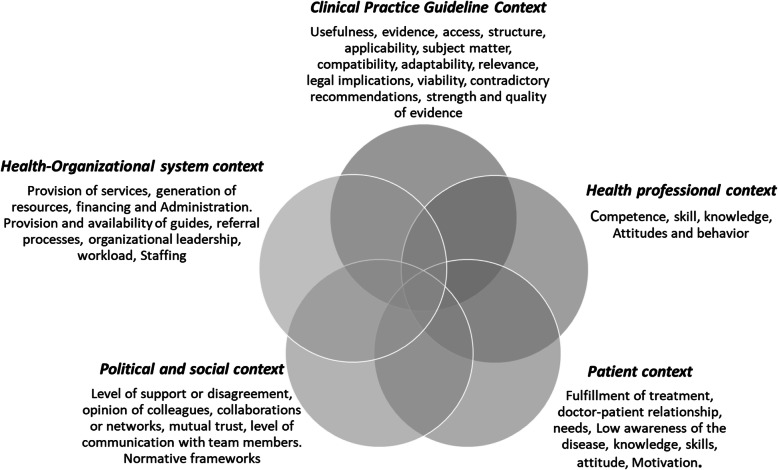
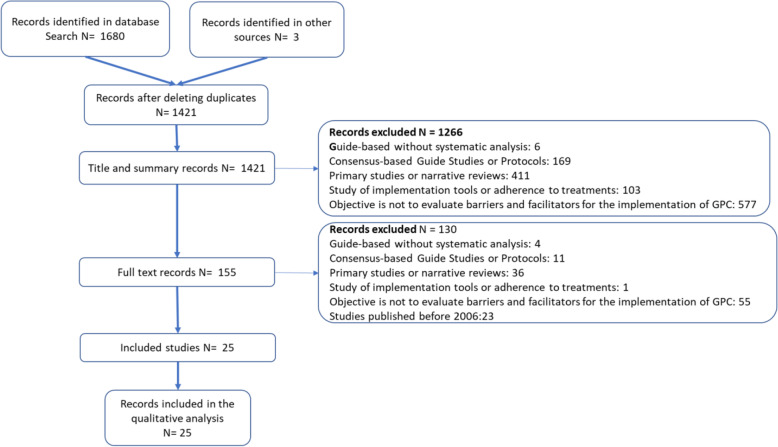
Introduction: Clinical practice guidelines (CPGs) are designed to improve the quality of care and reduce unjustified individual variation in clinical practice. Knowledge of the barriers and facilitators that influence the implementation of the CPG recommendations is the first step in creating strategies to improve health outcomes. The present systematic meta-review sought to explore the barriers and facilitators for the implementation of CPGs. Methods: A search was conducted in the PubMed, Embase, Cochrane, Health System Evidence and International Guideline Library (G-I-N) databases. Systematic reviews of qualitative, quantitative or mixed-methods studies that identified barriers or facilitators for the implementation of CPGs were included. The selection of the title and abstract, the evaluation of the full text, extraction of the data and the quality assessment were carried out by two independent reviewers. To summarise the evidence, we grouped the barriers and facilitators according to the following contexts: political and social, health organisational system, guidelines, health professionals and patients. Results: Overall, 25 systematic reviews were selected. The relevant barriers in the social-political context were the absence of a leader, difficulties with teamwork and a lack of agreement with colleagues. Relevant barriers in the health system were a lack of time, financial problems and a lack of specialised personnel. Barriers of the CPGs included a lack of clarity and a lack of credibility in the evidence. Regarding the health professional, a lack of knowledge about the CPG and confidence in oneself were relevant. Regarding patients, a negative attitude towards implementation, a lack of knowledge about the CPG and sociocultural beliefs played a role. Some of the most frequent facilitators were consistent leadership, commitment of the members of the team, administrative support of the institution, existence of multidisciplinary teams, application of technology to improve the practice and education regarding the guidelines. Conclusions: The barriers and facilitators described in this review are factors that influence the implementation of evidence in clinical practice. Knowledge of these factors should contribute to the development of a theoretical basis for the creation of CPG implementation strategies to improve professional practice and health outcomes for patients.
Overview
The claims and statistics of this paper haven’t been checked yet.
Free: it reads the open-access text and checks the first 5 claims that cite a source we can check. Create a free account to check every claim.
Integrity signals
Registry
Cites
Statistics
Figures
Verification
Claims the paper makes
The claims and statistics of this paper haven’t been checked yet.
Free: it reads the open-access text and checks the first 5 claims that cite a source we can check. Create a free account to check every claim.
Claims other papers make about this one
Each is checked against this paper’s own text: does it say what the citing paper says it does?
The source backs part of the claim, not all of it — or backs it for a different population, condition or comparison.
In the citing paper
“Contextual barriers (such as lack of supporting policies and regulations), health system barriers (such as the hospital’s lack of administrative support and resources to build up and maintain the program), and individual barriers (such as health care professionals’ lack of time, interest, and motivation in engaging in the program) may hinder the widespread adoption of the program [71].”
From Effectiveness of an Internet-Based Acceptance and Commitment Therapy Intervention for Reducing Psychological Distress in Health Care Professionals: Randomized Controlled Trial (2024) · cites this paper as [71]
Experimental — accuracy not yet measured
Self-check
Percentages, sums and reported differences re-computed from the paper’s own numbers.
The self-check needs the paper’s full text.
Citations
Cites
Preferred Reporting Items for Systematic Reviews and Meta-Analyses: the PRISMA statement
Moher, D., Liberati, A., Tetzlaff, J., Altman, D. G., & for the PRISMA Group (2009) · BMJ · doi:10.1136/bmj.b2535 · Cited by 83,823
Preferred Reporting Items for Systematic Reviews and Meta-Analyses: The PRISMA Statement
Moher, D., Liberati, A., Tetzlaff, J., Altman, D. G., & The PRISMA Group (2009) · PLoS Medicine · doi:10.1371/journal.pmed.1000097 · Cited by 64,042
Preferred reporting items for systematic reviews and meta-analyses: the PRISMA Statement.
(2009) · PubMed Central · Cited by 44,859
From best evidence to best practice: effective implementation of change in patients' care
Grol, R., & Grimshaw, J. (2003) · The Lancet · doi:10.1016/s0140-6736(03)14546-1 · Cited by 4,531
Aromataris, E., Fernandez, R., Godfrey, C. M., Holly, C., Khalil, H., & Tungpunkom, P. (2015) · International Journal of Evidence-Based Healthcare · doi:10.1097/xeb.0000000000000055 · Cited by 2,587
Synthesising qualitative and quantitative evidence: A review of possible methods
Dixon-Woods, M., Agarwal, S., Jones, D., Young, B., & Sutton, A. (2005) · Journal of Health Services Research & Policy · doi:10.1177/135581960501000110 · Cited by 2,132
What drives change? Barriers to and incentives for achieving evidence‐based practice
Grol, R., & Wensing, M. (2004) · Medical Journal of Australia · doi:10.5694/j.1326-5377.2004.tb05948.x · Cited by 1,378
Flottorp, S. A., Oxman, A. D., Krause, J., Musila, N. R., Wensing, M., Godycki-Cwirko, M., Baker, R., & Eccles, M. P. (2013) · Implementation Science · doi:10.1186/1748-5908-8-35 · Cited by 1,138
Francke, A. L., Smit, M. C., de Veer, A. J., & Mistiaen, P. (2008) · BMC Medical Informatics and Decision Making · doi:10.1186/1472-6947-8-38 · Cited by 1,134
Gravel, K., Légaré, F., & Graham, I. D. (2006) · Implementation Science · doi:10.1186/1748-5908-1-16 · Cited by 755
Research works printed but not linked: 2
- Centro Cochrane Iberoamericano T Manual Cochrane de Revisiones Sistemáticas de Intervenciones, versión 5.1. 0 2012 Barcelona Centro Cochrane Iberoamericano 1 639
- The Joanna Briggs Institute Checklist for Systematic Reviews and Research Syntheses 2016 Adelaide Joanna Briggs Institute
Cited by
Gibbs, A. J., Gray, B., Wallis, J. A., Taylor, N. F., Kemp, J. L., Hunter, D. J., & Barton, C. J. (2023) · Osteoarthritis and Cartilage · doi:10.1016/j.joca.2023.05.015 · Cited by 277
Wang, T., Tan, J.-Y. (., Liu, X.-L., & Zhao, I. (2023) · BMJ Open · doi:10.1136/bmjopen-2022-062158 · Cited by 261
Huo, Y., Couzner, L., Windsor, T. D., Laver, K., Dissanayaka, N. N., & Cations, M. (2023) · Implementation Science Communications · doi:10.1186/s43058-023-00428-0 · Cited by 220
“These facilitating factors are commonly reported as essential in efforts to implement innovation in healthcare [57–59], and staff who report having inadequate time for change (whether this is real or perceived) are less likely to implement innovation [58].”
BackgroundWorld Heart Federation Cholesterol Roadmap 2022
Ray, K. K., Ference, B. A., Séverin, T., Blom, D., Nicholls, S. J., Shiba, M. H., Almahmeed, W., Alonso, R., Daccord, M., Ezhov, M., et al. (2022) · Global Heart · doi:10.5334/gh.1154 · Cited by 146
Core Recommendations for Osteoarthritis Care: A Systematic Review of Clinical Practice Guidelines
Conley, B., Bunzli, S., Bullen, J., O’Brien, P., Persaud, J., Gunatillake, T., Dowsey, M. M., Choong, P., & Lin, I. B. (2023) · Arthritis Care & Research · doi:10.1002/acr.25101 · Cited by 179
“require clear, consistent management recommendations (31).”
Metadata
- Authors
- Correa, V. C., Lugo-Agudelo, L. H., Aguirre-Acevedo, D. C., Contreras, J. A. P., Borrero, A. M. P., Patiño-Lugo, D. F., & Valencia, D. A. C.
- Affiliations
- Universidad de Antioquia (CO)
- Corresponding author
- Patiño-Lugo, Daniel F.
- ORCID
- Venue
- Health Research Policy and Systems
- Published
- 2020-06-29
- Volume
- 18
- Issue
- 1
- Pages
- 74-74
- ISSN
- 1478-4505 (ISSN-L)
- PMC
- PMC7322919
- OpenAlex
- W3037023615
- Cited by
- 407
- References
- 36
- Citations by year
- 2026: 44 · 2025: 98 · 2024: 102 · 2023: 91 · 2022: 42 · 2021: 25 · 2020: 4
- FWCI
- 6.78
- Type
- journal article
- Language
- en
- Open access
- gold
- doi.org
- Licence
- cc-by
- creativecommons.org/licenses/by/4.0 (tdm)
- creativecommons.org/licenses/by/4.0 (vor)
- Locations
- Health Research Policy and Systems (publishedVersion, cc-by)
- PubMed Central (publishedVersion, cc-by)
- PubMed (publishedVersion)
- Institutional Repository University of Antioquia (University of Antioquia) (submittedVersion, cc-by)
- DOAJ (DOAJ: Directory of Open Access Journals) (submittedVersion, cc-by-sa)
- Funders
- Colciencias (829-2015)
- Topics
- Health Sciences › Medicine › Public Health, Environmental and Occupational Health › Clinical practice guidelines implementation
- Health Sciences › Health Professions › General Health Professions › Health Policy Implementation Science
- Health Sciences › Health Professions › General Health Professions › Health Sciences Research and Education
- Keywords
- guideline implementation, barriers and facilitators, health system factors, health professionals' knowledge, patient attitudes, leadership, multidisciplinary team, administrative support, guideline credibility, implementation strategies
- MeSH terms
- Government Programs, Health Personnel, Humans, Leadership, Professional Practice, Qualitative Research
About these checks
Registry, retraction, Cites and statistics results are computed, not judged, with one exception: a printed reference that no index lists is read once by a model before it counts as a citation error. Claims are extracted by a model and kept only when their quote appears verbatim in the text; each cited source is then checked, with a model’s help, for whether it says what the claim relies on. Those verdicts can be wrong — read the claim’s quote and the cited source before relying on one.
Statistics and arithmetic are recomputed, not judged.
Confidence bands are shown only for fields calibrated on our annotated test set. None is calibrated yet, so no band is shown.
What counts as a claim ›How we measure confidence ›How we check this ›
Are you an author, or do you see a problem with this page? Request a review
How to cite
Cite CoChat for the checks on this page, and the paper for its own findings.
- This page
- CoChat. (2026). Citation check: Individual, health system, and contextual barriers and facilitators for the implementation of clinical practice guidelines: a systematic metareview. https://app.cochat.ai/papers/10.1186/s12961-020-00588-8
- The paper
- Correa, V. C., Lugo-Agudelo, L. H., Aguirre-Acevedo, D. C., Contreras, J. A. P., Borrero, A. M. P., Patiño-Lugo, D. F., & Valencia, D. A. C. (2020). Individual, health system, and contextual barriers and facilitators for the implementation of clinical practice guidelines: a systematic metareview. Health Research Policy and Systems. https://doi.org/10.1186/s12961-020-00588-8
Data sources
Bibliographic data: Semantic Scholar, OpenAlex, Crossref.
Contains information from the Semantic Scholar Academic Graph Datasets, made available under the ODC Attribution License (ODC-BY 1.0).
Semantic Scholar’s data is described in: Kinney, R., et al. (2023). The Semantic Scholar Open Data Platform. arXiv:2301.10140.
