

The DOI matches its Crossref record; 54 of the 54 references it cites were found in a registry or an index.
Research co-design in health: a rapid overview of reviews
Open accessPublished version of a preprint
Abstract
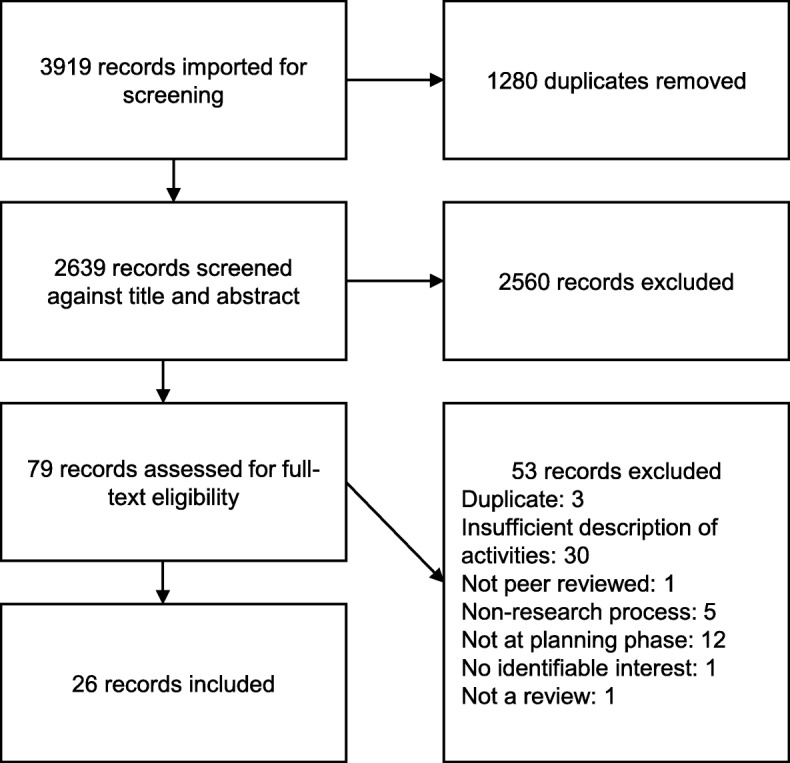
Background: Billions of dollars are lost annually in health research that fails to create meaningful benefits for patients. Engaging in research co-design – the meaningful involvement of end-users in research – may help address this research waste. This rapid overview of reviews addressed three related questions, namely (1) what approaches to research co-design exist in health settings? (2) What activities do these research co-design approaches involve? (3) What do we know about the effectiveness of existing research co-design approaches? The review focused on the study planning phase of research, defined as the point up to which the research question and study design are finalised. Methods: Reviews of research co-design were systematically identified using a rapid overview of reviews approach (PROSPERO: CRD42019123034). The search strategy encompassed three academic databases, three grey literature databases, and a hand-search of the journal Research Involvement and Engagement . Two reviewers independently conducted the screening and data extraction and resolved disagreements through discussion. Disputes were resolved through discussion with a senior author (PB). One reviewer performed quality assessment. The results were narratively synthesised. Results: A total of 26 records (reporting on 23 reviews) met the inclusion criteria. Reviews varied widely in their application of ‘research co-design’ and their application contexts, scope and theoretical foci. The research co-design approaches identified involved interactions with end-users outside of study planning, such as recruitment and dissemination. Activities involved in research co-design included focus groups, interviews and surveys. The effectiveness of research co-design has rarely been evaluated empirically or experimentally; however, qualitative exploration has described the positive and negative outcomes associated with co-design. The research provided many recommendations for conducting research co-design, including training participating end-users in research skills, having regular communication between researchers and end-users, setting clear end-user expectations, and assigning set roles to all parties involved in co-design. Conclusions: Research co-design appears to be widely used but seldom described or evaluated in detail. Though it has rarely been tested empirically or experimentally, existing research suggests that it can benefit researchers, practitioners, research processes and research outcomes. Realising the potential of research co-design may require the development of clearer and more consistent terminology, better reporting of the activities involved and better evaluation.
Overview
The claims and statistics of this paper haven’t been checked yet.
Run the check — free, no account needed. It reads the open-access text and checks the sources it cites.
Integrity signals
Registry
Cites
Statistics
Figures
Verification
Claims the paper makes
The claims and statistics of this paper haven’t been checked yet.
Run the check — free, no account needed. It reads the open-access text and checks the sources it cites.
Claims other papers make about this one
Each is checked against this paper’s own text: does it say what the citing paper says it does?
The source backs part of the claim, not all of it — or backs it for a different population, condition or comparison.
In the citing paper
“Despite the rise in popularity and continued growth of youth engagement in health research, systematic and deliberate theory‐building has been limited.”
From A systematic review of theories, models and frameworks used for youth engagement in health research (2024) · cites this paper as [43]
Experimental — accuracy not yet measuredThe cited source says what the claim attributes to it.
In the citing paper
“Given the near‐unanimous recognition that the biggest gap in this area of research is the lack of evidence on impact gained through rigorous evaluation, 43 , 57 , 58 , 61 , 90 the small number of impact‐focused models and frameworks is noteworthy.”
From A systematic review of theories, models and frameworks used for youth engagement in health research (2024) · cites this paper as [43]
The cited source says what the claim attributes to it.
In the citing paper
“This is consistent with review findings of empirical studies in PPI whereby short‐term, individual‐level outcomes were more represented in the literature. 43 , 91 , 92”
From A systematic review of theories, models and frameworks used for youth engagement in health research (2024) · cites this paper as [43]
Self-check
Percentages, sums and reported differences re-computed from the paper’s own numbers.
The self-check needs the paper’s full text.
Citations
Cites
Preferred Reporting Items for Systematic Reviews and Meta-Analyses: the PRISMA statement
Moher, D., Liberati, A., Tetzlaff, J., Altman, D. G., & for the PRISMA Group (2009) · BMJ · doi:10.1136/bmj.b2535 · Cited by 83,823
Preferred Reporting Items for Systematic Reviews and Meta-Analyses: The PRISMA Statement
Moher, D., Liberati, A., Tetzlaff, J., Altman, D. G., & The PRISMA Group (2009) · PLoS Medicine · doi:10.1371/journal.pmed.1000097 · Cited by 64,042
Preferred reporting items for systematic reviews and meta-analyses: the PRISMA Statement.
(2009) · PubMed Central · Cited by 44,859
Michie, S., van Stralen, M. M., & West, R. (2011) · Implementation Science · doi:10.1186/1748-5908-6-42 · Cited by 13,697 · cited 1×
“For example, the Fogg Behaviour Model [53] or the COM-B Behaviour Change model [54] could be used to diagnose actors’ capabilities, motivation, and triggers or opportunities.”
MethodDevelopment of AMSTAR: A measurement tool to assess the methodological quality of systematic reviews
Shea, B. J., Grimshaw, J. M., Wells, G. A., Boers, M., Andersson, N., Hamel, C., Porter, A. C., Tugwell, P., Moher, D., & Bouter, L. M. (2007) · BMC Medical Research Methodology · doi:10.1186/1471-2288-7-10 · Cited by 4,374
SANRA—a scale for the quality assessment of narrative review articles
Baethge, C., Goldbeck-Wood, S., & Mertens, S. (2019) · Research Integrity and Peer Review · doi:10.1186/s41073-019-0064-8 · Cited by 3,469
A Systematic Review of Co-Creation and Co-Production: Embarking on the social innovation journey
Voorberg, W., Bekkers, V., & Tummers, L. G. (2014) · Public Management Review · doi:10.1080/14719037.2014.930505 · Cited by 2,700
A behavior model for persuasive design
Fogg, B. (2009) · Proceedings of the 4th International Conference on Persuasive Technology · doi:10.1145/1541948.1541999 · Cited by 2,328
Avoidable waste in the production and reporting of research evidence
Chalmers, I., & Glasziou, P. (2009) · The Lancet · doi:10.1016/s0140-6736(09)60329-9 · Cited by 2,208
Staniszewska, S., Brett, J., Simera, I., Seers, K., Mockford, C., Goodlad, S., Altman, D. G., Moher, D., Barber, R., Denegri, S., et al. (2017) · BMJ · doi:10.1136/bmj.j3453 · Cited by 1,983
Research works printed but not linked: 6
- Oliver S, Gray J. A bibliography of research reports about patients’, clinicians’ and researchers’ priorities for new research. London: James Lind Alliance; 2006.
- Tricco AC, Langlois EV, Straus SE. Rapid reviews to strengthen health policy and systems: a practical guide. Geneva: Alliance for Health Policy and Systems Research World Health Organization; 2017.
- Veritas health innovation covidence systematic review software. Melbourne.https://www.covidence.org/home. Accessed 31 Jan 2020.
- INVOLVE. Guidance on co-producing a research project. Southampton: INVOLVE; 2018.
- INVOLVE. Co-production in action: number one. Southampton: INVOLVE; 2019.
- Algate F, Gallagher R, Nguyen S, Ruda S, Sanders M (2014) EAST: four simple ways to apply behavioural insights. https://www.bi.team/publications/east-four-simple-ways-to-apply-behavioural-insights/. Accessed 31 Jan 2020.
Cited by
Sorted by citations
Vargas, C., Whelan, J., Brimblecombe, J. K., & Allender, S. E. (2022) · Public Health Research & Practice · doi:10.17061/phrp3222211 · Cited by 856
Grindell, C., Coates, E., Croot, L., & O’Cathain, A. (2022) · BMC Health Services Research · doi:10.1186/s12913-022-08079-y · Cited by 409
Co-production: A resource to guide co-producing research in the sport, exercise, and health sciences
Smith, B. M., Williams, O., Bone, L., & Collective, T. M. S. W. C.-P. (2022) · Qualitative Research in Sport Exercise and Health · doi:10.1080/2159676x.2022.2052946 · Cited by 312
Are you really doing ‘codesign’? Critical reflections when working with vulnerable populations
Moll, S. E., Wyndham‐West, M., Mulvale, G. M., Park, S., Buettgen, A., Phoenix, M. P., Fleisig, R. V., & Bruce, E. (2020) · BMJ Open · doi:10.1136/bmjopen-2020-038339 · Cited by 284
Designing and undertaking randomised implementation trials: guide for researchers
Wolfenden, L., Foy, R., Presseau, J., Grimshaw, J., Ivers, N. M., Powell, B. J., Taljaard, M., Wiggers, J., Sutherland, R., Nathan, N., et al. (2021) · BMJ · doi:10.1136/bmj.m3721 · Cited by 287
Metadata
- Authors
- Slattery, P., Saeri, A. K., & Bragge, P.
- Affiliations
- Monash University (AU)
- Corresponding author
- Slattery, Peter
- Venue
- Health Research Policy and Systems
- Published
- 2020-02-11
- Volume
- 18
- Issue
- 1
- Pages
- 17-17
- ISSN
- 1478-4505 (ISSN-L)
- PMC
- PMC7014755
- OpenAlex
- W3008652539
- Cited by
- 1,313
- References
- 54
- Citations by year
- 2026: 259 · 2025: 311 · 2024: 315 · 2023: 188 · 2022: 132 · 2021: 97 · 2020: 10
- FWCI
- 20.43
- Type
- journal article
- Language
- en
- Open access
- gold
- doi.org
- Locations
- Health Research Policy and Systems (publishedVersion, cc-by)
- PubMed Central (publishedVersion, cc-by)
- PubMed (publishedVersion)
- Monash University Research Portal (Monash University) (submittedVersion, cc-by)
- DOAJ (DOAJ: Directory of Open Access Journals) (submittedVersion, cc-by-sa)
- Funders
- Transport Accident Commission
- Topics
- Health Sciences › Health Professions › General Health Professions › Mental Health and Patient Involvement
- Health Sciences › Health Professions › General Health Professions › Health Policy Implementation Science
- Health Sciences › Medicine › Public Health, Environmental and Occupational Health › Community Health and Development
- Keywords
- research co-design, end-user involvement, patient and public involvement, research waste, learning planning, research engagement
- MeSH terms
- Systematic Reviews as Topic, Humans, Interinstitutional Relations, Research Design, Biomedical Research, Community-Based Participatory Research
About these checks
Registry, retraction, Cites and statistics results are computed, not judged, with one exception: a printed reference that no index lists is read once by a model before it counts as a citation error. Claims are extracted by a model and kept only when their quote appears verbatim in the text; each cited source is then checked, with a model’s help, for whether it says what the claim relies on. Those verdicts can be wrong — read the claim’s quote and the cited source before relying on one.
Statistics and arithmetic are recomputed, not judged.
Confidence bands are shown only for fields calibrated on our annotated test set. None is calibrated yet, so no band is shown.
What counts as a claim ›How we measure confidence ›How we check this ›
Are you an author, or do you see a problem with this page? Request a review
