

Review of disability weight studies: comparison of methodological choices and values
Open accessThe DOI matches its Crossref record; 65 of the 69 references it cites were found in a registry or an index.
Abstract
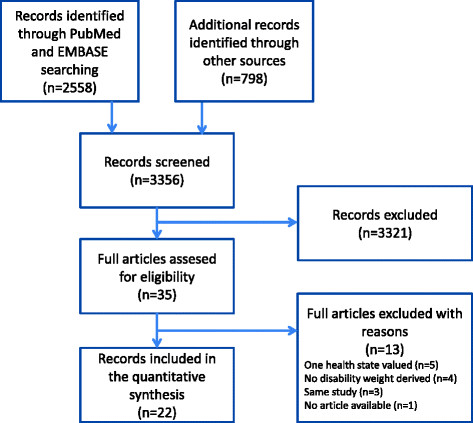
INTRODUCTION: The disability-adjusted life year (DALY) is widely used to assess the burden of different health problems and risk factors. The disability weight, a value anchored between 0 (perfect health) and 1 (equivalent to death), is necessary to estimate the disability component (years lived with disability, YLDs) of the DALY. After publication of the ground-breaking Global Burden of Disease (GBD) 1996, alternative sets of disability weights have been developed over the past 16 years, each using different approaches with regards to the panel, health state description, and valuation methods. The objective of this study was to review all studies that developed disability weights and to critically assess the methodological design choices (health state and time description, panel composition, and valuation method). Furthermore, disability weights of eight specific conditions were compared. METHODS: Disability weights studies (1990¿2012) in international peer-reviewed journals and grey literature were identified with main inclusion criteria being that the study assessed DALY disability weights for several conditions or a specific group of illnesses. Studies were collated by design and methods and evaluation of results. RESULTS: Twenty-two studies met the inclusion criteria of our review. There is considerable variation in methods used to derive disability weights, although most studies used a disease-specific description of the health state, a panel that consisted of medical experts, and nonpreference-based valuation method to assess the values for the majority of the disability weights. Comparisons of disability weights across 15 specific disease and injury groups showed that the subdivision of a disease into separate health states (stages) differed markedly across studies. Additionally, weights for similar health states differed, particularly in the case of mild diseases, for which the disability weight differed by a factor of two or more. CONCLUSIONS: In terms of comparability of the resulting YLDs, the global use of the same set of disability weights has advantages, though practical constraints and intercultural differences should be taken into account into such a set.
Overview
The claims and statistics of this paper haven’t been checked yet.
Free: it reads the open-access text and checks the first 5 claims that cite a source we can check. Create a free account to check every claim.
Integrity signals
Registry
Cites
Statistics
Figures

Verification
Claims the paper makes
The claims and statistics of this paper haven’t been checked yet.
Free: it reads the open-access text and checks the first 5 claims that cite a source we can check. Create a free account to check every claim.
Claims other papers make about this one
Each is checked against this paper’s own text: does it say what the citing paper says it does?
In the citing paper
“Consistent with this possibility, meta-analyses of longitudinal studies show that depression is a consistent predictor of the subsequent first onset of coronary artery disease, stroke, diabetes, heart attacks, obesity, osteoporosis and certain types of cancer. 183”
From Time for united action on depression: a Lancet–World Psychiatric Association Commission (2022) · cites this paper as [183]
Self-check
Percentages, sums and reported differences re-computed from the paper’s own numbers.
The self-check needs the paper’s full text.
Citations
Cites
The Framing of Decisions and the Psychology of Choice
Tversky, A., & Kahneman, D. (1981) · Science · doi:10.1126/science.7455683 · Cited by 18,497
Methods for the Economic Evaluation of Health Care Programmes
Drummond, M. E., Sculpher, M. J., Torrance, G. W., O’Brien, B. J., & Stoddart, G. L. (2005) · doi:10.1093/oso/9780198529446.001.0001 · Cited by 13,648
Murray, C. J. L., Vos, T., Lozano, R., Naghavi, M., Flaxman, A. D., Michaud, C., Ezzati, M., Shibuya, K., Salomon, J. A., Abdalla, S., et al. (2012) · The Lancet · doi:10.1016/s0140-6736(12)61689-4 · Cited by 8,888
(1996) · Cited by 6,884
EQ-SD: a measure of health status from the EuroQol Group
Rabin, R., & Charro, F. D. (2001) · Annals of Medicine · doi:10.3109/07853890109002087 · Cited by 5,613 · cited 1×
“Widely used MAUIs include the EQ-5D health questionnaire and Health Utilities Index (HUI) [17,18].”
MethodMethods for the economic evaluation of health care programmes
Wilson, S. H. (1987) · Journal of Epidemiology and Community Health · doi:10.1136/jech.41.4.355-a · Cited by 4,275 · cited 1×
“desirability of a health state [5,6].”
Quantifying the burden of disease: the technical basis for disability-adjusted life years.
Murray, C. J. L. (1994) · Europe PMC (PubMed Central) · Cited by 1,916
Generic and Disease-Specific Measures in Assessing Health Status and Quality of Life
Patrick, D. L., & Deyo, R. A. (1989) · Medical Care · doi:10.1097/00005650-198903001-00018 · Cited by 1,790
Cross-Cultural Correlates of Life Satisfaction and Self-Esteem
Diener, E., & Diener, M. (1995) · Journal of Personality and Social Psychology · doi:10.1037/0022-3514.68.4.653 · Cited by 1,722
Salomon, J. A., Vos, T., Hogan, D. R., Gagnon, M., Naghavi, M., Mokdad, A., Begum, N., Shah, R., Karyana, M., Kosen, S., et al. (2012) · The Lancet · doi:10.1016/s0140-6736(12)61680-8 · Cited by 1,322 · cited 8×
“The number of judges varied from nine [28] to 30,230 [27].”
BackgroundMethodInfluentialSelf-citation
Research works printed but not linked: 2
- Essink-Bot ML Bonsel GJ Murray CJL, Lopez AD, Salomon JA How to derive disability weights? Summary Measures of Population Health: Concepts, Ethics, Measurement and Applications 2002 World Health Organization, Geneva
- Kwong JC Crowcroft NS Campitelli MA Ratnasingham S Daneman N Deeks SL Manuel DG Ontario Burden of Infectious Disease Study 2010 Ontario Agency for Health Protection and Promotion and the Institute for Clinical Evaluative Sciences, Toronto
Cited by
Time for united action on depression: a Lancet–World Psychiatric Association Commission
Herrman, H., Patel, V., Kieling, C., Berk, M., Buchweitz, C., Cuijpers, P., Furukawa, T. A., Kessler, R. C., Kohrt, B. A., Maj, M., et al. (2022) · The Lancet · doi:10.1016/s0140-6736(21)02141-3 · Cited by 1,104
Cassini, A., Plachouras, D., Eckmanns, T., Abu Sin, M., Blank, H.-P., Ducomble, T., Haller, S., Harder, T., Klingeberg, A., Sixtensson, M., et al. (2016) · PLOS Medicine · doi:10.1371/journal.pmed.1002150 · Cited by 929
Self-citationNandi, A., Counts, N., Chen, S., Seligman, B., Tortorice, D., Vigo, D., & Bloom, D. E. (2022) · eClinicalMedicine · doi:10.1016/j.eclinm.2022.101580 · Cited by 402
Cassini, A., Colzani, E., Pini, A., Mangen, M.-J. J., Plass, D., McDonald, S. A., Maringhini, G., van Lier, A., Haagsma, J. A., Havelaar, A. H., et al. (2018) · Eurosurveillance · doi:10.2807/1560-7917.es.2018.23.16.17-00454 · Cited by 328
“Most infectious diseases cause temporary mild disabilities; it is important to note that according to the methodology used to estimate disability weights, these may differ substantially for similar health states [54].”
BackgroundSelf-citationGlobal Burden of Disease of Mercury Used in Artisanal Small-Scale Gold Mining
Steckling, N., Tobollik, M., Plaß, D., Hornberg, C., Ericson, B., Fuller, R., & Böse‐O’Reilly, S. (2017) · Annals of Global Health · doi:10.1016/j.aogh.2016.12.005 · Cited by 183
“The DW is the key element to be able to sum up the time lost due to premature death and time lived in a state of reduced health.(24) DALY quantifications were performed without age weighting and time discounting.”
BackgroundDevleesschauwer, B., Haagsma, J. A., Angulo, F. J., Bellinger, D. C., Cole, D., Döpfer, D., Fazil, A., Fèvre, E. M., Gibb, H. J., Hald, T., et al. (2015) · PLOS ONE · doi:10.1371/journal.pone.0142498 · Cited by 148
“DWs for several health states have been derived for the GBD studies and for various national burden of disease studies [40].”
MethodSelf-citationMethodology for Valuing the Health Impacts of Air Pollution
Narain, U., & Sall, C. (2016) · World Bank, Washington, DC eBooks · doi:10.1596/24440 · Cited by 107
Saxton, A. T., Poenaru, D., Ozgediz, D., Ameh, E. A., Farmer, D. L., Smith, E. R., & Rice, H. E. (2016) · PLoS ONE · doi:10.1371/journal.pone.0165480 · Cited by 102
Jung, S., Kang, H., Sung, S., & Hong, T. (2019) · Building and Environment · doi:10.1016/j.buildenv.2019.106267 · Cited by 74
Disease and Health Inequalities Attributable to Air Pollutant Exposure in Detroit, Michigan
Martenies, S. E., Milando, C. W., Williams, G. O., & Batterman, S. (2017) · International Journal of Environmental Research and Public Health · doi:10.3390/ijerph14101243 · Cited by 76
“The health burden is quantified using three metrics: the number of incident cases of mortality or morbidity attributable to pollutant exposure (attributable cases); disability-adjusted life years (DALYs); and monetized impacts.”
BackgroundInfluentialMeasuring the Burden of Gambling Harm in New Zealand
Browne, M., Bellringer, M., Greer, N. L., Kolandai‐Matchett, K., Rawat, V., Langham, E., Rockloff, M., du Preez, K. P., & Abbott, M. (2017) · Tuwhera (Auckland University of Technology) · doi:10.11575/prism/9668 · Cited by 110
“Method variance, or different mean estimates obtained by using different protocols, is a well-recognised concern in utility elicitation studies (Haagsma et al., 2014; Schwarzinger, Southard, Burstrom, & Nord, 2003; Haagsma, Havelaar, Janssen, & Bonsel, 2008; Nord, 1991; Murray et al., 2013).”
MethodTaenia solium taeniasis/cysticercosis: From parasite biology and immunology to diagnosis and control
Dixon, M. A., Winskill, P., Harrison, W. E., & Basáñez, M.-G. (2021) · Advances in Parasitology/Advances in parasitology · doi:10.1016/bs.apar.2021.03.003 · Cited by 78
zDALY: An adjusted indicator to estimate the burden of zoonotic diseases
Torgerson, P. R., Rüegg, S. R., Devleesschauwer, B., Abela-Ridder, B., Havelaar, A. H., Shaw, A. P. M., Rushton, J., & Speybroeck, N. (2017) · One Health · doi:10.1016/j.onehlt.2017.11.003 · Cited by 78
“Although time trade-offs have been used to estimate DWs for DALYs [44,45], in GBD 2010 DWs for DALY calculations were developed through household surveys.”
Self-citationDisability Weights Measurement for 228 Causes of Disease in the Korean Burden of Disease Study 2012
Ock, M., Lee, J. Y., Oh, I., Park, H., Yoon, S., & Jo, M. (2016) · Journal of Korean Medical Science · doi:10.3346/jkms.2016.31.s2.s129 · Cited by 68
Burden of Covid-19 restrictions: National, regional and global estimates
Fink, G., Tediosi, F., & Felder, S. (2022) · EClinicalMedicine · doi:10.1016/j.eclinm.2022.101305 · Cited by 60
“27 The fourth limitation is that the Covid-19 mortality data available (using excess mortality) may still underestimate the true toll of the epidemic in some countries, particularly in those with limited resources.”
Charalampous, P., Polinder, S., Wothge, J., von der Lippe, E., & Haagsma, J. A. (2022) · Archives of Public Health · doi:10.1186/s13690-022-00860-z · Cited by 57
Self-citationReflections on key methodological decisions in national burden of disease assessments
von der Lippe, E., Devleesschauwer, B., Gourley, M., Haagsma, J. A., Hilderink, H. B. M., Porst, M., Wengler, A., Wyper, G. M. A., & Grant, I. (2020) · Archives of Public Health · doi:10.1186/s13690-020-00519-7 · Cited by 56
“Abbreviations ABDS: Australian Burden of Disease Study; AIHW: Australian Institute of Health and Welfare; ASR: Age-standardised rates; BoD: Burden of disease; DALYs: Disability-adjusted life years; ESP: European Standard Population; GBD: Global Burden of Disease; ICD-10: International Statistical Classification of Dis…”
MethodResultInfluentialSelf-citationFarmakis, I. T., Barco, S., Mavromanoli, A. C., Agnelli, G., Cohen, A. T., Giannakoulas, G. A., Mahan, C. E., Konstantinides, S., & Valerio, L. (2022) · Journal of the American Heart Association · doi:10.1161/jaha.122.027514 · Cited by 49
“36,37 The EQ-5D health questionnaire generates a utility index that ranges from 0 (death) to 1 (perfect health).”
Sunyoto, T., Verdonck, K., Safi, S. E., Potet, J., Picado, A., & Boelaert, M. (2018) · PLoS neglected tropical diseases · doi:10.1371/journal.pntd.0006914 · Cited by 52
Standardised reporting of burden of disease studies: the STROBOD statement
Devleesschauwer, B., Charalampous, P., Gorasso, V., Assunção, R., Hilderink, H. B. M., Idavain, J., Lesnik, T., Santric-Milicevic, M. M., Pallari, E., Pires, S. M., et al. (2024) · Population Health Metrics · doi:10.1186/s12963-024-00347-9 · Cited by 46
“In addition to these add-on checklists, we also foresee that the STROBOD statement can be used in complement to other statements, such as GATHER [15].”
MethodSelf-citationTeng, K. T., Devleesschauwer, B., de Noordhout, C. M., Bennett, P. F., McGreevy, P. D., Chiu, P.-Y., Toribio, J.-A. L. M. L., & Dhand, N. K. (2018) · PLoS ONE · doi:10.1371/journal.pone.0202580 · Cited by 44
Neethling, I., Jelsma, J. M., Ramma, L., Schneider, H. M., & Bradshaw, D. (2016) · Global Health Action · doi:10.3402/gha.v9.31754 · Cited by 44
“(2) indicated that even when fairly similar methodological valuation designs were used, there were marked differences in disability weights for the same health state between different studies.”
BackgroundMethodInfluentialEstimation of Disability Weights in the General Population of South Korea Using a Paired Comparison
Ock, M., Ahn, J., Yoon, S., & Jo, M.-W. (2016) · PLoS ONE · doi:10.1371/journal.pone.0162478 · Cited by 41
Disability weights based on patient-reported data from a multinational injury cohort
Gabbe, B. J., Lyons, R. A., Simpson, P. M., Rivara, F. P., Ameratunga, S. N., Polinder, S., Derrett, S., & Harrison, J. (2016) · Bulletin of the World Health Organization · doi:10.2471/blt.16.172155 · Cited by 37
Self-citationColzani, E., Cassini, A., Lewandowski, D., Mangen, M.-J. J., Plaß, D., McDonald, S., van Lier, A., Haagsma, J. A., Maringhini, G., Pini, A., et al. (2017) · PLoS ONE · doi:10.1371/journal.pone.0170662 · Cited by 47
Self-citationDisability Weights Measurement for 289 Causes of Disease Considering Disease Severity in Korea
Ock, M., Park, B., Park, H., Oh, I., Yoon, S., Cho, B., & Jo, M. (2019) · Journal of Korean Medical Science · doi:10.3346/jkms.2019.34.e60 · Cited by 39
Establishing disability weights for congenital pediatric surgical conditions: a multi-modal approach
Poenaru, D., Pemberton, J., Frankfurter, C., Cameron, B. H., & Stolk, E. A. (2017) · Population Health Metrics · doi:10.1186/s12963-017-0125-5 · Cited by 35
“offers a comprehensive review of DW methods and studies published through 2012 [21].”
Burden of disease studies in the WHO European Region—a mapping exercise
O’Donovan, M. R., Gapp, C., & Stein, C. (2018) · European Journal of Public Health · doi:10.1093/eurpub/cky060 · Cited by 36
“13,14 In early DALY estimates two additional social weights, discounting and age weighting, were widely used.”
Nomura, S., Yamamoto, Y., Yoneoka, D., Haagsma, J. A., Salomon, J. A., Ueda, P., Mori, R., Santomauro, D. F., Vos, T., & Shibuya, K. (2021) · Population Health Metrics · doi:10.1186/s12963-021-00253-4 · Cited by 33
“However, only few studies are available that would allow contextual examination of differences in DWs across a wide range of health states but these studies have been conducted in a more distant past and used very different methods [7, 18, 19, 31].”
BackgroundSelf-citationWhat Justifies the Allocation of Health Care Resources to Patients with Disorders of Consciousness?
Peterson, A. H., Aas, S., & Wasserman, D. (2021) · AJOB Neuroscience · doi:10.1080/21507740.2021.1896594 · Cited by 37
“Experts, stakeholders, or the general public are asked to evaluate different potential health states using a variety of methods (Haagsma et al. 2014).”
BackgroundLiu, X., Wang, F., Zhou, M., 余永, Qi, J., Yin, P., Yu, S., Zhou, Y., Lin, L., Liu, Y., et al. (2022) · The Lancet Regional Health - Western Pacific · doi:10.1016/j.lanwpc.2022.100520 · Cited by 35
Self-citationOn the human consequences of terrorism
Arce, D. G. (2018) · Public Choice · doi:10.1007/s11127-018-0590-9 · Cited by 31
“Given that Haagsma et al. (2011b) find that the interclass correlation coefficient between observed and predicted comorbidity disability is highest for the additive approach, the additive composite disability weight, DW+, will be used in all calculations from this point forward. Finally, in calculating LD no adjustmen…”
BackgroundMethodInfluentialLi, Y., You, S., Lee, K., Yaesoubi, R., Hsu, K., Gift, T. L., Chesson, H. W., Berruti, A. A., Salomon, J. A., & Rönn, M. M. (2023) · The Journal of Infectious Diseases · doi:10.1093/infdis/jiad047 · Cited by 33
“Estimates for disability weights (utilities) differ substantially across previous studies [43] including the 2 studies used in our analysis, GBD reporting community-based measures and IOM reporting measures from expert perspective [15, 23].”
The Burden of Respiratory Disease from Formaldehyde, Damp and Mould in English Housing
Clark, S. N., Lam, H. C. Y., Goode, E., Marczylo, E. L., Exley, K. S., & Dimitroulopoulou, S. (2023) · Environments · doi:10.3390/environments10080136 · Cited by 34
Rawat, V., Browne, M., Bellringer, M., Greer, N. L., Kolandai‐Matchett, K., Rockloff, M., Langham, E., Hanley, C., du Preez, K. P., & Abbott, M. (2018) · Quality of Life Research · doi:10.1007/s11136-018-1882-8 · Cited by 34
Ock, M., Jo, M., Gong, Y.-H., Lee, H., Lee, J., & Sim, C. S. (2016) · BMC Public Health · doi:10.1186/s12889-016-2904-5 · Cited by 24
“In fact, after the development of DALYs, there have been some debates on the measurement of health loss, the use of person tradeoffs, disability weights of whose perspectives, and the universality of disability weights [5].”
BackgroundSpronk, I., Edgar, D. W., van Baar, M. E., Wood, F. M., Loey, N. E. E. V., Middelkoop, E., Renneberg, B., Öster, C., Orwelius, L., Moi, A. L., et al. (2020) · BMC Public Health · doi:10.1186/s12889-020-8233-8 · Cited by 22
Self-citationKim, Y., Jo, M., Park, H., Oh, I., Yoon, S., Pyo, J., & Ock, M. (2020) · Journal of Korean Medical Science · doi:10.3346/jkms.2020.35.e219 · Cited by 22
Tisavipat, N., Jitpratoom, P., Siritho, S., Prayoonwiwat, N., Apiwattanakul, M., Boonyasiri, A., Rattanathamsakul, N., & Jitprapaikulsan, J. (2023) · Multiple Sclerosis and Related Disorders · doi:10.1016/j.msard.2023.104511 · Cited by 22
Impact of food and water-borne diseases on European population health
Cassini, A., Colzani, E., Kramarz, P., Kretzschmar, M., & Takkinen, J. (2016) · Current Opinion in Food Science · doi:10.1016/j.cofs.2016.06.002 · Cited by 26
“Several sets of disability weights are available, all based on different elicitation methods [28].”
BackgroundSelf-citationPark, J. I., & Jung, H. H. (2017) · PLoS ONE · doi:10.1371/journal.pone.0172001 · Cited by 23
Charalampous, P., Pallari, E., Gorasso, V., von der Lippe, E., Devleesschauwer, B., Pires, S. M., Plaß, D., Idavain, J., Ngwa, C. H., Noguer, I., et al. (2022) · BMC Public Health · doi:10.1186/s12889-022-13925-z · Cited by 19
Self-citationde Noordhout, C. M., Devleesschauwer, B., Salomon, J. A., Turner, H., Cassini, A., Colzani, E., Speybroeck, N., Polinder, S., Kretzschmar, M., Havelaar, A. H., et al. (2017) · European Journal of Public Health · doi:10.1093/eurpub/ckx090 · Cited by 18
“These analyses were performed using the overall database of 255 health states available in Haagsma et al. 14 We hereby extracted the 74 probit coefficients and DWs of the health states relating to infectious diseases, which were the primary focus of this study.”
Self-citationDisability Weights for Pediatric Surgical Procedures: A Systematic Review and Analysis
Smith, E. R., Concepcion, T. L., Lim, S. L., Sadler, S. J., Poenaru, D., Saxton, A. T., Shrime, M. G., Ameh, E. A., Rice, H. E., & Surgery, G. I. F. C. (2018) · World Journal of Surgery · doi:10.1007/s00268-018-4537-6 · Cited by 21
“Disability weights are intended to quantify social preferences for different states of health [17, 54, 55].”
BackgroundChandran, S. L. N., Tiwari, A., Lustosa, A. A., Demir, B., Bowers, B., Albuquerque, R. G., Prado, R. B. R., Lambert, S. M., Watanabe, H., Haagsma, J. A., et al. (2021) · PLoS neglected tropical diseases · doi:10.1371/journal.pntd.0009209 · Cited by 19
“The advantage of HRQOL based weights is that they can sufficiently capture disease burden by covering the patient’s perspective [15].”
BackgroundMethodSelf-citationThe Inequitable Global Burden of Lip and Oral Cancers: Widening Disparities Across Countries
Harris, J. A., Ritchie, C. A., Hanna, G. J., McCain, J. P., & Ji, Y. D. (2020) · Journal of Oral and Maxillofacial Surgery · doi:10.1016/j.joms.2020.12.035 · Cited by 15
Comparative Disease Assessment: a multi-causal approach for estimating the burden of mortality
Seuc, A. H., Fernandez-Gonzalez, L., & Mirabal, M. (2020) · Journal of Public Health · doi:10.1007/s10389-020-01340-w · Cited by 15
Charalampous, P., Haagsma, J. A., Jakobsen, L. S., Gorasso, V., Noguer, I., Padrón‐Monedero, A., Sarmiento-Suárez, R., Santos, J. V., McDonald, S., Plaß, D., et al. (2023) · Epidemiology and Infection · doi:10.1017/s0950268823000031 · Cited by 15
“Several sets of disability weights are available, each reflecting different elicitation techniques [22, 23].”
BackgroundSelf-citationSteckling, N., Devleesschauwer, B., Winkelnkemper, J., Fischer, F., Ericson, B., Krämer, A., Hornberg, C., Fuller, R., Plaß, D., & Böse‐O’Reilly, S. (2017) · International Journal of Environmental Research and Public Health · doi:10.3390/ijerph14010057 · Cited by 14
Steckling, N., Plaß, D., Böse‐O’Reilly, S., Kobal, A. B., Krämer, A., & Hornberg, C. (2015) · Health and Quality of Life Outcomes · doi:10.1186/s12955-015-0388-0 · Cited by 13
“The health states were presented as disease-specific and/ or generic descriptions [29].”
BackgroundMethodLarkins, A., Bruce, M., Bari, C. D., Devleesschauwer, B., Pigott, D. M., & Ash, A. L. (2022) · PLoS neglected tropical diseases · doi:10.1371/journal.pntd.0010567 · Cited by 16
“The choice of DWs to be used will clearly have an impact on resulting YLD values and DWs have been developed using a variety of different methods in different populations [20,21].”
Does blindness count? Disability weights for vision loss
Braithwaite, T., Taylor, H. R., Bourne, R., Keeffe, J. E., & Pesudovs, K. (2016) · Clinical and Experimental Ophthalmology · doi:10.1111/ceo.12874 · Cited by 15
Opio, C. K., Kazibwe, F., Lalitha, R., Kabatereine, N. B., & Ocama, P. (2021) · Journal of Patient-Reported Outcomes · doi:10.1186/s41687-021-00389-9 · Cited by 11
Valerio, L., Grochtdreis, T., Mavromanoli, A. C., Farmakis, I. T., Abele, C., Neusius, T., Mohr, K., Christodoulou, K. C., Hobohm, L., Keller, K., et al. (2025) · European Journal of Preventive Cardiology · doi:10.1093/eurjpc/zwaf307 · Cited by 14
High impact health service interventions for attainment of UHC in Africa: A systematic review
Karamagi, H. C., Berhane, A., Kidane, S. N., Nyawira, L., Ani–Amponsah, M., Nyanjau, L., Maoulana, K., Seydi, A. B.-W., Nzinga, J., Dangou, J.-M., et al. (2022) · PLOS Global Public Health · doi:10.1371/journal.pgph.0000945 · Cited by 13
Z., L. P. N., Hartnack, S., & Torgerson, P. R. (2022) · Animals · doi:10.3390/ani12141845 · Cited by 14
Review of Issues for Disability Weight Studies
Ock, M., Ko, S., Lee, H., & Jo, M. (2016) · Health Policy and Management · doi:10.4332/kjhpa.2016.26.4.352 · Cited by 10
Wang, F., Lui, J., & Wang, J. (2023) · International Journal of Environmental Research and Public Health · doi:10.3390/ijerph20032419 · Cited by 8
Can global or national disability weights represent provincial level?
He, Q., Zhou, M., Yin, P., Jiang, B., Qi, J., Liu, Y., Liu, J., You, J., Zhou, Y., Long, Z., et al. (2023) · BMC Public Health · doi:10.1186/s12889-022-14347-7 · Cited by 9
“Disability-adjusted life years (DALYs)is a generally recognized measure of disease burden, which comprehensively considers the impact of death and disability on health [1, 5, 6].”
BackgroundLei, S., Zheng, R., Zhang, S., Huang, Y., Qiao, L., Song, B., He, Y., Du, L., Wang, N., Xi, Y., et al. (2023) · 中国科学通报:英文版 · doi:10.1016/j.scib.2023.06.013 · Cited by 8
Kovács, N., Mahrouseh, N., Monasta, L., Andreella, A., Campostrini, S., & Varga, O. (2025) · Scientific Reports · doi:10.1038/s41598-024-84374-4 · Cited by 12
Quantifying Impairment and Disability in Bioarchaeological Assemblages
Stodder, A. L. W. (2017) · Springer eBooks · doi:10.1007/978-3-319-56949-9_10 · Cited by 8
Gabbe, B. J., Dipnall, J. F., Lynch, J. W., Rivara, F. P., Lyons, R. A., Ameratunga, S. N., BRUSSONI, M. J., Lecky, F. E., Bradley, C., Simpson, P. M., et al. (2018) · BMJ Open · doi:10.1136/bmjopen-2018-024755 · Cited by 8
“The EQ-5D-3L (EQ-5D) is a generic measure of health status, consisting of a descriptive component asking about problems in five dimensions (mobility, self-care, usual activities, pain or discomfort and anxiety or depression) and the most widely used MAUI for this purpose.(32) The EQ-5D is captured by the VSTR, VOTOR,…”
MethodAndreella, A., Monasta, L., & Campostrini, S. (2023) · Population Health Metrics · doi:10.1186/s12963-023-00317-7 · Cited by 8
“We decided then to use the 2019 GBD disability weights having been tested and validated several times [24, 26].”
BackgroundMethodInfluentialGonzález, R., Mitra, K., Vela, E., Gézsi, A., Paajanen, T. I., Gál, Z., Hullám, G., Mäkinen, H., Nagy, T., Kuokkanen, M., et al. (2024) · Journal of Medical Internet Research · doi:10.2196/53162 · Cited by 8
“In this research, the use of estimations of mean DW [44] to assess the burden of disease conditions achieved desirable results and was conceptually justified, but it undoubtedly exhibited significant limitations.”
Lobo, E., Nanda, L., Akhouri, S. S., Shrivastava, C., Ronghang, R., Menon, G. R., & Dutta, A. (2019) · Frontiers in Public Health · doi:10.3389/fpubh.2019.00276 · Cited by 7
Liu, X., Wang, Y., Wang, F., Zhou, H., Zhang, Q., Meng, R., Yu, Y., Liu, Y., & Yu, C. (2025) · Population Health Metrics · doi:10.1186/s12963-025-00425-6 · Cited by 5
“Considering education, profession, and other sociodemographic characteristics of respondents may impact the assessments of DW [11–14], this study also explores the influential factors of DW estimates.”
Haagsma, J. A., & Charalampous, P. (2024) · Population Health Metrics · doi:10.1186/s12963-024-00342-0 · Cited by 6
“…shift with regards to study population is the shift towards the use of less complex health state preference elicitation methods, as some members of a study population consisting of persons from the general population may have lower numeracy or literacy levels compared to health experts [16, 17].”
BackgroundSelf-citationGerhard, R. L., Gabbe, B. J., Cameron, P. A., Newstead, S., Morrison, C. N., Clarke, N., & Beck, B. (2025) · Journal of Safety Research · doi:10.1016/j.jsr.2024.11.028 · Cited by 7
Schmidt, C. A., Abdi, A. A., Mouhanna, F., Kahn, E., Compton, K., Baumann, M. M., Kelly, Y. O., Kendrick, P., Sylte, D. O., Li, Z., et al. (2025) · The Lancet Regional Health - Americas · doi:10.1016/j.lana.2025.101064 · Cited by 7
“63 With that caveat, our results complement previous estimates of HALE in the USA.”
Evaluative Diversity and the (Ir)Relevance of Well-Being
Aas, S. (2020) · Oxford University Press eBooks · doi:10.1093/oxfordhb/9780190622879.013.12 · Cited by 5
Estimation of disability free life expectancy in non small cell lung cancer based on real world data
Lin, S.-M., Yang, S., Wu, T.-I., Wang, J., & Liu, L. (2023) · Scientific Reports · doi:10.1038/s41598-023-40117-5 · Cited by 5
“…to our best of knowledge, like many of the previous studies, these estimations were predominantly relied on cross-sectional approach over a specific time period and the most of them were derived from consensus from an expert focus group or a sample of general population living in the community 13 .”
ResultOkello, N. O., Okello, T. W., & Zunckel, M. (2020) · Clean Air Journal · doi:10.17159/caj/2020/30/1.8012 · Cited by 10
Many Miles to Go: A Systematic Review of the State of Cost-Utility Analyses in Brazil
Campolina, A. G., Rozman, L. M., Decimoni, T. C., Leandro, R., Novaes, H. M. D., & de Soárez, P. C. (2016) · Applied Health Economics and Health Policy · doi:10.1007/s40258-016-0290-x · Cited by 6
Spronk, I., Haagsma, J. A., Edgar, D. W., van Baar, M. E., Polinder, S., & Wood, F. M. (2020) · Burns · doi:10.1016/j.burns.2019.12.001 · Cited by 5
Self-citationCharalampous, P., Maas, C. C. H. M., & Haagsma, J. A. (2024) · BMJ Public Health · doi:10.1136/bmjph-2023-000470 · Cited by 5
Self-citationEstimating the Burden of Foodborne Disease
Lake, R., Minato, Y., & Havelaar, A. H. (2023) · Elsevier eBooks · doi:10.1016/b978-0-12-822521-9.00121-0 · Cited by 4
Self-citationA systematic review of the methodological considerations in Campylobacter burden of disease studies
Tumulty, M., Bari, C. D., Devleesschauwer, B., Pires, S. M., & Kabir, Z. (2025) · PLoS neglected tropical diseases · doi:10.1371/journal.pntd.0012681 · Cited by 4
“Establishing DWs lacks a universal standard, complicating the assessment of their validity [38,67].”
Shi, Y., Wang, B., Zhao, J., Wang, C., Li, N., Chen, M., & Wan, X. (2024) · JMIR Public Health and Surveillance · doi:10.2196/52019 · Cited by 3
“For this purpose, series multi-attribute utility instruments based on health-related quality of life (HRQOL) are used to classify health status [1,4].”
Linking animal and human health burden: challenges and opportunities
Martins, S. B., Pigott, D., Devleesschauwer, B., Fastl, C., Bari, C. D., & Venkateswaran, N. (2024) · Scientific and Technical Review (World Organisation for Animal Health) · doi:10.20506/rst.43.3520 · Cited by 3
“An essential part of this component is disability weights (DWs) where each health state related to an illness is assigned a value between zero (perfect health) and one (equivalent to death) [4].”
BackgroundDisability weight measurement for the severity of different diseases in Wuhan, China
Liu, X., Guo, Y., Wang, F., Yu, Y., Yan, Y., Wen, H., Shi, F., Wang, Y., Wang, X., Shen, H., et al. (2023) · Population Health Metrics · doi:10.1186/s12963-023-00304-y · Cited by 4
“The findings suggest that there might be culture or contextual differences in perception of disease severity compared with different survey conducted elsewhere [19, 33].”
ResultNontarak, J., Assanangkornchai, S., & Callinan, S. (2020) · International Journal of Environmental Research and Public Health · doi:10.3390/ijerph17051595 · Cited by 4
“The TTO method elicits preference scores of a certain health state presented to the respondent by making a trade-off between length of life and quality of life [6].”
BackgroundMethodDisability weights measurement for 17 diseases in Japan: A survey based on medical professionals
Piao, X., Tsugawa, S., Takemura, Y., Ichikawa, N., Kida, R., Kunie, K., & Managi, S. (2021) · Economic Analysis and Policy · doi:10.1016/j.eap.2021.02.010 · Cited by 3
Mohtashami, S., Safa, N., Guadagno, E., Baird, R., & Poenaru, D. (2020) · Canadian Journal of Surgery · doi:10.1503/cjs.004819 · Cited by 3
Fortuna, D., Caselli, L., Romoli, M., Vignatelli, L., Vaudano, A. E., Mandrioli, J., Malagù, S., Costantini, M., Tibaldi, G., Gildoni, G., et al. (2025) · Population Health Metrics · doi:10.1186/s12963-025-00404-x · Cited by 2
“However, empirical research has shown that the mapping criteria are dependent on the panel composition [39].”
A Comparison of Disability Weights for Alcohol Use Disorders
Nontarak, J., Assanangkornchai, S., & Callinan, S. (2020) · Journal of Health Science and Medical Research · doi:10.31584/jhsmr.2020759 · Cited by 2
“This indicates the importance of methods in deriving disability weights.(25) However, it is not clear why the VAS method gave the highest weights in this study.”
Methodde Hollander, A. E. M., & KAMP, I. V. (2019) · Elsevier eBooks · doi:10.1016/b978-0-12-409548-9.11869-x · Cited by 2
Tooth life expectancy and burden of tooth loss: Two cross-sectional studies in Taiwan
Liang, L.-Y., Tsai, M., Shih, K., Huang, S.-M., Morisky, D. E., & Fu, E. (2022) · Journal of Dental Sciences · doi:10.1016/j.jds.2022.05.002 · Cited by 1
“00429 modified following the previous studies.(3,7,16) The YLDs-T per capita was subsequently calculated.”
MethodDisability Weight – ein umstrittenes Maß zur Bewertung von Gesundheitsbeeinträchtigungen
Tobollik, M., Terschüren, C., Steckling, N., McCall, T., & Hornberg, C. (2015) · Springer eBooks · doi:10.1007/978-3-658-10679-9_16 · Cited by 1
Diallo, O. O., Lynch, C. F., Kealy, G. P., Cavanaugh, J., Ramirez, M., Torner, J. C., & Peek-Asa, C. L. (2016) · doi:10.17077/etd.kc4ii76s · Cited by 1
Opio, C. K., Kazibwe, F., Lalitha, R., Kabatereine, N. B., & Ocama, P. (2020) · doi:10.21203/rs.3.rs-42011/v1 · Cited by 1
Simple Analytics of Disability Adjusted Life Years (DALYS)Preprint
Grand, M. C. (2014) · SSRN Electronic Journal · doi:10.2139/ssrn.2505138 · Cited by 1
Disability weights for castration-resistant prostate cancer: an empirical investigation
Borsoi, L., Ciani, O., Vivo, R. D., Russo, G. I., Scarcia, M., Fino, C. D., Beccaglia, P., & Luccarini, I. (2022) · Global & Regional Health Technology Assessment · doi:10.33393/grhta.2022.2431
“In the absence of a gold standard to evaluate the validity of DWs (6), we first compared the results obtained with the rankings of matching diseases drawn the GBD 2013 study (33), a web-based survey of participants aged 18-65 years in four European countries (Hungary, Italy, the Netherlands and Sweden).”
BackgroundResultการประยกตใชแนวคดคณภาพชวตในการประเมนสขภาพของพนกงานในองคกร
เลิศพิทักษ์พงศ์, ช. (2016) · doi:10.58837/chula.the.2016.230
Cassini, A. (2023) · Utrecht University Repository (Utrecht University) · doi:10.33540/1881
Self-citationDetermining the Population Health Impact of Environmental Noise
Brink, M., & Haagsma, J. A. (2024) · Springer-AAS acoustics series. · doi:10.1007/978-981-97-6121-0_5
Self-citationNewly estimated disability weights for 196 health states in Hubei Province, China
Zhou, M., Zhang, L., He, T., Zhu, S., Tang, Y., Li, Q., Shen, M., & Pan, J. (2024) · Population Health Metrics · doi:10.1186/s12963-024-00359-5
Lundberg, D. J. (2025) · SocArXiv (OSF Preprints) · doi:10.31235/osf.io/nzk62_v1
Tian, G., He, S., Cui, Y., Zhou, F., Ma, Y., Yang, W., Shuai, J., Wang, Q., Deng, Z., & Yan, Y. (2025) · Population Health Metrics · doi:10.1186/s12963-025-00417-6
“This may have resulted in some differences in children’s perspectives [28, 38].”
Nomura, S., Yamamoto, Y., Yoneoka, D., Haagsma, J. A., Salomon, J. A., Ueda, P., Mori, R., Santomauro, D. F., Vos, T., & Shibuya, K. (2021) · Figshare · doi:10.6084/m9.figshare.14478413
Self-citation
Metadata
- Authors
- Haagsma, J. A., Polinder, S., Cassini, A., Colzani, E., & Havelaar, A. H.
- Affiliations
- Erasmus MC (NL)
- European Centre for Disease Prevention and Control (SE)
- Utrecht University (NL)
- Corresponding author
- Haagsma, Juanita A
- Venue
- Population Health Metrics
- Published
- 2014-08-23
- Volume
- 12
- Issue
- 1
- Pages
- 20-20
- ISSN
- 1478-7954 (ISSN-L)
- PMC
- PMC4445691
- OpenAlex
- W2171186399
- Cited by
- 105
- References
- 69
- Citations by year
- 2026: 1 · 2025: 8 · 2024: 10 · 2023: 13 · 2022: 13 · 2021: 8 · 2020: 12 · 2019: 4 · 2018: 8 · 2017: 10 · 2016: 14 · 2015: 3 · 2014: 1
- FWCI
- 2.75
- Type
- journal article
- Language
- en
- Open access
- gold
- doi.org
- Locations
- Population Health Metrics (publishedVersion, cc-by)
- PubMed Central (publishedVersion, cc-by)
- PubMed (publishedVersion)
- EUR Research Repository (Erasmus University Rotterdam) (acceptedVersion)
- EUR Research Repository (Erasmus University Rotterdam) (submittedVersion)
- Rivm (National Institute for Public Health and the Environment) (submittedVersion)
- Topics
- Social Sciences › Economics, Econometrics and Finance › Economics and Econometrics › Health Systems, Economic Evaluations, Quality of Life
- Social Sciences › Economics, Econometrics and Finance › Economics and Econometrics › Economic and Environmental Valuation
- Health Sciences › Health Professions › Physical Therapy, Sports Therapy and Rehabilitation › Musculoskeletal pain and rehabilitation
- Keywords
- disability weights, disability-adjusted life years, years lived with disability, health state valuation, health state descriptions, expert panel, disease staging, global burden of disease, intercultural differences
About these checks
Registry, retraction, Cites and statistics results are computed, not judged, with one exception: a printed reference that no index lists is read once by a model before it counts as a citation error. Claims are extracted by a model and kept only when their quote appears verbatim in the text; each cited source is then checked, with a model’s help, for whether it says what the claim relies on. Those verdicts can be wrong — read the claim’s quote and the cited source before relying on one.
Statistics and arithmetic are recomputed, not judged.
Confidence bands are shown only for fields calibrated on our annotated test set. None is calibrated yet, so no band is shown.
What counts as a claim ›How we measure confidence ›How we check this ›
Are you an author, or do you see a problem with this page? Request a review
Data sources
Bibliographic data: Semantic Scholar, OpenAlex, Crossref.
Contains information from the Semantic Scholar Academic Graph Datasets, made available under the ODC Attribution License (ODC-BY 1.0).
Semantic Scholar’s data is described in: Kinney, R., et al. (2023). The Semantic Scholar Open Data Platform. arXiv:2301.10140.
