

The DOI matches its Crossref record; 51 of the 52 references it cites were found in a registry or an index.
Prevalence and risk factors for anemia severity and type in Malawian men and women: urban and rural differences
Open accessAbstract
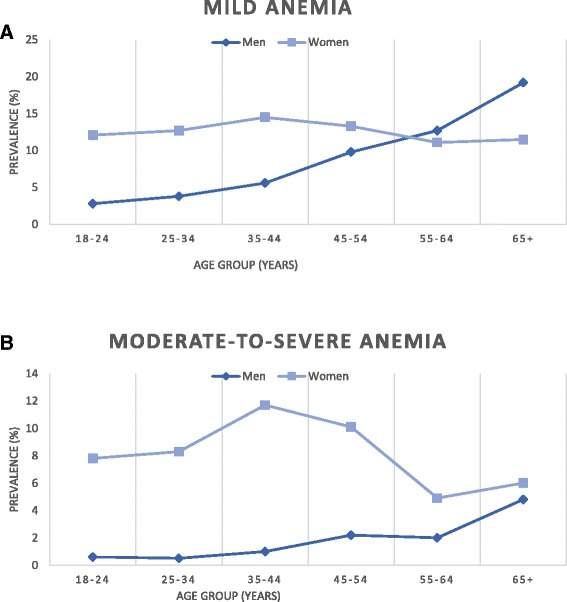
BACKGROUND: The global burden of anemia is large especially in sub-Saharan Africa, where HIV is common and lifestyles are changing rapidly with urbanization. The effects of these changes are unknown. Studies of anemia usually focus on pregnant women or children, among whom the burden is greatest. We describe prevalence and risk factors for anemia among rural and urban men and women of all ages in Malawi. METHODS: We analyzed data from a population-wide cross-sectional survey of adults conducted in two sites, Karonga (rural) and Lilongwe (urban), commencing in May 2013. We used multinomial logistic regression models, stratified by sex to identify risk factors for mild and moderate-to-severe anemia. RESULTS: Anemia prevalence was assessed among 8,926 men (age range 18-100 years) and 14,978 women (age range: 18-103 years). Weighted prevalence levels for all, mild, and moderate-to-severe anemia were 8.2, 6.7 and 1.2% in rural men; 19.4, 12.0 and 7.4% in rural women; 5.9, 5.1 and 0.8% in urban men; and 23.4, 13.6 and 10.1% in urban women. Among women, the odds of anemia were higher among urban residents and those with higher socioeconomic status. Increasing age was associated with higher anemia prevalence in men. Among both men and women, HIV infection was a consistent risk factor for severity of anemia, though its relative effect was stronger on moderate-to-severe anemia. CONCLUSIONS: The drivers of anemia in this population are complex, include both socioeconomic and biological factors and are affecting men and women differently. The associations with urban lifestyle and HIV indicate opportunities for targeted intervention.
Overview
The claims and statistics of this paper haven’t been checked yet.
Run the check — free, no account needed. It reads the open-access text and checks the sources it cites.
Integrity signals
Registry
Cites
Statistics
Figures
Verification
Claims the paper makes
The claims and statistics of this paper haven’t been checked yet.
Run the check — free, no account needed. It reads the open-access text and checks the sources it cites.
Claims other papers make about this one
Each is checked against this paper’s own text: does it say what the citing paper says it does?
In the citing paper
“Physically, frequent or prolonged bleeds add to girls and women’s risk of anaemia, particularly for those who are nutritionally compromised, or having comorbidities such as HIV.24”
From Beyond menstrual hygiene: addressing vaginal bleeding throughout the life course in low and middle-income countries (2017) · cites this paper as [24]
Self-check
Percentages, sums and reported differences re-computed from the paper’s own numbers.
The self-check needs the paper’s full text.
Citations
Cites
Worldwide prevalence of anaemia, WHO Vitamin and Mineral Nutrition Information System, 1993–2005
McLean, E., Cogswell, M., Egli, I., Wojdyla, D., & de Benoist, B. (2009) · Public Health Nutrition · doi:10.1017/s1368980008002401 · Cited by 2,734
Socioeconomic Status in Health Research
Braveman, P., Cubbin, C., Egerter, S. A., Chideya, S., Marchi, K. S., Metzler, M. M., & Posner, S. F. (2005) · JAMA · doi:10.1001/jama.294.22.2879 · Cited by 2,360
Pickett, K. E., & Pearl, M. (2001) · Journal of Epidemiology & Community Health · doi:10.1136/jech.55.2.111 · Cited by 2,207
A systematic analysis of global anemia burden from 1990 to 2010
Kassebaum, N. J., Jasrasaria, R., Naghavi, M., Wulf, S. K., Johns, N. E., Lozano, R., Regan, M. C., Weatherall, D. J., Chou, D. P., Eisele, T. P., et al. (2013) · Blood · doi:10.1182/blood-2013-06-508325 · Cited by 2,115
Stevens, G. A., Finucane, M. M., De‐Regil, L. M., Paciorek, C., Flaxman, S. R., Branca, F., Peña‐Rosas, J. P., Bhutta, Z. A., & Ezzati, M. (2013) · The Lancet Global Health · doi:10.1016/s2214-109x(13)70001-9 · Cited by 1,977
Guralnik, J. M., Eisenstaedt, R. S., Ferrucci, L., Klein, H. G., & Woodman, R. C. (2004) · Blood · doi:10.1182/blood-2004-05-1812 · Cited by 1,450
Anaemia in low-income and middle-income countries
Balarajan, Y., Ramakrishnan, U., Özaltin, E., Shankar, A. H., & Subramanian, S. V. (2011) · The Lancet · doi:10.1016/s0140-6736(10)62304-5 · Cited by 1,393
Haas, J. D., & Brownlie, T. (2001) · The Journal of Nutrition · doi:10.1093/jn/131.2.676s · Cited by 1,186
Galobardes, B. (2004) · Epidemiologic Reviews · doi:10.1093/epirev/mxh008 · Cited by 753
Severe Anemia in Malawian Children
Calis, J. C. J., Phiri, K. S., Faragher, E. B., Brabin, B. J., Bates, I., Cuevas, L. E., de Haan, R. J., Phiri, A., Malange, P., Khoka, M., et al. (2008) · New England Journal of Medicine · doi:10.1056/nejmoa072727 · Cited by 494
Self-citation
Research works printed but not linked: 1
- WHO, VMNIS. Haemoglobin concentrations for the diagnosis of anaemia and assessment of severity. Geneva: Vitamin and Mineral Nutrition Information System, WHO; 2011.
Cited by
Sorted by citations
Gautam, S., Min, H., Kim, H., & Jeong, H.-S. (2019) · PLoS ONE · doi:10.1371/journal.pone.0218288 · Cited by 157
Kassa, G. M., Muche, A. A., Berhe, A. K., & Fekadu, G. A. (2017) · BMC Hematology · doi:10.1186/s12878-017-0090-z · Cited by 139
Teshale, A. B., Tesema, G. A., Worku, M. G., Yeshaw, Y., & Tessema, Z. T. (2020) · PLoS ONE · doi:10.1371/journal.pone.0238957 · Cited by 142
Nankinga, O., & Aguta, D. (2019) · BMC Public Health · doi:10.1186/s12889-019-8114-1 · Cited by 97
Sharif, N., Das, B., & Alam, A. (2023) · PLoS ONE · doi:10.1371/journal.pone.0281015 · Cited by 111
Metadata
- Authors
- Adamu, A. L., Crampin, A., Kayuni, N., Amberbir, A., Koole, O., Phiri, A., Nyirenda, M., & Fine, P.
- Affiliations
- Bayero University Kano (NG)
- London School of Hygiene & Tropical Medicine (GB)
- Malawi Epidemiology and Intervention Research Unit (MW)
- Corresponding author
- Adamu, Aishatu L.
- Venue
- Population Health Metrics
- Published
- 2017-03-29
- Volume
- 15
- Issue
- 1
- Pages
- 12-12
- ISSN
- 1478-7954 (ISSN-L)
- PMC
- PMC5371260
- OpenAlex
- W2598653401
- Cited by
- 114
- References
- 52
- Citations by year
- 2026: 6 · 2025: 9 · 2024: 14 · 2023: 14 · 2022: 16 · 2021: 20 · 2020: 21 · 2019: 5 · 2018: 5 · 2017: 4
- FWCI
- 7.35
- Type
- journal article
- Language
- en
- Open access
- gold
- doi.org
- Licence
- cc-by
- Locations
- Population Health Metrics (publishedVersion, cc-by)
- PubMed Central (publishedVersion, cc-by)
- PubMed (publishedVersion)
- ENLIGHTEN (Jurnal Bimbingan dan Konseling Islam) (acceptedVersion)
- LSHTM Research Online (London School of Hygiene and Tropical Medicine) (acceptedVersion)
- DOAJ (DOAJ: Directory of Open Access Journals) (submittedVersion)
- Greater South Information System
- Funders
- Wellcome Trust
- Topics
- Health Sciences › Medicine › Hematology › Iron Metabolism and Disorders
- Health Sciences › Medicine › Genetics (clinical) › Hemoglobinopathies and Related Disorders
- Health Sciences › Medicine › Public Health, Environmental and Occupational Health › Malaria Research and Control
- Keywords
- anemia, anemia severity, anemia prevalence, risk factors, HIV infection, urbanization, urban-rural differences, sex differences, socioeconomic status, adults, Malawi
- MeSH terms
- Adolescent, Adult, Aged, Aged, 80 and over, Anemia, Cross-Sectional Studies, Female, Humans, Malawi, Male, Middle Aged, Risk Factors, Rural Population, Severity of Illness Index, Sex Factors, Socioeconomic Factors, Urban Population, HIV Infections, Prevalence, Logistic Models, Young Adult
About these checks
Registry, retraction, Cites and statistics results are computed, not judged, with one exception: a printed reference that no index lists is read once by a model before it counts as a citation error. Claims are extracted by a model and kept only when their quote appears verbatim in the text; each cited source is then checked, with a model’s help, for whether it says what the claim relies on. Those verdicts can be wrong — read the claim’s quote and the cited source before relying on one.
Statistics and arithmetic are recomputed, not judged.
Confidence bands are shown only for fields calibrated on our annotated test set. None is calibrated yet, so no band is shown.
What counts as a claim ›How we measure confidence ›How we check this ›
Are you an author, or do you see a problem with this page? Request a review
