

The DOI matches its Crossref record; 62 of the 62 references it cites were found in a registry or an index.
Response to IL-6 trans- and IL-6 classic signalling is determined by the ratio of the IL-6 receptor α to gp130 expression: fusing experimental insights and dynamic modelling
Open accessAbstract
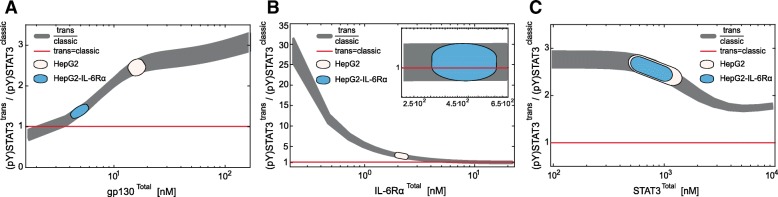
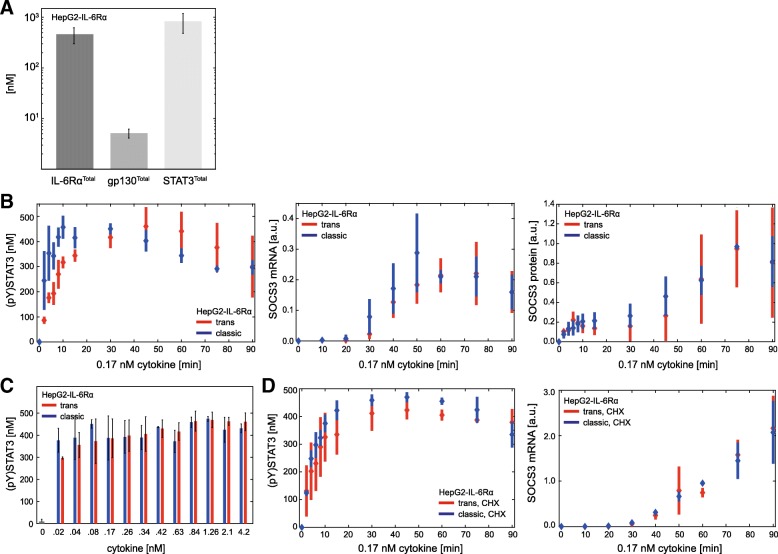
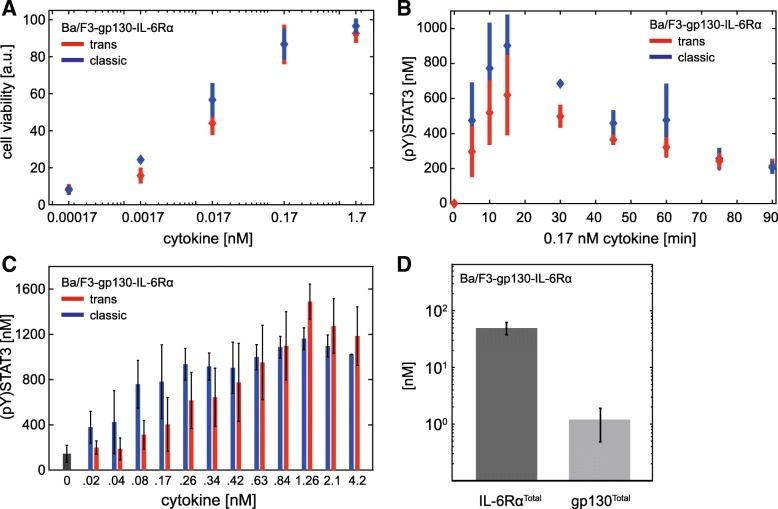
BACKGROUND: Interleukin-6 is a pleiotropic cytokine with high clinical relevance and an important mediator of cellular communication, orchestrating both pro- and anti-inflammatory processes. Interleukin-6-induced signalling is initiated by binding of IL-6 to the IL-6 receptor α and subsequent binding to the signal transducing receptor subunit gp130. This active receptor complex initiates signalling through the Janus kinase/signal transducer and activator of transcription pathway. Of note, IL-6 receptor α exists in a soluble and a transmembrane form. Binding of IL-6 to membrane-bound IL-6 receptor α induces anti-inflammatory classic signalling, whereas binding of IL-6 to soluble IL-6 receptor α induces pro-inflammatory trans-signalling. Trans-signalling has been described to be markedly stronger than classic signalling. Understanding the molecular mechanisms that drive differences between trans- and classic signalling is important for the design of trans-signalling-specific therapies. These differences will be addressed here using a combination of dynamic mathematical modelling and molecular biology. METHODS: We apply an iterative systems biology approach using set-based modelling and validation approaches combined with quantitative biochemical and cell biological analyses. RESULTS: The combination of experimental analyses and dynamic modelling allows to relate the observed differences between IL-6-induced trans- and classic signalling to cell-type specific differences in the expression and ratios of the individual subunits of the IL-6 receptor complex. Canonical intracellular Jak/STAT signalling is indifferent in IL-6-induced trans- and classic signalling. CONCLUSION: This study contributes to the understanding of molecular mechanisms of IL-6 signal transduction and underlines the power of combined dynamical modelling, model-based validation and biological experiments. The opposing pro- and anti-inflammatory responses initiated by IL-6 trans- and classic signalling depend solely on the expression ratios of the subunits of the entire receptor complex. By pointing out the importance of the receptor expression ratio for the strength of IL-6 signalling this study lays a foundation for future precision medicine approaches that aim to selectively block pro-inflammatory trans-signalling. Furthermore, the derived models can be used for future therapy design.
Overview
The claims and statistics of this paper haven’t been checked yet.
Run the check — free, no account needed. It reads the open-access text and checks the sources it cites.
Integrity signals
Registry
Cites
Statistics
Figures
Verification
Claims the paper makes
The claims and statistics of this paper haven’t been checked yet.
Run the check — free, no account needed. It reads the open-access text and checks the sources it cites.
Claims other papers make about this one
Each is checked against this paper’s own text: does it say what the citing paper says it does?
The source backs part of the claim, not all of it — or backs it for a different population, condition or comparison.
In the citing paper
“Only the specific inhibition of IL-6 trans-signaling, rather than total inhibition of IL-6 signaling, is sufficient to suppress tumor progression [71, 72].”
From The double-edged effects of IL-6 in liver regeneration, aging, inflammation, and diseases (2024) · cites this paper as [72]
Experimental — accuracy not yet measuredThe source backs part of the claim, not all of it — or backs it for a different population, condition or comparison.
In the citing paper
“In addition, evidences suggest that IL-6 trans-signaling, but not IL-6 classic signaling, is essential to promote HCC carcinogenesis and progression, and only the activation of membrane-bound IL-6R and gp130 in hepatocytes seems not sufficient for tumor formation [71, 72].”
From The double-edged effects of IL-6 in liver regeneration, aging, inflammation, and diseases (2024) · cites this paper as [72]
Experimental — accuracy not yet measured
Self-check
Percentages, sums and reported differences re-computed from the paper’s own numbers.
The self-check needs the paper’s full text.
Citations
Cites
A new mathematical model for relative quantification in real-time RT-PCR
Pfaffl, M. W. (2001) · Nucleic Acids Research · doi:10.1093/nar/29.9.e45 · Cited by 34,610
IL‐6 in inflammation, immunity, and disease
Tanaka, T., Narazaki, M., & Kishimoto, T. (2014) · Cold Spring Harbor Perspectives in Biology · doi:10.1101/cshperspect.a016295 · Cited by 5,046
Principles of interleukin (IL)-6-type cytokine signalling and its regulation
HEINRICH, P. C., BEHRMANN, I., HAAN, S., HERMANNS, H. M., MÜLLER-NEWEN, G., & SCHAPER, F. (2003) · Biochemical Journal · doi:10.1042/bj20030407 · Cited by 3,272
Self-citationThe pro- and anti-inflammatory properties of the cytokine interleukin-6
Scheller, J., Chalaris, A., Schmidt-Arras, D., & Rose-John, S. (2011) · Biochimica et Biophysica Acta (BBA) - Molecular Cell Research · doi:10.1016/j.bbamcr.2011.01.034 · Cited by 3,212
IL-6 as a keystone cytokine in health and disease
Hunter, C. A., & Jones, S. A. (2015) · Nature Immunology · doi:10.1038/ni.3153 · Cited by 2,511
A family of cytokine-inducible inhibitors of signalling
Starr, R., Willson, T. A., Viney, E. M., Murray, L. J. L., Rayner, J. R., Jenkins, B. J., Gonda, T. J., Alexander, W. S., Metcalf, D., Nicola, N. A., et al. (1997) · Nature · doi:10.1038/43206 · Cited by 2,066
A new protein containing an SH2 domain that inhibits JAK kinases
Endo, T. A., Masuhara, M., Yokouchi, M., Suzuki, R., Sakamoto, H., Mitsui, K., Matsumoto, A., Tanimura, S., Ohtsubo, M., Misawa, H., et al. (1997) · Nature · doi:10.1038/43213 · Cited by 1,408
Atreya, R., Mudter, J., Finotto, S., Müllberg, J., Jostock, T., Wirtz, S., Schütz, M., Bartsch, B., Holtmann, M., Becker, C., et al. (2000) · Nature Medicine · doi:10.1038/75068 · Cited by 1,293
Structure and function of a new STAT-induced STAT inhibitor
Naka, T., Narazaki, M., Hirata, M., Matsumoto, T., Minamoto, S., Aono, A., Nishimoto, N., Kajita, T., Taga, T., Yoshizaki, K., et al. (1997) · Nature · doi:10.1038/43219 · Cited by 1,040
Molecular cloning and expression of an IL-6 signal transducer, gp130
Hibi, M., Murakami, M., Saito, M., Hirano, T., Taga, T., & Kishimoto, T. (1990) · Cell · doi:10.1016/0092-8674(90)90411-7 · Cited by 1,039
Cited by
Sorted by citations
Cytokines and Chemokines Involved in Osteoarthritis Pathogenesis
Molnar, V., Matišić, V., Kodvanj, I., Bjelica, R., Jeleč, Ž., Hudetz, D., Rod, E., Čukelj, F., Vrdoljak, T., Vidović, D., et al. (2021) · International Journal of Molecular Sciences · doi:10.3390/ijms22179208 · Cited by 664
A roadmap to target interleukin-6 in osteoarthritis
Wiegertjes, R., van de Loo, F. A. J., & Davidson, E. N. B. (2020) · Rheumatology · doi:10.1093/rheumatology/keaa248 · Cited by 195
Unterman, A., Sumida, T. S., Nouri, N., Yan, X., Zhao, A., Gasque, V., Schupp, J. C., Asashima, H., Liu, Y., Cosme, C., et al. (2022) · Nature Communications · doi:10.1038/s41467-021-27716-4 · Cited by 181
The exercise IL-6 enigma in cancer
Orange, S. T., Leslie, J., Ross, M., Mann, D. A., & Wackerhage, H. (2023) · Trends in Endocrinology and Metabolism · doi:10.1016/j.tem.2023.08.001 · Cited by 158
Thuya, W. L., Cao, Y., Ho, P. C., Wong, A. L., Wang, L., Zhou, J., Nicot, C., & Goh, B. C. (2025) · Cytokine & Growth Factor Reviews · doi:10.1016/j.cytogfr.2025.01.003 · Cited by 154
Metadata
- Authors
- Reeh, H., Rudolph, N., Billing, U., Christen, H., Streif, S., Bullinger, E., Schliemann-Bullinger, M., Findeisen, R., Schaper, F., Huber, H. J., & Dittrich, A.
- Affiliations
- Otto-von-Guericke-Universität Magdeburg (DE)
- Chemnitz University of Technology (DE)
- Boehringer Ingelheim (Germany) (DE)
- Corresponding author
- Dittrich, Anna
- ORCID
- Venue
- Cell Communication and Signaling
- Published
- 2019-05-17
- Volume
- 17
- Issue
- 1
- Pages
- 46-46
- ISSN
- 1478-811X (ISSN-L)
- PMC
- PMC6525395
- OpenAlex
- W2947098448
- Cited by
- 180
- References
- 62
- Citations by year
- 2026: 25 · 2025: 39 · 2024: 27 · 2023: 29 · 2022: 26 · 2021: 24 · 2020: 9 · 2019: 1
- FWCI
- 6.27
- Type
- journal article
- Language
- en
- Open access
- gold
- doi.org
- Locations
- Cell Communication and Signaling (publishedVersion, cc-by)
- Europe PMC (PubMed Central) (publishedVersion, cc-by)
- PubMed Central (publishedVersion, cc-by)
- PubMed (publishedVersion)
- MPG.PuRe (Max Planck Society) (submittedVersion, cc-by)
- DOAJ (DOAJ: Directory of Open Access Journals) (submittedVersion, cc-by-sa)
- Funders
- Bundesministerium für Bildung und Forschung (031A300A/InTraSig)
- Max-Planck-Gesellschaft (IMPRS ProEng)
- European Regional Development Fund (ERDF CDS)
- Topics
- Life Sciences › Immunology and Microbiology › Immunology › Cytokine Signaling Pathways and Interactions
- Life Sciences › Biochemistry, Genetics and Molecular Biology › Molecular Biology › Receptor Mechanisms and Signaling
- Life Sciences › Biochemistry, Genetics and Molecular Biology › Molecular Biology › Gene Regulatory Network Analysis
- Keywords
- interleukin-6, IL-6 trans-signalling, IL-6 receptor alpha, gp130, JAK/STAT signaling, cytokine signaling, model-based validation, pro-inflammatory signaling, anti-inflammatory signaling
- MeSH terms
- Animals, Humans, Models, Biological, Signal Transduction, Interleukin-6, Receptors, Interleukin-6, Cytokine Receptor gp130
About these checks
Registry, retraction, Cites and statistics results are computed, not judged, with one exception: a printed reference that no index lists is read once by a model before it counts as a citation error. Claims are extracted by a model and kept only when their quote appears verbatim in the text; each cited source is then checked, with a model’s help, for whether it says what the claim relies on. Those verdicts can be wrong — read the claim’s quote and the cited source before relying on one.
Statistics and arithmetic are recomputed, not judged.
Confidence bands are shown only for fields calibrated on our annotated test set. None is calibrated yet, so no band is shown.
What counts as a claim ›How we measure confidence ›How we check this ›
Are you an author, or do you see a problem with this page? Request a review
