

Regulation of anoikis by extrinsic death receptor pathways
Open accessThe DOI matches its Crossref record; 107 of the 109 references it cites were found in a registry or an index.
Abstract
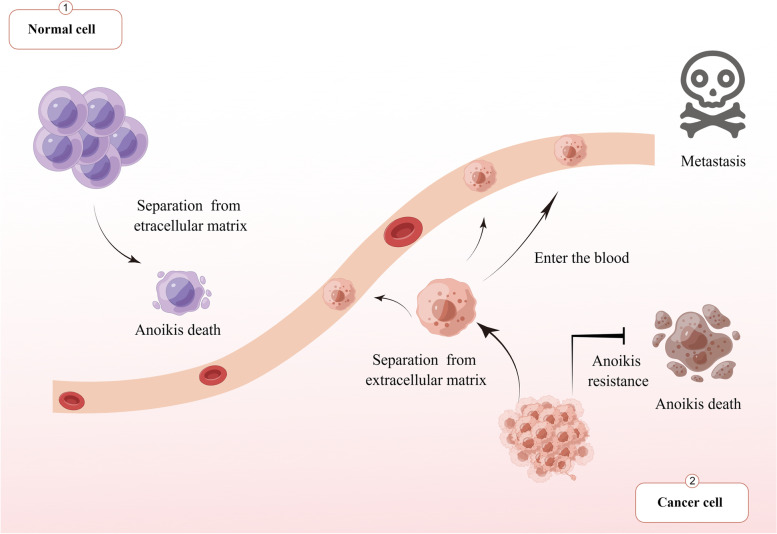
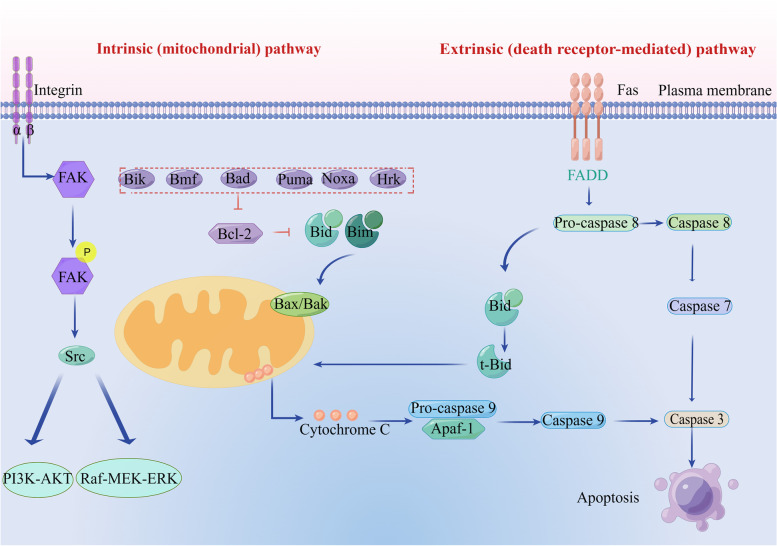
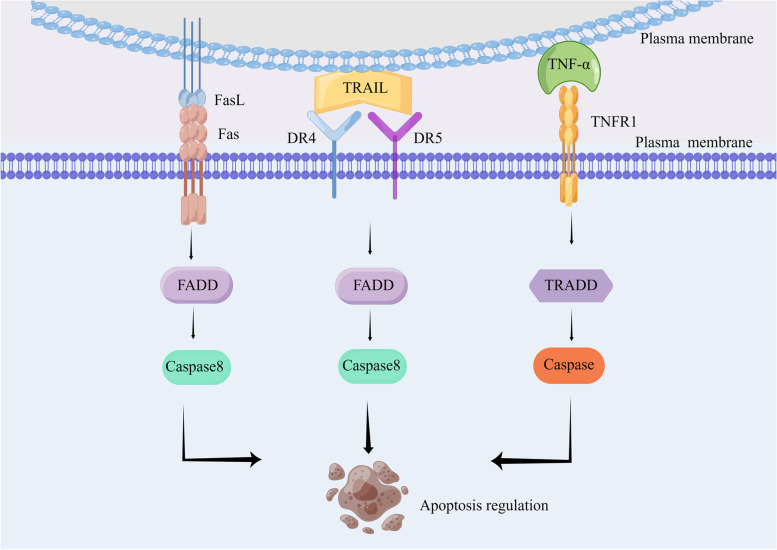
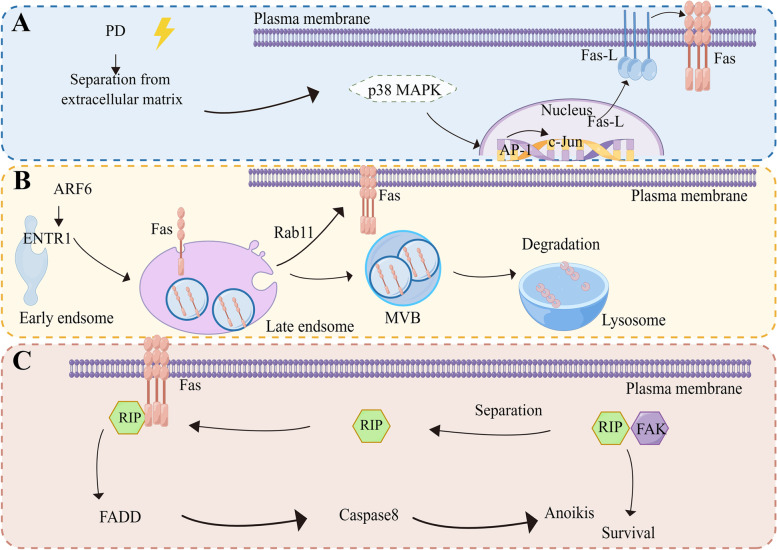
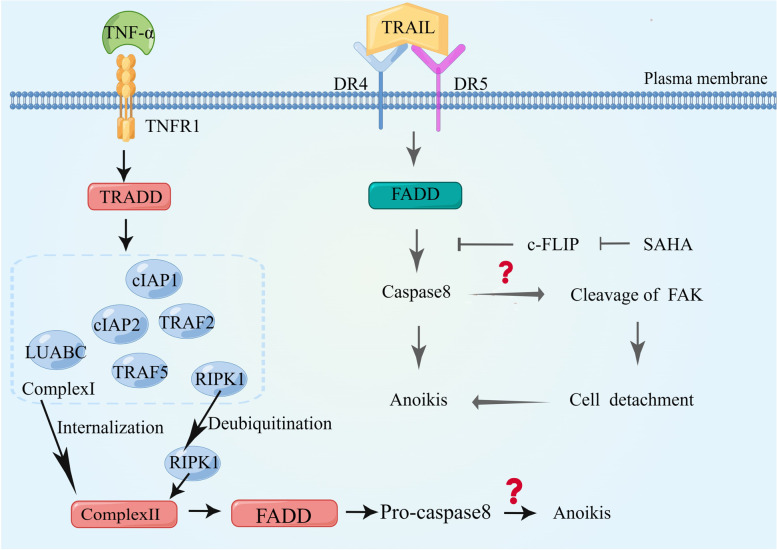
Metastatic cancer cells can develop anoikis resistance in the absence of substrate attachment and survive to fight tumors. Anoikis is mediated by endogenous mitochondria-dependent and exogenous death receptor pathways, and studies have shown that caspase-8-dependent external pathways appear to be more important than the activity of the intrinsic pathways. This paper reviews the regulation of anoikis by external pathways mediated by death receptors. Different death receptors bind to different ligands to activate downstream caspases. The possible mechanisms of Fas-associated death domain (FADD) recruitment by Fas and TNF receptor 1 associated-death domain (TRADD) recruitment by tumor necrosis factor receptor 1 (TNFR1), and DR4- and DR5-associated FADD to induce downstream caspase activation and regulate anoikis were reviewed. This review highlights the possible mechanism of the death receptor pathway mediation of anoikis and provides new insights and research directions for studying tumor metastasis mechanisms.
Overview
The claims and statistics of this paper haven’t been checked yet.
Free: it reads the open-access text and checks the first 5 claims that cite a source we can check. Create a free account to check every claim.
Integrity signals
Registry
Cites
Statistics
Figures
Verification
Claims the paper makes
The claims and statistics of this paper haven’t been checked yet.
Free: it reads the open-access text and checks the first 5 claims that cite a source we can check. Create a free account to check every claim.
Claims other papers make about this one
Each is checked against this paper’s own text: does it say what the citing paper says it does?
The source backs part of the claim, not all of it — or backs it for a different population, condition or comparison.
In the citing paper
“Snake venom metalloproteases (SVMPs) enzymatically degrade the structural components of the extracellular matrix and basement membranes, and this results in the detachment of cells from the basement membrane support, leading to apoptosis by a specialized mechanism called anoikis (Figure 2) [49,50,51].”
From Role of Regulated Cell Death Pathways in Snakebite Envenomation: Mechanisms, Crosstalk, and Therapeutic Opportunities (2026) · cites this paper as [50]
Experimental — accuracy not yet measured
Self-check
Percentages, sums and reported differences re-computed from the paper’s own numbers.
The self-check needs the paper’s full text.
Citations
Cites
Ferroptosis: mechanisms, biology and role in disease
Jiang, X., Stockwell, B. R., & Conrad, M. (2021) · Nature Reviews Molecular Cell Biology · doi:10.1038/s41580-020-00324-8 · Cited by 7,505 · cited 1×
“The signaling pathways of fer-roptosis have been found to involve proteins such as iron ion regulators, the production of reactive oxygen species (ROS), and protein kinases associated with cell death [14, 15].”
BackgroundFerroptosis: past, present and future
Li, J., Cao, F., Yin, H.-L., Huang, Z.-J., Lin, Z.-T., Mao, N., Sun, B., & Wang, G. (2020) · Cell Death & Disease · doi:10.1038/s41419-020-2298-2 · Cited by 4,171 · cited 1×
“The signaling pathways of fer-roptosis have been found to involve proteins such as iron ion regulators, the production of reactive oxygen species (ROS), and protein kinases associated with cell death [14, 15].”
BackgroundTwo CD95 (APO‐1/Fas) signaling pathways
Scaffidi, C., Fulda, S., Srinivasan, A., Friesen, C., Li, F., Tomaselli, K. J., Debatin, K., Krammer, P. H., & Peter, M. E. (1998) · The EMBO Journal · doi:10.1093/emboj/17.6.1675 · Cited by 3,000 · cited 1×
“Fas receptor activation triggers two distinct exter-nal pathways [43]: type I, leading to direct proteolysis of the target dependent on caspase 7 activation.”
BackgroundInduction of TNF receptor I-mediated apoptosis via two sequential signaling complexes
Micheau, O., & Tschopp, J. (2003) · Cell · doi:10.1016/s0092-8674(03)00521-x · Cited by 2,738 · cited 1×
“Whether RIPK1 deubiquitination causes anoikis remains unclear [97].”
BackgroundBorst, O., Walker, B., Münzer, P., Russo, A., Schmid, E., Faggio, C., Bigalke, B., Laufer, S., Gawaz, M., & Lang, F. (2013) · Cellular Physiology and Biochemistry · doi:10.1159/000350110 · Cited by 1,860
Pistritto, G., Trisciuoglio, D., Ceci, C., Garufi, A., & D'Orazi, G. (2016) · Aging · doi:10.18632/aging.100934 · Cited by 1,658 · cited 1×
“…the extracellular matrix due to its metastasis characteristics, tumor cells develop resistance, survive without adhesion to the extracellular matrix, and can flow to other tissues and organs through blood and lymph for adhesion and metastasis membrane rupture, ultimately leading to cell death [17].”
BackgroundEvery step of the way: integrins in cancer progression and metastasis
Hamidi, H., & Ivaska, J. (2018) · Nature Reviews Cancer · doi:10.1038/s41568-018-0038-z · Cited by 1,493 · cited 1×
“These multifunctional receptors play a pivotal role in orchestrating various cellular events, ensuring cellular homeostasis and tissue integrity [20–22], and differ from other receptors in their ability to transmit signals in both directions [23].”
BackgroundTNF? and the TNF receptor superfamily: Structure-function relationship(s)
Idriss, H. T., & Naismith, J. H. (2000) · Microscopy Research and Technique · doi:10.1002/1097-0029(20000801)50:3<184::aid-jemt2>3.0.co;2-h · Cited by 1,183 · cited 2×
“By binding with its receptors, such as TNFR1 and TNFR2, it triggers intracellular signaling pathways that regulate apoptosis and other biological processes [77].”
BackgroundPyroptosis: A new frontier in cancer
Fang, Y., Tian, S., Pan, Y., Li, W., Wang, Q., Tang, Y., Yu, T., Wu, X., Shi, Y., Ma, P., et al. (2020) · Biomedicine & Pharmacotherapy · doi:10.1016/j.biopha.2019.109595 · Cited by 1,049 · cited 1×
“The activation of these proteinases leads to the release of inflammatory factors and the occurrence of inflammatory reactions, ultimately resulting in cell death [16].”
BackgroundNecroptosis in development, inflammation and disease
Weinlich, R., Oberst, A., Beere, H. M., & Green, D. R. (2017) · Nature Reviews Molecular Cell Biology · doi:10.1038/nrm.2016.149 · Cited by 1,016 · cited 1×
“Necrosis is an irregular and passive form of cell death, typically caused by external factors such as trauma, infection, or ischemia [12].”
Background
Cited by
Zheng, J., She, H., Han, R., Tang, J., Dou, Y., Lu, C., Huang, D., Lin, C., Wu, D., He, C., et al. (2025) · Developmental Cell · doi:10.1016/j.devcel.2025.07.014 · Cited by 80
Self-citationChoi, J. Y., Boo, M. Y., & Boo, Y. C. (2024) · Molecules · doi:10.3390/molecules29102288 · Cited by 75
“The extrinsic receptor-dependent apoptosis pathway is mediated by death receptors, such as tumor necrosis factor receptor 1 (TNFR-1) and FAS, and an adaptor, FAS-associated protein with death domain (FADD) [138,139].”
BackgroundMethylglyoxal Formation—Metabolic Routes and Consequences
Vašková, J., Sabolová, G., Pudelský, J., Palenčár, D., & Mičková, H. (2025) · Antioxidants · doi:10.3390/antiox14020212 · Cited by 71
“This pathway is initiated when ligands bind to specific receptors on the cell surface, such as the death receptor (Fas) or the tumor necrosis factor (TNF) receptor [247,248].”
Mechanisms of action of the BCL-2 inhibitor venetoclax in multiple myeloma: a literature review
Cao, Q., Wu, X., Zhang, Q., Gong, J., Chen, Y., You, Y., Shen, J., Qiang, Y., & Cao, G. (2023) · Frontiers in Pharmacology · doi:10.3389/fphar.2023.1291920 · Cited by 61
Liu, F., Yang, Z., Li, J., Wu, T., Li, X., Zhao, L., Wang, W., Yu, W., Zhang, G., & Xu, Y. (2024) · Molecular Medicine · doi:10.1186/s10020-024-01020-5 · Cited by 53
Metadata
- Authors
- Han, Y.-H., Wang, Y., Lee, S.-J., Jin, M.-H., Sun, H.-N., & Kwon, T.
- Affiliations
- Heilongjiang Bayi Agricultural University (CN)
- Korea Research Institute of Bioscience and Biotechnology (KR)
- Corresponding author
- Han, Ying-Hao
- Sun, Hu-Nan
- Kwon, Taeho
- Venue
- Cell Communication and Signaling
- Published
- 2023-09-04
- Volume
- 21
- Issue
- 1
- Pages
- 227-227
- ISSN
- 1478-811X (ISSN-L)
- PMC
- PMC10478316
- OpenAlex
- W4386424302
- Cited by
- 84
- References
- 109
- Citations by year
- 2026: 19 · 2025: 44 · 2024: 18 · 2023: 3
- FWCI
- 2.22
- Type
- journal article
- Language
- en
- Open access
- gold
- doi.org
- Licence
- cc-by
- creativecommons.org/licenses/by/4.0 (tdm)
- creativecommons.org/licenses/by/4.0 (vor)
- Locations
- Cell Communication and Signaling (publishedVersion, cc-by)
- PubMed Central (publishedVersion, cc-by)
- PubMed (publishedVersion)
- DOAJ (DOAJ: Directory of Open Access Journals) (submittedVersion, cc-by-sa)
- Funders
- KRIBB Research Initiative Program (KGM5162322)
- Topics
- Life Sciences › Biochemistry, Genetics and Molecular Biology › Molecular Biology › Cell death mechanisms and regulation
- Health Sciences › Medicine › Oncology › Cancer-related Molecular Pathways
- Life Sciences › Biochemistry, Genetics and Molecular Biology › Cancer Research › NF-κB Signaling Pathways
- Keywords
- anoikis, death receptor signaling, anoikis resistance, caspase-8, FADD, TRADD, Fas, TNF receptor 1, DR4, DR5, metastasis, extrinsic apoptotic pathway, mitochondrial apoptosis
- MeSH terms
- Mitochondria, Protein Processing, Post-Translational, Caspases, Anoikis, Proteolysis
About these checks
Registry, retraction, Cites and statistics results are computed, not judged, with one exception: a printed reference that no index lists is read once by a model before it counts as a citation error. Claims are extracted by a model and kept only when their quote appears verbatim in the text; each cited source is then checked, with a model’s help, for whether it says what the claim relies on. Those verdicts can be wrong — read the claim’s quote and the cited source before relying on one.
Statistics and arithmetic are recomputed, not judged.
Confidence bands are shown only for fields calibrated on our annotated test set. None is calibrated yet, so no band is shown.
What counts as a claim ›How we measure confidence ›How we check this ›
Are you an author, or do you see a problem with this page? Request a review
Data sources
Bibliographic data: Semantic Scholar, OpenAlex, Crossref.
Contains information from the Semantic Scholar Academic Graph Datasets, made available under the ODC Attribution License (ODC-BY 1.0).
Semantic Scholar’s data is described in: Kinney, R., et al. (2023). The Semantic Scholar Open Data Platform. arXiv:2301.10140.
