

The DOI matches its Crossref record; 80 of the 80 references it cites were found in a registry or an index.
The associations between sedentary behaviour and mental health among adolescents: a systematic review
Open accessAbstract
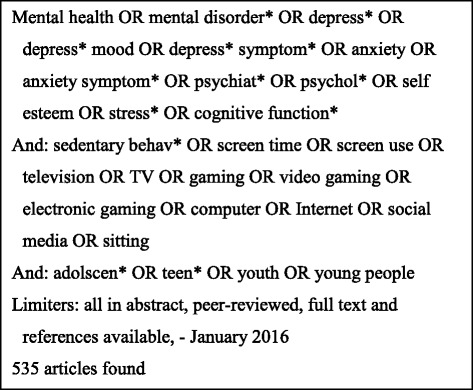
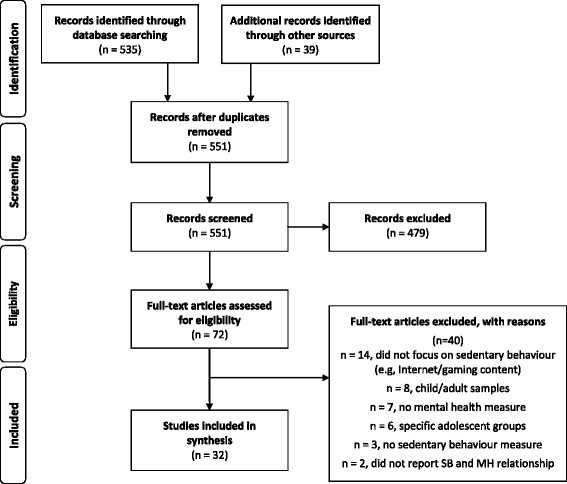
BACKGROUND: With technological developments and modernised sedentary lifestyles has come an increase in diseases associated with inactivity such as obesity and other non-communicable diseases. Emerging evidence suggests that time spent sedentary may also interact with mental health. This systematic review examined the associations between sedentary behaviour and mental health problems among adolescents. METHODS: This systematic review followed Preferred Reporting Items for Systematic Reviews and Meta-Analyses, and applied a quality assessment tool for quantitative studies to identity best available evidence. Following stringent search strategy of the databases; Cumulative Index to Nursing and Allied Health Literature, Global Health, Health Source: Nursing and Academic Edition, MEDLINE, PsychARTICLES and PsycINFO, we identified 32 articles eligible for review. RESULTS: All studies reported leisure screen time among adolescents, and two thirds of identified studies examined depressive symptomatology. Other mental health measures were; anxiety symptoms, self-esteem, suicide ideation, loneliness, stress, and psychological distress. Strong consistent evidence was found for the relationship between both depressive symptomatology and psychological distress, and time spent using screens for leisure. Moderate evidence supported the relationship between low self-esteem and screen use. Poorer mental health status was found among adolescents using screen time more than 2-3 h per day, and gender differences exist. Essential information was missing for quality of evidence including heterogeneity in mental health and screen time-based measures, and self-report data collection methods. CONCLUSIONS: The findings are of particular significance given the global public health concern of lifestyle-attributed diseases and the possibility for novel approaches to mental health. Future research should examine the psychological impact of reducing time spent using screens for leisure among adolescents, whilst accounting for possible confounding factors such as physical activity and dietary behaviours. It is critical that the reciprocal relationship between lifestyle behaviours and mental health is represented in both the psychiatric and public health forum.
Overview
The claims and statistics of this paper haven’t been checked yet.
Run the check — free, no account needed. It reads the open-access text and checks the sources it cites.
Integrity signals
Registry
Cites
Statistics
Figures
Verification
Claims the paper makes
The claims and statistics of this paper haven’t been checked yet.
Run the check — free, no account needed. It reads the open-access text and checks the sources it cites.
Claims other papers make about this one
Each is checked against this paper’s own text: does it say what the citing paper says it does?
In the citing paper
“More screen time has been associated with depressive symptoms among children and adolescents in several systematic reviews [11, 12, 43–50].”
From Screen time and mental health: a prospective analysis of the Adolescent Brain Cognitive Development (ABCD) Study (2024) · cites this paper as [45]
In the citing paper
“The results of the current review largely align with past systematic reviews, which have concluded that there is a positive association between screen time and depressive symptoms (Hoare et al., 2016;Liu et al., 2016;Stiglic & Viner, 2019;Wang et al., 2019), and a weak association between screen time and both anxiety and self-esteem (Stiglic & Viner, 2019).”
From The relationship between screen time and mental health in young people: A systematic review of longitudinal studies (2021) · cites this paper as Hoare et al., 2016
In the citing paper
“While positive associations between screen-based sedentary behaviors and emotional disorder symptoms have been previously identified, much of the work to date is cross-sectional (Hoare et al., 2016; Teychenne et al., 2015)”
From Reciprocal associations between screen time and emotional disorder symptoms during adolescence (2019) · cites this paper as Hoare et al., 2016
In the citing paper
“However, the accumulation of as little as 2 h of screen-time per day can be associated with depressive or anxiety (emotional) disorder symptoms in youth (Kremer et al., 2014; Hoare et al., 2016; Katon et al., 2010)”
From Reciprocal associations between screen time and emotional disorder symptoms during adolescence (2019) · cites this paper as Hoare et al., 2016
Self-check
Percentages, sums and reported differences re-computed from the paper’s own numbers.
The self-check needs the paper’s full text.
Citations
Cites
Preferred Reporting Items for Systematic Reviews and Meta-Analyses: the PRISMA statement
Moher, D., Liberati, A., Tetzlaff, J., Altman, D. G., & for the PRISMA Group (2009) · BMJ · doi:10.1136/bmj.b2535 · Cited by 83,823
The CES-D Scale: A Self-Report Depression Scale for Research in the General Population
Radloff, L. S. (1977) · Applied Psychological Measurement · doi:10.1177/014662167700100306 · Cited by 53,267
Preferred reporting items for systematic reviews and meta-analyses: the PRISMA Statement.
(2009) · PubMed Central · Cited by 44,859
Preferred reporting items for systematic reviews and meta-analyses: The PRISMA statement
Moher, D., Liberati, A., Tetzlaff, J., Altman, D. G., & the PRISMA Group* (2009) · Annals of Internal Medicine · doi:10.7326/0003-4819-151-4-200908180-00135 · Cited by 37,554
New well-being measures: Short scales to assess flourishing and positive and negative feelings
Diener, E., Wirtz, D., Tov, W., Kim-Prieto, C., Choi, D.-W., Oishi, S., & Biswas-Diener, R. (2010) · Social Indicators Research · doi:10.1007/s11205-009-9493-y · Cited by 4,980
Age of onset of mental disorders: a review of recent literature
Kessler, R. C., Amminger, G. P., Aguilar-Gaxiola, S., Alonso, J., Lee, S., & ??st??n, T. B. (2007) · Current Opinion in Psychiatry · doi:10.1097/yco.0b013e32816ebc8c · Cited by 3,457
The global prevalence of common mental disorders: a systematic review and meta-analysis 1980–2013
Steel, Z., Marnane, C., Iranpour, C., Chey, T., Jackson, J. W., Patel, V., & Silove, D. (2014) · International Journal of Epidemiology · doi:10.1093/ije/dyu038 · Cited by 2,846
Physical activity and mental health in children and adolescents: a review of reviews
Biddle, S. J. H., & Asare, M. (2011) · British Journal of Sports Medicine · doi:10.1136/bjsports-2011-090185 · Cited by 2,447
Systematic review of sedentary behaviour and health indicators in school-aged children and youth.
Tremblay, M. S., LeBlanc, A. G., Kho, M. E., Saunders, T. J., Larouche, R., Colley, R. C., Goldfield, G., & Gorber, S. (2011) · International Journal of Behavioral Nutrition and Physical Activity · doi:10.1186/1479-5868-8-98 · Cited by 2,085
Letter to the Editor: Standardized use of the terms “sedentary” and “sedentary behaviours”
Networ, S. B. R. (2012) · Applied Physiology, Nutrition, and Metabolism · doi:10.1139/h2012-024 · Cited by 1,873
Research works printed but not linked: 1
- Association AP. Diagnostic and statistical manual-text revision (DSM-IV-TRim, 2000): American Psychiatric Association. 2000.
Cited by
Sorted by citations
Keles, B., McCrae, N., & Grealish, A. (2020) · International Journal of Adolescence and Youth · doi:10.1080/02673843.2019.1590851 · Cited by 1,909
Biddle, S. J. H., Ciaccioni, S., Thomas, G., & Vergeer, I. (2019) · Psychology of Sport and Exercise · doi:10.1016/j.psychsport.2018.08.011 · Cited by 1,454
Rodriguez-Ayllon, M., Cadenas-Sánchez, C., Estévez-López, F., Muñoz, N. E., Mora-Gonzalez, J., Migueles, J. H., Molina-García, P., Henriksson, H., Mena-Molina, A., Martínez-Vizcaíno, V., et al. (2019) · Sports Medicine · doi:10.1007/s40279-019-01099-5 · Cited by 1,360
Stiglic, N., & Viner, R. M. (2019) · BMJ Open · doi:10.1136/bmjopen-2018-023191 · Cited by 1,259
“Only Hoare et al 20 reported on associations with anxiety, and found moderate evidence for a positive association between screentime duration and severity of anxiety symptoms.”
BackgroundTeenagers, screens and social media: a narrative review of reviews and key studies
Orben, A. (2020) · Social Psychiatry and Psychiatric Epidemiology · doi:10.1007/s00127-019-01825-4 · Cited by 706
Metadata
- Authors
- Hoare, E., Milton, K., Foster, C., & Allender, S.
- Affiliations
- Deakin University (AU)
- University of Oxford (GB)
- Corresponding author
- Hoare, Erin
- Venue
- International Journal of Behavioral Nutrition and Physical Activity
- Published
- 2016-10-08
- Volume
- 13
- Issue
- 1
- Pages
- 108-108
- ISSN
- 1479-5868 (ISSN-L)
- PMC
- PMC5055671
- OpenAlex
- W2529138009
- Cited by
- 616
- References
- 80
- Citations by year
- 2026: 54 · 2025: 60 · 2024: 82 · 2023: 83 · 2022: 81 · 2021: 78 · 2020: 85 · 2019: 51 · 2018: 32 · 2017: 9 · 2016: 1
- FWCI
- 3.64
- Type
- journal article
- Language
- en
- Open access
- gold
- doi.org
- Licence
- cc-by
- Locations
- International Journal of Behavioral Nutrition and Physical Activity (publishedVersion, cc-by)
- Europe PMC (PubMed Central) (publishedVersion, cc-by)
- PubMed Central (publishedVersion, cc-by)
- PubMed (publishedVersion)
- UEA Digital Repository (University of East Anglia) (acceptedVersion)
- Figshare (submittedVersion, cc-by)
- Bristol Research (University of Bristol) (submittedVersion, cc-by)
- Explore Bristol Research (submittedVersion, cc-by)
- Topics
- Health Sciences › Medicine › Public Health, Environmental and Occupational Health › Physical Activity and Health
- Social Sciences › Sociology and Political Science › Impact of Technology on Adolescents
- Social Sciences › Education › Child Development and Digital Technology
- Keywords
- sedentary behavior, adolescent mental health, leisure screen time, depressive symptoms, psychological distress, self-esteem, suicidal ideation, loneliness, anxiety, gender differences, lifestyle-related diseases
- MeSH terms
- Adolescent, Computers, Depression, Female, Humans, Leisure Activities, Male, Mental Health, Self Concept, Stress, Psychological, Television, Exercise, Video Games, Internet, Sedentary Behavior
About these checks
Registry, retraction, Cites and statistics results are computed, not judged, with one exception: a printed reference that no index lists is read once by a model before it counts as a citation error. Claims are extracted by a model and kept only when their quote appears verbatim in the text; each cited source is then checked, with a model’s help, for whether it says what the claim relies on. Those verdicts can be wrong — read the claim’s quote and the cited source before relying on one.
Statistics and arithmetic are recomputed, not judged.
Confidence bands are shown only for fields calibrated on our annotated test set. None is calibrated yet, so no band is shown.
What counts as a claim ›How we measure confidence ›How we check this ›
Are you an author, or do you see a problem with this page? Request a review
