

The DOI matches its Crossref record; 80 of the 80 references it cites were found in a registry or an index.
The associations between sedentary behaviour and mental health among adolescents: a systematic review
Open accessAbstract
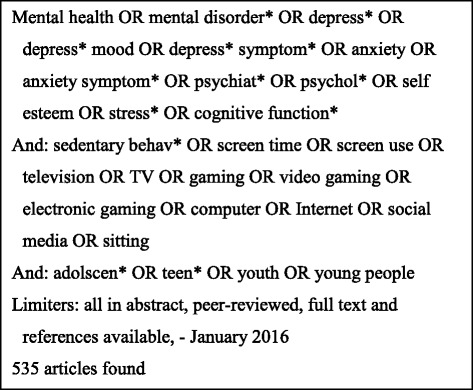
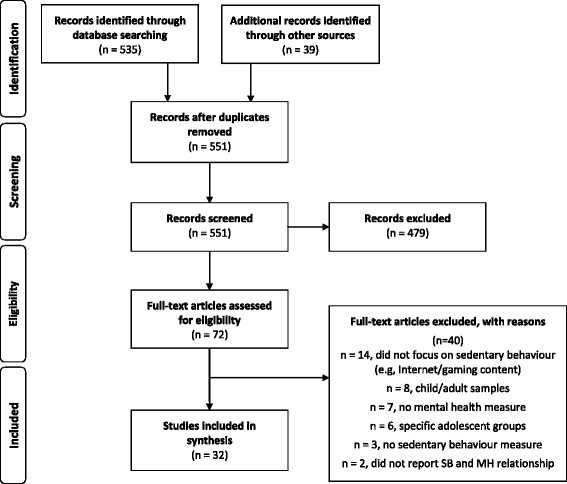
BACKGROUND: With technological developments and modernised sedentary lifestyles has come an increase in diseases associated with inactivity such as obesity and other non-communicable diseases. Emerging evidence suggests that time spent sedentary may also interact with mental health. This systematic review examined the associations between sedentary behaviour and mental health problems among adolescents. METHODS: This systematic review followed Preferred Reporting Items for Systematic Reviews and Meta-Analyses, and applied a quality assessment tool for quantitative studies to identity best available evidence. Following stringent search strategy of the databases; Cumulative Index to Nursing and Allied Health Literature, Global Health, Health Source: Nursing and Academic Edition, MEDLINE, PsychARTICLES and PsycINFO, we identified 32 articles eligible for review. RESULTS: All studies reported leisure screen time among adolescents, and two thirds of identified studies examined depressive symptomatology. Other mental health measures were; anxiety symptoms, self-esteem, suicide ideation, loneliness, stress, and psychological distress. Strong consistent evidence was found for the relationship between both depressive symptomatology and psychological distress, and time spent using screens for leisure. Moderate evidence supported the relationship between low self-esteem and screen use. Poorer mental health status was found among adolescents using screen time more than 2-3 h per day, and gender differences exist. Essential information was missing for quality of evidence including heterogeneity in mental health and screen time-based measures, and self-report data collection methods. CONCLUSIONS: The findings are of particular significance given the global public health concern of lifestyle-attributed diseases and the possibility for novel approaches to mental health. Future research should examine the psychological impact of reducing time spent using screens for leisure among adolescents, whilst accounting for possible confounding factors such as physical activity and dietary behaviours. It is critical that the reciprocal relationship between lifestyle behaviours and mental health is represented in both the psychiatric and public health forum.
Overview
The claims and statistics of this paper haven’t been checked yet.
Run the check — free, no account needed. It reads the open-access text and checks the sources it cites.
Integrity signals
Registry
Cites
Statistics
Figures
Verification
Claims the paper makes
The claims and statistics of this paper haven’t been checked yet.
Run the check — free, no account needed. It reads the open-access text and checks the sources it cites.
Claims other papers make about this one
Each is checked against this paper’s own text: does it say what the citing paper says it does?
In the citing paper
“More screen time has been associated with depressive symptoms among children and adolescents in several systematic reviews [11, 12, 43–50].”
From Screen time and mental health: a prospective analysis of the Adolescent Brain Cognitive Development (ABCD) Study (2024) · cites this paper as [45]
In the citing paper
“The results of the current review largely align with past systematic reviews, which have concluded that there is a positive association between screen time and depressive symptoms (Hoare et al., 2016;Liu et al., 2016;Stiglic & Viner, 2019;Wang et al., 2019), and a weak association between screen time and both anxiety and self-esteem (Stiglic & Viner, 2019).”
From The relationship between screen time and mental health in young people: A systematic review of longitudinal studies (2021) · cites this paper as Hoare et al., 2016
In the citing paper
“While positive associations between screen-based sedentary behaviors and emotional disorder symptoms have been previously identified, much of the work to date is cross-sectional (Hoare et al., 2016; Teychenne et al., 2015)”
From Reciprocal associations between screen time and emotional disorder symptoms during adolescence (2019) · cites this paper as Hoare et al., 2016
In the citing paper
“However, the accumulation of as little as 2 h of screen-time per day can be associated with depressive or anxiety (emotional) disorder symptoms in youth (Kremer et al., 2014; Hoare et al., 2016; Katon et al., 2010)”
From Reciprocal associations between screen time and emotional disorder symptoms during adolescence (2019) · cites this paper as Hoare et al., 2016
Self-check
Percentages, sums and reported differences re-computed from the paper’s own numbers.
The self-check needs the paper’s full text.
Citations
Cites
Preferred Reporting Items for Systematic Reviews and Meta-Analyses: the PRISMA statement
Moher, D., Liberati, A., Tetzlaff, J., Altman, D. G., & for the PRISMA Group (2009) · BMJ · doi:10.1136/bmj.b2535 · Cited by 83,823
The CES-D Scale: A Self-Report Depression Scale for Research in the General Population
Radloff, L. S. (1977) · Applied Psychological Measurement · doi:10.1177/014662167700100306 · Cited by 53,267
Preferred reporting items for systematic reviews and meta-analyses: the PRISMA Statement.
(2009) · PubMed Central · Cited by 44,859
Preferred reporting items for systematic reviews and meta-analyses: The PRISMA statement
Moher, D., Liberati, A., Tetzlaff, J., Altman, D. G., & the PRISMA Group* (2009) · Annals of Internal Medicine · doi:10.7326/0003-4819-151-4-200908180-00135 · Cited by 37,554
New well-being measures: Short scales to assess flourishing and positive and negative feelings
Diener, E., Wirtz, D., Tov, W., Kim-Prieto, C., Choi, D.-W., Oishi, S., & Biswas-Diener, R. (2010) · Social Indicators Research · doi:10.1007/s11205-009-9493-y · Cited by 4,980
Age of onset of mental disorders: a review of recent literature
Kessler, R. C., Amminger, G. P., Aguilar-Gaxiola, S., Alonso, J., Lee, S., & ??st??n, T. B. (2007) · Current Opinion in Psychiatry · doi:10.1097/yco.0b013e32816ebc8c · Cited by 3,457
The global prevalence of common mental disorders: a systematic review and meta-analysis 1980–2013
Steel, Z., Marnane, C., Iranpour, C., Chey, T., Jackson, J. W., Patel, V., & Silove, D. (2014) · International Journal of Epidemiology · doi:10.1093/ije/dyu038 · Cited by 2,846
Physical activity and mental health in children and adolescents: a review of reviews
Biddle, S. J. H., & Asare, M. (2011) · British Journal of Sports Medicine · doi:10.1136/bjsports-2011-090185 · Cited by 2,447
Systematic review of sedentary behaviour and health indicators in school-aged children and youth.
Tremblay, M. S., LeBlanc, A. G., Kho, M. E., Saunders, T. J., Larouche, R., Colley, R. C., Goldfield, G., & Gorber, S. (2011) · International Journal of Behavioral Nutrition and Physical Activity · doi:10.1186/1479-5868-8-98 · Cited by 2,085
Letter to the Editor: Standardized use of the terms “sedentary” and “sedentary behaviours”
Networ, S. B. R. (2012) · Applied Physiology, Nutrition, and Metabolism · doi:10.1139/h2012-024 · Cited by 1,873
Youth Risk Behavior Surveillance - United States, 2009
Eaton, D. K., Kann, L. K., Kinchen, S., Shanklin, S. L., Flint, K. H., Hawkins, J., Harris, W. A., Lowry, R., McManus, T., Chyen, D., et al. (2010) · PsycEXTRA Dataset · doi:10.1037/e661322010-001 · Cited by 1,754
Exercise as a treatment for depression: a meta-analysis adjusting for publication bias
Schuch, F. B., Vancampfort, D., Richards, J., Rosenbaum, S., Ward, P. B., & Stubbs, B. (2016) · Journal of Psychiatric Research · doi:10.1016/j.jpsychires.2016.02.023 · Cited by 1,529 · cited 1×
“Physical inactivity has been shown to interact with mental health [19, 59, 60], and exercise has been shown to have a positive effect in mental health treatment studies [61–63].”
BackgroundHealth-enhancing physical activity and sedentary behaviour in children and adolescents
Biddle, S., Gorely, T., & Stensel, D. J. (2004) · Journal of Sports Sciences · doi:10.1080/02640410410001712412 · Cited by 910
Adolescent Internet use: What we expect, what teens report
Gross, E. F. (2004) · Journal of Applied Developmental Psychology · doi:10.1016/j.appdev.2004.09.005 · Cited by 866
Relationship Between Diet and Mental Health in Children and Adolescents: A Systematic Review
O’Neil, A., Quirk, S. E., Housden, S., Brennan, S. L., Williams, L. J., Pasco, J. A., Berk, M., & Jacka, F. N. (2014) · American Journal of Public Health · doi:10.2105/ajph.2014.302110 · Cited by 734
Sedentary Behaviors and Health Outcomes Among Adults
Proper, K. I., Singh, A. S., van Mechelen, W., & Chinapaw, M. J. M. (2011) · American Journal of Preventive Medicine · doi:10.1016/j.amepre.2010.10.015 · Cited by 633
Sedentary Behavior and Dietary Intake in Children, Adolescents, and Adults
Pearson, N., & Biddle, S. J. H. (2011) · American Journal of Preventive Medicine · doi:10.1016/j.amepre.2011.05.002 · Cited by 604
Not so doomed: computer game play and positive adolescent development
Durkin, K., & Barber, B. L. (2002) · Journal of Applied Developmental Psychology · doi:10.1016/s0193-3973(02)00124-7 · Cited by 491
Høyer, B. B., Ramlau‐Hansen, C. H., Pedersen, H. S., Góralczyk, K., Chumak, L., Jönsson, B., Bonde, J. ., & Toft, G. V. (2015) · BMC Public Health · doi:10.1186/s12889-015-1465-3 · Cited by 441
Ybarra, M. L. (2004) · CyberPsychology & Behavior · doi:10.1089/109493104323024500 · Cited by 425
Growing Up Wired: Social Networking Sites and Adolescent Psychosocial Development
Spies Shapiro, L. A., & Margolin, G. (2014) · Clinical Child and Family Psychology Review · doi:10.1007/s10567-013-0135-1 · Cited by 422
Nelson, M. C., & Gordon-Larsen, P. (2006) · Pediatrics · doi:10.1542/peds.2005-1692 · Cited by 419
Pearson, N., Braithwaite, R. E., Biddle, S., van Sluijs, E. M. F., & Atkin, A. J. (2014) · Obesity Reviews · doi:10.1111/obr.12188 · Cited by 411
Screen time is associated with depression and anxiety in Canadian youth
Maras, D., Flament, M. F., Murray, M., Buchholz, A., Henderson, K. A., Obeid, N., & Goldfield, G. S. (2015) · Preventive Medicine · doi:10.1016/j.ypmed.2015.01.029 · Cited by 406
Daine, K., Hawton, K. E., Singaravelu, V., Stewart, A., Simkin, S., & Montgomery, P. (2013) · PLoS ONE · doi:10.1371/journal.pone.0077555 · Cited by 369
Physical activity, sedentary behavior, and health: Paradigm paralysis or paradigm shift?
Katzmarzyk, P. T. (2010) · Diabetes · doi:10.2337/db10-0822 · Cited by 365
Liu, M., Wu, L., & Yao, S. (2016) · British Journal of Sports Medicine · doi:10.1136/bjsports-2015-095084 · Cited by 364 · cited 1×
“comes of interest were limited to depression [20, 21], anxiety [3], or self-harm and suicide [22].”
The association between sedentary behaviour and risk of anxiety: a systematic review
Teychenne, M., Costigan, S. A., & Parker, K. (2015) · BMC Public Health · doi:10.1186/s12889-015-1843-x · Cited by 351 · cited 5×
“In addition, the conclusions drawn by this review are strengthened by the use of the quality assessment tool [26] and best evidence synthesis consistent with previous literature examining sedentary behaviour and health outcomes [3, 27, 28].”
BackgroundMethodInfluentialFrom depressive symptoms to depressive disorders: the relevance of thresholds
Ayuso‐Mateos, J. L., Nuevo, R., Verdes, E., Naidoo, N., & Chatterji, S. (2010) · The British Journal of Psychiatry · doi:10.1192/bjp.bp.109.071191 · Cited by 348
Emotional eating and food intake after sadness and joy
van Strien, T., Cebolla, A., Etchemendy, E., Gutiérrez‐Maldonado, J., Ferrer‐García, M., Botella, C., & Baños, R. (2013) · Appetite · doi:10.1016/j.appet.2013.02.016 · Cited by 336
Suchert, V., Hanewinkel, R., & Isensee, B. (2015) · Preventive Medicine · doi:10.1016/j.ypmed.2015.03.026 · Cited by 329
Cliff, D. P., Hesketh, K. D., Vella, S. A., Hinkley, T., Tsiros, M. D., Ridgers, N. D., Carver, A., Veitch, J., Parrish, A., Hardy, L. L., et al. (2016) · Obesity Reviews · doi:10.1111/obr.12371 · Cited by 327
(2012) · PubMed · Cited by 317
Young students' use of the Internet for mental health information and support
HORGAN, Á., & SWEENEY, J. (2010) · Journal of Psychiatric and Mental Health Nursing · doi:10.1111/j.1365-2850.2009.01497.x · Cited by 303 · cited 1×
“Similarly, it has been suggested that the Internet may offer increased access to health information, including mental health support [72, 73], and this relationship requires further investigation.”
BackgroundCostigan, S. A., Barnett, L., Plotnikoff, R. C., & Lubans, D. R. (2013) · Journal of Adolescent Health · doi:10.1016/j.jadohealth.2012.07.018 · Cited by 290
Physical activity, leisure-time screen use and depression among children and young adolescents
Kremer, P., Elshaug, C., Leslie, E., Toumbourou, J. W., Patton, G. C., & Williams, J. (2014) · Journal of Science and Medicine in Sport · doi:10.1016/j.jsams.2013.03.012 · Cited by 287
Correlates of Health-Related Social Media Use Among Adults
Thackeray, R., Crookston, B. T., & West, J. H. (2013) · Journal of Medical Internet Research · doi:10.2196/jmir.2297 · Cited by 286
Neurobiological effects of exercise on major depressive disorder: A systematic review
Schuch, F. B., Deslandes, A. C., Stubbs, B., Gosmann, N. P., Silva, C. T. B. D., & Fleck, M. P. D. A. (2016) · Neuroscience & Biobehavioral Reviews · doi:10.1016/j.neubiorev.2015.11.012 · Cited by 279
Chinapaw, M. J. M., Proper, K. I., Brug, J., van Mechelen, W., & Singh, A. S. (2011) · Obesity Reviews · doi:10.1111/j.1467-789x.2011.00865.x · Cited by 275
Mental Health, Wellness, and Childhood Overweight/Obesity
Russell‐Mayhew, S., McVey, G. L., Bardick, A. D., & Ireland, A. (2012) · Journal of Obesity · doi:10.1155/2012/281801 · Cited by 268
Depressive symptomatology, youth Internet use, and online interactions: A national survey
Ybarra, M. L., ALEXANDER, C. S., & Mitchell, K. J. (2005) · Journal of Adolescent Health · doi:10.1016/j.jadohealth.2003.10.012 · Cited by 260
Physical activity and common mental disorders
Harvey, S. B., Hotopf, M. H., Øverland, S. N., & Mykletun, A. (2010) · The British Journal of Psychiatry · doi:10.1192/bjp.bp.109.075176 · Cited by 249
Screen time, physical activity and mental health among urban adolescents in China
Cao, H., Qian, Q., Weng, T., Yuan, C., Sun, Y., Wang, H., & Tao, F. (2011) · Preventive Medicine · doi:10.1016/j.ypmed.2011.09.002 · Cited by 211
Lucas, M., Mekary, R. A., Pan, A., Mirzaei, F., O’Reilly, É. J., Willett, W. C., Koenen, K. C., Okereke, O. I., & Ascherio, A. (2011) · American Journal of Epidemiology · doi:10.1093/aje/kwr218 · Cited by 201
Electronic Media Use and Adolescent Health and Well-Being: Cross-Sectional Community Study
Mathers, M., Canterford, L. D., Olds, T., Hesketh, K. D., Ridley, K., & Wake, M. A. (2009) · Academic Pediatrics · doi:10.1016/j.acap.2009.04.003 · Cited by 196
Messias, E., Castro, J., Saini, A., Usman, M., & Peeples, D. (2011) · Suicide and Life-Threatening Behavior · doi:10.1111/j.1943-278x.2011.00030.x · Cited by 181 · cited 6×
“Other mental health outcomes examined were; psychological distress [44, 50, 52], loneliness [34, 37], sadness [45], stress [36], self-rated overall mental health status [38], and parent-reported mental health status of their child [49].”
BackgroundInfluentialSedentary behaviour and diet across the lifespan: an updated systematic review
Hobbs, M., Pearson, N., Foster, P. J., & Biddle, S. (2014) · British Journal of Sports Medicine · doi:10.1136/bjsports-2014-093754 · Cited by 178
Do, Y. K., Shin, E., Bautista, M. A., & Foo, K. (2013) · Sleep Medicine · doi:10.1016/j.sleep.2012.09.004 · Cited by 167
The impact of healthy lifestyle interventions on mental health and wellbeing: a systematic review
Dale, H., Brassington, L., & King, K. (2014) · Mental Health Review Journal · doi:10.1108/mhrj-05-2013-0016 · Cited by 161
Romer, D., Bagdasarov, Z., & More, E. (2013) · Journal of Adolescent Health · doi:10.1016/j.jadohealth.2012.11.012 · Cited by 145
Sund, A. M., Larsson, B., & Wichstrøm, L. (2011) · Social Psychiatry and Psychiatric Epidemiology · doi:10.1007/s00127-010-0208-0 · Cited by 141
Physical activity, screen time and self-rated health and mental health in Canadian adolescents
Herman, K. M., Hopman, W. M., & Sabiston, C. M. (2015) · Preventive Medicine · doi:10.1016/j.ypmed.2015.01.030 · Cited by 136
Media use and depression: exposure, household rules, and symptoms among young adolescents in the USA
Bickham, D. S., Hswen, Y., & Rich, M. (2015) · International Journal of Public Health · doi:10.1007/s00038-014-0647-6 · Cited by 134 · cited 5×
“…✔ Mathers et al. (2009) 925 ✔ ✔ ✔ Messias et al. (2011) 29,941 ✔ ✔ ✔ ✔ ✔ Nihill et al. (2013) 357 ✔ ✔ ✔ ✔ ✔ Pantic et al. (2011) 1860 ✔ ✔ Park (2009) 3449 ✔ ✔ Robinson et al. (2011) 1860 ✔ ✔ Trinh et al. (2015) 2,660 ✔ ✔ ✔ ✔ Ybarra et al. (2005) 1501 ✔ ✔ Young et al. (2013) 136,589 ✔ ✔…”
BackgroundInfluentialDiseases of comfort: primary cause of death in the 22nd century
Choi, B. C. K., Hunter, D. J., Tsou, W., & Sainsbury, P. (2005) · Journal of Epidemiology & Community Health · doi:10.1136/jech.2005.032805 · Cited by 128
Self-concept, self-esteem, gender, race and information technology use
Jackson, L. A., von Eye, A., Fitzgerald, H. E., Zhao, Y., & Witt, E. A. (2009) · Computers in Human Behavior · doi:10.1016/j.chb.2009.11.001 · Cited by 126
Associations between obesogenic risk factors and depression among adolescents: a systematic review
Hoare, E., Skouteris, H., Fuller‐Tyszkiewicz, M., Millar, L., & Allender, S. E. (2013) · Obesity Reviews · doi:10.1111/obr.12069 · Cited by 123
Self-citationDevelopment of a Consensus Taxonomy of Sedentary Behaviors (SIT): Report of Delphi Round 1
CHASTIN, S. F. M., Schwarz, U., & Skelton, D. A. (2013) · PLoS ONE · doi:10.1371/journal.pone.0082313 · Cited by 113
Depressive symptoms in adolescence: the association with multiple health risk behaviors
Katon, W., Richardson, L., Russo, J., McCarty, C. A., Rockhill, C., McCauley, E., Richards, J., & Grossman, D. C. (2010) · General Hospital Psychiatry · doi:10.1016/j.genhosppsych.2010.01.008 · Cited by 111
Witt, E. A., Massman, A. J., & Jackson, L. A. (2011) · Computers in Human Behavior · doi:10.1016/j.chb.2010.10.025 · Cited by 108
Asare, M., & Danquah, S. A. (2015) · Child and Adolescent Psychiatry and Mental Health · doi:10.1186/s13034-015-0043-x · Cited by 91
Physical Activity, Sedentary Behavior, and Depressive Symptoms Among Adolescents
Hume, C., Timperio, A. F., Veitch, J., Salmon, J., Crawford, D. A., & Ball, K. (2011) · Journal of Physical Activity and Health · doi:10.1123/jpah.8.2.152 · Cited by 90
Mediators of psychological well-being in adolescent boys
Lubans, D. R., Smith, J. J., Morgan, P. J., Beauchamp, M. R., Miller, A., Lonsdale, C., Parker, P., & Dally, K. (2016) · Journal of Adolescent Health · doi:10.1016/j.jadohealth.2015.10.010 · Cited by 90
(2015) · Europe PMC (PubMed Central) · Cited by 78
Media use and health outcomes in adolescents: findings from a nationally representative survey.
Casiano, H., Kinley, J., Katz, L. Y., Chartier, M., & Sareen, J. (2012) · Europe PMC (PubMed Central) · Cited by 72
Can Doping be a Good Thing? Using Psychoactive Drugs to Facilitate Physical Activity Behaviour
Marcora, S. (2015) · Sports Medicine · doi:10.1007/s40279-015-0412-x · Cited by 72
Multiple health-risk behaviour and psychological distress in adolescence.
Arbour‐Nicitopoulos, K. P., Faulkner, G., & Irving, H. M. (2012) · Europe PMC (PubMed Central) · Cited by 71
Stubbs, B., Vancampfort, D., Rosenbaum, S., Ward, P. B., Richards, J., Ussher, M., & Schuch, F. B. (2016) · Sports Medicine · doi:10.1007/s40279-015-0441-5 · Cited by 66
Lifestyle and demographic correlates of poor mental health in early adolescence
Robinson, M., Kendall, G. E., Jacoby, P. A., Hands, B. P., Beilin, L. J., Silburn, S., Zubrick, S. R., & Oddy, W. H. (2010) · Journal of Paediatrics and Child Health · doi:10.1111/j.1440-1754.2010.01891.x · Cited by 63
Self-Concept, Self-Esteem, Gender, Race, and Information Technology Use
Jackson, L. A., Zhao, Y., Witt, E. A., Fitzgerald, H. E., von Eye, A., & Harold, R. D. (2009) · CyberPsychology & Behavior · doi:10.1089/cpb.2008.0286 · Cited by 57
Jacka, F. N., & Berk, M. (2007) · Acta Neuropsychiatrica · doi:10.1111/j.1601-5215.2007.00246.x · Cited by 42
Nihill, G. F. J., Lubans, D. R., & Plotnikoff, R. C. (2013) · Mental Health and Physical Activity · doi:10.1016/j.mhpa.2012.02.003 · Cited by 38
Hoare, E., Millar, L., Fuller‐Tyszkiewicz, M., Skouteris, H., Nichols, M. S., Jacka, F. N., Swinburn, B. A., Chikwendu, C., & Allender, S. E. (2014) · Journal of Epidemiology & Community Health · doi:10.1136/jech-2013-203562 · Cited by 35
Self-citationThe Association Between Internet Use and Depressive Symptoms Among South Korean Adolescents
Park, S. (2009) · Journal for Specialists in Pediatric Nursing · doi:10.1111/j.1744-6155.2009.00191.x · Cited by 35
It's a Boy Thing: The Role of the Internet in Young People's Psychological Wellbeing
Donchi, L., & Moore, S. M. (2004) · Behaviour Change · doi:10.1375/bech.21.2.76.55426 · Cited by 33
Association Between Media Use in Adolescence and Depression in Young Adulthood: A Longitudinal Study
Primack, B. A., Swanier, B., Georgiopoulos, A. M., Land, S. R., & Fine, M. J. (2009) · Archives of General Psychiatry · doi:10.1001/archgenpsychiatry.2008.532 · Cited by 30 · cited 5×
“(2009) [16] United States 4142 adolescents in grade 7 through 12 Mean age at follow-up: 21.”
BackgroundInfluentialPhysical activity and hypothalamic–pituitary–adrenocortical axis function in adolescents
Martikainen, S., Pesonen, A., Lahti, J. M. T., Heinonen, K., Pyhälä, R., Tammelin, T., Kajantie, E., Strandberg, T. E., Reynolds, R. M., & Räikkönen, K. (2014) · Psychoneuroendocrinology · doi:10.1016/j.psyneuen.2014.06.023 · Cited by 22
Arat, G. (2015) · Vulnerable Children and Youth Studies · doi:10.1080/17450128.2015.1045437 · Cited by 18
Lifestyle Practices, Psychological Well-Being, and Substance Use among Chinese-Canadian Youth
Fang, L., Zhang, V. F., Poon, H. L. M., Fung, W. L. A., & Katakia, D. (2014) · Journal of Ethnic & Cultural Diversity in Social Work · doi:10.1080/15313204.2014.932732 · Cited by 10
Associations between obesogenic risk factors and depression among adolescents: A systematic review
Hoare, E., Skouteris, H., Fuller‐Tyszkiewicz, M., Millar, L., & Allender, S. E. (2013) · Obesity Research & Clinical Practice · doi:10.1016/j.orcp.2013.12.600 · Cited by 7
Self-citation
Research works printed but not linked: 1
- Association AP. Diagnostic and statistical manual-text revision (DSM-IV-TRim, 2000): American Psychiatric Association. 2000.
Cited by
Sorted by citations
Keles, B., McCrae, N., & Grealish, A. (2020) · International Journal of Adolescence and Youth · doi:10.1080/02673843.2019.1590851 · Cited by 1,909
Biddle, S. J. H., Ciaccioni, S., Thomas, G., & Vergeer, I. (2019) · Psychology of Sport and Exercise · doi:10.1016/j.psychsport.2018.08.011 · Cited by 1,454
Rodriguez-Ayllon, M., Cadenas-Sánchez, C., Estévez-López, F., Muñoz, N. E., Mora-Gonzalez, J., Migueles, J. H., Molina-García, P., Henriksson, H., Mena-Molina, A., Martínez-Vizcaíno, V., et al. (2019) · Sports Medicine · doi:10.1007/s40279-019-01099-5 · Cited by 1,360
Stiglic, N., & Viner, R. M. (2019) · BMJ Open · doi:10.1136/bmjopen-2018-023191 · Cited by 1,259
“Only Hoare et al 20 reported on associations with anxiety, and found moderate evidence for a positive association between screentime duration and severity of anxiety symptoms.”
BackgroundTeenagers, screens and social media: a narrative review of reviews and key studies
Orben, A. (2020) · Social Psychiatry and Psychiatric Epidemiology · doi:10.1007/s00127-019-01825-4 · Cited by 706
Metadata
- Authors
- Hoare, E., Milton, K., Foster, C., & Allender, S.
- Affiliations
- Deakin University (AU)
- University of Oxford (GB)
- Corresponding author
- Hoare, Erin
- Venue
- International Journal of Behavioral Nutrition and Physical Activity
- Published
- 2016-10-08
- Volume
- 13
- Issue
- 1
- Pages
- 108-108
- ISSN
- 1479-5868 (ISSN-L)
- PMC
- PMC5055671
- OpenAlex
- W2529138009
- Cited by
- 616
- References
- 80
- Citations by year
- 2026: 54 · 2025: 60 · 2024: 82 · 2023: 83 · 2022: 81 · 2021: 78 · 2020: 85 · 2019: 51 · 2018: 32 · 2017: 9 · 2016: 1
- FWCI
- 3.64
- Type
- journal article
- Language
- en
- Open access
- gold
- doi.org
- Licence
- cc-by
- Locations
- International Journal of Behavioral Nutrition and Physical Activity (publishedVersion, cc-by)
- Europe PMC (PubMed Central) (publishedVersion, cc-by)
- PubMed Central (publishedVersion, cc-by)
- PubMed (publishedVersion)
- UEA Digital Repository (University of East Anglia) (acceptedVersion)
- Figshare (submittedVersion, cc-by)
- Bristol Research (University of Bristol) (submittedVersion, cc-by)
- Explore Bristol Research (submittedVersion, cc-by)
- Topics
- Health Sciences › Medicine › Public Health, Environmental and Occupational Health › Physical Activity and Health
- Social Sciences › Sociology and Political Science › Impact of Technology on Adolescents
- Social Sciences › Education › Child Development and Digital Technology
- Keywords
- sedentary behavior, adolescent mental health, leisure screen time, depressive symptoms, psychological distress, self-esteem, suicidal ideation, loneliness, anxiety, gender differences, lifestyle-related diseases
- MeSH terms
- Adolescent, Computers, Depression, Female, Humans, Leisure Activities, Male, Mental Health, Self Concept, Stress, Psychological, Television, Exercise, Video Games, Internet, Sedentary Behavior
About these checks
Registry, retraction, Cites and statistics results are computed, not judged, with one exception: a printed reference that no index lists is read once by a model before it counts as a citation error. Claims are extracted by a model and kept only when their quote appears verbatim in the text; each cited source is then checked, with a model’s help, for whether it says what the claim relies on. Those verdicts can be wrong — read the claim’s quote and the cited source before relying on one.
Statistics and arithmetic are recomputed, not judged.
Confidence bands are shown only for fields calibrated on our annotated test set. None is calibrated yet, so no band is shown.
What counts as a claim ›How we measure confidence ›How we check this ›
Are you an author, or do you see a problem with this page? Request a review
