

The role of self-regulatory skills and automaticity on the effectiveness of a brief weight loss habit-based intervention: secondary analysis of the 10 top tips randomised trial
Open accessThe DOI matches its Crossref record; 40 of the 41 references it cites were found in a registry or an index; 16 of the 47 sources its claims cite were checked for support.
Abstract
BACKGROUND: Habit-interventions are designed to promote the automaticity of healthy behaviours and may also enhance self-regulatory skills during the habit-formation process. A recent trial of habit-based advice for weight loss (10 Top Tips; 10TT), found that patients allocated to 10TT lost significantly more weight over 3 months than those allocated to usual care, and reported greater increases in automaticity for the target behaviours. The current study aimed to test the hypothesis that i) 10TT increased self-regulatory skills more than usual care, and ii) that self-regulatory skills and automaticity changes mediated the effect of 10TT on weight loss. METHODS: 537 obese patients from 14 primary care practices in the UK were randomized to receive 10TT or usual care. Patients in the 10TT group received a leaflet containing tips for weight loss and healthy habits formation, a self-monitoring log book and a wallet-sized shopping guide on how to read food labels. Patients were weighed and completed validated questionnaires for self-regulation and automaticity at baseline and 3-month follow-up. Within-group and Between-group effects were explored using Paired T-test and ANCOVA, respectively. Mediation was assessed using bootstrapping to estimate indirect effects and the sobel test. RESULTS: Over 3 months patients who were given 10TT reported greater increases in self-regulatory skills (Mean difference: .08; 95% CI .01; .15) than those who received usual care. Changes in self-regulatory skills and automaticity over 3 months mediated the effect of the intervention on weight loss (β = .52, 95% Bias Corrected CI .17; .91). CONCLUSIONS: As hypothesised, 10TT enhanced self-regulatory skills and changes in self-regulatory skills and automaticity mediated the effect of the intervention on weight loss. This supports the proposition that self-regulatory training and habit formation are important features of weight loss interventions. TRIAL REGISTRATION: This study was prospectively registered with the International Standard Randomised Controlled Trials ( ISRCTN16347068 ) on 26 September 2011.
Overview
CoChat Summary
TL;DR
In this secondary analysis of the 10 Top Tips (10TT) randomised trial, a brief habit-based weight-loss intervention increased self-regulatory skills more than usual care, and changes in self-regulatory skills and automaticity mediated the intervention’s effect on weight loss. Greater engagement with the 10TT log books was associated with greater improvements in self-regulatory skills, automaticity, and weight.
Key findings
- Over 3 months, participants given 10TT had a greater increase in self-regulatory skills than those receiving usual care: mean difference .08 (95% CI .01; .15, p = .019); both groups increased significantly (intervention completer change .22, control .12).
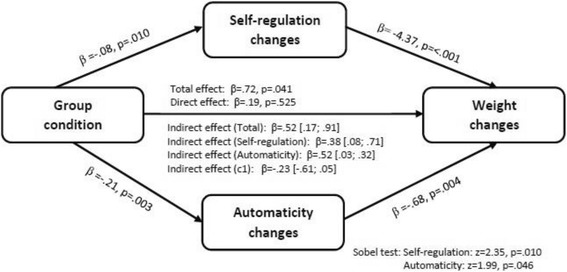
- Changes in self-regulatory skills and automaticity mediated the effect of 10TT on weight loss: β = .52, 95% Bias Corrected CI .17; .91; Sobel tests were significant for self-regulation changes (z = 2.35, p = .010) and automaticity changes (z = 1.99, p = .046).
- The parent trial found 10TT participants lost 0.87 kg more than usual care over 3 months (95% CI −1.47; −0.27) and had greater increases in automaticity (adjusted sum difference = 8.45, 95% CI 2.59; 14.32).
- About 40% of 10TT participants returned log books; those with the greatest changes in self-regulatory skills, automaticity, and weight used self-monitoring sheets for around 14, 14, and 15 weeks respectively, versus a median of 13 weeks overall, and managed around 6–7 tips per week versus 5.5.
Methods
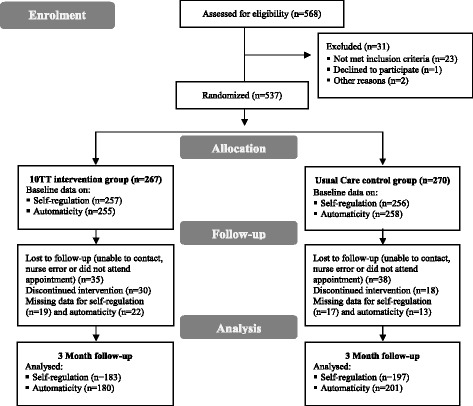
- Secondary analysis of a two-arm, individually randomised (1:1) controlled trial in 537 obese adults (BMI ≥ 30, aged 18+) from 14 primary care practices in England; participants received 10TT materials (leaflet, self-monitoring log book, food-label shopping guide) or usual care, with baseline and 3-month follow-up.
- Self-regulatory skills were measured with an adapted 31-item Self-Regulation Questionnaire; automaticity of 16 target behaviours was measured with a single item from the Self-Report Habit Index.
- Analyses used paired t-tests and ANCOVA for within- and between-group effects, regression models, and mediation analysis using Baron and Kenny’s approach with bootstrapping and Sobel tests; multiple imputation sensitivity analyses and descriptive log-book analyses were also performed.
Limitations
- Stated in the paper: the analyses were exploratory because the trial was powered only to detect weight differences; self-regulation used an adapted SRQ that removed the middle response option and may have increased ceiling effects; automaticity used only one item and an overall score, limiting conclusions about specific behaviours; all measures were self-report and may reflect perceived rather than actual change; missing data compromised internal validity and nullified randomisation, making results more cohort-like; generalisability was limited by underrepresentation of ethnic minorities and men and a slightly older sample, and participants were not blinded to condition, although 3-month assessments were blinded.
- Evident from the text: mediation and log-book findings come from secondary, non-randomised comparisons and cannot establish causality; log-book analyses include only the roughly 40% of 10TT participants who returned books, so selection bias is likely.
Model-written summary. Check it against the paper before relying on it.
Integrity signals
Registry
Cites
Statistics
Figures
Verification
Claims the paper makes
13 Valid · 2 Not valid · 16 Not checked · 60 Own results and interpretations
At least one cited source doesn’t support this claim or points to a different paper, and none confirmed it — see the verdicts below.
In the paper
“which is the period usually required to form habits [9, 13]”
§ The role of self-regulatory skills and automaticity on the effectiveness of a brief weight loss habit-based intervention: secondary analysis of the 10 top tips randomised trial > Background
What the sources say
- Not checked — no full text of the sourcecites [9] Lally P Gardner B Promoting habit formation Health Psych Rev 2013 7 S137 S158 10.1080/17437199.2011.603640 source
- Disputedcites [13] Lally P Van Jaarsveld CHM Potts HWW Wardle J How are habits formed: modelling habit formation in the real world Eur J Soc Psychol 2010 40 998 1009 10.1002/ejsp.674 sourceExperimental — accuracy not yet measured
The Results section reports a median of 66 days—not three months—to reach 95% of the modelled automaticity plateau, with a range of 18 to 254 days. The Discussion likewise emphasizes substantial variation. The study lasted 12 weeks, but it does not identify that duration as the period usually required to form a habit. (LLM, conf=0.86)
Checked by a reasoning model — may be wrong.
plain- Asserted: passes — The authors put it forward as true.
- Checkable: passes — It can be checked against evidence.
- Load-bearing: passes — The paper’s conclusions depend on it.
- Based: passes — The paper gives a reason why it holds.
The cited sources support only part of this claim — read each source’s verdict below.
In the paper
“Evidence from recent studies suggests that brief habit-based interventions [4, 5], may be an innovative approach for promoting weight loss, even when conscious motivation is low [5].”
§ The role of self-regulatory skills and automaticity on the effectiveness of a brief weight loss habit-based intervention: secondary analysis of the 10 top tips randomised trial > Background
What the sources say
- Not checked — no full text of the sourcecites [5] Rothman AJ Sheeran P Wood W Reflective and automatic processes in the initiation and maintenance of dietary change Ann Behav Med 2009 38 S4 S17 10.1007/s12160-009-9118-3 19787308 source
- Partly supportedcites [4] Beeken RJ Leurent B Vickerstaff V A brief intervention for weight control based on habit-formation theory delivered through primary care: results from a randomised controlled trial Int J Obes 2017 41 246 254 10.1038/ijo.2016.206 PMC5300101 27867204 sourceExperimental — accuracy not yet measured
The Introduction describes habit-based advice as a promising approach when motivation is too low for more demanding interventions, and the Discussion reports weight loss with the brief 10TT intervention. But the Discussion also says trial participants were likely more motivated than the wider population, so the study does not establish weight loss among people with low conscious motivation. The supplied copy gives section labels but no page numbers. (LLM, conf=0.86)
hedgedstates a possible cause- Asserted: passes — The authors put it forward as true.
- Checkable: passes — It can be checked against evidence.
- Load-bearing: passes — The paper’s conclusions depend on it.
- Based: passes — The paper gives a reason why it holds.
The sources with a verdict support this claim; the rest weren’t checked yet, have no full text we could read, or their verdicts aren’t rated yet.
In the paper
“Habit-based interventions promote the repetition of target behaviours in a consistent context in order to make them become more automatic and habitual [6, 7].”
§ The role of self-regulatory skills and automaticity on the effectiveness of a brief weight loss habit-based intervention: secondary analysis of the 10 top tips randomised trial > Background
What the sources say
- Supportedcites [6] Beeken RJ, Croker H, Morris S, et al. Study protocol for the 10 top tips (10TT) trial: randomised controlled trial of habit-based advice for weight control in general practice. BMC Public Health. 2012;12:667. PMC3490723 22898059 source
The Background section states that repeating a behaviour in a consistent context enables it to become automatic. It also describes the paper’s habit-based intervention as promoting target behaviours with advice on repetition and context stability. (LLM, conf=0.94)
- Not checked — no full text of the sourcecites [7] Verplanken B Wood W Interventions to break and create consumer habits J Public Policy & Mark 2006 25 90 103 10.1509/jppm.25.1.90 source
plainstates a cause- Asserted: passes — The authors put it forward as true.
- Checkable: passes — It can be checked against evidence.
- Load-bearing: passes — The paper’s conclusions depend on it.
- Based: passes — The paper gives a reason why it holds.
- Supported
The sources with a verdict support this claim; the rest weren’t checked yet, have no full text we could read, or their verdicts aren’t rated yet.
In the paper
“weight loss interventions applying this approach are still scarce [10, 11]”
§ The role of self-regulatory skills and automaticity on the effectiveness of a brief weight loss habit-based intervention: secondary analysis of the 10 top tips randomised trial > Background
What the sources say
- Not checked — no full text of the sourcecites [10] Lally P Chipperfield A Wardle J Healthy habits: efficacy of simple advice on weight control based on a habit-formation model Int J Obes 2008 32 700 707 10.1038/sj.ijo.0803771 18071344 source
- Supportedcites [11] Gardner B A review and analysis of the use of 'habit' in understanding, predicting and influencing health-related behaviour Health Psych Rev. 2015 9 277 295 10.1080/17437199.2013.876238 PMC4566897 25207647 source
In “Habit and behavioural change interventions,” the review reports that only eight interventions were explicitly designed to change habits and seven used habit formation. It identifies weight-loss interventions among that small group, supporting the claim that interventions applying this approach were scarce at the time of the review. Page numbers are not available in the supplied passages. (LLM, conf=0.90)
plain- Asserted: passes — The authors put it forward as true.
- Checkable: passes — It can be checked against evidence.
- Load-bearing: passes — The paper’s conclusions depend on it.
- Based: passes — The paper gives a reason why it holds.
The sources with a verdict support this claim; the rest weren’t checked yet, have no full text we could read, or their verdicts aren’t rated yet.
In the paper
“their mechanisms of action are not completely understood.”
§ The role of self-regulatory skills and automaticity on the effectiveness of a brief weight loss habit-based intervention: secondary analysis of the 10 top tips randomised trial > Background
What the sources say
- Not checked — no full text of the sourcecites [10] Lally P Chipperfield A Wardle J Healthy habits: efficacy of simple advice on weight control based on a habit-formation model Int J Obes 2008 32 700 707 10.1038/sj.ijo.0803771 18071344 source
- Supportedcites [11] Gardner B A review and analysis of the use of 'habit' in understanding, predicting and influencing health-related behaviour Health Psych Rev. 2015 9 277 295 10.1080/17437199.2013.876238 PMC4566897 25207647 source
The ‘Habit and behavioural change interventions’ section reports weight loss following a habit-based intervention. It also says existing comparisons make it difficult to identify the intervention’s ‘active ingredient’ and whether behaviour changes through habit or deliberation, supporting the claim that its mechanisms are not completely understood. Page numbers were not supplied. (LLM, conf=0.90)
plain- Asserted: passes — The authors put it forward as true.
- Checkable: passes — It can be checked against evidence.
- Load-bearing: passes — The paper’s conclusions depend on it.
- Based: passes — The paper gives a reason why it holds.
30 more claims · 5 with their cited sources checked
Create a free account to see all 91 claims and every source verdict.
- Probably not a substantial claim. 39
- It may state two separate claims as one. 21
- The quote only partly states this claim. 2
Statistics that don’t add up
Each reported p-value recomputed from its test statistic and degrees of freedom, each partial η² from its F, and each ratio, mean difference or B printed with a p checked against its own confidence interval.
Rated minor: it would not touch a result — a value no result rests on, a p-value that stays on the same side of the significance level, or a conflict that is clerical, resolved elsewhere in the paper, or outside its own findings.
In the paper
“(z = 1.97, p = .004”
§ The role of self-regulatory skills and automaticity on the effectiveness of a brief weight loss habit-based intervention: secondary analysis of the 10 top tips randomised trial > Results > Mediation analysis
Reported p = .004 · recomputed p = .049
Statistics recomputed
Every reported test result, recomputed from its test statistic and degrees of freedom. A result shows as not adding up only once an independent check has confirmed it.
- Doesn’t add upz = 1.97reported p = .004 · recomputed p = .049
“(z = 1.97, p = .004”
- Consistentz = 2.35reported p = .01 · recomputed p = .019
“(z = 2.35, p = .010”
The paper states an exact test
- Consistentz = 1.99reported p = .046 · recomputed p = .047
“(Z = 1.99, p = .046”
- Consistentz = 2.54reported p = .01 · recomputed p = .011
“(z = 2.54, p = .01”
Self-check
Percentages, sums and reported differences re-computed from the paper’s own numbers.
Each contradiction between two passages listed here was confirmed by an independent check.
Rated minor: it would not touch a result — a value no result rests on, a p-value that stays on the same side of the significance level, or a conflict that is clerical, resolved elsewhere in the paper, or outside its own findings.
In the paper
“| ≥ 75 | 53 | .68 (.27) | 35.3 (24) | .67 (.24) | 100 (24) | 14 | 91.6 (22) | 13 | 95.8 (23) | 10 | 92.0 | 6.5 |”
§ The role of self-regulatory skills and automaticity on the effectiveness of a brief weight loss habit-based intervention: secondary analysis of the 10 top tips randomised trial > Results > Descriptive analysis of the 10TT log books
Reported 35.3 · recomputed 45.283019
Rated minor: it would not touch a result — a value no result rests on, a p-value that stays on the same side of the significance level, or a conflict that is clerical, resolved elsewhere in the paper, or outside its own findings.
In the paper
§ The role of self-regulatory skills and automaticity on the effectiveness of a brief weight loss habit-based intervention: secondary analysis of the 10 top tips randomised trial > Results > Participants flow and characteristics
“| Mean (SD) | 4.4 (1.0) | 4.5 (.9) | 2.4 (.3) | 2.4 (.3)Δ | 4.5 (.9) | 4.4 (1.0)Δ |”
§ The role of self-regulatory skills and automaticity on the effectiveness of a brief weight loss habit-based intervention: secondary analysis of the 10 top tips randomised trial > Results > Participants flow and characteristics
“| Characteristics | All participants Intervention group (N = 267) | All participants Control group (N = 270) | Self-regulation outcome Completersi (N-380) | Self-regulation outcome Non-completers (N = 157) | Automaticity outcome Completersi (N = 381) | Automaticity outcome Non-completers (N = 156) |”
Rated minor: it would not touch a result — a value no result rests on, a p-value that stays on the same side of the significance level, or a conflict that is clerical, resolved elsewhere in the paper, or outside its own findings.
In the paper
§ The role of self-regulatory skills and automaticity on the effectiveness of a brief weight loss habit-based intervention: secondary analysis of the 10 top tips randomised trial > Background
“0.87 kg (95% CI -1.47; −.027, adjusted mean)”
§ The role of self-regulatory skills and automaticity on the effectiveness of a brief weight loss habit-based intervention: secondary analysis of the 10 top tips randomised trial > Results > Mediation analysis
“difference of 0.87 (95% CI -1.47; −.27)”
Citations
Cites
Baron, R. M., & Kenny, D. A. (1986) · Journal of Personality and Social Psychology · doi:10.1037/0022-3514.51.6.1173 · Cited by 91,532 · cited 2×
“Baron RM, Kenny DA.”
MethodPreacher, K. J., & Hayes, A. F. (2008) · Behavior Research Methods · doi:10.3758/brm.40.3.879 · Cited by 34,117 · cited 4×
“Preacher KJ, Hayes AF.”
BackgroundMethodInfluentialDeveloping and evaluating complex interventions: the new Medical Research Council guidance
Craig, P., Dieppe, P., Macintyre, S., Michie, S., Nazareth, I., & Petticrew, M. (2008) · BMJ · doi:10.1136/bmj.a1655 · Cited by 10,995 · cited 1×
“Improving the theoretical understanding of how habit-based interventions bring about weight loss is pressing, as it may provide guidance on the development of more effective interventions [12] to tackle the obesity epidemic.”
BackgroundSelf-citationHealth effects of overweight and obesity in 195 countries over 25 years
Collaborators, T. G. 2. O. (2017) · New England Journal of Medicine · doi:10.1056/nejmoa1614362 · Cited by 7,918
The Spread of Obesity in a Large Social Network over 32 Years
Christakis, N. A., & Fowler, J. H. (2007) · New England Journal of Medicine · doi:10.1056/nejmsa066082 · Cited by 5,007
Self-regulation and depletion of limited resources: Does self-control resemble a muscle?
Muraven, M., & Baumeister, R. F. (2000) · Psychological Bulletin · doi:10.1037/0033-2909.126.2.247 · Cited by 4,510 · cited 1×
“habit acquisition phase within 10TT involves actions such as setting goals, planning, self-monitoring and reviewing progress [23], it is possible that it may also enhance”
BackgroundOn the Self-Regulation of Behavior
Carver, C. S., & Scheier, M. F. (1998) · Cambridge University Press eBooks · doi:10.1017/cbo9781139174794 · Cited by 4,110
Finucane, M. M., Stevens, G. A., Cowan, M. J., Danaei, G., Lin, J. K., Paciorek, C. J., Singh, G. M., Gutierrez, H. R., Lu, Y., Bahalim, A. N., et al. (2011) · The Lancet · doi:10.1016/s0140-6736(10)62037-5 · Cited by 4,050 · cited 1×
“more than 600 million adults worldwide [1, 2] and increases risk for chronic diseases [2, 3].”
BackgroundOn the Self-Regulation of Behavior
Wright, B. R. E., Carver, C. S., & Scheier, M. F. (2000) · Contemporary Sociology · doi:10.2307/2654424 · Cited by 3,327
Effective techniques in healthy eating and physical activity interventions: A meta-regression.
Michie, S., Abraham, C., Whittington, C., McAteer, J., & Gupta, S. (2009) · Health Psychology · doi:10.1037/a0016136 · Cited by 2,229 · cited 1×
“This is also in line with recent evidence suggesting that nutrition and weight loss interventions that include self-regulation components tend to be more effective [33, 34].”
Result
Research works printed but not linked: 2
- WHO Global status report on noncommunicable diseases 2014 no. 978 92 4 156485 2014 Geneva World Health Organization
- Gardner B A review and analysis of the use of 'habit' in understanding, predicting and influencing health-related behaviour Health Psych Rev. 2015 9 277 295 10.1080/17437199.2013.876238 PMC4566897 25207647 · DOI · Paper page
Cited by
The Handbook of Behavior Change
(2020) · Cambridge University Press eBooks · doi:10.1017/9781108677318 · Cited by 407
Hagger, M. S. (2019) · Psychology of Sport and Exercise · doi:10.1016/j.psychsport.2018.12.007 · Cited by 305
“Theory and preliminary research has suggested that training individuals to adopt sets of self-regulatory skills may assist in the development of habits (Kaushal & Rhodes, 2015; Kaushal et al., 2017b; Kliemann et al., 2017).”
BackgroundChanging Behavior Using the Theory of Planned Behavior
Ajzen, I., & Schmidt, P. (2020) · The Handbook of Behavior Change · doi:10.1017/9781108677318.002 · Cited by 266
Changing Behavior Using the Model of Action Phases
Keller, L., Gollwitzer, P. M., & Sheeran, P. (2020) · The Handbook of Behavior Change · doi:10.1017/9781108677318.006 · Cited by 147
Gardner, B., Arden, M. A., Brown, D., Eves, F. F., Green, J., Hamilton, K., Hankonen, N., Inauen, J., Keller, J., Kwasnicka, D., et al. (2023) · Psychology & Health · doi:10.1080/08870446.2021.2003362 · Cited by 110
“Even where habit-based interventions have shown promise, researchers have often failed to conclusively demonstrate that changes in behaviour are attributable to habit change (but see Kliemann et al., 2017).”
BackgroundChanging Behavior Using the Health Action Process Approach
Schwarzer, R., & Hamilton, K. (2020) · The Handbook of Behavior Change · doi:10.1017/9781108677318.007 · Cited by 102
Canuto, R., Garcez, A., de Souza, R. V., Kac, G., & Olinto, M. T. A. (2021) · Obesity Reviews · doi:10.1111/obr.13143 · Cited by 71
Gardner, B., Richards, R., Lally, P. J., Rebar, A. L., Thwaite, T. L., & Beeken, R. J. (2021) · Appetite · doi:10.1016/j.appet.2021.105183 · Cited by 84
Self-citationFacilitating bicycle commuting beyond short distances: insights from existing literature
Banerjee, A., Łukawska, M., Jensen, A. F., & Haustein, S. (2021) · Transport Reviews · doi:10.1080/01441647.2021.2004261 · Cited by 80
Breaking bad habits by improving executive function in individuals with obesity
Allom, V., Mullan, B. A., Smith, E., Hay, P., & Raman, J. (2018) · BMC Public Health · doi:10.1186/s12889-018-5392-y · Cited by 62
“provided support for the effectiveness of habit based interventions in the promotion of weight loss [25].”
Changing Behavior Using Social Cognitive Theory
Łuszczyńska, A., & Schwarzer, R. (2020) · Cambridge University Press eBooks · doi:10.1017/9781108677318.003 · Cited by 105
Gardner, B., Rebar, A. L., & Lally, P. J. (2020) · Cambridge University Press eBooks · doi:10.1017/9781108677318.041 · Cited by 82
Cleo, G., Glasziou, P., Beller, E., Isenring, E., & Thomas, R. (2019) · International Journal of Obesity · doi:10.1038/s41366-018-0067-4 · Cited by 53
Warner, L. M., & French, D. (2020) · Cambridge University Press eBooks · doi:10.1017/9781108677318.032 · Cited by 79
Patterson, K., Davey, R., Keegan, R. J., & Freene, N. (2021) · PLoS ONE · doi:10.1371/journal.pone.0258460 · Cited by 52
Changing Behavior Using Ecological Models
Salmon, J., Hesketh, K. D., Arundell, L., Downing, K. L., & Biddle, S. (2020) · Cambridge University Press eBooks · doi:10.1017/9781108677318.017 · Cited by 90
Changing Behavior Using Self-Determination Theory
Hagger, M. S., Hankonen, N. E., Chatzisarantis, N. L. D., & Ryan, R. M. (2020) · Cambridge University Press eBooks · doi:10.1017/9781108677318.008 · Cited by 87
Attitudes and Persuasive Communication Interventions
Hamilton, K., & Johnson, B. T. (2020) · Cambridge University Press eBooks · doi:10.1017/9781108677318.031 · Cited by 61
Planning and Implementation Intention Interventions
Rhodes, R. E., Grant, S. J., & de Bruijn, G. (2020) · Cambridge University Press eBooks · doi:10.1017/9781108677318.039 · Cited by 49
Miranda, V. P. N., Coimbra, D. R., Bastos, R. R., Júnior, M. V. M., & Amorim, P. R. D. S. (2021) · PLoS ONE · doi:10.1371/journal.pone.0256069 · Cited by 44
Changing Behavior Using Habit Theory
Orbell, S., & Verplanken, B. (2020) · Cambridge University Press eBooks · doi:10.1017/9781108677318.013 · Cited by 66
Changing Behavior: A Theory- and Evidence-Based Approach
Hagger, M. S., Cameron, L. D., Hamilton, K., Hankonen, N. E., & Lintunen, T. (2020) · Cambridge University Press eBooks · doi:10.1017/9781108677318.001 · Cited by 63
Tarrant, M., Haslam, C., Carter, M., Calitri, R., & Haslam, S. A. (2020) · Cambridge University Press eBooks · doi:10.1017/9781108677318.044 · Cited by 43
Changing Behavior Using the Health Belief Model and Protection Motivation Theory
Orbell, S., Zahid, H., & Henderson, C. J. (2020) · Cambridge University Press eBooks · doi:10.1017/9781108677318.004 · Cited by 40
Kliemann, N., Croker, H. A., Johnson, F., & Beeken, R. J. (2019) · JMIR mhealth and uhealth · doi:10.2196/12326 · Cited by 33
“A recent study also found that the weight loss promoted by the 10TT was mediated by improvements in both self-regulatory skills and automaticity of the target behaviors [9].”
BackgroundSelf-citationChanging Behavior Using Integrated Theories
Hagger, M. S., & Hamilton, K. (2020) · Cambridge University Press eBooks · doi:10.1017/9781108677318.015 · Cited by 51
Changing Behavior Using the Transtheoretical Model
DiClemente, C. C., & Graydon, M. M. (2020) · Cambridge University Press eBooks · doi:10.1017/9781108677318.010 · Cited by 38
Liddelow, C., Mullan, B. A., & Novoradovskaya, E. (2020) · International Journal of Behavioral Medicine · doi:10.1007/s12529-020-09862-z · Cited by 35
Developing Behavior Change Interventions
Hankonen, N. E., & Hardeman, W. (2020) · Cambridge University Press eBooks · doi:10.1017/9781108677318.021 · Cited by 38
Changing Behavior by Changing Environments
Marteau, T. M., Fletcher, P. C., Hollands, G. J., & Munafo, M. R. (2020) · Cambridge University Press eBooks · doi:10.1017/9781108677318.014 · Cited by 35
Design, Implementation, and Evaluation of Behavior Change Interventions: A Ten-Task Guide
Abraham, C., & Denford, S. (2020) · Cambridge University Press eBooks · doi:10.1017/9781108677318.019 · Cited by 36
Changing Behavior Using the Reflective-Impulsive Model
Deutsch, R., & Strack, F. (2020) · Cambridge University Press eBooks · doi:10.1017/9781108677318.012 · Cited by 37
Imagery, Visualization, and Mental Simulation Interventions
Hagger, M. S., & Conroy, D. (2020) · Cambridge University Press eBooks · doi:10.1017/9781108677318.033 · Cited by 25
Dyadic Behavior Change Interventions
Scholz, U., Berli, C., Lüscher, J., & Knoll, N. (2020) · Cambridge University Press eBooks · doi:10.1017/9781108677318.043 · Cited by 29
Rothman, A. J., Klein, W. M. P., & Sheeran, P. (2020) · Cambridge University Press eBooks · doi:10.1017/9781108677318.020 · Cited by 30
Changing Behavior Using the Common-Sense Model of Self-Regulation
Cameron, L. D., Fleszar‐Pavlović, S. E., & Khachikian, T. (2020) · Cambridge University Press eBooks · doi:10.1017/9781108677318.005 · Cited by 32
Huseinovic, E., Hörnell, A., Johansson, I., Esberg, A., Lindahl, B., & Winkvist, A. (2019) · Nutrition Journal · doi:10.1186/s12937-019-0464-0 · Cited by 20
Engagement of Stakeholders in the Design, Evaluation, and Implementation of Complex Interventions
Hudson, J. L., Moon, Z., Hughes, L. D., & Moss-Morris, R. E. (2020) · Cambridge University Press eBooks · doi:10.1017/9781108677318.024 · Cited by 29
Kliemann, N., Croker, H. A., Johnson, F., & Beeken, R. J. (2018) · Eating Behaviors · doi:10.1016/j.eatbeh.2018.09.003 · Cited by 26
“Also, a recent study showed that habit-based interventions promoting the repetition of target behaviours in a consistent context hold promise for enhancing self-regulatory skills among adults with obesity (Kliemann et al., 2017).”
BackgroundSelf-citationGneezy, U., Kajackaite, A., & Meier, S. (2020) · Cambridge University Press eBooks · doi:10.1017/9781108677318.036 · Cited by 28
Ruiter, R. A. C., Crutzen, R., de Leeuw, E., & Kok, G. (2020) · Cambridge University Press eBooks · doi:10.1017/9781108677318.018 · Cited by 22
Changing Behavior Using Social Identity Processes
Reynolds, K. J., Branscombe, N. R., Subašić, E., & Willis, L. (2020) · Cambridge University Press eBooks · doi:10.1017/9781108677318.016 · Cited by 24
Eating Behaviors and Diet Quality: A National Survey of Australian Young Adults
Cartwright, J., Haslam, R. L., Clarke, E. D., Attia, J. R., Hutchesson, M., Rollo, M. E., Callister, R., Burrows, T. L., Truby, H., McCaffrey, T. A., et al. (2022) · Journal of Nutrition Education and Behavior · doi:10.1016/j.jneb.2021.12.001 · Cited by 21
The role of choice in eating behaviours
Bartle, T., Mullan, B. A., Novoradovskaya, E., Allom, V., & Hasking, P. A. (2019) · British Food Journal · doi:10.1108/bfj-04-2019-0222 · Cited by 15
Webb, T. L., & de Bruin, M. (2020) · Cambridge University Press eBooks · doi:10.1017/9781108677318.037 · Cited by 17
Guzek, D., Skolmowska, D., & Głąbska, D. (2022) · Nutrients · doi:10.3390/nu14081679 · Cited by 16
Ryu, S. W., Son, Y. G., & Lee, M. K. (2019) · European Journal of Oncology Nursing · doi:10.1016/j.ejon.2019.101703 · Cited by 17
Critical and Qualitative Approaches to Behavior Change
Chamberlain, K., & Lyons, A. C. (2020) · Cambridge University Press eBooks · doi:10.1017/9781108677318.030 · Cited by 16
The Science of Behavior Change: The Road Ahead
Hagger, M. S., Cameron, L. D., Hamilton, K., Hankonen, N. E., & Lintunen, T. (2020) · Cambridge University Press eBooks · doi:10.1017/9781108677318.046 · Cited by 16
Rezapour, T., Aupperle, R. L., Paulus, M. P., & Ekhtiari, H. (2019) · Elsevier eBooks · doi:10.1016/b978-0-12-815298-0.00029-0 · Cited by 10
Maximizing User Engagement with Behavior Change Interventions
Yardley, L., Morrison, L. G., Müller, I., & Bradbury, K. J. (2020) · Cambridge University Press eBooks · doi:10.1017/9781108677318.025 · Cited by 13
Autonomy-Supportive Interventions
Reeve, J., & Cheon, S. H. (2020) · Cambridge University Press eBooks · doi:10.1017/9781108677318.035 · Cited by 15
Mechanisms of Action in a Behavioral Weight-Management Program: Latent Growth Curve Analysis
Bates, S. E., Norman, P. E., Breeze, P. R., Brennan, A., & Ahern, A. L. (2021) · Annals of Behavioral Medicine · doi:10.1093/abm/kaab019 · Cited by 12
“In one study, the effect of a brief habit-based weight loss intervention was mediated by automaticity [27].”
BackgroundImplementation Science and Translation in Behavior Change
Łuszczyńska, A., Łobczowska, K., & Horodyska, K. (2020) · Cambridge University Press eBooks · doi:10.1017/9781108677318.023 · Cited by 13
de Ridder, D. T. D., Gillebaart, M., & Friese, M. (2020) · Cambridge University Press eBooks · doi:10.1017/9781108677318.040 · Cited by 11
Epton, T., & Armitage, C. J. (2020) · Cambridge University Press eBooks · doi:10.1017/9781108677318.038 · Cited by 8
Evaluation of Behavior Change Interventions
Matthews, L., & Simpson, S. A. (2020) · Cambridge University Press eBooks · doi:10.1017/9781108677318.022 · Cited by 10
The Role of Self-Regulation in the Effect of Self-Tracking of Physical Activity and Weight on BMI
Kooiman, T. J. M., Dijkstra, A., Kooy, A., Dotinga, A., van der Schans, C. P., & de Groot, M. (2020) · Journal of Technology in Behavioral Science · doi:10.1007/s41347-020-00127-w · Cited by 8
Economic and Behavioral Economic Approaches to Behavior Change
Brown, P. M., Cameron, L. D., Wilkinson, M., & Taylor, D. (2020) · Cambridge University Press eBooks · doi:10.1017/9781108677318.042 · Cited by 10
Motivational Interviewing Interventions
Berman, A. H., Beckman, M., & Lindqvist, H. (2020) · Cambridge University Press eBooks · doi:10.1017/9781108677318.045 · Cited by 14
Conner, M. T., Williams, D. M., & Rhodes, R. E. (2020) · Cambridge University Press eBooks · doi:10.1017/9781108677318.034 · Cited by 8
Addressing Underserved Populations and Disparities in Behavior Change
Schüz, B., & Hooper, M. W. (2020) · Cambridge University Press eBooks · doi:10.1017/9781108677318.027 · Cited by 8
Wongtongtair, S., Iamsupasit, S., Somrongthong, R., Kumar, R., & Yamarat, K. (2021) · F1000Research · doi:10.12688/f1000research.51156.1 · Cited by 7
“Studies have proposed face-to-face consultation interventions for weight loss among obese adolescents across the globe based on the health belief model (HBM) and social support theories in different parts of the globe.(4,5) Such intervention requires significant funding and, over the last decade, the Thai government s…”
MethodChanging Behavior Using Integrative Self-Control Theory
Hofmann, W., Dohle, S., & Diel, K. (2020) · Cambridge University Press eBooks · doi:10.1017/9781108677318.011 · Cited by 8
Changing Behavior in the Digital Age
Kavanagh, D. J. (2020) · Cambridge University Press eBooks · doi:10.1017/9781108677318.029 · Cited by 20
McClelland, J., Gallagher, D., Moore, S. E., McGirr, C., Beeken, R. J., Croker, H. A., Eastwood, K., O’Neill, R. F., Woodside, J. V., McGowan, L. J., et al. (2024) · BMC Pregnancy and Childbirth · doi:10.1186/s12884-024-06945-7 · Cited by 3
Self-citationCan self-regulation explain why not everyone is overweight or obese?
Plummer, A., & Walker, I. A. (2021) · Australian Journal of Psychology · doi:10.1080/00049530.2021.1883999 · Cited by 2
“Recent weight interventions based on self-regulation and automaticity show promising results (Kliemann et al., 2017).”
BackgroundStecher, C. D., Cloonan, S., Linnemayr, S., & Huberty, J. (2023) · JMIR Research Protocols · doi:10.2196/39930 · Cited by 4
“Self-monitoring of behavior also helps individuals build self-regulatory skills [95], which may be particularly useful during the “learning phase” of the habit formation process [46].”
Krukowski, R. A., Day, K. R., You, W., Pellegrini, C. A., & West, D. S. (2024) · Contemporary Clinical Trials · doi:10.1016/j.cct.2024.107711 · Cited by 2
Behavior Change in Community Contexts
Trickett, E. J., & Paterson, S. E. (2020) · Cambridge University Press eBooks · doi:10.1017/9781108677318.028 · Cited by 2
Burr, K., Roberson, K. B., Onsomu, E. O., Yancu, C. N., & Pritchard, R. A. (2020) · Family & Community Health · doi:10.1097/fch.0000000000000248 · Cited by 1
Cost-Effectiveness Evaluations of Behavior Change Interventions
Wang, T., Downes, M., Byrnes, J., & Scuffham, P. (2020) · Cambridge University Press eBooks · doi:10.1017/9781108677318.026 · Cited by 1
Integrating Neuro-Psychological Habit Research into Consumer Choice ModelsPreprint
Webb, R., Fong, J., Mazar, A., et al. (2024) · SSRN Electronic Journal · doi:10.2139/ssrn.4853969 · Cited by 1
Changing Behavior Using Control Theory
Mansell, W. (2020) · Cambridge University Press eBooks · doi:10.1017/9781108677318.009 · Cited by 13
Hagger, M. S., Cameron, L. D., Hamilton, K., Hankonen, N. E., & Lintunen, T. (2020) · Cambridge University Press eBooks · doi:10.1017/9781108677318.047
McClelland, J., Gallagher, D., Moore, S. E., McGirr, C., Beeken, R. J., Croker, H. A., Eastwood, K., O’Neill, R. F., Woodside, J. V., McGowan, L. J., et al. (2024) · Research Square · doi:10.21203/rs.3.rs-3759776/v1
Self-citationKrukowski, R. A., Day, K. R., You, W., et al. (2024) · SSRN Electronic Journal · doi:10.2139/ssrn.4862399
Chew, H. S. J., Ngooi, J. W., Ang, W. W., Du, R. C., Chan, P. Z., Jansson, M. M., Zhu, B., Cao, Y., Ngo, C., Foo, R., et al. (2026) · Annals of Behavioral Medicine · doi:10.1093/abm/kaag017 · Cited by 1
Metadata
- Authors
- Kliemann, N., Vickerstaff, V., Croker, H., Johnson, F., Nazareth, I., & Beeken, R. J.
- Affiliations
- University College London (GB)
- University of Leeds (GB)
- Corresponding author
- Beeken, Rebecca J.
- ORCID
- Venue
- International Journal of Behavioral Nutrition and Physical Activity
- Published
- 2017-09-05
- Volume
- 14
- Issue
- 1
- Pages
- 119-119
- ISSN
- 1479-5868 (ISSN-L)
- PMC
- PMC5583960
- OpenAlex
- W2752486066
- Semantic Scholar
- dfc4f41cc5fece5f53296121fff3e114d9a04134
- Cited by
- 79
- References
- 41
- Citations by year
- 2026: 2 · 2025: 1 · 2024: 3 · 2023: 1 · 2022: 3 · 2021: 8 · 2020: 52 · 2019: 5 · 2018: 4
- FWCI
- 19.07
- Type
- journal article
- Language
- en
- Open access
- gold
- doi.org
- Licence
- cc-by
- Locations
- International Journal of Behavioral Nutrition and Physical Activity (publishedVersion, cc-by)
- PubMed Central (publishedVersion, cc-by)
- PubMed (publishedVersion)
- White Rose Research Online (University of Leeds, The University of Sheffield, University of York) (acceptedVersion)
- DOAJ (DOAJ: Directory of Open Access Journals) (submittedVersion)
- UCL Discovery (University College London) (submittedVersion)
- Funders
- Cancer Research UK
- Coordenação de Aperfeiçoamento de Pessoal de Nível Superior
- Marie Curie and National Institute for Health Research
- Core funded by University College London
- YCR
- Topics
- Social Sciences › Psychology › Applied Psychology › Behavioral Health and Interventions
- Health Sciences › Nursing › Nutrition and Dietetics › Nutrition, Health and Food Behavior
- Health Sciences › Medicine › Public Health, Environmental and Occupational Health › Obesity and Health Practices
- Keywords
- weight loss, self-regulation skills, automaticity, habit formation, obesity, primary care, mediation, self-monitoring, food label reading, healthy eating habits
- MeSH terms
- Self-Control, Adult, Aged, Female, Follow-Up Studies, Habits, Humans, Male, Middle Aged, Obesity, Primary Health Care, Surveys and Questionnaires, Socioeconomic Factors, Reproducibility of Results, Weight Loss, Health Behavior, Body Mass Index, Sample Size
About these checks
Registry, retraction, Cites and statistics results are computed, not judged, with one exception: a printed reference that no index lists is read once by a model before it counts as a citation error. Claims are extracted by a model and kept only when their quote appears verbatim in the text; each cited source is then checked, with a model’s help, for whether it says what the claim relies on. Those verdicts can be wrong — read the claim’s quote and the cited source before relying on one.
The claim verdicts this report counts are experimental: their accuracy is not yet measured.
A language model drew the claims from the paper on 2026-10-10, under version 3 of the claim definition (model deepseek-v4.1-flash, prompt extract-v3).
A second model labelled each claim on 2026-10-10 (model jev-1.13-20260917, definition revision gold-guideline-v0.2).
Cited sources are checked with a language model’s help (gpt-6-sol).
Statistics and arithmetic are recomputed, not judged.
Confidence bands are shown only for fields calibrated on our annotated test set. None is calibrated yet, so no band is shown.
What counts as a claim ›How we measure confidence ›How we check this ›
Are you an author, or do you see a problem with this page? Request a review
Data sources
Bibliographic data: Semantic Scholar, OpenAlex, Crossref.
Contains information from the Semantic Scholar Academic Graph Datasets, made available under the ODC Attribution License (ODC-BY 1.0).
Semantic Scholar’s data is described in: Kinney, R., et al. (2023). The Semantic Scholar Open Data Platform. arXiv:2301.10140.
